The Outcome-Based Pricing Revolution
Outcome pricing is a risk reallocation, not just a new model. Explore how Intercom Fin scales at $0.99/resolution and the billing infrastructure it requires.

AI Summary
The Fundamental Question That’s Breaking Traditional SaaS
A customer service director at a mid-sized e-commerce company recently described the tension driving the biggest pricing transformation in SaaS history. She said, “We pay fifteen thousand dollars monthly for our support platform. Fifteen seats at a thousand dollars each. But what keeps me up at night: we’re handling thirty thousand tickets a month, and our average cost per resolution is twelve dollars when you factor in all the overhead. Now our vendor adds an AI agent that can resolve tickets automatically. If it works, we might only need five seats instead of fifteen. But somehow, we’d be paying less while getting more value. That doesn’t make sense for anyone.”
She’s right. It doesn’t make sense. That misalignment explains why we’re witnessing the most significant repricing of software value in the industry’s history. The shift from access-based pricing to outcome-based pricing isn’t a tactical adjustment. It’s a fundamental rethinking of what customers are actually buying and how vendors should capture the value they create.
When software starts doing the actual work instead of just enabling humans to do the work, how should that software be priced?
Understanding the Paradigm: From Seats to Outcomes
Outcome-based pricing is a model where customers pay based on measurable results or completed work rather than for access to software or consumption of resources. The vendor’s compensation ties directly to the value delivered, not to the inputs used to deliver that value.
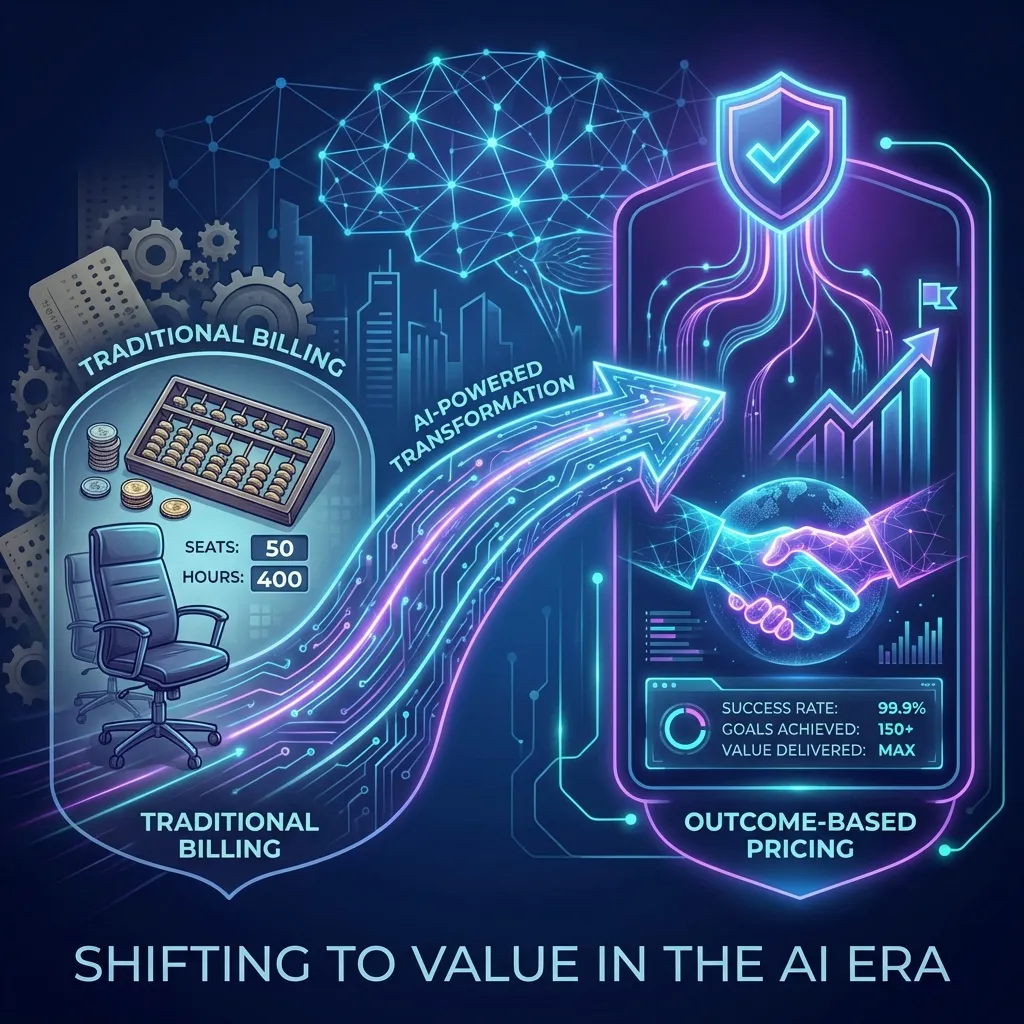
This sits at one end of a spectrum that has evolved over the past two decades. At the other end is traditional seat-based pricing, where you pay for each user who has access to the software regardless of how much they use it or what value they derive. In the middle sits usage-based pricing, where you pay based on consumption of resources or activity levels. Outcome-based pricing takes the final step by tying payment not to consumption but to completion.
Consider three different ways to price an AI customer service agent. Under seat-based pricing, you might pay a thousand dollars monthly for each support agent who has access to the AI tool. Under usage-based pricing, you might pay a dollar for every conversation the AI engages in, whether it successfully resolves the issue or not. Under outcome-based pricing, you pay only when the AI successfully resolves a customer’s issue without requiring human intervention. To see the underlying model inference costs that set the floor for any of these models, check the AI token pricing tracker. Same product, radically different value alignment.
The data on adoption tells a story about where we are in this transition. According to current industry research, only five to nine percent of SaaS companies have fully implemented pure outcome-based pricing models as of early 2026. That headline number understates what’s actually happening. When you look at companies experimenting with outcome-based components as part of hybrid models, the number jumps to between thirty and forty-seven percent. Among AI-native products launched in the past eighteen months, informal surveys suggest over sixty percent are considering or actively testing outcome-based approaches for at least some features.
What’s driving this experimentation? AI breaks the previous pricing models in ways that can’t be patched with incremental adjustments. Traditional SaaS pricing assumed that software was a tool that made humans more productive. You charged based on how many humans were using the tool, which made intuitive sense because the value scaled with headcount. More users meant more work getting done, which meant more value delivered. But AI agents don’t just make humans more productive. They do the work themselves. An AI agent that autonomously resolves customer service tickets isn’t making a human support rep more efficient. It’s replacing the need for that human in that particular workflow. Charging per seat for something that reduces the number of seats you need creates a death spiral for your own pricing model.
The Intercom Case Study: Pioneering Outcome Pricing at Scale
To understand how outcome-based pricing works in practice, there’s no better example than Intercom’s Fin AI Agent. Launched in early 2023, Fin represents the most high-profile and successful implementation of pure outcome-based pricing in enterprise software, and the company’s journey offers invaluable lessons for anyone considering this model.
Intercom faced the exact problem described earlier. They’d built an AI agent that could autonomously handle customer service conversations from start to finish. In testing, Fin was resolving customer inquiries without any human intervention, operating twenty-four hours a day, handling unlimited conversations simultaneously. Seat-based pricing made no sense because Fin wasn’t a tool that users accessed, it was an autonomous agent doing the work. Usage-based pricing based on conversations would mean customers paid even when Fin failed to resolve the issue, essentially paying twice: once for Fin’s unsuccessful attempt and again for the human cleanup afterward.
The breakthrough came when Aisling O’Reilly, who leads pricing at Intercom, and her team asked customers what would make them comfortable trying Fin. The answer was direct: they’d pay when it works. So Intercom introduced a pure outcome-based model. Customers pay ninety-nine cents per successfully resolved conversation. Use the Intercom pricing calculator to model how Fin’s $0.99/resolution rate compares to your current cost per ticket. Success is defined in one of two ways. Either the customer confirms the answer was satisfactory, or the customer exits the conversation without requesting further assistance or follow-up within a twenty-four-hour window. If Fin can’t resolve the issue and escalates to a human agent, the customer pays nothing.
The results have been remarkable. Fin now resolves over one million customer service conversations per week across Intercom’s customer base. The AI has progressed from an initial resolution rate of roughly twenty-five percent when it launched to fifty-six percent today. Intercom has built Fin into a strong eight-figure annual recurring revenue business that grew at an annualized rate of three hundred ninety-three percent in the first quarter after monetization. Perhaps more critically, the outcome-based pricing model has created organizational alignment. When your revenue depends on your product working, everyone in the company becomes obsessed with making it work better. The research and development team isn’t just building features, they’re building revenue-generating capabilities because every improvement in resolution rate flows directly through to top-line growth.
The technical implementation required sophisticated measurement infrastructure. Intercom already had the advantage of being a customer service platform, so they had systems in place to track conversation outcomes. But they still needed to build metering that could reliably distinguish between resolved and unresolved conversations, attribute each resolution correctly to either Fin or a human agent, handle edge cases where customers might initially accept an answer but later return with follow-up questions, and provide transparent reporting so customers could validate what they were being charged for. This isn’t trivial. When you’re billing based on outcomes rather than easily observable inputs like seats or API calls, the measurement layer becomes mission-critical. Get it wrong, and you’ll either undercharge and leak revenue or overcharge and destroy customer trust.
The Intercom experience also reveals the limitations and challenges of outcome-based pricing. Not every customer wants this model. Some organizations prefer the predictability of fixed subscription pricing even if it’s technically less aligned with value. Intercom had to build safeguards to prevent bill shock, including usage caps and alerts that notify customers when they’re approaching thresholds. And Intercom kept their core platform on seat-based pricing. Only Fin operates on outcome-based economics. This hybrid approach gave them a stable revenue base while experimenting with the new model for a specific, measurable capability.
Why Now? The Convergence Enabling Outcome Pricing
Outcome-based pricing is emerging now after decades of SaaS history operating on different models for specific reasons. A convergence of technological, operational, and market factors has created conditions where outcome pricing has shifted from theoretically attractive but practically impossible to genuinely viable.
The first factor is AI’s capability to deliver measurable outcomes autonomously. Previous generations of software assisted humans in achieving outcomes, but the software itself didn’t complete the work. A CRM system helps a sales rep close deals, but the sales rep does the closing. An email marketing platform helps a marketer nurture leads, but the marketer creates the campaigns and makes the strategic decisions. The outcomes these tools enabled were real, but they were joint outcomes produced by human intelligence and software capabilities working together. That made attribution difficult. How much of the closed deal should be credited to the CRM versus the sales rep’s skill and effort? This attribution challenge made outcome-based pricing impractical for most software categories.
But AI agents change this calculus. When Fin resolves a customer service ticket, there’s no joint production problem. The AI did the work. When an AI agent schedules a meeting by negotiating back and forth with multiple participants, the AI completed the task. When an AI coding assistant writes a function that passes all tests and gets deployed to production, the AI delivered the outcome. The work is discrete, measurable, and attributable. This clear attribution is what makes outcome pricing technically feasible in ways it wasn’t before.
The second enabling factor is advances in measurement and observability infrastructure. Software that charges based on outcomes needs sophisticated systems to track whether outcomes were actually achieved, and modern data infrastructure has reached a level of maturity that makes this possible at scale. Companies have access to real-time event streaming platforms that can capture millions of outcome-relevant events per hour. They have analytics systems that can process complex logic to determine outcome success. They have dashboards that can provide transparency to customers about what outcomes were delivered and how charges were calculated. Cloud-native architectures with microservices and instrumentation built in from the beginning make it much easier to emit and collect the telemetry needed for outcome tracking than it was in the monolithic application era.
The third factor is customer sophistication around value metrics. In the early days of SaaS, customers were learning how to buy software as a service at all. The subscription model itself was novel, and pricing conversations often centered on getting comfortable with the idea of paying monthly rather than purchasing perpetual licenses. Today’s buyers, especially enterprise procurement teams, are vastly more sophisticated about software economics. They understand concepts like total cost of ownership, they track software spend rigorously, and they’re comfortable with complex pricing models as long as those models align with value. Research shows that forty-three percent of enterprise buyers now consider vendors’ willingness to share risk through pricing as a significant factor in purchase decisions.
The fourth factor is competitive pressure driving differentiation. In many software categories, feature parity has become the norm. If you’re selling customer service software or sales engagement tools or marketing automation, your competitors probably have very similar capabilities. Pricing model becomes one of the few remaining vectors for differentiation. Offering outcome-based pricing when competitors still charge per seat sends a powerful signal. It says you’re so confident in your product’s ability to deliver value that you’re willing to tie your own revenue to customer success. For buyers, especially in categories where they’ve been burned by software that underdelivered on promises, that signal matters enormously. It builds trust in a way that product demos and case studies never quite can.
The Merchant’s Challenge: Handling the Transition
If you’re a SaaS company considering outcome-based pricing, the decision isn’t whether it would theoretically align better with customer value. Of course it would. The decision is whether you can successfully execute the transition from where you are today to a model that works operationally and financially. The key challenges you’ll face, and how forward-thinking companies are addressing them, break down as follows.
The first challenge is identifying the right value metric. This sounds simple but turns out to be one of the hardest parts of implementing outcome-based pricing. Your value metric needs to satisfy several criteria simultaneously. It must be measurable with high confidence, meaning you can track it reliably in your systems without ambiguity. It must be attributable primarily to your product rather than to other factors, or customers will dispute charges. It must be meaningful to customers in terms of their business objectives, not just internally meaningful to you. It must occur with sufficient frequency that revenue is relatively predictable rather than lumpy. And ideally, it should be resistant to gaming by customers who might manipulate the metric to reduce their bills.
Intercom’s choice of “resolved conversations” for Fin hits all the criteria. Conversations happen frequently, resolution is measurable, the AI’s role is clear, and customers care about resolution rates because unresolved conversations create support costs. Compare that to a hypothetical AI sales tool that wanted to charge based on “closed deals influenced by AI suggestions.” This fails multiple tests. Attribution is murky because deals involve many touchpoints. Deal frequency might be low, creating revenue volatility. And defining “influenced by” creates endless room for customer disputes.
Some companies are finding success with proxy metrics that approximate outcomes without requiring perfect attribution. An AI-powered lead generation tool might charge based on qualified leads delivered rather than revenue generated, since leads are easier to measure and attribute even though revenue is the ultimate outcome the customer cares about. A coding assistant might charge based on lines of code written and accepted into the codebase rather than business value created by that code. These aren’t perfect outcome measures, but they’re closer to outcomes than pure usage metrics while remaining operationally practical.
The second major challenge is managing the disconnect between costs and revenue. Your costs to deliver the service are largely usage-based. You pay your cloud provider based on compute consumed. You pay AI model providers based on tokens processed. But your revenue is outcome-based. You only get paid when the outcome is achieved.
Consider what happens when an AI agent attempts to resolve a customer issue but fails. You incurred real costs for the compute and model API calls during that failed attempt, but under outcome-based pricing, you receive zero revenue. If your failure rate is high, you’re effectively donating compute resources to customers. This is why outcome-based pricing requires high confidence in your product’s ability to consistently deliver results. As OpenView Partners research found, seventy-eight percent of SaaS companies that successfully implemented outcome pricing had products with market presence of five-plus years. They’d had time to mature the product and understand its success rates.
Some companies address this mismatch through hybrid models that include both a base fee and outcome components. You might charge a monthly platform fee that covers access and infrastructure, then add outcome-based pricing on top for actual work completed. This gives you a revenue floor to cover baseline costs while still aligning the variable portion with value delivered. Another approach is setting minimum commitments where customers commit to a certain volume of outcomes annually, giving you predictable revenue while maintaining outcome alignment for marginal usage above the commitment.
The third challenge is transitioning existing customers from your current pricing model to an outcome-based approach. Customers on annual contracts have negotiated specific pricing terms. You can’t unilaterally change those terms without creating churn risk or legal exposure. Even customers on month-to-month agreements might view a pricing model change as a negative surprise that prompts them to evaluate alternatives.
The best practices that are emerging involve treating outcome-based pricing as an option rather than a forced migration, at least initially. When contracts come up for renewal, you offer customers a choice. They can remain on the existing model if they prefer predictability, or they can opt into outcome-based pricing if they want maximum alignment. The pitch for outcome-based is that you’re so confident in delivering value that you’re willing to tie your compensation to results. Early adopters self-select into the new model, giving you real-world data on how it performs financially before you need to migrate your entire customer base.
This option-based approach also helps you refine the model. You might discover that certain customer segments or use cases work better with outcome pricing than others. Maybe enterprise customers with dedicated success teams get excellent results and love the alignment, while small businesses without technical resources struggle to achieve outcomes and prefer the simplicity of fixed pricing. You can then tailor your approach by segment rather than forcing everyone into the same model.
The fourth challenge is figuring out willingness to pay for outcomes. When you’re pioneering a new pricing model, you don’t have market benchmarks to reference. Set the price too high, and customers will stick with less efficient manual processes or traditional software. Set it too low, and you’re leaving money on the table or worse, creating an unsustainable business model where your costs exceed your revenue.
The companies doing this well are running extensive pricing research before launch. Intercom conducted detailed customer interviews to understand what human agents cost per resolution and what efficiency gains customers expected from AI. This gave them a ceiling — the AI needed to cost meaningfully less than the fully-loaded human cost — and a floor — the price needed to be high enough that Intercom could profitably deliver the service. They landed at ninety-nine cents per resolution, which for most customers represents an eighty to ninety percent cost reduction compared to human-handled tickets while giving Intercom healthy margins.
Another effective approach is starting with pilot programs at negotiated pricing, learning from early adopters, and using that data to refine the model before general availability. You’re conducting willingness-to-pay research with real money at stake, which gives you more reliable signals than surveys or conjoint analysis. The risk is that early pilots might lock you into pricing that turns out to be suboptimal, so it’s important to retain pricing flexibility in pilot agreements.
The Infrastructure Requirements: Building to Support Outcomes
Shifting from strategy to execution, consider what infrastructure you actually need to support outcome-based pricing. Many companies underestimate the complexity and end up either abandoning the model or implementing it in ways that create operational nightmares.
The foundation is crystal-clear attribution from usage to outcomes. Every action your system takes needs to be logged with sufficient metadata to later determine whether it contributed to an outcome. If an AI agent sends three messages in a conversation before successfully resolving a customer’s issue, you need to know that all three messages were part of the same conversation thread, which customer account it was for, when the conversation started and ended, what the resolution criterion was, and whether that criterion was met. This requires instrumentation throughout your product stack, not just at the billing layer.
Most companies implementing outcome pricing are taking a streaming architecture approach where events flow through a central pipeline that tags each event with outcome-relevant attributes. When the outcome is determined, either immediately or after some delay, a separate process joins the outcome back to the initiating events and triggers billing. This requires careful schema design so that you can reliably correlate events across time. It also requires thinking through edge cases. What happens if a conversation spans a billing period boundary? What if the customer disputes whether an outcome was achieved? What if there’s a technical failure that prevents you from capturing the outcome event? All of these scenarios need defined handling logic, or you’ll spend enormous time manually investigating billing disputes.
The second infrastructure requirement is real-time or near-real-time ROI measurement and reporting. One of the key value propositions of outcome-based pricing is that customers can directly see the value they’re receiving for their spend. But this only works if you provide visibility. You need dashboards that show customers exactly what outcomes were delivered, when they occurred, what they cost, and how those costs compare to their previous approaches. The best implementations include calculators that let customers estimate their expected savings based on their volume assumptions. They also include alerts that notify customers proactively if they’re trending toward unexpected costs, giving them time to adjust usage patterns rather than being surprised by the invoice.
This transparency serves multiple purposes. It builds trust because customers can verify charges themselves rather than taking your word for it. It helps with adoption because seeing real outcomes encourages increased usage. And it preemptively handles billing disputes because customers have already reviewed and acknowledged the outcomes throughout the billing period rather than seeing them for the first time when the invoice arrives. Building these dashboards requires exposing near-real-time data from your billing system, which many legacy billing platforms aren’t designed to support. This is one reason why companies implementing outcome pricing often end up needing to upgrade their entire billing infrastructure.
The third requirement is tools for pricing experiments and simulations. When you’re charging based on outcomes, small changes in how you define success or how you price different outcome types can have massive revenue implications. You need the ability to model “what if” scenarios before implementing changes. What would changing the resolution window from twenty-four hours to forty-eight hours do to recognized outcomes and revenue? How would charging different rates for simple versus complex outcomes work, and what would the distribution look like?
The companies handling this well have built internal analytics platforms that sit on top of their billing data and let pricing teams run these simulations using historical data. They can take six months of actual usage data, replay it with different pricing rules, and see what revenue would have been. This lets them de-risk pricing changes by testing them on historical data before implementing them with real customers. It also helps with forecasting because you can simulate different usage scenarios and understand the revenue implications.
Fourth, you need billing systems that can handle variable consideration and complex rating logic. Traditional SaaS billing platforms are optimized for subscription models where the amount you bill each period is known in advance based on the plan the customer is on. Outcome-based pricing inverts this. The amount you bill is determined by actual outcomes achieved during the period, which might vary dramatically month to month. Your billing system needs to support usage-based rating, not just subscription management. It needs to handle tiered pricing structures where different volumes or types of outcomes might have different rates. It needs to support credits and adjustments because billing disputes are more common with variable models than with fixed subscriptions.
Many companies find that their existing quote-to-cash systems simply can’t support these requirements, forcing them to build custom billing infrastructure or adopt specialized platforms designed for usage-based models. This is not a trivial migration. Your billing system integrates with your CRM, your finance system, your payment processing, and your revenue recognition. Replacing it requires careful planning and usually takes quarters or even years to complete. This is why some companies choose to implement outcome-based pricing only for new products while leaving existing products on legacy infrastructure and pricing.
Revenue Recognition: The Accounting Complexity
Revenue recognition is an aspect of outcome-based pricing that often gets overlooked until it becomes a crisis. The accounting treatment of outcome-based pricing is materially different from subscription models, and getting it wrong can create significant problems with auditors, investors, and your financial statements.
Under ASC 606, the revenue recognition standard that governs how SaaS companies account for their revenue, you can only recognize revenue when performance obligations have been satisfied and the amount of consideration is determinable. With traditional subscriptions, this is straightforward. You deliver access to the software continuously over the contract term, so you recognize revenue ratably. If a customer pays twelve thousand dollars for an annual subscription, you recognize one thousand dollars per month as revenue.
But with outcome-based pricing, the performance obligation isn’t access, it’s delivery of specific outcomes. This changes everything. If a customer prepays for a certain number of outcomes or commits to a minimum spend, when do you recognize that revenue? The conservative accounting treatment is to recognize it only when the outcomes are actually delivered, not when the cash is received. This means you’re sitting on deferred revenue that might get consumed quickly if the customer uses your product heavily, or might stretch out over many months if usage is light. This creates forecasting challenges because you can’t reliably predict when deferred revenue will convert to recognized revenue.
The complexity multiplies when you have hybrid models that combine base subscriptions with outcome components. The subscription portion likely recognizes ratably over time, but the outcome portion recognizes as outcomes are delivered. If a customer buys credits that can be used for both subscription access and outcome-based features, you potentially have different revenue recognition treatment depending on how credits get consumed. Your accounting team needs clear policies that define how to allocate credits between the different performance obligations, and those policies need to be documented and blessed by your auditors.
For a deeper treatment of how usage-based revenue flows through the books, see the guide on revenue recognition for usage-based pricing. A practical expedient in ASC 606 called “right to invoice” can simplify some of this complexity. If the amount you charge corresponds directly with the value to the customer of your performance to date, and you bill a fixed amount for each outcome delivered, you might be able to recognize revenue as you invoice based on delivered outcomes. This treats outcome-based pricing similarly to how you’d recognize revenue for a service contract where you bill based on time and materials. But applying this expedient requires careful evaluation of your specific contract terms and close coordination with your accounting advisors.
The revenue recognition challenge also affects how you need to structure your finance operations. You need much tighter integration between your billing system and your accounting system than traditional SaaS companies require. You need real-time visibility into outcome delivery so finance can forecast recognized revenue accurately. And you need modeling tools to project future revenue recognition based on deferred revenue balances and historical consumption patterns. Many companies find they need to hire additional finance headcount or upgrade their financial systems to handle this complexity, which represents real incremental cost that needs to be factored into the decision to pursue outcome-based pricing.
The Second-Order Effects: How Pricing Changes Everything
One of the most striking aspects of outcome-based pricing is how it creates second-order effects that ripple through your entire organization in ways you might not anticipate. These effects can be positive or negative, but either way, they’re significant enough that you need to plan for them deliberately.
The first major effect is on sales compensation and process. Traditional SaaS sales compensation is built around annual contract value or total contract value. Sales reps get paid a percentage of the deal size when the contract is signed. But with outcome-based pricing, especially for usage-based components, the initial contract value might be quite small because it only reflects minimum commitments. The real revenue potential comes from actual consumption over time. This creates tension in how you compensate sales teams.
If you pay commission only on the initial commitment, you’re not incentivizing reps to close deals with customers who will become heavy users and generate substantial revenue through outcomes delivered. But if you pay commission on actual consumption, sales reps face income uncertainty and you’re asking them to function as both closers and customer success managers. The hybrid approach that’s emerging involves paying sales reps commission on the committed minimum plus a smaller percentage on consumption above the commitment, with customer success teams participating in the upside from driving increased usage. This aligns incentives better but requires commission tracking systems.
The sales process itself also changes. With traditional pricing, sales conversations focus on features, implementation timelines, and negotiating the per-seat price or total contract value. With outcome-based pricing, the conversation shifts to defining what outcomes matter to the customer, establishing baseline performance so you can measure improvement, and building confidence that your product will actually deliver the promised outcomes. This is a much more consultative sale that requires sales reps to have deeper expertise in the customer’s business and how your product drives value. Many companies find they need to restructure their sales teams or provide additional training to handle outcome-based sales effectively.
The second major effect is on product roadmap prioritization. When you charge based on outcomes, features that improve outcome success rates directly impact revenue. Every percentage point improvement in Intercom Fin’s resolution rate flows through to increased revenue because more conversations qualify for billing. This creates powerful incentives to prioritize product investments that increase outcome reliability and quality, even if those investments are invisible to users. A traditional SaaS company might prioritize flashy new features that win deals in competitive evaluations. An outcome-based SaaS company prioritizes improvements that increase success rates, even if those improvements happen under the hood.
This can be a significant positive because it aligns product development with delivering real value rather than checking feature boxes to win bake-offs. But it can also create tension when customers ask for features that don’t necessarily improve outcomes. If customers want a redesigned UI that looks more modern but doesn’t measurably impact success rates, how do you prioritize that against infrastructure improvements that increase outcome reliability? You need clear frameworks for balancing outcome-driving investments against other types of customer requests.
The third effect is on customer success and support operations. When customers are paying based on outcomes, your success team’s job becomes helping customers maximize outcomes, not just ensuring they’re satisfied with the software. This is a subtle but important distinction. A traditional customer success manager might focus on adoption metrics, training, and helping customers use more features. An outcome-focused customer success manager is laser-focused on helping customers achieve more of the outcomes they’re paying for, which might mean narrower feature usage but better results with core capabilities.
This changes the metrics you use to measure success team performance. Instead of tracking account health scores or product adoption percentages, you’re tracking outcome delivery rates, customer trajectory toward outcome goals, and efficiency of outcome achievement. You might measure your success team based on whether customers in their portfolio are achieving above-average outcome rates compared to similar customers. This requires different skills and different tooling than traditional customer success, and companies often need to retrain or restructure their success organizations to support outcome-based models effectively.
Looking Forward: What’s Next in Outcome Pricing
As we close this examination of outcome-based pricing, let’s look forward to where this model is headed and what we can expect over the next few years. More companies will adopt outcome-based components, even if pure outcome pricing remains relatively rare. But the path forward isn’t just about more adoption of the same model we see today. The model itself will evolve in several important ways.
The first evolution is increasing sophistication in how outcomes are defined and priced. The current generation of outcome-based pricing, exemplified by Intercom Fin, uses relatively simple outcome definitions. A conversation is resolved or it isn’t. But as companies gain experience with the model, we’ll see more nuanced approaches. Different types of outcomes might command different prices based on complexity or value. Resolving a simple “what’s your refund policy” question is different from resolving a complex technical integration issue, yet current models price them identically. Expect tiered outcome pricing where straightforward outcomes cost less than complex ones, with AI systems that can classify outcome difficulty automatically.
We’ll also likely see outcomes bundled together into higher-level value metrics that map more directly to business impact. Instead of charging per resolved conversation, a customer service platform might charge based on customer satisfaction scores or churn reduction. Instead of charging per lead delivered, a sales tool might charge based on pipeline generated or deals influenced. These higher-level outcomes are harder to measure and attribute but align even more closely with what customers care about. The companies that can credibly measure and price these business-level outcomes will capture premium value.
The second evolution is the development of AI systems that validate other AI systems’ work. Right now, outcome determination often requires some form of human validation or at least structured rules that define success. But as AI capabilities advance, we’ll see AI agents evaluating whether other AI agents successfully completed their work. An AI agent might review a support conversation handled by another AI and determine whether the resolution was actually satisfactory based on semantic analysis of the exchange, follow-up behavior, and context about what the customer was trying to achieve. This removes human bottlenecks from outcome validation and enables more granular outcome tracking.
The third evolution is more sophisticated handling of the attribution problem. Current outcome pricing works best for discrete, clearly attributable actions. But much of AI’s value comes from more diffuse contributions to complex processes with multiple contributors. Pricing an AI assistant that helps a developer write code but doesn’t write entire functions autonomously requires different attribution models than pricing Fin. Pricing an AI tool that provides insights that influence strategic decisions but doesn’t make the decisions itself requires the same. The companies that figure out attribution models for these joint-production scenarios will unlock outcome-based pricing for much broader categories of software.
The fourth evolution is better financial instruments for managing outcome revenue volatility. One of the biggest barriers to broader outcome pricing adoption is that it makes revenue less predictable, which makes financial planning harder and can reduce company valuations. We’ll see innovations in how companies structure contracts to provide more predictability while maintaining outcome alignment. This might include outcome floors where customers pay a minimum amount regardless of outcomes achieved, combined with outcome ceilings that cap charges even if usage spikes. Or we might see financial products that let companies hedge their outcome revenue risk, similar to how commodity producers hedge price risk.
The final evolution worth watching is regulatory and accounting standards catching up to outcome-based models. Right now, companies implementing outcome pricing are navigating uncharted territory with revenue recognition, contracting, and even consumer protection law. As the model becomes more common, we’ll see clearer guidance from accounting standards boards about how to recognize revenue for different types of outcome arrangements. We’ll see contract templates and legal structures emerge that handle common issues more elegantly. And we may see regulation, particularly in industries like healthcare and financial services, that addresses when and how outcome-based pricing is appropriate.
Synthesis: The Pricing Model as Competitive Weapon
Outcome-based pricing isn’t just a billing innovation. It’s a fundamental realignment of how software companies and their customers share value and risk. The shift from paying for access to paying for outcomes represents a maturation of the software industry from selling tools to selling results.
For customers, outcome-based pricing reduces risk and eliminates the waste that’s inherent in paying for access to capabilities you might not fully utilize. It creates transparency around value delivery that traditional pricing obscures. And it forces vendors to be accountable for actually delivering results rather than just providing software and hoping customers figure out how to use it effectively.
For vendors, outcome pricing creates stronger alignment with customer success, which reduces churn and increases expansion potential. It can support premium pricing because you’re capturing a share of measurable value rather than negotiating based on seat counts or usage volumes. And it differentiates you in crowded markets where feature parity makes traditional sales motion increasingly difficult.
But this model is hard. It requires technical sophistication in measurement and attribution. It demands operational excellence in consistently delivering outcomes. It introduces financial complexity in forecasting and revenue recognition. And it requires organizational changes across sales, product, customer success, and finance.
The companies that will succeed with outcome-based pricing aren’t necessarily the ones with the best AI technology, though that certainly helps. They’re the companies that treat pricing as a strategic capability and invest in the infrastructure, processes, and organizational alignment needed to execute complex pricing models well. They’re the companies that can measure outcomes reliably, communicate value clearly, and deliver results consistently.
As AI continues to automate more types of work, the pressure to adopt outcome-based pricing will only increase. Software that does work rather than enabling work demands different pricing models. The question isn’t whether your industry will move toward outcome pricing. The question is whether you’ll lead that transition or be forced to follow as competitors establish the new normal.
Where does your company stand in this evolution? Have you identified which of your capabilities deliver discrete, measurable outcomes that could support outcome pricing? Have you assessed whether your current infrastructure could support the measurement and billing requirements? Have you calculated what revenue might look like under outcome models compared to your current approach? For an increasing number of software companies, these are urgent operational questions that determine competitive position in the AI era.
The shift to outcome-based pricing represents one of the most significant changes in software business models since the original transition from perpetual licenses to subscriptions. Just as that earlier transition created massive value for companies that moved early and got it right, the current transition to outcome pricing will create durable advantages for the companies that execute it well. The infrastructure and organizational capabilities required to succeed with outcome pricing take years to build. The companies starting that journey now will be positioned to lead their markets. The companies that wait will find themselves at a structural disadvantage that’s difficult to overcome.
About This Series
The Future Ahead is a series exploring where the AI industry is heading and how it will fundamentally transform billing workflows, billing infrastructure, and pricing models.
Read Part 1: The AI Billing Infrastructure Crisis
Next in series: Part 3 - Coming soon
Still have a question? Ask Abhilash — an AI trained on every guide, article, and pricing teardown on this site. Free, no signup. Ask a follow-up