AI Token Deflation and the Bill Shock Paradox
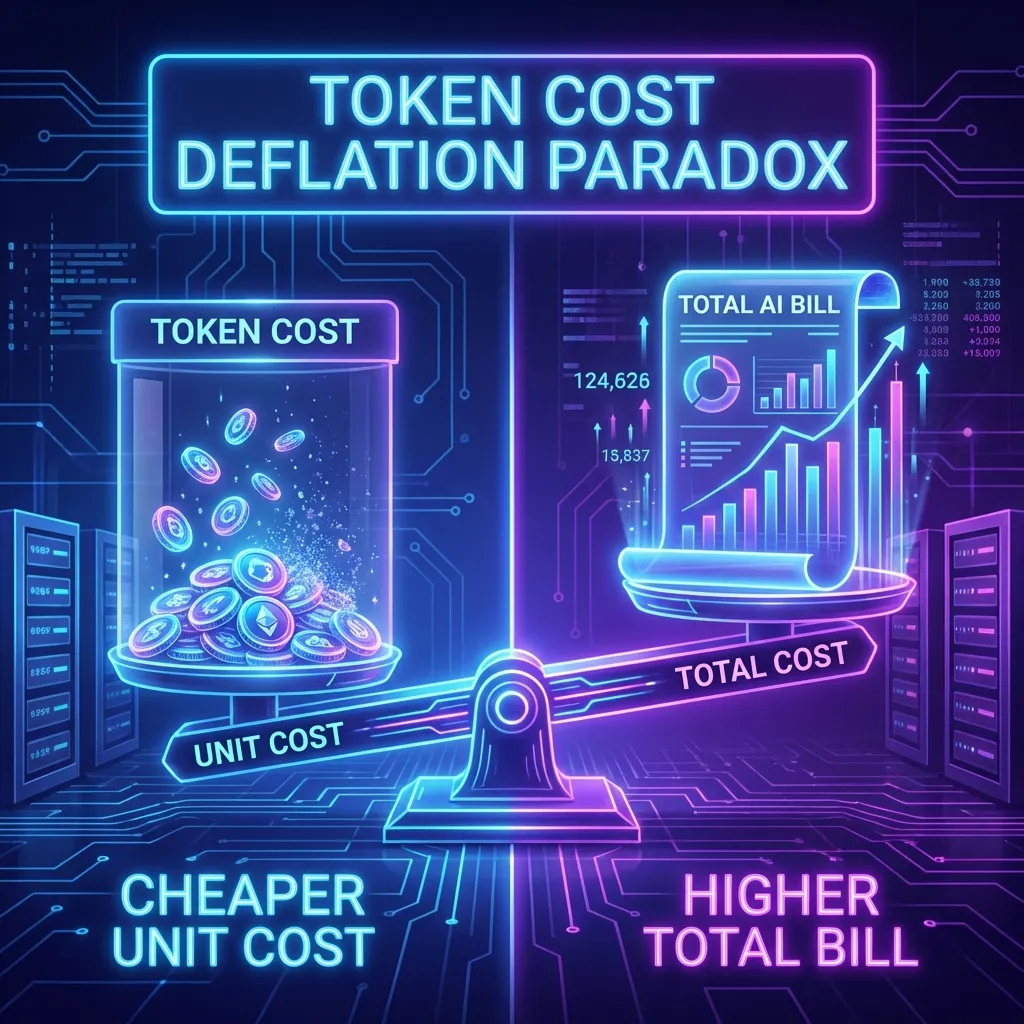
Token costs fell 99.6% in two years yet total AI bills are up 30–50% YoY. Learn why reasoning tokens, context inflation, and new use cases consume all the savings.

AI Summary
The Number That Changes Everything
Here’s a data point that should fundamentally reshape how you think about AI economics. The cost per token for achieving GPT-3.5 level performance has dropped from twenty dollars per million tokens in November 2022 to seven cents per million tokens by October 2024. That’s not a twenty percent reduction or even a fifty percent reduction. That’s a reduction of over ninety-nine point six percent in less than two years. To put that in perspective, if automobiles had experienced similar cost deflation over the same period, a forty-thousand-dollar car would now cost sixteen dollars.
This isn’t a gradual trend or a modest efficiency gain. This is one of the steepest cost curves in the history of technology. Track current rates across every major model in real time with the AI token pricing tracker. And it’s creating a paradox that’s confusing even sophisticated practitioners in the AI industry. Token costs are collapsing at an unprecedented rate, yet total AI spending is accelerating. Companies that expected their AI bills to decrease as model prices dropped are instead watching their monthly invoices climb by thirty to fifty percent year over year. Finance teams are struggling to forecast AI spend because the underlying unit economics are moving in opposite directions simultaneously.
What’s happening here reveals something profound about the nature of AI adoption and consumption patterns. The story isn’t really about cost reduction at all. It’s about a fundamental transformation in how we consume computational resources, what we’re willing to use AI for when it becomes cheap enough, and what that means for how software companies need to structure their pricing and billing infrastructure. The following unpacks what this means for the future of AI-native business models.
Understanding the Deflation: Why Costs Are Cratering
Before we can understand the paradox, we need to appreciate the magnitude and drivers of the cost deflation we’re witnessing. The numbers tell a striking story when you trace the pricing evolution of leading models over the past few years.
When OpenAI released GPT-4 in March 2023, it came with premium pricing that reflected its cutting-edge capabilities. The model cost thirty dollars per million input tokens and sixty dollars per million output tokens. For context, that meant processing a novel-length text through the model and receiving a comprehensive analysis could easily cost several hundred dollars. This pricing positioned GPT-4 as a tool for high-value use cases where the cost could be justified by the outcome, but it priced out casual experimentation and made many potential applications economically infeasible.
Just eight months later, OpenAI introduced GPT-4 Turbo, which offered superior capabilities at dramatically reduced pricing. Ten dollars per million input tokens and thirty dollars per million output tokens represented a fifty percent reduction from the original GPT-4, while simultaneously improving performance on many benchmarks. Then in May 2024, GPT-4o launched at five dollars per million input tokens and fifteen dollars per million output tokens, cutting prices in half again while adding multimodal capabilities that previous generations lacked.
But the most dramatic example of deflation came with GPT-4o mini, which debuted at fifteen cents per million input tokens and sixty cents per million output tokens. This model, which significantly outperforms GPT-3.5 Turbo on most tasks, costs ninety-nine percent less than the text-davinci-003 model from 2022. To state this differently, you can now process over three hundred times more text for the same dollar than you could just over two years ago, while getting better results from a more capable model.
And the trend shows no signs of slowing. Google’s Gemini 1.5 Flash 8B variant dropped pricing to as low as seven cents per million tokens by late 2024 for GPT-3.5 equivalent performance. DeepSeek’s R1 model entered the market at fifty-five cents per million input tokens and two dollars nineteen cents per million output tokens, undercutting Western providers by roughly ninety percent while claiming competitive performance on reasoning tasks. Even at the high end, by mid-2025, GPT-4o pricing had reportedly fallen to three dollars per million input tokens in some accounts, representing an eighty-three percent reduction from its launch pricing just a year earlier.
Three primary forces are driving this deflation, and understanding them helps explain why the trend is sustainable rather than a temporary market anomaly. The first force is raw computational efficiency improvements. Each generation of AI chips from NVIDIA, AMD, and emerging competitors delivers dramatically better performance per watt and per dollar of capital investment. NVIDIA’s Blackwell architecture, for instance, offers a thirtyfold improvement in inference speed over the previous H100 generation for AI workloads. When inference becomes thirty times more efficient, providers can afford to drop prices substantially while maintaining or improving their margins.
The second force is algorithmic innovation that allows models to achieve equivalent performance with less computation. Techniques like mixture of experts architectures, where only a subset of a large model’s parameters activate for each query, dramatically reduce the computational cost of running inference without sacrificing capability. Model distillation approaches that compress knowledge from large models into smaller ones create efficient variants that cost a fraction as much to run while delivering comparable results for many tasks. And improvements in training techniques mean that new models often require less computation to achieve capabilities that previous generations struggled to reach.
The third force, and perhaps the most powerful, is intense market competition. The AI foundation model market in 2025 looks nothing like the near-monopoly that OpenAI enjoyed in early 2023. Anthropic’s Claude models have captured substantial enterprise market share, with recent estimates suggesting Anthropic holds thirty-two percent of enterprise API usage compared to OpenAI’s twenty percent. Google’s Gemini family provides strong alternatives across the performance spectrum. Chinese labs like DeepSeek and Alibaba’s Qwen are producing models that rival Western offerings at a fraction of the cost. And open-source models from Meta, Mistral, and others create a price floor that prevents proprietary providers from maintaining premium pricing for basic capabilities. When customers can easily switch between providers or adopt open models, pricing power erodes rapidly, and competition drives prices toward the cost of computation.
The combination of these forces creates a deflationary spiral that benefits customers in the short term but creates profound challenges for anyone trying to build a sustainable business on top of these models. When your foundational cost basis can drop by fifty percent in a single quarter due to a provider pricing change or a new model release, traditional approaches to margin management and financial forecasting simply don’t work. And when that’s happening simultaneously across multiple providers at different rates, the complexity multiplies.
The Consumption Explosion: Why Bills Are Rising
Now we come to the heart of the paradox. If token costs have dropped ninety-nine percent, why are AI bills going up? The answer lies in understanding that consumption doesn’t remain constant as prices fall. In fact, consumption has exploded in ways that more than compensate for the declining unit costs, and several distinct factors are driving this consumption growth.
The first and perhaps most visible driver is the phenomenon of reasoning tokens. Earlier generations of language models worked in a relatively straightforward way. You provided a prompt as input, the model processed it through a single forward pass, and it generated an output. The number of tokens consumed was roughly predictable based on the length of your prompt and the desired length of the response. But starting with OpenAI’s o1 series and now continuing with GPT-5, Claude 4 with extended thinking, Gemini 3 Deep Think, and others, we’ve entered an era of reasoning models that work fundamentally differently.
Reasoning models don’t just respond to your prompt. They think through the problem by generating thousands of internal reasoning tokens before producing their final answer. These reasoning tokens represent the model’s step-by-step thought process, considering different approaches, evaluating options, and working through complex logic. From the user’s perspective, you might receive a concise two-hundred-token answer to your question. But behind the scenes, the model may have consumed ten thousand reasoning tokens to arrive at that answer. You’re being billed for all ten thousand two hundred tokens even though only two hundred are visible.
The token multiplier from reasoning can be dramatic. Recent developer benchmarks testing identical simple queries found staggering variations. A straightforward model might answer a skateboarding trick question using seven tokens total. Claude with extended thinking uses two hundred fifty-five tokens for the same answer. An aggressive reasoning configuration of Grok-4 consumed six hundred three tokens to produce an identical two-word response. In extreme cases documented by users, some reasoning models have consumed over six hundred tokens to generate just two words of actual output.
This creates a peculiar economic situation. On a per-token basis, GPT-5 or Claude 4.5 might cost the same or less than previous generation models. But on a per-query basis, they often cost substantially more because of the reasoning token overhead. A company that migrates from GPT-4 to GPT-5 expecting cost savings might find their bills increase by fifty to one hundred fifty percent because reasoning-heavy queries consume so many more tokens even at lower per-token prices. And because reasoning token consumption varies dramatically based on query complexity, bills become much less predictable. Simple questions might use minimal reasoning, while complex problems could trigger reasoning token usage that’s ten or twenty times higher than the average.
The second major consumption driver is dramatically expanded context windows. Early language models had context limits measured in thousands of tokens. GPT-3 supported four thousand tokens of combined input and output. GPT-3.5 Turbo increased this to sixteen thousand tokens. Modern models have blown past these limitations entirely. GPT-4o and Claude Opus 4.5 support two hundred thousand token context windows as standard. Gemini 3 Pro handles one million tokens. GPT-5.2 supports four hundred thousand tokens. And importantly, customers are actually using these expanded contexts, not just appreciating them as a spec sheet feature.
When you can fit entire codebases, multiple books, or complete business document archives into a single context window, usage patterns change fundamentally. Instead of carefully selecting the most relevant excerpts to include in a prompt, users dump entire document sets into the context and let the model figure out what’s relevant. This is actually the right approach for many use cases because it reduces the cognitive overhead on the user and allows the model to make connections across the full corpus that wouldn’t be possible with selective excerpts. But it means input token consumption per query has increased by an order of magnitude or more for these long-context use cases.
Consider a legal research application. In the GPT-3 era, you might have selected the ten most relevant paragraphs from case law to include in your sixteen-thousand-token prompt, consuming perhaps twelve thousand tokens of input. With GPT-5.2’s four-hundred-thousand-token context, you instead include twenty complete legal briefs totaling three hundred thousand tokens and let the model synthesize across all of them. Your per-query cost just increased twenty-five-fold on the input side, even if the per-token price dropped. And because the model has more context to work with, it might generate a more comprehensive output, further increasing costs.
The third driver is multimodal expansion. Text-only models were relatively easy to budget for because token consumption correlated reasonably well with text length. But modern models accept and generate images, audio, and video, and these modalities consume tokens at dramatically higher rates than text. A single high-resolution image can be encoded as thousands or tens of thousands of tokens depending on the model’s vision tokenizer. A one-minute audio clip might consume fifteen thousand to thirty thousand tokens. Video is even more token-intensive because it’s essentially a sequence of images plus audio.
The practical implication is that applications built on multimodal models have wildly variable token consumption depending on their input mix. A customer service chatbot that primarily handles text exchanges might average a few hundred tokens per interaction. But as soon as a customer uploads a photo of a broken product or the bot generates a visual diagram to explain something, that single interaction might spike to ten or twenty thousand tokens. Finance teams trying to forecast AI costs struggle with this variability because the input mix can shift unpredictably based on user behavior patterns that are hard to anticipate.
The fourth driver, which often gets overlooked in discussions focused on model costs, is simply that AI usage is proliferating across more use cases as costs decline. This is exactly what economic theory would predict, but the magnitude can still surprise. When using GPT-4 cost multiple dollars per thousand queries, companies restricted usage to high-value workflows where the ROI was clear. As costs dropped by an order of magnitude with GPT-4o and GPT-4o mini, applications that were previously economically marginal suddenly became viable. Companies that used AI for a handful of carefully selected use cases are now finding dozens of places where AI adds value at the new price points.
And this isn’t just about deploying AI more broadly within a company. It’s about the compounding effect of AI becoming embedded in user-facing workflows. When you put an AI feature in front of thousands or millions of end users, usage volumes can explode overnight in ways that internal tools never would. A company might process a few thousand AI queries per day when usage is restricted to internal teams. But launch a customer-facing AI feature, and you might process millions of queries per day. Even at drastically lower per-token costs, the volume increase swamps the unit cost decrease.
These four forces - reasoning tokens, expanded context windows, multimodal inputs, and proliferating use cases - combine to create the paradox. Token costs have dropped ninety-nine percent, but token consumption has increased by several hundred percent or more for many applications. The net result is that total AI spending is climbing despite plummeting unit costs. According to recent industry data, average monthly AI spend per organization rose from sixty-three thousand dollars in 2024 to eighty-five thousand five hundred dollars in 2025, representing a thirty-six percent increase. Nearly half of all companies now spend over one hundred thousand dollars monthly on AI infrastructure and services. And these numbers are increasing quarter over quarter even as per-token prices continue to fall.
What This Means for Billing Infrastructure
The deflationary environment combined with explosive consumption growth creates unique challenges for billing infrastructure that go far beyond what traditional SaaS billing was designed to handle. Let’s examine the specific requirements that emerge from this new reality.
The first requirement is the ability to handle dramatically higher transaction volumes. When token costs were twenty dollars per million, processing ten million tokens in a month represented a two-hundred-dollar bill. Most billing systems can handle that scale without breaking a sweat. But when token costs drop to twenty cents per million, that same two-hundred-dollar bill requires processing one billion tokens. And if consumption has increased proportionally with the price decrease, you might be processing ten billion tokens per month per customer. At that scale, your metering infrastructure needs to handle potentially trillions of events per month across your customer base, each of which needs to be attributed, rated, and aggregated for billing.
Traditional billing platforms that batch process usage data daily or weekly simply can’t keep up with this volume. You need streaming architectures that can ingest millions of events per minute, maintain running aggregates in memory, and periodically flush to persistent storage without losing data or double-counting usage. You need database designs optimized for write-heavy workloads where you’re constantly appending new usage records. And you need query patterns that can efficiently calculate month-to-date usage for customers with billions of individual usage events, because customers expect to see current usage reflected in dashboards in near real-time.
The second requirement is shifting from token-level to mega-token-level granularity in your billing presentation. When tokens were expensive, itemizing billing at the individual token level made sense because each token represented meaningful monetary value. But when a million tokens costs fifteen cents, tracking and displaying usage at the token level creates more noise than signal. Your invoice shouldn’t show that a customer consumed twelve billion three hundred forty-five million six hundred seventy-eight thousand nine hundred twelve tokens last month. That number is impossible to comprehend or validate.
The emerging practice is to present billing in mega-tokens or millions of tokens as the base unit. Your invoice shows that the customer consumed twelve thousand three hundred forty-six mega-tokens, which is much more digestible. This requires rethinking not just how you display invoices but also how you structure rate cards. Instead of pricing at dollars per token, you price at dollars per mega-token or dollars per million tokens. This shift mirrors what happened in telecommunications when minutes became so cheap that carriers stopped itemizing individual calls and moved to monthly plans measured in hundreds or thousands of minutes.
The third requirement is handling frequent credit conversion ratio updates. Many companies have adopted credit-based pricing as a buffer against the volatility in underlying model costs — see the guide to prepaid credit models for implementation patterns. Customers buy credits that can be redeemed for various AI operations, with the credit-to-token exchange rate set by the vendor. The advantage of this approach is that your customer-facing pricing can remain stable even as your costs fluctuate. When model prices drop, you can quietly adjust the exchange rate so that each credit buys more tokens, passing some savings to customers without renegotiating contracts. When you add new capabilities that consume more tokens, you can adjust the exchange rate for those specific features without touching base pricing.
But this only works if your billing infrastructure can handle frequent updates to conversion ratios. In a traditional subscription business, pricing rarely changes, so rate cards might be updated quarterly or annually. In an AI business experiencing rapid deflation, you might need to update conversion ratios monthly or even more frequently as you optimize routing, adopt new models, or respond to provider pricing changes. Your billing system needs to support versioned rate cards where different time periods can use different conversion ratios, and it needs to apply the correct ratio based on when usage occurred, not when it was invoiced.
The fourth requirement is supporting much larger included credit pools and more flexible overage structures. When token costs were high, a reasonable included allowance might have been ten million tokens per month in a premium plan. That represented real monetary value and aligned with actual usage for most customers. But when token costs drop ninety-nine percent, a ten-million-token allowance becomes trivial and easily exhausted by customers who have only light usage. To maintain the same economic value of the included allowance, you might need to offer one billion tokens or more.
This creates interesting challenges around how you structure tiers and overages. If your basic plan includes one billion tokens monthly and your premium plan includes ten billion tokens, the percentage price difference between tiers needs to be much larger to justify the upgrade. You can’t charge twice as much for ten times the tokens when the underlying cost is so low. Some companies are responding by moving toward effectively unlimited credit pools within plans, where customers can consume as much as they want without overages as long as their usage stays within reasonable bounds defined by fair use policies. This shifts the pricing model from pure consumption to something more like traditional SaaS subscriptions where the vendor absorbs usage variability in exchange for revenue predictability.
The fifth requirement is fundamentally rethinking what you track and monitor for cost management. When token costs were significant, obsessive tracking of every token consumed made economic sense. Companies built elaborate cost monitoring dashboards showing token consumption by model, by customer, by feature, by time of day. These dashboards drove optimization efforts to reduce waste and improve margins. But as token costs approach negligible levels, the ROI on extreme cost tracking diminishes. The engineering time spent optimizing away ten thousand tokens of waste is worth more than the money saved when those tokens cost a few cents.
This doesn’t mean cost tracking becomes irrelevant. At scale, even tiny per-token costs add up. A company processing trillions of tokens annually needs to track costs carefully because even one-cent improvements per million tokens translates to tens or hundreds of thousands of dollars saved. And for companies offering AI features on thin margins, understanding unit economics remains critical even when absolute costs are low. But for small to medium usage volumes, the focus shifts from granular token tracking to broader questions about whether you’re using the right model for each task and whether your pricing is structured to capture value appropriately.
The Markup-Based Pricing Question
This brings us to one of the most provocative implications of sustained token cost deflation, the question of whether markup-based pricing remains viable as a long-term strategy. Markup-based pricing is when you charge customers based on your costs plus some multiplier or margin percentage. If it costs you one dollar to process a customer’s request, you charge them three dollars, maintaining a three-times markup or sixty-seven percent gross margin.
Markup-based pricing has been common in AI applications precisely because costs were high and visible. Use the OpenAI pricing calculator to see how current token rates translate into per-feature cost at different usage volumes. When you’re paying OpenAI thirty dollars per million tokens, charging customers ninety dollars per million tokens feels justified. You’re providing value through your application layer, your user interface, your workflow integration, and your support, and the markup compensates you for that value. Customers understand that they’re paying more than the raw API costs, and that’s acceptable as long as the delta seems reasonable.
But as token costs collapse toward trivial levels, markup-based pricing becomes increasingly awkward. Imagine your underlying cost drops from thirty dollars per million tokens to thirty cents per million tokens. A three-times markup means you’re now charging ninety cents instead of ninety dollars. Your revenue per customer just decreased by ninety-nine percent even though you’re delivering the same value through your application. This is obviously not sustainable. You can’t maintain a business when your revenue collapses along with your cost basis.
The natural response is to hold pricing steady even as costs decline, which means your markup percentage balloons. Where you were charging three-times your cost, you’re now charging one hundred times your cost or more. From a gross margin perspective, this is fantastic. You went from a sixty-seven percent margin to a ninety-nine percent margin. But from a customer perception perspective, it creates tension. Sophisticated customers who understand that raw token costs have cratered will question why your prices haven’t dropped proportionally. They’ll view the growing gap between your costs and your prices as evidence that you’re capturing excess margin, and they’ll be more susceptible to competitive offerings that underprice you.
There’s also a strategic risk in maintaining high markups on low absolute costs. If you’re charging ninety cents per million tokens when it costs you thirty cents, a competitor can undercut you at sixty cents and still maintain healthy margins. But neither of you is making much money in absolute terms because the dollar values are so small. You’re competing intensely over pricing that doesn’t really matter to the customer’s budget. A customer’s total bill might drop from nine hundred dollars per month to six hundred dollars per month if they switch to your cheaper competitor, a savings of three hundred dollars that probably took less effort to negotiate than the meeting time spent discussing it.
The alternative to markup-based pricing is value-based pricing, where you charge based on the outcomes you deliver or the value the customer derives rather than based on your costs. This is actually the right answer for AI applications, and it’s the model we explored in depth in our previous article on outcome-based pricing. But value-based pricing requires understanding what outcomes matter to customers, building measurement systems that can track outcome delivery reliably, and having the confidence to tie your revenue to customer success rather than to your cost basis.
Many companies are not ready to make that leap, especially while their products are still evolving rapidly and outcome metrics are not yet well established. So we’re seeing a proliferation of hybrid approaches that try to balance the stability of subscriptions with some alignment to consumption. You might have a base subscription fee that covers access and infrastructure, with usage-based components on top for high-volume consumption. Or you might charge based on a value proxy like active users or processed records that correlates with both value and underlying costs without being a direct markup on tokens.
The uncomfortable reality is that as token costs approach zero, many AI features that currently generate revenue as separate line items will need to be bundled into base platform pricing as table-stakes capabilities. This is the same trajectory that storage followed in SaaS. Twenty years ago, companies charged meaningful premiums for additional storage because storage was expensive. Today, essentially all SaaS products include generous storage allowances because the cost is negligible and charging separately creates friction. AI compute is on the same path. Within a few years, including basic AI capabilities in your product without separate charges may become necessary just to remain competitive, with revenue coming from the value of your overall platform rather than from AI compute specifically.
Updating Pricing Models for the Deflationary Era
Given these dynamics, what should companies actually do about pricing as token costs continue to decline? Let’s walk through practical approaches that account for the deflationary environment while maintaining sustainable business models.
The first principle is to decouple customer-facing pricing from underlying cost structure as much as possible. This is where credit-based systems really shine. When you sell customers a package of ten thousand credits per month for five hundred dollars, they understand what they’re buying in terms that are meaningful to them, how much of your service they can use. Behind the scenes, you maintain a dynamic exchange rate between credits and tokens that you can adjust as your costs change. When model prices drop or you optimize your routing to use cheaper models, you can increase the credit-to-token ratio, effectively passing savings to customers by making their credits go further, without changing the dollar price they pay or requiring contract amendments.
This requires building your billing infrastructure to support versioned pricing rules where the same credit can have different token values depending on when it was used, which model it was used with, and what type of operation was performed. Your billing system needs to store not just how many credits were consumed but also the pricing rules in effect at the time of consumption so that you can accurately calculate costs and margins retroactively. This is more complex than simple token counting, but it provides crucial flexibility as your underlying economics shift.
The second principle is to offer larger included allowances or even unlimited usage within tiers as baseline costs decline. When token costs were thirty dollars per million, including ten million tokens per month in a plan represented three hundred dollars of cost, which was meaningful. At thirty cents per million tokens, that same ten million tokens costs you three dollars, which is trivial compared to the other costs of serving a customer. You can afford to be much more generous with included allowances because the marginal cost of additional usage is negligible until customers reach truly extreme volumes.
This shifts pricing from being about consumption limits to being about access to capabilities and service levels. Your basic tier might include unlimited API calls but restrict which models you can access, how many concurrent requests you can make, or what response time SLAs you receive. Your premium tier unlocks better models, higher concurrency, and faster responses, not more volume. This is the model that cloud providers have moved toward for compute, where you pay primarily for performance and access to specialized resources rather than for basic compute cycles.
The third principle is to implement soft limits and notifications rather than hard usage caps that create bill shock. When a customer is approaching or exceeding their expected usage, notify them proactively and offer options. Can we optimize their implementation to be more efficient? Should they upgrade to a higher tier? Do they want to set a firm spending cap to prevent surprises? The conversation focuses on helping the customer achieve their goals economically rather than on enforcing limits to protect your margins.
This approach recognizes that in a deflationary environment, losing a customer over a billing dispute about a few hundred dollars of overage charges is far more costly than absorbing some variable usage. Customer lifetime value in SaaS businesses is typically many multiples of annual contract value. Alienating a customer who would otherwise remain with you for years over a one-time usage spike that cost you fifty dollars is economically irrational. Build billing systems that make it easy to have constructive conversations about usage rather than systems that automatically penalize overages in ways that damage relationships.
The fourth principle is to invest in helping customers optimize their usage even though it might reduce your short-term revenue. This seems counterintuitive, but in a deflationary market it’s strategically correct. When customers use your product inefficiently, burning through more tokens than necessary, they experience higher costs than they should for the value they receive. This makes them more sensitive to competitive pricing and more likely to churn. But when you help them optimize, they get more value per dollar spent, which increases satisfaction and retention even though they might spend less in absolute terms.
This means providing detailed analytics about where tokens are being consumed, suggesting prompt engineering improvements that reduce token usage without degrading output quality, offering model selection guidance that helps customers use cheaper models for appropriate tasks, and building features into your product that automatically optimize token consumption in ways customers can’t easily do themselves. When you’re transparent about costs and proactive about optimization, customers view you as a partner helping them succeed rather than a vendor trying to maximize revenue extraction.
The fifth principle is to run regular pricing experiments to understand elasticity in your market. When costs are dropping rapidly, your pricing can probably drop substantially without hurting revenue if consumption increases proportionally. But you won’t know the relationship between price and volume unless you test. Consider running pilots where you offer select customers significantly lower pricing in exchange for detailed usage feedback. Monitor whether they consume proportionally more at lower prices, which would suggest you should reduce pricing broadly. If consumption increases faster than proportionally, you know the market is highly elastic and aggressive pricing could drive growth. If consumption doesn’t increase much, you know customers are constrained by factors other than cost, and you can maintain current pricing while your margins expand.
Use your experiments to segment customers by their price sensitivity and usage patterns. Some customers might be high-volume, price-sensitive users who would dramatically increase consumption at lower prices. Others might be low-volume, convenience-focused users who care more about features and support than about marginal cost differences. Tailor your pricing strategy by segment rather than assuming one approach works for everyone. And update your segmentation regularly because customer needs evolve as they mature in their AI adoption journey.
The Long-Term Horizon: When Tokens Become Free
As we look two to three years into the future, it’s worth contemplating what happens as token costs continue their relentless decline toward effectively zero. We’re not literally talking about free, but we may be heading toward a world where the marginal cost of an AI inference call is comparable to the marginal cost of a database query today, negligible for all practical business purposes. What are the implications for how we structure AI products and pricing models in that world?
The first implication is that AI capabilities increasingly become table-stakes features bundled into base products rather than separately priced offerings. Just as no modern SaaS product charges separately for HTTPS encryption or database storage beyond generous included amounts, AI-powered features like chat interfaces, document summarization, or basic code assistance will be expected as part of the core product. Revenue will come from the overall value of your platform, not from metering AI usage specifically.
This means the companies that win won’t be those that optimized pricing models for AI consumption. They’ll be companies that used cheap AI to build better products that solve more valuable problems for customers. The focus shifts from monetizing the technology to monetizing the outcomes the technology enables. When the technology itself becomes commoditized, differentiation comes from your data, your workflows, your integrations, your user experience, and your domain expertise, not from your access to foundation models.
The second implication is that we may see a bifurcation in AI pricing models between commodity intelligence and premium intelligence. Cheap, fast inference on models comparable to today’s GPT-4o or Claude Sonnet might become so inexpensive that nobody bothers to meter it carefully. But truly cutting-edge reasoning, operating on massive context windows with extremely high token consumption, might remain expensive enough to warrant careful pricing. Your product might include unlimited basic AI interactions as a standard feature while charging separately for access to premium reasoning capabilities for complex problems.
This creates interesting product design questions. Do you automatically route queries to the appropriate intelligence level based on complexity, optimizing for cost, or do you let users choose what level they want for each query? If you’re absorbing the cost of commodity intelligence, do you implement fair use policies to prevent abuse even though marginal costs are low? These are versions of questions cloud providers have already navigated with compute and storage, but the answers may differ for intelligence because the range of possible consumption is so much broader.
The third implication is that cost tracking infrastructure may need to shift focus from usage metering to utilization optimization. When tokens are effectively free, the question isn’t how many tokens did we consume, but are we using AI in the places where it creates the most value? Your monitoring systems track where AI is being used, what tasks it’s handling, what the success rates are, and where human judgment is still required. The goal is maximizing the productivity and value generated per engineer or per product manager, not minimizing the cost per token.
This is a more sophisticated and arguably more valuable form of monitoring, but it requires different instrumentation. Instead of just tracking token consumption, you need to track what work got done, how long it took, what the quality was, and whether the AI made the right decisions. You’re measuring outcomes and efficiency rather than inputs and costs. Building this instrumentation is harder than metering tokens, but it provides much more actionable insight for improving your product and your business.
The fourth implication is that the companies currently building advantages through superior AI cost management may find those advantages evaporate. If you’ve invested heavily in optimizing token consumption, routing queries to the cheapest appropriate models, and building elaborate cost monitoring systems, that’s valuable while token costs matter. But when token costs drop to negligible levels, all that optimization infrastructure becomes less important. The company that was paying ten times more per token than you but delivering better user experiences may win the market despite their cost inefficiency, because users don’t care what your costs are, they care about the value they receive.
This suggests being careful about over-investing in cost optimization at the expense of product quality and customer experience. There’s a level of cost management that’s prudent and necessary, but obsessing over squeezing out every wasted token is probably not the highest-value use of engineering time in a world where token costs are falling ninety percent every couple of years. Focus instead on delivering so much value that customers would happily pay your prices even if they knew your margins were ninety-nine percent.
Practical Recommendations for Billing Infrastructure
Let’s close with specific, actionable recommendations for how billing teams should adapt their infrastructure and processes to handle the deflationary environment we’ve described.
First, ensure your metering and billing infrastructure can handle at least one hundred times your current transaction volume without meaningful degradation. Token cost deflation means transaction volumes will explode even if dollar revenue stays relatively flat. If your current architecture starts to struggle at your existing load, you need to redesign now before volume increases create operational crises. This likely means moving from batch processing to stream processing, from monolithic databases to distributed systems, and from synchronous workflows to asynchronous event-driven architectures.
Second, implement dynamic rate card systems that allow you to update credit-to-token conversion ratios frequently without requiring code deployments or contract changes. Your billing logic should fetch current exchange rates from a configuration service for each rating operation, not have rates hard-coded or stored in static database tables that require manual updates. Build approval workflows that let your pricing team update rates after appropriate review but without needing engineering involvement. And implement effective dating so that rate changes can be scheduled in advance and applied consistently across customers with different billing cycles.
Third, build comprehensive usage analytics that help both your team and your customers understand consumption patterns. Customers should be able to see not just their total usage but their usage by feature, by model, by complexity level, and over time. They should be able to project their month-end bill based on current run rates and set their own alerts. Your revenue operations team should be able to segment customers by usage patterns, identify outliers who might need intervention, and run cohort analyses to understand how usage evolves as customers mature. These analytics become more important, not less, as token costs fall because understanding usage patterns is key to optimizing both your product and your pricing.
Fourth, implement soft governance mechanisms that guide customers toward efficient usage without creating billing disputes. This might include real-time nudges that suggest using a cheaper model for simple queries, warning messages when usage spikes unexpectedly, and automated optimization features that reduce token consumption transparently. The goal is helping customers get maximum value from their spending, which builds loyalty and reduces churn even if it marginally reduces per-customer revenue.
Fifth, consider offering customers the option to choose between consumption-based pricing and flat-rate subscriptions based on their preference. Some customers will prefer the alignment and fairness of consumption pricing even at lower absolute costs. Others will prefer the predictability of fixed monthly fees even if they’re paying a bit more on average. Giving customers choice in pricing models can be a competitive differentiator, but it requires billing infrastructure that can handle multiple pricing approaches simultaneously for similar products.
Finally, prepare for the eventual reality that AI consumption may need to move from being a separate line item to being bundled into your core platform pricing. Have a migration plan for how you’ll transition customers from AI being a measured, metered service to AI being an included capability when that time comes. Think through how you’ll price base platform access in a world where the costs of delivering AI features are negligible but the value they provide is substantial. And consider how you’ll continue to differentiate and charge premium prices for advanced capabilities even when baseline capabilities become free.
Synthesis: Thriving in the Deflationary Future
The token cost deflation we’re experiencing represents one of the most dramatic cost reductions in the history of technology. Within the span of just a few years, the cost of accessing intelligence that rivals human capability in many domains has dropped by orders of magnitude, and it continues to fall. This creates both extraordinary opportunities and significant challenges for anyone building businesses on top of these models.
The opportunities are clear. Capabilities that were economically infeasible at past price points become viable. Markets that couldn’t be served profitably can now be addressed. Features that would have been too expensive to offer become standard inclusions. The addressable market for AI-powered products is expanding rapidly because more use cases clear the ROI bar as costs decline.
But the challenges are equally significant. Traditional approaches to pricing and billing break down when your cost basis is in free fall. Revenue models predicated on marking up costs become unsustainable when costs approach zero. Financial forecasting becomes extremely difficult when both unit costs and consumption volumes are moving rapidly in opposite directions. And building competitive advantage based on cost efficiency may prove short-lived when costs become negligible for everyone.
The companies that will thrive in this deflationary environment are those that recognize early that the game isn’t about optimizing token costs. It’s about delivering so much value that customers happily pay premium prices regardless of what your underlying costs are. It’s about building pricing models that capture value rather than just covering costs plus margin. It’s about creating differentiation through data, integrations, workflows, and domain expertise rather than through access to commodity AI capabilities. And it’s about having billing infrastructure that’s flexible enough to evolve as rapidly as the underlying economics are evolving.
As we’ve explored in this series, the challenges facing AI-native companies are multifaceted. In our first article, we examined how the rapid pace of model updates creates an impossible trilemma for merchants trying to build stable businesses on volatile infrastructure. In our second article, we analyzed the shift to outcome-based pricing as the inevitable evolution when software starts doing work rather than just enabling work. And in this piece, we’ve unpacked how token cost deflation creates paradoxical situations where your bills increase even as your unit costs collapse.
These aren’t three separate problems. They’re interconnected facets of a single transformation in how software is built, delivered, and monetized. The common thread is that AI breaks assumptions that traditional SaaS was built on. Assumptions about stability, about predictability, about the relationship between costs and pricing, about how value accrues to customers. Success in the AI era requires rethinking these assumptions fundamentally rather than trying to patch old models to fit new realities.
The deflation we’re experiencing isn’t a temporary market anomaly that will correct. It’s structural and sustainable, driven by real efficiency gains and intense competition. Plan your business accordingly. Don’t build pricing models that assume token costs will stabilize at today’s levels. They won’t. They’ll keep dropping. Build for a future where the intelligence itself is free and what matters is what you do with it. That’s the future that’s coming faster than most people realize, and the companies positioning for it today will be the ones that dominate their markets tomorrow.
About This Series
The Future Ahead is a series exploring where the AI industry is heading and how it will fundamentally transform billing workflows, billing infrastructure, and pricing models. .
Read Previous Articles:
Next in series: Part 4 - Coming soon
Still have a question? Ask Abhilash — an AI trained on every guide, article, and pricing teardown on this site. Free, no signup. Ask a follow-up