 Abhilash John
 AI Cost Monitoring for Mid-Market Companies
Mid-market companies face a unique 'squeeze' in AI cost management—enterprise complexity without enterprise resources. Here's the specialized approach they need.
AI Summary
Your company just crossed $150 million in annual revenue. You have 800 employees, five AI tools in production, and your CFO is asking pointed questions about why AI spending jumped 180% in the last quarter. When you try to get answers, you discover that nobody in your organization actually knows the total AI spend. Your engineering team tracks some costs in their observability tools. Finance sees vendor invoices. Different departments are buying AI subscriptions independently. Your actual AI spend is probably double what anyone thinks it is.
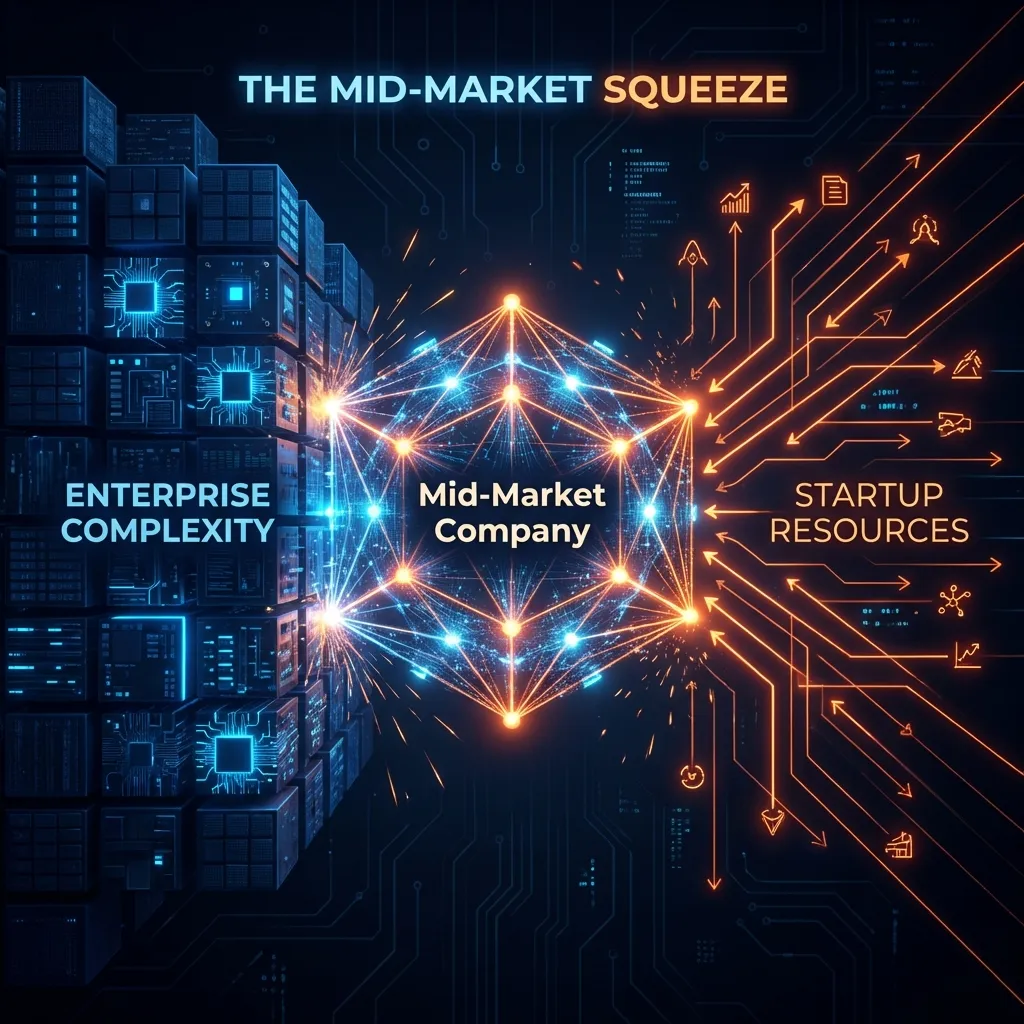
This plays out constantly at mid-market companies, and it reveals a structural gap most business leaders miss. Mid-market organizations sit in an uncomfortable position for AI cost management. You’re too large and complex to manage AI costs with spreadsheets and monthly invoice reviews like a startup can. But you don’t have the dedicated FinOps teams, sophisticated tooling, or unlimited budgets that Fortune 500 companies deploy for cost governance. You face enterprise-scale problems with startup-scale resources.
Mid-market companies often have the most acute need for proper AI cost monitoring. Your AI budgets are growing faster than almost any other spending category, with average increases of 150% year over year. You’re typically allocating between $500,000 and $2 million annually for AI initiatives, which is significant enough to affect your bottom line but not large enough to justify hiring a dedicated team to manage it. Unlike enterprises that can absorb cost overruns or startups that can pivot quickly, you’re in a middle ground where cost surprises can damage quarterly results but you lack the infrastructure to prevent them.
The Mid-Market Squeeze: Too Big for Simple, Too Small for Enterprise
Mid-market companies face constraints that make AI cost management particularly challenging. You’re squeezed from both sides. On one side, you have complexity that rivals much larger companies. You’re running multiple AI tools across different departments. Your customer support team uses an AI chatbot. Your development team uses AI coding assistants. Your sales team has AI SDR tools. Your operations team might use AI for fraud detection or document processing.
This complexity means you can’t look at your credit card statement once a month and call it cost management. You have dozens of AI-related line items spread across multiple vendors, cloud providers, and internal systems. Your costs are fragmented across OpenAI API usage, Anthropic subscriptions — check current rates at the AI token pricing tracker — vector database services, cloud compute for running models, SaaS AI tools with usage-based pricing, and various other categories. Without proper aggregation and tracking, you cannot know what you’re spending on AI.
The squeeze: while you have enterprise-level complexity in your AI spending, you don’t have enterprise-level resources to manage it. Fortune 500 companies solve this problem by hiring dedicated FinOps teams with five or ten people whose full-time job is cost governance. They implement sophisticated multi-cloud cost management platforms that cost $50,000 or more per year. They have data engineers who build custom dashboards and attribution systems.
Your finance team is probably five to fifteen people total, managing everything from accounts payable to financial planning to investor relations. Nobody owns AI cost management full-time. You likely can’t justify spending $50,000 per year on an enterprise cost monitoring platform when your total AI budget might be $800,000. Startup solutions are too simple for your complexity. Enterprise solutions are too expensive and require too much operational overhead for your resources.
The Real Cost of Poor Visibility: More Than Just Budget Surprises
Without clear cost visibility, you lose the ability to make smart strategic decisions about your AI investments.
Your sales team loves the new AI SDR tool and swears it’s generating qualified leads. But you’re paying $7,000 per month for it, and you don’t know whether those leads convert at a high enough rate to justify the cost. Your finance team wants to cut it. Your sales team pushes back. Nobody has the data to make an informed decision because you can’t connect the AI costs to actual business outcomes.
This repeats across your organization. Product teams want to add AI features but can’t confidently predict what they’ll cost at scale. Finance teams can’t forecast next quarter’s AI spend because historical usage is poorly tracked. Engineering teams optimize for functionality without understanding the cost implications of their architecture decisions.
Poor cost visibility also produces what I call silent budget creep. Your initial AI budget might be $500,000 for the year. Throughout the year, different teams independently add AI tools or increase usage of existing ones. Marketing adds an AI content generation tool at $300 per month. Customer success implements AI chat support at $4,000 per month. Engineering scales up their vector database, adding $2,000 per month. Each individual decision seems reasonable. Collectively, you’re adding $100,000 in annual AI spend that nobody budgeted for, and by the time finance notices, you’re over budget with no easy way to pull back without disrupting operations.
Research shows 64% of mid-market companies use third-party cost monitoring tools — higher than larger companies. Mid-market companies recognize they have a cost visibility problem and are actively trying to solve it. But many are using tools that weren’t designed for the unique challenges of AI cost management.
Why Your Current Approach Probably Isn’t Working
You probably have some combination of monthly invoice reviews, spreadsheets where someone manually aggregates costs from different sources, maybe an observability tool that tracks some of your LLM API usage, and periodic check-ins where finance asks engineering to explain cost spikes.
This might have worked when you first started experimenting with AI. When you had one or two AI tools and monthly costs were $5,000, spreadsheets and invoice reviews were manageable. But as you’ve scaled AI adoption across your organization, this approach has become inadequate.
Manual aggregation doesn’t scale and is always incomplete. Someone in finance is spending hours each month pulling together AI costs from AWS bills, OpenAI invoices, Anthropic charges, your vector database provider, various SaaS AI tools, and other sources. They’re copying numbers into a spreadsheet, trying to categorize things correctly, and producing a report that’s probably a week old by the time it’s finished. This report misses things because AI costs are scattered across so many places. Your developers might be using AI tools on personal credit cards and expensing them. Different departments might have their own vendor relationships. The aggregated number is always an underestimate, and you don’t know by how much.
Monthly invoice reviews give you visibility far too late to be actionable. By the time you see that costs jumped by $30,000 last month, you’ve already spent the money and the patterns that drove the spike are in the past. A bug in your code that causes excessive API calls could cost tens of thousands of dollars before anyone notices in the monthly invoice.
The tools you’re using also weren’t designed for comprehensive AI cost tracking. A cloud cost management tool tells you about AWS or GCP spending but doesn’t see your OpenAI API usage or third-party AI SaaS subscriptions. An LLMOps tool like Langfuse or Helicone tracks LLM API calls but misses infrastructure costs, vector database spending, and SaaS AI tools. A general SaaS spend management platform shows subscriptions but doesn’t capture usage-based costs or internal AI infrastructure. Each tool gives you part of the picture, but nobody has the complete view.
Without proper cost attribution that connects spending to business value, you know you spent $85,000 on AI last month but not how much was for high-margin enterprise customers versus low-margin SMB customers, or which product features are consuming the most AI resources.
Recent surveys show that while 57% of companies still rely primarily on spreadsheets for AI cost management, and 41% use consultants for cost analysis, these approaches are widely recognized as inadequate. Companies know they need better solutions but struggle to find tools that fit their specific needs and constraints.
What Mid-Market Companies Actually Need: Five Core Capabilities
Based on working with dozens of mid-market companies, five core capabilities separate those with good AI cost governance from those struggling with visibility.
Unified cost aggregation across all AI spending. A single place where you can see costs from LLM providers, cloud infrastructure, vector databases, workflow automation platforms, SaaS AI tools, and any other AI-related spending. The aggregation needs to happen automatically, pulling data through APIs rather than requiring manual entry, providing real-time or near-real-time views.
When your CFO asks what you spent on AI last month, you should pull up a dashboard showing the complete picture in seconds: OpenAI costs of $12,000 (model cost-per-call with the OpenAI pricing calculator), Anthropic at $8,000, Pinecone at $3,000, AWS AI workloads at $15,000, Intercom AI at $4,000, Cursor licenses at $2,000, internal compute and storage at $6,000. Total AI spend of $50,000, fully accounted for.
Cost attribution connecting spending to business dimensions. You need to slice AI costs by product feature, customer segment, department, and team. This attribution should happen at the transaction level — when you make an AI API call or run a workflow, it should be tagged with metadata about what business process it supports. With good attribution, you can answer: what’s our AI cost per customer in the enterprise segment versus the SMB segment? How much are we spending on our document analysis feature compared to our chatbot? Which department is driving the most AI usage?
Total cost tracking for complex AI workflows, not just individual API calls. Modern AI applications involve multi-step processes that include LLM calls, vector database searches, tool executions, and workflow orchestration. Your cost monitoring needs to capture all of these and aggregate them into a single logical transaction cost. If your monitoring only captures the LLM portion of a workflow, you might think something costs $0.20 when it actually costs $0.50, which throws off your unit economics.
Forecasting and budgeting support that accounts for the volatility of usage-based pricing. Unlike subscription software where costs are predictable, AI costs fluctuate based on actual usage. You need tools that help you model scenarios like “if we roll out this AI feature to all customers, what will it do to our costs?” or “based on current growth trends, what should we budget for next quarter?” Good forecasting considers historical usage patterns, growth trends, seasonality, and planned feature launches.
Ease of implementation and operation. You don’t have a team who can spend weeks integrating complex tools and months learning how to operate them. You need something that can be set up quickly, with just API connections or lightweight SDKs, and that provides value immediately without extensive configuration or custom development.
The Budget Reality: What You Can Afford and What You Should Expect
If your total AI spending is $800,000 per year, how much should you spend on tools to monitor and manage that spend? The general principle in FinOps is 1-3% of managed spending on cost management tooling, which would be $8,000 to $24,000 annually.
At the lower end, around $8,000 to $12,000 per year, expect basic but functional cost aggregation and reporting: a platform that connects to your major AI cost sources through APIs, provides dashboards showing spending trends and breakdowns, and offers alerting when costs spike.
In the middle of the range, around $12,000 to $18,000 annually, expect more comprehensive capabilities including better cost attribution, integration with more data sources, more sophisticated alerting and anomaly detection, and better forecasting. This is the sweet spot for most mid-market companies.
At the higher end, $18,000 to $25,000 per year, expect near-enterprise-grade capabilities adapted for mid-market scale: detailed attribution, advanced analytics, integration with your business intelligence tools, and potentially some custom development.
You can get effective AI cost monitoring at mid-market budgets. You don’t need to spend $50,000 on enterprise platforms. But you also shouldn’t expect to effectively manage hundreds of thousands in AI spending with free tools or DIY spreadsheet solutions. Cost monitoring is insurance: a small percentage of your AI budget protecting against waste, inefficiency, and strategic mistakes that could easily cost many times what the monitoring tool costs.
The Implementation Strategy: Start Small, Prove Value, Expand
One of the biggest mistakes mid-market companies make with AI cost monitoring is trying to achieve complete visibility across every system, perfect attribution for every transaction, and comprehensive forecasting all at once. This approach fails because it’s too complex, takes too long, and requires too much effort from teams that are already stretched thin.
Start by identifying your largest AI cost buckets. The guide to tracking and metering usage events covers how to instrument each bucket. For most companies, this is LLM API usage from providers like OpenAI and Anthropic, combined with major cloud infrastructure costs for AI workloads. These might represent 60-70% of your total AI spending. Get visibility into just these areas first. Connect your cost monitoring tool to the APIs for these major cost sources and start seeing unified reporting on them. This should take days or weeks to implement, not months, and immediately gives you much better visibility.
Once you have that foundation and people are using it to understand spending patterns, expand to the next tier: your vector database spending, major AI SaaS subscriptions, and workflow automation costs. Each expansion adds more completeness to your cost picture. Each step provides incremental value rather than being a big-bang implementation that takes forever and delivers nothing until everything is done.
As you expand coverage, progressively add more sophisticated capabilities. Start with basic cost aggregation and reporting. Once people trust the data and use it regularly, add alerting and anomaly detection. Then add attribution capabilities to slice costs by different business dimensions. Then add forecasting and what-if modeling. Each capability builds on the previous ones.
This phased approach works for mid-market organizations because it respects your resource constraints. You’re not asking your platform team to spend two months on a major implementation project. You’re asking them to spend a few days getting basic visibility, see the value, and incrementally add more over time. It also reduces risk: if you discover the tool doesn’t work well for your needs, you’ve invested only a small amount of time and can pivot to a different approach.
Common Pitfalls and How to Avoid Them
Assuming your existing tools can solve the problem. Your cloud cost management platform says they’ve added AI capabilities. Your observability platform claims they can track AI costs now. Your SaaS spend management tool promises it handles usage-based pricing. It’s tempting to add these features to tools you already pay for, but this rarely works well.
General-purpose tools treat AI cost management as a feature addition, not a core competency. They bolt on some AI-specific dashboards and call it done. They’re missing the deep understanding of AI cost dynamics, the nuances of usage-based pricing for LLM APIs, the complexity of agentic workflow costs, and the specific attribution challenges that AI presents. You end up with a feature that checks a box but doesn’t solve your problem.
Tool proliferation without consolidation. Your engineering team implements one tool for tracking LLM costs. Your DevOps team implements a different tool for cloud cost tracking. Your finance team buys a SaaS spend management platform. Before long, you have four or five different tools that each provide partial visibility, but you still don’t have a unified view. Explicitly prioritize consolidation and unified visibility when evaluating tools. A single platform that covers 80% of your AI costs is more valuable than three platforms that each cover different 40% slices with overlap and gaps.
Implementing monitoring without clear ownership. You set up a cost monitoring tool and give access to engineering, finance, and operations teams. Everyone can see the dashboards. But nobody is specifically responsible for acting on the insights, investigating anomalies, or driving optimization initiatives. The tool generates data but it doesn’t translate into action. Establish clear ownership when you implement cost monitoring — typically someone in finance operations or engineering operations who is accountable for AI cost management, responsible for regularly reviewing dashboards, investigating spikes, working with teams to optimize usage, and ensuring cost data influences decision-making.
Focusing on cost reduction rather than cost optimization aligned with business value. When teams see their AI costs for the first time, the immediate reaction is often to panic and start cutting wherever possible. The goal isn’t minimum AI spending, it’s optimal AI spending that delivers maximum business value per dollar spent. Sometimes the right decision is to spend more, not less, because the business value justifies it. Good cost monitoring helps you make these trade-offs by connecting costs to business outcomes.
Building Cost Awareness into Your Culture
The best monitoring tools in the world won’t help if your teams don’t care about costs and don’t consider cost implications when making decisions. You need to shift from a world where only finance thinks about costs to one where engineers, product managers, and business leaders all have cost consciousness built into how they work.
This cultural shift is particularly important in mid-market companies because you don’t have the same separation of concerns that large enterprises have. In a Fortune 500 company, there might be a dedicated cost optimization team. At a mid-market company, everyone needs to play that role to some degree. Your developers need to think about the cost implications of their architecture choices. Your product managers need to consider costs when designing features. Your customer success team needs to understand how different usage patterns affect costs.
Building this cost awareness starts with visibility and education. Make sure relevant cost data is accessible to the people making decisions. If a product manager is deciding whether to expand an AI feature, they should be able to easily see what the current costs are and what the projected costs would be at higher usage. If a developer is choosing between two implementation approaches, they should understand the cost difference.
Education means helping people understand the cost model for the AI tools and services you use. Many developers have no idea that vector database operations can be expensive at scale, or that different LLM models have dramatically different cost profiles, or that prompt structure can significantly affect token usage. Run training sessions or create internal documentation that helps your teams understand these cost dynamics.
Recognition and incentives matter for building cost culture. When a team finds a way to reduce costs without sacrificing quality or functionality, celebrate that win publicly. The specific mechanism matters less than sending a signal that the organization values thoughtful cost management. At the same time, be careful not to create perverse incentives where teams are afraid to spend on AI even when it makes business sense. The message shouldn’t be “AI is expensive so don’t use it.” The message should be “understand your AI costs and make intentional trade-offs between cost and value.”
The Path Forward: Taking Action This Quarter
Start with an AI cost audit to understand your current reality. Spend a week having someone inventory all AI-related spending across your organization. Talk to department heads, review vendor contracts, look at cloud bills, and create a comprehensive list of where AI costs are coming from. You’ll probably discover spending you didn’t know about. The goal is a baseline understanding of what you’re actually spending before you try to implement monitoring and optimization.
Once you have that baseline, calculate what you can afford to invest in cost monitoring using the 1-3% guideline. If you’re spending $600,000 annually on AI, that suggests a budget of $6,000 to $18,000 for cost monitoring tools and processes.
Define what success looks like for AI cost monitoring at your organization. Be specific. Success might mean having visibility into 80% of AI spending within 30 days of month end. It might mean attributing AI costs to the top five customer segments. It might mean detecting and investigating cost anomalies within 48 hours instead of 30 days later.
Evaluate two or three specialized AI cost monitoring platforms against your success criteria and budget. Focus on platforms purpose-built for mid-market companies rather than trying to adapt enterprise tools or cobble together free tools. Get trial access to test with your own data before committing.
Implement your chosen solution in phases. Plan for a 90-day implementation: month one is basic visibility, month two is expanded coverage and alerting, month three is attribution and forecasting.
Assign someone to be responsible for AI cost management — a finance operations person, an engineering leader, or a technical program manager. Create a monthly rhythm where costs are reviewed, trends are analyzed, and optimization opportunities are identified.
AI cost monitoring will become more critical, not less, as your AI usage grows and becomes more embedded in core business operations. Mid-market companies that build strong cost monitoring capabilities now will invest confidently in AI innovation, price their products correctly, and forecast and budget accurately. Those that continue with fragmented visibility and reactive cost management will find themselves either over-spending on AI and eroding margins, or under-investing and falling behind competitors. For mid-market companies, where neither outcome is acceptable, getting AI cost monitoring right is a competitive necessity.