AI Summary
About
Abacus.AI runs two distinct businesses under one brand. The consumer-facing side is ChatLLM, marketed as an “AI super-assistant” that bundles access to most state-of-the-art LLMs (GPT, Claude/Opus, Gemini, Grok, DeepSeek, Qwen and others), top image and video generators, a general-purpose AI Agent, and a coding agent / CLI behind a single low-cost subscription. The enterprise-facing side is the Abacus.AI agentic AI platform, which lets organizations build RAG chatbots on their own data, set up AI workflows, run autonomous tasks, and deploy on dedicated GPU compute clusters.
ChatLLM targets individuals, prosumers, and teams who want one assistant in front of every frontier model rather than juggling separate ChatGPT, Claude, and Gemini subscriptions. The enterprise platform targets midmarket and large organizations that need permission-aware chatbots, SSO/SAML, enterprise-grade support, and compliance (SOC 2, GDPR, HIPAA) across in-VPC and multi-cloud deployments.
The company is not a fresh consumer startup. It launched in 2019 as RealityEngines.ai, an enterprise AutoML / real-time ML platform, and rebranded to Abacus.AI alongside a $13M Series A in July 2020, followed by a $22M Series B (Coatue) in November 2020. The prosumer ChatLLM seat only arrived years later — the earliest archived ChatLLM Teams page dates to May 2024. In July 2025 Abacus.AI raised a $101M Series C led by IVP at a $605M valuation (a16z, GV, Lightspeed, Foundation Capital, ICONIQ, and ServiceNow/Snowflake’s Frank Slootman participating), against a reported ~$30M ARR. Competitively, ChatLLM sits in the same “every-model-in-one-seat” lane as Poe, OpenRouter, and You.com, while the enterprise platform competes with Glean and other RAG/agent stacks — but Abacus is unusual in running both from one brand and one underlying inference cloud.
Pricing summary : per-seat ChatLLM subscriptions plus a sales-led enterprise platform
Abacus.AI uses two parallel pricing models, one per product:
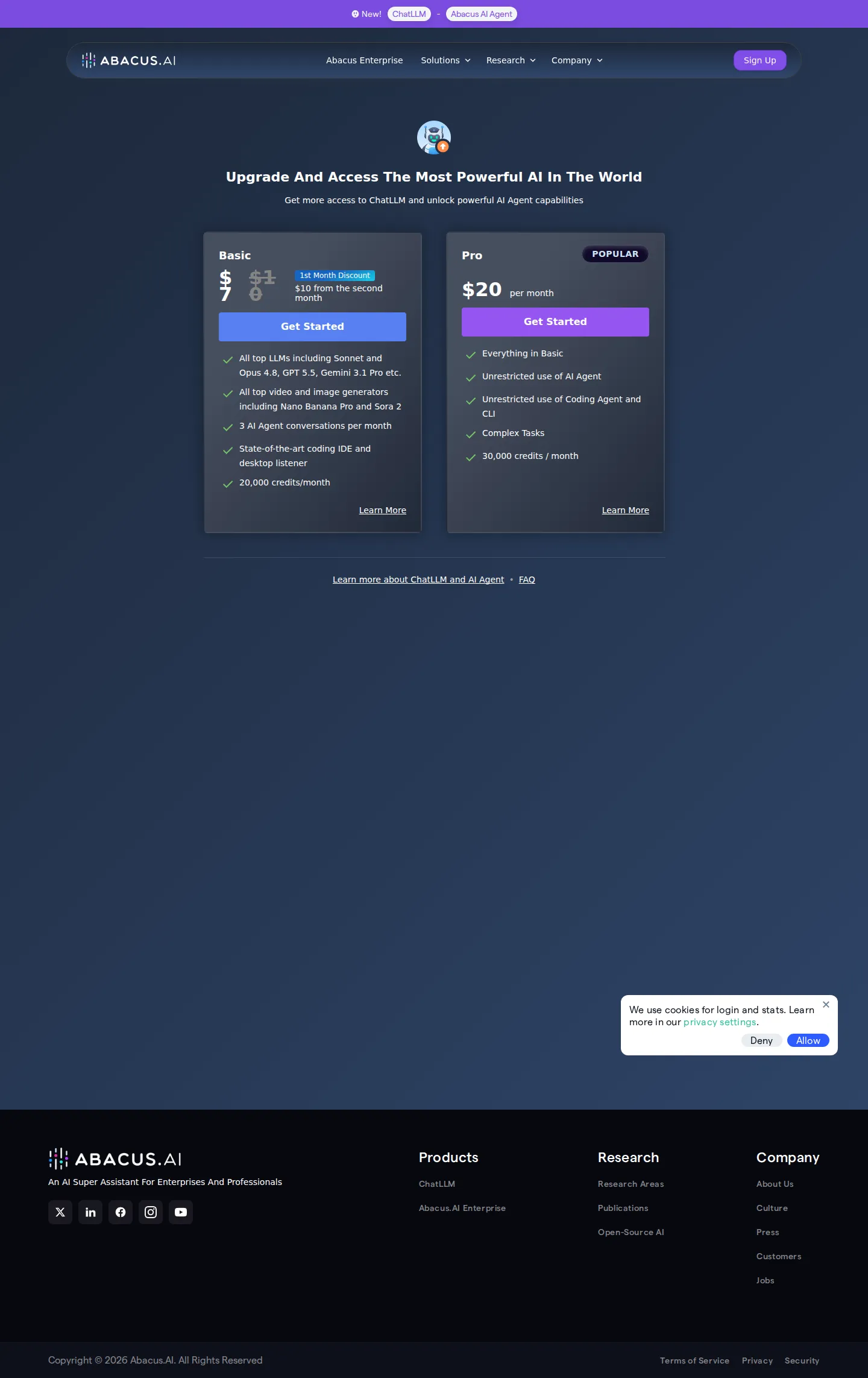
- ChatLLM — per-seat subscription with a monthly credit pool: Basic is $7 for the first month, then $10/month; Pro is $20/month. Each seat carries a monthly credit pool — 20,000 credits/month on Basic and 30,000 credits/month on Pro — that meters heavier usage such as image and video generation. ChatLLM Teams carries the same first-month mechanic — $7 for the first month, then $10/user/month — with no seat cap; new invited users added after signup are billed immediately at the full $10/user/month (the $7 discount applies to the initial subscription only).
- Enterprise agentic AI platform — sales-led / contact-sales: RAG chatbots, AI workflows, the enterprise Abacus AI Agent, dedicated GPU compute clusters, SSO/SAML, and SOC 2 / GDPR / HIPAA compliance are quoted through a free expert consultation. No list price is published on the site.
What makes this different: the same vendor pairs an almost commodity-priced consumer seat ($10/mo for access to every frontier model) with an opaque, consumption-and-compute-driven enterprise platform — a barbell where the cheap seat is the funnel and the dedicated-GPU enterprise platform is the monetization.
Pricing by product
ChatLLM (Individual plans)
| Tier | Price | Included | Key mechanics |
|---|---|---|---|
| Basic | $7 first month, then $10 / mo | All top LLMs and image/video generators; 3 AI Agent conversations/month; coding IDE + desktop listener; 20,000 credits/month | Entry seat; $7 is a first-month discount, not a free tier |
| Pro | $20 / mo | Everything in Basic; unrestricted AI Agent; unrestricted Coding Agent + CLI; complex tasks; 30,000 credits/month | ”POPULAR” — recommended seat for power users |
ChatLLM (Team plans)
| Tier | Price | Included | Key mechanics |
|---|---|---|---|
| Teams | $7 / user first month, then $10 / user / mo | Shared projects, custom chatbots/agents, team invites, integrations (Slack, Teams, GDrive, Confluence) | No seat cap; the $7 discount applies to the initial subscription only — users invited afterward are billed immediately at the full $10/user/mo |
Abacus.AI Enterprise platform (sales-led)
| Tier | Price | Included | Key mechanics |
|---|---|---|---|
| Enterprise | Custom | Permission-aware RAG chatbots, AI workflows, enterprise Abacus AI Agent, dedicated GPU compute clusters, SSO/SAML, SOC 2 / GDPR / HIPAA, in-VPC + multi-cloud deployment | Free expert consultation; no published list price |
Sales motions across products: PLG / self-serve for ChatLLM Basic, Pro, and Teams; sales-led (free expert consultation) for the enterprise agentic AI platform.
Credits — the metered unit inside each ChatLLM seat
Each ChatLLM seat ships a fixed monthly credit allowance — 20,000 credits/month on Basic and 30,000 credits/month on Pro. Credits meter resource-heavy operations: for example, on the Basic tier video generation is capped at a maximum of 3 conversations and a maximum of 2,500 credits per conversation, while Pro lifts those limits. Standard text chat against frontier LLMs is described as effectively unmetered (“send 1000s of messages without attachments”), with rate limiting triggered mainly by large attachments rather than by per-message credit draw.
Hidden costs : what ChatLLM Teams and credit limits really cost
ChatLLM’s headline prices are low and transparent, but two mechanics quietly drive the real bill: per-user Teams billing with no cap and immediate charging, and per-conversation credit caps on heavy operations like video generation. The enterprise platform has no published list price at all, so its true cost is a third, fully opaque, line.
Archetype 1 — a 12-person team standardizing on ChatLLM Teams. A small company puts its whole team on ChatLLM Teams at $10/user/month. Because new invites are billed immediately (not batched to a renewal date), mid-month hiring shows up on the next charge right away.
| Line item | Monthly cost |
|---|---|
| 12 seats × $10/user/month (ChatLLM Teams) | $120 |
| 1 mid-month seat added (billed immediately, prorated) | ~$10 |
| Total (one full month, 13 seats) | ~$130 |
The lesson: Teams has no seat-cap discount and no annual-prepay tier shown, so the bill is simply linear in headcount — easy to forecast, but with no volume break as a team scales to dozens of seats.
Archetype 2 — a Basic-tier user who leans on video generation. A solo creator on ChatLLM Basic ($10/month after the first-month $7) tries to use Abacus AI Studio for video.
| Line item | Monthly cost |
|---|---|
| ChatLLM Basic seat | $10 |
| Video generation: capped at 3 conversations, max 2,500 credits each | $0 extra |
| To lift the cap → upgrade to Pro ($20/month, 30,000 credits) | +$10 |
| Total (if upgrading for video headroom) | $20 |
The lesson: Basic does not bill video overage as a surcharge — it simply hard-caps heavy operations (max 3 video conversations, 2,500 credits each). The “hidden cost” is not a runaway invoice but a forced upgrade to Pro the moment a Basic user wants real video or unrestricted agent use.
Want to estimate your own Abacus.AI bill? Use the Abacus.AI pricing calculator to model your monthly cost based on seats and credit usage.
Pricing evolution : from a single assistant seat to credit-metered tiers
Abacus.AI’s pricing history is a two-act story: years of enterprise-only, sales-led pricing (2019–2023) followed by the prosumer ChatLLM seat that has been live since at least May 2024. Archived snapshots of the ChatLLM Teams page render through JavaScript, so most months preserve the marketing copy but not an extractable price grid; the standalone abacus.ai/pricing grid was not archived until March 2026. The cadence below reflects only the quarters where a snapshot or funding event shows a verifiable change.
Cadence
| Quarter | Price changes | Product / SKU additions | Notes |
|---|---|---|---|
| 2020 Q3 | 0 | 0 | RealityEngines.ai rebrands to Abacus.AI; $13M Series A. Enterprise-only, sales-led pricing. |
| 2020 Q4 | 0 | 0 | $22M Series B (Coatue). Still enterprise MLOps/AutoML, contact-sales only. |
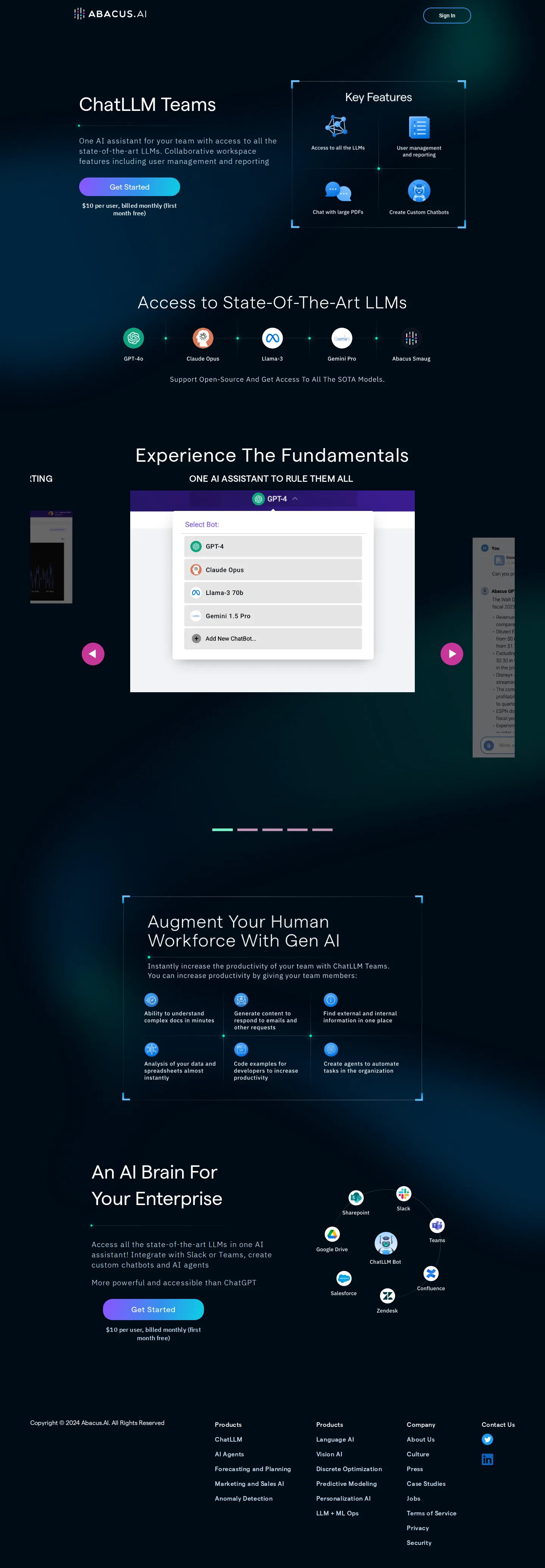
| 2024 Q2 | 1 | 1 | Earliest archived ChatLLM Teams page: $10/user/month seat ($7 first month), no seat cap; bundled “CodeLLM.” |
| 2025 Q3 | 0 | 0 | $101M Series C (IVP) at a $605M valuation; consumer seat unchanged at $10/user/month. |
| 2025 Q4 | 0 | 1 | ChatLLM Teams rebrands the bundled agent from “CodeLLM” to “DeepAgent” (and DeepAgent Desktop). |
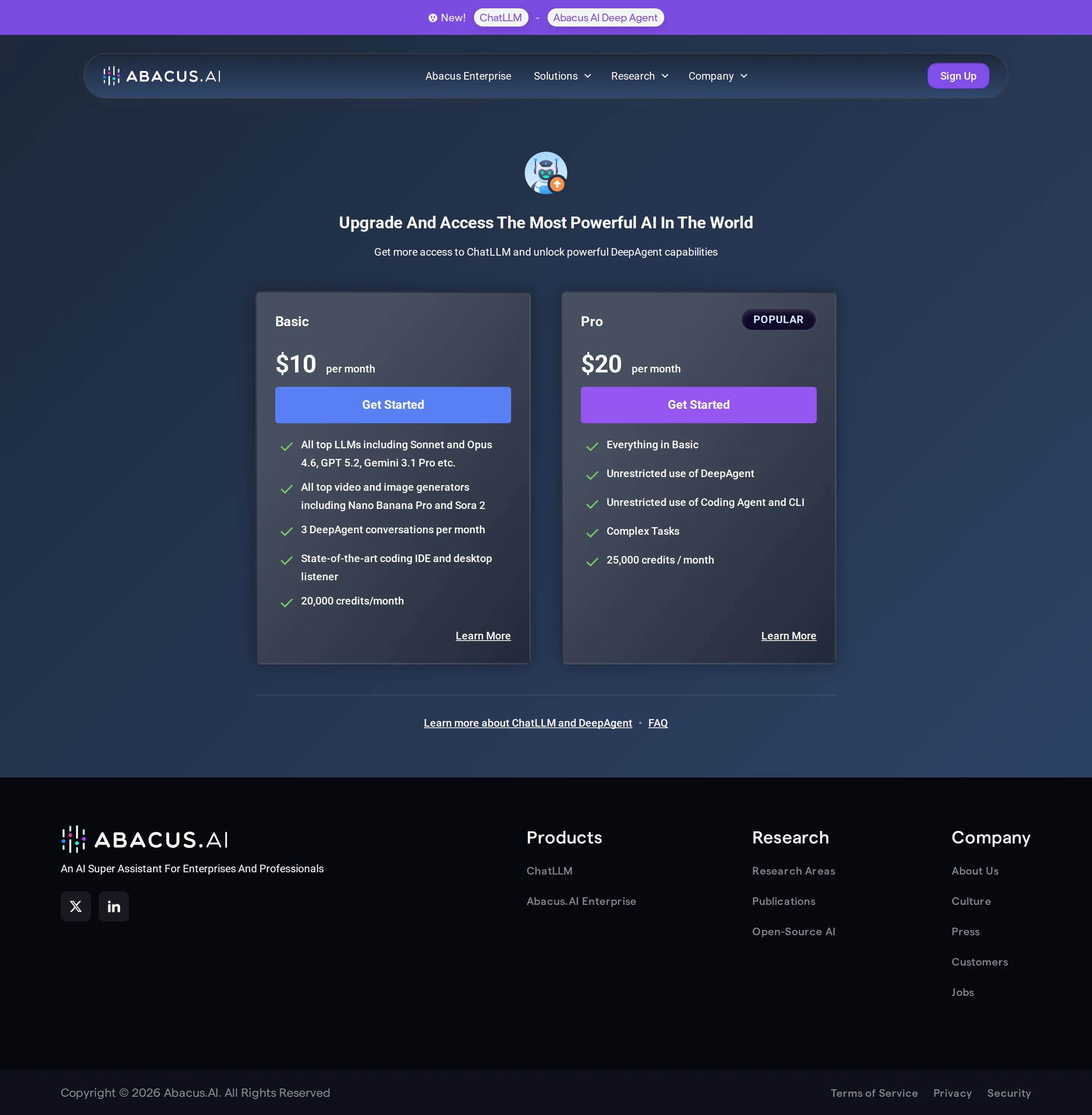
| 2026 Q1 | 1 | 0 | Standalone abacus.ai/pricing grid archived: Basic $10, Pro $20 (25,000 credits), DeepAgent branding. |
| 2026 Q2 | 2 | 0 | Basic gains a $7 first-month discount; Pro credits 25,000 → 30,000; bundled agent renamed “DeepAgent” → “AI Agent.” |
Tracked range: 2020-07 – 2026-06. Quarters not listed were verified stable or preserved only as JS-rendered snapshots without an extractable price grid. Enterprise platform pricing has been contact-sales for the entire range.
Notable changes
- 2020-07-14 — RealityEngines.ai rebrands to Abacus.AI alongside a $13M Series A (TechCrunch); pricing is enterprise-only and sales-led.
- 2020-11-18 — $22M Series B led by Coatue (abacus.ai/pr2020_11_18).
- 2024-05 — Earliest archived ChatLLM Teams page shows the prosumer pivot: $10/user/month ($7 first month), no seat cap, bundled “CodeLLM” (Wayback, chatllm.abacus.ai).
- 2025-07 — $101M Series C led by IVP at a $605M valuation, with a16z, GV, Lightspeed, ICONIQ and Frank Slootman participating; the $10 consumer seat is unchanged.
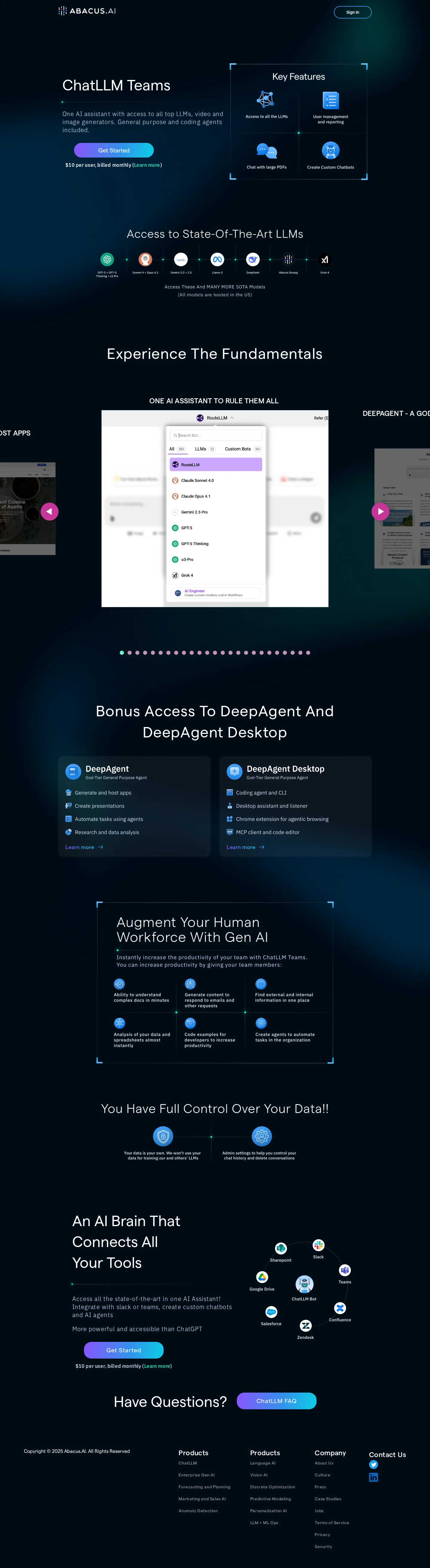
- 2025-10 — ChatLLM Teams rebrands the bundled agent from “CodeLLM” to “DeepAgent” (Wayback, chatllm.abacus.ai).
- 2026-03 — First archived
abacus.ai/pricinggrid: Basic $10/month (20,000 credits), Pro $20/month (25,000 credits), DeepAgent branding (Wayback). - 2026-06 — Basic adds a $7 first-month discount; Pro’s monthly credit pool rises to 30,000 (from 25,000); the bundled agent is renamed “AI Agent” in the UI.
The enterprise-to-prosumer pivot in detail
What makes Abacus.AI’s evolution unusual is the direction: most AI companies start consumer and bolt on enterprise. Abacus did the reverse. From 2019 it sold a sales-led enterprise AutoML/MLOps platform with no public price. The ChatLLM seat, live since at least May 2024, retro-fits a self-serve, almost commodity-priced consumer funnel ($10/month) onto that enterprise inference cloud. The two acts share infrastructure — the same model-routing and agent stack powers both the $10 seat and the dedicated-GPU enterprise deployments — but only the consumer side ever got a published list price. The seat price itself has been remarkably stable: $10/user/month from 2024 through 2026, with the only real movement being the addition of a Basic/Pro split, a first-month discount, and incremental credit-pool bumps.
What’s unique : one cheap seat in front of every frontier model
1. A single low-cost seat aggregates every frontier model. For $10–$20/month, ChatLLM fronts GPT, Opus/Sonnet, Gemini, Grok, DeepSeek, Qwen, Kimi and 20+ other models, plus top image and video generators — and Abacus claims it adds new models 24–48 hours after release. That positions ChatLLM as a credit-based aggregator competing on breadth, not on a single house model, in the same lane as Poe and OpenRouter.
2. Credit pools meter only the expensive operations. Standard text chat against frontier LLMs is effectively unmetered (“send 1000s of messages without attachments”), while a fixed monthly credit pool (20,000 on Basic, 30,000 on Pro) governs heavy operations like video generation. This is a hybrid seat-plus-credit model: the seat is the price the buyer sees, and credits act as a soft governor rather than a metered overage line.
3. A barbell: a commodity-priced consumer funnel and an opaque enterprise platform. The same vendor pairs a near-commodity $10 seat with a fully sales-led enterprise agentic AI platform (dedicated GPU clusters, SSO/SAML, SOC 2/HIPAA, in-VPC) that has no published price. The cheap seat is the top of the funnel; the enterprise platform is where deal-size monetization happens.
4. Hard caps instead of overage surcharges. On heavy operations like video, Basic doesn’t bill overage — it hard-caps (max 3 conversations, 2,500 credits each) and pushes the upgrade to Pro. This keeps invoices predictable and avoids the surprise-bill backlash that has hit usage-metered competitors, but it converts “more usage” into a binary upgrade rather than a smooth spend curve.
5. Enterprise-to-prosumer, not the usual direction. Unlike most AI assistants that start consumer and add enterprise, Abacus began as a sales-led enterprise MLOps platform (as RealityEngines.ai) and added the prosumer seat on top of its existing inference cloud — a reuse-the-infrastructure play rather than a ground-up consumer product.
Strengths & weaknesses
| Strengths | Weaknesses |
|---|---|
| Aggregates all frontier models for ~$10–$20/mo | No free tier — $7 is only a first-month discount |
| Transparent, low ChatLLM list prices | Enterprise platform pricing is fully opaque |
| Per-user Teams billing scales with no seat cap | Credit caps on heavy ops (video) are easy to miss |
| Hard caps keep invoices predictable (no surprise overage) | No annual-prepay or volume discount shown on Teams |
| Seat price stable at $10 since 2024 (low churn risk) | Frequent product renames (CodeLLM → DeepAgent → AI Agent) muddy the brand |
Billing UX : in-app billing, invoices, and immediate per-seat charges
- Billing and Invoices page — reached from the desktop interface by clicking the top-right profile corner; shows subscription details, past payments, downloadable invoices, and payment-method updates.
- Self-serve cancellation — subscriptions can be canceled anytime directly from the ChatLLM interface.
- Immediate per-seat charges on Teams — when a Teams admin invites a new user, that seat is billed immediately at the full $10/user/month (no first-month discount on added seats), and the monthly bill scales with team size.
- First-month discount mechanic — both Basic and Teams show a “$7 for the first month, then $10 billed monthly” price, automatically reverting to $10 from the second month; Pro carries no such discount.
- Per-conversation credit caps — heavy operations like video generation are capped per conversation (e.g., Basic: max 3 conversations, max 2,500 credits per conversation) rather than billed as overage.
Strategic wins : why the barbell pricing works
1. A $10 seat in front of every frontier model
Pricing one low seat against the whole frontier-model market is a sharp value-metric choice: the buyer compares $10/month for “every model” against $20/month for one (ChatGPT Plus, Claude Pro), and the breadth wins for prosumers who model-hop. By keeping the seat flat and unmetered for text, Abacus sidesteps the cognitive load of token-based pricing that scares off non-technical buyers.
2. Credit pools that meter only the expensive operations
Putting a fixed credit pool around video and image generation — while leaving text chat effectively unmetered — is a clean application of hybrid usage-based pricing: the buyer pays a predictable seat and only feels the meter on genuinely GPU-expensive work. It protects gross margin on the costly operations without taxing the cheap ones, which is exactly the entitlement-style governance that keeps a flat seat economically viable.
3. A consumer funnel feeding a sales-led enterprise platform
The barbell lets Abacus run product-led growth on the $10 seat while reserving its real monetization — dedicated-GPU enterprise deployments — for a sales-led motion. The cheap seat builds bottom-up familiarity inside organizations; the enterprise platform captures the budget once an account needs SSO, compliance, and in-VPC deployment. One inference cloud serves both, so the consumer funnel is nearly free to operate.
Areas to improve : where the model leaks trust or revenue
1. No free tier blunts the PLG funnel
The “$7” Basic card reads like a discount, not a free entry — there is no $0 tier to let a curious user try every model before paying. For a product whose whole pitch is breadth, a capped free tier (a handful of agent runs and a small monthly credit allowance) would let the self-serve funnel do its job before the credit card. Fix: add a genuine free tier with a hard credit cap, and reframe Basic’s $7 as “first month, then $10” rather than a price that looks free.
2. Opaque enterprise pricing slows self-serve evaluation
The enterprise platform shows no price, no starting band, and no example deal size — just “free expert consultation.” For midmarket buyers comparing against a Glean or an in-house build, that opacity adds a sales call to step one. Fix: publish a “starting from” band or a representative deployment example (seats + compute envelope) so technical evaluators can self-qualify, the way many sales-led platforms now anchor with a public floor.
3. Credit caps on heavy operations are easy to miss
Basic’s video cap (max 3 conversations, 2,500 credits each) is buried in the FAQ, not surfaced on the pricing card, so a user discovers it mid-task. Fix: show remaining credits and the per-operation cap inline in the product UI, and warn before a video run will exhaust the pool — the kind of usage-visibility control that prevents the “why did it stop?” support ticket.
Monetization stack & signals : how Abacus.AI builds & buys its revenue engine
Buys 0 Builds 0
Abacus.AI meters ChatLLM on a top-up credit pool through its own in-app Billing & Invoices flow, but names no payments or metering vendor publicly — buy-vs-build stays unconfirmed.
-
“View all past payments by going to your profile and navigating to the Billing and Invoices page... download past invoices and update your payment information. If you want to spend more credits, you can always buy more.”
- Metering Metering inferred
Signals reviewed · derived from product docs
Key takeaways
- Breadth can be the value metric. Abacus prices one $10 seat against “every frontier model,” turning model-aggregation itself into the thing the buyer pays for — a viable wedge against single-model subscriptions that cost twice as much.
- A flat seat with a credit governor beats raw usage pricing for prosumers. Leaving text unmetered and capping only GPU-heavy operations gives a predictable bill while protecting margin where it actually matters.
- Hard caps avoid surprise-bill backlash but force binary upgrades. Capping video instead of charging overage keeps invoices clean, at the cost of converting “I need more” into “upgrade to Pro” rather than a smooth spend curve.
- You can run enterprise-to-prosumer, not just the reverse. A sales-led platform can graft a self-serve seat onto its existing inference cloud and reuse the infrastructure — the consumer funnel is nearly free when the compute is already built.
- Price stability is a feature. Holding the seat at $10 from 2024 to 2026 — while raising credit allowances rather than the headline price — signals reliability and reduces the churn risk that frequent price hikes create.
UBP implications
- Credit pools work best as governors, not as the headline price. Abacus shows that a fixed seat with an embedded credit allowance reads as simpler than per-unit metering while still rationing the expensive operations — the seat is what the buyer evaluates, credits are the safety valve.
- Raising the allowance instead of the price is a quiet lever. Bumping Pro from 25,000 to 30,000 credits at a constant $20 delivers a “more for the same” message and defends against churn without the friction of a visible price increase.
- A barbell de-risks usage pricing at the top. By keeping the consumer seat flat and reserving consumption-and-compute monetization for opaque enterprise deals, Abacus avoids exposing prosumers to the volatility that pure usage-based pricing creates — a pattern other dual-audience AI vendors can copy.
Sources
- Abacus.AI pricing page (accessed 2026-06-02)
- ChatLLM FAQ (accessed 2026-06-02)
- ChatLLM Teams / enterprise assistant page (accessed 2026-06-02)
- Abacus.AI enterprise agentic AI platform (accessed 2026-06-02)
Browse the full pricing blueprint to compare Abacus.AI against other AI-platform pricing.
Bottom line
Abacus.AI runs a deliberate barbell: a near-commodity $10–$20 ChatLLM seat that fronts every frontier model and acts as a self-serve funnel, paired with a fully opaque, sales-led enterprise agentic AI platform where dedicated-GPU deals are monetized. The seat price has been strikingly stable since 2024 — the company raises credit allowances and adds a Basic/Pro split rather than touching the headline number — while the enterprise side has never carried a published price across the entire tracked range. It’s a clean example of using a cheap, transparent consumer tier to feed an expensive, custom-quoted one, built on a single shared inference cloud.
Want to compare Abacus.AI against other AI-platform pricing? Browse the pricing blueprint.
Pricing timeline : Major events on a vertical axis
Each milestone below corresponds to a public pricing change, product launch, or material adjustment. Major events use a filled marker; minor adjustments use a faded one.
Basic gains $7 first-month; Pro credits 25,000 to 30,000; AI Agent rename
The live pricing page shows Basic at $7 for the first month then $10/month (20,000 credits/month) and Pro at $20/month with credits raised to 30,000/month (from 25,000 in March). The bundled agent is now branded 'AI Agent.' The enterprise agentic AI platform remains contact-sales.
Dedicated /pricing page: Basic $10, Pro $20 (25,000 credits)
The first archived snapshot of the standalone abacus.ai/pricing grid (2026-03) shows Basic at $10/month (20,000 credits/month, no first-month discount shown) and Pro at $20/month with 25,000 credits/month and 'DeepAgent' branding. (Wayback, abacus.ai/pricing 2026-03.)
DeepAgent branding replaces CodeLLM in ChatLLM Teams
By 2025-10 the ChatLLM Teams page held the $10/user/month seat steady but rebranded the bundled agent from 'CodeLLM' to 'DeepAgent' ('Bonus Access to DeepAgent and DeepAgent Desktop'). (Wayback, chatllm.abacus.ai 2025-10.)
ChatLLM Teams live at $10/user/month ($7 first month)
By the earliest archived ChatLLM Teams snapshot (2024-05), Abacus.AI had launched a prosumer/consumer seat: $10/user/month with a $7 first-month discount, no seat cap, billed monthly by team size. This is the pivot from enterprise-only to a self-serve seat. The page bundled 'Bonus Access to CodeLLM.' (Wayback, chatllm.abacus.ai 2024-05.)
$22M Series B (Coatue)
Abacus.AI raised a $22M Series B led by Coatue with Decibel and Index participating, scaling the enterprise MLOps / deep-learning platform. Still enterprise-only, contact-sales pricing. (abacus.ai/pr2020_11_18.)
RealityEngines.ai rebrands to Abacus.AI ($13M Series A)
The company launched as RealityEngines.ai (enterprise AutoML / real-time ML platform) and rebranded to Abacus.AI alongside a $13M Series A. Pricing at this stage was enterprise-only and sales-led — no published consumer list price. (TechCrunch, 2020-07-14.)
- · Abacus.AI launched in 2019 as RealityEngines.ai, an enterprise AutoML platform, and only rebranded to Abacus.AI alongside its $13M Series A in July 2020 — the consumer ChatLLM seat came years later.
- · In July 2025 Abacus.AI raised a $101M Series C led by IVP at a $605M valuation, with a16z, GV, Lightspeed, ICONIQ and Snowflake's Frank Slootman participating — yet its flagship consumer seat still lists at just $10/month.
- · ChatLLM Teams has no seat cap and bills new invited users immediately at $10/user/month, so a Teams admin's monthly bill scales the instant they add a colleague — there is no monthly batching.
Questions & answers
- How much does Abacus.AI ChatLLM cost?
- ChatLLM has two paid plans: Basic at $7 for the first month then $10/month, and Pro at $20/month. There is no free tier.
- What are credits on Abacus.AI ChatLLM?
- Each seat includes a monthly credit pool — 20,000 credits/month on Basic and 30,000 credits/month on Pro — consumed by model usage such as video and image generation.
- How is Abacus.AI ChatLLM Teams billed?
- ChatLLM Teams bills $7 for the first month, then $10/user/month, with no cap on team size. New users you invite after the initial signup are billed immediately at the full $10/user/month — the $7 discount applies only to the initial subscription.
- Does Abacus.AI publish enterprise platform pricing?
- No. The enterprise Abacus.AI agentic AI platform is quoted through a free expert consultation; no list price is shown on the site.