AI Summary
About
E2B is an open-source cloud-infrastructure company that runs secure, isolated sandboxes — micro-VMs purpose-built to execute AI-generated code and host autonomous agents. The product gives AI applications a full virtual computer (terminal, filesystem, and git) that can safely run untrusted, LLM-generated code without exposing the host environment. E2B is operated by FoundryLabs, Inc. and has raised a $21M Series A. The company markets two faces of the same platform: a self-serve developer product (Hobby and Pro plans) and an enterprise offering (the Ultimate tier) for scaled agent platforms.
E2B serves AI-native startups, research labs, and large enterprises that need to run agentic workloads at scale. Its enterprise page cites adoption by 94% of Fortune 100 companies, 3M+ monthly SDK downloads, and 1B+ started sandboxes, with named customers and case studies including Hugging Face, Manus, Groq, Lindy, and Gumloop. Use cases span running short AI-generated code snippets, code interpreting and data analysis, fully autonomous coding agents (Claude Code, Codex, Amp, Devin), computer-use workflows, and reinforcement-learning training runs that launch hundreds of sandboxes in parallel.
E2B competes with Modal, Daytona, Northflank, and the code-interpreter / sandbox offerings bundled into AI labs’ own platforms. Its differentiation is an open-source, self-hostable architecture (BYOC and on-prem for enterprises not ready to commit to a managed plan), per-second compute billing that charges only for running-sandbox time, and a security posture (total VM isolation, SOC 2, HIPAA, US & EU regions) aimed at running untrusted agent-generated code in regulated environments.
Pricing summary : How E2B layers a platform fee on per-second sandbox compute
E2B uses a freemium-plus-usage model: every plan separates a flat platform-access fee from the metered compute bill. The free Hobby tier includes a one-time $100 of usage credits, community support, sandbox sessions up to 1 hour, and up to 20 concurrent sandboxes — with no credit card required. Pro is $150/month plus separate per-second compute usage, and it raises limits to 24-hour sessions, 100 concurrent sandboxes, customizable CPU and RAM, and the ability to buy extra concurrency up to 1,100. Critically, upgrading to Pro grants no additional usage credits — the fee buys higher ceilings, not compute.
- Platform fee: $0 (Hobby) or $150/mo (Pro); custom for Enterprise.
- Compute usage (per second of running sandbox): $0.000014/s per vCPU at 1 vCPU, scaling to $0.000028/s at the 2-vCPU default, $0.000056/s (4), $0.000084/s (6), and $0.000112/s (8). RAM and storage are billed separately on top.
- Concurrency add-ons (stacked on Pro): Pro+ (600 concurrent) +$500/mo; Pro++ (1,100 concurrent) +$1,000/mo.
- Enterprise: custom-quoted, sales-led, stated $3,000/mo minimum.
This is a hybrid model where the seat-like platform fee and the metered compute hours are both meaningful to the bill. What makes this different: the Pro fee and the usage meter are explicitly decoupled — Pro raises limits but never subsidizes compute — so customers always see their per-second running-sandbox cost as a separate line rather than a bundled allowance that hides the true marginal cost.
Pricing by product
E2B platform plans
| Tier | Price | Included | Key mechanics |
|---|---|---|---|
| Hobby | Free + usage | One-time $100 of usage credits; community support; up to 1-hour sessions; up to 20 concurrent sandboxes | No credit card required; free entry point for evaluation and hobby agents |
| Pro | $150 / mo + usage | Everything in Hobby; customizable CPU & RAM; up to 24-hour sessions; up to 100 concurrent sandboxes; buy concurrency up to 1,100 | Most popular tier; payment by Stripe; grants higher limits but no additional credits |
| Ultimate / Enterprise | Custom ($3,000/mo min) | 1,100+ concurrent; BYOC + on-prem; RBAC; SLAs; SOC 2 + HIPAA; US & EU regions | Sales-led, contact-us; custom pricing and dedicated support |
Compute usage — per second of running sandbox
E2B charges per second of running-sandbox compute. Per-vCPU rates apply on both Hobby and Pro; RAM and storage are metered separately on top.
| vCPUs | Plan | Per-second rate |
|---|---|---|
| 1 | Hobby / Pro | $0.000014/s |
| 2 (default) | Hobby / Pro | $0.000028/s |
| 4 | Hobby / Pro | $0.000056/s |
| 6 | Hobby / Pro | $0.000084/s |
| 8 | Hobby / Pro | $0.000112/s |
Hobby caps at 8 vCPUs, 8 GB RAM, and 10 GB disk; Pro raises these to 8+ vCPUs, 8+ GB RAM, and 20+ GB disk. Sandbox creation rate is 1/sec on Hobby and 5/sec on Pro; concurrent builds are 20 on both. Higher CPU or RAM limits are available by contacting support.
Concurrency add-ons (Pro)
| Add-on | Concurrent sandboxes | Price |
|---|---|---|
| Pro (base) | 100 | Included in $150/mo |
| Pro+ | 600 | +$500/mo |
| Pro++ | 1,100 | +$1,000/mo |
| Enterprise | 1,100+ | Custom |
Sales motions across products: PLG / self-serve for Hobby and Pro (sign-up plus Stripe billing, with concurrency add-ons purchased in the dashboard); sales-led for the Ultimate / Enterprise tier, BYOC / on-prem, and any limits above the published ceilings.
Hidden costs : What E2B customers actually pay beyond the $150 platform fee
Archetype A: A team running a moderate Pro agent workload
A team on Pro running a default 2-vCPU / 4 GB workload for 1,000 sandbox run-hours per month (e.g., 100 sandboxes averaging 10 hours each), staying within the included 100 concurrency. The hosted Workload Pricing Estimator computes this directly:
| Line item | Monthly cost |
|---|---|
| Pro plan base fee | $150 |
| Compute usage (2 vCPU / 4 GB × 1,000 run-hours) | $166 |
| Concurrency add-on (within included 100) | $0 |
| Estimated total | $316/month |
The usage meter ($166) already exceeds the $150 platform fee at just 1,000 run-hours, so for any team running sustained sandboxes the per-second compute — not the seat-like Pro fee — is the dominant cost line. This is the classic usage-dominant hybrid shape.
Archetype B: A scaled platform needing high concurrency
A growth-stage AI product running many sandboxes in parallel and needing 600 concurrent capacity, with heavier 4-vCPU machines running 4,000 run-hours/month:
| Line item | Monthly cost |
|---|---|
| Pro plan base fee | $150 |
| Pro+ concurrency add-on (600 concurrent) | $500 |
| Compute usage (4 vCPU at $0.000056/s × 4,000 run-hours) | ~$806 |
| RAM + storage (billed separately, not itemized here) | Additional |
| Estimated total | ~$1,456/month + RAM/storage |
At 600 concurrency and sustained compute the bill is dominated by the concurrency add-on and per-second usage; if this workload needs 1,100+ concurrency or crosses the $3,000/mo Enterprise minimum, a custom Enterprise quote becomes the path. The estimator explicitly flags when a configuration sits below the Enterprise threshold.
Want to estimate your own E2B bill? Use the E2B pricing calculator to model your monthly cost based on vCPUs, RAM, run-hours, and concurrency tier.
Pricing evolution : How E2B structured its freemium-plus-usage sandbox pricing
The headline numbers have been remarkably stable: the $150/mo Pro fee and the per-second vCPU rates ($0.000014/s at 1 vCPU through $0.000112/s at 8 vCPU) have not changed across the full tracked range. What has evolved is the packaging — how credits, concurrency, RAM/storage, and the Pro feature list are presented.
Cadence
| Quarter | Price changes | Product / SKU additions | Notes |
|---|---|---|---|
| 2024 Q4 | 0 | 0 | Three-tier structure already live — Hobby free / Pro $150/mo / Ultimate “Custom”; full 1–8 vCPU per-second rates; $11.5M Decibel seed banner |
| 2025 Q1 | 0 | 1 | Ultimate tier relabeled “Custom” → “Enterprise” (contact-us); compute rates unchanged |
| 2025 Q2 | 0 | 1 | RAM/storage pricing surfaced ($0.0000045/GiB/s, 512 MiB RAM default, free storage 1 GiB Hobby / 5 GiB Pro); Pro feature list trimmed (dropped dedicated Slack channel + prioritized features) |
| 2025 Q3 | 0 | 0 | $21M Series A (Insight Partners, announced 2025-07-28); Pro’s first bullet changed from “$100 credits” to “Everything in the Hobby tier,” matching the docs’ no-additional-credits rule |
| 2025 Q4 | 0 | 0 | Usage calculator simplified from odd vCPU steps (1–8) to even steps (1,2,4,6,8); all rows relabeled “Hobby / Pro” |
| 2026 Q2 | 0 | 1 | Concurrency add-ons foregrounded — Pro bullet “purchase extra concurrency up to 1,100” added (Pro+ +$500/mo for 600; Pro++ +$1,000/mo for 1,100); Enterprise floor stated at $3,000/mo |
Tracked range: 2024-11 – 2026-06 (Wayback monthly sampling of e2b.dev/pricing). Quarters not listed above were verified stable (0 price changes, 0 SKU additions).
Notable changes
- 2024-12 — Earliest tracked snapshot: Hobby free / Pro $150/mo (with $100 credits, Slack channel, prioritized features) / Ultimate “Custom”; per-second vCPU rates 1–8 already published. Seed round of $11.5M led by Decibel announced in-banner.
- 2025-01 — Top tier relabeled from “Custom” to “Enterprise.”
- 2025-03 — RAM and storage pricing added to the usage calculator ($0.0000045/GiB/s; 512 MiB RAM default; free 1 GiB Hobby / 5 GiB Pro storage).
- 2025-05 — Pro feature list trimmed: dropped the dedicated Slack channel and prioritized-features perks.
- 2025-07-28 — $21M Series A led by Insight Partners (with Decibel, Sunflower, Kaya), announced on e2b.dev/blog/series-a; banner appears on the pricing page in the 2025-08 snapshot.
- 2025-08 — Pro’s credit bullet changed from “One-time $100 of usage in credits” to “Everything in the Hobby tier,” making the no-extra-credits rule explicit on the page itself.
- 2025-11 — Usage calculator collapsed to even vCPU steps (1,2,4,6,8), all rows shown as “Hobby / Pro.”
- 2026-05 — Pro gained the “purchase extra concurrency up to 1,100” bullet, foregrounding the stackable Pro+ (+$500/mo) and Pro++ (+$1,000/mo) concurrency add-ons.
The credit-decoupling shift in detail
The single most consequential pricing-page change was subtle: in 2024-12 the Pro tier’s first bullet read “One-time $100 of usage in credits” — the same credit line shown on the free Hobby tier — which a buyer could easily read as “Pro gives me $100 of compute too.” By the 2025-08 snapshot that bullet had been replaced with “Everything in the Hobby tier,” and E2B’s billing docs now state plainly that “upgrading to the Pro tier does not grant additional credits; it only increases the limits available to your team.”
This is a deliberate move from an ambiguous, allowance-flavored message to a clean platform-fee-plus-metered-usage model: the $150/mo buys ceilings (24-hour sessions, 100 concurrent, bigger machines), and every second of compute is billed on top. Removing the credit line from Pro closed the most likely source of first-invoice surprise — a buyer assuming the seat fee subsidized compute — and made the marginal cost visible as its own line. The trade-off, addressed in Areas to improve, is that the no-credits rule is still easy to miss at the upgrade step.
What’s unique : E2B’s distinctive sandbox pricing mechanics
1. Platform fee fully decoupled from usage credits. Most freemium-plus-usage products bundle some credit allowance into the paid plan. E2B explicitly does not — the docs state that “upgrading to the Pro tier does not grant additional credits; it only increases the limits available to your team.” The $150/mo fee buys ceilings (runtime, concurrency, machine size), and every second of compute is metered on top. This clean separation of access fee and consumption keeps the marginal cost visible.
2. Per-second running-sandbox billing. The meter only runs while a sandbox is actually executing — paused or stopped sandboxes cost nothing in compute. For agentic workloads that spin up, do a burst of work, and tear down, this per-second granularity makes short runs nearly free while keeping always-on workloads honestly priced.
3. Concurrency as a priced product, not just a limit. Rather than gating concurrency behind a higher plan, E2B sells it as stackable add-ons (Pro+ 600 for +$500/mo, Pro++ 1,100 for +$1,000/mo) layered on the base Pro fee. This lets a small team buy exactly the parallelism it needs without jumping to Enterprise.
4. Open-source and self-hostable as a pricing pressure valve. Because E2B is open-source, teams not ready to commit to an enterprise plan can self-host in their own cloud. BYOC and on-prem are first-class Enterprise deployment modes — a structural answer to the data-residency and cost objections that usually push large customers off managed platforms.
5. Security posture priced into the Enterprise tier. SOC 2, HIPAA, RBAC, SLAs, and US / EU data residency are the explicit value of the Ultimate tier — appropriate for running untrusted, LLM-generated code in regulated environments, and the reason the Enterprise minimum sits at $3,000/mo.
Strengths & weaknesses
| Strengths | Weaknesses |
|---|---|
| Generous free Hobby tier with $100 credits, no credit card | Pro grants no credits — usage bill can surprise teams expecting an allowance |
| Per-second billing means paused sandboxes cost nothing | RAM and storage rates are not broken out on the public pricing table |
| Concurrency sold as granular add-ons, not plan jumps | Concurrency above 100 quickly adds $500–$1,000/mo flat |
| Open-source + self-hostable (BYOC / on-prem) relieves lock-in | Large gap between Pro ceilings and the $3,000/mo Enterprise minimum |
| Strong security/compliance posture (SOC 2, HIPAA, EU regions) | Per-vCPU table published, but full per-config cost requires the estimator |
| Transparent hosted estimator computes total monthly cost | Concurrency add-ons and RAM/storage rates live off the headline grid (in docs / estimator) |
| Headline price stable since 2024 ($150 Pro, fixed per-vCPU rates) | Pro’s “no extra credits” rule is easy to miss for buyers expecting an allowance |
Billing UX : E2B’s dashboard controls and payment experience
- Dashboard billing tab — Upgrade plans and purchase concurrency add-ons directly from the dashboard billing tab; Enterprise routes to contact sales.
- Dashboard usage tab — Check running usage and accrued compute costs in the dashboard usage tab for real-time spend visibility.
- Hosted Workload Pricing Estimator — A standalone estimator (pricing.e2b.dev) computes total monthly cost from vCPUs, RAM, run-hours, and concurrency tier, and flags when a configuration is below the $3,000/mo Enterprise threshold.
- Usage cost calculator on the pricing page — Per-vCPU per-second rate breakdown (1–8 vCPU) directly on e2b.dev/pricing.
- Stripe payment — Pro is billed via Stripe (“payment by Stripe”); Hobby requires no credit card.
- Spending limits — The billing docs reference setting spending limits and handling credit exhaustion (FAQ: “Can I set spending limits?”, “What happens when I run out of credits?”).
- Free credit balance — The one-time $100 Hobby credit is tracked against usage; new users start with $100 in free credits.
- Custom compute configuration — CPU and RAM are set per template via
cpuCountandmemoryMBin the build configuration; higher limits via [email protected].
Strategic wins : Why E2B’s pricing decisions worked
1. Decoupling the platform fee from usage credits keeps marginal cost honest
By refusing to bundle credits into Pro, E2B avoids the bill-shock pattern where customers blow through a hidden allowance and then face opaque overage. The $150 fee buys limits; compute is always a visible per-second line. This transparency is a trust win for usage-based pricing.
2. Per-second billing matches the agentic workload shape
Agents burst: spin up a sandbox, run code, tear down. Charging per second of running time — and nothing for paused sandboxes — aligns the bill to actual value delivered, the core goal of value-metric pricing. It also makes the free Hobby tier genuinely usable for evaluation.
3. Concurrency-as-add-on captures scaling revenue without forcing Enterprise
Selling 600 and 1,100 concurrency as +$500 and +$1,000 add-ons lets a growing team pay for exactly the parallelism it needs. This granular expansion path smooths the jump that would otherwise push mid-sized customers straight to a sales call.
4. Open-source self-hosting defuses lock-in objections
Offering BYOC and on-prem — and a genuinely self-hostable open-source core — answers the data-residency and vendor-lock-in concerns that usually stall enterprise infra deals, turning a common objection into a packaging advantage.
5. Holding the headline price steady while sharpening the message
Across the full 2024-11 to 2026-06 Wayback record, E2B never moved the $150/mo Pro fee or the per-second vCPU rates — it only refined the packaging (renaming Ultimate to Enterprise, surfacing RAM/storage, replacing Pro’s ambiguous “$100 credits” bullet with “Everything in the Hobby tier”). Price stability plus message-clarity edits is a quieter playbook than repricing: it builds trust with the AI-native developers who would notice a meter increase, while still closing the credit-allowance ambiguity that caused bill-shock risk.
Areas to improve : Gaps in E2B’s pricing approach
1. Publish RAM and storage rates on the pricing page
The public table breaks out per-vCPU rates but not the separate RAM and storage charges, even though both are billed. Surfacing those rates (or folding them into a single per-config rate) would let customers forecast without leaving for the estimator and reduce the “billed separately” ambiguity.
2. Close the gap between Pro ceilings and the $3,000/mo Enterprise minimum
A team that outgrows Pro+ / Pro++ but is nowhere near $3,000/mo of value faces a cliff. A self-serve “Scale” step between Pro++ and Enterprise — or letting some Enterprise features (e.g., basic SSO) attach to Pro — would smooth the path and capture customers who stall at the jump.
3. Make the “Pro grants no credits” rule unmissable at checkout
The no-additional-credits rule is documented but easy to miss for a buyer assuming the $150 includes an allowance. Surfacing a clear “Pro = limits, not credits; compute billed separately” note at the upgrade step would prevent the predictable first-invoice surprise.
4. Offer a startup or volume credit program publicly
E2B promotes a “Join Startups Program,” but the credit terms are not public. Publishing the program’s credit allowance and eligibility would help convert the AI-native startups that are E2B’s natural base before they evaluate Modal or Daytona.
Monetization stack & signals : how E2B builds & buys its revenue engine
Buys 1 Builds 1 3 open roles
E2B buys its payment rail from Stripe but runs the meter behind its usage pricing in-house — a Head of Finance opening scopes "usage-based revenue accuracy" over data flowing "from product telemetry to invoices to revenue recognition," naming no metering vendor.
- In-house usage-metering & rev-rec pipeline In-house build inferred Job post May 2026
“Own usage-based revenue accuracy. Our pricing meters compute, sandbox-time, and other usage signals. The data flowing from product telemetry to invoices to revenue recognition has to be airtight.”
-
“Payment by Stripe (label on the Pro $150/mo tier on the pricing page).”
-
“Familiarity with Stripe metering, custom invoicing systems, or consumption billing platforms (Metronome, Orb, etc.)”
- Head of Finance Billing engineering seen May 1, 2026
- Business Operations RevOps seen May 1, 2026
- Customer Support Engineer Customer success seen Apr 30, 2026
Signals reviewed · derived from public job posts, product docs
Job postings fill and close over time — once a posting is filled we keep it as a dated citation (the quoted evidence remains); use View open roles for current listings.
Key takeaways
-
Decouple the platform fee from the usage meter — and say so on the page. E2B’s refusal to bundle credits into Pro keeps marginal cost visible and avoids hidden-allowance bill shock. Notably, the page itself evolved toward clarity: the Pro tier’s old “$100 credits” bullet was replaced with “Everything in the Hobby tier” in 2025, a small wording change that removes a real source of buyer confusion — a move other usage-based products should copy when their platform fee and consumption are genuinely distinct.
-
Match billing granularity to the workload. Per-second running-sandbox billing fits bursty agentic workloads far better than per-sandbox or per-month flat fees. The closer the meter tracks actual value delivered, the more defensible the price.
-
Sell capacity dimensions as add-ons, not plan jumps. Concurrency-as-add-on ($500 / $1,000 stacked on Pro) gives teams a granular expansion path and smooths the otherwise-jarring leap toward an Enterprise sales motion.
-
Use open-source as a pricing pressure valve. A self-hostable core plus BYOC / on-prem turns the lock-in objection into a packaging strength, letting reluctant enterprises adopt without feeling trapped.
-
Mind the gap to your Enterprise floor. A $3,000/mo Enterprise minimum sitting far above the top self-serve add-on creates a cliff that can stall otherwise-expanding customers — intermediate steps capture that revenue.
UBP implications
-
Visible marginal cost beats bundled allowances for trust. When the platform fee and the consumption charge are genuinely separate value drivers, exposing both as distinct lines — as E2B does — builds more durable usage-based pricing relationships than allowance-style bundles that obscure the true unit cost.
-
Compute-time metering is the natural value metric for agent infrastructure. As AI agents become the dominant workload, per-second running-sandbox time (not seats, not API calls) is emerging as the cleanest value metric for sandbox and execution platforms.
-
Capacity ceilings can be a priced dimension of their own. E2B prices concurrency separately from compute, showing that scaling limits — not just consumption — can be monetized as standalone add-ons in a hybrid model.
Sources
- E2B pricing page (accessed 2026-07-29)
- E2B Workload Pricing Estimator (accessed 2026-07-29)
- E2B billing & limits docs (accessed 2026-07-29)
- E2B enterprise page (accessed 2026-07-29)
- Blueprint corpus index
Bottom line
E2B priced its open-source agent-sandbox platform around one disciplined idea: keep the platform-access fee and the compute meter completely separate. The free Hobby tier ($100 credits, 20 concurrent, no credit card) is a genuine evaluation surface, Pro at $150/mo buys higher limits but explicitly no additional credits, and per-second running-sandbox compute ($0.000014/s per vCPU, scaling with machine size) is always a visible line on top. Concurrency above the included 100 is sold as stackable add-ons (Pro+ +$500/mo, Pro++ +$1,000/mo), and the custom Enterprise tier — with a $3,000/mo minimum, BYOC/on-prem, and SOC 2 / HIPAA posture — handles regulated, high-concurrency deployments.
For teams building and running AI agents that need to execute untrusted code safely, E2B’s per-second, paused-is-free billing fits the bursty agentic workload shape better than flat per-month plans. The gaps are forecasting polish (RAM/storage rates off the public table) and a cliff between the top self-serve add-on and the Enterprise floor — packaging refinements rather than structural flaws.
Compare with peers via the blueprint corpus, or model your own spend with the E2B pricing calculator.
Pricing timeline : Major events on a vertical axis
Each milestone below corresponds to a public pricing change, product launch, or material adjustment. Major events use a filled marker; minor adjustments use a faded one.
Hobby free / Pro $150/mo + per-second usage / custom Enterprise
Current structure: free Hobby tier with $100 one-time credits (20 concurrent, 1-hour sessions), Pro at $150/mo plus per-second compute usage with 100 concurrent and 24-hour sessions, stackable concurrency add-ons (Pro+ +$500/mo for 600, Pro++ +$1,000/mo for 1,100), and a custom Enterprise tier with a $3,000/mo minimum, BYOC/on-prem, and SOC 2 / HIPAA posture.
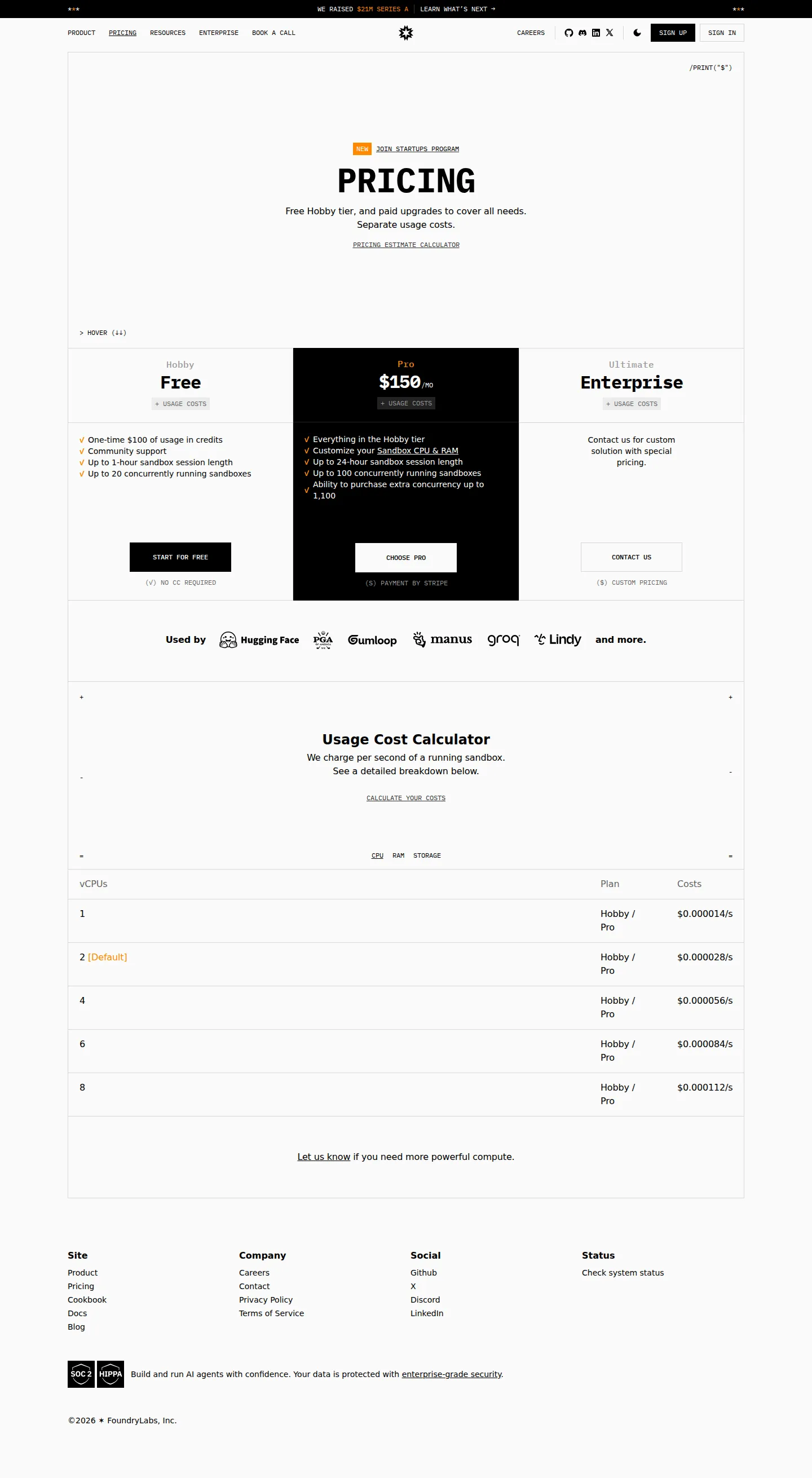
Concurrency add-ons surfaced: buy extra concurrency up to 1,100
Wayback snapshot (2026-05) adds a new Pro bullet — "Ability to purchase extra concurrency up to 1,100" — and a "Pricing estimate calculator" link, foregrounding concurrency as a priced, stackable add-on (Pro+ +$500/mo for 600, Pro++ +$1,000/mo for 1,100) on top of the base $150/mo Pro fee.
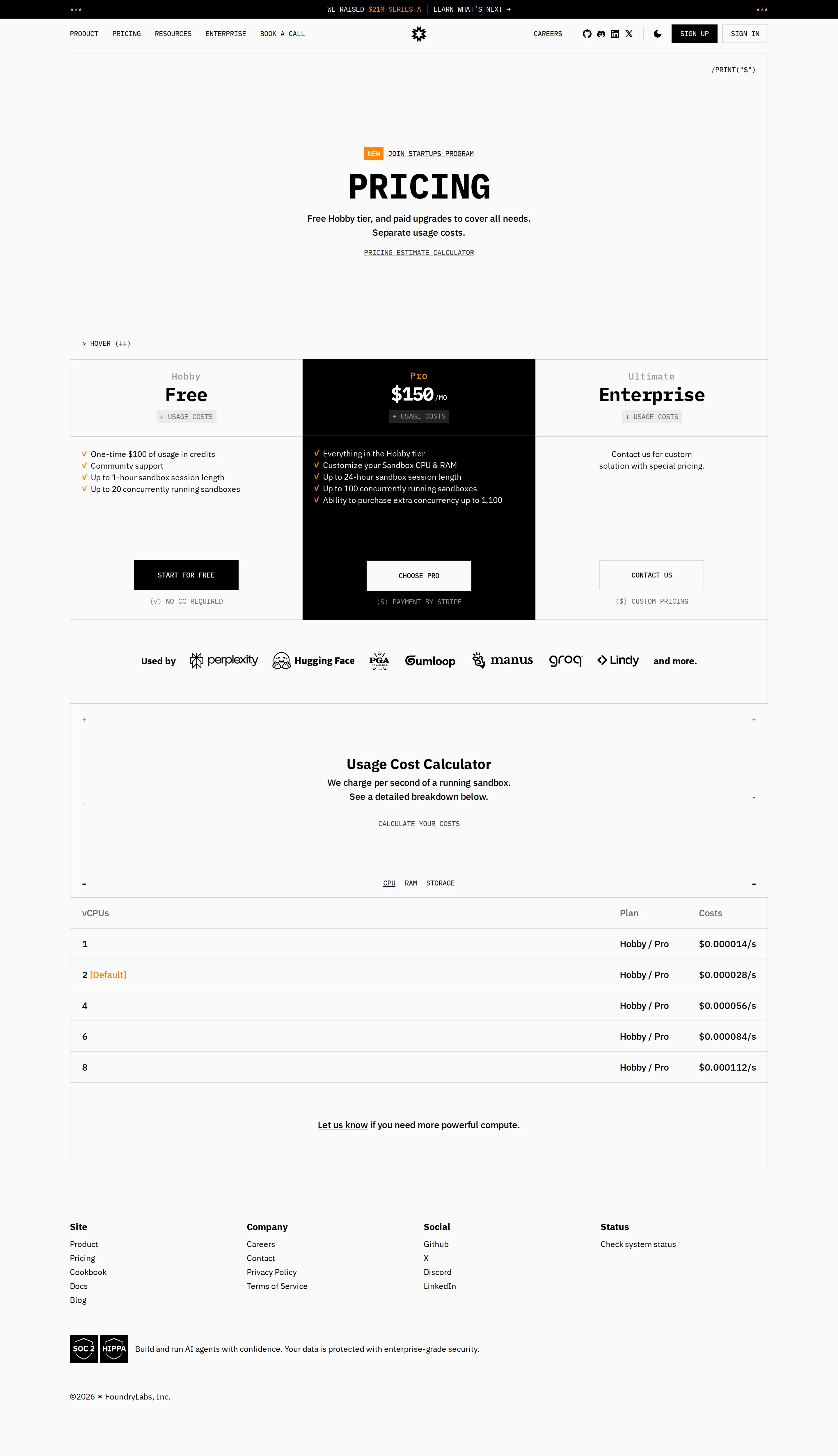
Usage calculator simplified to even vCPU steps
Wayback snapshot (2025-11) shows the per-vCPU usage table collapsed from odd steps (1,2,3,4,5,6,7,8) to even steps (1,2,4,6,8), and every row relabeled "Hobby / Pro" rather than restricting the non-default rows to Pro. Headline rates ($0.000014/s at 1 vCPU to $0.000112/s at 8) were unchanged.
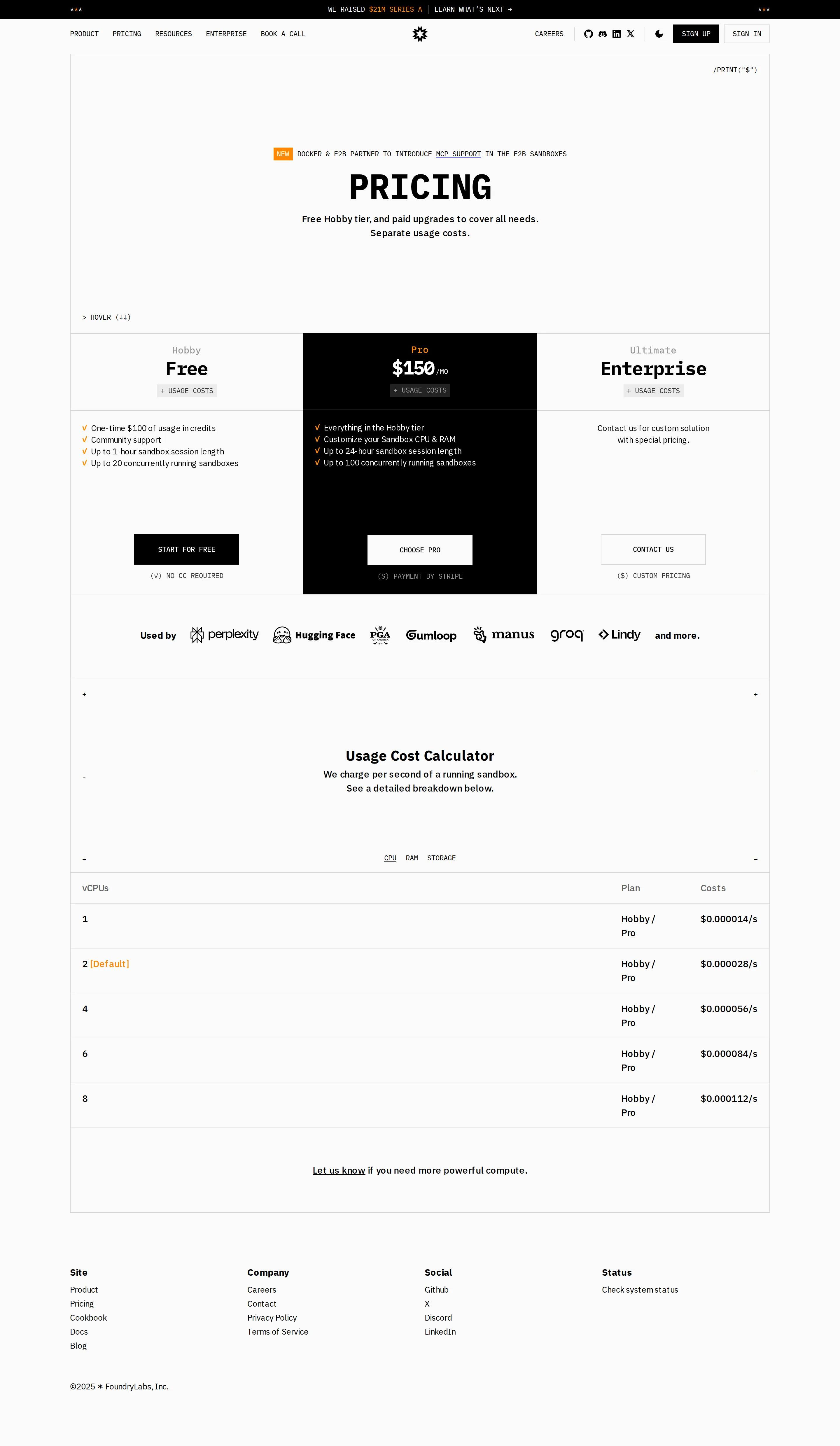
$21M Series A; Pro stops advertising its own credit grant
Wayback snapshot (2025-08) shows a "$21M Series A led by Insight Ventures" banner (round announced 2025-07-28 on e2b.dev/blog/series-a). The Pro tier's first bullet changed from "One-time $100 of usage in credits" to "Everything in the Hobby tier" — aligning the page with the docs rule that upgrading to Pro grants no additional credits, only higher limits.
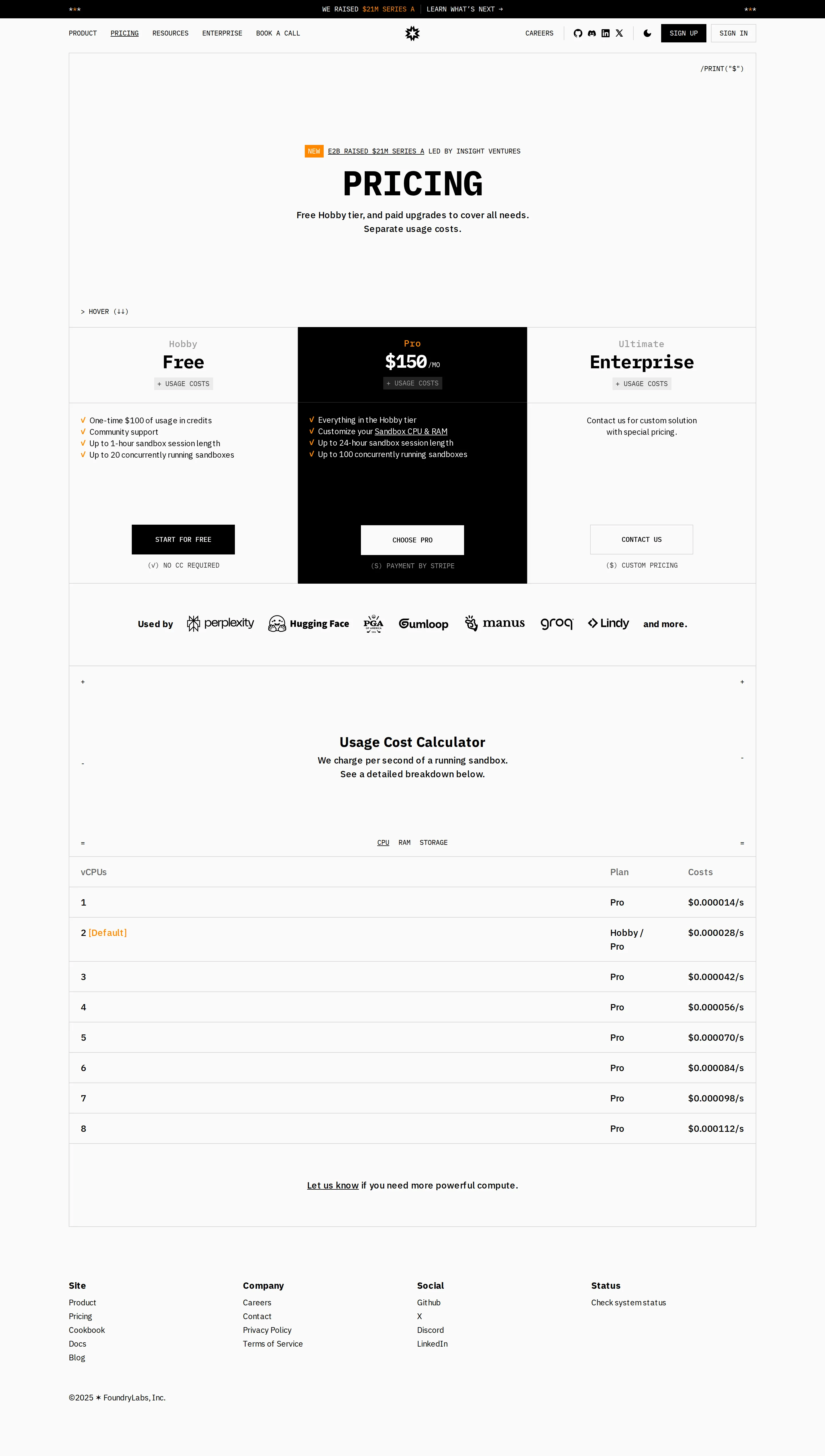
Pro perks trimmed: Slack channel and prioritized features dropped
Wayback snapshot (2025-05) shows the Pro tier's feature list trimmed — the "dedicated Slack channel with live support" and "prioritized features" bullets were removed, leaving customizable CPU/RAM, 24-hour sessions, and 100 concurrent. A "Book a call" nav entry appeared.
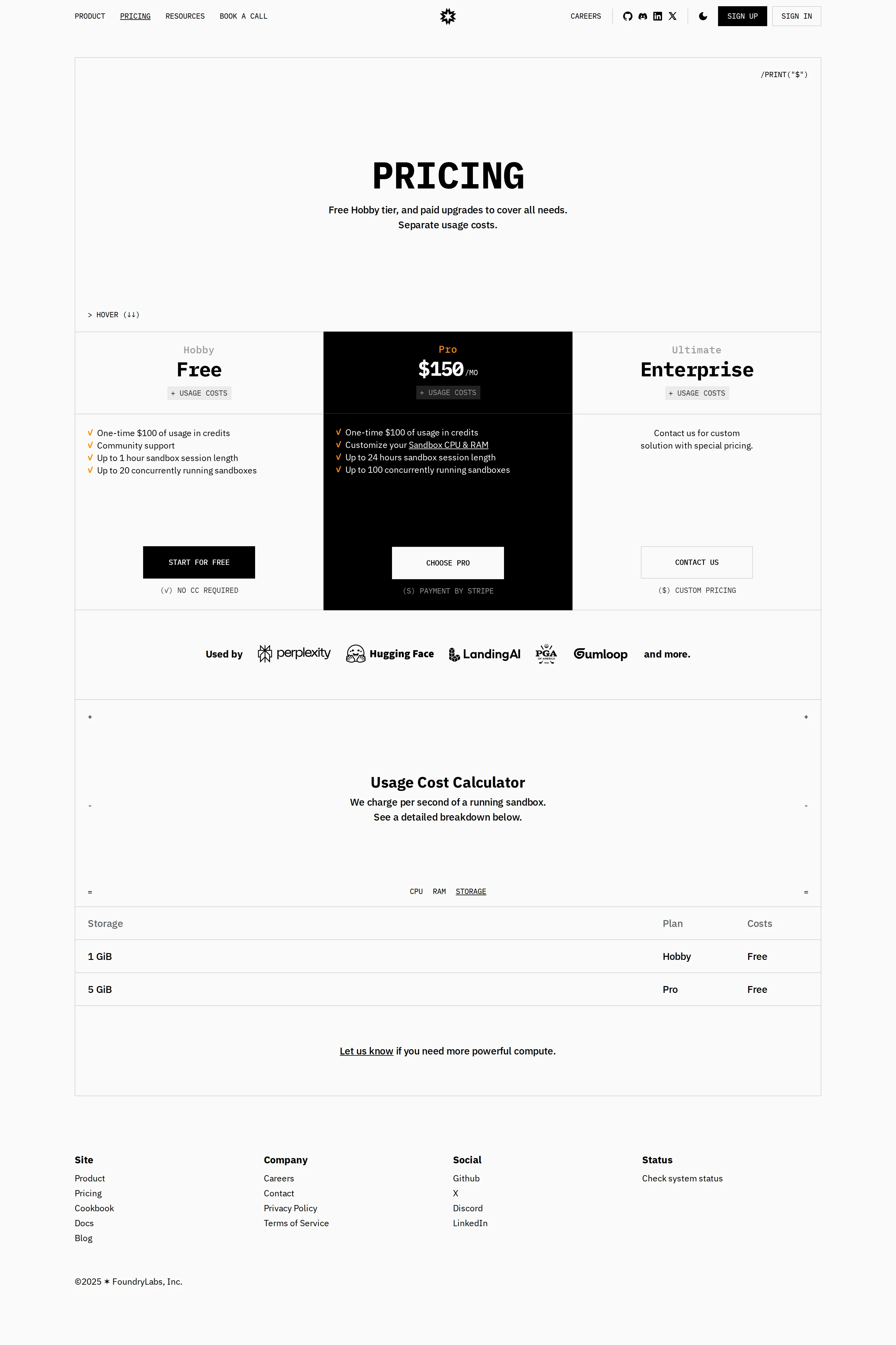
RAM and storage pricing surfaced on the pricing page
Wayback snapshot (2025-03) adds explicit RAM/storage lines to the usage calculator: RAM defaults to 512 MiB (adjustable 128–8,192 MiB), storage bills at $0.0000045/GiB/s, with free storage allowances of 1 GiB on Hobby and 5 GiB on Pro. Per-vCPU compute rates were unchanged.
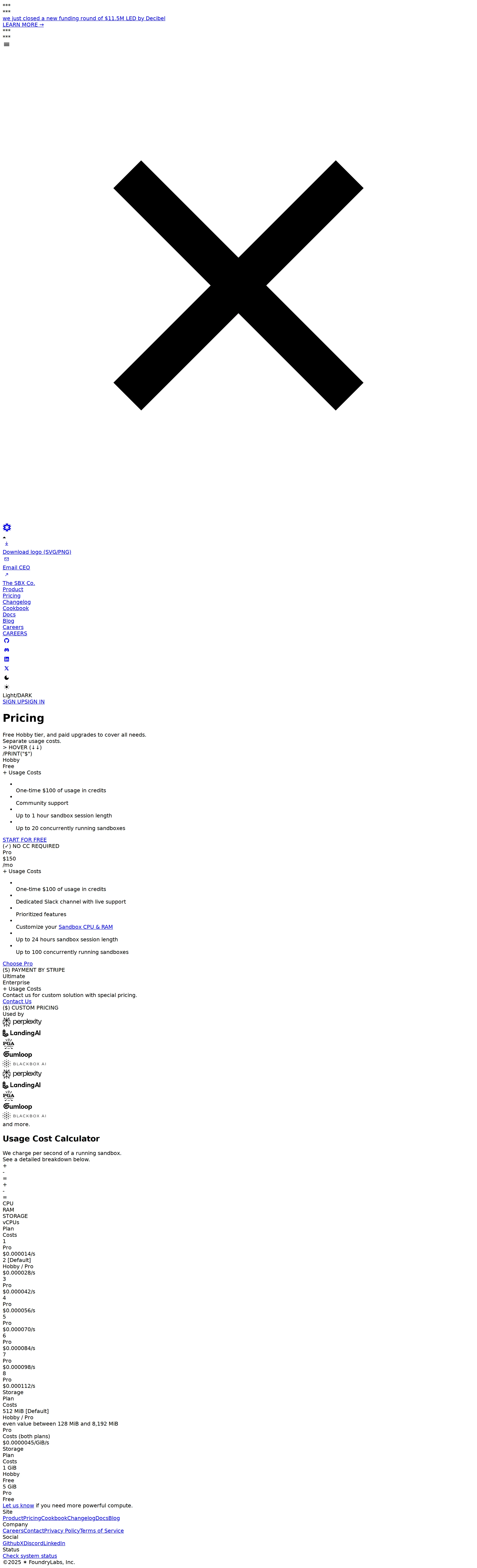
Ultimate tier renamed Custom → Enterprise
Wayback snapshot (2025-01) shows the top tier relabeled from "Custom" to "Enterprise" while keeping contact-us / custom pricing. Hobby, Pro, and the per-second vCPU rates were unchanged.
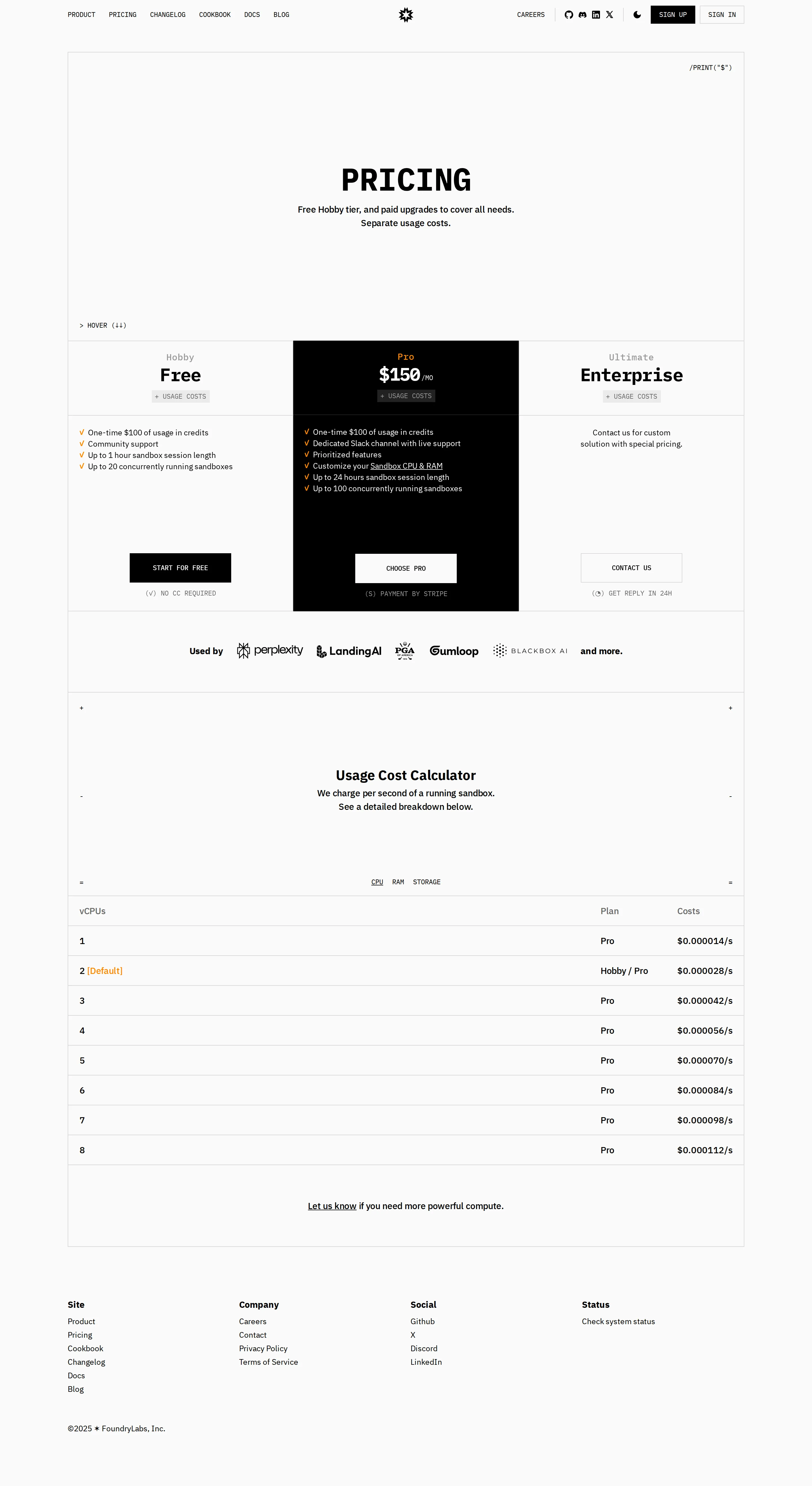
Three-tier structure: Hobby free / Pro $150/mo / Ultimate Custom
Wayback snapshot (2024-12) shows the freemium-plus-usage structure already in place: free Hobby ($100 one-time credits, 20 concurrent, 1-hour sessions), Pro at $150/mo (then advertising $100 credits, a dedicated Slack channel, prioritized features, customizable CPU/RAM, 24-hour sessions, 100 concurrent), and an "Ultimate" tier labeled "Custom." Per-second compute rates ran 1–8 vCPU ($0.000014/s base to $0.000112/s at 8 vCPU). A banner announced the $11.5M seed round led by Decibel.
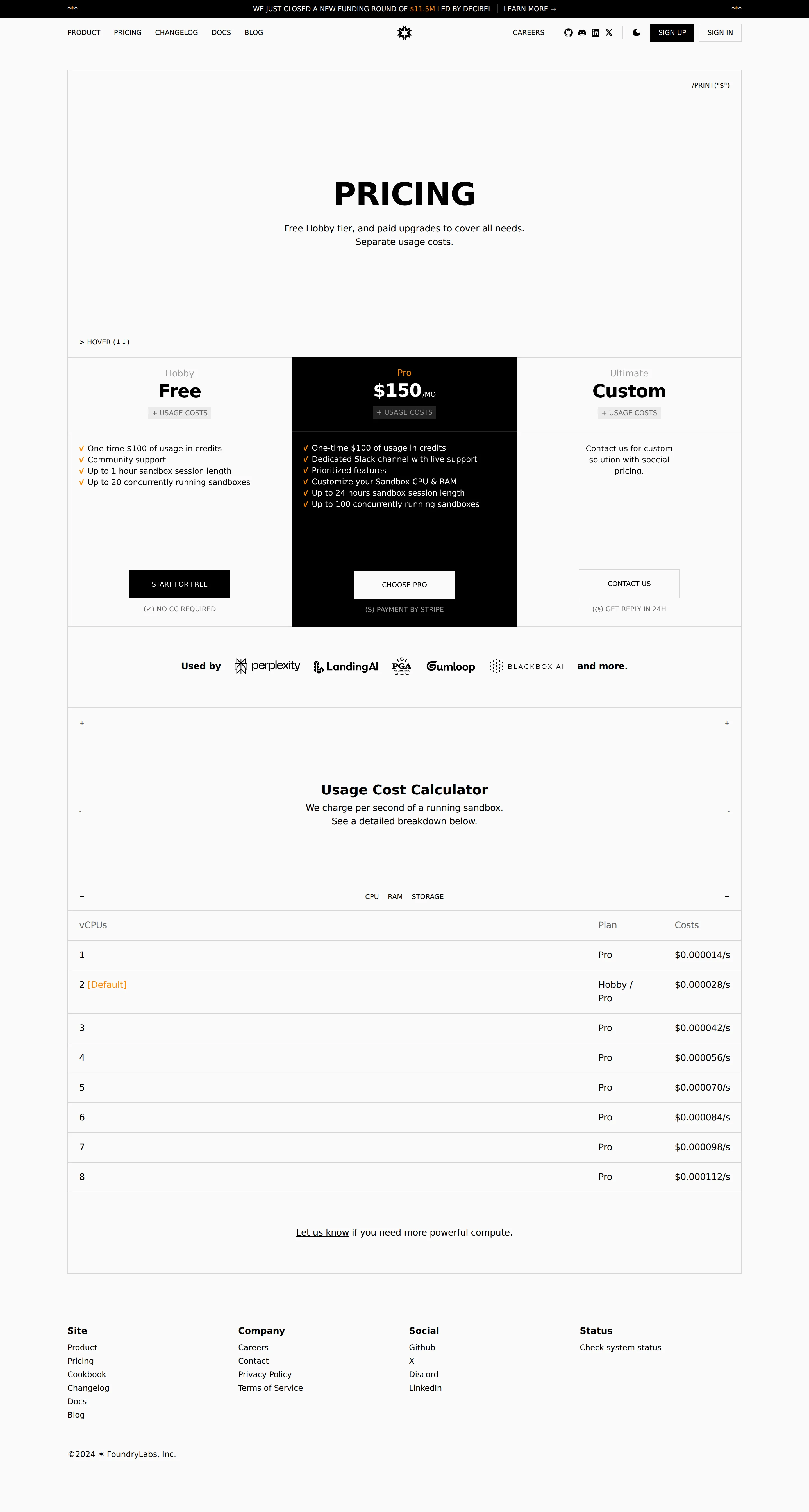
- · E2B charges per second of running-sandbox compute, not per sandbox or per API call — the meter only runs while a micro-VM is actually executing, so a paused or stopped sandbox costs nothing in compute.
- · Upgrading from Hobby to Pro grants zero additional usage credits. The $150/mo Pro fee buys higher limits (longer runtime, more concurrency, bigger machines), not a credit allowance — a deliberate split between the platform-access fee and the metered compute bill.
- · E2B is operated by FoundryLabs, Inc. and raised a $21M Series A in July 2025 led by Insight Partners (after an $11.5M seed led by Decibel). Its open-source sandbox SDK reports 3M+ monthly downloads and 1B+ started sandboxes, with 94% of Fortune 100 companies cited as users on the enterprise page.
Questions & answers
- How much does E2B cost?
- E2B has a free Hobby tier (one-time $100 of usage credits, up to 20 concurrent sandboxes, 1-hour sessions) and a Pro tier at $150/month plus separate per-second compute usage. Enterprise is custom-quoted with a stated $3,000/month minimum.
- How is E2B compute usage billed?
- E2B charges per second of running-sandbox compute. Per-vCPU rates are $0.000014/s (1 vCPU), $0.000028/s (2 vCPU, the default), $0.000056/s (4), $0.000084/s (6), and $0.000112/s (8). RAM and storage are billed separately, and you only pay while a sandbox is actually running.
- Does upgrading to E2B Pro give me more credits?
- No. The $150/month Pro fee only raises your limits — longer sandbox sessions (24 hours), more concurrency (100), larger machines, and higher resource ceilings. It does not grant any additional usage credits beyond the metered compute you pay for.
- What does E2B Enterprise cost?
- Enterprise (the Ultimate tier) is custom-quoted and sales-led. The hosted pricing estimator states a $3,000/month minimum. It adds BYOC / on-prem deployment, RBAC, SLAs, SOC 2 and HIPAA posture, 1,100+ concurrency, and US / EU data-residency regions.
- Does E2B have a free tier?
- Yes. The Hobby tier is free with no credit card required and includes a one-time $100 of usage credits, community support, sandbox sessions up to 1 hour, and up to 20 concurrently running sandboxes.
- Can I self-host E2B?
- Yes. E2B is open-source and can be self-hosted in your own cloud, and Enterprise customers can deploy via BYOC or on-prem. This is positioned as an alternative for teams not ready to commit to an enterprise plan.