AI Summary
About
Freed is an AI medical scribe that listens to a patient visit and drafts the clinical note, letting clinicians offload documentation. The product targets individual practitioners — physicians, nurse practitioners, therapists, and other licensed clinicians — across specialties from family medicine to psychiatry, and positions itself as a time-recovery tool (“Your free time is priceless”) rather than an enterprise IT purchase. Freed is HIPAA-compliant and explicitly does not store patient recordings.
Freed sells bottom-up to the clinician, not top-down to the hospital. The pricing page leads with three self-serve per-clinician tiers a single doctor can buy with a credit card, and only escalates to a sales-led Groups plan once a clinic needs organization-wide controls (BAA, SSO, centralized billing, admin dashboards). That land-with-the-individual, expand-to-the-clinic motion is the same playbook used by other prosumer-first vertical SaaS.
The company is privately held, founded in 2023 by CEO Erez Druk (built, in his telling, as “a love letter to clinicians,” starting with his physician wife). Freed scaled fast for a vertical AI tool: by early 2025 it reported more than 17,000 paying clinicians across 96 specialties and roughly $19M ARR (per Sacra), and in March 2025 it raised a $30M Series A led by Sequoia Capital (with Scale Venture Partners and others), bringing total funding to about $34M. Investors framed the growth — 4x YoY ARR at scale — in consumer-SaaS terms (Slack, Zoom). That bottom-up, individual-clinician adoption is what funds the prosumer-first pricing the rest of this page analyzes, and it places Freed against rivals like Abridge, Nabla, Heidi, and Microsoft/Nuance DAX in the ambient-clinical-documentation market.
Pricing summary : How Freed’s per-clinician AI scribe tiers are priced
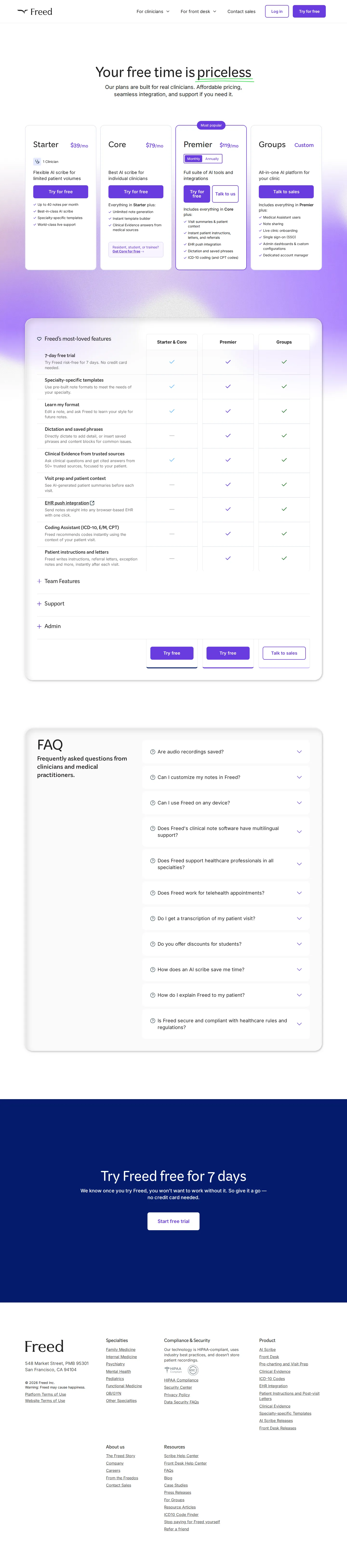
Freed uses a tiered per-clinician subscription — a flat monthly fee per seat with no metered usage billing — across three published self-serve tiers plus one custom clinic plan:
- Per-seat tiers: Starter at $39/mo (capped at 40 notes/month), Core at $79/mo (unlimited notes), and Premier at $119/mo monthly / $104/mo billed annually (marked “Most popular”).
- Capacity gate, not a meter: the only usage limit is Starter’s “up to 40 notes per month” — it gates the entry tier rather than billing overage, so heavier users upgrade to Core’s unlimited notes instead of paying per note.
- Custom clinic plan: Groups is quoted by sales and layers org-wide BAA, SSO, admin dashboards, centralized billing, and a volume discount on top of Premier.
What makes this different: Freed deliberately avoids per-note or per-minute metering — the natural usage meter for an ambient scribe — and instead sells flat per-seat subscriptions under a subscription pricing model with a single capacity gate, betting that clinicians want a predictable monthly bill over a usage meter that scales with every patient they see.
Pricing by product
AI scribe (Individual plans)
| Tier | Price | Included | Key mechanics |
|---|---|---|---|
| Starter | $39 / mo | Up to 40 notes per month, best-in-class AI scribe, specialty-specific templates, live support | Capacity-gated entry tier; upgrade when you exceed 40 notes |
| Core | $79 / mo | Everything in Starter plus unlimited note generation, instant template builder, Clinical Evidence answers from medical sources | ”Best AI scribe for individual clinicians”; “Resident, student, or trainee? Get Core for free” banner |
| Premier | $119 / mo (monthly) · $104 / mo (annual) | Everything in Core plus visit summaries & patient context, instant patient instructions/letters/referrals, EHR push integration, dictation and saved phrases, ICD-10 coding (and CPT codes) | “Most popular”; only tier discounted by annual billing |
Clinic (Business plan)
| Tier | Price | Included | Key mechanics |
|---|---|---|---|
| Groups | Custom | Everything in Premier plus Medical Assistant users, note sharing, live clinic onboarding, SSO, admin dashboards & custom configurations, org-wide BAA, centralized billing, group volume discount, coding/ROI dashboards, custom note retention, dedicated account manager | Sales-led, quoted via “Talk to sales” |
Sales motions across products: PLG / self-serve for Starter, Core, and Premier (credit-card checkout after a 7-day trial); sales-led for Groups.
Hidden costs : What clinics actually pay as they scale seats
Freed’s flat per-seat model is unusually transparent — there is no per-note overage or hidden metering. The “hidden” cost is structural: the entry tier’s note cap and the jump to clinic-wide plans.
A solo clinician who outgrows the note cap
| Line item | Monthly cost |
|---|---|
| Starter plan ($39/mo, 40 notes) | $39 |
| Upgrade to Core after exceeding ~40 notes/month (unlimited) | +$40 |
| Effective Core spend | $79 |
A clinician seeing more than ~2 patients per working day blows past Starter’s 40-note cap and must move to Core — so for any full-time practice, $79/mo is the real floor, not the $39 headline.
A 5-clinician practice on Premier (annual)
| Line item | Monthly cost |
|---|---|
| 5 × Premier seats ($104/mo annual) | $520 |
| Total (before Groups discount) | $520 |
At five seats the practice is paying $6,240/year and still lacks SSO, org-wide BAA, and centralized billing — the trigger to move to the custom Groups plan, where pricing is quoted (and a volume discount applies) rather than published.
Want to estimate your own Freed bill? Use the Freed pricing calculator to model your monthly cost based on tier, seat count, and monthly vs. annual billing.
Pricing evolution : From a single $99 scribe plan to a tiered clinic ladder
Freed’s pricing has moved in one clear direction: from a single flat $99-per-clinician plan to the three-tier $39 / $79 / $119 ladder live today. The old model — one price, with a 50% resident discount and a 9% annual discount, landing around $1K ACV per clinician — is documented by Sacra around the March 2025 Series A, when Freed was at roughly $19M ARR and 17,000+ paying clinicians. The tiered /pricing page first appears in the Wayback archive in May 2025; by September 2025 it carries explicit “2–9 clinicians” and “10+ clinicians — custom pricing” group bands.
Cadence
| Quarter | Price changes | Product / SKU additions | Notes |
|---|---|---|---|
| 2025 Q1 | 0 | 0 | Single flat $99/clinician/mo plan (50% resident discount, 9% annual discount) per Sacra at the March 2025 Series A. |
| 2025 Q2 | unknown | 1 | Tiered Individual-vs-Group /pricing page first captured by Wayback (2025-05-16); per-tier prices not legible (JS skeleton). |
| 2025 Q3 | unknown | 1 | Group bands formalized — “2–9 clinicians” self-serve and “10+ clinicians — custom pricing” (2025-09 snapshot). |
| 2026 Q2 | 0 | 0 | Current ladder captured live: Starter $39, Core $79, Premier $119/$104, Groups custom. |
Tracked range: 2025-03 – 2026-06. Per-tier dollar amounts between the $99 flat plan and the current ladder could not be reconstructed: Wayback’s /pricing snapshots in this window render as JS skeletons, so the exact transition prices are marked unknown rather than guessed.
Notable changes
- 2025-03 — Single flat $99/clinician/mo plan documented by Sacra (50% resident discount, 9% annual discount, ~$1K ACV) alongside the $30M Series A led by Sequoia Capital; Freed at ~$19M ARR, 17,000+ clinicians.
- 2025-05-16 — First Wayback 200-status capture of
getfreed.ai/pricingshows an Individual-vs-Group tier structure (prices not legible in the archived skeleton). - 2025-09-08 — Group bands appear explicitly: “2–9 clinicians” self-serve trial plus “10+ clinicians — custom pricing.”
- 2026-06-05 — Live capture: three self-serve clinician tiers ($39 / $79 / $119) plus a custom Groups plan; annual billing discounts only Premier (to $104/mo); 7-day no-card trial in place of any free tier.
The $99-flat to tiered unbundle in detail
The shift is more than a price change — it is a repackaging. Under the old flat plan, every clinician paid the same $99 regardless of volume or feature use. The current ladder splits that single offer three ways: light users get a cheaper-but-capped Starter ($39, 40 notes), full-volume solo clinicians land on Core ($79, unlimited) — notably below the old $99 single price — and power features (EHR push, ICD-10 coding, visit summaries) are fenced into Premier ($119/$104). The net effect lowers the entry barrier for price-sensitive trial users while raising the ceiling for clinicians who want the full toolset, a classic good-better-best migration off a single SaaS plan.
What’s unique : Flat per-seat pricing in a usage-shaped category
1. Flat seats where the category screams for a meter. An ambient scribe has an obvious usage meter — notes generated, or minutes recorded. Freed refuses it. Core and above are unlimited notes for a flat monthly fee, so a clinician’s bill never moves with patient volume. That predictability is the product promise, not just the pricing.
2. The only usage limit is a feature gate, not a billing meter. Starter’s “up to 40 notes per month” caps the cheapest tier, but Freed never charges per-note overage — it routes heavier users up the ladder to Core’s unlimited plan. The cap exists to create a $39→$79 upgrade trigger, not to meter consumption.
3. Annual billing discounts exactly one tier. Unusually, only Premier is cheaper annually ($119→$104/mo). Starter and Core carry the same headline price under either billing period (against a struck-through $59 anchor), so Freed reserves the annual-commitment incentive for its highest-value individual tier.
4. A clean prosumer-to-clinic seam. The three published tiers are pure self-serve; the moment a buyer needs org-wide BAA, SSO, or centralized billing, they cross into the sales-led Groups plan. Compliance and admin controls — not features — are what gate the hand-off to sales.
Strengths & weaknesses
| Strengths | Weaknesses |
|---|---|
| Fully public, predictable per-seat pricing — no metered surprises | No permanent free tier; only a 7-day trial in a price-sensitive segment |
| Clear $39 → $79 → $119 upgrade ladder with a built-in cap trigger | Starter’s 40-note cap makes the $39 headline unrealistic for full-time use |
| Self-serve checkout lets a single clinician buy with a card | Groups pricing is fully opaque (custom quote), hiding clinic economics |
| Annual incentive targeted at the highest-value tier (Premier) | Annual discount is shallow and absent on Starter/Core |
| HIPAA-compliant, no patient-recording storage — trust by default | Per-seat model leaves volume-based value (high-throughput clinics) on the table |
Billing UX : Self-serve trial, toggle, and the sales hand-off
- 7-day free trial, no credit card — every paid plan is preceded by a no-card trial (“Try Freed risk-free for 7 days”).
- Monthly / Annually toggle, defaults to Annually — a billing-period switch on the Premier card only; the page loads with “Annually” pre-selected ($104/mo), and switching to “Monthly” raises it to $119/mo. Starter and Core show one flat price regardless of toggle state.
- “Resident, student, or trainee?” banner — a callout under the Core card links out to a “Get Core for free” offer for that cohort.
- “Try for free” self-serve checkout — Starter, Core, and Premier each expose a direct trial/sign-up CTA for credit-card purchase.
- “Talk to sales” / “Talk to us” — Groups (and optionally Premier) route to sales for custom clinic quoting.
- Plan-comparison matrix — a feature grid groups Starter & Core vs. Premier vs. Groups across Team Features, Support, and Admin rows (license management, centralized billing, SSO, custom note retention).
- Group volume discount — surfaced as an Admin-row benefit, applied within the custom Groups quote rather than shown as a published rate.
Strategic wins : Why predictable per-seat pricing fits the clinician buyer
1. Predictable seats beat a scary meter for individual clinicians
By pricing unlimited notes at a flat monthly fee, Freed removes the single biggest objection to AI tooling for a solo clinician — a bill that grows with every patient. A flat seat reads as a fixed business expense, not a variable cost to monitor. This is the same instinct behind many per-seat pricing winners and is reinforced by the broader case for pricing an AI product against unpredictable costs — and it runs counter to the wider trend of AI companies shifting away from per-user licenses.
2. The note cap manufactures a clean upgrade trigger
Starter’s 40-note ceiling is a packaging device, not a meter: it makes $39 viable for light users while pushing anyone with a real practice up to Core’s $79 unlimited plan. Gating the cheap tier by output volume is a textbook good-better-best fencing move that protects the higher tier’s value — and picking “notes per month” as that fence is itself a usage-metric selection decision, even though Freed never bills on the metric.
3. Reserving the annual discount for Premier concentrates commitment where it pays
Rather than discounting every tier annually, Freed only rewards an annual commitment on its most-loaded Premier plan. That keeps Starter/Core margins intact while using the discount to lock in the highest-value individual customers — a targeted alternative to the metered-plan discounting common in usage-based pricing models.
Areas to improve : Where Freed’s packaging leaves value or trust on the table
1. The $39 headline is misleading for full-time clinicians
A practitioner seeing more than a couple of patients a day exhausts Starter’s 40-note cap, making the real entry price $79. Fix: show an effective-cost helper (“most full-time clinicians choose Core”) or a notes-per-month slider so buyers self-select honestly instead of anchoring on a price they’ll outgrow in a week.
2. No free tier in the most price-sensitive software segment
Individual clinicians are the hardest cohort to convert on price, yet Freed offers only a 7-day trial. Fix: a permanent free tier capped very low (e.g., 5 notes/month) would let skeptical clinicians keep the tool in their workflow past the trial window, mirroring freemium land motions that work for prosumer tools.
3. Groups pricing is fully opaque
Hiding all clinic economics behind “Talk to sales” forces every multi-seat buyer into a sales conversation, slowing the self-serve-to-clinic expansion Freed’s own ladder is designed to enable. Fix: publish a per-seat Groups starting rate (or a transparent volume-discount schedule) so small practices can size the jump without a call.
Monetization stack & signals : how Freed builds & buys its revenue engine
3 open roles
Freed's revenue-org hiring is post-sale clinician/product support plus a single demand-gen marketer — fitting its self-serve, credit-card prosumer motion rather than a quota-carrying sales build-out.
- Demand Generation Growth seen Jun 12, 2026
- Clinician Support Representative Customer success seen Apr 14, 2026
- Product Support Specialist Customer success seen Apr 14, 2026
Signals reviewed · derived from public job posts
Job postings fill and close over time — once a posting is filled we keep it as a dated citation (the quoted evidence remains); use View open roles for current listings.
Key takeaways
- A flat seat can beat a meter even in a usage-shaped category. Freed prices unlimited notes per seat precisely because its buyer fears a bill that scales with patient volume — pricing to the customer’s anxiety, not to the cost driver.
- Use a capacity cap to fence tiers, not to bill overage. Starter’s 40-note limit creates a clean upgrade trigger without introducing per-unit billing complexity — the cap is packaging, not metering.
- Target annual discounts at the tier you most want to lock in. Discounting only Premier annually concentrates commitment incentives where lifetime value is highest, instead of diluting margin across every plan.
- Gate the sales hand-off on compliance, not features. Freed escalates to sales only when buyers need org-wide BAA, SSO, and centralized billing — keeping the self-serve path as long as possible.
- Transparency builds trust in regulated buyers. Publishing every individual price (and stating “doesn’t store patient recordings”) lowers the trust barrier for clinicians evaluating an AI tool on protected health data.
UBP implications
- Not every consumption-shaped product should meter consumption. Freed shows that when buyers value predictability over fairness-to-usage, a flat seat can out-convert a per-unit meter — a counterweight to the assumption that AI products must be usage-billed.
- Capacity caps are a lightweight bridge between subscription and usage. A per-period output cap (40 notes/month) delivers much of usage-based price discrimination without any metering infrastructure or overage billing.
- Selective annual discounting is an underused lever. Applying the annual incentive to a single high-value tier — rather than uniformly — lets vendors protect entry-tier margin while still rewarding the commitments that matter most.
Sources
- Freed pricing page (accessed 2026-08-28)
- Freed for clinicians (product overview) (accessed 2026-06-05)
- Freed blog (accessed 2026-06-05)
Bottom line
Freed prices an ambient AI scribe the way a clinician wants to buy one: a flat, predictable per-seat fee with unlimited notes from the Core tier up, a 40-note cap that quietly fences the cheap plan, and a sales hand-off triggered by clinic-grade compliance rather than features. The bet is that individual clinicians will pay $79–$119 a month for a bill that never moves with patient volume — and that opacity on Groups pricing is a tolerable price for keeping the self-serve ladder clean.
Want to compare Freed against other vertical-SaaS pricing? Browse the pricing blueprint.
Pricing timeline : Major events on a vertical axis
Each milestone below corresponds to a public pricing change, product launch, or material adjustment. Major events use a filled marker; minor adjustments use a faded one.
Current published ladder captured
Three self-serve clinician tiers — Starter $39/mo (40 notes/mo), Core $79/mo (unlimited), Premier $119/mo monthly or $104/mo annual ('Most popular') — plus a custom Groups plan and a 7-day no-card trial.
Tiered /pricing page appears in archives
Wayback's first 200-status capture of getfreed.ai/pricing (2025-05-16) shows an Individual-vs-Group plan structure, and the 2025-09 snapshot adds explicit '2–9 clinicians' and '10+ clinicians — custom pricing' group bands. Tier dollar amounts are not legible in these archives (JS-rendered skeletons), so exact per-tier prices for this period are unknown.
Single flat $99/clinician plan (pre-tier era)
Before unbundling into tiers, Freed sold one flat plan at $99 per clinician per month, with a 50% discount for residents/trainees and a 9% annual-commitment discount (~$1K ACV per clinician). Documented by Sacra at ~$19M ARR and 17,000+ clinicians around the March 2025 Series A. Price not independently captured from archives — Wayback /pricing snapshots from this period render as JS skeletons.
- · Freed's entry Starter plan is the rare consumer-software tier gated by an explicit output cap — 'up to 40 notes per month' — rather than by feature locks alone.
- · The annual toggle only discounts the top Premier tier ($119/mo monthly drops to $104/mo annually); Starter ($39) and Core ($79) show the same headline price either way, against a struck-through $59 anchor.
- · Freed sells no free tier — only a 7-day, no-credit-card trial — even though its target buyer is an individual clinician, the most price-sensitive segment in healthcare software.
Questions & answers
- How much does Freed cost?
- Freed is a per-clinician subscription with three published tiers: Starter at $39/mo (up to 40 notes per month), Core at $79/mo (unlimited notes), and Premier at $119/mo billed monthly or $104/mo billed annually (annual billing only discounts Premier — Starter and Core are flat). A custom Groups plan is quoted by sales.
- Does Freed have a free plan?
- No. Freed offers a 7-day free trial with no credit card required, but there is no permanent free tier — every clinician moves to a paid plan after the trial.
- What does the Premier plan add over Core?
- Premier adds visit summaries and patient context, instant patient instructions/letters/referrals, EHR push integration, an AI clinician assistant with a medical knowledge base, and ICD-10 coding (with CPT codes in beta).
- What is the Groups plan?
- Groups is Freed's custom-quoted clinic plan. It includes everything in Premier plus Medical Assistant users (in alpha), patient sharing (in beta), live clinic onboarding, single sign-on (SSO), admin dashboards, and a dedicated account manager. Pricing is via 'Talk to sales.'
- Did Freed used to cost $99 per month?
- Yes. Earlier, Freed sold a single flat plan at $99 per clinician per month (with a 50% discount for residents/trainees and a 9% annual-commitment discount). It has since unbundled that plan into the three-tier Starter/Core/Premier ladder, so the current $79 Core tier includes unlimited notes for less than the old single price.
- Is Freed a venture-backed company?
- Yes. Freed was founded in 2023 by CEO Erez Druk and raised a $30M Series A led by Sequoia Capital in March 2025 (bringing total funding to about $34M), after reaching more than 17,000 paying clinicians and roughly $19M ARR.