AI Summary
About
Hebbia is an enterprise AI company that builds Matrix, an agentic platform for institutional knowledge work — reading, reasoning over, and answering questions across thousands of unstructured documents (filings, contracts, earnings transcripts, data rooms) with full citation trails. Matrix presents results in a tabular “data-grid” interface and uses Hebbia’s proprietary iterative source decomposition to break one hard question into many parallel tasks across full documents, without the chunking limits of typical RAG tools.
Hebbia has also introduced Max (“Staff AI on your next deal”), a second, distinct product line first observed in the site’s navigation and footer in August 2026. Max is pitched directly at dealmakers — modeling LBOs, screening targets, spreading comps, shelling decks, and working from email — for banking, private equity/credit, and law firms. Like Matrix, Max discloses no pricing; access is gated behind a “Get access” request.
The buyer is squarely the high-stakes knowledge worker: asset managers, private equity and credit funds, hedge funds, investment banks, and law firms. Hebbia reports that roughly a third of the world’s top asset managers by AUM are customers, alongside names like Centerview Partners, Oak Hill Advisors, Charlesbank, American Industrial Partners, and the US Air Force. The homepage (redesigned as of August 2026) now headlines new traction stats: $30 trillion in AUM across firms using Hebbia, roughly 200,000 prompts run per day, and 1.5 billion pages processed.
Founded in 2021 by CEO George Sivulka and headquartered in New York, Hebbia has raised about $161M total. Its $130M Series B in July 2024, led by Andreessen Horowitz with Index Ventures (and earlier backing from Google Ventures and Peter Thiel), valued the company around $700M. Reported ARR was roughly $13M as of mid-2024 after a reported 15x expansion over 18 months.
For the most current information, visit Hebbia.
Pricing summary : How Hebbia’s pricing model works
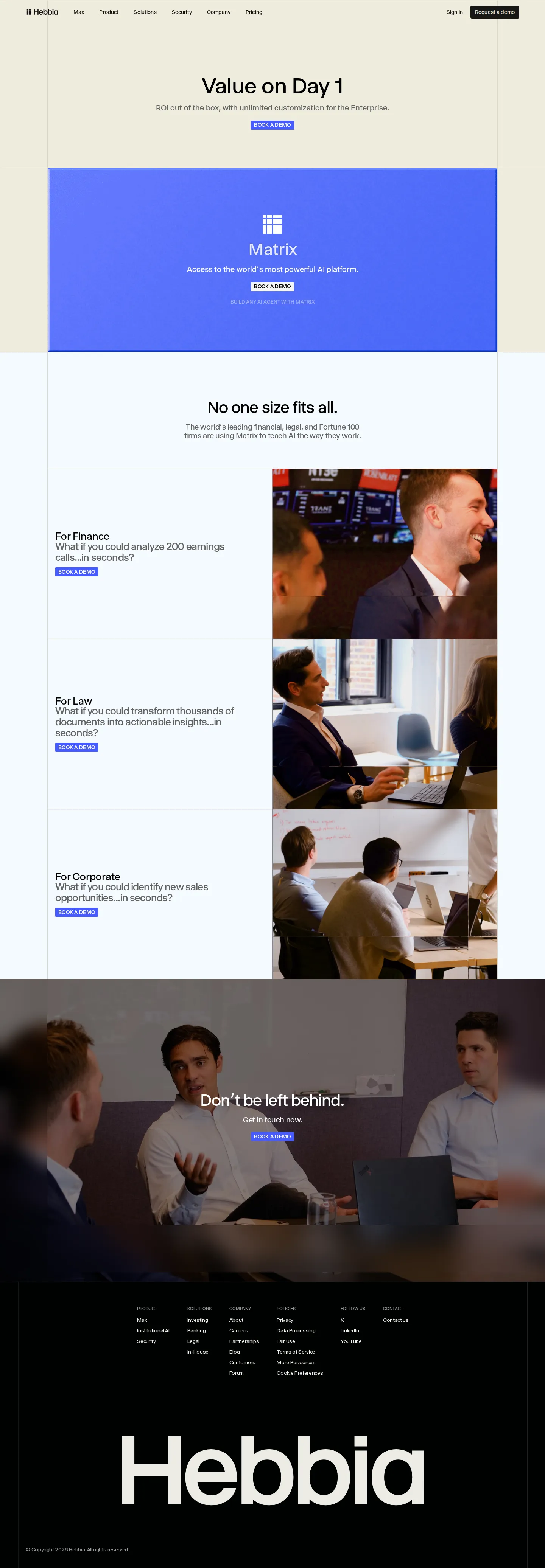
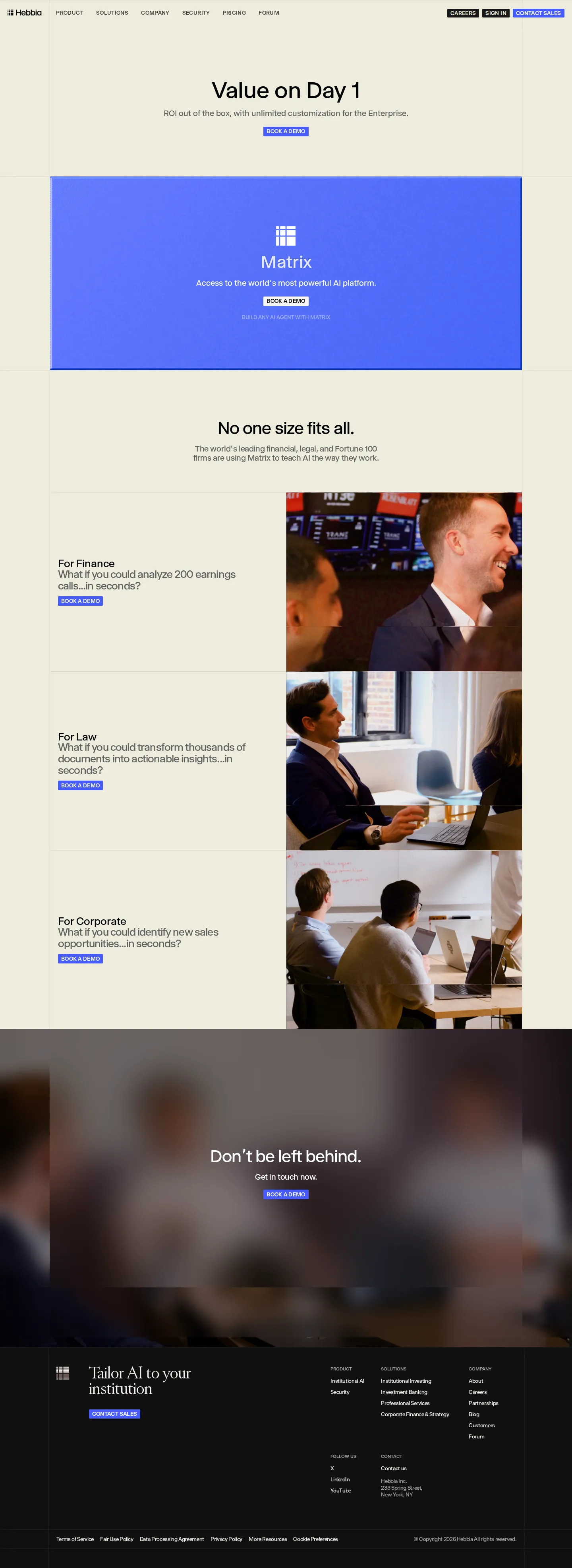
Here’s the honest version: Hebbia publishes no prices. Its pricing page is a single “Book a Demo” wall (the nav CTA now reads “Request a demo,” not “Contact Sales”) — no plans, no rate card, no calculator. Every deal is sales-quoted as a custom enterprise contract with a reported one-year-plus minimum commitment.
What you can verify from multiple third-party sources (Sacra, Metronome, eesel) is the shape of the model: per-seat licensing in two tiers, with usage unlimited inside each tier.
- Professional seats — reported at around $10,000 per seat per year. For power users who build agents, configure workflows, run unlimited reasoning, and use advanced integrations.
- Lite seats — reported at $3,000 to $3,500 per seat per year. For users who consume outputs and run pre-configured agents with deep search.
Larger finance and law deployments are reported to land in the mid-to-high six-figure annual range. Community chatter (Reddit) has speculated “upwards of $20,000 per user, per year” all-in and likened the cost to a Bloomberg Terminal — but that is unconfirmed speculation, not a quoted rate.
New in August 2026: a second product, Max, appeared in the top nav and footer (“Product: Max, Institutional AI, Security”) with its own page at hebbia.com/max. Max is a dealmaking-focused AI agent — distinct branding from Matrix — but it carries the exact same opacity: no plans, no rate card, just a “Get access” gate. Whether Max is bundled into existing Matrix seat contracts or sold as a separate line item is not disclosed anywhere on-site.
What makes this different: Hebbia is an AI-heavy product that deliberately refuses consumption pricing. There are no per-document, per-token, or per-query charges — usage is unlimited within a seat tier, bounded only by a Fair Use Policy. The bet is that seat-based simplicity removes adoption friction for buyers who hate unpredictable AI bills.
Note: all dollar figures in this analysis are third-party reported estimates, not an official Hebbia rate card. Hebbia does not confirm pricing publicly.
Pricing by product
Matrix (seat plans)
| Tier | Price (reported) | Included | Key mechanics |
|---|---|---|---|
| Lite seat | ~$3,000–$3,500/seat/yr* | Pre-built agents, deep search | Output consumers; unlimited use within Fair Use Policy |
| Professional seat | ~$10,000/seat/yr* | Unlimited reasoning, agent building, integrations | Power users; the land-and-expand entry point |
| Enterprise platform | Contact Sales (mid-to-high six figures/yr reported) | Custom seat mix, SSO, security review, dedicated support | 1-year+ commitment; fully quoted |
Max (dealmaking agent)
| Tier | Price | Included | Key mechanics |
|---|---|---|---|
| Max access | Contact Sales (unpublished) | LBO modeling, target screening, comps, deck generation, email-based workflows | New product line (first observed Aug 2026); gated behind a “Get access” request; unknown whether bundled with Matrix seats or sold standalone |
Sales motions across products: sales-led only — there is no self-serve or free tier, for Matrix or Max. Seat figures are third-party reported estimates (Sacra, Metronome), not published by Hebbia. Deals typically begin with Professional seats in PE, credit, and M&A teams, then expand via cheaper Lite seats. Max has no reported pricing at all — its cost structure is unknown.
Hidden costs : What Hebbia users actually pay
The “hidden cost” with Hebbia isn’t an overage meter — it’s the opacity and the commitment. Because nothing is published, you only learn your price after a sales cycle, and you’re committing to a year-plus contract negotiated per-seat.
| Line item | Annual cost (reported) |
|---|---|
| Professional seats | ~$10,000 per seat per year* |
| Lite seats | ~$3,000–$3,500 per seat per year* |
| Usage overages | None — unlimited within a Fair Use Policy |
| Per-document / per-token fees | None disclosed |
| Typical enterprise deployment | Mid-to-high six figures per year (reported) |
*Reported estimates, not an official rate card.
The upside: no surprise consumption bill. The downside: the per-seat number is high, the minimum commitment is long, and you can’t price-shop without talking to sales — which makes Hebbia hard to evaluate against transparent competitors without an NDA-bound conversation.
Want to estimate your own Hebbia bill? Use the Hebbia pricing calculator to model a seat-mix scenario based on these reported figures.
Pricing evolution : Hebbia pricing history and changes
Cadence
| Period | Price changes | Product / SKU additions | Notes |
|---|---|---|---|
| 2024 | 0 published | Matrix scaled post–Series B | $130M raise (a16z + Index), ~$700M valuation; seat model in market |
| 2026 Q2 | 0 published | — | Pricing page still a “Contact Sales” wall; two-tier seat model reported by third parties |
| 2026 Q3 | 0 published | Max (dealmaking agent) launched | New product line alongside Matrix; still zero public pricing, gated behind “Get access” |
Tracked range: 2024–present. Hebbia has never published a public rate card, so there are no Wayback price snapshots to diff — only third-party reporting of the seat tiers.
Notable changes
- 2024-07 — $130M Series B (a16z, Index) at a ~$700M valuation; Matrix’s per-seat enterprise model scales into finance and law. No public pricing introduced.
- 2026-06-15 — Sales-only confirmed; third-party sources (Sacra, Metronome) report a Professional/Lite two-tier seat model with unlimited in-tier usage under a Fair Use Policy.
- 2026-08 (first observed) — “Max” appears as a new top-level nav item and dedicated /max page — a distinct dealmaking-agent product from Matrix. No pricing disclosed; access gated behind “Get access.”
What’s unique : Hebbia’s distinctive pricing mechanics
1. AI product, deliberately not usage-priced. Most agentic AI vendors meter tokens, runs, or “resolutions.” Hebbia does the opposite — flat per-seat with unlimited reasoning inside a Fair Use Policy. It sells predictability to finance buyers who can’t tolerate a variable AI invoice.
2. Two-tier seats as a land-and-expand engine. Expensive Professional seats (~$10K) land the deal with power users who build agents; cheap Lite seats ($3K–$3.5K) scale adoption to everyone who just consumes outputs. The price gap is the growth mechanic.
3. Total opacity as positioning. The pricing page is a single “Contact Sales” button. For a Bloomberg-Terminal-tier product sold to PE and Big Law, opacity signals exclusivity and lets every deal be value-priced to the account rather than anchored to a list price.
Strengths & weaknesses
| Strengths | Weaknesses |
|---|---|
| Predictable flat per-seat cost — no surprise AI consumption bill | No published pricing; you can’t evaluate without a sales cycle |
| Unlimited reasoning within a tier removes usage anxiety for heavy users | High per-seat number (~$10K Professional) screens out smaller buyers |
| Clear two-tier seat model maps to power-user vs consumer personas | One-year-plus minimum commitment; hard to trial or exit |
| Deep vertical fit (finance/law) justifies premium per-seat pricing | Reported figures are unconfirmed — buyers negotiate without an anchor |
Billing UX : Hebbia billing controls and transparency
- Billing controls — Enterprise contract billing only. Seats are provisioned per the negotiated contract; there is no self-serve plan picker, no in-app upgrade, and no public price page.
- Usage visibility — Because pricing is per-seat with unlimited in-tier usage, there’s no consumption meter to watch — but there’s also no public spend dashboard described. A Fair Use Policy governs volume rather than a billed cap.
- Payment options — Annual enterprise invoicing with a reported one-year-plus minimum commitment. No credit-card self-checkout; procurement runs through sales and a security/compliance review (SSO, DPA, fair-use terms).
Strategic wins : Why Hebbia’s pricing decisions worked
1. Selling predictability to people who hate variable bills
Hebbia’s customers are PE, credit, and Big Law — buyers who run mission-critical workflows and despise unpredictable cost. Flat per-seat pricing with unlimited reasoning is a feature, not a limitation. It echoes the broader move away from pure consumption metering for high-trust enterprise AI.
2. Premium per-seat anchored to value, not cost
At a reported ~$10K/seat, Professional pricing isn’t cost-plus — it’s value-priced against the analyst hours Matrix replaces. By keeping the rate card private, every deal is negotiated to the account’s willingness to pay. See how AI companies are shifting pricing models for context.
3. Two-tier seats as built-in expansion
Land with Professional power users, expand with Lite consumers. The seat split is the net-revenue-retention engine — a clean example of choosing the right usage (here, seat) metric to match how value spreads through an org.
Areas to improve : Gaps in Hebbia’s pricing approach
1. Zero pricing transparency raises the evaluation cost
A “Contact Sales” wall with no anchor — not even “starts at” — forces every prospect into a sales cycle just to learn ballpark cost. For buyers comparing against more transparent competitors, that friction is real, and it fuels the bill-shock and cost-unpredictability anxiety Hebbia otherwise solves.
2. High seat minimums lock out the mid-market
At reported ~$10K/seat Professional pricing plus a one-year-plus commitment, Hebbia is structurally inaccessible to smaller funds and boutique firms that could still benefit from Matrix. There’s no lighter on-ramp below the Lite seat.
3. Unverified public figures undercut buyer trust
Because Hebbia confirms nothing, the only numbers in circulation come from third parties and Reddit speculation (“upwards of $20K/user”). A single official “indicative range” would reduce negotiation friction and curb wildly inflated estimates.
Monetization stack & signals : how Hebbia builds & buys its revenue engine
Buys 4 Builds 0 8 open roles
Hebbia buys its entire GTM stack — its GTM Systems and GTM Engineer roles state ownership of a Salesforce-anchored stack (Salesforce, Outreach, Gong, Clay). The dominant hiring area is customer-success: "Forward Deployed" AI Strategists and Client Partners who embed with finance and law accounts to drive seat expansion.
-
“You'll own our full GTM tech stack including Salesforce, Outreach, Gong, Apollo, Clay, Claude, and more, and be responsible for how we use AI to transform the way our field teams work.”
-
“You'll own our full GTM tech stack including Salesforce, Outreach, Gong, Apollo, Clay, Claude, and more, and be responsible for how we use AI to transform the way our field teams work.”
-
“You'll own our full GTM tech stack including Salesforce, Outreach, Gong, Apollo, Clay, Claude, and more, and be responsible for how we use AI to transform the way our field teams work.”
-
“You'll own our full GTM tech stack including Salesforce, Outreach, Gong, Apollo, Clay, Claude, and more, and be responsible for how we use AI to transform the way our field teams work.”
- Revenue Operations RevOps seen May 18, 2026
- GTM Engineer RevOps seen May 18, 2026
- GTM Systems RevOps seen May 18, 2026
- Account Executive, Enterprise Retention seen Nov 24, 2025
- Forward Deployed Banker (AI Strategist) Customer success seen Oct 1, 2025
- Forward Deployed Investor (AI Strategist) Customer success seen Oct 1, 2025
- AI Strategist, Principal Customer success seen Oct 1, 2025
- Client Partner Customer success seen Oct 1, 2025
- +10 more matched roles
Signals reviewed · derived from public job posts
Job postings fill and close over time — once a posting is filled we keep it as a dated citation (the quoted evidence remains); use View open roles for current listings.
Key takeaways
- Hebbia sells Matrix on per-seat enterprise contracts only — no public rate card, ever. The pricing page is a Contact Sales wall.
- Reported tiers: Professional ~$10K/seat/yr, Lite $3K–$3.5K/seat/yr, with deployments reaching mid-to-high six figures annually — all third-party estimates, not confirmed.
- It deliberately avoids consumption pricing — usage is unlimited within a seat tier under a Fair Use Policy, selling predictability to finance buyers.
- The two-tier seat split is a land-and-expand engine — expensive power-user seats land deals, cheap consumer seats scale them.
- Opacity is a positioning choice for a Bloomberg-tier product, but it raises evaluation friction and lets speculation fill the vacuum.
UBP implications
- Not all AI products should be usage-priced. Hebbia shows that for high-stakes, high-trust verticals, flat per-seat predictability can beat consumption metering as a selling point. See introduction to usage-based pricing for when each fits.
- The value metric can be a seat, not a token. Hebbia ties price to who gets value (power user vs consumer) rather than how much compute they burn — a deliberate usage-metric choice.
- Transparency is a spectrum, and opacity has a cost. Sales-only pricing maximizes per-deal value capture but raises buyer-evaluation friction — a tradeoff every enterprise AI vendor weighs.
Sources
- Hebbia pricing page (accessed 2026-06-15) — “Contact Sales,” no public prices
- Hebbia homepage (accessed 2026-06-15)
- Sacra — Hebbia revenue, valuation & funding (accessed 2026-06-15) — reported seat tiers, funding, ARR
- Metronome pricing index — Hebbia (accessed 2026-06-15) — reported seat tiers, mechanics
- eesel AI — Hebbia AI pricing (accessed 2026-06-15) — community estimates, sales-only confirmation
Bottom line
Hebbia is the premium, sales-only end of enterprise AI: Matrix is an agentic multi-document analysis platform built for asset managers, PE/credit funds, banks, and law firms, sold on per-seat contracts with no public rate card. Third-party reporting puts Professional seats near $10,000/year and Lite seats at $3,000–$3,500/year, with large deployments in the mid-to-high six figures annually — but Hebbia confirms none of it, so treat every figure as a reported estimate. The distinctive move is refusing consumption pricing entirely: unlimited usage within a seat tier, betting that predictability wins finance and law buyers who can’t stomach a variable AI bill.
Want to compare Hebbia against other enterprise AI companies? Browse the pricing blueprint.
Pricing timeline : Major events on a vertical axis
Each milestone below corresponds to a public pricing change, product launch, or material adjustment. Major events use a filled marker; minor adjustments use a faded one.
New product line: Max, a dealmaking AI agent
Hebbia added 'Max' ('Staff AI on your next deal') as a top-level nav item and dedicated /max page — a distinct product from Matrix, positioned for bankers, PE/credit dealmakers, and law firms. No pricing is disclosed; access is gated behind a 'Get access' request, same sales-only opacity as Matrix.
Sales-only seat pricing confirmed; tiered seats reported
Pricing page remains a 'Contact Sales' wall. Third-party sources report a two-tier seat model — Professional ~$10K/seat/yr and Lite $3K–$3.5K/seat/yr — with unlimited usage within a tier under a Fair Use Policy.
Series B and enterprise seat model
Hebbia raised a $130M Series B (a16z + Index) at a ~$700M valuation, scaling Matrix on per-seat enterprise contracts to finance and law buyers. No public rate card introduced.
- · Hebbia's pricing page is literally just a 'Contact Sales' button — there is no published rate card anywhere on the site.
- · Third-party reporting pegs Professional seats near $10,000/year — and Reddit chatter has compared the all-in cost to a Bloomberg Terminal subscription.
- · Hebbia deliberately refuses consumption pricing despite running heavy AI workloads: usage is unlimited within a seat tier, capped only by a Fair Use Policy.
Questions & answers
- What is Hebbia's pricing model?
- Hebbia uses per-seat enterprise licensing with no public rate card. Every contract is sales-quoted with a typical one-year minimum commitment. Third-party sources report two seat tiers: Professional around $10,000/seat/year and Lite at $3,000–$3,500/seat/year. Hebbia itself only shows 'Contact Sales.'
- How much does Hebbia cost per seat?
- Hebbia does not publish prices. Multiple third parties (Sacra, Metronome) report Professional seats at roughly $10,000/seat/year and Lite seats at $3,000–$3,500/seat/year. Larger finance and law deployments are reported to land in the mid-to-high six-figure annual range. Treat all figures as reported estimates, not an official rate card.
- Does Hebbia have a free tier or usage-based billing?
- No free tier — Hebbia is sales-led enterprise only. It deliberately avoids consumption/usage billing: within a seat tier, reasoning and document analysis are unlimited, governed only by a Fair Use Policy. You pay per seat, not per document or per token.
- What's the difference between Hebbia's Professional and Lite seats?
- Reported tiers: Professional seats (~$10K/yr) are for power users who design agents, configure workflows, and run unlimited reasoning. Lite seats ($3K–$3.5K/yr) are for users who consume outputs and run pre-built agents. Deals typically start with Professional seats in high-stakes teams and expand via Lite seats.