AI Summary
About
Nomic, Inc. is an AI company best known for its open-weight Nomic Embed text and multimodal embedding models and the Atlas data-exploration platform for visualizing, searching, and curating large unstructured datasets. As of mid-2026 the company’s primary commercial motion has shifted toward a domain-specific AEC (architecture, engineering, and construction) product: the Nomic Platform deploys agentic workflows over a firm’s drawings, specs, and project data to automate code-compliance checks, drawing review, submittal review, and firm-wide search.
The company sells two distinct things under one brand. The Nomic Platform (priced at www.nomic.ai/pricing) now runs a self-serve funnel — a Free tier and a $20/month Individual tier — beneath its seat-priced Business and custom Enterprise tiers aimed at design and construction firms, while the Atlas data-exploration app (priced separately at atlas.nomic.ai/pricing) remains a self-serve tiered subscription for data scientists and ML teams. The same Parse, Extract, and Embed models that power the Platform are also exposed through a Developer API. Nomic, founded in 2022 and backed by Coatue and others, built its early reputation on open-weight research — the open-source Nomic Embed models remain Apache 2.0 — before steering its commercial motion toward the vertical AEC market in late 2025.
That straddle matters for pricing strategy: Nomic now competes in two different markets at once. As a vertical platform it sits alongside enterprise construction-tech tooling, where buyers expect seat-based pricing with annual commitments; as an embeddings provider it competes with Cohere, Voyage AI, and OpenAI on per-token cost, where the relevant comparison is the metered token-based meter. The result is a pricing surface that genuinely reads as two companies bolted together.
Pricing summary : self-serve Free/Individual, seat-plus-pooled-AI Business/Enterprise, and per-token embedding overage on Atlas
Nomic runs a hybrid model that differs by surface. The flagship Nomic Platform now spans a full self-serve-to-enterprise ladder: a Free tier (no credit card, limited agent requests), a $20/month Individual tier (full platform access except the Agent API, AI usage funded via on-demand top-ups), a $40/user/month Business tier (25-seat minimum, $20 of pooled AI usage included per seat), and a custom Enterprise tier. As of the 2026-08-14 capture, the pricing page and FAQ still do not state a separate dollar-denominated platform-commitment minimum — only the 25-seat floor is stated, though 25 seats at the per-seat rate still nets to the same monthly total previously called out separately. The separate Atlas app remains a more conventional tiered subscription with explicit per-token embedding overage.
The billing dimensions captured:
- Free tier — $0/month, no credit card required; limited agent requests and access to core Platform surfaces.
- Individual — $20/user/month, self-serve; everything in Free plus extended agent requests and all product surfaces except the Agent API, with AI usage funded by on-demand top-ups.
- Seats — $40/user/month (Nomic Platform Business), $125/seat/month (Atlas Business); Business carries a 25-seat minimum on an annual commitment.
- Included AI usage pool — $20 per seat per month on Business/Enterprise, pooled org-wide per the pricing FAQ; rolls forward within the annual term. The FAQ (2026-08-14 capture) states this balance is billed “at the underlying model rates, with no markup on those model costs” for Assistant chats, Workflows, document indexing, and Agent API calls.
- Per-token embedding usage — on Atlas, $1 per 10M text tokens and $1 per 50k images charged as overage after each tier’s included monthly pool.
- Assistant queries — metered per tier (3 / 30 / 1,000-per-seat) on Atlas.
What makes this different: Nomic added a genuine self-serve funnel (Free + $20 Individual) directly on the flagship AEC platform — previously seat-and-commit only — while still decoupling access (seats) from consumption (a pooled AI-usage allowance funded $20 at a time per seat) once buyers reach Business or Enterprise.
Pricing by product
Nomic Platform (AEC) — Free, Individual, Business & Enterprise
| Tier | Price | Included | Key mechanics |
|---|---|---|---|
| Free | $0 | No credit card required; limited agent requests; access to core Platform surfaces | Self-serve sign-up |
| Individual | $20 / user / mo | Everything in Free, plus extended agent requests, all product surfaces except Agent API, included AI usage with on-demand top-ups, solo workspace | Self-serve; single-seat workspace |
| Business | $40 / user / mo | Everything in Individual, plus $20 included AI usage per seat (pooled org-wide), project delivery, file integrations (Autodesk, Bentley, SharePoint & more), centralized team billing & administration, usage analytics, org-wide privacy controls, SAML/OIDC SSO, Agent API access | 25-seat minimum; most-popular tier |
| Enterprise | Custom | Everything in Business, plus pooled usage commits, invoice/PO billing, SCIM seat management, audit logs & compliance reporting, multi-region data hosting (EU, AU, US, UK), priority support & dedicated CSM | Sales-led; dedicated CSM |
Plan mechanics (from the pricing page’s plan cards, Compare-plans table, and FAQ): Free requires no credit card. Individual is a self-serve, single-seat plan at $20/month with AI usage funded via on-demand top-ups rather than an org-wide pool. Business requires a 25-seat minimum on an annual commitment; the pricing page and FAQ no longer state a separate dollar-denominated platform commitment the way the June 2026 capture did (25 seats at $40/month each already nets to that same total, just not called out as its own line item anymore). Each $40 Business seat contributes $20 to a pooled AI-usage balance shared org-wide across Platform, Assistant, Workflows, and Developer API; overages occur only after the pool is consumed, with alerts and limits in the admin dashboard. Enterprise additionally offers a larger, annually pre-committed “pooled usage commit” on top of the per-seat allowance.
Atlas (data-exploration app) — self-serve tiers
| Tier | Price | Included | Key mechanics |
|---|---|---|---|
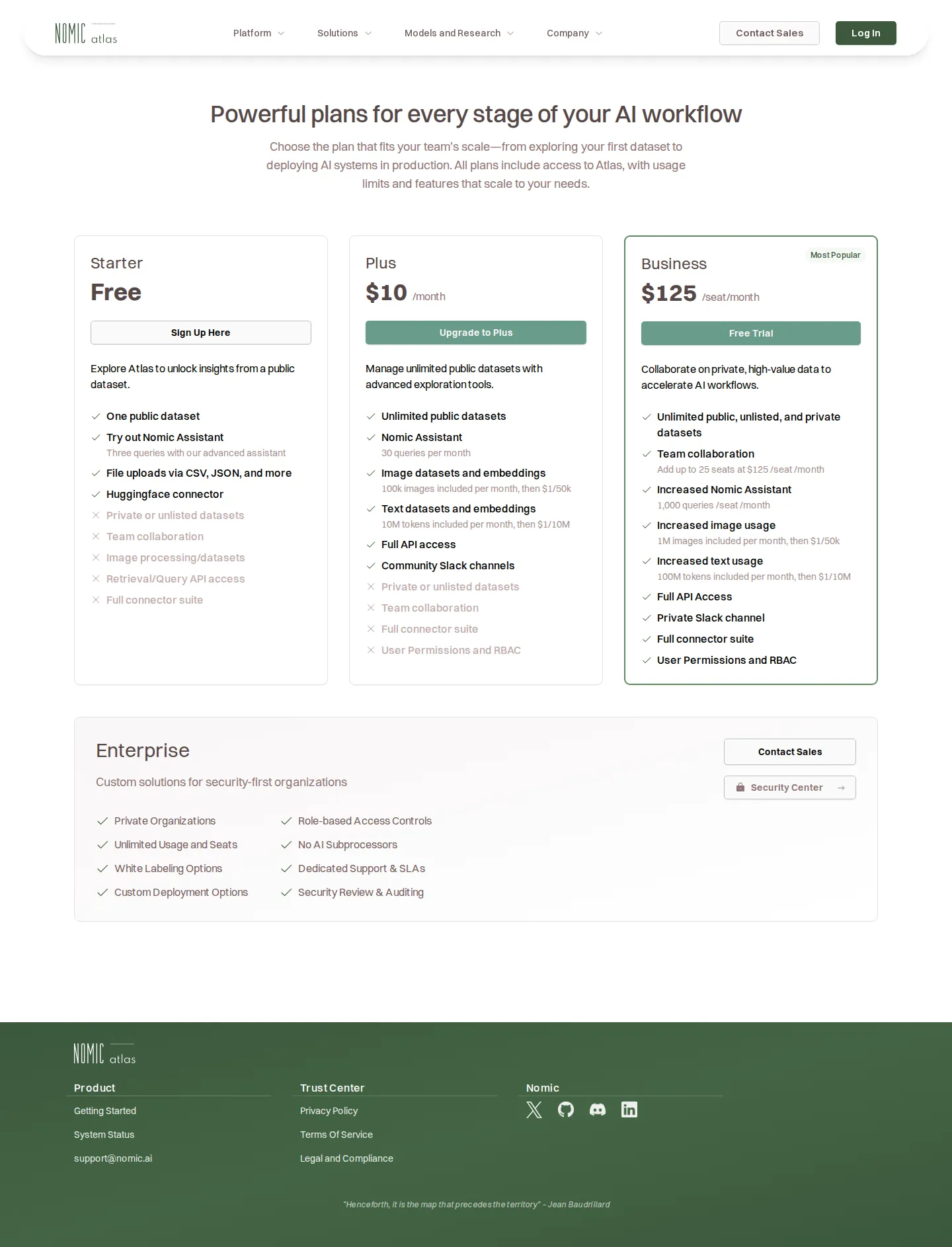
| Starter | Free | One public dataset; 3 Nomic Assistant queries; CSV/JSON uploads; HuggingFace connector | Public datasets only; no API access |
| Plus | $10 / mo | Unlimited public datasets; 30 Assistant queries/mo; 100k images/mo then $1/50k; 10M tokens/mo then $1/10M | Full API access; entry self-serve tier |
| Business | $125 / seat / mo | Private/unlisted datasets, RBAC; 1,000 queries/seat/mo; 1M images/mo then $1/50k; 100M tokens/mo then $1/10M | Add up to 25 seats; most-popular Atlas tier; free trial |
| Enterprise | Custom | Unlimited usage & seats; no AI subprocessors; white-labeling; custom deployment; SLAs | Sales-led; security review & auditing |
Nomic Embed — per-token embedding rate
The Embed Text endpoint (POST https://api-atlas.nomic.ai/v1/embedding/text) serves nomic-embed-text-v1 and nomic-embed-text-v1.5 (8,192-token max input; task types search_document, search_query, classification, clustering). The docs API reference does not publish a standalone dollar-per-token rate; the captured per-token embedding price is the Atlas overage rate of $1 per 10M text tokens (and $1 per 50k images), charged after each Atlas tier’s included monthly pool. On the Nomic Platform, embedding consumption instead draws from the org-level $20-per-seat included AI-usage pool. The new AEC-focused Developer API overview page (www.nomic.ai/developer) lists “Contact Sales” with no public per-call price.
Sales motions across products: PLG / self-serve for Nomic Platform Free/Individual, Atlas Starter/Plus/Business, and the Nomic Embed API; sales-led for Nomic Platform Business/Enterprise and Atlas Enterprise.
Hidden costs : the 25-seat floor, the platform commitment, and embedding overage past the pool
The biggest “hidden” cost on the Nomic Platform is structural: you cannot buy fewer than 25 seats, and the $1,000/month platform commitment applies regardless. A small pilot is not an option at list price.
Archetype A — a 30-person AEC firm onboarding the Nomic Platform. They license 30 seats but exceed the included AI-usage pool in heavy code-compliance months.
| Line item | Monthly cost |
|---|---|
| 30 seats × $40/user/mo | $1,200 |
| Platform commitment (already covered by 30 × $40) | $0 (floor met) |
| Included AI usage pool (30 × $20) | $0 (prepaid in seat fee) |
| Embedding/indexing overage past the pool (~est. $400) | $400 |
| Estimated monthly total | $1,600 |
The 30 seats clear the $1,000 platform floor, so the marginal cost is the $400 of AI-usage overage once the org burns through its $600/month pooled allowance. The lesson: at this size the seat fee dominates and overage is a manageable tail — but a 10-person firm would still pay the 25-seat minimum ($1,000/month) for capacity it cannot use.
Archetype B — a data-science team using Atlas Business for private embeddings. Five seats, heavy text embedding.
| Line item | Monthly cost |
|---|---|
| 5 seats × $125/seat/mo (Atlas Business) | $625 |
| Included text: 100M tokens/seat pool — assume 700M tokens used | included to 500M, then overage |
| Text overage: 200M tokens over pool × $1 / 10M | $20 |
| Image overage: 6M images over pool × $1 / 50k | $120 |
| Estimated monthly total | $765 |
The per-token rate is cheap, so on Atlas the seat fee dominates and embedding overage is a rounding error unless volumes are extreme — the opposite of a pure consumption model where the meter drives the bill. Teams running very high embedding volumes are often better off self-hosting the open-weight Nomic Embed models for free.
Want to estimate your own Nomic bill? Use the Nomic pricing calculator to model your monthly cost based on seats, the included AI-usage pool, and embedding token/image overage.
Pricing evolution : from open embeddings (2024) to a vertical AEC platform (late 2025)
Nomic’s pricing history is really a positioning history. For its first two years the company was an open-research embeddings and data-visualization shop; its monetizable surface was the Atlas app and a metered embedding API. In late 2025 the primary site repositioned to a seat-priced AEC platform, and the embeddings story moved to a secondary domain.
Cadence
| Quarter | Price changes | Product / SKU additions | Notes |
|---|---|---|---|
| 2024 Q1 | 0 | 2 | 2024-02-01 Nomic Embed text-v1 (open-weight); 2024-02-14 v1.5 Matryoshka resizable embeddings. |
| 2024 Q2 | 0 | 1 | 2024-06 Nomic Embed Vision adds multimodal (image) embeddings, metered at $1 per 50k images on Atlas. |
| 2024 Q4 | 0 | 1 | Atlas tiered pricing (Free / Plus / Business / Enterprise) present by the first archived snapshot (2024-10-06). |
| 2025 Q1 | 0 | 1 | 2025-02-17 Nomic Embed Text v2 (open multilingual mixture-of-experts). |
| 2025 Q4 | 1 | 1 | 2025-11 AEC pivot: www.nomic.ai/pricing launches the seat + platform-commit Nomic Platform; Atlas tiers move to atlas.nomic.ai. |
Tracked range: 2024-02–2026-06. Quarters not listed were verified stable (0 price changes, 0 SKU additions) in available archives. Atlas tier dollar figures predate the late-2025 pivot but archived snapshots render as a JS SPA, so exact historical figures are not independently legible; current figures are from the 2026-06-03 live capture.
Notable changes
- 2024-02-01 — Nomic Embed text-v1 launches as the first fully reproducible open embedding model to beat OpenAI’s ada-002 on MTEB (nomic.ai/news); it anchors the metered $1/10M-token Atlas embedding rate still in effect.
- 2024-06 — Nomic Embed Vision extends the meter to images ($1 per 50k) by sharing the text latent space.
- 2025-02-17 — Nomic Embed Text v2 ships as an open multilingual MoE model, keeping the open-weight posture even as the company moves upmarket.
- 2025-11 — The AEC pivot: the Nomic Platform replaces the embeddings-first homepage with a vertical construction product priced on seats plus a $1,000/month platform commitment and a pooled AI-usage allowance.
The embeddings-to-AEC pivot in detail
The most consequential change is not a price move but a market move. Before late 2025, Nomic’s commercial pricing was essentially Atlas tiers plus a per-token embedding meter — a developer/data-science motion. After the pivot, the headline product is a vertical AEC platform sold to architecture and construction firms with a 25-seat minimum, an annual commitment, and a $1,000/month floor. The embedding meter did not disappear; it was re-packaged. On the Platform, embedding and indexing consumption now draws from the org-level $20-per-seat included AI-usage pool rather than being billed per token. The same models, the same underlying meter — but wrapped in a seat-priced enterprise commitment and aimed at a non-developer buyer. This is a textbook case of a company moving from a bottom-up usage meter to a top-down seat-and-commit packaging to chase enterprise contract values.
What’s unique : pooled AI usage funded per seat, an open-weight model under a paid platform, and a dual-surface split
Half of every seat fee is prepaid usage. Each $40 Nomic Platform seat includes $20 of AI usage that flows into a single org-wide pool. This is unusual: most seat-priced products treat usage as a separate overage line, but Nomic explicitly funds the meter from the seat fee, so adding a seat raises both the headcount cap and the shared consumption budget at the same time. It blurs the line between seat-based and usage-based billing deliberately.
A pooled, org-level meter rather than per-seat metering. AI usage is not metered per user — it aggregates into one balance consumed across Platform, Assistant, Workflows, and the Developer API. Heavy users and light users share a common pool, which simplifies admin forecasting and avoids per-seat overage surprises.
Metadata-only visibility means no charge until you act. Connected SharePoint, Egnyte, ACC, or Bentley sources surface metadata for free; billing only begins when you explicitly index or invoke AI. This decouples connecting data from paying for it — a meaningful trust signal for firms with terabytes of legacy project archives.
An open-weight model living under a paid platform. Nomic Embed remains Apache 2.0 and self-hostable for free, yet the same models are the engine of a paid seat-and-commit platform. Few companies run an open-source flagship and a closed enterprise commitment in parallel; Nomic’s bet is that the open model drives credibility and the platform captures the enterprise spend.
One brand, two pricing philosophies. The Atlas app is a conventional self-serve freemium ladder; the Platform is a sales-led seat-plus-commit enterprise contract. The same company runs both motions simultaneously against different buyers.
Strengths & weaknesses
| Strengths | Weaknesses |
|---|---|
| Seat fee bundles a usage allowance, so buyers get predictable budgets with built-in headroom. | The 25-seat minimum and $1,000/month platform commitment lock out small AEC firms and pilots at list price. |
| Pooled org-level usage avoids per-seat overage surprises and simplifies forecasting. | Two pricing surfaces under one brand (Platform vs Atlas) create real confusion about “what does Nomic cost?” |
| Metadata-only visibility means connecting data is free; you pay only when you index or invoke AI. | No public per-call Developer API price on www.nomic.ai/developer — it routes to “Contact Sales”. |
| Open-weight Nomic Embed (Apache 2.0) gives a free self-host path and strong developer credibility. | The AEC pivot abandons the original developer/data-science buyer who came for cheap, open embeddings. |
| Cheap, transparent embedding overage on Atlas ($1/10M tokens) undercuts closed API competitors. | Embedding consumption on the Platform is opaque — it draws from a pool rather than a published per-token rate. |
Billing UX : pooled-usage admin controls, alerts, and metadata-only data visibility
Named billing controls captured from the pricing page and FAQ:
- On-demand AI-usage top-ups (Individual) — the self-serve $20/month Individual tier funds AI usage by purchasing top-ups on demand rather than drawing from an org-wide pool.
- Org-level AI-usage pool (Business/Enterprise) — the $20-per-seat allowance aggregates into a single shared balance across Platform, Assistant, Workflows, and Developer API; adding a seat raises the pool by $20.
- Admin dashboard alerts & limits — overages “only occur after included AI usage is consumed,” with alerts and spend limits set in the admin dashboard.
- Rollover within the annual term — unused included AI usage rolls forward within the annual commitment period.
- Metadata-only visibility (no charge until indexed) — users see metadata from connected SharePoint, Egnyte, ACC, or Bentley sources but are billed only when they explicitly index or invoke AI.
- Centralized team billing & usage analytics — included on the Business plan; usage analytics and reporting surface per-org consumption.
- Add-on usage packages / pooled usage commits — Business teams can buy additional included-AI-usage packages or add seats ($40/user/mo) to raise the pool; Enterprise can pre-commit a larger annual usage pool (“pooled usage commits”).
- Side-by-side plan comparison — the pricing page renders a Free / Individual / Business / Enterprise feature matrix (agent requests, Agent API access, AI usage mechanics, SSO, invoice/PO billing, SCIM, audit logs, multi-region hosting, etc.).
- No-markup usage billing disclosure — the pricing FAQ (“How does AI usage work?”) states AI usage is charged “at the underlying model rates, with no markup on those model costs.”
- “What can I do with $20 of AI usage?” FAQ estimator — the page quantifies the pooled allowance in concrete terms: approximately 80–200 Assistant sessions, 20–80 drawing sheet reviews, 50–130 code compliance checks, or 10–25 submittal reviews per $20, varying with context size, tool calls, and response length.
Strategic wins : funding the meter from the seat, pooling usage, and using an open model as a wedge
1. Funding the usage meter from the seat fee removes overage anxiety
By including $20 of AI usage inside every $40 seat, Nomic gives buyers a built-in consumption budget before any overage applies. This is a smart answer to the classic enterprise objection to usage-based pricing: unpredictability. The seat fee feels like a flat subscription while the underlying meter still aligns cost to value, much like the credit-pool hybrids other AI tools have adopted.
2. Pooling usage at the org level beats per-seat metering for forecasting
Nomic aggregates the included allowance into one shared balance rather than per-user quotas. Heavy and light users net out against a single pool, so finance teams forecast one number instead of policing dozens of seats. This sidesteps the “dead seats” problem that plagues strict per-seat metering and makes the platform commitment easier to defend in budget reviews.
3. The open-weight model is a credibility wedge for an enterprise platform
Nomic Embed stays Apache 2.0 and self-hostable, which earns developer trust and benchmark credibility — then the same models power a paid seat-and-commit platform. The free model is the top of a funnel whose bottom is a $12,000/year-minimum enterprise contract. Few firms execute this open-core-to-vertical-platform move; Nomic’s is unusually clean because the open artifact and the paid product share an engine.
4. Metadata-only visibility lowers the activation barrier for data-rich firms
Letting customers connect terabytes of SharePoint/Egnyte/ACC/Bentley data and see metadata for free — charging only on explicit indexing — removes the scariest line item from the first conversation. It converts “how much will all our data cost?” into “pay only for what you actually use,” a land-and-expand motion well suited to large legacy archives.
Areas to improve : the small-firm floor, the dual-surface confusion, and the missing API price
1. The 25-seat / $1,000-month floor excludes small AEC firms
The list-price entry point is effectively $12,000/year for capacity a 5-to-10-person firm cannot use. A genuine starter tier — say a 5-seat “Studio” plan with a proportionally smaller commitment — would open the long tail of boutique architecture practices that are exactly the buyers most starved for automation. The fix is a smaller committed package, not a free trial.
2. The two-surface split confuses the core pricing question
“What does Nomic cost?” has no single answer because the Platform and Atlas live on different domains with different models. A unified pricing hub that explicitly frames “Platform for AEC firms / Atlas for data teams / Embed API for developers” — instead of two disconnected pricing pages — would cut buyer confusion and reduce wasted sales cycles. Clear pricing-page information architecture is itself a conversion lever.
3. No public Developer API price undercuts the open-model goodwill
The www.nomic.ai/developer page routes to “Contact Sales” with no per-call rate, which sits awkwardly next to an open-weight, transparently-benchmarked model. Publishing a per-token Developer API rate (as it already does for Atlas overage) would let developers self-serve and would convert the open-model audience into paying API customers without a sales conversation.
4. Platform embedding cost is opaque relative to Atlas
On Atlas the embedding meter is published ($1/10M tokens); on the Platform the same consumption silently draws from the pooled allowance with no visible per-unit rate. Surfacing the effective per-document or per-token conversion inside the admin dashboard would let Platform buyers reason about marginal cost the way Atlas users already can.
Monetization stack & signals : how Nomic builds & buys its revenue engine
No vendor or in-house monetization tool is independently evidenced; the only read is the page's own mechanics. Both surfaces meter consumption — per-token $1/10M on Atlas and a pooled $20-per-seat org meter on the AEC Platform — implying a real in-house usage-metering layer, but no source names it.
Signals reviewed · derived from public sources
Key takeaways
- Bundle the meter into the seat to neutralize overage fear. Nomic funds $20 of usage from each $40 seat, so the bill reads like a subscription while the underlying model still meters consumption — a pattern any team adding usage to a seat product can copy.
- Pool usage at the org level, not per seat. A single shared balance is far easier to forecast and defend than dozens of per-user quotas, and it eliminates the dead-seat waste problem.
- An open-weight flagship can be a paid platform’s funnel. Nomic Embed’s Apache 2.0 license drives credibility and developer adoption that feed a seat-and-commit enterprise product — open-core works as a wedge, not just charity.
- Charge on action, not on connection. Metadata-only visibility (pay only when you index) removes the scariest cost from the first sales conversation for data-rich buyers.
- A pivot is a packaging decision, not just a product one. Nomic kept the same embedding engine but re-packaged it from a per-token meter into a seat-plus-commit enterprise contract to chase larger AEC deal sizes.
UBP implications
- Seat-funded usage pools are a viable bridge from subscription to consumption. By pre-funding the meter from the seat fee, Nomic gets the alignment of usage pricing with the predictability buyers demand — a template for SaaS teams nervous about pure metering.
- Org-level pooling changes the unit of forecasting. When usage is pooled rather than per-seat, the value metric shifts from “users” to “organizational consumption,” which is a more honest proxy for value delivered in agentic, automation-heavy products.
- Open models and metered APIs can coexist with sales-led platforms. Nomic shows that a single company can run a freemium open meter and a sales-led commitment side by side — usage pricing need not be all-or-nothing across a product portfolio.
Sources
- Nomic Platform pricing — www.nomic.ai/pricing (accessed 2026-08-14)
- Atlas app pricing — atlas.nomic.ai/pricing (accessed 2026-08-14)
- Nomic Developer API overview — www.nomic.ai/developer (accessed 2026-08-11)
- Nomic Embed Text API reference — docs.nomic.ai (accessed 2026-08-11)
- Nomic News (announcements / changelog) — www.nomic.ai/news (accessed 2026-06-03)
- Nomic Embed Text v1 announcement — www.nomic.ai/news/nomic-embed-text-v1 (accessed 2026-06-03)
For the full corpus of analyzed pricing models, see the pricing blueprint index.
Bottom line
Nomic is two pricing stories in one brand: an open-weight embeddings lineage that gave it credibility, and a late-2025 pivot to a seat-priced AEC platform — $40/user/month with a 25-seat minimum, a $1,000/month commitment, and a clever $20-per-seat pooled AI-usage allowance — that is where the company now chases enterprise revenue. The mechanics are genuinely interesting (funding the meter from the seat, pooling usage org-wide, charging only on indexing), but the small-firm floor and the two-surface confusion are real friction. See how it compares across the pricing blueprint.
Pricing timeline : Major events on a vertical axis
Each milestone below corresponds to a public pricing change, product launch, or material adjustment. Major events use a filled marker; minor adjustments use a faded one.
Two surfaces confirmed — AEC Platform + Atlas tiers
As of the 2026-06-03 capture, www.nomic.ai/pricing lists Business $40/user/month (25-seat min, $1,000/month commit, $20 included AI usage/seat) and custom Enterprise. The separate atlas.nomic.ai/pricing app runs Free / Plus $10/mo / Business $125/seat/mo / custom Enterprise, with embedding overage at $1 per 10M text tokens and $1 per 50k images.
AEC Platform pivot — seat + platform-commit model on www.nomic.ai
Nomic's primary site repositions to a vertical AEC (architecture, engineering, construction) agentic platform. The first archived www.nomic.ai/pricing snapshot (2025-11-15) shows the Nomic Platform Business plan at $40/user/month (annual, 25-seat minimum, $1,000/month platform commitment) with $20 pooled AI usage per seat, plus a custom Enterprise tier. The legacy Atlas tiers and the per-token Embed rate move to atlas.nomic.ai.
Nomic Embed Text v2 — multilingual MoE
v2 ships as an open multilingual mixture-of-experts embedding model, extending Nomic Embed beyond English while keeping the open-weight, reproducible posture.
Atlas tiered pricing established (Free / Plus / Business / Enterprise)
The Atlas data-exploration app's tier structure — Free Starter, Plus, Business and custom Enterprise — is in place by the earliest archived atlas.nomic.ai/pricing snapshot (2024-10-06). The page is a JS-rendered SPA, so exact archived dollar figures are not independently legible from the static archive; current figures ($10 Plus, $125/seat Business) are from the 2026-06-03 live capture.
Nomic Embed Vision — multimodal embeddings
Nomic adds an image-embedding model sharing the text latent space, enabling multimodal search. On Atlas this is metered separately as $1 per 50,000 images after each tier's included image pool.
Nomic Embed v1.5 — Matryoshka resizable embeddings
v1.5 adds Matryoshka Representation Learning so a single model emits 64-to-768-dimension embeddings, letting users trade vector size against quality at no extra per-token cost.
Nomic Embed text-v1 launches — open-weight embedding model
Nomic releases nomic-embed-text-v1 (Apache 2.0, 8,192-token context), the first fully reproducible open embedding model to beat OpenAI's text-embedding-ada-002 on MTEB. Embeddings are consumed through Atlas and the Developer API; metered embedding overage on Atlas is quoted at $1 per 10M text tokens.
- · Nomic's main site (www.nomic.ai) pivoted from an embeddings/data-platform company to a vertical AEC (architecture, engineering & construction) agentic platform — its first Wayback pricing snapshot at www.nomic.ai/pricing appeared 2025-11-15, while the legacy Atlas tiers had been archived since October 2024.
- · As of the 2026-08-11 capture, the Nomic Platform pricing page no longer states a separate $1,000/month platform-commitment minimum — but Business still requires a 25-seat floor, which at $40/seat computes to that same $1,000/month ($12,000/year) in practice. The page also now offers a self-serve Free tier and a $20/month Individual tier beneath Business, a funnel that did not exist in the June 2026 capture.
- · Each $40 seat contributes exactly $20 of AI usage to a single org-wide pool shared across Platform, Assistant, Workflows and the Developer API — half of every seat fee is pre-paid metered consumption.
Questions & answers
- How much does the Nomic Platform cost?
- The Nomic Platform now runs a self-serve-to-enterprise ladder: a Free tier, a $20-per-month Individual tier, a $40-per-user-per-month Business plan (25-seat minimum, annual commitment, $20 of pooled AI usage included per seat), and a custom Enterprise tier.
- What is the difference between the Nomic Platform and Atlas?
- The Nomic Platform (www.nomic.ai/pricing) is the AEC product for architecture, engineering and construction firms, now with its own Free and $20/mo Individual self-serve tiers below seat-priced Business/Enterprise. Atlas (atlas.nomic.ai/pricing) is a separate self-serve data-exploration app with Free, $10/mo Plus and $125/seat/mo Business tiers.
- How much does Nomic Embed cost per token?
- On Atlas, embedding usage beyond each tier's included pool is billed at $1 per 10M text tokens and $1 per 50,000 images. On the Nomic Platform, embedding consumption instead draws from the on-demand top-up balance (Individual) or the org-level $20-per-seat included AI-usage pool (Business/Enterprise).
- Does Nomic have a free tier?
- Yes. The Nomic Platform itself now has a Free tier (no credit card required, limited agent requests, access to core Platform surfaces), and the Atlas Starter tier is free and includes one public dataset, three Nomic Assistant queries, and CSV/JSON uploads. The Nomic Embed models are also open-weight under Apache 2.0 and can be self-hosted at no cost.
- What is the cheapest way to pay for Nomic embeddings?
- For production teams, the Atlas Plus tier at $10/month includes 10M text tokens and 100k images per month before overage. The open-weight Nomic Embed models can also be run locally for free without any API charge.
- Does the Nomic Platform have a minimum spend?
- Business requires a 25-seat minimum on an annual contract, which at $40/seat/month computes to roughly $1,000/month ($12,000/year) before AI-usage overages — but as of the 2026-08-11 capture, the pricing page no longer states a separate dollar-denominated platform-commitment minimum. Below Business, the Free and $20/month Individual tiers carry no minimum spend.