Why LLMOps Tools Miss 40-70% of Your AI Costs
LLMOps tools capture only 30-60% of AI spend. Learn why infrastructure, vector databases, and agentic chains are invisible to proxy-based cost tracking.

AI Summary
Your engineering team has been using Langfuse for the past six months to monitor your AI application. The dashboard looks great, showing token usage, latency metrics, and costs for every OpenAI API call. Everything seems under control. Then your CFO walks into your office with a question that stops you cold: “We spent $127,000 on AI last quarter, but your Langfuse dashboard only shows $43,000. Where did the other $84,000 go?”
Many engineering leaders face this gap. LLMOps tools like Langfuse, Helicone, Portkey, and LangSmith have become essential for developer teams building AI applications. They provide excellent visibility into LLM API costs and performance. But for tracking the complete cost picture of running AI in production, they have significant blind spots that leave finance teams frustrated and businesses unable to properly calculate margins.
Understanding What LLMOps Tools Actually Track
These platforms emerged to solve a specific set of problems developers face when building applications on top of large language models.
Consider what happens when you make a simple API call to OpenAI’s GPT-4. You send a prompt, the model processes it and returns a response, and you get charged based on token consumption in both input and output. For a developer building a reliable AI application, you need to track several things about this interaction: how long the request took, whether it succeeded or failed, how many tokens were used, what the actual prompt and response looked like, and whether there are patterns in failures or slow responses.
LLMOps tools were built to answer these questions. They sit as a proxy or wrapper around your LLM API calls and capture detailed telemetry about every interaction. When you integrate a tool like Helicone with a single line change, it starts logging every request you make to OpenAI, Anthropic, or whichever model provider you’re using. You can see exact prompts, responses, token counts, costs, and latency for each call.
This visibility is valuable for development teams. When a user reports strange responses from your AI feature, you can trace back to that specific session and see exactly what prompts were sent and what the model returned. When your OpenAI bill suddenly doubles, you can identify which part of your application is making excessive API calls. If a particular prompt is consuming 5,000 tokens when it should only need 500, you can optimize it.
For what they were designed to do — helping developers build better AI applications by providing detailed observability into LLM interactions — these tools work well. The problem starts when organizations assume these tools can serve as complete cost management platforms for their entire AI spend.
The Fundamental Architecture Problem: Proxies Only See What Passes Through Them
Most LLMOps tools work as proxies that sit between your application and the LLM provider. Your code makes a request, it passes through the LLMOps tool which logs it, and then the tool forwards the request to OpenAI or Anthropic. When the response comes back, it flows through the tool again before reaching your application.
This proxy architecture can only track what passes through it. A security camera pointed at your front door gives you excellent visibility into everyone who enters and exits through that door. But it tells you nothing about people using the side entrance, the back door, or climbing through windows.
In AI applications, there are many “entrances” beyond the simple prompt-to-response flow that LLMOps proxies monitor. Consider an AI customer support system: when a customer asks a question, your system makes an initial call to GPT-4 to understand intent, performs a vector database search to find relevant knowledge base articles, calls your internal order management API to check order status, makes a tool call through n8n to update your CRM, and makes another GPT-4 call to generate the response.
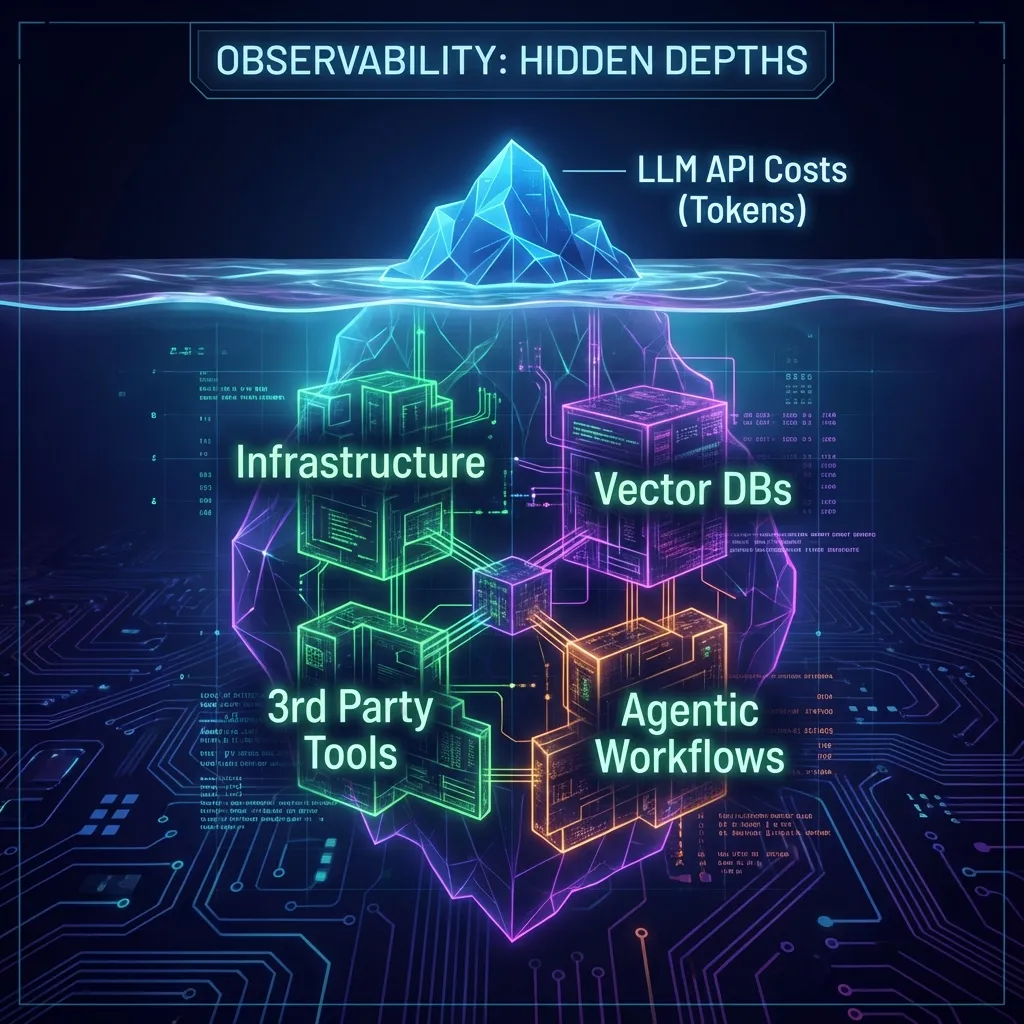
Your LLMOps tool captures those two GPT-4 calls perfectly — token usage, cost, latency, everything. But the vector database query costs money. The compute time to run your order lookup API costs money. The n8n workflow execution costs money if you’re on a usage-based plan. None of these flow through your LLMOps proxy, so none show up in your cost tracking.
This is the agentic workflow cost visibility problem, and it becomes more common as AI applications grow sophisticated. Modern AI systems orchestrate complex multi-step workflows involving vector databases, tool calls to external APIs, internal compute for processing data, and coordination between multiple AI models. The LLMOps tool sees only the LLM portion of this workflow, which might represent 30-40% of the total execution cost.
Missing the Infrastructure Layer Completely
Even solving the agentic workflow problem leaves another large category of costs uncaptured: your underlying cloud infrastructure.
Running AI applications in production means paying for more than API calls to model providers. You’re running services on AWS, Google Cloud, or Azure. You have a vector database like Pinecone or Weaviate charging you based on vectors stored and searched. You have compute instances running your application code, storage costs for saving conversation histories and embeddings, and data transfer costs when moving data between services.
Your LLMOps platform knows nothing about any of this. Consider an AI documentation assistant that helps users find information in your product docs. For every query, you’re embedding the user’s question using OpenAI’s embedding model — see current rates at the AI token pricing tracker — doing a vector search in your Pinecone database, retrieving relevant docs, and then using GPT-4 to generate an answer.
Your LLMOps tool shows you the embedding costs and the GPT-4 costs. But it won’t show you that your Pinecone bill is $2,800 per month for storing 50 million embeddings and handling 2 million searches. It won’t show you the $1,200 per month on EC2 instances running your API service, the $600 per month in S3 costs for conversation histories, or the $400 per month in data transfer fees.
Add those up and your total infrastructure cost for this feature might be $5,000 per month, while your LLMOps dashboard shows $2,300. That’s a 54% gap between what you think you’re spending and what you’re actually spending. Pricing decisions made on that data are built on a false floor.
The Third-Party AI Tools That Never Touch Your LLMOps Infrastructure
Your company probably uses multiple AI tools as part of daily operations. Your sales team might use an AI SDR tool for lead qualification. Your customer support team might use Intercom’s AI chatbot to handle tier-one tickets. Your developers use Cursor or GitHub Copilot for coding assistance. Your HR team might use an AI recruiting tool to screen resumes. Your marketing team uses various AI content generation tools.
Every one of these tools consumes AI resources and costs your company money. Some charge by seat, some by usage, some through hybrid models. But none of these costs flow through your LLMOps infrastructure because they’re completely separate applications. The LLM calls these tools make go from their infrastructure to model providers, not through your monitoring stack.
Your AI spend ends up scattered across dozens of line items in your expense management system, with no unified view of total AI cost. When someone from finance asks “how much are we spending on AI?”, nobody can give an accurate answer without manually aggregating costs from OpenAI invoices, Anthropic bills, Pinecone subscriptions, Cursor seats, Intercom AI usage charges, cloud infrastructure costs, and a dozen other sources.
The product costs might be $50,000 per month and well understood, but there’s another $30,000 per month in AI tool subscriptions scattered across different departments that nobody’s aggregating or optimizing. These are real costs that affect the company’s bottom line, and none of them show up in the LLMOps platform.
The Developer-Centric Focus Misses Business-Critical Questions
There’s a fundamental mismatch between what LLMOps tools provide and what businesses need, and it goes beyond missing certain costs.
Developers using LLMOps tools care about: Is this API call succeeding or failing? What’s the p95 latency? How can I optimize this prompt to use fewer tokens? Which model performs better for this task? Finance teams, product managers, and executives care about entirely different questions: What’s our gross margin on each AI-powered feature? How much does it cost to serve a customer using our AI tools? Which customer segments are most profitable? How do our margins change as we scale usage?
LLMOps tools weren’t designed to answer these business-focused questions. They track technical metrics like tokens and inference time, but they don’t connect those metrics to business outcomes like revenue per feature or gross margin per customer. Even when the LLMOps tool accurately tracks all the costs it can see, it still doesn’t provide the insights business stakeholders need for strategic decisions.
A product manager deciding whether to invest more in an AI summarization feature can learn from the LLMOps dashboard that the feature consumed 50 million tokens last month at a cost of $2,400. But they can’t learn that the feature served 8,000 customers, that those customers pay an average of $150 per month, that power users in the enterprise segment consume 10 times more tokens than SMB customers, or that gross margin on this feature after all costs is 68% for enterprise but only 22% for SMB.
Feature-level profitability analysis requires connecting cost data to product analytics, customer segmentation, and revenue data. LLMOps tools don’t make this connection because it’s outside their scope. Companies with excellent LLMOps observability often have no idea whether their AI features are actually profitable. They know what the LLM API calls cost, but they don’t know the total cost to deliver value to customers, and they can’t calculate accurate gross margins.
The Tool Call Execution Problem: When the Runtime Goes Invisible
When you build an AI agent using frameworks like LangChain or tools like n8n, the agent doesn’t call an LLM and return a response. The agent uses tools — calling external APIs or running code to accomplish tasks. An AI customer service agent might use a “check order status” tool that queries your order database, or a “send email” tool that actually sends an email.
These tool calls aren’t executed by OpenAI or Anthropic. They’re executed by your runtime environment, like your Node.js server or Python application. The flow works like this: your application calls the LLM, the LLM returns a response saying “I need to use the check order status tool with order ID 12345,” then your runtime executes that tool call using your own code, gets the result, and sends it back to the LLM for the next step.
An LLMOps proxy sees the initial LLM call and sees subsequent LLM calls, but has zero visibility into what happened during tool execution. It doesn’t know that your runtime spent 2 seconds calling your order database and consuming compute resources. It doesn’t know that your tool call triggered a chain of operations in n8n or Zapier that each have their own costs.
One developer documented spending $700 evaluating just 100 RAG question-answer pairs using RAGAS for context precision evaluation. The LLM API costs were only about $150 of that total. The remaining $550 came from vector database searches, embedding generations, compute time for running evaluations, and workflow orchestration. An LLMOps tool tracking only the LLM portion would have shown $150 and missed $550, making the evaluation look 4.6 times cheaper than it was.
The Margin Blind Spot
Accurate cost tracking isn’t about knowing how much you spent last month. It’s about understanding your unit economics and margins well enough to make smart decisions. When you have significant blind spots in your cost data, those decisions can be seriously wrong.
Suppose you’re a SaaS company that added an AI-powered feature to help users analyze their data. You charge $50 per month extra for this feature. Your LLMOps dashboard shows the average user costs you $12 per month in LLM API calls. Based on this, you calculate 76% gross margin on this feature — looks great, so you decide to expand it and lower the price to drive adoption.
But the actual costs look like this: $12 in LLM API calls that your LLMOps tool tracks, $8 in vector database costs, $6 in compute costs for your API servers, $4 in data storage and transfer, and $3 in workflow automation. The real total cost per user is $33, not $12.
Your gross margin isn’t 76%, it’s 34%. At 34% margins, the strategy should be different. You shouldn’t lower the price to drive adoption because you don’t have enough cushion. You should focus on optimizing costs before scaling. You might need to rethink your pricing model entirely.
The margin blind spot from incomplete cost tracking affects every major business decision about your AI products: how to price them, which features to invest in, which customer segments are most profitable, whether you can afford a freemium tier. All of these require accurate cost data, and LLMOps tools alone can’t provide that.
The Fragmentation Cascade: When Multiple Teams Use Different Tools
This problem compounds when you scale beyond a single team. Your data science team might use Weights & Biases for ML experiments. Your backend engineering team uses Langfuse for production API monitoring. Your product team uses LangSmith because it integrates with their LangChain implementations. Your infrastructure team uses Datadog for cloud cost monitoring. Different business units use various third-party AI tools with their own billing dashboards.
Nobody in your organization can answer: “What did we spend on AI this month across the entire company?” Getting that answer requires logging into a dozen different platforms — start with the OpenAI pricing calculator to model your baseline LLM spend — exporting data, normalizing formats, dealing with different time zones and aggregation periods, and manually combining everything. Most companies don’t do this work because it’s too time-consuming, so they operate on educated guesses about total AI spend.
This fragmentation also blocks cost attribution across your organization. You can’t answer which department drives most AI costs, which products are AI-intensive versus AI-light, or whether costs are growing proportionally to your user base. The data exists somewhere across all these tools, but there’s no unified view that makes it actionable.
Finance teams trying to forecast and budget need clean historical data, but it’s scattered across multiple sources with different levels of granularity and accuracy. They can’t identify trends or patterns because nobody’s aggregating the data consistently. They either over-budget to be safe, which ties up capital, or under-budget and deal with awkward conversations when teams exceed their allocations.
What’s Actually Needed: A Different Approach to AI Cost Intelligence
Proper AI cost management has requirements significantly different from what traditional LLMOps tools provide.
The guide to aggregation methods for usage-based billing covers the architecture for a unified view. First, you need comprehensive cross-platform cost aggregation: pulling together costs from LLM providers, vector databases, cloud infrastructure, workflow automation platforms, and third-party AI tools. AI costs are too fragmented to see clearly without this.
Second, you need cost attribution that connects technical spend to business outcomes. Knowing you spent $50,000 on OpenAI last month isn’t enough. You need to know that $18,000 was for your document analysis feature used by enterprise customers at 73% gross margin, $22,000 was for your chatbot used by SMB customers at 31% gross margin, and $10,000 was for internal operations that don’t generate direct revenue. This attribution requires tagging costs at the transaction level with metadata about which product feature, customer segment, and business process generated them.
Third, you need visibility into the full cost of agentic workflows, not just the LLM components. When a single customer interaction involves an LLM call, several vector searches, multiple tool executions, and workflow orchestration, you need systems that trace and aggregate all those costs as a single logical transaction. You need to answer “what did it cost us to resolve this customer support ticket?”, not “what did the LLM calls within this ticket cost?”
Fourth, connecting cost data to revenue and customer data lets you calculate real margins. Finance teams need to see AI costs alongside the revenue those costs generate, segmented by customer type, pricing tier, product feature, and other business dimensions.
Fifth, cost forecasting needs to account for the unique volatility of usage-based pricing. Unlike traditional software where costs are relatively stable, AI costs can spike dramatically based on user behavior, new feature launches, or shifts in usage patterns. You need systems that detect these changes early and help you model scenarios like “if we launch this new feature to 50% of users, what happens to our costs?”
The Window for Building This Is Closing Fast
Cloud providers like AWS, Google Cloud, and Azure are rapidly adding AI-specific cost tracking to their native cost management tools. LLMOps platforms are racing to add more business-focused features, budget controls, and integration capabilities. Traditional FinOps tools are building out AI-specific modules. Even the LLM providers themselves are adding better cost management features.
Each player has inherent advantages and limitations based on where they sit in the stack. Cloud providers have great infrastructure visibility but limited sight into third-party AI tools and SaaS applications. LLMOps tools have excellent detail on LLM usage but miss the broader cost picture. FinOps platforms have business context but struggle with the technical nuances of AI costs.
A new category of tools is emerging that sits at the intersection of all these existing categories: purpose-built for AI cost intelligence. These tools aggregate data from cloud providers, LLM APIs, observability platforms, and business systems to provide a unified view. They focus on the challenges unique to AI cost management — attribution for agentic workflows, connecting technical metrics to business outcomes, and forecasting usage-based costs.
For companies grappling with AI cost management today, LLMOps tools are necessary but insufficient. You need them for developer observability and optimization, but you can’t rely on them alone for complete cost management. Until better solutions emerge, most companies cobble together partial solutions using data warehouses to aggregate costs from multiple sources, custom dashboards to visualize the combined data, and manual processes to connect costs to business metrics.
This gets harder to sustain as AI usage scales across your organization. Incomplete cost tracking isn’t a trivial technical gap. It affects your ability to price products correctly, calculate margins accurately, forecast spending reliably, and make smart decisions about where to invest in AI capabilities. Understanding these limitations is the first step toward building or buying the cost intelligence capabilities your business needs.
Still have a question? Ask Abhilash — an AI trained on every guide, article, and pricing teardown on this site. Free, no signup. Ask a follow-up