The Great SaaS Shift to Usage-Based Pricing
AI economics are forcing SaaS to usage-based pricing. Learn the hybrid model, what billing platforms handle the transition, and why CAC payback math must change.

AI Summary
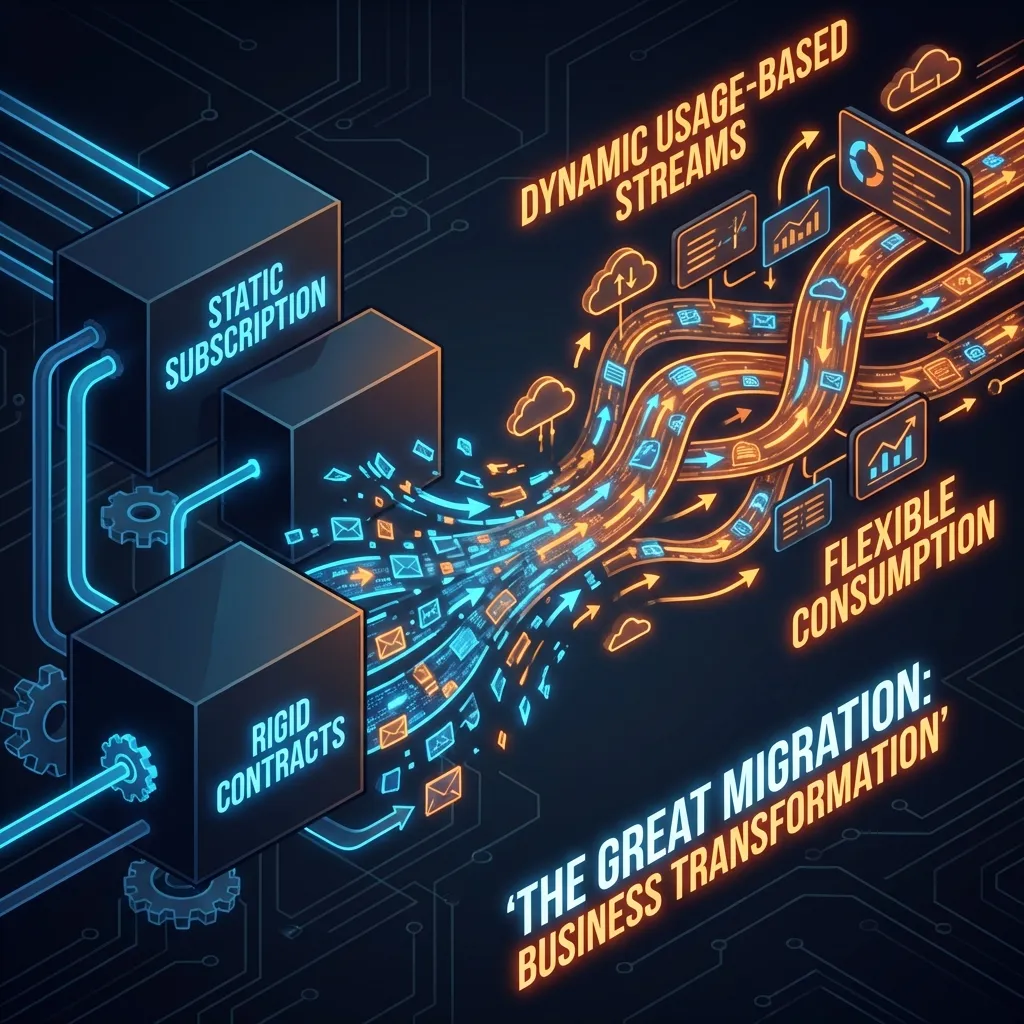
Something fundamental is changing in how software is sold. In 2018, only 27% of SaaS companies offered usage-based pricing. By 2022, that number jumped to 46%. Today, 61% of companies are either using or planning to implement usage-based pricing models. This is a transformation.
If your company is still on a pure subscription model, you’re increasingly in the minority. And if you’re thinking about making the transition to usage-based pricing, you’re probably wrestling with the same questions everyone else is: how do we price it? How do we forecast revenue? How do we manage costs? And most importantly, are we ready for this?
Why the Shift Is Happening
The move to usage-based pricing isn’t arbitrary. It’s driven by fundamental changes in how software is built and what customers expect. The rise of AI is accelerating this shift because AI has real marginal costs. Unlike traditional software where serving one more user costs almost nothing, AI incurs actual compute costs with every use — compare real-time model rates at the AI token pricing tracker.
For AI-powered products, usage-based pricing isn’t just attractive, it’s often necessary. Your costs scale with usage, so your pricing needs to as well. Otherwise you end up with a dangerous mismatch where heavy users drive up your costs while paying the same flat fee as light users. That’s a recipe for poor unit economics.
Customers also increasingly prefer paying for what they use rather than paying for capacity they might not need. It lowers the barrier to entry. A company can start small, prove value, and scale up their spending as they scale up their usage. That’s a more natural fit for how businesses operate.
There’s also a competitive angle. If your competitors offer usage-based pricing and you don’t, you’re at a disadvantage. Customers shopping around will see your fixed subscription as risky and inflexible compared to pay-as-you-go alternatives. You might have a better product, but if your pricing model is less attractive, you’ll lose deals.
The Hybrid Model Reality
Pure usage-based pricing is hard to pull off. You need predictable revenue to run your business. Your investors want to see stable ARR. Your finance team wants to forecast accurately. Pure usage creates too much variability on both sides of the equation.
So most companies end up with hybrid models — a base subscription fee plus usage charges, or tiered pricing where each tier includes some amount of usage, or committed usage contracts where customers commit to minimum spending in exchange for discounts. Most companies experiment with several variations before finding what works.
The challenge with hybrid models is complexity. Your pricing page gets more complicated. Your sales process requires more explanation. Your billing system needs to handle multiple charging mechanisms. And your customers need to understand how they’ll be billed. Get any of this wrong and you create friction that hurts conversion and retention.
Companies spend months debating their hybrid pricing structure. How much should the base fee be? What usage should it include? How should overage be priced? Should there be volume discounts? Each decision involves tradeoffs between simplicity, competitiveness, and profitability.
The Forecasting Challenge
CFOs hate usage-based pricing, at least at first. Forecasting becomes much harder. With subscriptions, you can predict next quarter’s revenue with reasonable accuracy. You know how many customers you have, their subscription levels, your churn rate, and your growth trajectory. The math is straightforward.
Usage-based revenue is much more volatile. The same customer might spend $5,000 one month and $15,000 the next, depending on their usage patterns. New features can drive unexpected usage spikes. Seasonality affects different customers differently. Macro events can cause usage to surge or plummet across your customer base.
This forecasting challenge extends to costs too. If your revenue is variable, your costs need to be variable in a predictable way, or your margins will be all over the place. This requires much more sophisticated financial modeling than traditional subscription businesses need.
The companies that handle this well build detailed usage models. They track leading indicators of usage. They segment customers by usage patterns and forecast each segment separately. They build scenario models showing best case, worst case, and expected case. It’s more work, but it’s necessary to maintain financial predictability.
The Billing Infrastructure Problem
Implementing usage-based pricing requires completely different billing infrastructure than subscriptions. You need to track usage in real time or near real time. You need to aggregate usage across potentially millions of events. You need to handle complex pricing rules. You need to generate invoices that customers can actually understand.
Most companies underestimate this complexity. They think they can bolt usage tracking onto their existing subscription billing system. Then they discover their billing system wasn’t built for this. It can’t handle the volume of events. It can’t execute complex pricing logic. It can’t provide the transparency customers need.
This often leads to a messy period where companies are using multiple billing systems, spreadsheets, and manual processes to piece together what customers owe. Finance teams that spend days every month reconciling usage data and generating accurate invoices won’t sustain that at scale.
The guide to implementation best practices for usage-based pricing covers infrastructure selection in detail. The modern approach is to use specialized usage-based billing platforms: tools like Stripe Billing, Metronome, or Amberflo are built for usage-based pricing. They handle the event ingestion, aggregation, and billing calculation. But even with these tools, you need to instrument your product properly to track usage accurately.
The Customer Communication Challenge
One of the biggest challenges with usage-based pricing is helping customers understand their bills. With subscriptions, the bill is the same every month. Customers know what to expect. With usage pricing, every bill is different. This can create anxiety and confusion.
Customers want to know what they’re being charged for and why. They want to see their usage trends. They want to be able to predict their future bills. If you can’t provide this visibility, you’ll get support tickets, payment disputes, and churned customers who felt blindsided by unexpected charges.
The best companies provide detailed usage dashboards where customers can see their consumption in real time. They send alerts when usage is trending high. They provide tools for customers to set budgets and limits. They make the billing transparent and predictable even though it’s variable.
This isn’t just nice to have. It’s essential for reducing churn and improving customer satisfaction. Customers who understand and control their usage are much happier than customers who feel like they’re on a meter they can’t read.
The Sales Process Transformation
Usage-based pricing changes your sales process. With subscriptions, the sales conversation is about value and features — you’re convincing customers to commit to a fixed monthly or annual payment. The negotiation is about price level and contract terms.
With usage-based pricing, the conversation shifts to usage patterns and projections. Customers want to understand how much they’ll likely spend. They want to see pricing calculators. They want references from similar companies. The sales team needs to be able to model usage scenarios and estimate costs.
This requires sales reps to have a much deeper understanding of how customers will actually use the product. They need to ask detailed questions about use cases, volumes, and workflows. They need to help customers understand their likely spending trajectory as they scale. This is a more consultative sales approach than the typical subscription sale.
Many companies struggle with this transition. Their sales team is used to selling subscriptions. They know how to overcome objections about price. But they don’t know how to have conversations about usage modeling. Training your sales team for usage-based selling is a non-trivial investment.
The Unit Economics Imperative
With subscription pricing, unit economics were relatively simple — customer acquisition cost, monthly recurring revenue, and customer lifetime value. The key metrics were CAC payback period and LTV to CAC ratio.
Usage-based pricing requires more sophisticated unit economics. You need to understand cost per unit of usage. You need to track gross margin not just at the customer level but at the usage level. You need to model how costs and revenue scale together as usage increases.
For AI companies especially, usage costs can be substantial. If your usage grows faster than your revenue, or if your costs per unit are too high, you can lose more money as customers use your product more. Companies that succeed with usage-based pricing track their unit costs carefully, optimize them continuously, and price with explicit margin targets in mind. They look at the economics of every transaction, not just total revenue and total costs.
The Innovation Enabler
Despite all the challenges, usage-based pricing enables innovation in powerful ways. It lowers the barrier for customers to try your product. Instead of committing to a big annual contract, they can start small and pay as they go. This is especially valuable for startups and new products where customers are risk-averse.
Usage-based pricing also aligns incentives. Customers only pay more when they’re getting more value. If they’re using your product heavily, it’s because it’s working for them. That makes sales conversations easier — you’re not trying to convince customers to pay more; they’re naturally paying more as they derive more value.
For product development, usage-based pricing provides clear signals about what customers value. Features that drive heavy usage are valuable. Features that sit unused aren’t. This helps you prioritize your roadmap based on actual customer behavior, not just survey responses or sales anecdotes.
Usage-based pricing can also enable creative packaging. You can offer premium features on a pure usage basis. Customers can try them and only pay if they use them. This removes the barrier to experimentation and can increase overall revenue by making premium features more accessible.
Making the Transition
Use the OpenAI pricing calculator to benchmark what your AI costs would look like under different usage tiers. Start by understanding your usage patterns: instrument your product to track how customers actually use it. Look for natural metering points that correlate with value. You need this data before you can design a good usage-based pricing model.
Test with new customers first. Existing customers on subscriptions can be grandfathered or migrated gradually. But new customers can be on your usage-based model from day one. This gives you a chance to refine the model, your billing systems, and your customer communication without disrupting your existing revenue base.
Usage-based pricing touches every part of your business — product, engineering, sales, finance, customer success. Everyone needs to understand the new model and adapt their processes. Underestimating this organizational change is a common mistake.
Monitor your metrics closely in the first few months. Are customers using more or less than you expected? Are bills coming in higher or lower than modeled? Is churn increasing? Are customers complaining about unpredictability? Catch and fix problems quickly before they compound.
The Competitive Imperative
Usage-based pricing isn’t going away. It’s becoming the standard, especially for AI-powered products. The companies that figure it out will have advantages in customer acquisition, retention, and unit economics. The ones that stick with pure subscriptions will increasingly look out of touch.
Success requires more than just changing your pricing page. It requires new infrastructure, new processes, and new capabilities across your organization. It requires much tighter integration between your product and your business operations. And it requires treating pricing and cost management as strategic capabilities, not afterthoughts.
The transition is hard. But the companies that invest in doing it right will be better positioned for sustainable growth — clearer unit economics, better customer alignment, and more flexibility to innovate. In a market moving toward usage-based models, that’s not an advantage. It’s increasingly a requirement for staying competitive.
Still have a question? Ask Abhilash — an AI trained on every guide, article, and pricing teardown on this site. Free, no signup. Ask a follow-up