AI Summary
About
Apollo.io is a B2B sales-intelligence and engagement platform that combines a large contact-and-company database with prospecting, email/call sequencing, and deal-execution tooling. Sellers use it to find verified emails and phone numbers, build targeted lists, run automated outreach, and manage pipeline — collapsing what would otherwise be several point tools (data provider, sequencer, dialer, CRM enrichment) into one workflow.
Apollo positions itself as “the most loved sales platform on the planet,” citing a 4.7/5 rating across roughly 9,000 reviews and use by 500,000+ companies, including Fortune 500 customers such as Ernst & Young, Oracle, and Lyft. It competes with data providers like ZoomInfo and Lusha and engagement platforms like Outreach and Salesloft, differentiating on an all-in-one bundle priced for teams of all sizes.
The company sells primarily self-serve through tiered per-seat plans, with a sales-led motion reserved for its Organization (Custom) plans where custom API rate limits, security, and governance requirements come into play.
Apollo raised a $100 million Series D led by Bain Capital Ventures in August 2023 at a $1.6 billion valuation (Sequoia, Tribe, and Nexus participating), bringing total funding to roughly $250 million after the company grew revenue 9x over the prior two years. In March 2026 it acquired signal-scoring startup Pocus to push toward an “AI-native GTM operating system,” and it reports 400% growth in enterprise accounts over the trailing year — context that helps explain the credit-allotment tightening covered in Pricing evolution below.
Pricing summary : How Apollo’s per-seat-plus-credit-pool model works
Apollo uses a hybrid model that pairs a per-seat subscription with a metered credit pool, across three dimensions:
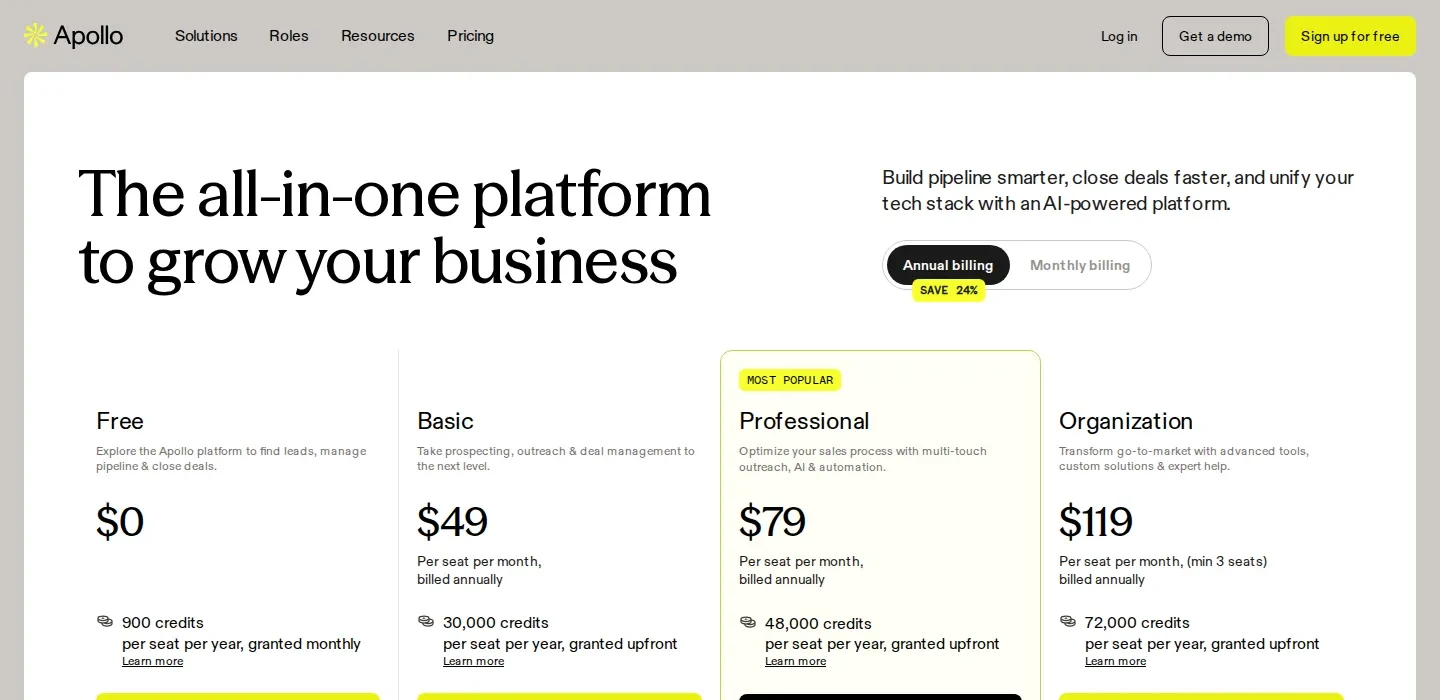
- Per-seat tier: A free Free plan plus paid Basic ($49/user/mo annual, $65 monthly), Professional ($79 annual, $99 monthly), and Organization ($119 annual, $149 monthly Annual-Only, min 3 users) tiers. Apollo advertises a 24% annual saving. The grid renders client-side from a runtime API — it has intermittently failed to load for automated capture — so these are cross-checked against that same runtime plan payload. See our hybrid pricing model breakdown and usage-based pricing fundamentals for how seat-plus-usage hybrids work.
- Monthly credit pool: Every tier includes an allotment of credits spent on email reveals (1 credit per contact), mobile/phone reveals (8 credits per verified number), dialer minutes (2 credits/min in the US, 10 in Europe and APAC, up to 36 in Africa), exports (consumed when a contact leaves Apollo via CSV, CRM, or Person API), and API enrichment/search calls. Annual plans grant credits upfront — 30,000 (Basic), 48,000 (Professional), 72,000 (Organization) per user per year. Credits reset each billing cycle and do not roll over; more can be bought mid-cycle on a volume ladder from $0.025 down to $0.015 per credit. This is a classic credit-based billing lever layered on top of seats — see our guide to prepaid credit models for how non-rolling pools are designed.
- Per-team add-ons: Two optional SKUs sit outside the seat price — Inbound and Advanced Dialer, each $149 per team per month billed monthly, or $119 per team per month billed annually. Both are bought in-app after a paid plan is selected, and the page labels them “Introductory pricing — features and pricing may change.”
What makes this different: the seat fee buys access, but the credit pool is the true usage meter — and Apollo tightened that meter in mid-2025, halving most allotments without touching the headline dollar price (see Pricing evolution). As of July 2026 Apollo also publishes exact per-endpoint credit rates for its API, so the same pool that funds a rep’s email reveals is now openly priced for programmatic enrichment. Even its “Unlimited” plans are bounded by a Fair Use Policy (the lesser of annual spend ÷ $0.025 or 1 million credits per account per year).
Pricing by product
Apollo platform (per-seat plans)
| Tier | Price (annual / monthly) | Included | Key mechanics |
|---|---|---|---|
| Free | $0 | 900 credits/user/yr (75/user/mo on monthly billing); 2 sequences; Gmail-only sending; basic filters; 25-record selection limit; AI Assistant capped at 5 chats (10 messages per chat) | Free forever; the FAQ calls it the “Starter plan which is free forever” and it is the downgrade target after a trial ends |
| Basic | $49 / $65 per user/mo | 30,000 credits/user/yr (2,500/user/mo monthly); unlimited sequences; connect non-Gmail/Microsoft email; 6 intent topics; 1,000-record selection limit; “US Dialer (credits apply)“ | Per-seat, billed monthly or annually; 14-day trial — the page states two different trial-credit figures (see Billing UX) |
| Professional | $79 / $99 per user/mo | 48,000 credits/user/yr (4,000/user/mo); A/Z testing, call recordings & AI insights (4,000 mins), deal management, Projects (BETA); 2,500-record selection limit | MOST POPULAR badge; recommended tier for growing teams |
| Organization | $119 / $149 per user/mo | 72,000 credits/user/yr (6,000/user/mo); custom API rate limits; 12 intent topics; call recordings & AI insights (8,000 mins); SSO, advanced security, bring-your-own LLM API key; 10,000-record selection limit | Min 3 seats; $149 monthly card is sold “Annual Only”; “Talk to Sales” CTA alongside self-serve |
“AI Assistant” carries an INTRODUCTORY FREE badge on Basic, Professional, and Organization — Apollo’s own release notes say it “is currently free as an introductory offer … (pricing and availability may change)”, so it is not a permanent inclusion. The grid also footnotes “Prices exclude any applicable taxes.”
Add-ons (per team, not per seat)
| Add-on | Price | Included | Key mechanics |
|---|---|---|---|
| Inbound | $149 per team/mo (monthly) or $119 per team/mo (annual) | Website Visitor – Company (Global) — identify up to 50,000 companies/mo; Domain Tracking up to 100 domains; Form Enrichment 5,000 form contacts/mo (credit usage applies); Website Visitor – Contact (US only) up to 10,000 contacts/mo; Form Builder still marked COMING SOON | Bought in-app after a paid plan is selected; “Introductory pricing — features and pricing may change” |
| Advanced Dialer | $149 per team/mo (monthly) or $119 per team/mo (annual) | International Dialer, Parallel Dialer, Power Dialer, Local Presence | Same in-app attach motion; add-on downgrades take effect at the end of the billing cycle |
Credit consumption (the usage meter)
| Credit type | Cost | When it’s consumed |
|---|---|---|
| 1 credit per contact | Revealing a contact’s personal email, business email, or both — never more than 1 | |
| Phone/mobile | 8 credits per number | Revealing a verified number (mobile, direct, office extension) |
| Dialer minutes | 2 credits/min (US & North America), 10 (Europe, APAC), 14 (Central & South America), 28 (Middle East), 36 (Africa) | Calling through the Apollo dialer, priced by destination region; Middle East/Africa/Central & South America rates fell 20% / 20% / 6.7% since the 2026-07-22 check |
| Export | Credits per exported contact | Exporting a contact outside Apollo (CSV, CRM, or Person API enrichment sync) |
| AI power-ups | 1 credit per power-up | Running an AI power-up on a record |
| Extra credits | $0.025/credit falling to $0.015/credit at 250,000 | Buying add-on credits mid-cycle; a recurring, non-prorated charge |
Apollo API — per-endpoint credit rates
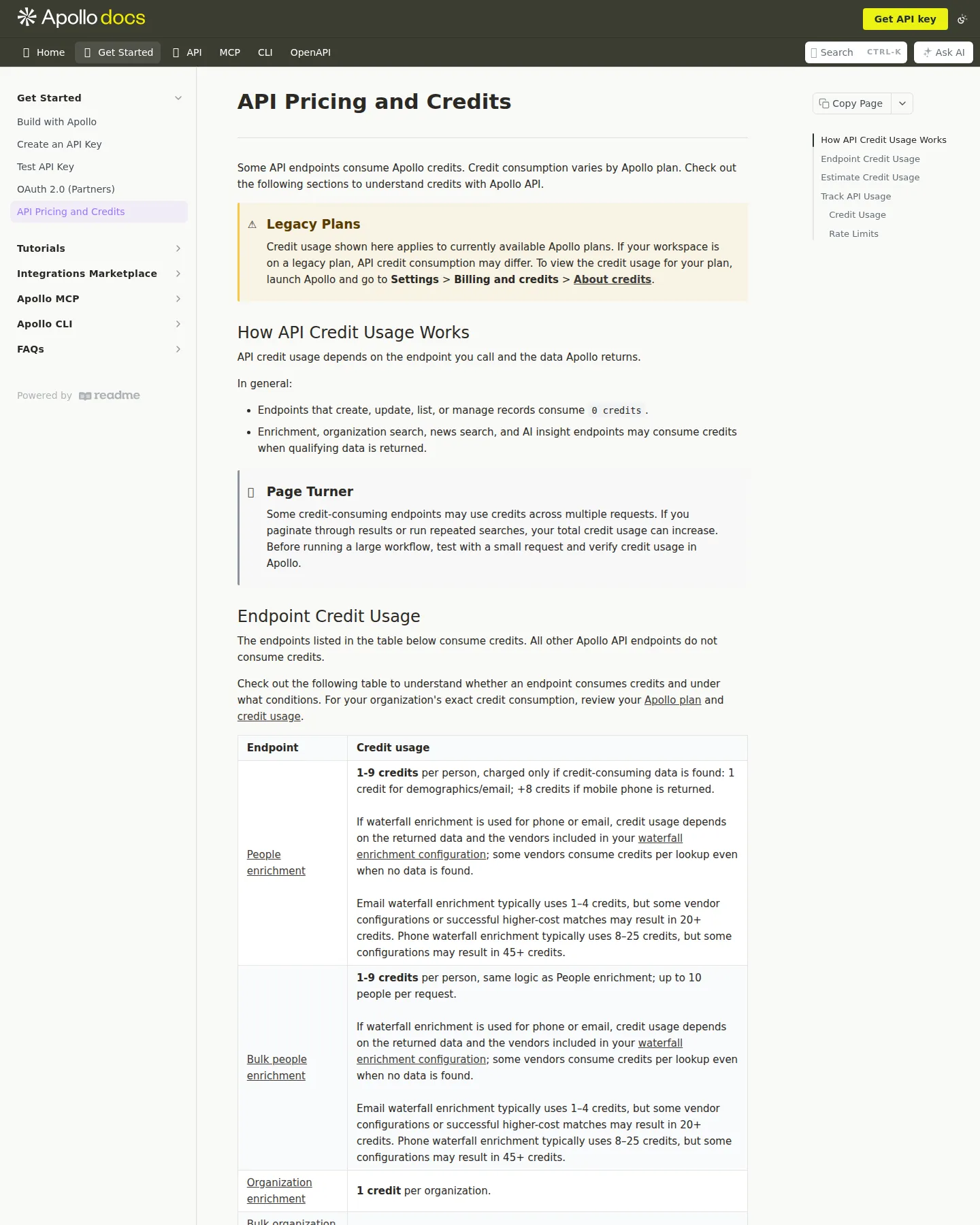
Apollo’s API has no separate dollar price: calls draw down the same account credit pool the app uses. Apollo’s plan comparison lists API Enrichment and “All other APIs” on every tier including Free, differentiated by rate limit rather than access — Free/Trial is throttled to 50 calls/min, 200/hr and 600/day on enrichment, Basic and Professional get 1,000/min with no hourly or daily cap, and Organization gets “200 / custom”, “600 / custom” and “6,000 / custom” on the non-enrichment endpoints. (The pricing-page FAQ separately points buyers with “more advanced integrations” to Custom plans, and docs.apollo.io says only that “access to Apollo API depends on your Apollo plan.”) In July 2026 Apollo replaced its old “these endpoints consume credits” list with an explicit per-endpoint rate table.
| Endpoint | Credit rate | Key mechanics |
|---|---|---|
| People enrichment | 1–9 credits per person, charged only if credit-consuming data is found: 1 credit for demographics/email, +8 credits if a mobile phone is returned | The mobile number, not the person, is the expensive unit |
| Bulk people enrichment | 1–9 credits per person, same logic; up to 10 people per request | Batching saves requests, not credits |
| Email waterfall enrichment | Typically 1–4 credits, but “some vendor configurations or successful higher-cost matches may result in 20+ credits” | Third-party vendors in the waterfall “consume credits per lookup even when no data is found” |
| Phone waterfall enrichment | Typically 8–25 credits, but “some configurations may result in 45+ credits” | Same no-hit-still-charged caveat |
| Organization enrichment | 1 credit per organization | Flat |
| Bulk organization enrichment | 1 credit per organization | Flat |
| Organization search | 1 credit per page, up to 100 results per page | Metered per page, so pagination multiplies cost |
| Organization job postings | 1 credit per page, up to 10,000 results per page | Cheapest per-record surface in the table |
| Get complete organization info | 1 credit per company | Flat |
| News articles search | 1 credit per page, up to 25 results per page | Metered per page |
| Get complete person info | 1 credit per person | Flat |
| Get / export conversations | 1 credit per conversation if the conversation has AI insights; otherwise 0 credits | AI output is the billable trigger, not the retrieval |
| Create / update / list / manage records | 0 credits | Write and CRUD endpoints are free |
Apollo footnotes the table with a legacy-plan caveat: “Credit usage shown here applies to currently available Apollo plans. If your workspace is on a legacy plan, API credit consumption may differ.” Rate limits are separate from credits, vary by endpoint and plan, and return 429 Too Many Requests when exceeded.
Sales motions across products: PLG / self-serve for Free, Basic, Professional, and both $149 add-ons; sales-led for Organization (Custom), where API rate limits and security terms are negotiated.
Hidden costs : What the credit pool actually costs at scale
The advertised per-seat headline understates what heavy prospecting teams pay, because the credit pool — not the seat — is the binding constraint. Email reveals, mobile reveals, and exports all draw down the same monthly allotment, and credits do not roll over, so high-volume teams routinely buy additional credits mid-cycle. Our usage-based pricing migration post shows how non-rolling pools quietly inflate bills.
Archetype: a 5-rep team on Professional (annual)
A 5-seat Professional team on annual billing pays 5 × $79 = $395/month in seats and gets 48,000 credits/user/year = 4,000/user/month = 20,000 credits/month for the team. Email reveals cost ≤1 credit; mobile reveals and exports cost more. Here’s how a moderately active month draws down that pool.
| Line item | Monthly cost |
|---|---|
| 5 seats (Professional, annual) | $395 |
| 2,000 email reveals (≤1 credit each) | ~2,000 credits |
| 600 mobile-number reveals (>1 credit each) | >600 credits |
| 2,000 contact exports to CRM (export credits) | export credits per row |
| Pool consumed vs 20,000 included | within pool this month |
| Total seat cost | $395/mo + add-on credits if pool runs dry |
The lesson: the same team in 2025-H1 had 120,000 credits/user/year included; after the mid-2025 cut to 48,000 the pool is ~60% smaller for the identical $79 seat price. A team that comfortably fit its workload before now risks exhausting credits well before month-end — so the add-on credit purchases, not the seat fee, become the variable line that determines the real bill. Finance teams modeling this should read our usage-based pricing for finance teams guidance on budgeting non-rolling pools.
Want to estimate your own Apollo bill? Use the Apollo pricing calculator to model your monthly cost based on seats, email/mobile reveals, and exports.
Pricing evolution : From legacy plans to the new credit system
Cadence
| Quarter | Price changes | Product / SKU additions | Notes |
|---|---|---|---|
| 2022 Q2 | 0 | 0 | Legacy “Email Credits” model: Free (50 email credits/mo), Basic $49 (200 email credits/mo), Professional $99 (Unlimited Email Credits + 50 mobile numbers/mo). Email and mobile were separate meters. |
| 2025 Q2 | 0 | 0 | Unified credit pool live: $0 / $49 / $79 / $119 annual; generous allotments of 60,000 (Basic), 120,000 (Professional), 180,000 (Organization) credits/user/year. |
| 2025 Q3 | 1 | 0 | The “new credit system”: included annual credits cut ~50–60% (Basic 60,000→30,000, Professional 120,000→48,000, Organization 180,000→72,000) with dollar prices unchanged — an effective price increase delivered through the meter. |
| 2026 Q2 | 0 | 1 | Prices and allotments hold ($0 / $49 / $79 / $119 annual; 900 / 30,000 / 48,000 / 72,000 credits). Apollo acquired Pocus (signal-scoring) to build an “AI-native GTM operating system.” |
| 2026 Q3 | 1 | 0 | 2026-07-18: Apollo published per-endpoint API credit rates for the first time — people enrichment 1–9 credits (+8 when a mobile phone is returned), phone waterfall 8–25 and up to 45+ credits, search metered per page rather than per record. No rate moved; rates that were previously login-gated simply became public. 2026-08-28: Apollo cut Dialer credit rates in three regions — Middle East 35→28 (-20%), Africa 45→36 (-20%), Central & South America 15→14 (-6.7%) — while US/North America (2) and Europe/APAC (10) held; the same capture caught the plan-comparison grid rendering directly for the first time since April 2026. Seat prices unchanged. |
Tracked range: 2022-05–2026-08. Dollar prices have held at $49 / $79 / $119 (annual) across the tracked window; the material changes were the 2025 credit-allotment cut, the 2026-07 API rate disclosure, and the 2026-08 regional Dialer credit cut, none of which touched a seat price. 2023–2024 main-page snapshots rendered as API skeletons and could not be price-read.
Notable changes
- 2022-05 — Legacy model used separate Email Credit and Mobile Number meters; Professional advertised “Unlimited Email Credits” (Wayback 2022-05-26).
- 2023-08-29 — Apollo raised a $100M Series D led by Bain Capital Ventures at a $1.6B valuation, total funding ~$250M (TechCrunch, PR Newswire).
- 2025-H2 — Included credit allotments cut ~50–60% with no dollar-price change; Apollo’s FAQ calls this its “new credit system,” auto-applied to new customers and rolled out gradually to existing ones (Wayback 2025-05-08 vs 2025-08-11).
- 2026-03-19 — Apollo acquired Pocus to advance an “AI-native GTM operating system” (PR Newswire).
- 2026-07-18 — Apollo rewrote its API docs page from “API Pricing” to “API Pricing and Credits,” publishing per-endpoint credit rates that had previously lived behind a login: people enrichment 1–9 credits per person (1 for demographics/email, +8 if a mobile phone is returned), email waterfall typically 1–4 credits (20+ in some vendor configurations), phone waterfall typically 8–25 credits (45+ in some), 1 credit per organization or person, 1 credit per page of search results, and 0 credits for create/update/list/manage endpoints. Apollo also disclosed that waterfall vendors “consume credits per lookup even when no data is found.” Seat prices were unchanged (Apollo API docs).
- 2026-08-28 — Apollo’s live pricing API showed per-minute Dialer credit costs falling in three regions since the prior 2026-07-22 check: Middle East 35→28 credits/min (-20%), Africa 45→36 (-20%), Central & South America 15→14 (-6.7%); US/North America (2) and Europe/APAC (10) were unchanged. Seat prices, credit allotments, add-on prices, and the mid-cycle credit-purchase ladder held. The same capture caught the plan-comparison grid rendering directly for both the Annual and Monthly toggle states — the first clean render under standard (non-stealth) capture since April 2026, after months of intermittent “Failed to load plan comparison” errors — and surfaced a site-internal inconsistency: the pricing FAQ now says a 14-day trial includes 100 credits, while the plan-card trial tooltip (from the same live API) still reads “50 lead credits per user.”
The mid-2025 credit cut in detail
Between the May and August 2025 Wayback snapshots, Apollo held every published seat price constant — Free $0, Basic $49, Professional $79, Organization $119 (annual) — but roughly halved the included credit allotments: Basic fell from 60,000 to 30,000 credits/user/year, Professional from 120,000 to 48,000, and Organization from 180,000 to 72,000. Because the credit pool is the real usage meter (every email reveal, mobile reveal, and export draws it down), cutting the pool while holding the seat price is an effective price increase that never appears on the headline. Apollo frames it operationally as a “new credit system” auto-applied to new customers and rolled out gradually to existing ones — which also means two customers on the identical $79 Professional seat can have very different included capacity depending on when they signed up. This is the kind of meter-side adjustment we track in our analysis of moving from entitlements to credits.
What’s unique : Distinctive mechanics in Apollo’s pricing
1. Price held, meter tightened. Apollo’s most distinctive move is the mid-2025 credit cut: it left $49 / $79 / $119 seat prices untouched while halving included credit allotments. The dollar headline looks frozen, but effective cost-per-reveal rose sharply — a hybrid pricing lever that’s invisible to anyone comparing only sticker prices.
2. The cheap unit is flat; the scarce one carries the price — and Apollo decides which you get. Apollo never charges more than 1 credit to reveal a contact’s email, personal or business or both, but the July 2026 API rate card shows where the money actually sits: the same enrichment call jumps to 9 credits the moment a mobile phone comes back. Because that +8, and the waterfall bands behind it (1–4 credits for email, 8–25 for phone, “45+ credits” in some configurations), depend on which vendor hits, an identical batch of 1,000 people can cost 1,000 credits or 9,000+ on match rates the caller cannot see in advance — and Apollo concedes that some waterfall vendors “consume credits per lookup even when no data is found,” so a miss is not necessarily free. Search compounds it from the other side: organization search bills 1 credit per page of up to 100 results, so pagination strategy rather than record count drives the meter.
3. Fair-Use-capped “Unlimited” plans. Even Unlimited tiers are bounded by a Fair Use Policy: 10,000 credits/month for non-paying accounts, or the lesser of (annual spend ÷ $0.025) or 1 million credits per account per year for paying accounts.
4. Export as a separate meter. Export credits are charged the moment data leaves Apollo (CSV, CRM, Person API), making “getting data out” a distinct cost from “looking data up.”
5. Split legibility — and a fix that’s one data point, not a guarantee. For four months, April through July 2026, Apollo’s live plan grid returned “Failed to load plan comparison” to non-interactive clients, so its seat prices existed in the DOM only after JS execution and had to be read from the vendor’s own runtime plan endpoint rather than the served HTML. On 2026-08-28 the grid rendered directly under standard (non-stealth) capture for both the Annual and Monthly toggle — the first clean render in that window. That’s a real improvement, but one successful render after a multi-month outage confirms the failure is intermittent, not that it’s fixed; the underlying cause hasn’t been disclosed. Meanwhile Apollo moved its per-endpoint API credit rates the opposite direction on purpose: in July 2026 it took them out of the login-gated About Credits page and into public docs. The company has now shown it can publish both price lists cleanly — the open question is whether the buyer-facing grid stays legible or reverts to failing the next crawl.
Strengths & weaknesses
| Strengths | Weaknesses |
|---|---|
| Free $0 plan lowers the barrier to adoption | Mid-2025 credit cut (~50–60% fewer credits) raised effective cost at the same seat price |
| Transparent, low seat prices ($49 / $79 / $119 annual) | Per-seat prices were API-gated and invisible to crawlers for four months (April–July 2026); the grid rendered directly again on 2026-08-28, but one clean render doesn’t prove the underlying issue is fixed |
| All-in-one bundle (data + sequencing + dialer) replaces tools | Credits don’t roll over — unused allotment is lost each cycle |
| ≤1 credit per email keeps reveal costs predictable | Legacy vs “new credit system” means identical seats can carry different included capacity |
| Annual billing offered on every paid tier | Community reports of non-refundable downgrades; the pricing FAQ still implies API access is Custom-only when the plan grid grants it on every tier |
| Per-endpoint API credit rates published in full since July 2026, out from behind the login-gated About Credits page | API spend isn’t deterministic: enrichment swings 1→9 credits on whether a mobile is returned, phone waterfall can hit 45+, and some waterfall vendors charge even on a no-hit |
Billing UX : Named controls for plans and credits
- Plan Overview / plan subscription page — in-app surface to view the current plan, upgrade or downgrade seats, and request cancellation. Upgrades (plan or seat count) take effect immediately; downgrades take effect immediately for plan/seats but at the end of the billing cycle for add-ons, and “refunds will not be processed for downgrades mid-term.”
- Monthly vs annual billing toggle — every paid tier can be billed monthly or annually (Organization only annually), with a 24% advertised annual saving; annual plans unlock all credits at the start of the annual cycle (quarterly/semi-annual annual plans release credits accordingly).
- Customize Credits slider — additional credits can be purchased at any time from the plan subscription page on a volume ladder starting at $0.025 per credit and stepping down to $0.015 per credit past 250,000. Apollo’s help centre is explicit that these are “a recurring charge” billed again every cycle, “take immediate effect and are not prorated.” Mid-cycle add-on credits remain available until the end of the current billing period “even if you downgrade before then,” and purchased credits can take up to 24 hours to appear in the balance.
- Settings → Billing and credits → Credit usage — the in-app credit meter, viewable by team or by individual; the same path (
Settings > Billing and credits > About credits) is where legacy-plan workspaces look up their own API credit rates. - Settings → Integrations → API Keys → Usage — per-key API usage and rate-limit view, also reachable programmatically via the view-usage endpoint; exceeding a limit returns
429 Too Many Requests. - Add-on attach flow — the pricing page instructs buyers to “select your paid plan first, then add any add-on in-app,” so the $149 Inbound and Advanced Dialer SKUs are never part of the initial checkout.
- Trial plans — a selectable 14-day trial grants almost all features of the chosen plan, but Apollo’s own site is internally inconsistent on the credit allotment: the pricing-page FAQ states trials include 100 credits, while the tooltip attached to the “Start 14-day trial” button on the Basic and Professional cards still reads “Trial accounts are limited to 50 lead credits per user” (Professional’s tooltip adds “and do not include mobile numbers”). Model the lower, tooltip-sourced figure until Apollo reconciles the two. The caveat is explicit: “The ability to link a non-Gmail/Microsoft account to send email campaigns is not included” during a trial. At the end, buyers convert to a paying plan or “downgrade to our Starter plan which is free forever.”
Strategic wins : Pricing decisions that worked
1. Free $0 plan as the top of the funnel
Apollo’s free plan (Gmail-only sending, 900 credits/user/year) seeds adoption inside sales teams before any purchase, mirroring the PLG land-and-expand pattern covered in our usage-based pricing guides. The free tier is generous enough to demonstrate value but capped tightly enough (2 sequences, monthly-granted credits) to make the $49 Basic upgrade an easy next step.
2. Credit pool as a usage meter on top of seats
Layering a non-rolling credit pool over per-seat plans lets Apollo monetize heavy data consumption without abandoning the predictability buyers expect from seats — a pattern we unpack in our writeup on moving from entitlements to credits. Crucially, it gave Apollo a margin lever (the mid-2025 allotment cut) that never required touching the advertised seat price.
3. Tightening the meter instead of raising the price
By cutting included credits ~50–60% in 2025 while holding $49 / $79 / $119, Apollo raised effective revenue per seat without triggering the sticker-shock that a visible price increase would have — the textbook advantage of metering value rather than access, as we discuss in usage-based pricing for SaaS + AI.
4. Pricing the API in the same currency as the app
Apollo never gave its API a dollar price; calls draw down the identical credit pool that funds a rep’s email and mobile reveals. That choice means programmatic adoption expands the existing meter instead of opening a second price list to defend, and it keeps one lever — the allotment — controlling both surfaces. Publishing the per-endpoint rates on 2026-07-18 cashed the benefit in: engineers can now size a job before running it, which removes a procurement blocker, without Apollo conceding anything on the pool itself. It’s the same single-currency discipline we cover in our guide to prepaid credit models.
Areas to improve : Gaps with proposed fixes
1. Make the price grid reliably render, not just occasionally render
From April through July 2026, Apollo’s plan-comparison grid returned “Failed to load plan comparison” to non-interactive clients, leaving anonymous visitors and AI crawlers with no price signal — the numbers in this analysis had to be pulled from Apollo’s own plan endpoint, and a stale monthly price sat unnoticed on archived renders for months as a result. On 2026-08-28 the grid rendered directly for both billing toggles under standard capture, the first clean render in that window — encouraging, but a single success after a four-month outage doesn’t establish the fix is durable. Rendering prices server-side (or shipping a static fallback) would remove the intermittency altogether and improve AI-search citation eligibility, the same discoverability concern we raise in our usage-based pricing migration writeup.
2. Communicate credit-allotment changes openly
The mid-2025 cut halved included credits at the same dollar price, but it surfaces only as a terse “new credit system” FAQ note. A clear changelog of allotment-per-tier over time would reduce the sense of a stealth increase and let finance teams budget — our usage-based pricing for finance teams post shows why transparent unit-rate history accelerates buyer trust.
3. Let unused credits roll over (or expire more gracefully)
Because credits reset and do not roll over, buyers who under-consume in a slow month feel they wasted spend — a recurring G2/Reddit complaint (“lost 3,000 credits because we had a slow month”). A partial rollover or a credit-bank option would soften that perceived loss without materially hurting Apollo’s expansion revenue.
4. Don’t charge for waterfall lookups that return nothing
The 2026-07-18 rate disclosure is a real transparency gain, but it also put a hard edge in writing: with waterfall enrichment “some vendors consume credits per lookup even when no data is found,” and phone waterfall can reach “45+ credits” in some configurations. A buyer can therefore burn credits on a batch that returns zero usable numbers — the worst possible shape for a usage meter, because spend rises exactly when delivered value is zero. Two concrete fixes: absorb no-hit vendor costs into the seat price the way Apollo already absorbs multi-address email reveals into a single credit, and expose a per-call credit ceiling plus a pre-flight cost estimate on the enrichment endpoints so a job can’t silently cost 45x the modelled rate. Charging only on delivered value is the principle we argue for in our writeup on moving from entitlements to credits.
Monetization stack & signals : how Apollo.io builds & buys its revenue engine
Buys 6 Builds 0 4 signal roles
Apollo buys its revenue core — Stripe, Salesforce, Ironclad, Gong, Snowflake — but is rebuilding quote-to-cash on top of it. The tell is the Business Systems hire below, scoped to a "next-generation quote-to-cash build ahead of Apollo's pre-IPO scale."
-
“Reconcile revenue sub-ledger to the general ledger across Salesforce and Stripe, and contract management system in a high-volume transaction environment”
-
“Reconcile revenue sub-ledger to the general ledger across Salesforce and Stripe, and contract management system in a high-volume transaction environment”
-
“Run SQL queries to extract and analyze revenue data from our data warehouse (Snowflake), supporting reconciliations, variance analysis, and ad hoc investigations”
-
“Use those findings to diagnose root causes — whether that's a SFDC field mapping issue, an Ironclad template gap, or a rep behavior — and drive the fixes upstream so the same error doesn't recur”
-
“Implement and administer Salesforce-integrated tools as needed (for example Chili Piper, Ironclad, Gong), promote Salesforce best practices and end-user adoption”
-
“Experience with marketing automation/lifecycle tooling (Apollo uses Customer.io internally); experience with a comparable platform such as Braze, Iterable, or HubSpot workflows is transferable”
-
“you will own revenue accounting and recognition under ASC 606, work directly with large, complex, and sometimes ambiguous datasets, and partner closely with our Finance systems, Revenue Operations, Legal, and Billings teams”
-
The quote-to-cash rebuild is being assembled on Apollo's own multi-instance Salesforce, with Ironclad and Gong administered alongside it, and is explicitly scoped to "pre-IPO scale" — finance-readiness of the revenue stack is the driver.
“govern a multi-instance Salesforce environment, support the next-generation quote-to-cash build ahead of Apollo's pre-IPO scale, and contribute to a growing portfolio of AI-driven GTM builds”
-
Pricing & Packaging is a standing team, not a one-off hire — this PM sits alongside it and owns "credit and plan upsells that surface at the right time, driven by deeper and more habitual usage." The credit pool is run as the expansion engine.
“you'll partner closely with the Activation, Free-to-Paid, and Pricing & Packaging teams to keep the monetization experience cohesive end to end”
-
Open since May: a dedicated deal desk on the Revenue team reviewing order forms for "non-standard terms" and reconciling Salesforce against contract data before errors reach billing. The quote-to-cash spine — SFDC plus Ironclad — is being formalized as a sales-led motion layers onto the self-serve core.
“Audit closed-won deals for accuracy between Salesforce and contract data, and surface reconciliation gaps before they hit billing or provisioning”
- Director of Pricing and Packaging Monetization seen Jun 5, 2026
Apollo hired a senior owner for the credit meter itself, pairing that mandate with "Experience in cloud-based product monetization and transformation to usage-based pricing" as a core qualification — the same lever it pulled for the 2025 allotment cut. The posting has since closed.
“Define and refine monetization strategies to drive revenue growth, aligned with our PLG vision and usage-based pricing approaches.”
4 more matched roles — supporting evidence
- Lifecycle Specialist, Digital Success & Expansion Customer success seen May 26, 2026
- Go-To-Market Engineer II, Mid-Market Customer success seen May 26, 2026
- Senior High-Touch Onboarding Manager Customer success seen May 26, 2026
- Billing Advocate Billing engineering seen May 22, 2026
Signals reviewed · derived from public job posts
Job postings fill and close over time — once a posting is filled we keep it as a dated citation (the quoted evidence remains); use View open roles for current listings.
Key takeaways
- Seats gate access; credits meter value. Apollo’s hybrid puts the real usage signal in a credit pool, not the seat — a pattern other data-heavy SaaS can copy.
- The meter is your quietest price lever. Apollo raised effective prices ~50–60% in 2025 by cutting credit allotments while freezing the $49 / $79 / $119 seat headline — a move no sticker-price comparison would catch.
- Non-rolling credits drive expansion revenue. Because credits reset each cycle, heavy users predictably buy more, smoothing Apollo’s expansion motion — but they also generate the most consistent billing complaints.
- Simplify the cheap unit; concentrate the price in the scarce one. Charging ≤1 credit per email regardless of address count trades a little margin for far easier budgeting, while the +8-credit mobile charge Apollo published in July 2026 puts the real cost on the input that is genuinely hard to source. Buyers get one simple number to reason about and one expensive one to control.
- Even “Unlimited” needs a cap. Apollo’s Fair Use Policy shows how to market unlimited while protecting margins with a credits-per-dollar ceiling.
UBP implications
- Allotment is the new price. When the seat is fixed and value is metered by a credit pool, the included allotment becomes the true price knob — Apollo’s 2025 cut shows how vendors can re-price without ever changing a dollar figure, and why buyers must track credits-per-tier over time, not just headline rates.
- Export-as-a-meter reframes data ownership. Charging when data leaves the platform makes “getting your data out” a billable event — a lever worth watching across data platforms.
- Publishing the rate card is necessary but not sufficient — and reliability is its own dimension of legibility. From April through July 2026 Apollo’s pricing grid intermittently failed to load for crawlers, undercutting the discoverability usage-based vendors need — if your seat prices live only in archived snapshots, AI search engines cite competitors instead. The grid rendered cleanly again on 2026-08-28, but an intermittent price surface is arguably worse than a permanently gated one, since buyers and crawlers can’t predict in advance which they’ll get. Apollo’s July 2026 rate-card disclosure shows the other half of the problem: a rate that is fully published can still be unforecastable when the charge depends on what the vendor returns (1 or 9 credits per person, 8–25 or 45+ on a phone waterfall, and sometimes a charge on a no-hit). Usage-based vendors owe buyers a price surface that is published, renders consistently, and is boundable in advance.
Sources
- Apollo.io pricing page (accessed 2026-07-23) — the plan grid renders client-side and returns “Failed to load plan comparison” to crawlers
- Apollo’s own plan payload at
app.apollo.io/api/v1/pricing_variants/randomand plan-comparison payload atapp.apollo.io/api/v1/pricing_variants/comparison_chart— the runtime endpoints the pricing grid renders from (accessed 2026-07-23); source of the per-seat prices, credit allotments, add-on prices, dialer credit rates, and per-tier API rate limits above - Apollo.io About Credits page (accessed 2026-07-23)
- Apollo API pricing docs (accessed 2026-07-23)
- Apollo docs: create an API key (accessed 2026-07-23)
- Apollo help centre: Customize and Manage Your Apollo Plan (accessed 2026-07-23) — add-on credit charging mechanics
- Apollo help centre: Access a Free Trial of Apollo (accessed 2026-07-23)
- Apollo help centre: Release Notes 2026 (accessed 2026-07-23) — AI Assistant introductory-free status
- Apollo.io changelog (accessed 2026-07-23)
Browse more company breakdowns in the pricing blueprint.
Bottom line
Apollo.io blends predictable per-seat tiers ($0 / $49 / $79 / $119 per user per month, billed annually) with a monthly credit pool that meters email reveals, mobile reveals, and exports — a hybrid where the seat buys access and the credits do the metering. Its defining move is the mid-2025 “new credit system,” which halved included credit allotments while leaving the dollar headline untouched: an effective price increase delivered entirely through the meter. In July 2026 it pointed the other way, publishing per-endpoint API credit rates — 1–9 credits per enriched person, up to 45+ for a phone waterfall — so programmatic spend is modellable for the first time, even as the seat grid itself spent April through July 2026 intermittently invisible to crawlers, forcing these numbers out of Apollo’s own runtime plan endpoint. That grid rendered directly again on 2026-08-28, in the same capture that caught a real, if modest, cut to international Dialer credit rates — Middle East and Africa down 20%, Central & South America down 6.7% — the first confirmed price move since the 2026 API disclosure. All three moves say the same thing: for usage-based vendors, the price, the allotment behind it, the odds of what a call returns, and whether the price page itself is even visible all need to be legible to be trusted.
Want to compare Apollo against other sales-intelligence pricing? Browse the pricing blueprint.
Pricing timeline : Major events on a vertical axis
Each milestone below corresponds to a public pricing change, product launch, or material adjustment. Major events use a filled marker; minor adjustments use a faded one.
Dialer credit rates cut 20% in the Middle East and Africa
Apollo's live pricing API shows per-minute Dialer credit costs falling in three regions: Middle East 35→28 credits/min, Africa 45→36, Central & South America 15→14. US/North America (2) and Europe/APAC (10) were unchanged. Seat prices ($0 / $49 / $79 / $119 annual), credit allotments, add-on prices, and the mid-cycle credit ladder ($0.025-$0.015) were all unchanged. This capture also confirmed the live plan grid — which had returned 'Failed to load plan comparison' to automated capture since April 2026 — rendered directly for both the Annual and Monthly billing toggle states.
Per-endpoint API credit rates published for the first time
Apollo rewrote its docs page from 'API Pricing' to 'API Pricing and Credits' and replaced the old which-endpoints-consume-credits list with an explicit rate table: people enrichment 1–9 credits per person (1 for demographics/email, +8 if a mobile phone is returned), email waterfall enrichment typically 1–4 credits (20+ in some vendor configurations), phone waterfall enrichment typically 8–25 credits (45+ in some configurations, and some vendors charge even when no data is found), 1 credit per organization or person lookup, 1 credit per page of search results, and 0 credits for create/update/list/manage endpoints. Seat prices were unchanged at $0 / $49 / $79 / $119 per user per month annual, and Apollo notes legacy-plan workspaces may consume differently.
Per-seat tiers metered by a monthly credit pool
Free $0 (75 credits/user/mo on monthly billing; 900/user/yr annual), Basic $59/mo or $49/mo annual (2,500/mo; 30,000/yr), Professional $99/mo or $79/mo annual, MOST POPULAR (4,000/mo; 48,000/yr), and Organization $149/mo Annual-Only or $119/mo annual with a 3-user minimum (6,000/mo; 72,000/yr). Credits reset each cycle and do not roll over. (Wayback snapshot 2026-04-01 — the live grid is API-gated and did not render.)

Credit allotments cut ~50–60% (the 'new credit system')
Apollo halved most included credit allotments while leaving dollar prices unchanged: Basic dropped 60,000→30,000, Professional 120,000→48,000, and Organization 180,000→72,000 credits/user/year. Prices stayed $49 / $79 / $119 annual. Apollo's pricing FAQ describes this as a 'new credit system' rolled out gradually to existing customers, with new customers auto-enrolled. (Wayback snapshot 2025-08-11.)

Unified credit pool with generous allotments
By May 2025 Apollo had moved to a single credit pool spanning email, export, and mobile reveals. Annual prices were $0 / $49 / $79 / $119 per user per month; annual credit allotments were 1,200 (Free), 60,000 (Basic), 120,000 (Professional) and 180,000 (Organization) per user per year. (Wayback snapshot 2025-05-08.)

Legacy 'Email Credits' model with Unlimited on Professional
Apollo metered separate Email Credit and Mobile Number allotments. Free included 50 email credits/mo and a 2-sequence cap; Basic was $49/user/mo (200 email credits/mo); Professional was $99/user/mo with Unlimited Email Credits plus 50 mobile numbers/mo. Email reveals and mobile reveals were distinct meters, not a unified pool. (Wayback snapshot 2022-05-26.)

- · Apollo cut its included credit allotments by roughly half in mid-2025 — Basic dropped from 60,000 to 30,000 credits/user/year and Professional from 120,000 to 48,000 — while leaving the dollar price ($49 / $79 annual) untouched: a stealth price hike delivered entirely through the credit meter.
- · Apollo's live pricing page renders its plan-comparison grid from a runtime API that has intermittently returned 'Failed to load plan comparison' to non-interactive browsers and crawlers between April and July 2026 (it rendered normally again by August 2026); the only schema.org pricing markup Apollo does ship names an 'Enterprise Plan' that does not exist in the live grid.
- · Apollo never charges more than 1 credit to reveal a contact's email — personal, business, or both come for the same single credit.
Questions & answers
- How much does Apollo.io cost?
- Apollo has a free plan ($0), Basic at $49/user/mo (or $65 billed monthly), Professional at $79/user/mo (or $99 monthly), and Organization at $119/user/mo billed annually with a 3-user minimum (the $149 monthly card is sold 'Annual Only'). Every paid tier also draws from a monthly credit pool.
- Does Apollo.io have a free plan?
- Yes. Apollo's Free plan is $0 forever and includes 900 credits per user per year (granted monthly) plus a 2-sequence cap and Gmail-only campaign sending. Trial plans of a paid tier include almost all features of the selected plan, but Apollo's own site disagrees on the credit allotment: the pricing-page FAQ says trials include 100 credits, while the plan card's own trial tooltip says Basic and Professional trials are 'limited to 50 lead credits per user' (Professional's tooltip adds that mobile numbers are excluded).
- How do Apollo credits work?
- Each paid tier includes a credit pool used to reveal emails, export contacts, and reveal mobile numbers. Credits renew each billing cycle and do not roll over; annual plans grant all credits upfront — 30,000/user/year on Basic, 48,000 on Professional, and 72,000 on Organization.
- Did Apollo.io reduce its credit allotments?
- Yes. Between May and August 2025 Apollo cut included annual credits by roughly half — Basic from 60,000 to 30,000, Professional from 120,000 to 48,000, and Organization from 180,000 to 72,000 credits per user per year — while leaving dollar prices unchanged. Apollo calls this its 'new credit system'.
- How much does an email or phone number cost in credits?
- Revealing a contact's email costs at most 1 credit — personal, business, or both for the same single credit. Verified phone numbers cost more: Apollo's published API rates charge +8 credits when a mobile phone is returned on people enrichment, and a phone waterfall lookup typically runs 8–25 credits and can exceed 45. Dialer minutes are priced separately by destination region — 2 credits/min for US and North America calls, 10 for Europe and APAC, 14 for Central & South America, 28 for the Middle East, and 36 for Africa — and Apollo cut the Middle East, Africa, and Central & South America rates by 20%, 20%, and 6.7% respectively in an August 2026 update (previously 35, 45, and 15 credits/min).
- Does Apollo offer API access?
- Yes. Apollo's plan comparison lists API Enrichment and 'All other APIs' on every tier including Free, with per-tier rate limits (Free/Trial is throttled to 50 calls/min, 200/hr and 600/day on enrichment; Organization gets custom limits). API calls carry no separate dollar price — they draw down the same account credit pool the app uses. Since July 2026 Apollo publishes per-endpoint rates: 1–9 credits per enriched person, 1 credit per organization or per page of search results, and 0 credits for create, update, list, and manage endpoints.