AI Summary
About
Bolt.new is an AI full-stack web application generator built by StackBlitz. Users describe an app in natural language and Bolt generates, runs, and edits the full-stack code in the browser — including hosting, databases, and custom domains — then lets them ship it. It competes in the AI app-builder space alongside tools like Lovable, v0, and Replit Agent, with StackBlitz’s in-browser WebContainer runtime as its underlying technical edge.
Bolt.new is one of the fastest-growing software products on record. StackBlitz launched it in October 2024 and rode it from $0 to roughly $20M ARR in about two months, reaching ~$40M ARR and 3M+ registered users by March 2025 (Contrary Research). That traction funded a $105.5M Series B in January 2025 (led by Emergence Capital and GV, at a reported ~$700M post-money valuation), on top of a $22M Series A in November 2024 — roughly $135M raised in total. Eric Simons (co-founder and CEO) frames the model bluntly: “Selling inference is our revenue model today.”
The product is monetized on a token meter: each generation and edit consumes tokens, so the bill scales with how much the AI does rather than with seats alone. The pricing page footer (© 2026 StackBlitz) confirms Bolt.new is a product brand of StackBlitz rather than a separate company.
For the most current information on Bolt.new’s pricing and market position, visit Bolt.new.
Pricing summary : seat subscription plus a monthly token meter
Bolt.new uses a hybrid pricing model: a flat per-seat subscription that bundles a monthly allotment of tokens, which are the AI’s usage unit. The dimensions are:
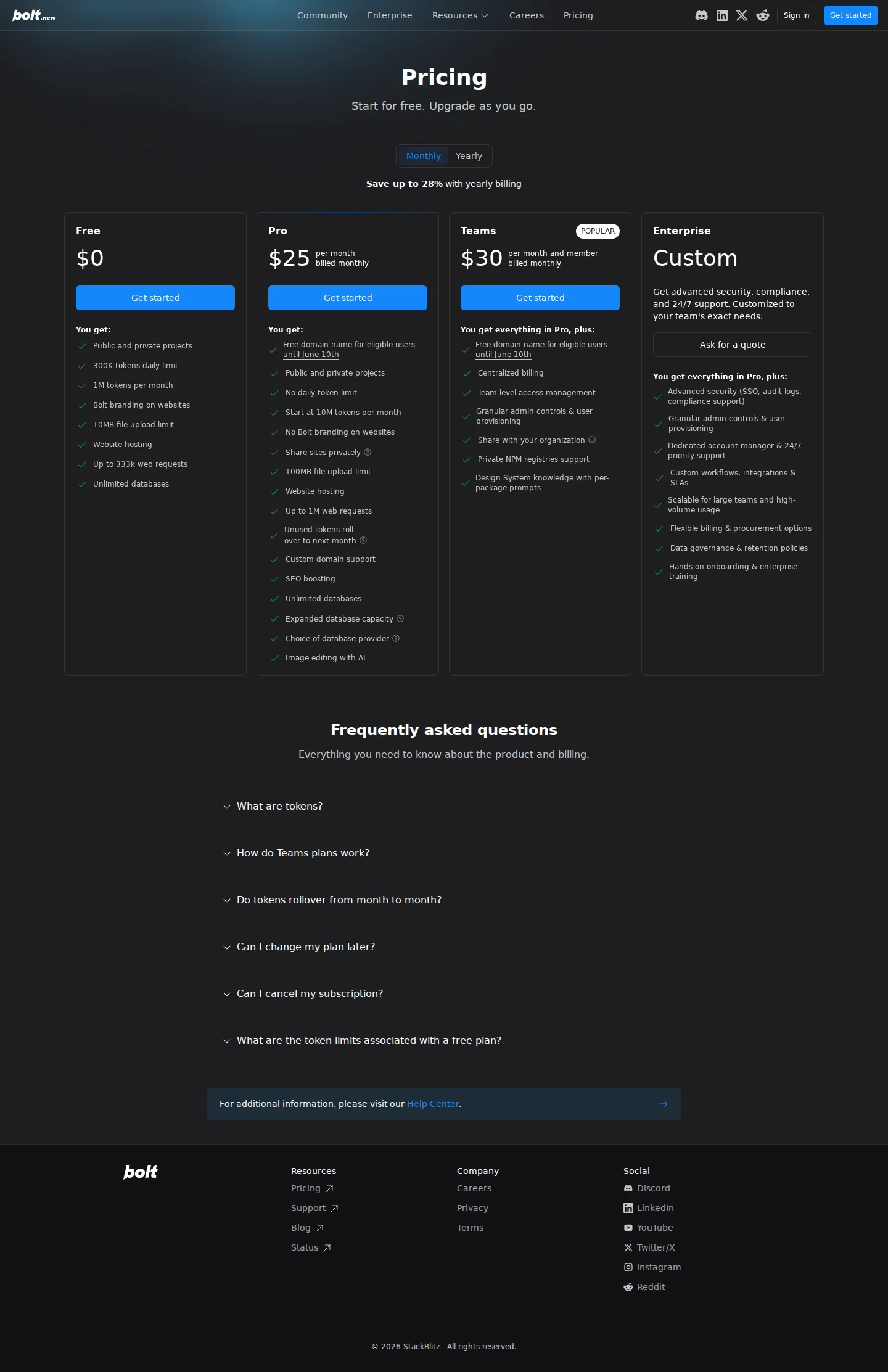
- Seat / plan fee — Free $0, Pro $25/mo, Teams $30 per member/mo, Enterprise custom. Yearly billing cuts the effective monthly rate up to 28% (Pro $18/mo, Teams $27 per member/mo).
- Token allotment — Free caps at 300K tokens/day and 1M tokens/month; Pro and above start at 10M tokens/month with no daily limit. Unused tokens on paid plans roll over to the next month.
- Other caps — file upload size (10MB Free, 100MB Pro) and web request volume (333K Free, 1M Pro) scale with the plan.
What makes this different: token rollover. Most token-metered AI tools reset the meter monthly, so a light month is forfeited; Bolt.new lets Pro and Teams customers bank unused tokens, smoothing the bill-shock risk that comes with usage-based pricing.
Pricing by product
Bolt.new (Individual plans)
| Tier | Price | Included | Key mechanics |
|---|---|---|---|
| Free | $0 | 300K tokens/day, 1M tokens/month; public + private projects; website hosting up to 333K web requests; 10MB upload; unlimited databases | Bolt branding on hosted sites; no token rollover |
| Pro | $25/mo ($18/mo billed yearly) | Starts at 10M tokens/month, no daily limit; 100MB upload; up to 1M web requests; custom domains; SEO boosting; image editing with AI | Unused tokens roll over; no Bolt branding |
Bolt.new (Business plans)
| Tier | Price | Included | Key mechanics |
|---|---|---|---|
| Teams | $30/member/mo ($27/member/mo billed yearly) | Everything in Pro, per member, plus centralized billing, team access management, granular admin controls, private NPM registries, Design System knowledge | Self-serve team setup; marked POPULAR on the pricing page |
| Enterprise | Custom (ask for a quote) | Everything in Pro plus SSO (Okta/Azure AD/SAML), SOC 2 Type 2, audit logs, BYOK deployment to your own AWS/Azure tenant, dedicated CSM, custom workflows & SLAs | Sales-led, quoted; HIPAA/FedRAMP-ready per the enterprise page |
Sales motions across products: PLG / self-serve for Free, Pro, and Teams; sales-led for Enterprise.
Hidden costs : What Bolt.new users actually pay
The $25/mo Pro headline is the floor, not the real cost. Bolt.new’s true bill is governed by token burn, and on a non-trivial app that burn is fast and lumpy. The 10M-token Pro allotment sounds large, but most token consumption is the model reading, understanding, and syncing your project files — not just your prompt — so the meter accelerates as the codebase grows. Community reports put a single complex prompt at ~200K tokens, and users describe burning through the full 10M Pro allotment in roughly three days of active development (Banani, No Code MBA).
The error-loop tax. The sharpest complaint is paying tokens to fix the AI’s own mistakes. When a generation introduces a bug, each retry re-reads the project and burns more tokens, so a single stubborn error can cost millions of tokens to resolve. Debugging sessions alone are reported at ~$14–$24 each in token-reload spend, and one Ask HN post (2025-12-19) was titled “Startup launch destroyed by Bolt.new’s AI. 10M tokens gone, no response.”
The stack tax. A functioning production app usually needs a real database, which in practice means adding Supabase Pro (~$25/mo). That pushes the realistic minimum for a shipping project to ~$50/mo before any token reloads (Vitara).
| Archetype | Plan | Token spend | Realistic monthly cost |
|---|---|---|---|
| Hobbyist / demo | Free | Within 1M/mo cap | $0 (Bolt branding stays) |
| Solo builder, light month | Pro | ≤10M (rollover absorbs spikes) | $25 |
| Solo builder, real app + DB | Pro + Supabase Pro | 10M base, occasional reload | ~$50–$70 |
| Heavy build week (error loops) | Pro + reloads | 10M base + 1–3 reloads @ $20/10M | ~$45–$85 |
| Power user | Pro (scaled tier) | up to 120M @ $200/mo, or 1,200M @ $2,000/mo | $200–$2,000 |
Token reloads are on-demand top-ups priced at $20 per 10M tokens and never expire while a paid subscription is active. Bolt does not publish the per-action token cost, so spend is hard to predict before you run a prompt.
Want to estimate your own Bolt.new bill? Use the Bolt.new pricing calculator to model token burn against your build pattern.
Pricing evolution : Bolt.new pricing history and changes
Cadence
| Quarter | Price changes | Product / SKU additions | Notes |
|---|---|---|---|
| 2024 Q4 | — | Launch | Bolt.new launches Oct 2024; Pro tier reported at $20/mo for 10M tokens, monthly reset. |
| 2025 Q3 | 0 | Token rollover | Unused paid-plan tokens begin rolling over one extra month from 2025-07-01. |
| 2026 Q1 | 1 | Teams tier | Pro shown at $25/mo; Teams tier ($30/member) live; Enterprise self-serve quote path. |
| 2026 Q2 | 0 | 0 | Structure stable across Wayback snapshots 2026-03 → 2026-06: Free / Pro $25 / Teams $30 / Enterprise. |
Tracked range: launch (2024-10) → present. Live pricing structure independently verified against Wayback snapshots for 2026-03 through 2026-06; snapshots from 2025-07 through 2026-02 archived as JS skeletons (pricing did not render), so pre-2026-03 prices below are sourced from secondary coverage and marked as such.
Notable changes
- 2024-10 — Launch. Pro reported at $20/mo for 10M tokens with a monthly reset (no rollover), tied to Claude 3.5 Sonnet inference (Contrary Research). Secondary source; not preserved in a readable Wayback snapshot.
- 2025-07-01 — Token rollover introduced. Unused tokens on paid subscriptions begin carrying over for one additional month (valid up to two months total) — a direct response to the “tokens reset and I lose them” complaint (Bolt support docs).
- By 2026-03 — Pro list price observed at $25/mo in Wayback snapshots (up from the $20 launch price), with the Teams tier ($30/member) and token reloads ($20 per 10M) live. Verified via the readable 2026-03
bolt.new/pricingsnapshot. - 2026-03 → 2026-06 — No change. Free $0 / Pro $25 / Teams $30 / Enterprise custom held steady across four consecutive monthly Wayback snapshots and the live capture.
What’s unique : Bolt.new’s distinctive pricing mechanics
1. Tokens, not seats or outputs, are the meter. Bolt prices the AI’s work — every read, generation, and edit consumes tokens — so the bill tracks how hard the model labors on your codebase rather than how many people log in. Eric Simons calls this “selling inference,” and StackBlitz was early to wire a self-serve token-based meter directly on top of frontier-model inference cost. The flat seat fee just buys an allowance; the real variable is burn.
2. Token rollover — an unusual softener. Most token-metered AI tools reset the meter monthly, so a light month is forfeited. Bolt rolls unused paid-plan tokens forward one extra month (live since 2025-07-01). It’s a small concession that materially changes the buyer’s mental model: tokens feel banked rather than rented, which dampens the “use it or lose it” pressure that drives bill-shock resentment.
3. WebContainers as the cost lever. Bolt runs a full Node.js stack in the browser via StackBlitz’s WebContainers (a Rust/WASM kernel that cold-boots under 10MB), so the runtime and hosting happen on the user’s own CPU. That removes a whole layer of server-side compute cost that rivals carry, letting Bolt spend its margin almost entirely on model inference — the thing it actually meters and resells.
Strengths & weaknesses
| Strengths | Weaknesses |
|---|---|
| Generous, genuinely usable free tier (1M tokens/mo) lowers the trial barrier and fueled $0→$20M ARR in ~2 months | Token burn is fast and opaque — the per-action token cost is unpublished, and a complex prompt can eat ~200K tokens, so spend is hard to predict before you run it |
| Token rollover on paid plans removes the “use it or lose it” penalty most metered tools impose | The error-loop tax — users pay tokens to fix the AI’s own mistakes; one stubborn bug can drain millions of tokens, the loudest community complaint |
| Self-serve, transparent list prices on Free/Pro/Teams; only Enterprise is quote-gated | Headline price is misleading — $25 Pro is a floor; a shipping app realistically needs ~$50/mo once Supabase Pro and token reloads are added |
| WebContainers push runtime/hosting onto the user’s CPU, keeping Bolt’s costs concentrated on inference it resells | 10M Pro allotment exhausts quickly on real projects (reportedly ~3 days of active dev), pushing serious builders into $20/10M reloads or $200–$2,000 power tiers |
Billing UX : token rollover, yearly toggle, and centralized team billing
- Monthly / Yearly toggle — the pricing page has a billing-period switch; yearly billing is advertised as saving “up to 28%” and lowers the displayed per-month rate (Pro $25 → $18, Teams $30 → $27 per member).
- Token rollover — on Pro and Teams, unused monthly tokens carry over to the next month, so under-utilized months are not forfeited (the pricing card calls this out explicitly with an info tooltip).
- Daily vs monthly token caps — Free enforces both a 300K daily and 1M monthly ceiling; paid plans remove the daily limit, leaving only the monthly allotment.
- Centralized billing (Teams) — the Teams plan consolidates billing across members and adds team-level access management plus granular admin controls and user provisioning.
- Flexible billing & procurement (Enterprise) — Enterprise adds flexible billing and procurement options, data governance/retention policies, and “no surprise overages or interrupted workflows” per the enterprise page.
- Self-serve upgrade — every paid plan exposes a “Get started” CTA for self-serve checkout; only Enterprise routes to “Ask for a quote.”
Strategic wins : Why Bolt.new’s pricing decisions worked
1. Metering inference directly turned a cost line into the revenue line
Bolt’s core bet was to price the exact thing that costs it money — model inference — and resell it on a meter. That alignment is why ARR scaled with usage almost mechanically: more building meant more tokens meant more revenue, with no seat-expansion lag. It’s a textbook case of choosing the value metric that is the cost driver. See choosing the right usage metric for why this alignment matters.
2. A fat free tier as the top of a usage funnel
Giving away 1M tokens/month is expensive, but it let Bolt convert the viral October-2024 launch into paying users at remarkable speed ($60K ARR on day one, $20M in two months). The free allotment is large enough to ship a real demo, which is exactly the moment a builder hits the daily cap and upgrades — a deliberate usage-based pricing funnel where the product sells itself by running out. Related: how AI companies are shifting away from per-user licenses.
3. Rollover defused the metered-pricing trust problem early
Token-metered tools live or die on whether buyers trust the meter. Adding rollover (2025-07) before the backlash fully metastasized was a cheap, high-signal move: it told users “we won’t punish a quiet month,” softening the bill-shock anxiety that otherwise stalls adoption of consumption pricing.
Areas to improve : Gaps in Bolt.new’s pricing approach
1. Make token cost legible before the prompt runs
The single biggest complaint is that token spend is unpredictable: Bolt doesn’t publish a per-action cost, and most burn comes from the model re-reading project files, not the visible prompt. A live “this prompt will cost ~X tokens” estimate, or a per-prompt cap, would convert the opaque meter into something buyers can plan around — the core fix for bill-shock and cost unpredictability.
2. Don’t charge full price for the AI’s own mistakes
The error-loop tax — paying millions of tokens to fix bugs the model introduced — reads to users as being billed for the vendor’s defects. A retry credit, a discounted “fix” mode, or capped charges on failed generations would directly address the loudest thread of community frustration and the “10M tokens gone” incident reports.
3. Acknowledge the true cost of a shipping app
The $25 Pro headline understates the ~$50/mo a real, database-backed project costs once Supabase Pro and reloads are factored in. A documented “what a production app actually costs” reference — or a first-party bundled database — would close the gap between marketing and the bill, and reduce the “more expensive than advertised” sentiment.
Monetization stack & signals : how Bolt.new builds & buys its revenue engine
Buys 0 Builds 2
Builds the spine behind its own usage pricing in-house: a StackBlitz engineering case study credits Rails for letting the team ship token-purchase billing on demand, and the token meter that runs Bolt's pricing is first-party, not a Metronome/Orb buy. No public ATS to read hiring from.
-
“when users started running out of tokens and demanded the opportunity to buy more, the team was able to quickly implement new billing options thanks to Rails' flexibility and reliability.”
-
“Ruby powers the core backend of the web applications: users, permissions, billing, and other core business logic beyond the WebAssembly magic is written in Ruby and benefits from the reliability and scalability of Rails.”
Signals reviewed · derived from engineering blogs
Key takeaways
- Bolt.new bills on tokens, not seats. A flat plan fee (Free $0, Pro $25/mo, Teams $30/member, Enterprise custom) buys a monthly token allowance; the real cost driver is how much the AI reads, writes, and edits.
- The headline price is a floor. Pro is $25/mo, but a database-backed app that actually ships realistically runs ~$50/mo once Supabase Pro and on-demand token reloads ($20 per 10M) are added.
- Token rollover is the differentiating softener. Paid plans carry unused tokens forward one extra month (since 2025-07), unlike most metered AI tools that reset to zero — a deliberate counter to bill-shock distrust.
- Token burn is fast and opaque. Real projects can exhaust the 10M Pro allotment in ~3 days; the per-action cost is unpublished, and the “error-loop tax” of paying to fix the AI’s mistakes is the loudest community grievance.
- The model scaled because it metered its own cost. Pricing inference directly let revenue track usage with no seat lag — a big reason Bolt went $0→$20M ARR in roughly two months and ~$40M by March 2025.
UBP implications
- Meter the cost driver itself. Bolt’s cleanest win is pricing the exact thing it pays for — inference. When your value metric is your COGS, revenue scales with usage automatically and gross margin stays legible; this is the alignment most consumption-pricing teams chase.
- A metered model needs a trust valve. Rollover, retry credits, and pre-prompt cost estimates aren’t niceties — for usage pricing they’re the difference between adoption and backlash. Bolt’s token-burn complaints show what happens when the meter feels punitive: the “error-loop tax” became its defining UX criticism even as ARR soared.
- Cost opacity caps trust before it caps revenue. Bolt’s refusal to publish per-action token cost makes spend unpredictable, which is fine at viral-launch velocity but becomes the ceiling on enterprise and serious-builder trust. Transparency about what an action costs is itself a feature in usage-based pricing.
Sources
- Bolt.new pricing page (accessed 2026-06-08)
- Bolt.new enterprise page (accessed 2026-06-08)
- Bolt support — Tokens (accessed 2026-06-08)
- Bolt support — Maximizing token efficiency (accessed 2026-06-08)
- Bolt.new official website (accessed 2026-06-08)
Bottom line
Bolt.new is one of the clearest case studies in metering AI inference directly. By making tokens — the AI’s own cost — the value metric, StackBlitz tied revenue to usage and scaled from $0 to ~$20M ARR in about two months. The flat $25 Pro headline is just an entry fee; the real bill is governed by token burn, which on a serious project is fast, lumpy, and (per the community) frustratingly opaque. Token rollover softens the edges, but the unpublished per-action cost and the “error-loop tax” remain the model’s weak points. The lesson for anyone building usage-based pricing: aligning your meter with your cost driver is powerful, but it only holds if buyers can see — and trust — what each action costs.
Want to compare Bolt.new against other AI coding and developer-tools companies? Browse the pricing blueprint.
Pricing timeline : Major events on a vertical axis
Each milestone below corresponds to a public pricing change, product launch, or material adjustment. Major events use a filled marker; minor adjustments use a faded one.
Current plan structure: Free / Pro / Teams / Enterprise
Four tiers. Free $0 (300K daily / 1M monthly tokens). Pro $25/mo ($18 billed yearly), starting at 10M tokens/month with rollover and no daily limit. Teams $30/member/mo ($27 billed yearly). Enterprise custom with SSO, SOC 2, and BYOK deployment. Structure verified against Wayback snapshots 2026-03 through 2026-06.
Token rollover introduced on paid plans
Unused tokens on paid subscriptions begin rolling over one additional month (valid up to two months), softening the monthly-reset bill-shock complaint. Source: Bolt support docs.
Launch: Pro at $20/mo for 10M tokens (monthly reset)
Bolt.new launches from StackBlitz. Pro reported at $20/mo for 10M tokens with a monthly reset and no rollover, billed against Claude 3.5 Sonnet inference. Secondary source (Contrary Research); not preserved in a readable Wayback snapshot.
- · Bolt.new bills on tokens — the AI's usage unit — not lines of code. Free gives 300K tokens/day and 1M/month; Pro starts at 10M tokens/month with no daily cap.
- · Unused Pro and Teams tokens roll over to the next month, an unusual softener for a token-metered AI tool where most rivals reset the meter monthly.
- · Bolt.new is built by StackBlitz — the pricing page footer reads © 2026 StackBlitz — making it a product brand rather than a separate corporate entity.
Questions & answers
- How much does Bolt.new cost?
- Bolt.new has four plans: Free ($0), Pro ($25/mo or $18/mo billed yearly), Teams ($30 per member/mo or $27 billed yearly), and Enterprise (custom quote). Yearly billing saves up to 28%.
- Does Bolt.new have a free tier?
- Yes. The Free plan is $0 and includes 300K tokens per day, 1M tokens per month, public and private projects, website hosting, and unlimited databases, with Bolt branding on hosted sites.
- What are tokens on Bolt.new?
- Tokens are Bolt.new's usage unit, consumed as the AI generates and edits your application. Free is capped at 300K/day and 1M/month; Pro starts at 10M tokens/month with no daily limit and unused tokens roll over.
- Do unused Bolt.new tokens roll over?
- Yes, on paid plans. Pro and above carry unused monthly tokens over to the next month, so a light usage month is not lost. The Free plan does not roll tokens over.
- Is Bolt.new the same as StackBlitz?
- Bolt.new is a product built by StackBlitz. Billing and the corporate entity (the © 2026 StackBlitz footer on the pricing page) are StackBlitz; Bolt.new is the AI app-generation surface.