AI Summary
About
Byword is an AI content platform built for programmatic and editorial SEO. It researches what to write about, generates long-form articles designed to rank, scores them for SEO in real time, and publishes them directly into CMSes like WordPress, Webflow, Ghost, HubSpot and Medium — plus thousands of apps via webhooks and Zapier. The product spans five surfaces marketed as Research Intelligence, AI Generation, Smart Optimization, Programmatic SEO and Pages, positioning Byword as an end-to-end “research → write → optimize → publish” content engine rather than a single-shot writing assistant.
The company is a bootstrapped, founder-led business — Mack Grenfell launched Byword around 2021-2022 and scaled it without venture funding, reportedly past $1M ARR and 50,000+ users by late 2024 (Starter Story). Its pricing page now cites 85,000+ users, 3M+ articles generated and support for 47 languages, with social proof from marketing strategists and healthcare-SEO practitioners. The platform is GCP-hosted (London region, 99.98% advertised uptime) with SOC 2 and GDPR posture; bring-your-own-model API keys are encrypted with AES-256 in Google Cloud Secret Manager. Byword serves solo SEOs and bloggers at the entry tier and scales up to content teams and multi-client agencies running programmatic-SEO campaigns.
Byword competes with AI-writing and programmatic-SEO tools by anchoring on the unit buyers actually care about — a finished, publishable article — and pricing per article rather than per word or per token. Its standout structural move is offering both a managed credit model (Byword absorbs model costs inside a per-article price) and a bring-your-own-API “Unlimited” model that strips out markup entirely for the highest-volume customers.
Pricing summary : How Byword’s article-credit and BYO-API model works
Byword uses a hybrid article-credit model with three dimensions, layered on top of a freemium entry point:
- Monthly article credits (the core meter): Each paid plan bundles a fixed number of articles per month — Starter 25, Standard 80, Scale 300. On monthly billing the plans cost $99, $299 and $999; annual billing lowers them by ~17% to $83, $249 and $833 per month. Credits accumulate rather than expiring.
- Per-article overage: Articles beyond the monthly allotment are billed per article at a rate that falls as you climb tiers — $3.50 (Starter), $3.00 (Standard), $2.50 (Scale). The Free tier’s implied credit price is $5.00 per article.
- Team seats: Standard includes 3 seats (+$25 each), Scale includes 10 seats (+$20 each). Starter is solo-use only.
A fourth, separate path exists for high volume: Byword Unlimited is a flat $1,999/mo platform fee with no credit caps and unlimited seats, where customers connect their own Anthropic Claude and Google Gemini API keys and pay the model providers directly at roughly $0.10/article.
What makes this different: Byword sells the same product two ways — a managed credit-based model where it marks up model costs inside a per-article price, and a bring-your-own-API Unlimited plan that removes the markup entirely once article volume makes the flat platform fee cheaper than buying credits.
Pricing by product
Byword content plans (Individual & team)
| Tier | Price (monthly) | Included | Key mechanics |
|---|---|---|---|
| Free | $0 | 5 lifetime free articles, 3 domains, all AI models, basic voice matching & research | No credit card; one-time allowance, not monthly |
| Starter | $99 / mo | 25 articles/month, solo use, 5 domains, Research + Optimize | $3.50 per extra article; solo only |
| Standard | $299 / mo | 80 articles/month, 3 team seats, unlimited domains, API access | ”Most popular tier”; $3.00 per extra article; +$25/seat |
| Scale | $999 / mo | 300 articles/month, 10 team seats, unlimited domains, priority support | $2.50 per extra article; +$20/seat |
Annual billing reduces the per-month price by ~17%: Starter $83/mo (save $198/yr), Standard $249/mo (save $598/yr), Scale $833/mo (save $1,998/yr). Per-article overage rates are unchanged by billing cadence.
Byword Unlimited (bring-your-own-API)
| Tier | Price | Included | Key mechanics |
|---|---|---|---|
| Unlimited | $1,999 / mo | Unlimited articles, unlimited team seats, all integrations, dedicated infrastructure | BYO Claude + Gemini keys; ~$0.10/article paid to providers; zero Byword markup; “everything in Scale” |
Byword markets Unlimited as paying for itself at ~400 articles/month. Its published savings math: Scale = $999 + (articles − 300) × $2.50; Unlimited = $1,999 + articles × $0.10. Targeted at multi-client agencies generating 500+ articles/mo.
Per-article credit price by tier
| Tier | Credit price per article | Monthly articles included | Extra-article rate |
|---|---|---|---|
| Free | $5.00 | 5 (lifetime) | — |
| Starter | $3.50 | 25 | $3.50 |
| Standard | $3.00 | 80 | $3.00 |
| Scale | $2.50 | 300 | $2.50 |
| Unlimited | ~$0.10 (BYO-API at cost) | unlimited | n/a |
Sales motions across products: PLG / self-serve for Free, Starter, Standard and Scale (sign up, 5 free articles, pay online); sales-led / contact-sales for Byword Unlimited (high-volume agency motion with a “Contact sales” path).
Hidden costs : What heavy and team users actually pay per article
The advertised plan prices understate what high-volume and multi-seat teams actually pay, because both extra articles and extra seats bill on top of the base fee. Modeling two realistic archetypes shows where the meter runs.
A 5-seat team on Standard generating 150 articles/month
| Line item | Monthly cost |
|---|---|
| Standard base plan (80 articles, 3 seats) | $299 |
| 70 extra articles × $3.00 | $210 |
| 2 extra seats × $25 | $50 |
| Total | $559 |
At this volume the extra-article overage alone ($210) approaches the base plan fee. This is the classic overage-creep trap — the buyer signed up for a $299 plan and is paying $559 — and it is exactly the band where the next tier (Scale, $999 base / $2.50 overage) starts to make sense.
An agency generating 1,000 articles/month: Scale vs Unlimited
Byword’s own savings calculator publishes the crossover math directly. At 1,000 articles/month:
| Line item | Scale plan | Byword Unlimited |
|---|---|---|
| Base / platform fee | $999 | $1,999 |
| Articles | 700 extra × $2.50 = $1,750 | 1,000 × ~$0.10 = $100 (paid to Claude/Gemini) |
| Total / month | $2,749 | $2,099 |
| Effective cost per article | $2.75 | ~$2.10 |
Byword’s published formulas are Scale = $999 + (articles − 300) × $2.50 and Unlimited = $1,999 + articles × $0.10, which cross at roughly 400 articles/month. At 1,000/mo Unlimited saves ~$650/mo ($7,800/yr); Byword markets ~$10,250/mo of savings at 5,000 articles and ~$22,250/mo at 10,000. The hidden cost flips polarity here: the “hidden” expense for a high-volume agency is staying on Scale and paying $2.50/article overage when a flat $1,999 platform fee plus at-cost model spend would be far cheaper. The catch is that Unlimited shifts model-cost volatility and API-key management onto the buyer — a tradeoff worth weighing against marked-up vs at-cost AI billing.
Want to estimate your own Byword bill? Use the Byword pricing calculator to model your monthly cost based on article volume, seats and the Scale-vs-Unlimited crossover.
Pricing evolution : From article-credit tiers toward bring-your-own-model unlimited
Byword’s three core article tiers ($99 / $299 / $999) have been remarkably stable since 2023 — every price move and SKU change has happened at the top of the line (the unlimited / managed tiers) or in the packaging mechanics (overage, seats, billing cadence) rather than the headline subscription prices.
Cadence
| Quarter | Price changes | Product / SKU additions | Notes |
|---|---|---|---|
| 2023 Q4 | 0 | 0 | Earliest archive (2023-12-07): $5/article pay-as-you-go + Starter $99 / Standard $299 / Scale $999, plus Unlimited $2,499/mo and managed Unlimited Plus $9,999/mo; GPT-4 powered |
| 2024 Q4 | 1 | 1 | Unlimited cut $2,499 → $1,999/mo; the $9,999 Unlimited Plus replaced by a sales-led Managed tier from $3,999/mo + $999 onboarding (2024-12-03) |
| 2026 Q2 | 0 | 1 | Pricing-page rebuild (2026-06-07): added per-extra-article overage, team seats, domain tiers, annual/monthly toggle (~17% off) and accumulating credits; BYO-API stack moved GPT-4 → Claude + Gemini; standalone Managed tier no longer public |
Tracked range: 2023-12 to 2026-06. Quarters not listed were not independently archived in a fully-rendered state (several 2024–2025 snapshots returned JS skeletons and were not used for price claims).
Notable changes
- 2023-12 — Earliest archived pricing: $5/article pay-as-you-go, four subscription tiers, and a top-end split between self-serve Unlimited ($2,499/mo, BYO API keys) and fully-managed Unlimited Plus ($9,999/mo). Source: web.archive.org snapshot of byword.ai/pricing.
- 2024-12 — Unlimited repriced down to $1,999/mo; Unlimited Plus retired in favor of a “Managed” tier from $3,999/mo plus a $999 onboarding fee. Source: web.archive.org snapshot.
- 2026-06 — Full rebuild of the public pricing page: per-extra-article overage, per-seat add-ons, domain tiering, a monthly/annual toggle (~17% annual saving), accumulating credits, and a migration of the BYO-API model stack from OpenAI GPT-4 to Anthropic Claude + Google Gemini at ~$0.10/article. Source: byword.ai/pricing.
The Unlimited tier’s evolution in detail
Byword’s most interesting pricing motion sits entirely at the top of its lineup. The bring-your-own-API idea — pay a flat platform fee, plug in your own model keys, pay providers at cost — is not a 2026 invention: the December 2023 archive already described an Unlimited plan where customers “work off your own API keys,” priced at $2,499/mo on a dedicated server. Over three years the company did three things to it: (1) lowered the platform fee from $2,499 to $1,999/mo as model costs fell; (2) collapsed the managed offering, swapping a $9,999/mo “Unlimited Plus” for a leaner “Managed from $3,999/mo + $999 onboarding,” then dropping it from the public page entirely by 2026; and (3) swapped the underlying models from OpenAI GPT-4 to Anthropic Claude + Google Gemini, which is what pushed the at-cost per-article figure down to ~$0.10. The net effect is that the at-cost Unlimited tier got cheaper and simpler over time while the managed, high-touch end of the line was deprecated — a deliberate tilt toward self-serve, usage-aligned billing.
What’s unique : Article-unit pricing and a dual managed/BYO-API model
1. Pricing on the finished article, not words or tokens. Byword meters the unit buyers compare against freelancers — a complete, publishable article — rather than words or tokens, making per-article cost directly comparable to a freelance rate.
2. A marginal price that falls with scale. The per-article credit price drops from $3.50 (Starter) to $2.50 (Scale), and credits accumulate rather than expiring, rewarding heavier and steadier buyers.
3. The same product sold two ways. Byword offers both a managed credit model (model costs marked up inside the per-article price) and a bring-your-own-API Unlimited plan that removes the markup entirely once volume justifies the flat $1,999/mo platform fee.
Strengths & weaknesses
| Strengths | Weaknesses |
|---|---|
| Article-unit pricing maps directly to a freelance-rate comparison | Free tier is only 5 lifetime articles, not a recurring allowance |
| Marginal per-article price falls as tiers climb | Large gaps between tiers ($99 → $299 → $999) can over/under-serve |
| BYO-API Unlimited removes markup for high-volume buyers | Unlimited shifts model-cost risk and key management to the buyer |
| Credits accumulate instead of expiring | Seats are extra on every tier; Starter is solo-only |
Billing UX : Monthly/annual toggle, accumulating credits and a BYO-key flow
- Monthly / Annual billing toggle — the pricing page switches all tiers between monthly and annual rates inline, with an explicit “Save 17% with annual billing” label and per-tier annual-savings callouts (“Save $198/yr”, “Save $598/yr”, “Save $1,998/yr”).
- Accumulating article credits — the comparison table states “Credits accumulate,” so unused monthly article credits carry forward instead of expiring at cycle end.
- Per-extra-article overage — articles beyond the monthly allotment bill at the plan’s stated extra-article rate ($3.50 / $3.00 / $2.50), shown directly on each plan card.
- Per-seat add-on pricing — extra team seats are surfaced inline on the plan cards and comparison table (+$25/seat on Standard, +$20/seat on Scale).
- Bring-your-own-API key flow (Unlimited) — Unlimited customers add their Anthropic Claude and Google Gemini keys, which Byword encrypts with AES-256 and stores in Google Cloud Secret Manager; billing for generation then flows to the model providers directly at ~$0.10/article.
- Savings calculator (Unlimited page) — an interactive volume slider on the Unlimited page models Scale-plan cost vs Unlimited cost at 500–25,000 articles/month and shows the crossover (~400 articles/mo).
Strategic wins : Pricing decisions that work in Byword’s favor
1. Pricing the article, not the token
Byword anchors its price on a finished article, the unit buyers already benchmark against freelancers ($50–200 each, per Byword’s own FAQ) — a value-metric choice explored in our usage-based pricing fundamentals guide. This makes the comparison instant: a $3 article reads as a 95% discount to a freelancer, which is a far easier sell than a per-token quote, a theme we cover in how to price AI products buyers actually understand.
2. A falling marginal price that rewards scale
Dropping per-article cost from $3.50 to $2.50 across tiers gives heavier buyers a built-in volume discount without negotiation, echoing the volume-tier logic in usage-based pricing models. Combined with non-expiring credits, it nudges buyers up-tier rather than churning when usage is lumpy.
3. A bring-your-own-API escape hatch at the top
The $1,999/mo Unlimited plan lets Byword keep its highest-volume agencies instead of losing them to direct API use — a retention pattern relevant to anyone weighing marked-up vs at-cost AI billing. Crucially, Byword passes its own model-cost deflation straight through: when GPT-4 gave way to cheaper Claude/Gemini calls, the at-cost figure fell to ~$0.10/article, making Unlimited more attractive without Byword cutting its own platform fee.
4. Keeping the core three tiers price-stable for years
Starter $99, Standard $299 and Scale $999 have not moved since at least 2023. Holding the headline prices constant while restructuring overage, seats and the unlimited end of the line gives existing customers predictability and lets Byword experiment at the margins — a discipline many AI tools lack as covered in our usage-based pricing models analysis.
Areas to improve : Gaps in Byword’s pricing and proposed fixes
1. The lifetime free tier limits trial confidence
Five lifetime articles is a thin runway for a product whose value compounds with volume; a small recurring monthly free allowance (even 1–2 articles/month) could lift trial-to-paid conversion by letting prospects keep the habit alive, as discussed in our pricing metric selection guidance.
2. Wide gaps between tiers can strand mid-volume buyers
The $99 → $299 → $999 jumps leave a buyer needing ~150 articles overpaying on Standard overage or jumping to Scale; an intermediate tier or smoother overage curve would fit them better.
3. Seats billed on every tier raise the team entry cost
Starter is solo-only and every additional seat costs $20–$25/mo, so small teams hit add-on costs early; bundling a couple of seats into Starter would lower the team-adoption barrier.
Key takeaways
- Price the buyer’s unit of value. Byword meters finished articles, not tokens, so its price is directly comparable to a freelancer’s rate.
- Let the marginal price fall with scale. Dropping per-article cost from $3.50 to $2.50 across tiers rewards heavier commitment.
- Offer a BYO-cost escape hatch at high volume. The $1,999/mo Unlimited plan removes markup once volume makes the flat fee cheaper than credits.
- Make credits durable. Accumulating (non-expiring) credits reduces buyer anxiety about wasted spend.
- Show the crossover explicitly. Byword’s savings calculator surfaces exactly when Unlimited beats Scale, reducing decision friction.
UBP implications
- Outcome-adjacent units beat raw consumption units. Pricing per article lands closer to perceived value than per-token metering.
- Dual managed/BYO-API models can coexist. Vendors can capture markup at low volume and switch to a thin platform fee at high volume without abandoning either segment.
- Accumulating credits change the UBP psychology. Non-expiring credits soften the “use-it-or-lose-it” friction that pure metered models create.
Sources
- Byword pricing page (accessed 2026-06-07)
- Byword Unlimited plan page (accessed 2026-06-07)
- Byword changelog (accessed 2026-06-07)
Bottom line
Byword prices on the unit its buyers actually compare against a freelancer — a finished, publishable article — selling 25 to 300 monthly article credits across $99–$999/mo tiers with a marginal price that falls as you scale, then offering a $1,999/mo bring-your-own-API Unlimited plan that strips out markup entirely for the highest-volume agencies.
Want to compare Byword against other AI content and usage-based pricing models? Browse the pricing blueprint.
Pricing timeline : Major events on a vertical axis
Each milestone below corresponds to a public pricing change, product launch, or material adjustment. Major events use a filled marker; minor adjustments use a faded one.
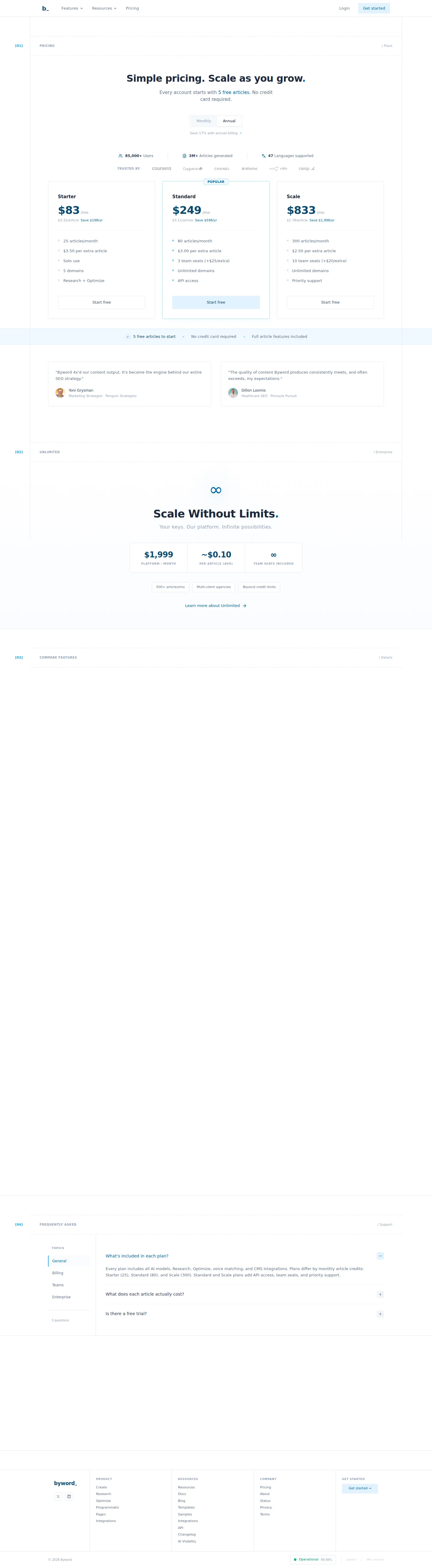
Credit-priced rebuild: per-article overage, seats, annual billing, Claude+Gemini BYO-API
A full pricing-page rebuild. The three tiers now expose marginal per-article rates ($3.50/$3.00/$2.50) and per-extra-article overage, add team seats (Standard 3 +$25/ea, Scale 10 +$20/ea) and domain tiering, introduce a monthly/annual toggle (~17% off; Starter $83, Standard $249, Scale $833) and accumulating non-expiring credits. Unlimited stays $1,999/mo but the BYO-API stack moves from OpenAI/GPT-4 to Anthropic Claude + Google Gemini at ~$0.10/article. The standalone 'Managed' tier is no longer on the public pricing page. Source: byword.ai/pricing captured 2026-06-07.
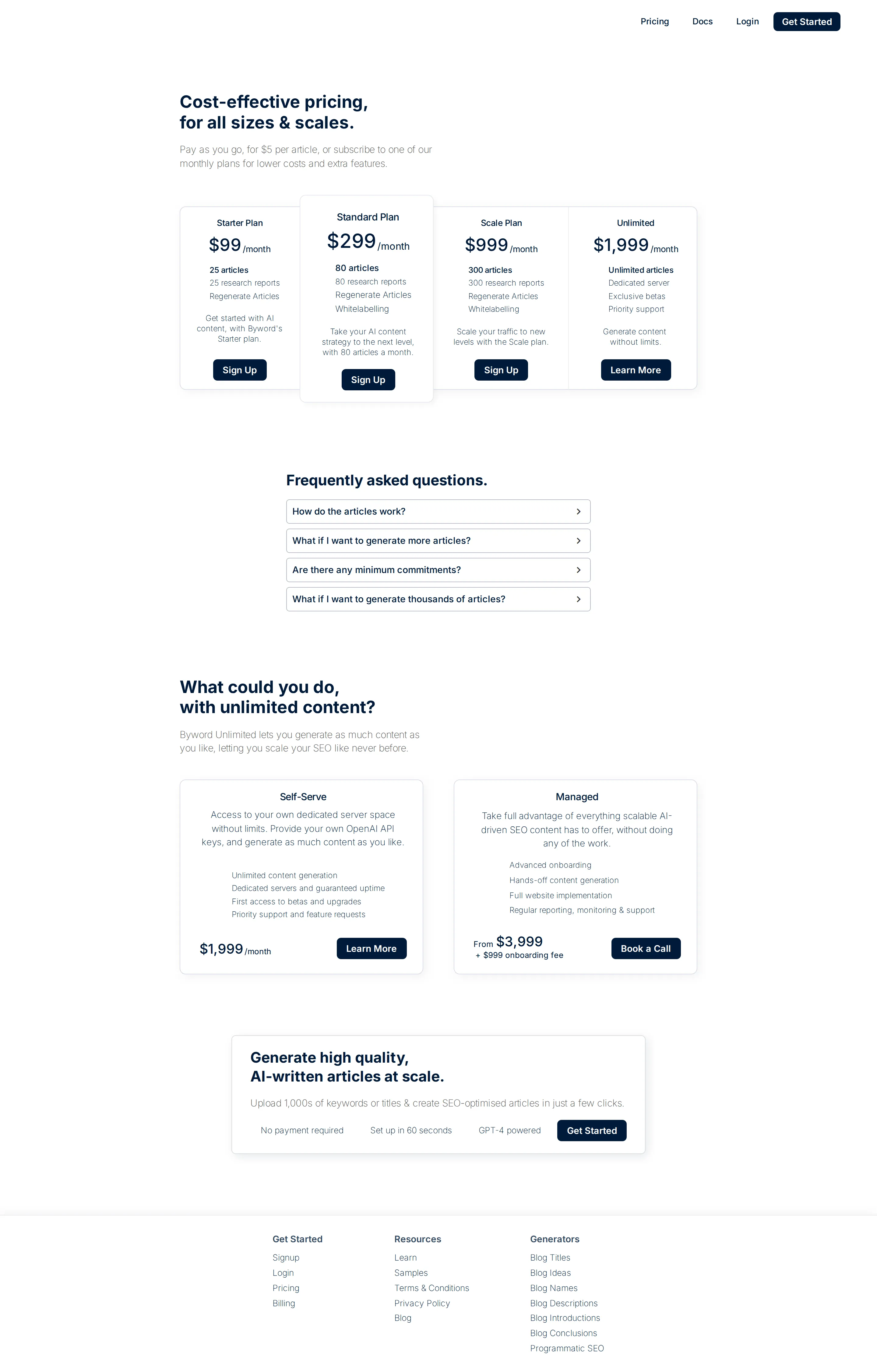
Unlimited cut to $1,999; Unlimited Plus replaced by Managed $3,999
The $99/$299/$999 article tiers and $5 pay-as-you-go held steady, but the top of the line was restructured: Unlimited dropped from $2,499 to $1,999/mo (self-serve, bring-your-own OpenAI API keys), and the $9,999 Unlimited Plus was replaced by a sales-led 'Managed' tier from $3,999/mo plus a $999 onboarding fee. Still GPT-4 powered. Source: web.archive.org snapshot 2024-12-03.
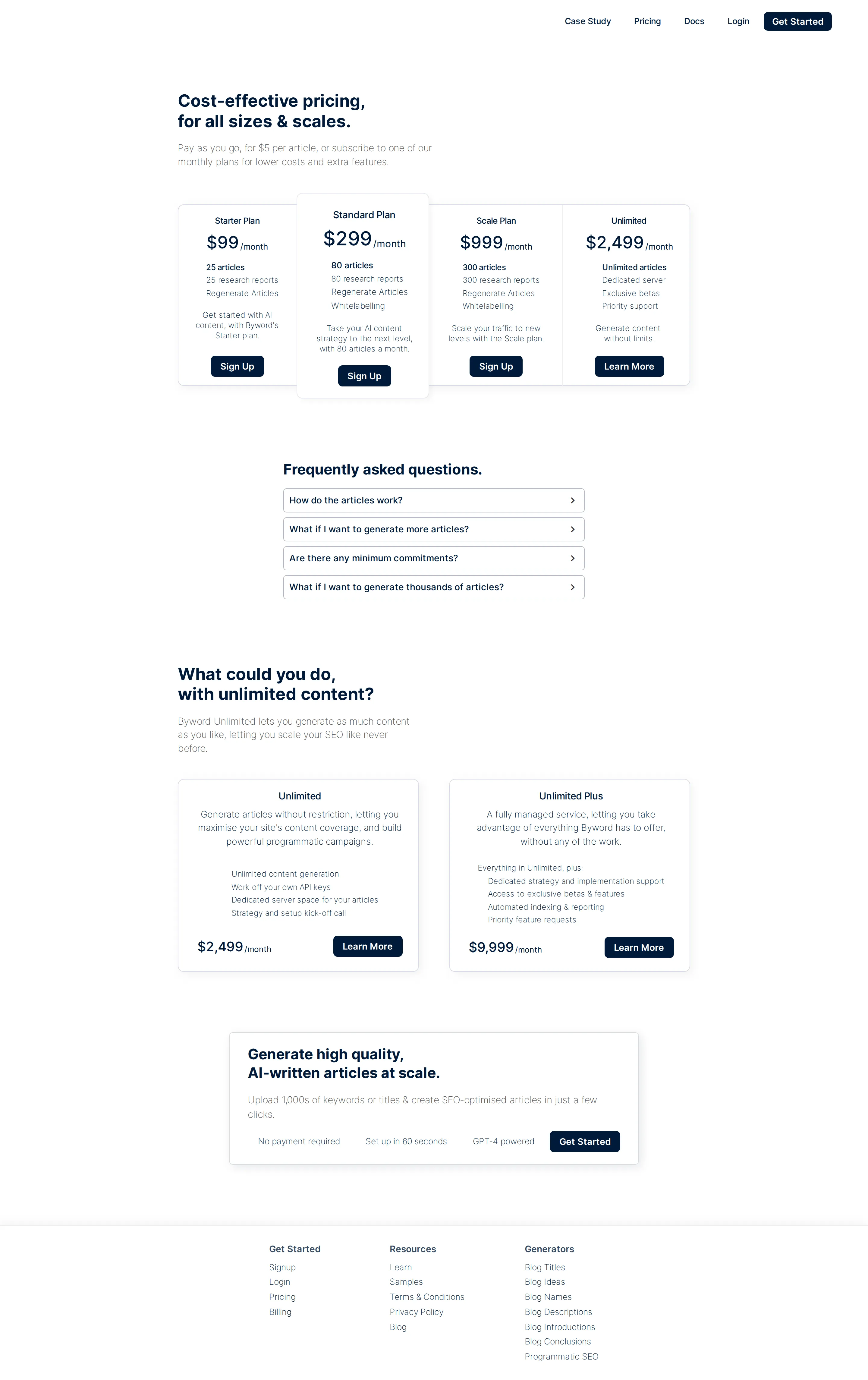
Pay-as-you-go $5/article + four subscription tiers
Earliest archived structure: pay-as-you-go at $5 per article plus Starter $99 (25 articles), Standard $299 (80), Scale $999 (300), each bundling matching 'research reports' and whitelabelling on Standard+. Two unlimited paths sat on top — Unlimited $2,499/mo (dedicated server, 'work off your own API keys') and a fully-managed Unlimited Plus at $9,999/mo. Marketed as 'GPT-4 powered.' Source: web.archive.org snapshot of byword.ai/pricing 2023-12-07.
- · Byword was bootstrapped by Mack Grenfell (Oxford physics/philosophy, ex-Goldman Sachs, ex-CERN intern), founded around 2021-2022 and reportedly past $1M ARR with 50,000+ users by late 2024 — no VC funding.
- · The bring-your-own-API idea is not new: a December 2023 archive of Byword's pricing already offered an Unlimited plan where you 'work off your own API keys' — back then it cost $2,499/mo and ran on GPT-4.
- · Byword's Unlimited tier got cheaper over time — $2,499/mo in 2023, $1,999/mo by 2024 — while the BYO model stack quietly migrated from OpenAI's GPT-4 to Anthropic Claude + Google Gemini by 2026.
Questions & answers
- Does Byword have a free trial?
- Yes. Every new account gets 5 free articles immediately with no credit card required, enough to test voice matching, research and the output quality before choosing a plan.
- How much does Byword cost per month?
- On monthly billing, Starter is $99 (25 articles), Standard is $299 (80 articles) and Scale is $999 (300 articles). Annual billing lowers these to $83, $249 and $833 per month respectively.
- What does a Byword article actually cost?
- Each article drawn from your monthly credits costs between $2.50 and $3.50 depending on plan. Articles beyond your allotment are billed at the same per-extra-article rate ($3.50 Starter, $3.00 Standard, $2.50 Scale).
- What is Byword Unlimited?
- Byword Unlimited is a $1,999/mo plan with no article credit limits and unlimited team seats. You connect your own Anthropic Claude and Google Gemini API keys and pay those providers directly at roughly $0.10 per article, with no Byword markup.
- Do Byword credits expire?
- No. The pricing page states that monthly article credits accumulate rather than expiring at the end of the billing cycle.
- Has Byword's pricing changed over time?
- The three core tiers ($99/$299/$999) have held steady since at least 2023. The unlimited tier dropped from $2,499/mo (2023) to $1,999/mo (2024), a separate $9,999/mo managed plan was retired, and the BYO-API model stack moved from OpenAI GPT-4 to Anthropic Claude and Google Gemini by 2026.