AI Summary
About
DeepSeek (深度求索) is a Chinese AI research laboratory founded in July 2023 by Liang Wenfeng, who also founded High-Flyer Capital Management, a quantitative hedge fund. Unlike most AI labs that are independent startups or big-tech subsidiaries, DeepSeek is a research organization funded by a profitable hedge fund — giving it unusual financial autonomy from external investor pressure and quarterly revenue expectations.
DeepSeek’s impact on the global AI industry vastly outstrips its commercial scale. The January 2025 release of DeepSeek-R1 — a reasoning model competitive with OpenAI o1 at roughly 1/30th the inference cost, with full model weights open-sourced under the MIT license — triggered the largest single-day stock market move attributable to an AI event in history. Nvidia’s stock dropped approximately 17%, erasing roughly $600B in market cap, as markets re-evaluated whether massive GPU clusters were actually necessary for frontier AI.
By mid-2025, DeepSeek operates a modest commercial presence compared to its technical impact: a free web chat product, a developer API, and public model weight releases. It has no enterprise sales team, no SLA offerings, and no compliance certifications. Revenue comes entirely from API token consumption. Its open-source releases have driven billions of inference calls globally via third-party hosting providers such as Fireworks AI, Together AI, and Amazon Bedrock — expanding DeepSeek’s reach without proportional commercial investment.
Pricing summary : How DeepSeek’s free chat and pay-per-token API work together
DeepSeek runs a minimal two-surface model: a free web chat for end-users and a pure usage-based API for developers. There is no consumer subscription tier — no equivalent to ChatGPT Plus or Claude Pro. The API is the only revenue model, billed per token with deep cache-hit discounts.
The API pricing is structured around three levers. Base prices are far cheaper than equivalent US-frontier models (V4-Flash off-peak cache-miss input at $0.22/1M vs GPT-4o at roughly $2.50/1M). Cache hit pricing is the headline lever: V4-Flash cache-hit input is $0.007/1M off-peak versus $0.22/1M cache miss off-peak, still a 97% reduction on reused context. Tiering by capacity offers V4-Pro (at $0.66/1M off-peak cache-miss input) for heavier reasoning workloads alongside the cheaper V4-Flash.
The fourth lever is the open-source alternative: because DeepSeek’s weights are MIT-licensed, developers can self-host entirely independent of DeepSeek’s API. This creates a natural ceiling on API pricing — DeepSeek cannot charge much above the cost of self-hosting without losing users to third-party hosts or on-premise deployment. This is the purest form of usage-based pricing with limited pricing power.
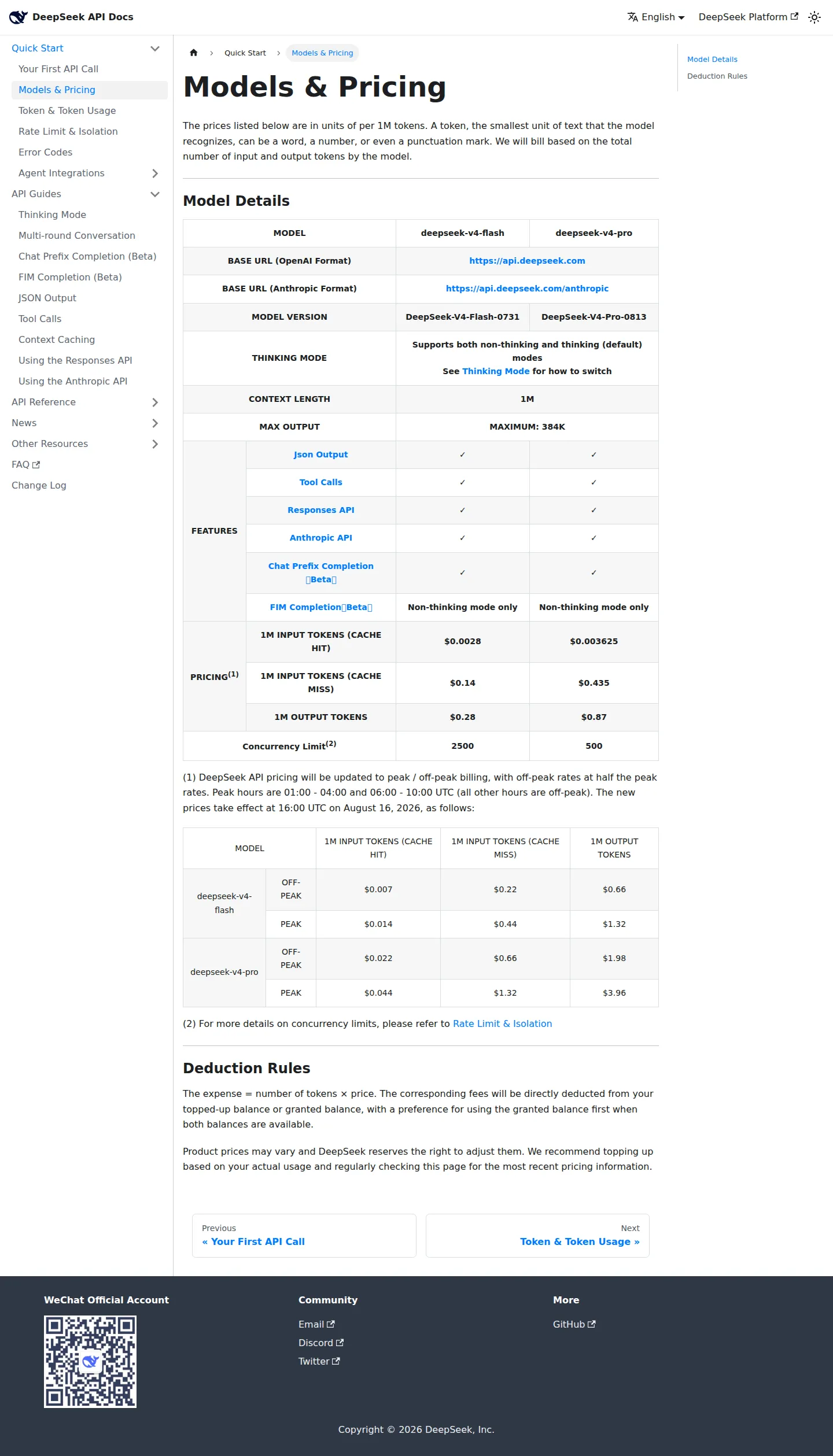
As of the 2026-08-26 capture, the fifth lever — peak/off-peak time-of-use billing, first confirmed on 2026-08-14 for a 16:00 UTC, 2026-08-16 cutover — is now the sole published rate card on DeepSeek’s Models & Pricing page; the prior flat per-token rates no longer appear anywhere on the page. Peak hours are 01:00–04:00 and 06:00–10:00 UTC, Monday through Friday (a weekday qualifier not previously documented — the full weekend is off-peak); all other hours are off-peak, at exactly half of peak. V4-Flash cache-miss input is now $0.22/1M off-peak and $0.44/1M peak — roughly 1.5x and 3x its pre-cutover flat rate, respectively — and V4-Pro cache-miss input is $0.66/1M off-peak and $1.32/1M peak, also roughly 1.5x and 3x its pre-cutover flat rate; the increases range from roughly 1.5x (off-peak, cheaper line items) to over 12x (peak, cache-hit input) versus the pre-cutover flat rates (see Pricing evolution for the exact prior figures). The same capture also surfaced a new model row, DeepSeek-V4-Flash-Vision-Exp, an experimental vision-capable variant billed on the same rate card as V4-Flash; full detail is under Pricing by product below.
Pricing by product
DeepSeek API — Current Rates (peak/off-peak, live since 2026-08-16 16:00 UTC)
Confirmed live as of the 2026-08-26 capture: the peak/off-peak rate card announced 2026-08-14 is now the only pricing table on DeepSeek’s Models & Pricing page — the prior flat per-token rates are gone. Peak hours are 01:00–04:00 and 06:00–10:00 UTC, Monday through Friday (a weekday restriction not previously documented); all other hours, including the full weekend, are off-peak. Off-peak rates are set at exactly half of peak.
| Model | Window | Input Cache Hit ($/1M) | Input Cache Miss ($/1M) | Output ($/1M) | Concurrency limit |
|---|---|---|---|---|---|
| DeepSeek-V4-Flash | Off-peak | $0.007 | $0.22 | $0.66 | 2500 |
| DeepSeek-V4-Flash | Peak | $0.014 | $0.44 | $1.32 | 2500 |
| DeepSeek-V4-Pro | Off-peak | $0.022 | $0.66 | $1.98 | 500 |
| DeepSeek-V4-Pro | Peak | $0.044 | $1.32 | $3.96 | 500 |
| DeepSeek-V4-Flash-Vision-Exp | Off-peak | $0.007 | $0.22 | $0.66 | 2500 |
| DeepSeek-V4-Flash-Vision-Exp | Peak | $0.014 | $0.44 | $1.32 | 2500 |
All three models share a 1M-token context window and a 384K max output. Versus the pre-cutover flat rates, the off-peak card is roughly 1.5–2.5x more expensive per line item, and the peak card is roughly 3–12x more expensive (the widest gap is on cache-hit input — DeepSeek’s cheapest line item before the cutover — which sees the largest relative jump: V4-Pro cache-hit input at $0.044/1M peak is over 12x its pre-cutover flat rate; see Pricing evolution for the exact prior figures). DeepSeek has not published a grace period or legacy-rate opt-out.
New model: DeepSeek-V4-Flash-Vision-Exp. First seen in the 2026-08-26 capture (absent from the 2026-08-14 capture), this is an experimental vision-capable variant of V4-Flash, versioned DeepSeek-V4-Flash-Vision-Exp with no dated build suffix. It is billed on the exact same rate card as V4-Flash and shares its 2500-request concurrency limit. Per the docs, images sent to this model are converted to tokens based on image dimensions and billed as input tokens alongside text tokens (see DeepSeek’s Vision: Token Usage guide for the conversion rule). Unlike Flash and Pro, FIM Completion (Beta) is not supported on Vision-Exp in either mode.
All three models support non-thinking and thinking (default) modes on the same SKU — there is no separate reasoning-model price. All three also expose the same core feature set (JSON output, tool calls, Responses API, Anthropic API, chat prefix completion in beta), with FIM completion restricted to non-thinking mode only on Flash and Pro, and unsupported entirely on Vision-Exp. The current Flash build is versioned DeepSeek-V4-Flash-0731; V4-Pro carries the dated build suffix DeepSeek-V4-Pro-0813.
The API is reachable in two wire formats at no price difference — https://api.deepseek.com for the OpenAI-compatible format and https://api.deepseek.com/anthropic for the Anthropic-compatible format — so a team can point an existing OpenAI or Anthropic SDK at DeepSeek without a rewrite. The Responses API endpoint is documented as supported on all three current models.
As of this capture (2026-08-26), the legacy model-name aliases deepseek-chat and deepseek-reasoner — previously documented as compatibility mappings to the non-thinking and thinking modes of DeepSeek-V4-Flash, scheduled for deprecation on 2026/07/24 15:59 UTC — remain absent from the Models & Pricing page, consistent with that deprecation date having passed.
Price Comparison: DeepSeek vs. US Frontier Models
| Model | Input ($/1M) | Output ($/1M) | vs. DeepSeek-V4-Flash input |
|---|---|---|---|
| DeepSeek-V4-Flash (off-peak) | $0.22 | $0.66 | — |
| DeepSeek-V4-Flash (peak) | $0.44 | $1.32 | 2× more expensive (vs. off-peak) |
| DeepSeek-V4-Pro (off-peak) | $0.66 | $1.98 | ~3× more expensive |
| GPT-4.1 nano | ~$0.10 | ~$0.40 | ~2.2× cheaper (vs. off-peak) |
| GPT-4o mini | ~$0.15 | ~$0.60 | ~1.5× cheaper (vs. off-peak) |
| GPT-4o | ~$2.50 | ~$10.00 | ~11× more expensive (vs. off-peak) |
| Claude 3.5 Sonnet | ~$3.00 | ~$15.00 | ~14× more expensive (vs. off-peak) |
Note: US-frontier prices are approximate reference rates for comparison, not DeepSeek’s advertised prices. DeepSeek-V4-Flash off-peak cache-miss input ($0.22/1M) is used as the baseline row; peak-hour and cache-hit rates shift these ratios further (cache-hit input off-peak is $0.007/1M, widening DeepSeek’s advantage). DeepSeek’s advantage is most pronounced on cache-hit input and on raw output rates against GPT-4o-class models, even after the 2026-08-16 rate-card change.
DeepSeek Web Chat
| Feature | Details |
|---|---|
| Access | Free, no account required for basic use |
| Models | DeepSeek-V4 (non-thinking and thinking/DeepThink modes) |
| Web search | Available |
| File uploads | Supported |
| API access | Not included; API requires separate registration |
Sales motions across products: PLG / self-serve only for both web chat and API. No enterprise sales, no support contracts. Open-source self-hosting available at infrastructure cost. Prices accessed 2026-08-26.
Hidden costs : What DeepSeek API users actually pay beyond published per-token rates
Archetype A: Developer switching from GPT-4o to DeepSeek-V4-Flash
A production application processing 1B input tokens and 200M output tokens per month (illustrative, using current V4-Flash rates):
| Scenario | Input cost | Output cost | Total |
|---|---|---|---|
| GPT-4o standard | approximately $2,500 | approximately $2,000 | approximately $4,500 |
| DeepSeek-V4-Flash, all cache-miss | approximately $140 | approximately $56 | approximately $196 |
| DeepSeek-V4-Flash, heavy cache reuse | approximately $3–$30 | approximately $56 | approximately $60–$90 |
The headline savings are real, but the hidden costs of switching to DeepSeek include: legal review for data sovereignty compliance (approximately $5K–$20K one-time), reliability engineering for API instability during peak global demand, and re-architecting prompt-caching boundaries to actually realize the steep cache-hit discount (cache hits only apply to repeated context prefixes within the cache window).
Archetype B: Enterprise evaluating self-hosting DeepSeek-V3
| Line item | Monthly cost estimate |
|---|---|
| 8× H100 80GB GPUs (cloud, on-demand) | $18,000–$28,000 |
| Storage + networking | $500–$1,000 |
| Engineering maintenance (0.25 FTE) | $5,000–$10,000 |
| Estimated total | $23,500–$39,000 |
Self-hosting V3 at scale (8 H100s) costs more per month than the API for most workloads below ~50B tokens/month. Above that volume, self-hosting economics become compelling. Third-party managed hosts (Fireworks AI, Together AI) offer a middle ground with lower management overhead and enterprise agreements.
Use the DeepSeek pricing calculator to estimate your monthly API cost and compare it against self-hosting economics at your token volume.
Pricing evolution : DeepSeek’s pricing history from V2 to R1
Cadence
| Quarter | Price changes | Product / SKU additions | Notes |
|---|---|---|---|
| 2023 Q3 | 0 | 0 | DeepSeek founded; internal research only |
| 2023 Q4 | 0 | 1 | DeepSeek Coder released open-source; no commercial API |
| 2024 Q2 | 1 | 1 | DeepSeek-V2 API launched at $0.14/1M input |
| 2024 Q4 | 1 | 1 | DeepSeek-V3: $0.27/1M, frontier performance, MIT weights |
| 2025 Q1 | 0 | 2 | DeepSeek-R1: $0.55/1M reasoning; off-peak discount added |
| 2025 Q2 | 0 | 1 | DeepSeek-V3-0324 update; pricing unchanged |
| 2026 Q3 | 1 | 0 | Peak/off-peak time-of-use pricing announced (2026-08-11 vague warning, 2026-08-14 full rate card), effective 2026-08-16; V4-Pro reached Responses API parity and picked up a dated build tag |
Tracked range: 2023 Q3–2026 Q3. Quarters not listed above were verified stable.
Notable changes
- 2024-05-07 — DeepSeek-V2 API launched at $0.14/1M input — roughly 1/100th of GPT-4 Turbo prices. Forced Chinese AI labs (Baidu, Alibaba Qwen, ByteDance) to cut prices within weeks. First evidence of a credible pricing floor challenge to US frontier labs.
- 2024-12-26 — DeepSeek-V3 released with MIT open-source weights. At $0.27/1M input vs GPT-4o’s $2.50, V3 was 9× cheaper while matching GPT-4o on many benchmarks. Training cost estimated at $5.5M. (DeepSeek-V3 technical report)
- 2025-01-20 — DeepSeek-R1 released with MIT open-source weights. Competitive with OpenAI o1 at $0.55/1M vs o1’s $15/1M — a 27× price difference. The open-source release meant any developer could self-host frontier-class reasoning. (DeepSeek-R1 arXiv paper)
- 2025-01-27 — Nvidia stock dropped ~17% following the R1 release as markets repriced AI compute necessity. The “DeepSeek moment” became shorthand for commoditization risk in AI infrastructure. (Reuters coverage)
- 2025-03-24 — DeepSeek-V3-0324 update released. Improved coding benchmark performance. No pricing changes.
- 2026-07-14 — DeepSeek reported to be preparing an IPO filing (Bloomberg), with follow-on reports of a fresh raise at a ~$74B valuation ahead of an onshore listing (Reuters, 2026-07-18) and annualized revenue near $500M (The Information, 2026-07-15). No pricing change accompanied the reports — the published per-token rates were unchanged. Worth watching: a public-listing process introduces disclosure and profitability pressure that historically tempers loss-leading rates, a potential future test of DeepSeek’s structurally low API pricing. To date the price ceiling still rests on open-source self-hosting economics, not investor expectations.
- 2026-08-11 — DeepSeek’s pricing docs added a footnote warning of a coming “significant” price increase, with no dollar amount, affected model, or effective date specified; per-token rates were unchanged at the time of capture. The same update added Responses API support for DeepSeek-V4-Flash only, with V4-Pro support listed as pending for “early August 2026.”
- 2026-08-14 — DeepSeek published the actual rate card: peak/off-peak time-of-use billing takes effect at 16:00 UTC on 2026-08-16. Peak hours (01:00–04:00 and 06:00–10:00 UTC) price roughly 3–12× today’s flat rates and off-peak prices roughly 1.5–2.5×; the steepest jump lands on cache-hit input — DeepSeek-V4-Pro cache-hit input rises from $0.003625/1M to $0.044/1M peak, over 12×. DeepSeek-V4-Pro also reached Responses API parity with V4-Flash and picked up a dated build tag (
DeepSeek-V4-Pro-0813).
The 2026-08-16 price increase in detail
DeepSeek’s per-token pricing had moved in only one direction since the 2024-05-07 V2 launch — down, culminating in an additional ~90% cut to cache-hit input in April 2026. The confirmed peak/off-peak card is the first reversal of that trend, and it lands hardest on the line item DeepSeek has marketed most aggressively: even at the off-peak rate, V4-Flash cache-hit input rises 2.5× (from $0.0028/1M to $0.007/1M), and V4-Pro cache-hit input rises over 6× off-peak and over 12× at peak. Cache-hit input has been the headline number in every DeepSeek-vs-GPT-4o comparison; it is now the number taking the largest proportional hit.
For buyers, three things follow. First, workloads that lean heavily on cache-hit input — large stable system prompts, repeated document context — lose the most relative advantage, even though DeepSeek stays cheap in absolute terms next to US frontier pricing. Second, time-of-day request routing becomes a real cost lever again for the first time since the 2025 off-peak discount was discontinued, except this time “off-peak” is still an increase over today’s flat rate, just the smaller of two increases. Third, DeepSeek has published no grace period or legacy-rate opt-out: the new card applies to all API traffic at the 16:00 UTC cutover on 2026-08-16, giving integrators roughly five days of notice from the confirmed rate card to go-live.
What’s unique : DeepSeek’s distinctive pricing mechanics
1. Cache-hit pricing is among the most aggressive in AI APIs — for now. DeepSeek cut its cache-hit input price to one-tenth of the launch price in April 2026: V4-Flash cache hits cost $0.0028/1M versus $0.14/1M on a cache miss — a 98% reduction on reused context. For applications with large, stable system prompts or repeated document contexts, architecting around prompt caching remains the highest-leverage cost optimization available in any AI API — but that leverage is compressing: DeepSeek confirmed on 2026-08-14 that a peak/off-peak rate card takes effect 2026-08-16, moving V4-Flash cache-hit input to $0.007/1M off-peak and $0.014/1M peak (2.5–5× today’s rate), with the sharpest jump on V4-Pro cache-hit input (up to $0.044/1M peak, over 12×). Time-of-use billing is returning to DeepSeek’s pricing — but now as a premium layered onto higher base rates, not the discount window it was in 2025.
2. Open-source weights create a self-imposed price ceiling. Because DeepSeek’s flagship weights are MIT-licensed, DeepSeek cannot price its API much above the cost of self-hosting without losing developers to third-party hosts. OpenAI, Anthropic, and Google do not release weights for their flagship models and thus have no such constraint. The result is commodity-level pricing power for DeepSeek — permanently anchored to infrastructure cost rather than value-based pricing.
3. No subscription tier is both a simplification and a limitation. Unlike every US AI company, DeepSeek has no paid consumer subscription. The entire business model is API token consumption. This simplicity creates a pure pay-as-you-go model but limits total addressable revenue: there is no $20/month per-user captured from the millions of people using the free web chat.
4. A 1M-token context window closes a former weakness. Earlier DeepSeek models were capped at 64K tokens — well below US competitors. The V4 generation now ships a 1M-token context window with up to 384K tokens of output, removing what had been DeepSeek’s most cited adoption barrier for long-document analysis, full-codebase review, and long-running agent sessions. Combined with cheap cache-hit input, large-context workloads are now economically viable on DeepSeek in a way they were not a year ago.
5. Technical transparency builds trust in a trust-deficit environment. DeepSeek publishes detailed technical reports with training costs, architecture details, and benchmark methodologies. For a company facing significant trust concerns around data sovereignty, this radical technical transparency serves as a credibility signal that partially offsets sovereignty concerns for developer audiences, even if it doesn’t address enterprise compliance requirements.
Strengths & weaknesses
| Strengths | Weaknesses |
|---|---|
| API pricing 5–30× cheaper than GPT-4o equivalents on reasoning models | Chinese company subject to Chinese law; data sovereignty risk for enterprise |
| Cache-hit input pricing (V4-Flash $0.0028/1M) is among the most aggressive in any AI API | API has had reliability and capacity issues during peak global demand periods |
| MIT open-source weights — self-host on any infrastructure | No enterprise SLA, no BAA, no SOC 2, no compliance certifications |
| Free web chat with no account required | A confirmed peak/off-peak rate card (2026-08-14, effective 2026-08-16) raises rates 1.5–12× versus today’s flat pricing — steepest on cache-hit input, DeepSeek’s core price advantage |
| No subscription complexity — pure pay-per-token simplicity | No consumer subscription tier — misses $20/mo per-user monetization entirely |
| 1M-token context window (V4 generation) closes the former 64K context gap | No multimodal capabilities (image generation, audio) in the API |
| Radical technical transparency (training costs, architecture published) | Many US enterprises restrict or ban DeepSeek API use for legal/compliance reasons |
Billing UX : DeepSeek’s API billing and account management experience
- Registration — API access requires account creation at
platform.deepseek.com. Credit card or equivalent payment required. - Prepaid credits — API usage is billed against a prepaid credit balance. No postpaid billing available. The docs state the charge outright: “The expense = number of tokens × price.”
- Two balance types with a fixed drawdown order — Charges are deducted from your topped-up balance or your granted balance, “with a preference for using the granted balance first when both balances are available.” Promotional/granted credit is therefore consumed before money you paid for.
- Free credits — New accounts have historically received a small amount of granted balance, though the amount has varied over time and is not a guaranteed published figure.
- Spend alerts — Basic usage dashboard in the API platform. No documented configurable spend cap or proactive budget alert feature.
- Cache pricing — Applied automatically when the same context prefix is reused within the cache TTL window; no request flag or developer action is required to receive the cache-hit rate.
- Time-of-use billing is now live (confirmed 2026-08-14, effective and captured as active 2026-08-26) — The pricing table now publishes peak and off-peak dollar figures directly for every model and token type — there is no longer a single flat rate anywhere on the page (see Pricing by product). Peak hours are 01:00–04:00 and 06:00–10:00 UTC, Monday through Friday — a weekday restriction not previously documented, meaning the entire weekend is off-peak; off-peak is exactly half the peak rate.
- Per-model concurrency limits — Capacity is governed by a published concurrency ceiling (2500 concurrent requests on V4-Flash and the new V4-Flash-Vision-Exp, 500 on V4-Pro) rather than a spend tier, documented under Rate Limit & Isolation.
- Dual wire-format endpoints —
https://api.deepseek.com(OpenAI format) andhttps://api.deepseek.com/anthropic(Anthropic format) are both billed identically, so SDK choice has no pricing consequence. - Responses API endpoint — at parity across all three current models — The docs list the Responses API surface as supported on DeepSeek-V4-Flash, DeepSeek-V4-Pro, and the newly added DeepSeek-V4-Flash-Vision-Exp, at no separate listed price.
- New vision model with its own token-conversion rule (first seen 2026-08-26) — DeepSeek-V4-Flash-Vision-Exp is billed on V4-Flash’s exact rate card; images sent to it are converted to input tokens based on image dimensions per DeepSeek’s Vision: Token Usage guide, and billed together with text tokens. FIM Completion (Beta) is not supported on this model.
- Published price-change disclaimer — The pricing page states that “Product prices may vary and DeepSeek reserves the right to adjust them,” and advises topping up against actual usage rather than pre-funding large balances.
- No enterprise tier — There is no enterprise sales, SLA, or support contract offering from DeepSeek directly. Organizations requiring enterprise agreements can access DeepSeek models via Amazon Bedrock or other third-party providers.
- Third-party hosting — Fireworks AI, Together AI, Amazon Bedrock, and others host DeepSeek models at slightly different price points with enterprise support, data residency options, and compliance features.
- Web chat — Free access at
chat.deepseek.com, no account required for basic use. Serves the current V4 models in both non-thinking and thinking (DeepThink) modes. (This capture: the page returned a Cloudflare human-verification challenge, consistent with the documentedcapture_hint; web-chat facts remain cross-checked against the first-party API docs only, not re-verified visually this run.)
Strategic wins : Why DeepSeek’s pricing decisions worked
1. V2’s shock pricing forced a Chinese AI industry price war
DeepSeek-V2’s $0.14/1M input price in May 2024 was not just competitive — it was a strategic declaration. Within weeks, Alibaba’s Qwen, Baidu’s ERNIE, and ByteDance’s Doubao had cut prices to match or undercut V2. DeepSeek established the price anchor for an entire regional AI market from a position of technical and cost advantage. This pricing-as-competitive-strategy approach mirrors how AWS’s EC2 pricing redefined cloud compute economics.
2. Open-sourcing V3 and R1 maximized global adoption over API revenue
The decision to MIT-license frontier-class models eliminated DeepSeek’s API pricing power but maximized adoption. Developers worldwide evaluated and deployed DeepSeek through third-party providers and self-hosted infrastructure, creating a global user base that a commercial API alone could never reach. This adoption-over-margin strategy mirrors Meta’s Llama playbook and is antithetical to OpenAI’s proprietary positioning — the bet is that ecosystem size and developer trust creates long-term strategic value.
3. Off-peak pricing created a unique value proposition for batch workloads — in 2025
For a period in 2025, DeepSeek offered an off-peak discount that solved a real developer problem: batch AI workloads (nightly enrichment, bulk classification, async document processing) don’t need real-time response but were paying the same rate as latency-sensitive calls. At the time, no US AI API offered a comparable time-of-use discount, giving DeepSeek a usage-based pricing advantage for cost-not-latency workloads. That structure returns 2026-08-16, but inverted: the peak/off-peak card confirmed 2026-08-14 makes off-peak the cheaper of two increases (roughly 1.5–2.5× today’s flat rate) rather than a discount below it, while peak hours (01:00–04:00 and 06:00–10:00 UTC) cost 3–12× more. The batch-workload routing incentive survives — off-peak still beats peak — but the win is now defensive (avoid the worst of the increase) rather than offensive (undercut competitors on price).
4. The R1 release reframed the global AI pricing narrative
By demonstrating that a reasoning model competitive with o1 could be built at 1/30th the inference cost and open-sourced, DeepSeek forced every AI lab and enterprise buyer to recalibrate their AI cost floor assumptions. Enterprise buyers who previously accepted GPT-4o pricing as “market rate” now have a credible alternative benchmark at 9× cheaper. DeepSeek’s technical cost transparency changed every AI procurement conversation in 2025 — even for organizations that never use DeepSeek directly.
Areas to improve : Gaps in DeepSeek’s pricing and product approach
1. Data sovereignty and compliance gaps block regulated enterprise adoption
DeepSeek has no BAA, no DPA, no SOC 2 certification, and no data residency controls outside China for its managed API. For healthcare, finance, government, and defense organizations, these are disqualifying factors regardless of price. The fix requires structural investment: offering a data processing agreement, establishing US/EU hosting options, and pursuing compliance certifications. Without this, DeepSeek misses the regulated enterprise segment entirely — leaving significant addressable market to OpenAI Enterprise and Anthropic Enterprise.
2. No default spend caps create runaway cost risk for agentic workloads
DeepSeek’s API has no documented spend cap or proactive budget alert system. While the prepaid balance provides a hard ceiling, a developer whose balance is fully funded has no protection against an agentic loop consuming the entire balance overnight. Configurable spend alerts and hard caps at 50%/80%/100% of balance threshold are table stakes for production API billing — DeepSeek’s absence of these features is a developer trust gap.
3. No multimodal API and a deprecating alias surface add migration friction
DeepSeek’s API remains text-only — no image, audio, or vision endpoints — so teams needing multimodal capabilities must pair it with another provider. At the same time, the legacy deepseek-chat and deepseek-reasoner aliases that many integrations still target are scheduled for deprecation on 2026-07-24, forcing a migration to deepseek-v4-flash / deepseek-v4-pro. For teams that standardized on the old alias names, this is avoidable churn that better-managed deprecation and versioning policies would soften with longer notice windows and clearer migration tooling.
4. Time-of-use billing reintroduces schedule complexity exactly as prices rise
The peak/off-peak card confirmed 2026-08-14 asks every integrator to either accept a blended cost increase or build time-aware request routing around two daily UTC windows (01:00–04:00 and 06:00–10:00) — new operational overhead with no published grace period or legacy-rate opt-out before the 2026-08-16 cutover. Teams with latency-sensitive production traffic that cannot be time-shifted absorb the full increase (up to 12× on V4-Pro cache-hit input) with no mitigation available. Well-communicated pricing changes typically pair a rate increase with a grace period or migration window; DeepSeek’s gap here is roughly five days from the confirmed rate card (2026-08-14) to cutover (2026-08-16).
Monetization stack & signals : how DeepSeek builds & buys its revenue engine
Buys 0 Builds 1
DeepSeek builds rather than buys: it meters its own inference economics in-house — its Open-Source-Week disclosure pegged the V3/R1 serving system's theoretical cost-profit margin at 545% ($87,072 daily H800 cost vs $562,027 of R1-priced tokens) — and that in-house cost meter, not a vendor tool, is what backs its aggressive token pricing.
- In-house V3/R1 inference-serving + cost-economics system (cross-node Expert Parallelism) Cost & FinOps Blog Mar 2025
“To optimize these two objectives, our solution employs cross-node Expert Parallelism (EP). ... Assuming the leasing cost of one H800 GPU is $2 per hour, the total daily cost amounts to $87,072. ... If all tokens were billed at DeepSeek-R1's pricing, the total daily revenue would be $562,027, with a cost profit margin of 545%.”
Signals reviewed · derived from engineering blogs
Key takeaways
-
Cache-hit input pricing is the most underutilized cost lever on DeepSeek today. V4-Flash cache-hit input is $0.0028/1M versus $0.14/1M on a cache miss — a ~98% reduction on reused context. Any team with large, stable system prompts or repeated document context should architect around prompt-cache boundaries to capture it. (Effective 2026-08-16, DeepSeek reintroduces time-of-use billing — but as a peak premium, not a discount: off-peak is still 1.5–2.5× today’s flat rate and peak is 3–12×, so caching remains the primary lever even as time-of-day routing becomes newly relevant for minimizing the increase, a pricing optimization worth revisiting once the new card is live.)
-
Open-source model weights are a pricing strategy, not just a research output. By releasing V3 and R1 under MIT license, DeepSeek anchored its API price to self-hosting economics and drove global adoption through third-party hosts. For AI companies with strong technical capabilities, open-source releases accelerate distribution faster than any sales motion — at the cost of long-term pricing power.
-
The cheapest API is not always the lowest total cost. DeepSeek’s price advantage must be weighed against reliability risk, data sovereignty legal overhead, and the absence of enterprise SLAs or compliance certifications. True cost modeling for AI API selection must include these non-token costs.
-
DeepSeek proved that frontier AI cost is not a sustainable moat. The $5.5M training cost for V3 demonstrated that frontier model capability is achievable at dramatically lower cost than US labs implied. This reframed every AI pricing conversation in 2025 — value-based pricing in AI APIs must now compete against a commodity-priced open-source baseline.
-
No enterprise tier is a deliberate constraint, not an oversight. DeepSeek’s absence of enterprise sales, support, and compliance features reflects its research-first identity. This means DeepSeek is positioned as a cost-optimization tool within existing AI stacks, not a primary AI vendor for regulated enterprises. Understanding this positioning clarifies where DeepSeek fits vs. OpenAI Enterprise or Anthropic Enterprise.
UBP implications
-
Cache-aware pricing is becoming a first-class cost lever across AI APIs. DeepSeek’s aggressive cache-hit discount — V4-Flash cache-hit input at one-tenth of cache-miss — shows how much pricing power lives in distinguishing reused context from net-new tokens. (DeepSeek experimented with an off-peak time-of-use discount in 2025; a peak/off-peak card returns 2026-08-16, but this time as a premium structure layered onto a broad price increase rather than a customer discount — worth watching whether other AI APIs adopt time-of-use billing as a margin lever rather than a buyer benefit.) Teams should design AI billing systems to meter and price cached vs uncached input as a first-class optimization — not an afterthought.
-
The open-source/API price parity creates the most efficient usage-based market in AI. Because DeepSeek API competes against self-hosted alternatives at roughly the same marginal cost, it has the most commodity-like pricing of any frontier AI API. This commodity pricing dynamic is the long-run equilibrium for AI APIs as open-source models reach parity — suggesting that AI API pricing strategies must eventually shift toward proprietary data, tooling, or reliability rather than model capability alone.
-
Sovereignty risk is an emerging hidden cost in AI procurement. Using DeepSeek requires explicitly pricing in legal review, DPA overhead, compliance certification gaps, and potential regulatory restrictions. This non-token cost is invisible in per-token comparisons but real in total cost of ownership. As AI APIs become geopolitically complex, procurement teams need a framework for pricing sovereignty risk alongside model capability and token cost.
Sources
- DeepSeek API pricing (docs) (accessed 2026-08-26) — Confirms the peak/off-peak rate card announced 2026-08-14 is now live: the flat V4-Flash and V4-Pro rates are gone from the page, replaced entirely by peak/off-peak dollar figures; a new experimental model, DeepSeek-V4-Flash-Vision-Exp, was added on the same rate card as V4-Flash; peak hours are now documented as Monday–Friday only. Independently re-fetched 2026-08-26 (separate render pipeline from the screenshot capture) — every off-peak/peak dollar figure and concurrency limit matched exactly.
- DeepSeek rate limit & isolation (docs) (accessed 2026-08-26) — independently re-confirms concurrency limits (2500 V4-Flash/Vision-Exp, 500 V4-Pro) via a page separate from the pricing table
- DeepSeek API changelog/updates (docs) (accessed 2026-08-26) — independently confirms the peak/off-peak rate card took effect 2026-08-16 16:00 UTC and the DeepSeek-V4-Flash-Vision-Exp release (2026-08-21, billed at V4-Flash rates)
- DeepSeek API pricing details, USD (docs) (accessed 2026-05-30)
- DeepSeek-V3 technical report on GitHub (accessed 2026-05-29)
- DeepSeek-R1 technical paper (arXiv 2501.12948) (accessed 2026-05-29)
- DeepSeek model weights on Hugging Face (accessed 2026-05-29)
- Amazon Bedrock — DeepSeek model availability (accessed 2026-05-29)
- Reuters — DeepSeek R1 and Nvidia stock reaction (accessed 2026-05-29)
Bottom line
DeepSeek is the most disruptive pricing story in AI history: a Chinese research lab trained frontier models at 1/50th the claimed cost of incumbents, open-sourced the weights under MIT license, and priced the managed API at 5–30× below US equivalents. Its aggressive cache-hit input pricing — V4-Flash cache hits at $0.0028/1M, one-tenth of the launch price — creates cost structures that no US AI API can match for repeated-context and long-context workloads, now backed by a 1M-token context window, though a confirmed peak/off-peak rate card (2026-08-14) raises those cache-hit rates 2.5–12× starting 2026-08-16 — the first price increase in DeepSeek’s API history, compressing but not eliminating the gap versus US frontier pricing. The gaps are real: data sovereignty concerns block regulated enterprise adoption, there is no multimodal API, and no enterprise support means DeepSeek fits as a cost-optimization layer within existing stacks rather than a primary AI vendor. For developers building cost-sensitive production applications who can manage sovereignty risk — or who self-host the open-source weights — DeepSeek offers the most aggressive value in the AI API market.
Browse the full pricing blueprint to compare DeepSeek against OpenAI, Anthropic, and other AI platforms.
Pricing timeline : Major events on a vertical axis
Each milestone below corresponds to a public pricing change, product launch, or material adjustment. Major events use a filled marker; minor adjustments use a faded one.
DeepSeek Announces Peak/Off-Peak Pricing — Effective Aug 16, 2026
DeepSeek replaced its vague "significant price increase" footnote with a concrete time-of-use rate card: peak-hour rates (01:00-04:00 and 06:00-10:00 UTC) roughly 3-11x current per-token prices depending on the line item, with off-peak rates at half of peak, effective 16:00 UTC on 2026-08-16. V4-Flash cache-miss input moves from a flat $0.14 to $0.22 off-peak / $0.44 peak; V4-Pro cache-miss input moves from a flat $0.435 to $0.66 off-peak / $1.32 peak. DeepSeek-V4-Pro also picked up a dated build suffix (-0813) and gained Responses API support, reaching feature parity with V4-Flash.

DeepSeek-V3-0324 Update — Improved Coding
DeepSeek released V3-0324, an update to V3 with improved coding and math reasoning. Scored above Claude 3.7 Sonnet on SWE-bench coding benchmark. API pricing unchanged.
Nvidia Stock Drops 17% Following R1 Release
Nvidia's stock fell approximately 17% (~$600B market cap loss) as markets re-evaluated whether the massive GPU clusters assumed necessary for frontier AI training were actually required. The R1 technical report showed training at 1/30th assumed compute.
DeepSeek-R1 Released — Reasoning Model, MIT Open-Source
DeepSeek-R1 launched with MIT open-source weights. Competitive with OpenAI o1 on reasoning benchmarks. API: $0.55/1M input (cache miss), $2.19/1M output — approximately 27× cheaper than OpenAI o1 at $15/$60 per 1M.
DeepSeek-V3 Released — Frontier Performance at $0.27/1M
DeepSeek-V3 released with MIT open-source weights. Matched or exceeded GPT-4o on multiple benchmarks. API: $0.27/1M input (cache miss), $1.10/1M output — approximately 9× cheaper than GPT-4o. Estimated training cost: $5.5M.
DeepSeek-V2 Launched — $0.14/1M Input, Market Shock
DeepSeek-V2, a 236B parameter mixture-of-experts model, launched via API at $0.14/1M input and $0.28/1M output — roughly 1/100th the price of GPT-4 Turbo. Forced immediate price cuts from Chinese AI labs within weeks.
DeepSeek Coder V1 Released Open-Source
DeepSeek released DeepSeek Coder, a coding-focused open-source model. Weights available on Hugging Face. No commercial API pricing at this stage.
DeepSeek Founded
DeepSeek AI founded in Hangzhou, China by Liang Wenfeng as a research subsidiary of High-Flyer hedge fund. Initial focus on foundation model research, not commercial deployment.
- · DeepSeek-R1's January 2025 release caused Nvidia's stock to drop approximately 17% (~$600B in market cap) in a single day — the largest single-day market cap loss attributable to an AI event in history — because R1 demonstrated frontier AI reasoning at roughly 1/30th the inference cost of OpenAI o1.
- · DeepSeek is funded by High-Flyer Capital Management, a Chinese quantitative hedge fund. DeepSeek reportedly trained V3 on approximately 2,000 Nvidia H800 GPUs at an estimated total cost of $5.5M — a fraction of the 10,000–100,000 GPU clusters used by US frontier labs for comparable models.
- · DeepSeek-V3 and R1 model weights are open-sourced under the MIT license, allowing any developer or company to self-host the models. This makes DeepSeek the only frontier-class model family that is both commercially cheap via API and fully free for self-hosting.
Questions & answers
- How much does DeepSeek API cost?
- DeepSeek API is billed on a peak/off-peak rate card, live since 16:00 UTC on 2026-08-16 (peak hours 01:00-04:00 and 06:00-10:00 UTC, Monday-Friday; all other hours, including weekends, are off-peak at exactly half the peak rate). DeepSeek-V4-Flash: $0.22/1M input cache-miss off-peak ($0.44 peak), $0.007/1M cache-hit off-peak ($0.014 peak), $0.66/1M output off-peak ($1.32 peak). DeepSeek-V4-Pro: $0.66/1M input cache-miss off-peak ($1.32 peak), $0.022/1M cache-hit off-peak ($0.044 peak), $1.98/1M output off-peak ($3.96 peak). Both models have a 1M-token context window and a 384K max output, and these are the current published first-party rates — roughly 1.5-2.5x the pre-2026-08-16 flat rates off-peak and 3-12x at peak. Concurrency is capped at 2500 requests on V4-Flash and 500 on V4-Pro.
- How does DeepSeek compare to OpenAI GPT-4o on price?
- DeepSeek-V4-Flash off-peak cache-miss input is $0.22/1M vs GPT-4o's roughly $2.50/1M — about 11× cheaper — and output is $0.66 vs about $10.00. With cache hits, V4-Flash input drops to $0.007/1M off-peak, making reused-context input effectively negligible compared with US frontier models.
- Is DeepSeek open source?
- Yes. DeepSeek model weights are released under the MIT license on Hugging Face. You can self-host DeepSeek on your own infrastructure or via third-party providers (Fireworks AI, Together AI, Amazon Bedrock) without using DeepSeek's API.
- What happened to deepseek-chat and deepseek-reasoner?
- The model names deepseek-chat and deepseek-reasoner are now compatibility aliases. deepseek-chat maps to the non-thinking mode of DeepSeek-V4-Flash and deepseek-reasoner maps to its thinking mode. Both aliases are scheduled to be deprecated on 2026-07-24, so new integrations should target deepseek-v4-flash or deepseek-v4-pro directly.
- Is DeepSeek safe to use for enterprise workloads?
- Enterprise risk must be evaluated carefully. DeepSeek is a Chinese company subject to Chinese law, which creates data residency and sovereignty concerns. It offers no enterprise SLA, BAA, or compliance certifications. Many organizations instead self-host the open-source weights on their own infrastructure to avoid data transfer to DeepSeek servers, or access models via Amazon Bedrock with AWS enterprise agreements.
- Does DeepSeek offer a free tier?
- DeepSeek's web chat (chat.deepseek.com) is free with no account required for basic use. New API accounts receive a small amount of free credits. There is no ongoing free API tier for production workloads — production use requires purchasing credits.