AI Summary
About
Heidi Health is an ambient AI clinical scribe: clinicians speak naturally during a patient encounter and Heidi produces a structured clinical note, handles transcription, and surfaces grounded clinical evidence with citations. Founded in Australia, the company targets doctors, nurses, mental-health and allied-health providers, dentists, and veterinarians, and reports deployment across 200+ specialties. Its core pitch is reclaiming documentation time — the marketing claims roughly 6 minutes saved per encounter and 90% less documentation work.
The product is sold as a per-seat SaaS with a genuine free-forever tier, positioning Heidi against other ambient-scribe and clinical-documentation vendors. Individual clinicians can self-serve up through the Clinician plan, while team, practice, and enterprise deployments route through sales (“Talk to us” / “Contact sales”). A separate product, Heidi Comms (an AI receptionist that answers, schedules, and resolves patient calls), is offered as a sales-led add-on rather than a self-serve SKU.
Heidi is privately held and Melbourne-based. It began as Oscer, an AI clinical-reasoning startup, before relaunching as Heidi’s ambient scribe in early 2024 (which is why its Crunchbase entity is still oscer). The company has raised roughly US$97M across rounds: an initial A$10M Series A (Nov 2023), a US$16.6M Series A extension led by Headline (Mar 2025, with Blackbird, Anthology/Menlo+Anthropic and others), and a US$65M Series B led by Point72 Private Investments — Steve Cohen’s firm — in October 2025 at a reported ~$465M valuation (TechCrunch). At the Series B, Heidi reported working with 2M+ clinicians weekly and processing 70M+ patient visits across 116 countries. Precise ARR and headcount are not disclosed.
Pricing summary : How Heidi Health’s per-seat freemium clinical-scribe pricing works
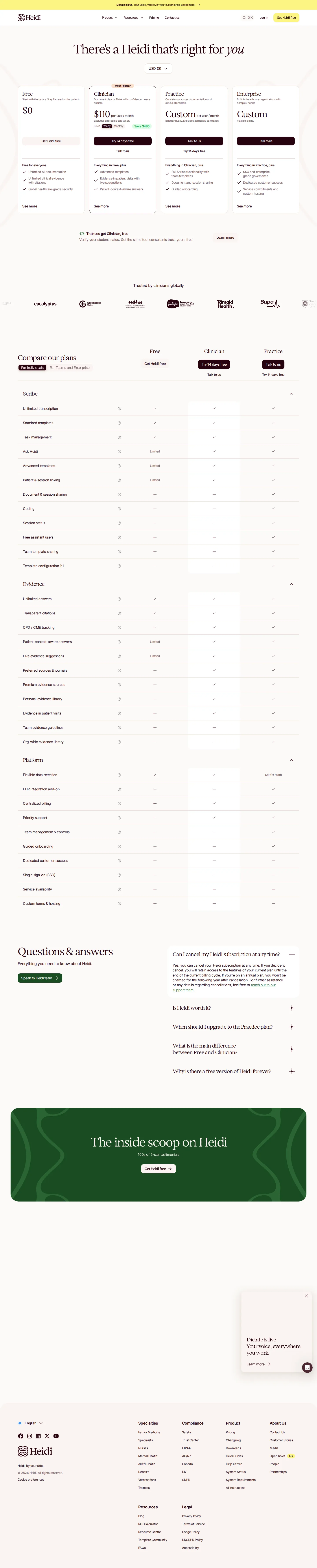
Heidi Health uses a per-seat subscription with a free tier (a freemium model), priced in per-seat units. As of the August 2026 capture, Heidi has consolidated its plan ladder from six named tiers down to four, and the pricing page now shows the same four plans regardless of which audience tab is active:
- Free ($0, self-serve): unlimited AI documentation and unlimited cited clinical evidence.
- Clinician ($110/user/mo, self-serve, “Most Popular”): the sole paid self-serve tier, with a 14-day free trial. The default rate is billed yearly; a Monthly toggle exists on the card, with annual billing advertised as saving $480/year.
- Practice (Custom per user/mo, sales-led, billed annually): previously listed at a fixed public per-seat price (see Pricing evolution) — now quoted via “Talk to us” rather than shown as a public number.
- Enterprise (Custom, sales-led, “flexible billing”).
- Add-on: Heidi Comms, an AI receptionist for patient calls, was previously quoted “Talk to us” with no published unit price; not re-verified in this capture.
The “For Individuals” / “For Teams and Enterprise” toggle still exists on the page (inside the “Compare our plans” matrix), but in this capture both tab states rendered an identical four-tier ladder — the previous Evidence Plus and Evidence Team mid-tiers have been discontinued. A new “Trainees get Clinician, free” program (student-status verification) now sits below the hero cards.
What makes this different: the free tier is still unusually generous for clinical AI — unlimited AI documentation and unlimited cited clinical evidence at $0 — but Heidi has traded tier granularity for simplicity, and pulled its mid-market Practice tier’s price off the public page in the process.
Pricing by product
Heidi scribe (All plans)
As of the August 2026 capture, Heidi shows the same four-tier ladder regardless of which audience tab (“For Individuals” or “For Teams and Enterprise”) is active in the pricing page’s plan-comparison matrix — the previous three-tier individual / three-tier team split, including the “Evidence Plus” and “Evidence Team” tiers, has been discontinued.
| Tier | Price | Included | Key mechanics |
|---|---|---|---|
| Free | $0 | Unlimited AI documentation, unlimited clinical evidence with citations, global healthcare-grade security | Free forever for any individual clinician |
| Clinician | $110 / user / mo | Everything in Free, plus advanced templates, evidence in patient visits with live suggestions, patient-context–aware answers | ”Most Popular”; self-serve; 14-day free trial; default yearly billing saves $480/yr; excludes applicable sales taxes |
| Practice | Custom / user / mo | Everything in Clinician, plus full Scribe functionality with team templates, document & session sharing, guided onboarding | Sales-led (“Talk to us”); 14-day free trial also offered; billed annually; excludes applicable sales taxes; was a fixed public per-seat price as of the June 2026 capture (see Pricing evolution) |
| Enterprise | Custom | Everything in Practice, plus SSO and enterprise-grade governance, dedicated customer success, service commitments & custom hosting | ”Flexible billing”; contact sales |
A “Trainees get Clinician, free” program (verified student status) now offers the Clinician tier at no cost to students.
Heidi Comms (separate add-on product)
| Tier | Price | Included | Key mechanics |
|---|---|---|---|
| Heidi Comms | Talk to us | AI receptionist that answers, schedules and resolves patient interactions; handles ~50% of routine calls; configurable agents for triage/scheduling/follow-ups | Sales-led; no published unit price; not re-verified in the August 2026 capture (not present in captured page text) |
Sales motions across products: PLG / self-serve for Free and Clinician; sales-led for Practice, Enterprise, and the Heidi Comms add-on.
Hidden costs : What clinical teams actually pay beyond the headline seat price
Heidi’s seat price is unusually legible — there is no usage meter to blow a budget, since consults and documentation are unlimited at every tier. The real cost variance comes from which tier you actually need, the annual-vs-monthly delta, region/currency, and the sales-gated add-ons.
Representative annual bills (USD, per the June 2026 capture):
| Scenario | Plan | Seats | List math | Annual cost |
|---|---|---|---|---|
| Solo clinician, notes only | Free | 1 | $0 | $0 |
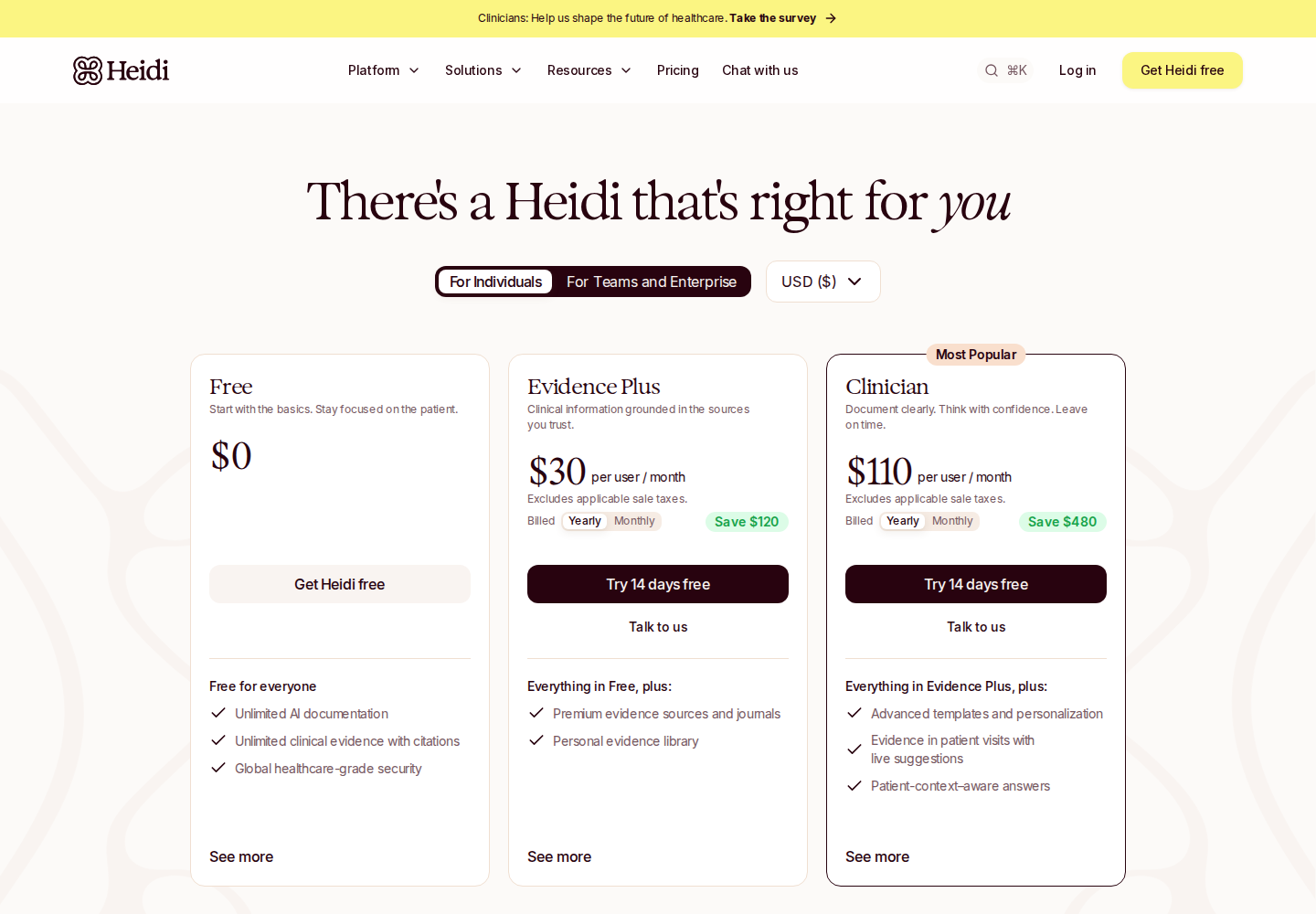
| Solo clinician wanting trusted evidence | Evidence Plus | 1 | $30 × 12 | $360/yr |
| Solo clinician, full toolkit | Clinician | 1 | $110 × 12 | $1,320/yr |
| 10-clinician practice | Practice | 10 | $180 × 12 × 10 | $21,600/yr |
| 50-clinician group | Enterprise | 50 | Custom (sales-led) | Quote only |
Where the headline price understates the bill:
- Annual-only framing. Paid prices are displayed as a per-month number but the headline rate is the yearly-billed one; the monthly toggle costs more. Annual billing is advertised as saving $120/yr (Evidence Plus) or $480/yr (Clinician), so the monthly path is materially pricier than the sticker implies.
- “Pro actions” / Scribe credits. Free and the entry Evidence tiers cap advanced agentic features (Ask Heidi prompts, custom template generation) at ~10 actions per month per Heidi’s help center. Heavy users of those features are effectively pushed to Clinician/Practice for “unlimited.”
- EHR integration is an add-on. The plan-comparison matrix lists “EHR integration add-on” as a separate line on Practice/Enterprise — integration into your record system is not bundled into the seat price.
- Heidi Comms is uncosted. The AI receptionist add-on is “Talk to us” with no public unit price, so any front-desk automation is a separate, sales-negotiated line.
- Region/currency. Prices vary by currency selector and geo; third-party trackers report a US/
en-usClinician rate higher than the $110 we captured on the default surface — confirm your own region’s page before budgeting.
For the mechanics of capping advanced features behind action limits, see our guide to entitlements and usage grants and our write-up on why per-user AI licenses are under pressure.
Want to estimate your own Heidi Health bill? Use the Heidi Health pricing calculator to model your monthly cost based on plan tier and seat count.
Pricing evolution : From free clinical scribe toward tiered team and enterprise plans
Heidi has rebuilt its pricing three times in roughly two years, and the trajectory is one of the cleaner case studies in the corpus: paid-only → freemium → multi-tier USD → evidence-centric repackaging. Crucially, the value metric never moved — it has always been per-clinician — but the packaging, currency, and upsell story changed repeatedly.
Cadence
| Quarter | Price changes | Product / SKU additions | Notes |
|---|---|---|---|
| 2024 Q1 | Pivot | Free tier added | Paid-only ($199/mo) in January flipped to Free-forever + Pro ($69/mo) by February. |
| 2024 Q2 | Currency + tier | Clinic tier added | Moved to AUD; added a third ‘Clinic’ tier ($149 AUD/mo, per-FTE). |
| 2024 Q4 | Repackage | Together + Enterprise tiers | Rebuilt as USD annual: Free / Pro $799 / Together $1,199 / Enterprise; ‘Pro actions’ metering introduced. |
| 2025 Q3 | 0 | 0 | Prices held: Pro $799, Together $1,199 (Wayback 2025-09). |
| 2025 Q4 | Repackage | Evidence-centric tiers | Tiers rebuilt around clinical-evidence depth (Evidence Plus/Clinician/Evidence Team/Practice), coinciding with the Oct 2025 Series B. |
| 2026 Q3 | Consolidate | Trainee program added | Ladder cut from six tiers to four: Evidence Plus ($30/user/mo) and Evidence Team ($50/user/mo) discontinued; Practice moved from a fixed $180/user/mo to sales-quoted “Custom”; “Trainees get Clinician, free” student program launched. |
Tracked range: 2024-01-17 – 2026-08-28, from Wayback snapshots and live captures of heidihealth.com/pricing.
Notable changes
- 2024-01 — Paid-only: Clinician $199/mo ($1,799/yr), per-FTE clinic option. No free tier (Wayback).
- 2024-02 — Freemium pivot: Free-forever scribe + Heidi Pro at $69 USD/mo (Wayback).
- 2024-04 — AUD pricing with a third tier: Pro $99 AUD/mo, Clinic $149 AUD/mo (Wayback).
- 2024-11 — Four-tier USD annual ladder: Free / Pro $799 / Together $1,199 / Enterprise, plus a ‘Pro actions’ quota (Wayback).
- 2025-09 — Pro $799 / Together $1,199 confirmed stable (Wayback).
- 2025-11 — Evidence-centric tier names (‘Practice’, ‘Clinician’) overtake ‘Together’ on the page (Wayback); the repackaging followed Heidi’s October 2025 Series B.
- 2026-06 — Per-seat ladder split by audience tab: Free / Evidence Plus $30 / Clinician $110 (individuals); Evidence Team $50 / Practice $180 / Enterprise Custom (teams).
- 2026-08 — Ladder consolidated from six tiers to four, shown identically on both audience tabs: Evidence Plus and Evidence Team discontinued, and Practice moved from a fixed $180/user/mo to sales-quoted “Custom” — a real loss of price transparency on Heidi’s mid-market tier. A new “Trainees get Clinician, free” student program also launched.
For more on how SaaS companies migrate packaging without breaking existing customers, see usage-based pricing migration for SaaS.
What’s unique : Distinctive mechanics in Heidi’s clinical-scribe pricing
Three things make Heidi’s pricing distinctive against both horizontal SaaS and other clinical-AI vendors:
-
The free tier gives away the core job-to-be-done. Most freemium products gate the main value behind a paywall and let you taste it for free. Heidi inverts this: unlimited AI documentation and unlimited cited clinical evidence are free forever. Paid tiers don’t unlock scribing — they unlock evidence depth, team controls, and governance. This is a deliberate land-grab in a market where competitors charge “hefty prices for transcription,” in Heidi’s own 2024 words.
-
The value metric is the clinician, not the work. Heidi has never metered consults, minutes, or tokens — every tier advertises “unlimited.” It charges strictly per seat / per FTE. That makes bills predictable for buyers but caps Heidi’s upside on its heaviest users, the opposite of usage-based models where revenue scales with consumption. The choice of value metric here is a strategic bet on adoption over extraction.
-
The upsell story was re-pointed from features to evidence — and survived a tier cut. The 2024 “Pro/Together” ladder sold features (custom templates, priority processing). The late-2025 “Evidence Plus / Clinician / Evidence Team / Practice” ladder sold clinical-evidence depth (premium sources, live in-visit suggestions, personal/team evidence libraries). When Heidi collapsed that six-tier ladder to four in August 2026 — dropping Evidence Plus and Evidence Team outright — the evidence-depth story stayed intact on the surviving Clinician and Practice tiers, and the per-seat mechanic never changed. That’s a sign the evidence positioning was the real differentiator, not just tier-naming decoration.
Strengths & weaknesses
Strengths
- Genuinely usable free tier. Unlimited notes and cited evidence at $0 makes Heidi the default “try it risk-free” recommendation in clinician communities — on Reddit’s r/FamilyMedicine and r/medicine it is frequently named as the budget/free pick, and a geriatrics physician described it as “a game changer.” That word-of-mouth is a cheap acquisition engine.
- Predictable, legible bills. Per-seat pricing with unlimited usage means no bill-shock — a meaningful advantage in healthcare procurement, where finance teams distrust variable AI costs.
- Clear upgrade ladder, now simpler. After the August 2026 consolidation, Free → Clinician → Practice → Enterprise maps cleanly from solo evaluation to multi-site governance in a single four-tier ladder, with self-serve (Free, Clinician) cleanly separated from sales-led (Practice, Enterprise) at the tier level rather than by which audience tab a visitor happened to land on.
Weaknesses
- Reliability is now the headline complaint. By May 2026, Heidi’s Trustpilot score had fallen to 3.3/5 across 481 reviews, with recent 1-star reviews dominated by lost recordings and dropped patient sessions (“losing between 3 and 6 sessions every week”). For a paid clinical tool, lost transcripts are an existential trust problem that no pricing tier fixes.
- Data-privacy questions. Threads on r/GPUK and r/doctorsUK pair note-quality praise with recurring questions about data handling — a friction point Heidi’s pricing/trust pages must continually answer.
- Practice’s price transparency went backward. Until August 2026, Practice carried a fixed, public $180/user/mo price — a real self-serve reference point for mid-market practices. That number is now sales-gated behind “Talk to us,” so alongside Enterprise and the uncosted Heidi Comms add-on, three of Heidi’s four tiers now require a sales conversation just to learn a number.
- Fewer self-serve price points. Discontinuing the $30 Evidence Plus and $50 Evidence Team tiers removed the two cheapest paid steps between Free and the $110 Clinician plan, widening the jump a price-sensitive individual or small team has to make to go from free to paid.
- Geo/currency ambiguity. The per-month display of an annually-billed price, plus region-varying currency (third-party trackers report a higher US Clinician rate than the $110 we captured), makes cross-market comparison harder than it should be.
Billing UX : Currency, billing-period and audience controls on the pricing page
- For Individuals / For Teams and Enterprise audience toggle — a segmented control inside the “Compare our plans” matrix; in the August 2026 capture it no longer swapped the plan set (both tab states rendered the same four-tier Free / Clinician / Practice / Enterprise ladder), unlike the previous design where it split individual vs team/enterprise tiers.
- Currency selector — an explicit currency dropdown (showing USD ($) in this capture) lets users switch the displayed currency; the site also geo-detects currency via a
preferred-currencycookie. - Per-card Billed Yearly / Monthly toggle — the Clinician plan card has a Yearly/Monthly switch; Yearly is the default and surfaces the savings (“Save $480”). The Evidence Plus card and its savings label no longer exist.
- “Try 14 days free” trial CTA — Clinician and Practice both expose a 14-day free trial alongside a “Talk to us” sales path.
- “Trainees get Clinician, free” banner — a verified-student program (new in this capture) sits below the hero cards, offering the Clinician tier at no cost with student-status verification.
- Compare our plans matrix — a full feature-comparison table (Scribe / Evidence / Platform rows) sits below the cards, still labeled with an Individuals vs Teams & Enterprise tab even though both tabs showed the same Free / Clinician / Practice columns in this capture.
Strategic wins : Pricing decisions that are working for Heidi
1. Free-forever core as a growth flywheel
Giving away unlimited scribing turned Heidi into the default community recommendation and helped it reach 2M+ clinicians weekly and 70M+ patient visits by the 2025 Series B. Co-founder Dr. Tom Kelly has publicly credited the freemium approach for customer acquisition. In a market where rivals charge for transcription, free core scribing is a wedge, not a giveaway.
2. Moving the upsell into clinical evidence
The late-2025 repackaging shifted paid differentiation from generic features to clinical-evidence depth (premium sources, live in-visit suggestions, evidence libraries). That ties the upgrade to clinicians’ actual decision-making, a stickier and more defensible reason to pay than template management — and aligns the paid story with the company’s “AI care partner” positioning at Series B.
3. Self-serve vs sales-led is now a property of the tier, not the tab
Before August 2026, the “For Individuals / For Teams and Enterprise” tab did double duty: it split individuals from teams and split self-serve tiers (Evidence Plus, Clinician) from sales-led ones (Evidence Team, Practice). The August 2026 consolidation removed that tab-level split — both tabs now show the same four tiers — but the underlying PLG-vs-sales-led boundary held: Free and Clinician stay self-serve with 14-day trials, Practice and Enterprise stay sales-quoted. That’s arguably cleaner than the old design, since a visitor no longer has to pick the “right” tab to see the tier that fits them. See our note on why per-user AI licenses are evolving for the broader context.
Areas to improve : Gaps in Heidi’s pricing presentation
1. Reconcile the per-month display with annual-only billing
Showing an annually-billed rate as a per-month figure, with the cheaper monthly toggle actually costing more, is easy to misread. A clearer “$X/user/mo billed annually (or $Y month-to-month)” framing per card would reduce surprise at checkout.
2. Restore a public number for the mid-market tier
Until August 2026, Practice carried a fixed, publicly listed price ($180/user/mo, billed annually) — Heidi’s clearest signal for practices sizing a purchase without a sales call. The August 2026 consolidation pulled that price behind “Talk to us,” leaving Practice and Enterprise both sales-gated alongside the uncosted Heidi Comms add-on. That’s a real step backward in pre-purchase transparency for exactly the segment (small-to-mid practices) most likely to comparison-shop; publishing even an indicative starting-at figure for Practice would recover most of the lost signal without giving up sales-led negotiation on genuine enterprise deals.
3. Make region/currency unambiguous
With the US en-us page reportedly showing a higher Clinician rate than the default surface, buyers can’t trust a single quoted number. A visible “prices shown for your region” label and a transparent currency note would prevent cross-market confusion.
4. Address the reliability narrative on the pricing/trust surface
When the loudest recent reviews are about lost sessions, a pricing page that leans on “100s of 5-star testimonials” reads as out of step. Surfacing uptime/SLA commitments (currently buried in the comparison matrix) earlier would better answer the question paying clinicians are actually asking.
Monetization stack & signals : how Heidi Health builds & buys its revenue engine
Buys 2 Builds 1 2 signal roles
Heidi buys its monetization spine from Stripe (Payments, Billing, Tax — confirmed by a Stripe case study and compliance docs) and, per a since-closed Lead SWE posting, is layering an in-house Commerce Platform on top for usage-based metering and seat management.
-
“Near-term responsibilities include launching usage-based billing, building seat management, and scaling Stripe integration into global markets”
-
“setting up Payments and the Optimised Checkout Suite, along with Billing and Invoicing, took the team just two to three days”
-
“Billing – Manages flat-fee subscription tiers and usage-based pricing models”
-
Heidi is building a dedicated Commerce Platform on its Stripe spine — the Lead SWE JD calls for usage-based metering, seat management, and multi-market Stripe scaling, signalling an in-house billing layer built on top of Stripe rather than off-the-shelf alone.
“Stripe API expertise in Billing, Connect, webhooks, idempotency, and reconciliation, as well as usage-based billing experience with metering, rating, proration, and invoice accuracy at scale”
-
Heidi is building a dedicated Commerce Platform on its Stripe spine — the Lead SWE JD calls for usage-based metering, seat management, and multi-market Stripe scaling, signalling an in-house billing layer built on top of Stripe rather than off-the-shelf alone.
“Stripe API expertise in Billing, Connect, webhooks, idempotency, and reconciliation, as well as usage-based billing experience with metering, rating, proration, and invoice accuracy at scale”
Signals reviewed · derived from public job posts, press & filings, product docs
Job postings fill and close over time — once a posting is filled we keep it as a dated citation (the quoted evidence remains); use View open roles for current listings.
Key takeaways
- Heidi is per-seat freemium, not usage-based, and now has just one self-serve paid step. Free-forever core scribing, then a single self-serve tier at $110/user/month (Clinician); Practice and Enterprise are both sales-quoted as of August 2026, after Heidi discontinued its $30 (Evidence Plus) and $50 (Evidence Team) mid-tiers and pulled Practice’s price behind “Talk to us” — all still per clinician, all still “unlimited usage.”
- The free tier is the strategy. Unlimited documentation and cited evidence at $0 drives community-led adoption; paid upgrades sell evidence depth and governance, not core function.
- Pricing has been rebuilt four times since 2024 — paid-only → freemium → USD multi-tier → evidence-centric → consolidated four-tier (August 2026) — while the per-clinician value metric never changed.
- Funding is no longer the constraint. ~US$97M raised, a US$65M Point72-led Series B (Oct 2025) at a ~$465M valuation, and 2M+ weekly clinicians give Heidi room to keep core scribing free.
- Reliability is the open risk. A 3.3/5 Trustpilot (481 reviews, May 2026) with recurring lost-session complaints is the trust gap that the generous pricing can’t paper over.
UBP implications
- Freemium can win a category before monetization is solved. Heidi made the expensive core function free, captured massive top-of-funnel, and only then figured out what to charge for. For AI products weighing usage vs subscription, Heidi is a case for prioritizing adoption metrics over early ARPU.
- Per-seat “unlimited” is a deliberate margin trade. By refusing to meter consults or tokens, Heidi accepts capped revenue on power users in exchange for predictable bills and zero bill-shock — a viable counter-position to the consumption-pricing wave, especially in budget-sensitive verticals like healthcare. Compare the usage-metric selection trade-offs.
- Repackaging can re-point an upsell — or trade transparency for simplicity — without touching the meter. Heidi moved its paid differentiator from features to clinical-evidence depth without changing the per-seat unit, and its August 2026 move from six tiers to four (dropping two named tiers and pulling Practice’s price behind sales) shows packaging can flex again in either direction, including backward on public pricing, while the underlying per-seat mechanic stays fixed. Packaging, value metric, and price transparency are three separable levers. See understanding usage-based pricing models for the framework.
Sources
- Heidi Health pricing page (accessed 2026-08-28)
- Heidi Health enterprise page (accessed 2026-08-28)
- Heidi help center — pricing plans, cost and features (accessed 2026-08-28) — independently confirms Free/Clinician/Practice tier structure, feature sets, and 14-day trial length; the article does not publish dollar figures and defers to the pricing page for current rates
- Heidi pricing page — Wayback archive (Jan 2024 – Sep 2025) (accessed 2026-06-06)
Browse the full pricing blueprint for more clinical-AI comparisons.
Bottom line
Heidi Health is one of the cleanest freemium plays in clinical AI: give away unlimited ambient scribing and cited evidence, charge per clinician for depth and governance, and let community adoption do the selling. The strategy has worked — 2M+ weekly clinicians, 70M+ visits, and a US$65M Point72-led Series B at a ~$465M valuation. The pricing itself has been rebuilt four times since 2024 (paid-only → freemium → USD multi-tier → evidence-centric → consolidated four-tier in August 2026) while the per-seat value metric stayed constant, making Heidi a useful study in separating packaging from the meter. The watch-items now cut two ways: an August 2026 tier cut pulled the Practice plan’s price behind sales — a real loss of public transparency on the mid-market tier — while a 3.3/5 Trustpilot score and recurring lost-session reports remain the reliability gap that generous free tiers can mask but not cure.
Pricing timeline : Major events on a vertical axis
Each milestone below corresponds to a public pricing change, product launch, or material adjustment. Major events use a filled marker; minor adjustments use a faded one.
Ladder consolidated to four tiers; Practice price pulled behind sales
Captured live: the six-tier ladder collapsed to four — Free ($0), Clinician ($110/user/mo, unchanged, self-serve, 'Most Popular'), Practice (was a fixed $180/user/mo, now sales-quoted 'Custom'), Enterprise (Custom). Evidence Plus ($30/user/mo) and Evidence Team ($50/user/mo) were discontinued. Both the 'For Individuals' and 'For Teams and Enterprise' audience tabs now render the identical four-tier set, where each previously showed a distinct three-tier split. A new 'Trainees get Clinician, free' verified-student program also appeared for the first time.
Per-seat Evidence/Clinician/Practice tiers, split by individual vs team tab
Captured live: Individuals — Free ($0), Evidence Plus ($30/user/mo), Clinician ($110/user/mo, Most Popular). Teams & Enterprise — Evidence Team ($50/user/mo), Practice ($180/user/mo), Enterprise (Custom). Prices shown billed yearly, displayed per-month, in USD; currency varies by region (a US/en-us geo reportedly shows higher Clinician pricing, unverified in our capture). Heidi Comms AI receptionist is a separate Talk-to-us add-on.
Evidence-centric repackaging begins (post-Series B)
Wayback (20251104180725) shows the tier names transitioning: 'Practice' and 'Clinician' now dominate the page while 'Together' fades to a legacy reference. The rebuild of tiers around clinical-evidence depth rolled out in Q4 2025, alongside the Oct 2025 Series B.
Pro $799 / Together $1,199 holds steady through Q3 2025
Wayback (20250909223525) confirms the same USD annual prices persisted: Free, Pro $799, Together $1,199, Enterprise (Custom). Pricing was stable from ~Nov 2024 to ~Sep 2025; 14-day trials replaced the earlier 7/30-day trials.
Repackaged to USD annual — Free / Pro $799 / Together $1,199 / Enterprise
Wayback (20241109201703) shows a four-tier USD ladder billed annually: Free ($0), Pro ($799 USD/yr, individuals), Together ($1,199 USD/user/yr, teams, 'Most popular'), and Enterprise (Custom). Introduced the 'Pro actions' metering concept (10/mo on Free) and a full feature-comparison matrix. '50+ countries.'
Three tiers in AUD — Basic / Pro $99 AUD / Clinic $149 AUD
Wayback (20240419174608) shows AUD pricing with a third tier: Basic (Free), Pro 'starting at $99 AUD/mo', and Clinic 'starting at $149 AUD/mo' (EHR integrations, billing recommendations, multi-clinician). Clinic billed per-FTE via annual contract. 'Trusted in 35+ countries.'
Freemium pivot — Free forever + Heidi Pro at $69/mo
Wayback (20240212223056) shows the model flipped to freemium: 'Heidi Free forever' (unlimited notes, custom templates, 10 AI prompts) plus 'Heidi Pro' at $69 USD/mo with a 7-day free trial. Core note generation became free; Pro sold unlimited dictation and priority processing.
Paid-only: Clinician license at $199/month, no free tier
Wayback (web.archive.org/web/20240117044058) shows Heidi as a paid-only product: Clinician Monthly $199/mo ($7/day), Clinician Yearly $1,799/yr ($5/day, 'Save ~$600'), and a per-FTE 'Multiple Clinicians' clinic option. No free plan existed. Banner read 'Today is an important day.'
- · Heidi started life as Oscer and was paid-only: a January 2024 Wayback snapshot shows a Clinician license at $199/month ($1,799/year), with no free tier at all. The free-forever scribe arrived around February 2024.
- · The product's value metric has never been usage. Heidi has only ever charged per clinician (per seat / per FTE) — it explicitly markets 'unlimited consults' and 'unlimited documentation' at every tier, including Free.
- · Heidi's October 2025 Series B was led by Point72 Private Investments, billionaire Steve Cohen's firm, at a reported ~$465M valuation — taking total funding to roughly US$97M for a company that was the AI-diagnostics startup Oscer just two years earlier.
Questions & answers
- How much does Heidi Health cost?
- As of the August 2026 capture, Heidi Health is free for individual clinicians on the Free plan. The only self-serve paid plan is Clinician at $110 per user per month (billed annually). Practice and Enterprise are both custom-quoted through sales — Practice was previously listed at a fixed $180 per user per month before that price was pulled behind a 'Talk to us' CTA in August 2026. Prices vary by region and currency.
- Does Heidi Health have a free plan?
- Yes. Heidi offers a free-forever plan with unlimited AI documentation and unlimited cited clinical evidence. The free tier has limits on advanced 'Pro actions' rather than on core scribing, so it is usable for day-to-day note generation, not just a trial.
- Is Heidi Health priced per seat or by usage?
- Per seat. Heidi charges per clinician (per user, or per FTE for clinics) and markets unlimited consults and unlimited documentation at every tier. There is no token, minute, or consult-volume meter — the value metric is the clinician, not the work done.
- How has Heidi Health's pricing changed over time?
- Heidi began in January 2024 as a paid-only product (Clinician at $199/month). It pivoted to freemium around February 2024 (Free plus Pro at $69/month), shifted to USD annual pricing by late 2024 (Pro $799/year, Together $1,199/year, Enterprise), rebuilt its tiers around clinical-evidence depth in late 2025 (Evidence Plus, Clinician, Evidence Team, Practice), and then consolidated to four tiers in August 2026 — dropping Evidence Plus and Evidence Team and moving Practice from a public $180/user/month price to sales-quoted 'Custom.'
- What is Heidi Comms and how is it priced?
- Heidi Comms is a separate AI receptionist product that answers, schedules and resolves patient calls. It is sold sales-led as a 'Talk to us' add-on with no published unit price, distinct from the per-seat scribe plans.
- Is Heidi Health worth it versus other AI scribes?
- Clinicians on Reddit frequently recommend Heidi's free tier as a zero-risk way to try ambient scribing, and praise its note quality. The main reservations are data-privacy questions and reliability: by May 2026 Heidi's Trustpilot score had fallen to 3.3/5 across 481 reviews, with recent complaints about lost or dropped sessions.