AI Summary
About
Heptabase is a visual knowledge-management app: instead of a linear document tree, you write atomic “cards” and arrange them on an infinite whiteboard, connecting ideas spatially to learn complex topics, research, and write. On top of that canvas it layers AI — an AI chat, an “AI Tutor,” PDF/OCR ingestion, YouTube transcript capture, insight generation, and voice notes.
The company is Hepta Platforms, Inc., founded in 2021 by Yu-An (Alan) Chan with co-founders, run by a small team based in Taipei, Taiwan. It went through Y Combinator’s W22 batch and raised a $1.7M seed from HOF Capital, Kleiner Perkins, Moving Capital, Tonic Fund, and others. The notable twist: Heptabase has reported being profitable on subscription revenue alone (~$200K/month at one point) and not spending the venture money — a rare posture for an AI-era startup. That profitability shapes the pricing: there’s no land-grab free tier, just a paid product with a short trial.
For the current rate card, see Heptabase pricing.
Pricing summary : How Heptabase’s pricing model works
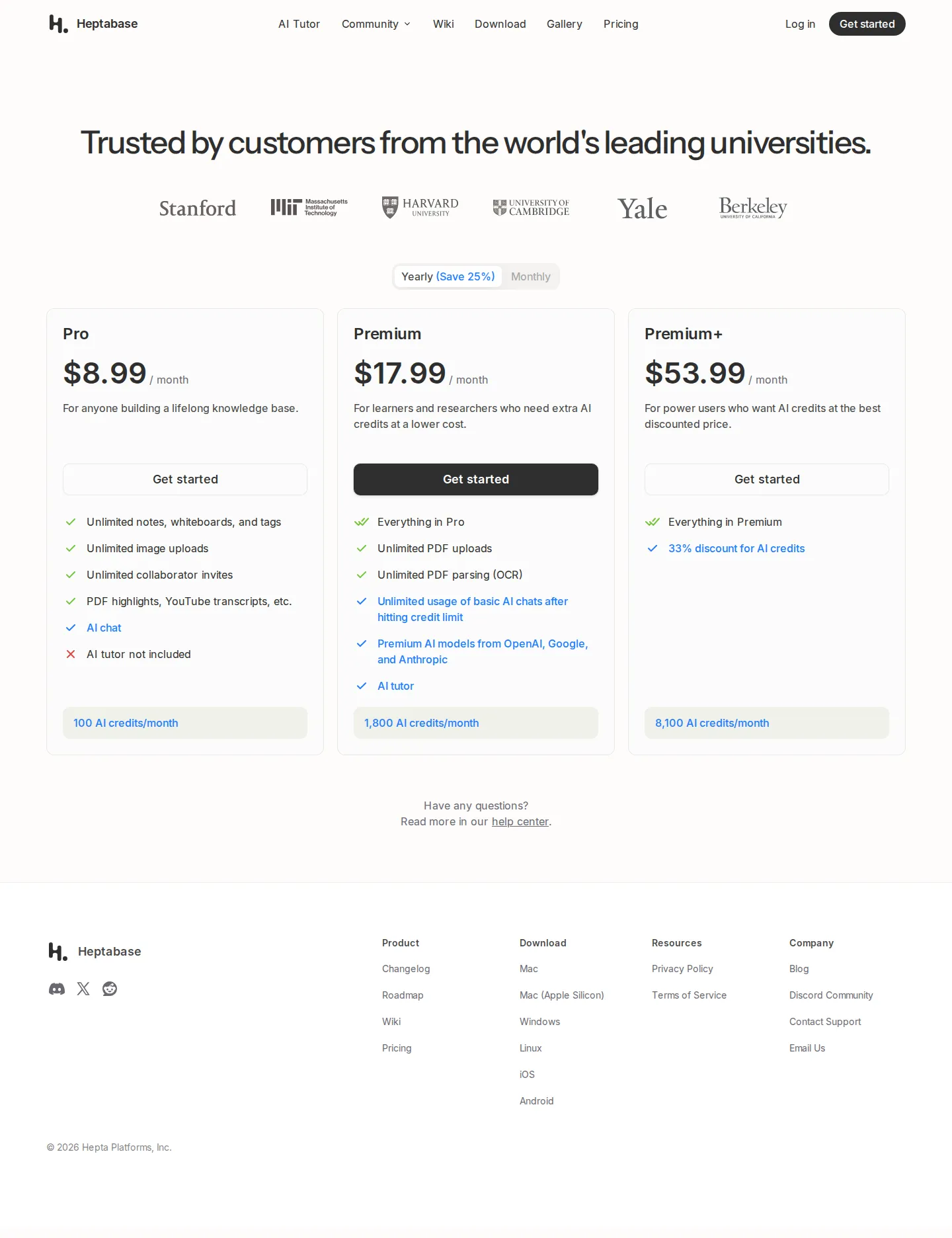
Heptabase sells one product across three tiers, and the tiers are differentiated almost entirely by how much AI you get. The core note-taking and whiteboard experience — unlimited notes, whiteboards, tags, image uploads, and collaborator invites — is identical on every plan. What you actually pay more for is a bigger monthly AI-credit allowance plus a few AI-adjacent unlocks (the AI Tutor, premium models, unlimited OCR).
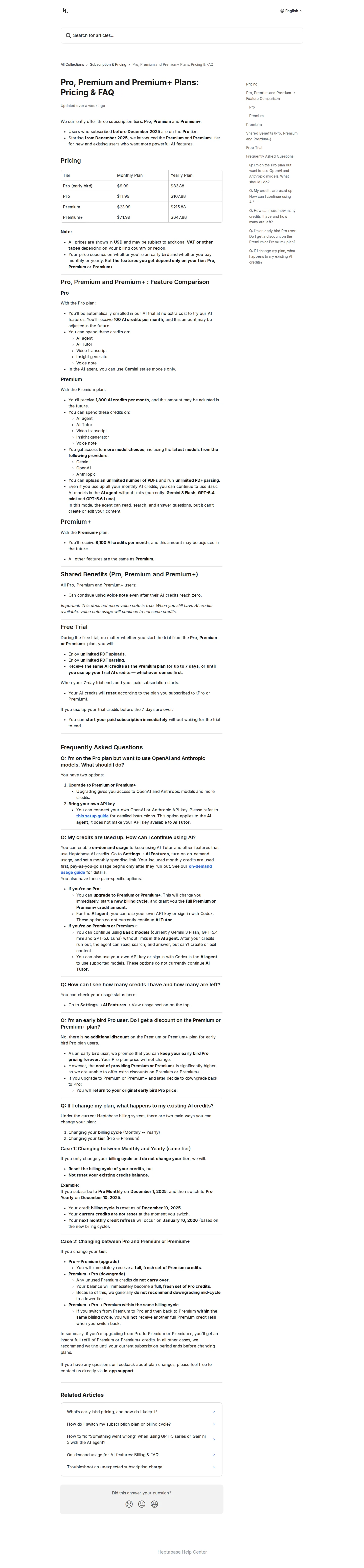
Billed yearly (the default toggle, marked “Save 25%”): Pro $8.99/mo ($107.88/yr), Premium $17.99/mo ($215.88/yr), Premium+ $53.99/mo ($647.88/yr). Billed monthly the same tiers cost $11.99, $23.99, and $71.99 — exactly 25% more. AI credits are 100, 1,800, and 8,100 per month respectively.
There is no permanent free tier. New users get a 7-day trial that grants Premium-level credits (1,800) regardless of the tier they pick, then must subscribe.
What makes this different: the subscription is a flat per-seat price, but the value lever is a usage meter (AI credits) bundled into each tier — a hybrid of classic seat pricing and consumption pricing. Heptabase also layers an optional pay-as-you-go mode on top: once a tier’s included credits run out, users can turn on “on-demand usage” (Settings → AI Features) and set a monthly spending limit, so extra AI consumption is metered per use instead of forcing a full tier upgrade.
Pricing by product
| Tier | Price (yearly) | Price (monthly) | AI credits/mo | Key unlocks |
|---|---|---|---|---|
| Pro | $8.99/mo ($107.88/yr) | $11.99/mo | 100 | Unlimited notes/whiteboards/tags, AI chat (no AI Tutor) |
| Premium | $17.99/mo ($215.88/yr) | $23.99/mo | 1,800 | AI Tutor, premium models, unlimited PDF + OCR |
| Premium+ | $53.99/mo ($647.88/yr) | $71.99/mo | 8,100 | 33% credit discount, max AI usage |
All three tiers can additionally enable on-demand (pay-as-you-go) usage under Settings → AI Features: once a tier’s included monthly credits are exhausted, a user-set monthly spending limit lets AI consumption continue on a metered basis rather than requiring an upgrade to the next tier.
Sales motions across products: fully self-serve / product-led across all three tiers. Every price is public on the pricing page; there is no enterprise “contact us” tier and no sales-quoted pricing. Early-bird subscribers from before the August 31, 2023 v1.0 launch keep a grandfathered $9.99/mo (monthly) / $83.88/yr rate permanently.
Hidden costs : What Heptabase users actually pay
Heptabase is unusually clean — there are no per-seat add-ons and no enterprise upsell. The historical “hidden cost” was the credit ceiling: credits do not roll over and reset each billing cycle, so a heavy AI month on Pro (100 credits) could leave you stranded mid-task with a full tier upgrade as the only fix. As of August 2026, Heptabase closed that gap with an on-demand overage mode (Settings → AI Features): any paid tier can set a monthly spending limit and keep consuming AI once included credits run out, billed pay-as-you-go instead of forcing an upgrade. The new hidden cost is the flip side of that fix — it’s an opt-in variable bill: turn on-demand on with a generous cap and your monthly charge can move, the exact unpredictability the flat-tier model used to rule out by design.
The mitigation: once Premium / Premium+ users exhaust credits, they can still fall back to free basic models (Gemini 3 Flash, GPT-5.4 mini, GPT-5.6 Luna) in chat without ever enabling on-demand — so variable billing stays opt-in, and mostly matters for Pro users or anyone who specifically wants premium-model continuity beyond their included allowance.
| Line item | Monthly cost (illustrative) |
|---|---|
| Pro base (yearly) | $8.99 |
| Hit the 100-credit wall, upgrade to Premium | +$9.00 (to $17.99) |
| Heavy AI user moving Premium → Premium+ | +$36.00 (to $53.99) |
| Typical AI-active user (Premium, yearly) | $17.99 |
Want to estimate your own Heptabase bill? Use the Heptabase pricing calculator to model your costs based on usage patterns.
Pricing evolution : Heptabase pricing history and changes
Cadence
| Period | Price changes | Product / SKU additions | Notes |
|---|---|---|---|
| 2023 Q3 | 1 | 0 | v1.0 launch; early-bird ends, standard $8.99/$11.99 set |
| 2025 Q4 | 0 | 2 | Premium + Premium+ tiers added (AI-credit upsell) |
| 2026 Q2 | 0 | 0 | Structure confirmed; no rate change |
| 2026 Q3 | 0 | 1 | On-demand pay-as-you-go AI-credit overage added; base tier prices unchanged |
Tracked range: 2023–present. Heptabase has been notably price-stable on its base plan — the $8.99/$11.99 Pro rate has held since the August 2023 v1.0 launch.
Notable changes
- 2023-08-31 — Early-bird period ends with v1.0. Standard pricing locked at $8.99/mo yearly ($107.88/yr) and $11.99/mo monthly. Early-bird subscribers grandfathered at $9.99/$83.88 forever.
- 2025-12 — Heptabase splits its single plan into three. The original becomes Pro (100 credits); Premium ($17.99 yearly, 1,800 credits, AI Tutor + premium models) and Premium+ ($53.99 yearly, 8,100 credits) launch to monetize heavier AI use.
- 2026-06 — Three-tier credit-metered structure confirmed live; credits do not roll over and add-on purchases are still unreleased.
- 2026-08-28 — Heptabase ships a pay-as-you-go AI-credit overage mode: any paid tier can enable “on-demand usage” (Settings → AI Features) and set a monthly spending limit, so AI consumption continues on a metered basis once included credits run out — replacing the prior “upgrade a whole tier” requirement. Base tier prices and included-credit allowances are unchanged.
What’s unique : Heptabase’s distinctive pricing mechanics
1. The product is free; the AI is the meter. Every tier ships the full note-and-whiteboard app with unlimited everything (notes, whiteboards, image uploads, collaborators). The only thing that scales with price is AI credits. Heptabase has essentially turned its base software into a fixed-cost commodity and made AI consumption the price ladder.
2. User-chosen overage, not vendor-imposed metering. Most usage-priced AI tools force metered overage on everyone once an allowance runs out. Heptabase spent over two years doing the opposite — tier-jump only, no top-ups — before adding a pay-as-you-go escape valve in August 2026 that a user must deliberately turn on and cap themselves (Settings → AI Features). The buyer picks their own risk tolerance: stay on flat, predictable tiers, or opt into a self-capped variable bill.
3. A “soft floor” of free basic models. Rather than cutting you off when credits run out, Premium/Premium+ users fall back to free unlimited basic models (Gemini 3 Flash, GPT-5.4 mini, GPT-5.6 Luna). Credits effectively gate premium model access, not all AI — an elegant way to cap cost exposure while keeping the app usable.
Strengths & weaknesses
| Strengths | Weaknesses |
|---|---|
| Radically simple, fully public pricing — three numbers, no sales call | No free tier; only a 7-day trial limits top-of-funnel discovery |
| Predictable flat cost by default; overage (added Aug 2026) is opt-in and user-capped, not vendor-imposed | Credits still don’t roll over, and the new pay-as-you-go overage has no published per-credit rate — buyers set a spending cap without knowing what it costs per unit of extra usage |
| Core product unlimited on every plan (no feature paywalls) | Pro’s 100 credits are easily exhausted by serious AI users |
| Profitable/independent, so pricing isn’t subsidized by burn | Pricing page lists credit counts but not what a credit does, confusing buyers |
| Annual discount is a clean, honest 25% | Premium models still require credits; heavy users face a steep $36/mo jump to Premium+ |
Billing UX : Heptabase billing controls and transparency
- Billing controls — Self-serve monthly or yearly toggle directly on the pricing page; 25% yearly discount applied automatically. Upgrading (Pro → Premium/Premium+) grants an immediate full refill of the new tier’s credits; downgrading forfeits unused higher-tier credits and resets to a fresh lower-tier balance. Switching only the billing cycle (Monthly ↔ Yearly) on the same tier keeps the existing credit balance intact and just resets the billing date.
- On-demand usage toggle — Under Settings → AI Features, users on any paid tier can turn on “on-demand usage” and set a monthly spending limit; included monthly credits are consumed first, and pay-as-you-go billing only begins once they run out.
- Usage visibility — Each plan’s credit allowance is stated up front on the pricing page; a Settings → AI Features usage panel shows current credit balance and consumption inside the app, though the pricing page itself does not explain credit-to-action conversion (a documented source of buyer confusion).
- Bring-your-own-key — On any tier, users can connect their own OpenAI or Anthropic API key, or sign in with Codex, to keep using the AI agent with supported models without spending Heptabase credits; this option does not extend to AI Tutor.
- Payment options — Standard card-based subscription in USD; prices may carry additional VAT/local tax depending on region. No invoicing/PO or enterprise procurement path advertised.
Strategic wins : Why Heptabase’s pricing decisions worked
1. Monetizing AI without re-pricing the base product
By keeping Pro at the long-standing $8.99 and bolting AI onto Premium/Premium+, Heptabase added an upsell ladder in December 2025 without alienating existing users or triggering a “they raised prices” backlash. The base plan stayed stable; new value got new SKUs. See how AI companies are shifting from per-user licenses.
2. Predictable-by-default, metered-by-choice
In a category drowning in token-meter anxiety, Heptabase kept its core promise — every plan defaults to a flat, known bill — while adding a pressure valve in August 2026: pay-as-you-go overage that a user must deliberately turn on and cap themselves. That beats forcing metering on everyone: buyers who value predictability never see a variable bill, and buyers who want continuity opt in and set their own ceiling, so Heptabase captures overage revenue without importing token-meter anxiety by default. Related: bill shock and cost unpredictability.
3. Self-funded pricing discipline
Because the company runs on revenue rather than venture burn, pricing is set to be sustainable, not to grab market share with a perpetual free tier. The 7-day trial converts intent without subsidizing freeloaders. See choosing the right usage metric.
Areas to improve : Gaps in Heptabase’s pricing approach
1. Explain what a credit buys
The single most-cited complaint is that the pricing page shows credit counts (100 / 1,800 / 8,100) but never says what a credit gets you — how many chats, how long a transcript, how many insights. Buyers can’t self-select a tier, so the credit meter creates friction instead of clarity.
2. Publish the on-demand overage rate
Heptabase shipped pay-as-you-go overage in August 2026, closing the add-on-credit gap this section used to flag — but the Settings → AI Features toggle only exposes a spending limit, not a per-credit or per-dollar conversion rate. A user has no way to estimate how much AI activity a $10 versus $50 monthly cap actually buys before turning it on. Publishing the same credit-to-action math requested in Point 1, applied to the overage meter specifically, would let buyers set an informed cap instead of guessing. See bill shock and cost unpredictability.
3. Reconsider the missing free tier
For a discovery-driven productivity tool competing with Notion/Obsidian’s generous free plans, a 7-day trial is a narrow funnel. A capped permanent free tier (even read-only or low-credit) could widen top-of-funnel without threatening the profitable paid base.
Monetization stack & signals : how Heptabase builds & buys its revenue engine
Buys 4 Builds 0
Buys its whole monetization stack off the shelf — Stripe runs payments and self-serve subscriptions, Amplitude and PostHog track usage and retention, Intercom handles support. A small, profitable team with nothing built in-house.
-
“The payment processors we work with are: Stripe”
-
“Amplitude Analytics is a web analytics service offered by Amplitude that tracks and reports website traffic.”
-
“PostHog is a product analytics service offered by PostHog Inc. that tracks and reports usage of our Service.”
-
“Intercom Support is a customer service offered by Intercom, Inc that provide a messaging and automation system for you to provide Feedback.”
Signals reviewed · derived from engineering blogs, product docs
Key takeaways
- One product, three AI tanks. Heptabase’s tiers differ almost entirely by AI-credit allowance (100 / 1,800 / 8,100), not by core features.
- Yearly = 25% off, cleanly. Pro $8.99 vs $11.99, Premium $17.99 vs $23.99, Premium+ $53.99 vs $71.99 — a transparent annual incentive.
- No free tier, but overage is now opt-in. The on-ramp is still just a 7-day trial, but since August 2026 running out of AI credits no longer forces a tier upgrade — a self-capped pay-as-you-go mode lets you keep going instead.
- Credits are the meter, model access is the gate. Premium users fall back to free basic models when credits run out, capping cost exposure.
- Profitability shapes the model. A self-funded, ~$200K/mo company prices for sustainable margin, not free-tier land grab.
UBP implications
- Bundled-credit hybrid is a credible middle path. Heptabase shows you can attach a usage meter (AI credits) to a flat seat price without exposing customers to raw token billing — predictable for buyers, upsell-friendly for vendors.
- Tier-jump and top-up don’t have to be mutually exclusive. Heptabase spent two-plus years as the poster child for “upgrade a whole tier, no top-ups,” then added user-capped pay-as-you-go overage in August 2026 without removing the tier ladder. The lesson: a hybrid seat+credit model can add metered overage as an opt-in escape valve without abandoning the predictability that made the flat tiers attractive in the first place. See choosing the right usage metric.
- A meter you can’t explain is friction, not pricing. The “what is a credit?” confusion is a cautionary tale: any consumption unit must be legible to buyers at the point of purchase, not just inside the app.
Sources
- Heptabase pricing page (accessed 2026-08-28)
- Pro, Premium and Premium+ Plans: Pricing & FAQ — Heptabase Help Center (accessed 2026-08-28)
- How do I switch my subscription plan or billing cycle? — Heptabase Help Center (accessed 2026-08-28)
- On-demand usage for AI features: Billing & FAQ — Heptabase Help Center (accessed 2026-08-28)
- What’s early-bird pricing, and how do I keep it? — Heptabase Help Center (accessed 2026-06-15)
- Heptabase — Y Combinator (W22) (accessed 2026-06-15)
Bottom line
Heptabase prices like the profitable, opinionated product it is: $8.99/mo (Pro), $17.99/mo (Premium), $53.99/mo (Premium+) billed yearly, 25% more billed monthly, with the tiers separated almost entirely by an AI-credit meter (100 / 1,800 / 8,100 per month). There’s no free tier, but as of August 2026 there is a token overage — an opt-in, self-capped pay-as-you-go mode that lets you keep going past your included credits without jumping a whole tier. It’s still refreshingly transparent and predictable by default, with two remaining gaps: explain what a credit actually buys, and publish what the new overage mode actually costs per unit of usage.
Want to compare Heptabase against other knowledge and productivity tools? Browse the pricing blueprint.
Pricing timeline : Major events on a vertical axis
Each milestone below corresponds to a public pricing change, product launch, or material adjustment. Major events use a filled marker; minor adjustments use a faded one.
On-demand pay-as-you-go AI credit overage ships
Heptabase added a self-serve overage mode: under Settings -> AI Features, any paid tier (Pro, Premium, Premium+) can set a monthly spending limit and keep using AI once included credits run out, billed pay-as-you-go instead of requiring a full tier upgrade. Base tier prices and included-credit allowances are unchanged.
Three-tier credit-metered structure confirmed
Pricing page shows Pro $8.99, Premium $17.99, Premium+ $53.99 (per month billed yearly, 25% off monthly). AI credits power chat, transcripts, insights, and voice notes; no credit rollover, no add-on purchases yet.
Premium and Premium+ tiers added
Heptabase split its single plan into three. The original plan became 'Pro' (100 AI credits/mo), and two AI-heavy tiers launched: Premium ($17.99/mo yearly, 1,800 credits, AI Tutor + premium models) and Premium+ ($53.99/mo yearly, 8,100 credits, 33% credit discount).
Early-bird period ends at v1.0 launch
Heptabase exited open beta with v1.0. Standard pricing became $8.99/mo billed yearly ($107.88/yr) and $11.99/mo billed monthly. Early-bird subscribers ($9.99 monthly / $83.88 yearly) keep their discounted rate permanently.
- · Heptabase is named after a fictional alien language (Heptapod) from the film Arrival that lets its speakers perceive past, present, and future at once — the pitch for thinking visually across time on an infinite canvas.
- · It's a Y Combinator W22 company that raised a $1.7M seed from HOF Capital, Kleiner Perkins, and others — yet reportedly never spent the investor money, running entirely on subscription revenue (~$200K/month at one point).
- · There is no free tier and no lifetime license: the only on-ramp is a 7-day trial that quietly hands you Premium-level AI credits no matter which plan you sign up for.
Questions & answers
- How much does Heptabase cost?
- Heptabase has three tiers. Billed yearly: Pro is $8.99/mo ($107.88/yr), Premium $17.99/mo ($215.88/yr), and Premium+ $53.99/mo ($647.88/yr). Billed monthly the same tiers are $11.99, $23.99, and $71.99 — yearly billing saves 25%.
- Does Heptabase have a free tier?
- No. Heptabase has no permanent free plan. It offers a 7-day free trial that grants Premium-level AI credits (1,800) plus unlimited PDF uploads and parsing regardless of which paid tier you choose. After the trial you must subscribe to keep using the app.
- What's the difference between Heptabase's Pro, Premium, and Premium+ plans?
- All three include unlimited notes, whiteboards, tags, and image uploads. The difference is AI: Pro gives 100 AI credits/month and excludes the AI Tutor; Premium adds the AI Tutor, premium models (OpenAI/Google/Anthropic), unlimited OCR, and 1,800 credits; Premium+ gives 8,100 credits plus a 33% discount on credits for power users.
- How do Heptabase AI credits work and do they roll over?
- Credits are consumed by AI chat, video transcripts, insight generation, and voice notes. They reset every billing cycle and do not roll over. Once credits run out, Premium and Premium+ users can keep using basic models (Gemini 3 Flash, GPT-5.4 mini, GPT-5.6 Luna) in chat for free, and any tier can also turn on on-demand (pay-as-you-go) usage with a user-set monthly spending limit to keep consuming AI beyond the included allowance.
- Can I buy extra AI credits on Heptabase?
- Yes. Under Settings → AI Features, users on any paid tier can enable on-demand usage and set a monthly spending limit. Included monthly credits are used first; once they run out, additional usage is billed pay-as-you-go up to that limit instead of requiring a full tier upgrade.