AI Summary
About
Higgsfield is an AI media-generation platform for creating images and videos from text prompts, marketed at creators, marketing teams, and businesses. The product spans a broad surface — Image, Video, Audio, a “Supercomputer” agentic workflow, a node-based Canvas editor, Marketing Studio, Cinema Studio, and an AI Influencer tool — and routes generation across 50+ underlying models (the company cites Sora, Kling, Soul, Nano Banana Pro, GPT Image, and Seedance). OpenAI’s Head of Startups has publicly endorsed Higgsfield as building “boldly on our Sora API.”
Higgsfield was founded in 2023 by Alex Mashrabov — former head of generative AI at Snap, who had earlier sold his startup AI Factory to Snap for $166M — alongside AI researcher Yerzat Dulat. It launched publicly in April 2024 with $8M seed funding led by Menlo Ventures, then raised a $50M Series A (September 2025, $1.0B valuation) and an $80M extension (January 2026, $1.3B valuation) led by Accel, for roughly $138M total. By early 2026 the company reported ~300,000 paying subscribers and a ~$300M annualized run rate (up from a ~$200M run rate the prior month), 15M+ users, and 4.5M video generations per day.
Commercially, Higgsfield sells access as a credit-based subscription: three individual plans (Basic, Pro, Max), two per-seat team plans (Team, Scale) for agencies and small teams, and a sales-led Enterprise plan. The company positions itself around production speed and cost — its enterprise page claims “10× faster production,” “$12K saved per created content,” and “40% higher engagement,” and says it is used by “100,000+ teams.”
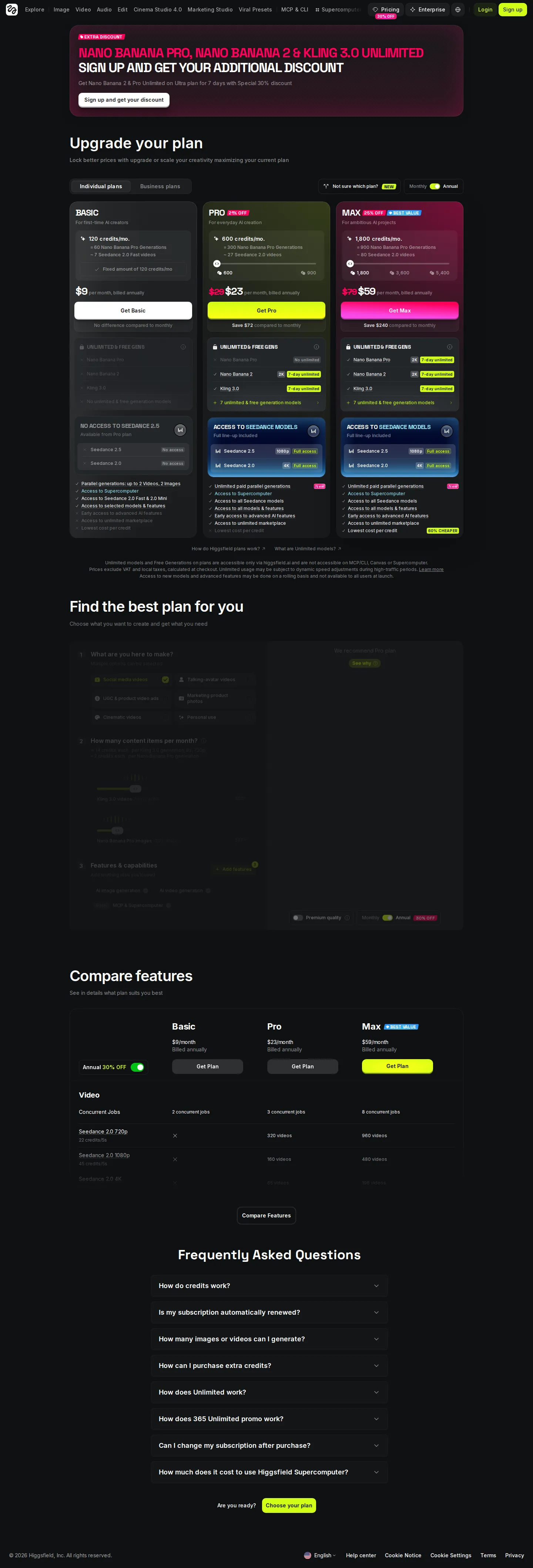
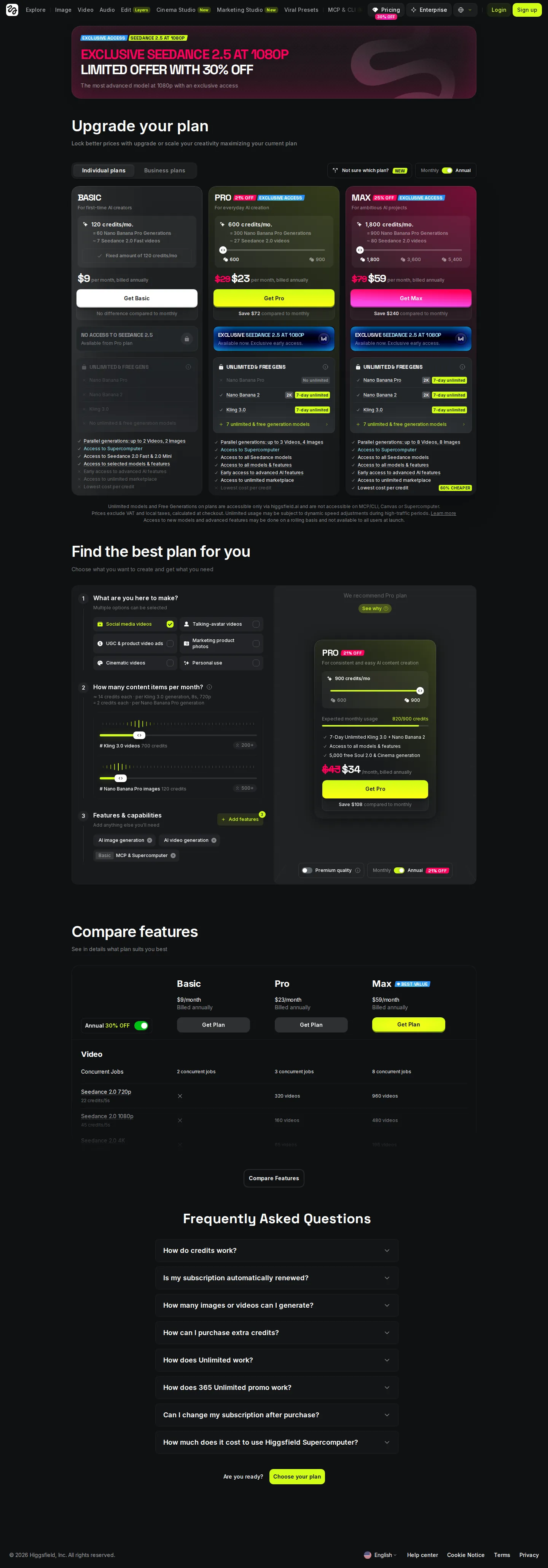
The pricing page is a client-rendered single-page app, and on every capture from 2026-06-05 through 2026-08-11 it bailed out to a skeleton loading state or an explicit “Unable to load pricing plans” error, so exact tier prices never appeared in server HTML, headless/stealth browser capture, or the Wayback archive. On 2026-08-14 the page finally rendered live prices to automated capture — and the tiers had changed again: the April-2026 Free/Starter/Plus/Ultra/Business ladder is gone, replaced by Basic ($9/mo), Pro ($29/mo or $23/mo annual), and Max ($79/mo or $59/mo annual) for individuals, plus per-seat Team ($79/seat or $65/seat annual) and Scale ($215/seat or $150/seat annual) plans for teams, and a custom-quoted Enterprise plan. No $0 Free plan card appears on the current grid. Pro and Max also introduced a credit slider (Pro: 600-900 credits/mo; Max: 1,800-5,400 credits/mo) that scales price with the chosen credit amount, replacing the prior fixed-allowance-per-tier model.
Pricing summary : How Higgsfield’s credit-based subscription works
Higgsfield uses a credit-based subscription (no free tier shown on the current grid) built on two billing dimensions:
- Individual plan tier (credits per month, slider-priced on Pro/Max): Three paid plans — Basic ($9/mo, fixed 120 credits), Pro ($29/mo or $23/mo annual, 21% off, 600-900 credits via a slider), and Max ($79/mo or $59/mo annual, 25% off, 1,800-5,400 credits via a slider) — each bundling a monthly allowance of “credits” spent on image and video generations across the platform’s 50+ models. Pro and Max render as the featured plans; Max carries a “MOST POPULAR” badge. The page also surfaces a recurring promotional discount (a visible 30% OFF badge on annual billing) and a monthly/annual billing toggle.
- Seats (Team / Scale / Enterprise): Two per-seat plans — Team (
$79/seat/mo, or $65/seat annual, 18% off, for 1,000 credits/seat, 2-9 members) adds a shared collaborative workspace (folders, roles, real-time review, in-project chat and video calls) but not SSO or admin spend controls, while Scale ($215/seat/mo, or $150/seat annual, 30% off, for 2,500 credits/seat, 5-15 members) adds SSO, admin spend control, and a priority generation queue on top of everything in Team — and a sales-led Enterprise plan adds unlimited seats, dedicated capacity (SLA), indemnification, no model training on customer data, and SOC2-aligned, GDPR-compliant security (SOC2 is still marked “coming soon” on Team and Scale). Enterprise is quote-based (“Contact Sales”).
What makes this different: Higgsfield meters a multi-model generation platform through a single shared “credit” unit rather than per-model or per-second video pricing, and lets buyers move the credit allowance itself via a slider on Pro/Max rather than picking a fixed tier size. The pricing page renders client-side and was gated to automated capture for months (2026-06-05 through 2026-08-11); it finally rendered live prices on 2026-08-14, revealing a full rename/reprice from the prior Starter/Plus/Ultra/Business ladder.
Pricing by product
Individual plans (credit-based subscription)
| Tier | Monthly | Annual (per mo) | Credits / month | Key mechanics |
|---|---|---|---|---|
| Basic | $9 | $9 (no discount) | 120 (fixed) | Entry tier; no Seedance 2.5 access; no unlimited/free-gen models; up to 2 parallel videos/2 images |
| Pro | $29 | $23 (21% off) | 600-900 (slider) | Featured; 7-day unlimited on Nano Banana 2 + Kling 3.0 (not Nano Banana Pro); early access to Seedance 2.5 @1080p; up to 3 parallel videos/4 images |
| Max | $79 | $59 (25% off) | 1,800 / 3,600 / 5,400 (slider) | “Most Popular”; 7-day unlimited incl. Nano Banana Pro; up to 8 parallel videos/8 images; “60% cheaper” per-credit callout |
Team, Scale and Enterprise plans
| Tier | Price | Credits | Included | Key mechanics |
|---|---|---|---|---|
| Team | $79/seat ($65 annual) | 1,000 / seat / month, pooled | Shared credit pool, shared workspace, basic analytics, priority support; no SSO, admin spend control, priority generation queue, delegated top-up access, indemnification, no-data-training guarantee, SOC2, or AI Educator/Slack support — the /team-plan card X-marks all five Security & Compliance items for Team (confirmed 2026-08-28), not just the three corrected on 2026-08-15 | Self-serve; 2-9 members, min. 2 seats. Confirmed live on /team-plan and back on /pricing’s Business tab as of 2026-08-28 |
| Scale | $215/seat ($150 annual) | 2,500 / seat / month, pooled | Everything in Team plus SSO, admin spend control, a priority generation queue, and detailed analytics; SOC2 is still marked “coming soon” (not yet live) | Self-serve; 5-15 members. Reconfirmed live on /pricing’s Business tab as of 2026-08-28 (previously only confirmed 2026-08-14) |
| Enterprise | Custom | Custom, volume rollover credits | Unlimited seats, dedicated capacity (SLA), SSO, indemnification, no data training, SOC2 (live, not “coming soon”), personal AI Educator | Sales-led, quoted (“Contact Sales”) |
Prices read directly from the live pricing page (Individual and Business tabs) and the dedicated /team-plan page on 2026-08-14 — the first capture on which the page rendered dollar figures at all; every capture from 2026-06-05 through 2026-08-11 returned a loading skeleton or an explicit “Unable to load pricing plans” client error with no prices. The tier structure also changed: the April-2026 Free/Starter/Plus/Ultra/Business ladder is retired, and no $0 Free plan card appears on the current grid. The Individual-tab figures (Basic/Pro/Max) are confirmed by screenshot; the Business-tab figures (Team/Scale/Enterprise) are confirmed by the automated text capture of that tab plus a second, independently screenshotted source (the /team-plan page, which visually confirms the Team price) — that tab’s own screenshot mis-rendered the Individual view due to a click/re-render timing artifact, not a data conflict. Pro and Max prices shown are each tier’s default (lowest) credit-slider position; both scale to a higher price at more credits (e.g., Pro’s built-in plan-finder tool showed 900 credits at $43/mo or $34/mo annual). Independent price-validation pass (2026-08-15): the Business tab’s plain-text capture lists “SSO / Admin spend control / Priority queue” as bullets under both Team’s and Scale’s “Admin & Control” section, but text extraction can’t distinguish a checkmark from an X — the /team-plan page’s own comparison card (screenshotted separately) shows those three items X-marked (not included) for Team, matching the Higgsfield help center’s explicit Team/Scale/Enterprise comparison table (higgsfield.ai/creator-hub/help-center/business/team-and-business-higgsfield), which lists Team’s SSO, per-user spend pausing, and priority queue as “No” (Scale and Enterprise only). The table above has been corrected accordingly.
Surface-availability caveat (2026-08-16), resolved 2026-08-28. A live first-party re-read two days after the 2026-08-14 capture found the /pricing page’s “Individual plans / Business plans” tab pair gone, with no Team, Scale or Enterprise card rendering there; Scale’s figures rested on the 2026-08-14 Business-tab capture alone in the interim. A fresh capture on 2026-08-28 (2026-08-28-main-business.txt/.webp, status 200) confirms the tab pair is back and both Team ($79/$65) and Scale ($215/$150) render on /pricing’s Business tab again, alongside their standing confirmation on /team-plan. This matches the page’s documented pattern of intermittent client-side render failures rather than a real withdrawal — no dollar figures changed across the outage.
Sales motions across products: self-serve / PLG for Basic, Pro, Max, Team and Scale; sales-led for Enterprise (Contact Sales).
Hidden costs : What credit-metered AI video buyers actually pay
The headline tier price is rarely the whole bill on a credit-metered media tool. The cost drivers that move the real number:
| Cost driver | What triggers it | Rough magnitude |
|---|---|---|
| Credit burn vs. allowance | Heavy video/image generation exhausts the bundled credits before cycle-end | A single high-end video can cost tens of credits; Basic’s fixed 120/mo goes fast |
| The slider, not the headline | Pro and Max advertise their slider’s floor; dialling credits up reprices the plan | Pro’s own plan-finder prices its 900-credit position at |
| Top-up credits | Buying more credits mid-cycle once the allowance is gone | ~$5 per 100 credits — no plan benefits attached |
| Credit expiry | Subscription credits do not roll over; they expire at the end of each credit cycle | Pay-for-capacity-you-lose if generation is bursty |
| Annual lump sum | Annual billing discounts 18-30% by tier but is charged upfront | Pro $23 ×12 = $276 upfront; Max $59 ×12 = $708 upfront |
| Promo vs. renewal | A standing 30% OFF badge advertises the best tier’s discount, not most tiers’ | Headline badge ≠ your tier’s actual saving (21% Pro, 25% Max, 18% Team) |
| Per-seat scaling (Team) | Each added seat adds ~$79/mo (or $65 annual) and 1,000 credits, 2-seat min | A 5-seat team ≈ $325-$395/mo before any top-ups |
| VAT and local taxes | Every headline figure is quoted pre-tax | ”Prices exclude VAT and local taxes, calculated at checkout” — add your local rate |
- Credit burn rate vs. allowance. The headline tier price only holds if generations stay inside the bundled allowance; heavy use forces a tier upgrade, a slider move, or top-ups.
- The advertised price is a floor, not a price. On Pro and Max the card shows the cheapest slider position — Higgsfield’s own recommender quotes ~$43/mo for Pro at 900 credits, roughly 48% above the $29 headline.
- Annual saves but locks cash. The monthly/annual toggle trades an 18-30% discount for a full-year upfront charge.
Want to estimate your own Higgsfield bill? A Higgsfield pricing calculator can model monthly cost by tier, credit consumption, and top-ups once the per-credit output mapping is confirmed.
Pricing evolution : Two renames in eight months, then the page finally renders
Cadence
| Quarter | Price changes | Product / SKU additions | Notes |
|---|---|---|---|
| 2026 Q1 | — | — | Tiers documented as Basic / Pro / Ultimate / Creator (~$9 to $249), free tier ~150 credits/mo (per Jan-2026 teardown). |
| 2026 Q2 | Rename + reprice | 0 | Tiers renamed and repriced to Starter $15 / Plus $49 / Ultra $129 / Business ~$89/seat + Enterprise; 30% OFF promo visible. |
| 2026 Q3 | Rename + reprice + tier split | +1 (Business → Team + Scale) | Tiers renamed again to Basic $9 / Pro $29 ($23 annual) / Max $79 ($59 annual), with Pro and Max moving to credit sliders; Business split into per-seat Team ($79/$65) and Scale ($215/$150); no $0 Free plan card shown; page rendered live prices for the first time since capture began. |
Tracked range: 2026-01 to 2026-08. The live pricing page renders client-side and was gated to automated capture from 2026-06-05 through 2026-08-11 (no historical figures recoverable from the Wayback archive, which was also offline at capture time); the Q1-Q2 dates are anchored to dated third-party pricing teardowns, while the Q3 change is read directly from the 2026-08-14 capture — the first to render live prices, re-confirmed by a live first-party browser read on 2026-08-16.
Was intermediate history missed? Almost certainly yes, and it is not recoverable. The Basic/Pro/Max reprice is dated 2026-08-14 because that is when it became observable, not when it happened — the only honest bound is that it landed somewhere in the ten-week window between 2026-06-05 and 2026-08-14, during which every capture returned a skeleton or an error and Wayback held no legible snapshot. Two details argue the change had already been live for a while before we saw it. The reprice is not one move but at least three stacked ones (a full tier rename, the introduction of credit sliders on two tiers, and the split of a single per-seat Business plan into Team and Scale), which vendors rarely ship in a single release. And the secondary sources this page leaned on during the blackout were themselves stale: the 2026-08-11 validation pass re-fetched five independent pricing roundups and all five still reported the Starter/Plus/Ultra/Business ladder — so third-party corroboration would not have caught the change either, and cannot now be used to date it. Any intermediate step between the April ladder and the August one is therefore unrecoverable, and the corpus should treat the 2026-06 and 2026-08-11 entries as reconfirmations of a stale reading rather than evidence the old ladder was still live on those dates.
Notable changes
-
2026-01-23 — A third-party pricing guide documented the then-current ladder as Basic ($0-$9) / Pro ($17-$29) / Ultimate ($29-$49) / Creator ($119-$249), with a free tier of ~150 credits/month, top-up credit packs ($5/80, $80/1,700), and 90-day credit expiry. Source: segmind.com.
-
2026-04-28 — Roundups now describe the renamed Starter / Plus / Ultra / Business structure (Starter $15/200cr, Plus $49→$39/1,000cr, Ultra $129→$99/3,000cr, Business $62-$89/seat/1,500cr-per-seat), plus a custom Enterprise plan. Sources: imagine.art (updated 2026-04-28), vo3ai, costbench.
-
2026-06-05 — First in-house Facts capture. The live page rendered as a skeleton (no prices), with only a 30% OFF promo and the 4-card consumer layout visible; the stale meta keyword string still read “Basic Pro Ultimate Creator.” Current figures were recovered from secondary sources.
-
2026-08-11 — Reconfirmation capture (headless + stealth). The pricing grid still exposed no dollar figures — one capture returned the same loading skeleton, another surfaced an explicit “Unable to load pricing plans / Try Again” client error — while the 30% OFF promo badge remained visible in the nav and the tier structure documented above is unchanged. Site-wide navigation was restructured (added Cinema Studio, Viral Presets, Academy, Community, Contests, Originals as top-level items; dropped the standalone “Collab” and “Apps” links), but no pricing or packaging change was observed.
-
2026-08-14 — The pricing page rendered live dollar figures for the first time since capture began on 2026-06-05, and the tiers had changed again: Free / Starter / Plus / Ultra / Business is retired, replaced by Basic ($9/mo) / Pro ($29/mo or $23 annual) / Max ($79/mo or $59 annual) for individuals — Pro and Max now use a credit slider instead of a fixed monthly allowance — and a per-seat Team ($79/$65) / Scale ($215/$150) split replacing the single Business plan. No $0 Free plan card appears on the current grid.
-
2026-08-15 — Independent second-source price-validation pass. The Higgsfield help center (
higgsfield.ai/creator-hub/help-center/business/team-and-business-higgsfield, a genuinely separate vendor surface from the pricing page) publishes an explicit Team/Scale/Enterprise feature-comparison table showing SSO, admin spend control, and priority queue as not included on Team — contradicting this page’s prior Team row, which had copied those items from the Business-tab capture’s plain-text bullet list (a checkmark-vs-X distinction that text extraction can’t preserve). A screenshotted/team-plancomparison card confirms the correction visually (those three items are X-marked for Team). Dollar figures on Basic/Pro/Max/Team/Scale were unaffected — this pass only corrected feature attribution. Separately, a same-day server-rendered fetch ofhiggsfield.ai/pricingvia a third-party JS-rendering proxy (r.jina.ai) returned a different Individual-tab structure — Starter ($19/mo, 270 fixed credits), Plus ($59/mo or $47 annual, 1,200 fixed credits), Ultra ($129/mo or $99 annual, 3,000-9,000 credit slider) — reproducible across two fetches minutes apart but not corroborated by any first-party render. Per this corpus’s standing policy of discounting single-method proxy-render reversals (a known SPA-proxy failure mode), the screenshot-backed Basic/Pro/Max figures above were left unchanged pending a first-party re-check. That re-check ran on 2026-08-16 and refuted the proxy reading — see below. -
2026-08-16 — Re-check pass: Basic/Pro/Max confirmed, the proxy reading refuted, and the Business tab disappears. Two live first-party browser loads of
higgsfield.ai/pricing(a reload between them) both rendered the same Basic $9 / Pro $29→$23 / Max $79→$59 cards captured on 2026-08-14, with the same 600-900 and 1,800-5,400 credit sliders. No Starter, Plus or Ultra card exists on the live page, so the 2026-08-15 r.jina.ai reading was a third-party rendering artifact rather than a live pricing experiment — that thread is closed, and the Individual ladder is now confirmed by two independent first-party methods (headless screenshot capture and a real browser engine) plus a second first-party URL (/team-plan, which re-renders the same three cards). Three genuine changes surfaced in the same pass. First, a one-time$3“Special” — 40 credits plus two days of unlimited Soul 2.0 — now sits below Basic as the cheapest entry point; it is a single charge, not a tier. Second, the only free access advertised anywhere on the page is a card-verified trial (“5 free generations on Exclusive Seedance 2.5 at 1080p with verified card”), which confirms the free tier is genuinely gone rather than merely unrendered —has_free_tieris set tofalseaccordingly. Third, the “Individual plans / Business plans” tab pair has vanished from/pricing: both strings are absent from the DOM across both loads, and no Team, Scale or Enterprise card renders there. Team survives at $79/$65 per seat on/team-plan; Scale was not reachable on any first-party surface that day. Given this page’s documented history of intermittent render failures, one day’s absence is not treated as withdrawal — Scale is retained below with an explicit “last confirmed 2026-08-14” qualifier and should be retired if the Business tab is still missing on the next pass. The live FAQ also contradicts a third-party claim this page had been carrying: subscription credits “expire at the end of each credit cycle,” not after ~90 days (that figure came from a 2026-01-23 segmind.com teardown), and the page now publishes its own credits-per-dollar strip — Team $1 = 33 credits, Max $1 = 31, Pro $1 = 27, Basic $1 = 14. -
2026-08-28 — Tier prices unchanged; the $3 entry SKU and the credits-per-dollar disclosure strip are both gone. A full recapture of
/pricing(Individual, Annual, and Business states) plus/enterpriseand/team-planfound every subscription price unchanged from 2026-08-14/16 — Basic $9, Pro $29/$23, Max $79/$59, Team $79/$65 per seat, Scale $215/$150 per seat, Enterprise custom. Two things did change. First, the one-time$3“Special” pack (40 credits + 2-day unlimited Soul 2.0) that had sat below Basic since 2026-08-16 no longer appears anywhere on the page — checked in the exact spot between the Basic and Pro cards where it previously rendered, across all three capture states; Basic ($9/mo) is once again the cheapest way onto the platform, with no near-free or one-time-purchase option shown. Second, the first-party credits-per-dollar disclosure strip (“Team $1 = 33 credits · Max $1 = 31 · Pro $1 = 27 · Basic $1 = 14”), new as of 2026-08-16, is also gone from the live grid. Both were confirmed present on 2026-08-16 (2026-08-16-main-validated.txt) and confirmed absent on 2026-08-28 acrossmain-monthly.txt,main-annual.txt, andmain-business.txt. Separately, the/pricingpage’s “Individual plans / Business plans” tab pair, missing on 2026-08-16, is back, so Team and Scale are once again directly confirmed on/pricingrather than resting on/team-planalone; and a sharper/team-plancapture shows Team’s card X-marking all five Security & Compliance items (delegated top-up access, indemnification, no-data-training, SOC2, AI Educator/Slack support), not just the three (SSO, admin spend control, priority queue) corrected on 2026-08-15. The site’s click/screenshot timing-race quirk recurred (the “monthly” state’s text capture read correctly while its screenshot mis-rendered the annual toggle position), consistent with prior captures and resolved by trusting the text capture. -
2026-08-28 (independent price-validation pass) — A second-source WebFetch of Higgsfield’s help center (Plans overview, Team & business plans, Billing, and two Credits articles — see 2026-08-28-help-center-validated.txt) found no dollar-price contradictions on Basic/Pro/Max/Team/Scale (the help center consistently defers to
/pricingfor exact figures rather than restating them) but did surface one internal inconsistency: this page’s FAQ claimed purchased top-up (“Credit Pack”) credits are “added instantly with no stated expiry,” while two help-center articles state explicitly that “Credit Pack and Auto-Refill credits expire 90 days from purchase” — matching the 90-day figure already carried elsewhere on this page (Strengths & weaknesses, UBP implications) but contradicted by the FAQ alone. The FAQ has been corrected to state the 90-day expiry.
The 2026 rename and reprice in detail
Between January and April 2026, Higgsfield retired its original consumer naming — Basic / Pro / Ultimate / Creator — for a cleaner Starter / Plus / Ultra / Business ladder. This was not a cosmetic relabel: the entry tier moved from a ~$5-$9 “Basic” toward a $15 “Starter,” the top consumer tier consolidated around Ultra at $129 ($99 annual), and a per-seat Business plan replaced the prosumer-priced “Creator” tier ($119-$249) with an agency-oriented, shared-pool seat model. Because the live page renders client-side, the page’s own SEO metadata never caught up — the meta keywords still advertise the old tier names months after the cards changed, which is exactly why an automated capture (and the prior stub of this page) mis-read the live structure. The change tracks the company’s commercial pivot over the same window: a $50M Series A (Sept 2025, TechCrunch) and $80M extension (Jan 2026), ~300,000 paying subscribers, and a run rate climbing from ~$200M to ~$300M annualized (Sacra).
The 2026-08-14 Basic/Pro/Max reprice in detail
Four months after the Starter/Plus/Ultra/Business rename, Higgsfield renamed its individual tiers a second time — back toward its original January-2026 naming (Basic / Pro / Max, echoing the even earlier Basic/Pro/Ultimate/Creator) — while also restructuring how each tier is priced. Three changes matter more than the naming itself. First, the $0 Free plan card is gone: the current grid runs Basic ($9) as the entry point, with no visible free option, a meaningful acquisition-funnel change from the freemium structure that had been in place since at least April. Second, Pro and Max introduced credit sliders (600-900 and 1,800-5,400 credits respectively) that let a buyer dial the monthly allowance — and the price — within a tier, replacing the prior one-price-per-tier model; Pro’s own plan-finder shows the top of its slider (900 credits) pricing out at roughly $43/mo, well above the $29 headline. Third, the single per-seat Business plan split into Team and Scale, giving Higgsfield two team price points (roughly $79/seat vs. $215/seat) instead of one — a segmentation move typical of a company that has learned its team buyers span very different sizes. Underneath all three changes sits the same structural quirk as before: the page is client-rendered and had been gated to automated capture for the ten weeks prior (2026-06-05 through 2026-08-11), so this reprice only became directly observable once the page happened to render on 2026-08-14.
What’s unique : Single-credit metering across 50+ generation models
1. One credit unit across a multi-model platform. Rather than pricing each underlying model (Sora, Kling, Soul, Seedance, GPT Image, Nano Banana Pro) separately, Higgsfield abstracts all of them behind a single “credit” meter, so users buy generation capacity, not model access — a hedge against the token cost deflation that keeps repricing the underlying models.
2. A pricing page that spent months refusing to render — then broke through. Unusually for a self-serve consumer product, Higgsfield’s prices don’t appear in server HTML; every capture from 2026-06-05 through 2026-08-11 returned a loading skeleton or an explicit error instead of numbers, and only on 2026-08-14 did the page finally render live dollar figures to capture. The same capture run still saw follow-up navigations time out, which points to fragile client-side rendering rather than a deliberate anti-bot gate — and it left the page’s own meta keywords advertising tier names that no longer exist.
3. A credit ladder that now scales twice — across tiers and within them. Basic ($9 / 120 fixed credits), Pro ($29-$43 for 600-900 credits via a slider), and Max ($79+ for 1,800-5,400 credits via a slider) still get cheaper per credit as you climb tiers — Basic is ~$0.075/credit versus ~$0.044-$0.048/credit on Pro and Max — but Pro and Max now also let buyers dial the credit allowance itself rather than picking a fixed size, adding a second scaling axis inside each tier.
4. Packaging elements now ship and reverse within days, not quarters. Beyond the multi-month tier renames, a one-time $3 entry SKU (40 credits plus two days of unlimited Soul 2.0) and a first-party credits-per-dollar disclosure strip (Team $1=33cr, Max $1=31cr, Pro $1=27cr, Basic $1=14cr) both appeared on 2026-08-16 and were both gone by the 2026-08-28 recapture — a 12-day live-then-pulled cycle that reads as Higgsfield testing entry-price and transparency mechanics directly on the production pricing page rather than in a closed beta.
Strengths & weaknesses
| Strengths | Weaknesses |
|---|---|
| Single credit unit simplifies a 50+ model platform into one meter | Prices and credit allotments render only client-side, and rendered as skeleton/error states for over 10 weeks (2026-06-05 to 2026-08-11) |
| Low $9/mo entry point (Basic) keeps first purchase cheap | No $0 Free plan card appears on the current grid — a likely acquisition-funnel change from the freemium model that was still in place as of the 2026-08-11 capture |
| Clear Basic→Pro→Max→Team→Scale→Enterprise upgrade ladder | Top-ups at ~$5/100cr + 90-day expiry can erode value vs. upgrading |
| Per-credit cost falls as you climb tiers, rewarding heavier use; sliders let buyers size credits precisely instead of guessing between fixed tiers | A slider’s “starting price” ($29 Pro, $79 Max) understates what many buyers will pay once they move the slider up |
| Enterprise security posture (SOC2/ISO42001, SSO, no data training) | Two tier-naming overhauls in eight months (→ Starter/Plus/Ultra/Business in April, → Basic/Pro/Max in August), plus a $3 entry SKU and a credits-per-dollar disclosure strip both added and withdrawn within 12 days (2026-08-16 to 2026-08-28), leave stale numbers scattered across third-party roundups and Higgsfield’s own historical meta tags |
| Team/Scale split gives agencies and larger creative orgs distinct price points | Global “30% OFF” nav badge advertises the best-case discount (Scale’s) while most tiers get less (18-25%) |
Billing UX : The visible controls on Higgsfield’s pricing surface
- Individual plans / Business plans tab switch — present 2026-08-14, gone 2026-08-16, back 2026-08-28 — the pricing page splits its whole plan grid into two top-level tabs (Basic/Pro/Max vs. Team/Scale/Enterprise) rather than a single combined grid. The tab pair briefly disappeared on 2026-08-16 (only Individual cards rendered, Team reachable only via
/team-plan); a 2026-08-28 capture confirms both tabs are back, with Team and Scale both reachable again on/pricingin addition to/team-plan. - Card-verified free trial (not a free tier) — the only free access advertised is “5 free generations on Exclusive Seedance 2.5 at 1080p with verified card, no charges and further payments,” desktop-only. A verified card is required up front. As of 2026-08-28, Basic ($9/mo) is once again the cheapest way onto the platform — a one-time entry-purchase SKU that briefly undercut it (present as of the 2026-08-16 capture, gone by 2026-08-28) is no longer on the page; see Pricing evolution.
- “X% CHEAPER” per-tier callout — Max’s card carries a badge quantifying its per-credit savings versus Basic (50% on the monthly toggle, 60% on annual/business); Pro and Team carry no equivalent badge. A first-party numeric credits-per-dollar disclosure strip that briefly supplemented this badge (present as of the 2026-08-16 capture) is gone as of the 2026-08-28 recapture; see Pricing evolution.
- Pre-tax pricing — a page footnote states “Prices exclude VAT and local taxes, calculated at checkout,” so every headline figure above is exclusive of local tax.
- Monthly / Annual billing toggle — a billing-period switch sits above the plan cards on both tabs; annual discounts Pro to $23, Max to $59, Team to $65/seat, and Scale to $150/seat (18-30% off depending on tier) but bills the year upfront.
- 30% OFF promotional badge — a standing annual-billing discount badge is surfaced on the pricing nav and each card; per-card discounts vary by tier (21% Pro, 25% Max, 18% Team, 30% Scale).
- Featured-tier highlighting — Max carries a pink “MOST POPULAR” badge and Team a blue “BEST VALUE” badge; Pro is also visually featured (lime “Get Pro” CTA).
- Credit sliders on Pro and Max — Pro’s slider scales 600→900 credits/month and Max’s scales 1,800→3,600→5,400 credits/month, each raising the price as the slider moves up.
- “Find the best plan for you” recommender — a 3-step quiz (content type → monthly volume via two credit sliders → feature add-ons) outputs a recommended plan and a live-priced preview card.
- Compare features table — a full feature/credit comparison table (with its own Annual-toggle switch) renders below the plan cards, listing per-model credit costs for every generation type (video, image, lipsync, character).
- Seat stepper (Team / Scale) — the Business tab exposes a +/- seat-count stepper (Team: 2-9 seats; Scale: 5-15 seats) that recalculates total pooled credits and total price live.
- Enterprise “Contact Sales” flow — Enterprise pricing is quote-based via a multi-step sales contact form (name, company, job title, business email, website) rather than self-serve checkout.
Strategic wins : Why Higgsfield’s packaging choices work
1. Abstracting 50+ models into one credit meter
By selling credits rather than model access, Higgsfield insulates buyers from underlying model churn and pricing volatility — a pattern shared with other credit-based AI platforms. It also lets the company route each generation to the cheapest capable model without renegotiating the customer’s plan.
2. A tier ladder built for both individuals and teams
Basic → Pro → Max → Team → Scale → Enterprise gives a continuous upgrade path from a low-priced individual entry tier to two per-seat team plans and a sales-led enterprise deal, echoing the freemium-adjacent pricing playbooks used across the AI media corpus even though the current grid shows no $0 free card. Because each consumer step still roughly multiplies both price and credits — and Pro/Max now let a buyer slide credits up within a tier — the ladder nudges heavy users to upgrade or scale the slider rather than top up.
3. Splitting Business into Team and Scale seat tiers
By replacing the single per-seat Business plan ($89/seat) with two distinct tiers — Team ($79/seat, 2-9 seats) for agencies and small teams, and Scale (~$215/seat, 5-15 seats) for larger creative orgs — Higgsfield gives its per-seat product two price points instead of one, capturing more of the value from bigger teams without pricing small agencies out. Bundling SSO, indemnification, no-data-training, and SOC2/ISO42001 alignment into the sales-led Enterprise tier above both gives a defensible B2B top end, the same enterprise-readiness lever that lets self-serve AI tools move upmarket without re-architecting their core meter.
Areas to improve : Fixing gated, opaque pricing
1. Make pricing render reliably — and index it
The page finally rendered live figures on 2026-08-14 after ten weeks of loading-skeleton or error states, but the same capture run still saw repeated timeouts on follow-up navigations — evidence the underlying client-side rendering is fragile, not fixed. That fragility keeps prices out of search engines, AI Overviews, and comparison tools whenever the render fails, a real discoverability cost for a self-serve product. Fix: server-render at least one canonical price and the per-tier credit allowance so the offer is reliably indexable and citable, rather than dependent on client-side hydration succeeding on any given visit.
2. Disclose what one credit buys
Without a published “1 credit = N seconds of video / N image generations” mapping, prospective buyers cannot estimate their bill. Fix: publish a credit-to-output conversion table, the way other usage-based pricing vendors expose their unit economics.
3. Make the headline discount badge match what most buyers actually get
The pricing nav prominently advertises “30% OFF,” but that figure is Scale’s best-case annual discount — most tiers get less (21% Pro, 25% Max, 18% Team), so the badge overstates the typical saving. Fix: show the actual per-tier discount next to the tier, or badge a representative average, so the headline number and the card-level price agree — the same transparency that smooths credit-based LLM billing migrations.
4. Stop testing pricing mechanics directly on the production page
A $3 one-time entry SKU and a credits-per-dollar disclosure strip both appeared on 2026-08-16 and were withdrawn by 2026-08-28 — a 12-day live-and-pulled cycle visible to any buyer who happened to load the page during that window. Shipping and reversing pricing elements this fast on the canonical pricing surface risks a buyer anchoring on, or screenshotting, a since-retracted offer or a since-removed transparency disclosure. Fix: run entry-price and disclosure experiments behind a flag or a small percentage rollout rather than on the live production pricing page, so the page buyers see stays a stable source of truth.
Monetization stack & signals : how Higgsfield builds & buys its revenue engine
Buys 5 Builds 0 5 open roles
Higgsfield buys its monetization stack: a Stripe case study confirms it runs Stripe Billing on Stripe Payments for its credit-metered subscription, and revenue-ops posts name HubSpot as the owned CRM. A Founding Data Engineer centralizes MRR/CAC/LTV metrics on an existing BigQuery warehouse.
-
“Billing's integration with Stripe Payments meant that Higgsfield could instantly collect subscription payments from around the world.”
-
“Higgsfield selected Stripe as its billing and payments provider in March 2025 after evaluating several options. Higgsfield launched its platform using Stripe Billing to manage what it expected to be a fast-growing subscription base. The team used Billing to quickly create and test new pricing tiers and launch promotional campaigns.”
-
“Own and optimize the systems that power Higgsfield's revenue operations, including HubSpot, Stripe, Ironclad, and related GTM tooling. Hands-on experience administering and optimizing HubSpot.”
- BigQuery Data platform Job post Jun 2026
“Mature our existing BigQuery-based stack by centralizing business logic in the warehouse and enforcing governance controls.”
-
“Translate product- and finance-defined metrics (engagement, MRR, CAC, LTV, margins, etc.) into durable, version-controlled warehouse models (dbt or equivalent).”
- AI Educator Customer success Jun 18, 2026
- GM, International Partnerships Customer success Jun 18, 2026
- GTM Engineer RevOps seen Jun 18, 2026
- Growth Manager Growth seen Jun 18, 2026
- Founding Data Engineer Billing engineeringData platform seen Jun 18, 2026
Signals reviewed · derived from public job posts, press & filings
Job postings fill and close over time — once a posting is filled we keep it as a dated citation (the quoted evidence remains); use View open roles for current listings.
Key takeaways
- A single credit unit can wrap a multi-model platform. Higgsfield meters image and video generation across 50+ models through one credit, decoupling its packaging from any individual model’s pricing.
- The current ladder is Basic ($9) → Pro ($29, or $23 annual) → Max ($79, or $59 annual) → Team ($79/seat) → Scale ($215/seat) → Enterprise, with no $0 Free card shown. Pro and Max now use credit sliders (600-900 and 1,800-5,400 credits) instead of a fixed allowance, so price scales continuously within a tier as well as across tiers.
- Fragile rendering is a bigger discoverability tax than deliberate gating. The pricing page returned only a skeleton or an explicit error on every capture from 2026-06-05 through 2026-08-11, then finally rendered live figures on 2026-08-14 — while the same run still timed out on follow-up navigations, suggesting an unstable client-side app rather than an intentional wall, and one that has left Higgsfield’s own meta keywords advertising tier names it retired months ago.
- Annual and slider mechanics hide the true cost. Annual billing discounts each tier 18-30% but is charged upfront, a global “30% OFF” badge overstates what most tiers actually save (Scale hits 30%, Pro only 21%), and Pro/Max’s advertised price is each slider’s floor — moving the slider (e.g., Pro to 900 credits) pushes the real price toward $43, well above the $29 headline; top-ups at ~$5/100 credits (90-day expiry) add more still.
- Two renames in eight months, and a second one that drops the free tier, both point to a B2B push. April’s swap of the prosumer “Creator” tier for a per-seat “Business” plan, and August’s further split of Business into Team and Scale plus the disappearance of the $0 Free card — alongside a $1.3B valuation and ~300K paying subscribers — show Higgsfield steering harder toward paid entry and agency/team seats rather than free-tier-led growth.
UBP implications
- Credit abstraction trades transparency for flexibility — and sliders add a second layer of it. Pricing in credits lets a multi-model vendor re-route to cheaper models freely, but it obscures the customer’s true per-output cost unless the credit-to-output mapping is published; letting Pro and Max buyers slide the allowance itself compounds that opacity, since the advertised card price is now only the floor of a range rather than the price — the core of the value-metric problem for AI media tools. A brief attempt at the opposite reinforces the point: Higgsfield published its own credits-per-dollar breakdown for less than two weeks (2026-08-16 to 2026-08-28) before withdrawing it, suggesting even the vendor found bare per-unit math a harder sell than staying opaque.
- Intermittent client-side rendering is worse for the AI-search citation path than a hard gate. A page that fails for ten weeks and then renders once creates an inconsistent signal for crawlers and AI assistants — some snapshots see numbers, most don’t — so products in this state risk citation flip-flopping between their own figures and third-party teardowns rather than cleanly forfeiting citation to one side.
- Dropping the visible free tier shifts the acquisition lever from allowance size to entry price. With no $0 Free card on the current grid, Higgsfield’s cheapest acquisition point becomes Basic’s $9/month rather than a free daily credit allowance — trading a wider top-of-funnel for immediate, if small, paid conversion, a trade-off worth watching for its effect on trial volume and CAC.
Sources
- Higgsfield pricing page (accessed 2026-08-15) — client-rendered; returned live dollar figures for the first time since 2026-06-05, after ten weeks of loading-skeleton and “Unable to load pricing plans” error states
- Higgsfield enterprise page (accessed 2026-08-14)
- Higgsfield team plan page (accessed 2026-08-14)
- Higgsfield help center — Team & business plans (accessed 2026-08-28) — independent second-source confirmation used to correct Team’s feature list (no SSO/admin spend control/priority queue) and reconfirmed on 2026-08-28
- Higgsfield help center — Plans overview (accessed 2026-08-28)
- Higgsfield help center — How Credit Packs work (accessed 2026-08-28) — independent second-source confirmation that purchased top-up credit packs expire 90 days after purchase, used to correct a “no stated expiry” claim in the FAQ
- Higgsfield help center — Top-up credit expiry (accessed 2026-08-28) — corroborates the 90-day top-up expiry independently of the Credit Packs article
- Higgsfield pricing explainer (geo.higgsfield.ai, first-party) (accessed 2026-06-06) — this URL now 404s as of 2026-08-15; kept for historical citation of the 2026-06-06 pricingHistory entry only
Bottom line
Higgsfield packages a sprawling, 50+ model AI image-and-video platform into a single credit-based subscription — Basic ($9), Pro ($29, or $23 annual), Max ($79, or $59 annual) for individuals, per-seat Team ($79/seat) and Scale ($215/seat) plans for teams, and a sales-led Enterprise tier. The model is clean and the ladder still rewards heavier use with cheaper credits, but the execution has been unreliable: prices render only client-side, and returned a loading skeleton or an explicit error on every capture from 2026-06-05 through 2026-08-11 before finally rendering live figures on 2026-08-14 — the same run that still timed out on follow-up page navigations. That capture also revealed a second rename in as many quarters (Starter/Plus/Ultra/Business → Basic/Pro/Max), the disappearance of the $0 Free plan card, and a new credit-slider mechanic on Pro and Max. A follow-up two weeks later added, then within 12 days withdrew, a $3 one-time entry SKU and a credits-per-dollar disclosure strip — further evidence that packaging here ships faster than it settles. Atop a $1.3B valuation and ~300K paying subscribers, the pattern — drop the free tier, split the team plan in two, let price float within a tier — reads as a clear push from broad, free-tier-led acquisition toward paid entry and agency/enterprise seats.
Want to compare Higgsfield against other AI media pricing? Browse the pricing blueprint.
Pricing timeline : Major events on a vertical axis
Each milestone below corresponds to a public pricing change, product launch, or material adjustment. Major events use a filled marker; minor adjustments use a faded one.
$3 entry SKU and credits-per-dollar disclosure withdrawn
A one-time $3 'Special' pack (40 credits plus two days of unlimited Soul 2.0) and a first-party credits-per-dollar disclosure strip (Team $1=33cr, Max $1=31cr, Pro $1=27cr, Basic $1=14cr) — both first observed on 2026-08-16 — are gone from a full recapture of the pricing page, /enterprise, and /team-plan on 2026-08-28. All core subscription prices (Basic $9, Pro $29/$23, Max $79/$59, Team $79/$65 per seat, Scale $215/$150 per seat) are unchanged; Basic is again the cheapest paid entry point, and the card-verified 5-generation trial is the only free-of-charge path.
Second rename: Basic / Pro / Max, plus a Team/Scale split — and the page finally renders
After returning a loading skeleton or an explicit 'Unable to load pricing plans' error on every capture from 2026-06-05 through 2026-08-11, Higgsfield's pricing page rendered live dollar figures for the first time on 2026-08-14. The tiers changed again: Free/Starter/Plus/Ultra/Business is retired in favor of Basic ($9/mo, 120 fixed credits), Pro ($29/mo or $23 annual, 600-900 credit slider), and Max ($79/mo or $59 annual, 1,800-5,400 credit slider) for individuals, with the old per-seat Business plan split into Team ($79/seat, $65 annual, 1,000 credits/seat) and Scale ($215/seat, $150 annual, 2,500 credits/seat). No $0 Free plan card appears on the current grid. Figures read directly from the live page for the first time.
Credit-based subscription — Free / Starter / Plus / Ultra / Business / Enterprise
As of the June 2026 capture, Higgsfield prices through a credit-based subscription: Free (limited daily credits), Starter $15/mo (200 credits), Plus $49/mo or $39 annual (1,000 credits), Ultra $129/mo or $99 annual (3,000 credits, scaling to 9,000), Business ~$89/seat or $62 annual (1,500 credits/seat, 2-seat minimum) and a custom Enterprise plan. A 30% OFF promo was visible. Exact figures are gated client-side and were recovered from four-plus secondary sources (see 2026-06-06-main-validated.txt); a manual authenticated screenshot is still required to confirm live numbers.
Renamed to Starter / Plus / Ultra / Business
By April 2026 the tiers were renamed and repriced to Starter ($15, 200 credits), Plus ($49 / $39 annual, 1,000 credits), Ultra ($129 / $99 annual, 3,000 credits) and a per-seat Business plan ($62-$89/seat, 1,500 credits/seat), per imagine.art (updated 2026-04-28) and other roundups. Figures recovered from secondary sources; live page renders client-side.
Basic / Pro / Ultimate / Creator credit tiers
As of January 2026, third-party teardowns documented a four-tier consumer ladder — Basic (around $0-$9), Pro ($17-$29), Ultimate ($29-$49) and Creator ($119-$249) — with a free tier of about 150 credits/month. Tier names and ranges per segmind.com (2026-01-23); exact live figures gated client-side.
- · Higgsfield's pricing page renders client-side and was gated to automated capture for months — but on 2026-08-14 it finally rendered real prices, revealing a full rename/reprice: the tier names had cycled all the way back to Basic/Pro/Max (echoing the ORIGINAL January-2026 Basic/Pro/Ultimate/Creator naming), retiring the Starter/Plus/Ultra/Business ladder that had been in place since April 2026 — and the pricing page's own meta keywords, ironically, now match the live 'Basic Pro' cards again by coincidence rather than by design.
- · Higgsfield's individual plans (Basic $9, Pro $29/$23 annual, Max $79/$59 annual) use a credit SLIDER rather than a fixed monthly allowance — Pro scales 600 to 900 credits and Max scales 1,800 to 5,400 credits, with price rising alongside the slider position — while the per-seat Business tier split into two plans, Team ($79/$65 per seat) and Scale ($215/$150 per seat).
- · Higgsfield was founded in 2023 by ex-Snap generative-AI head Alex Mashrabov (who had sold AI Factory to Snap for $166M) and reached a $1.3B valuation on roughly $138M raised, reporting 300,000 paying subscribers and a ~$300M annualized run rate by early 2026.
Questions & answers
- How much does Higgsfield cost?
- Higgsfield uses a credit-based subscription. As of a 2026-08-14 capture, the current individual tiers are Basic at $9/month (120 fixed credits), Pro at $29/month or $23 on annual billing (600-900 credits via a slider), and Max at $79/month or $59 annual (1,800-5,400 credits via a slider), plus per-seat Team ($79/seat, or $65 annual) and Scale ($215/seat, or $150 annual) plans and a custom Enterprise plan. No $0 free plan card appears on the current grid. These figures were read directly from the live pricing page, which had returned only a loading skeleton or an error on every capture from June through mid-August 2026 before finally rendering; confirm current numbers at higgsfield.ai/pricing.
- Does Higgsfield have a free tier?
- No. A live first-party re-read on 2026-08-16 confirmed there is no $0 Free plan card on Higgsfield's pricing page — a change from the free daily-credit tier that sat below Starter, Plus, Ultra and Business as recently as the 2026-08-11 capture. The paid ladder starts at Basic for $9/month. The only free access Higgsfield advertises is a card-gated trial — '5 free generations on Exclusive Seedance 2.5 at 1080p with verified card, no charges and further payments' — which requires a verified card and so is a trial rather than a free tier. A one-time $3 'Special' pack (40 credits plus two days of unlimited Soul 2.0) briefly undercut Basic as the cheapest entry point starting 2026-08-16, but a 2026-08-28 recapture found it removed from the page — Basic at $9/month is once again the cheapest way onto the platform.
- How does Higgsfield's credit system work?
- Every Higgsfield plan includes a monthly allowance of 'credits' that are spent on AI image and video generations across 50+ underlying models. Basic includes a fixed 120 credits/month; Pro and Max instead use a slider, scaling 600-900 credits and 1,800-5,400 credits respectively (price rises with the slider); Team adds 1,000 credits per seat. Top-up credits cost roughly $5 per 100. Per Higgsfield's own pricing FAQ, subscription credits do not roll over and expire at the end of each credit cycle — monthly plans refresh on the original purchase date, annual plans refresh every 30 days — while purchased top-up ('Credit Pack') credits expire 90 days after purchase and require an active subscription to use, per Higgsfield's help center. The page briefly published its own credits-per-dollar strip (Team $1 = 33 credits, Max $1 = 31, Pro $1 = 27, Basic $1 = 14) starting 2026-08-16, but a 2026-08-28 recapture found it removed — only a generic per-tier '% CHEAPER' badge on Max remains.
- How does Higgsfield's pricing compare across plans?
- Stepping up still roughly multiplies price and capacity: Basic is $9 for 120 credits (about $0.075/credit), Pro starts at $29 for 600 credits (about $0.048/credit) and can slide to 900 credits for roughly $43, and Max starts at $79 for 1,800 credits (about $0.044/credit) and slides up to 5,400 — so per-credit cost falls as you climb tiers even before accounting for the slider. Annual billing discounts each tier by 18-30% depending on plan (21% Pro, 25% Max, 18% Team, 30% Scale).
- Does Higgsfield offer team and enterprise plans?
- Yes. Higgsfield's former single per-seat Business plan is now split into two: Team (about $79/seat per month, or $65 annual, for 1,000 credits/seat, 2-9 seats) for agencies and small teams, and Scale (about $215/seat per month, or $150 annual, for 2,500 credits/seat, 5-15 seats) for larger creative teams — plus a sales-led Enterprise plan that adds SSO, indemnification, no model training on your data, dedicated capacity, and SOC2/ISO42001-aligned security. Enterprise pricing is quote-based (Contact Sales).
- Why are Higgsfield's prices hard to find?
- Higgsfield's pricing page is a client-rendered app that, on every capture from 2026-06-05 through 2026-08-11, bailed out to a loading skeleton or an explicit 'Unable to load pricing plans' error instead of showing numbers. On 2026-08-14 it finally rendered live dollar figures to automated capture for the first time — but the same capture run also saw repeated timeouts on follow-up navigations, so the underlying rendering still looks fragile rather than fixed. Prices before that date were triangulated from independent third-party pricing roundups; the current Basic/Pro/Max/Team/Scale figures were read directly from the live page.