AI Summary
About
InVideo makes invideo AI, a prompt/text-to-video generator: you type a brief and the product scripts, narrates, sources stock footage and edits a complete video — its v4 “agent” is advertised as creating up to 30 mins of video from a single prompt. It sits alongside the company’s original invideo Studio, a template-based online video editor, and exposes 200+ underlying image/video/audio/music models inside one workspace (Google Veo 3.1, Sora 2, Kling, Nano Banana Pro, Seedream, ElevenLabs and more). InVideo was founded in 2017 (Mumbai/San Francisco) and is widely reported to serve millions of users across 190+ countries; its homepage lists Apple, Google, Microsoft, Walmart, Visa and Disney teams as users.
InVideo monetizes through a freemium subscription layered on a single credit currency. A free watermarked tier funnels into two paid tiers — Plus (reported ~$25/mo) and Max (reported ~$60/mo), each about 20% cheaper billed annually — plus a custom-quoted Enterprise/Team plan. Every tier includes an AI generation-minutes allowance, and a platform-wide credit pool meters generative-model outputs; per InVideo’s FAQ, those generative models bill “at their original API pricing” and unused credits don’t roll over. Company financials (ARR, exact headcount, valuation) are left for further research.
For the most current information on InVideo AI’s pricing and market position, visit InVideo AI.
Pricing summary : How InVideo AI’s pricing model works
InVideo AI runs a freemium + per-seat subscription with a credit currency underneath. You pick a tier — Free, Plus or Max (Enterprise/Team is quoted) — and each tier bundles two metered things: an AI generation-minutes allowance and a pool of credits. Per InVideo’s live pricing FAQ, “credits work like currency on our platform and are used for video creation, generative models and across other features,” generative models are billed “at their original API pricing,” and — stated outright — “unused credits don’t roll over to the next month.”
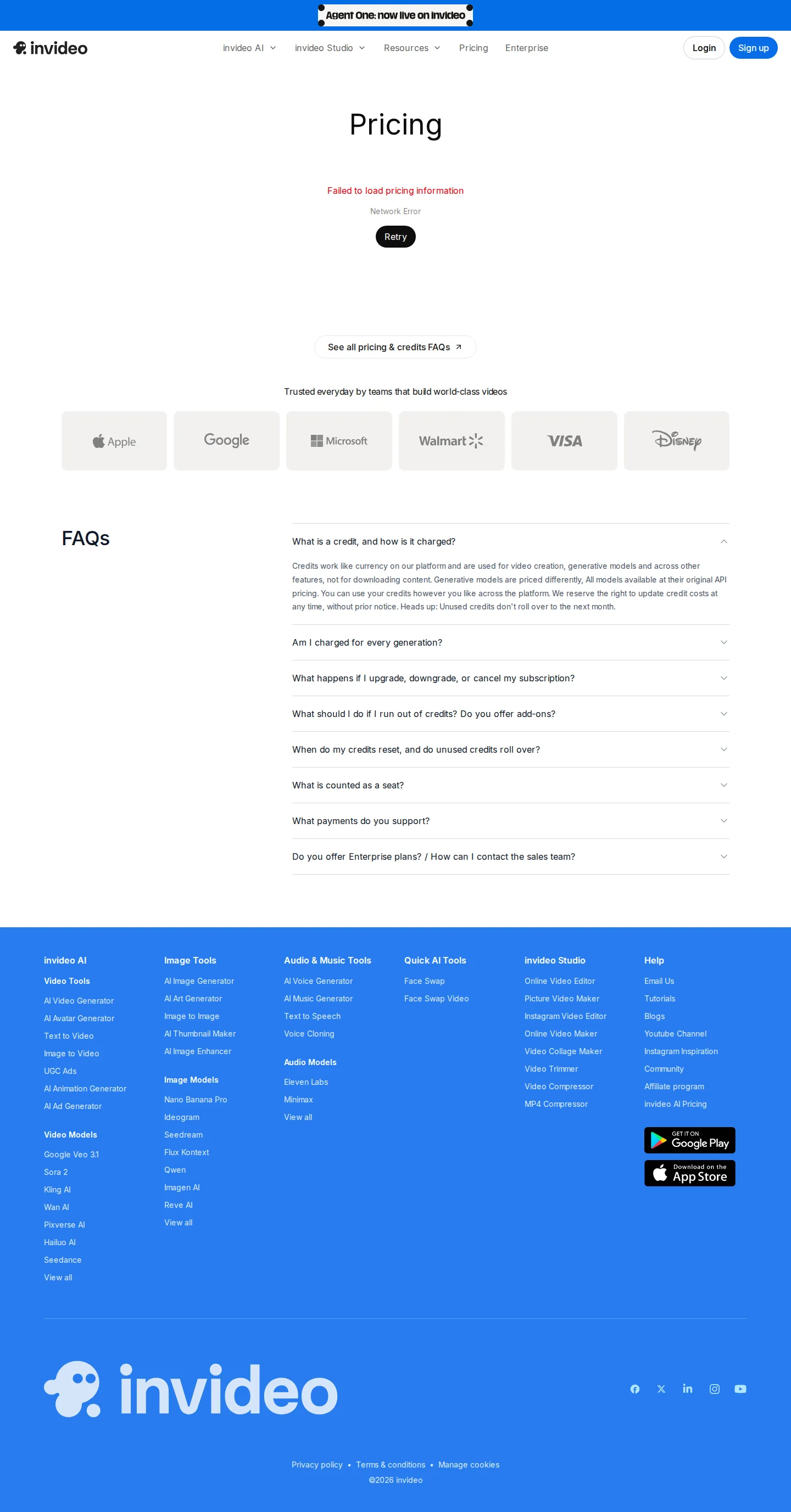
Prices come with a caveat. InVideo’s pricing page renders its plan table from a client-side API that was erroring on our capture date (“Failed to load pricing information / Network Error / Retry”), and direct fetches hit the same wall. So the prices below are third-party-reported and approximate: Free $0, Plus ~$25/mo (~$20/mo, $240/yr billed annually), Max ~$60/mo ($48/mo, ~$576/yr billed annually), each about 20% cheaper annually. What is confirmed from the live capture is the credit mechanic (currency, original-API generative pricing, no rollover, seat-based, add-on credits when you run out).
What makes this different: InVideo doesn’t mark up each model — it passes generative-model cost through “at their original API pricing” and meters it out of one shared credit pool, then wraps that in tiered minute allowances. It is a credit-based billing layer over a freemium subscription where the watermark, export resolution and commercial-use rights — not just the meter — are the real upgrade levers.
Pricing by product
| Tier | Price | Included (minutes / credits) | Key mechanics |
|---|---|---|---|
| Free | $0/mo | ~10 min/week AI generation (reported); credit pool for generative models | Watermarked exports; 720p cap; personal use; self-serve |
| Plus | ~50 min/mo AI generation (reported); credits + 8M+ iStock | No watermark; 1080p; commercial license; premium voices; credits don’t roll over | |
| Max | ~200 min/mo AI generation (reported); larger credit pool | No watermark; 4K; priority/faster generation; everything in Plus | |
| Enterprise / Team | Contact sales | Custom allowances; team seats | Sales-led quote; collaboration, dedicated support |
Sales motions across products: self-serve PLG for Free, Plus and Max — sign up, generate, pay by card per seat with credits metering generative output — and sales-led for Enterprise/Team (seats, higher allowances, support). All advertised exact prices above are third-party-reported because InVideo’s pricing API failed to load on capture; the credit/no-rollover/original-API mechanics are from the live capture FAQ.
Hidden costs : What InVideo AI users actually pay
The sticker price is the tier fee, but the numbers that actually move an InVideo bill are the generation-minutes allowance, the credit pool, and the fact that credits don’t roll over. Two costs hide inside the model. First, generative models bill “at their original API pricing” — so a single Veo 3.1 or Sora 2 generation can burn credits far faster than a basic stock-footage edit, and your effective rate depends entirely on which model you call. Second, the free tier’s real cost is the watermark plus 720p export cap plus personal-use-only license: you cannot ship a commercial, watermark-free video without paying.
Effective $-per-minute (computed from reported figures, NOT posted by InVideo): dividing the reported annual price by the reported monthly minutes allowance gives a rough floor cost before any à-la-carte credit top-ups.
| Plan (annual, reported) | Reported price/yr | Reported min/mo | Effective $/min (computed) |
|---|---|---|---|
| Plus | ~50 min/mo (~600/yr) | ~$0.40/min (roughly) | |
| Max | ~200 min/mo (~2,400/yr) | ~$0.24/min (roughly) |
The lesson: Max is dramatically cheaper per minute (~$0.24 vs ~$0.40) once you actually generate volume — the per-minute economics, not the headline price, are what justify the upgrade. But because unused credits/minutes are forfeited monthly, a light month on Max wastes most of the allowance, so the per-minute math only holds if you generate near the cap.
| Line item | Monthly cost (reported / computed) |
|---|---|
| Plus seat | |
| Max seat | |
| Premium generative model output (Veo / Sora / Kling) | drawn from credit pool at each model’s original API price |
| Add-on credits when you run out | extra purchase (à la carte) |
| Unused credits / minutes | forfeited — no rollover |
Want to estimate your own InVideo AI bill? Use the InVideo AI pricing calculator to model your cost across tiers, generation minutes and credit usage.
Pricing evolution : InVideo AI pricing history and changes
Cadence
| Period | Price changes | Product / SKU additions | Notes |
|---|---|---|---|
| 2017–2023 | Template-editor subscription tiers | invideo Studio (template video editor) | Pre-AI; subscription editor, not credit-metered generation |
| 2023 | Credit currency introduced | invideo AI (text-to-video) | Prompt-to-video launched on a platform-wide credit model |
| 2026 Q2 | Free / Plus ( | v4 agent (up to 30 min/prompt); 200+ models | Pass-through “original API pricing” for generative models; no credit rollover |
Tracked range: 2017–present. InVideo’s pricing page loads plans via an API that errored on the 2026-06-11 capture, so current price points are third-party-reported; the timeline anchors on the 2023 invideo AI / credit-model launch and the live 2026-06-11 FAQ capture.
Notable changes
- 2017 — InVideo launches as invideo Studio, a template-based online video editor on a conventional subscription — no AI generation, no credit currency.
- 2023 — Launch of invideo AI (text/prompt-to-video), introducing the platform-wide credit currency that meters AI generation and generative-model outputs alongside the subscription tiers.
- 2026 Q2 — Current shape: Free / Plus ~$25/mo / Max ~$60/mo (~20% off annual), a v4 “agent” advertised at up to 30 mins of video per prompt, 200+ underlying models, generative output billed “at their original API pricing,” and an explicit no-credit-rollover policy (all per the live FAQ; prices second-sourced).
What’s unique : InVideo AI’s distinctive pricing mechanics
1. Pass-through “original API pricing” for generative models.
Rather than re-pricing each model with its own markup, InVideo states generative models bill “at their original API pricing” and draws that cost from your shared credit pool. The platform acts as an aggregator that exposes 200+ models (Veo 3.1, Sora 2, Kling, Nano Banana Pro, ElevenLabs) at their underlying rate — so your effective cost depends on which model you call, not a flat InVideo per-output price.
2. One credit currency spanning video, image, audio and music.
Credits “work like currency on our platform” across every modality and feature, not just video. That single internal unit lets InVideo re-price model costs continuously (“we reserve the right to update credit costs at any time”) without renaming a plan — a textbook credit-based billing abstraction over a multi-model catalog.
3. Two meters in one plan: minutes allowance + credits.
Each tier bundles an AI generation-minutes allowance and a credit pool. Minutes gate how much you can generate; credits gate the cost of which models you use to generate it. It’s a seat-plus-usage hybrid where two distinct consumption axes sit inside one subscription tier.
4. The watermark, resolution and license are the real paywall.
Unlike pure usage tools, InVideo’s strongest upgrade lever is non-metered: the Free tier’s watermark, 720p cap and personal-use-only license. Paying for Plus is often less about more minutes and more about a clean, 1080p, commercially-licensed export — a packaging lever as powerful as the meter.
Strengths & weaknesses
| Strengths | Weaknesses |
|---|---|
| Generative output passed through “at original API pricing” — no opaque per-model markup | Pricing page loads via an API that can fail to render plans entirely (it errored on capture) |
| One credit currency spans video/image/audio/music — simple mental model | Effective $/output depends on which model you call; hard to predict before generating |
| Clear freemium funnel; paid tiers unlock watermark-free, higher-res, commercial exports | Unused credits and minutes don’t roll over — bursty/light months waste the allowance |
| Annual billing is ~20% cheaper across Plus and Max | ”Reserve the right to update credit costs at any time, without prior notice” — repricing risk |
| 200+ models and a 30-min-per-prompt agent inside one subscription | Exact prices not reliably published on-page (API-rendered, third-party-reported here) |
Billing UX : InVideo AI billing controls and transparency
- Billing controls — Self-serve card signup for Free, Plus and Max; Enterprise/Team routes to “contact sales.” A monthly-vs-annual choice (~20% off annual) is the main lever, and seats are defined per the FAQ for team plans.
- Usage visibility — Two meters to watch: the AI generation-minutes allowance and the credit pool. The FAQ confirms credits are charged per generation, that generative models cost differently (at original API pricing), and that running out routes you to add-on credit purchases — so a low-credit balance is the key signal to monitor.
- Transparency caveat — Prices are rendered client-side from an API that can fail to load (it returned “Failed to load pricing information / Network Error” on our capture). When that happens, a prospect sees tiers and FAQs but no numbers — a real transparency gap versus a static price table.
- Payment options — The FAQ has a dedicated “What payments do you support?” entry; standard card billing for self-serve tiers, with invoicing handled in the Enterprise/Team sales motion.
Strategic wins : Why InVideo AI’s pricing decisions worked
1. Aggregating 200+ models at pass-through cost.
By billing generative models “at their original API pricing” out of one credit pool, InVideo positions itself as a neutral aggregator rather than a marked-up reseller — letting it add new models (Veo, Sora, Kling) without re-papering plans. See how AI companies structure pricing.
2. Packaging the watermark/license as the paywall.
The free tier is genuinely usable for trying the product, but the watermark, 720p cap and personal-use license make any real deliverable require Plus — a packaging move that converts curious users without hard-capping the experience. Related: choosing the right usage metric.
3. One credit currency it can reprice on demand.
Metering everything in abstract credits — and reserving the right to “update credit costs at any time” — lets InVideo absorb shifts in underlying model cost without touching the plan grid, a structural advantage for a GPU-cost-exposed aggregator. See outcome-based pricing trends.
Areas to improve : Gaps in InVideo AI’s pricing approach
1. The price table itself can fail to load.
Rendering plans from a client-side API means a network or API hiccup leaves prospects staring at “Failed to load pricing information.” A static, server-rendered fallback price table would prevent the worst-case transparency failure. See bill shock and cost unpredictability.
2. Per-model credit cost is hard to predict before you generate.
Because generative output bills at each model’s original API price out of a shared pool, a buyer can’t easily forecast how far a credit balance goes — a published “this model costs roughly N credits per output” table would reduce the guesswork.
3. No-rollover punishes bursty creators.
Forfeiting unused minutes and credits each month penalizes the lumpy, project-based workflows creators actually have. A small rollover cap or a “credits expiring soon” nudge (thresholding/alerting) would soften the all-or-nothing reset.
Monetization stack & signals : how InVideo AI builds & buys its revenue engine
Buys 2 Builds 0
Buys its whole checkout-and-renewal spine from Stripe — CEO Sanket Shah names Stripe Payments + Stripe Billing in a Stripe case study, where Smart Retries lifted failed-renewal recovery from 23% to 30%. No public ATS, so no hiring signal; the revenue engine is outsourced, not built.
-
“Stripe is an incredibly important node in our current payment processing ecosystem...has made our business operations unnaturally simple”
-
“Stripe Billing optimisations such as Smart Retries improved Invideo's failed subscription renewal recovery rate from 23% to 30%.”
Signals reviewed · derived from press & filings
Key takeaways
- Pass-through model pricing is a positioning win for aggregators. Billing generative output “at original API pricing” lets InVideo add models without markup accusations or plan rewrites.
- One credit currency decouples plan names from model cost. Metering everything in credits — and reserving the right to reprice them — absorbs GPU-cost shifts without touching the published tiers.
- The watermark and license can be a stronger paywall than the meter. InVideo converts on watermark-free, higher-res, commercially-licensed exports as much as on more minutes.
- Two meters (minutes + credits) add predictability risk. Buyers must track both a minutes allowance and a credit pool whose burn rate depends on which model they call.
- API-rendered prices are a transparency liability. When the pricing API fails, prospects see no numbers at all — a static fallback would protect the funnel.
UBP implications
- Aggregators can meter in one credit currency while passing model cost through at API price. This keeps the value metric simple for buyers while preserving the ability to reprice the cost-of-goods layer continuously. See usage-based pricing strategy.
- Non-metered packaging levers (watermark, resolution, license) can drive conversion as hard as usage caps. UBP practitioners shouldn’t assume the meter is the only — or best — paywall.
- No-rollover credits are a use-it-or-lose-it consumption gate inside a subscription. They behave like usage pricing for heavy users and like a flat plan for light ones — relevant for anyone blending freemium with metered AI output.
Sources
- InVideo AI pricing page (accessed 2026-06-11) — official; plan table rendered via an API that returned “Failed to load pricing information / Network Error”; FAQ (credits, no rollover, original-API pricing, seats) captured
- InVideo AI product page (accessed 2026-06-11) — “200+ models”, v4 agent “up to 30 mins of video from a single prompt”
- InVideo pricing 2026 — Free vs Plus vs Max (Flowith) (accessed 2026-06-11) — Free $0, Plus
$25 ($20 annual), Max$60 ($48 annual); watermark/voiceover caps - InVideo AI pricing plans 2026 (MyMarky) (accessed 2026-06-11) — Plus
$25 ($240/yr), Max$60 ($576/yr); minutes & commercial-use detail - InVideo AI pricing (Costbench) (accessed 2026-06-11) — multi-tier ladder incl. Team; median buyer ~$255/yr
Bottom line
InVideo AI prices a prompt-to-video generator as freemium plus subscription over a single credit currency: a free but watermarked tier, Plus at roughly $25/month and Max at roughly $60/month (each about 20% cheaper billed annually), with generative-model outputs billed “at their original API pricing” out of a shared credit pool that doesn’t roll over. Its sharpest design choice is acting as a pass-through aggregator of 200+ models rather than marking each one up — and its sharpest liability is that the price table loads from an API that can fail outright, leaving prospects with tiers and FAQs but no numbers (as happened on our capture, which is why the prices here are third-party-reported). The real paywall is as much the watermark, resolution and commercial license as the meter. Browse the pricing blueprint for more fully-researched company profiles.
Want to compare InVideo AI against other generative-media and AI-platform companies? Browse the pricing blueprint.
Pricing timeline : Major events on a vertical axis
Each milestone below corresponds to a public pricing change, product launch, or material adjustment. Major events use a filled marker; minor adjustments use a faded one.
Free / Plus (~$25/mo) / Max (~$60/mo) credit-metered tiers
Current shape (third-party-reported, prices not in live capture): Free $0 (watermarked, 720p, ~10 min/week), Plus ~$25/mo (~$20 annual, no watermark, 1080p, ~50 min/mo, commercial license + iStock), Max ~$60/mo (~$48 annual, 4K, ~200 min/mo). A single credit currency meters generative-model outputs at each model's original API price; unused credits don't roll over. InVideo's pricing page loads plans via an API that returned 'Failed to load pricing information / Network Error' on capture day, so prices are second-sourced.
Launches invideo AI (text-to-video) on a credit model
InVideo, founded 2017 as a template-based online video editor (invideo Studio), launched 'invideo AI' — a text/prompt-to-video generator that scripts, narrates and edits a full video from a single prompt. It introduced the platform-wide credit currency that meters AI generation and generative-model outputs, alongside the existing subscription tiers.
- · InVideo's pricing page renders its plan table from a client-side API that was erroring on capture day ('Failed to load pricing information / Network Error / Retry') — the page advertises tiers but the prices themselves load dynamically, so the only thing reliably scrapeable was the FAQ.
- · InVideo's own FAQ says generative models are billed 'at their original API pricing' — InVideo passes through the raw model cost (Veo 3.1, Sora 2, Kling, Nano Banana Pro, ElevenLabs) and meters it out of your credit pool rather than marking up each model with its own price.
- · Unused credits don't roll over to the next month — InVideo states it outright in the FAQ — so any allowance you don't burn each cycle is forfeited, a classic use-it-or-lose-it credit mechanic.
Questions & answers
- What is InVideo AI's pricing model?
- InVideo AI is freemium plus per-seat subscription, layered on a single credit currency. There is a free watermarked tier, a Plus plan reported at about $25/month and a Max plan reported at about $60/month (each ~20% cheaper billed annually). Each tier includes an AI generation-minutes allowance, and a credit pool meters generative-model outputs — InVideo's live FAQ states generative models bill 'at their original API pricing' and that unused credits don't roll over. Enterprise/Team is custom-quoted.
- Does InVideo AI offer a free tier?
- Yes. The Free plan is $0 and lets you try prompt-to-video generation, but exports carry an InVideo watermark, are capped at 720p, and the AI generation allowance is small (third-party-reported at about 10 minutes per week). Removing the watermark and unlocking 1080p/4K exports and commercial use requires a paid Plus or Max plan.
- How much does InVideo AI cost per month?
- Third-party sources consistently report Plus at about $25/month (roughly $20/month, ~$240/year, billed annually) and Max at about $60/month (roughly $48/month, ~$576/year, billed annually) — both around 20% cheaper on annual billing. InVideo's own pricing page renders prices via an API that was erroring on our capture date, so treat these as approximate third-party figures rather than confirmed sticker prices. Enterprise/Team plans are custom-quoted.
- Is InVideo AI pricing usage-based or subscription?
- It is a hybrid. You pay a flat subscription per tier (Free, Plus, Max), but usage is metered two ways: an AI generation-minutes allowance per tier and a platform-wide credit currency. Per InVideo's FAQ, credits are spent on video creation and generative models, generative models are billed 'at their original API pricing', and unused credits do not roll over — so heavy generation behaves like consumption pricing inside a subscription wrapper.
- Can I use InVideo AI videos commercially?
- Commercial use and watermark-free, higher-resolution exports require a paid plan. The Free tier exports are watermarked at 720p and oriented to personal use; Plus (reported ~$25/mo) adds 1080p watermark-free exports plus a commercial license and iStock stock-media access, and Max (reported ~$60/mo) adds 4K exports. These commercial-use and resolution details are third-party-reported.