AI Summary
About
Krea AI runs a real-time AI creative studio: a browser canvas where images, video, 3D objects, lipsyncs and upscales are generated as you type or draw. It bundles over 150 models — including in-house models (Krea 2, Krea 1) and third-party engines like Nano Banana, Topaz, Magnific, Seedance, Veo3, Sora and Kling — behind one workspace, plus a node-based workflow editor (Nodes, Apps and an AI-powered Nodes Agent) for building and automating generation pipelines. The company reports a community of over 10 million users and positions itself on generation speed and breadth of model access.
Krea monetizes through freemium plus per-seat subscriptions, where the value of each tier is metered in compute units (its credit currency). A free plan gives a renewable 100 units/day; paid Basic, Pro and Max tiers include a fixed monthly unit allotment with rising model access, concurrency and upscale resolution; a Business plan adds team seats and admin; and Enterprise is custom-quoted. Company financials (ARR, headcount, valuation) are left for later research.
For the most current information on Krea AI’s pricing and market position, visit Krea AI.
Pricing summary : How Krea AI’s pricing model works
Krea runs a freemium-plus-subscription model where every plan is denominated in compute units — a single credit currency consumed by each image, video, 3D, lipsync, LoRA training and upscale generation. You pick a tier for its monthly unit allotment, model access and concurrency; when the units run out you either buy a one-time top-up pack (valid 90 days) or move up a tier. The free plan is unusual in that it refills daily rather than handing you a one-time balance.
Billing dimensions captured:
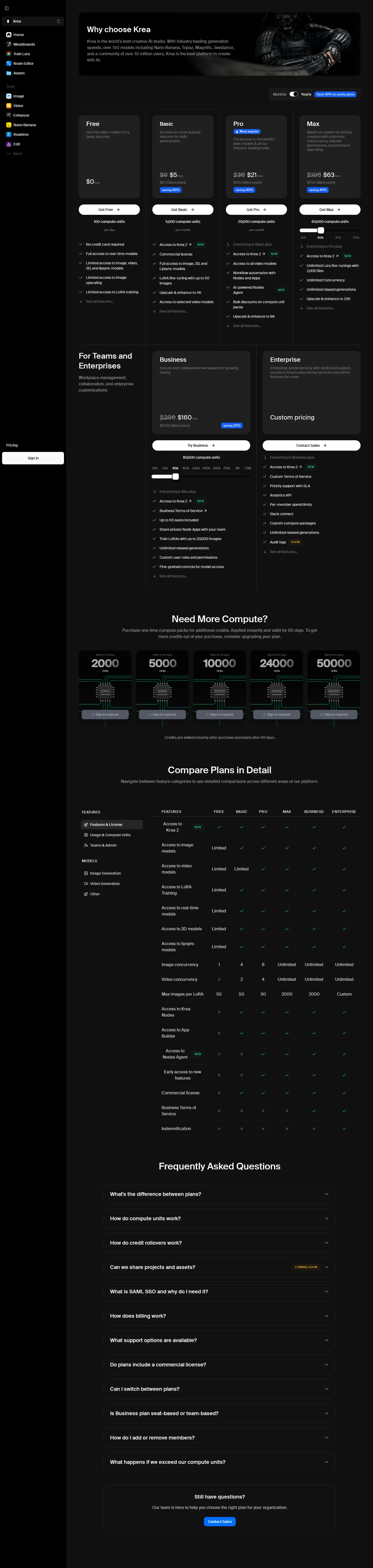
- Compute-unit allotments — Free 100 units per day; Basic 5,000 units/month; Pro 20,000 units/month; Max 60,000 units/month; Business 80,000 units/month; Enterprise custom.
- Subscription prices (annual) — Basic $63 billed yearly (saving 40%), Pro $252 billed yearly (saving 40%), Max $756 billed yearly (saving 40%), Business $1,920 billed yearly (saving 20%); Free is $0; Enterprise is custom.
- Monthly / Yearly toggle — the pricing page exposes a Monthly vs Yearly switch with “Save 40% on yearly plans” for the consumer tiers.
- One-time compute packs — 2,000 / 5,000 / 10,000 / 24,000 / 50,000 units, added instantly and valid for 90 days; Pro and above get bulk discounts on packs.
- Concurrency — image concurrency rises Free 1 → Basic 4 → Pro 8 → Max/Business/Enterprise unlimited; video concurrency Basic 2 → Pro 4 → Max+ unlimited.
- Seats — Business includes up to 50 seats at a flat price; Enterprise is custom with per-member spend limits.
- Relaxed generations — Max and above add unlimited relaxed (lower-priority) generations on in-house models after the unit allotment is exhausted.
What makes this different: Krea wraps a credit-based billing layer around a freemium ladder, but with two twists — a daily-refilling free meter rather than a one-time trial pile, and a top tier (Max) that keeps a 60,000-unit meter for full-speed work while adding unmetered relaxed-rate generation on its own models. Like other generative-media tools it sells subscriptions but meters everything in one currency it can re-price per model.
Pricing by product
| Tier | Price | Included (compute units) | Key mechanics |
|---|---|---|---|
| Free | $0 | 100 compute units per day (refills daily) | No credit card; real-time models; limited image/video/3D/lipsync/LoRA; 2K upscale; image concurrency 1 |
| Basic | $63 billed yearly (saving 40%) | 5,000 compute units / month | Commercial license; full image/3D/lipsync; selected video; 4K upscale; LoRA up to 50 images; image concurrency 4 |
| Pro | $252 billed yearly (saving 40%) | 20,000 compute units / month | All video models; Nodes, Apps & Nodes Agent; 8K upscale; bulk discounts on unit packs; image concurrency 8 |
| Max | $756 billed yearly (saving 40%) | 60,000 compute units / month | Unlimited relaxed generations (in-house models); unlimited concurrency & LoRA; 22K upscale |
| Business | $1,920 billed yearly (saving 20%) | 80,000 compute units / month | Up to 50 seats; Business ToS & no-training clause; custom roles, permissions & model-access controls |
| Enterprise | Custom (Contact Sales) | Custom compute packages | Priority support + SLA; analytics API; audit logs; per-member spend limits; custom ToS & SSO |
Sales motions across products: self-serve / PLG across Free, Basic, Pro, Max and Business — sign up, generate, and the unit meter (or a one-time pack purchase) handles the rest — with a sales-led “Contact Sales” path only for Enterprise custom packages, SLA and security. The daily free units are the top of a bottom-up funnel into paid monthly allotments.
Hidden costs : What Krea AI users actually pay
The sticker price on a Krea plan is the subscription, but the number that actually moves your bill is how fast your compute units evaporate — and that depends entirely on which models and resolutions you generate at. Premium video models (Veo3, Sora, Kling) and high-resolution upscales burn units far faster than a quick real-time image, so two users on the same Pro plan can have very different effective costs. Because monthly units do not roll over on Basic/Pro/Max, the real cost driver is the gap between your allotment and your actual generation volume, filled either with a one-time pack or a tier upgrade.
First, the effective monthly-equivalent subscription cost (the page advertises annual totals; spread over 12 months):
| Plan | Billed yearly | Monthly equivalent (computed) | Units / month |
|---|---|---|---|
| Basic | $63 | about $5.25/mo | 5,000 |
| Pro | $252 | about $21/mo | 20,000 |
| Max | $756 | about $63/mo | 60,000 |
| Business | $1,920 | about $160/mo | 80,000 |
Note these are the annual-billing monthly equivalents (40% off for consumer plans, 20% off Business). Paying month-to-month is roughly 40% higher on the consumer tiers — about $8.75 (Basic), about $35 (Pro) and about $105 (Max) per month — which is the lever Krea uses to push you onto an annual commitment.
Second, the effective cost per unit at each annual allotment, which is what determines your real per-generation economics:
| Plan | Units / month | Monthly equivalent | Approx. cost per 1,000 units |
|---|---|---|---|
| Basic | 5,000 | about $5.25 | about $1.05 |
| Pro | 20,000 | about $21 | about $1.05 |
| Max | 60,000 | about $63 | about $1.05 |
| Business | 80,000 | about $160 | about $2.00 |
The consumer ladder holds a remarkably flat ~$1 per 1,000 units — you mostly pay for higher concurrency, model access, upscale resolution and the unlimited-relaxed safety net, not cheaper units. Business units cost roughly double per unit because the price also buys 50 seats, team admin and a no-training legal posture. The genuinely variable cost is the one-time pack: it is the overage valve, but it expires in 90 days, so under-using a pack is pure waste, and Krea openly suggests upgrading your plan instead of repeatedly buying packs.
Want to estimate your own Krea AI bill? Use the Krea AI pricing calculator to model your monthly cost based on plan tier, compute-unit volume and top-up packs.
Pricing evolution : Krea AI pricing history and changes
Cadence
| Period | Price changes | Product / SKU additions | Notes |
|---|---|---|---|
| 2023–2024 | Freemium established | Real-time image studio | Free daily-credit wedge + paid subscriptions; compute-unit metering in place |
| 2026 Q2 | 0 (current capture) | Video, 3D, lipsync, Nodes; Business & Max tiers | Six-tier ladder: Free 100/day to Business 80,000/mo + Enterprise; 90-day top-up packs |
Tracked range: 2024–present. The current six-tier structure is read from the live 2026-06-11 capture of krea.ai/pricing; intermediate snapshots are not individually Wayback-verified on this network, so the timeline anchors on the freemium origin and the current capture.
Notable changes
- 2024 — Krea operates as a real-time AI image generator on a freemium model: a free daily compute-unit allowance to try the canvas, plus paid subscriptions for higher limits and commercial use. The compute-unit metering and the daily-free-credits wedge are in place from early on.
- By 2026-06-11 — The catalog has expanded to 150+ models spanning image, video, 3D, lipsync and upscaling, and the ladder is now six tiers — Free 100 units/day, Basic 5,000/mo ($63 yr), Pro 20,000/mo ($252 yr), Max 60,000/mo ($756 yr) with unlimited relaxed generations, Business 80,000/mo ($1,920 yr, up to 50 seats) and a custom Enterprise (source: captured
krea.ai/pricing). - By 2026-06-11 — One-time compute-unit packs (2,000–50,000 units, valid 90 days) provide the overage valve, with Pro and above getting bulk discounts on packs (source: captured
krea.ai/pricing).
What’s unique : Krea AI’s distinctive pricing mechanics
1. A daily-refilling free meter, not a one-time trial pile
Most credit-based creative tools hand you a fixed starting balance that, once spent, leaves the free tier useless. Krea instead gives 100 compute units every day, refilled daily and with no credit card. That makes the free plan a durable, renewable trickle — enough to keep casual users habituated indefinitely — rather than a short trial, which is a deliberate top-of-funnel choice for a 10-million-user community.
2. One credit currency across every modality, re-priced per model
Krea meters image, video, 3D, lipsync, LoRA training and upscaling in a single compute-unit currency. This is credit-based billing used to absorb the wildly different inference costs of 150+ models — a quick real-time image and a Veo3 video both draw from the same pool, and Krea can re-price each model’s unit cost without touching the plan structure.
3. “Max” is a metered plan plus an unmetered relaxed queue
Like other generative-media top tiers, Max is not flat-unlimited: it keeps a 60,000-unit/month meter for full-speed work and adds unlimited relaxed generations — lower-priority, slower-queue output on Krea’s in-house models only (Krea 2, Krea 1, Flux, Z-image, Qwen). It is a hybrid of fixed allowance plus deprioritized volume, which protects GPU margins while still advertising “unlimited.”
4. Top-up packs that expire in 90 days
The overage valve is a one-time compute-unit pack (2,000 to 50,000 units) added instantly — but it expires after 90 days. Even purchased credits are use-it-or-lose-it on a rolling quarter, and Krea explicitly steers heavy buyers toward upgrading their plan rather than re-buying packs, making the subscription the cheaper steady-state path.
Strengths & weaknesses
| Strengths | Weaknesses |
|---|---|
| Daily-refilling free tier (100 units/day) keeps casual users engaged with no card and no expiry cliff | Monthly units do not roll over on Basic/Pro/Max — unused allowance is forfeited each cycle |
| One compute-unit currency spans 150+ models across image, video, 3D, lipsync and upscale | The pricing page leads with annual totals; the real monthly rate (and per-model unit costs) take work to back out |
| Clean six-tier ladder with a visible Monthly/Yearly toggle and transparent public prices | Premium video/upscale models burn units fast, so two users on the same plan can have very different effective costs |
| Commercial license unlocked from Basic up, with Business/Enterprise adding no-training ToS & indemnification | Top-up packs expire in 90 days — under-used purchased credits are pure waste |
| Max’s unlimited relaxed-rate generations cap downside cost for heavy in-house-model users | ”Unlimited” on Max applies only to relaxed-rate in-house models, not full-speed access to premium engines |
Billing UX : Krea AI billing controls and transparency
- Monthly / Yearly toggle — the pricing page has a Monthly vs Yearly switch with “Save 40% on yearly plans,” exposing both rates before purchase (the captured page shows the yearly totals).
- Compute-unit allotment with no rollover (consumer) — each paid plan states an explicit monthly unit budget (5,000 / 20,000 / 60,000) that resets monthly; Business and Enterprise can roll units over with customizable periods.
- One-time top-up packs — an in-page “Need More Compute?” section sells 2,000–50,000-unit packs that are added instantly and valid for 90 days, with a note suggesting a plan upgrade for better value.
- Workspace seat pool (Business) — Business covers up to 50 seats at one flat price and shares a compute pool across members; Enterprise adds per-member spend limits.
- Concurrency surfaced per tier — the comparison grid lists image and video concurrency (1/4/8/unlimited) so buyers can see throughput limits before paying.
- Enterprise quote flow — Enterprise routes to a “Contact Sales” form for custom compute packages, SLA, analytics API, audit logs and SSO.
Strategic wins : Why Krea AI’s pricing decisions worked
1. A renewable free meter as a 10-million-user funnel
By refilling 100 units daily instead of handing out a one-time balance, Krea keeps casual creators active indefinitely without a card — a low-cost habit loop that helped seed a 10-million-user community. The free units are a soft consumption gate that qualifies engaged users into paid monthly allotments. See how AI companies structure pricing.
2. One currency to absorb 150+ models’ cost differences
Metering every modality in compute units lets Krea fold dramatically different inference costs (a real-time image vs a Veo3 clip) into one ledger it can re-price per model without re-papering plans — exactly the flexibility credit-based billing gives compute-heavy products. Related: choosing the right usage metric.
3. Annual lock-in via a steep 40% discount
The 40% yearly discount on consumer plans (and the page defaulting to yearly totals) pulls individual creators onto annual commitments, smoothing revenue against a volatile GPU cost base. See outcome-based pricing trends.
4. Relaxed-rate unlimited as a margin-safe ceiling
Max’s unlimited relaxed generations on in-house models give heavy users a predictable cost ceiling while protecting full-speed GPU capacity — unmetered volume on a deprioritized queue rather than unbounded premium access. See usage-based pricing strategy.
Areas to improve : Gaps in Krea AI’s pricing approach
1. Publish per-model unit costs and monthly sticker prices up front
The pricing page leads with annual totals and never states how many units a Veo3 second, a Sora clip or a 22K upscale actually costs — so buyers cannot estimate whether 20,000 units covers their work. Publishing per-model unit costs and the plain monthly rate would shorten self-qualification and reduce the bill-shock and cost-unpredictability risk that pushes users to over-buy or churn.
2. Let monthly units roll over (or warn before they expire)
Forfeiting unused units every cycle penalizes the lumpy, project-based workflows creators actually have. A modest rollover cap or an in-product “units expiring soon” nudge — the standard thresholding-and-alerting pattern — would soften the all-or-nothing reset and the 90-day pack expiry.
3. Clarify what “unlimited” on Max really means
Max advertises “unlimited” but the unmetered portion is relaxed-rate, in-house-model-only volume on top of a 60,000-unit meter. Putting the full-speed-vs-relaxed and in-house-vs-premium distinction directly on the plan card would set expectations and avoid the same label-versus-mechanics gap that erodes trust in unpredictable-cost plans.
Monetization stack & signals : how Krea AI builds & buys its revenue engine
3 open roles
An Account Executive, a Customer Success hire and a Growth Marketer show Krea layering a sales-led and retention motion onto its self-serve, credit-metered core. No billing or metering vendor is disclosed anywhere.
- Customer Success Customer success seen Apr 22, 2026
- Account Executive Monetization seen Jan 8, 2026
- Growth Marketer Growth seen Nov 18, 2025
Signals reviewed · derived from public job posts
Job postings fill and close over time — once a posting is filled we keep it as a dated citation (the quoted evidence remains); use View open roles for current listings.
Key takeaways
- Meter in one currency, sell in tiers. Krea prices every modality in compute units and packages them into subscription tiers — so it can re-price 150+ models’ inference cost without renaming a single plan.
- A daily-refilling free meter beats a one-time trial pile. Renewing 100 units/day keeps casual users habituated indefinitely, turning the free tier into a durable funnel rather than a short trial that strands users once spent.
- Non-rolling units plus 90-day packs make timing the real cost. The seat fee is a floor; forfeited monthly units and expiring packs mean under-use is pure waste — be explicit about where the allowance line is.
- “Unlimited” is a relaxed-rate queue, not flat access. Max’s unmetered volume is deprioritized, in-house-model-only generation — a smart margin-protection design whose label outruns its mechanics.
- Steep annual discounts buy revenue stability on a volatile cost base. The 40% yearly discount (and a page that defaults to annual totals) pulls creators onto commitments that smooth revenue against GPU cost swings.
UBP implications
- Credit currencies let GPU-bound businesses re-price the cost-of-goods layer continuously. Because Krea meters in abstract units and only the per-model conversion changes, it can absorb shifts in inference cost (new models, cheaper hardware) without re-papering plans — a structural advantage credit-based billing gives compute-heavy AI products.
- A daily-refilling free allowance is a consumption gate disguised as a generous freemium plan. The renewable 100 units/day qualifies engaged users into paid allotments while costing little — a UBP funnel mechanic dressed as a perk. See usage-based pricing strategy.
- “Unmetered at a relaxed rate” is an underused middle path between flat-rate and pure usage. Rather than choosing flat (margin risk) or fully metered (adoption friction), Krea offers unmetered volume on a deprioritized in-house queue — using queue priority as the real metered axis while marketing “unlimited.” See understanding usage-based pricing models.
Sources
- Krea AI pricing page (accessed 2026-06-11) — live capture: Free 100 units/day; Basic $63/yr 5,000/mo; Pro $252/yr 20,000/mo; Max $756/yr 60,000/mo; Business $1,920/yr 80,000/mo; Enterprise custom; 90-day top-up packs
- Krea AI official website (accessed 2026-06-11)
- Krea AI blog / news (accessed 2026-06-11)
Bottom line
Krea AI runs a clean credit-based freemium ladder for real-time generative media: a renewable 100-units-per-day free tier feeds paid Basic, Pro, Max and Business plans that meter every image, video, 3D, lipsync and upscale across 150+ models in one compute-unit currency. Its smartest moves are the daily-refilling free meter (a durable funnel, not a trial) and Max’s relaxed-rate unmetered generations (a margin-safe ceiling); its sharpest gaps are non-rolling monthly units, 90-day-expiring top-up packs, and a page that hides the monthly rate and per-model unit costs behind annual totals. It is a textbook case of how far a single credit currency can stretch across many models — and where credit-expiry mechanics start working against the buyer. Browse the pricing blueprint for more fully-researched company profiles.
Want to compare Krea AI against other generative-media and AI-platform companies? Browse the pricing blueprint.
Pricing timeline : Major events on a vertical axis
Each milestone below corresponds to a public pricing change, product launch, or material adjustment. Major events use a filled marker; minor adjustments use a faded one.
Six-tier credit ladder: Free 100/day to Business 80,000/mo + 90-day top-up packs
Captured krea.ai/pricing: Free 100 compute units/day; Basic 5,000 units/mo ($63 billed yearly, saving 40%); Pro 20,000 units/mo ($252 billed yearly); Max 60,000 units/mo ($756 billed yearly) with unlimited relaxed generations; Business 80,000 units/mo ($1,920 billed yearly, saving 20%, up to 50 seats); Enterprise custom. One-time compute packs (2,000–50,000 units) added instantly and valid 90 days.
Real-time generation studio, freemium launch
Krea grew up as a real-time AI image generator with a freemium model — a free daily allowance to try the canvas plus paid subscriptions for higher limits and commercial use. The compute-unit (credit) metering and the free-daily-credits wedge were in place from early on, before the catalog expanded to video, 3D, lipsync and 150+ models.
- · Krea's free tier resets daily, not monthly: you get 100 compute units per day with no credit card, so the free plan is a renewable trickle rather than a one-time trial balance — a different freemium shape from rivals that hand you a fixed starting credit pile.
- · One-time compute-unit packs (2,000 to 50,000 units) are added instantly but expire after 90 days, so even purchased credits are use-it-or-lose-it on a rolling quarter — and Krea explicitly nudges buyers to upgrade their plan instead 'to get more credits out of your purchase.'
- · The 'Max' plan keeps a 60,000-unit monthly meter for full-speed work but bolts on unlimited relaxed (lower-priority) generations on Krea's in-house models — so 'unlimited' here means slow-queue volume on Krea 2, Krea 1, Flux, Z-image or Qwen, not unmetered access to every premium model.
Questions & answers
- What is Krea AI's pricing model?
- Krea AI is freemium plus a per-seat subscription where each plan bundles a pool of compute units (credits) that meter every image, video, 3D, lipsync and upscale generation. Free gives 100 units per day; Basic, Pro, Max and Business include a fixed monthly unit allotment, and you can buy one-time compute-unit packs that expire after 90 days. Enterprise is custom-quoted.
- Does Krea AI offer a free tier?
- Yes. The Free plan is $0 and grants 100 compute units per day (refilled daily) with no credit card required. It includes full access to real-time models and limited access to image, video, 3D, lipsync, upscaling and LoRA training, with image concurrency of 1.
- How much does Krea AI cost per month?
- On annual billing the consumer plans are Basic $63/year, Pro $252/year and Max $756/year (each saving 40% versus monthly). Spread over 12 months that is roughly $8.75, about $35 and about $105 per month respectively. Business is $1,920 billed yearly (saving 20%) for up to 50 seats; Enterprise is custom pricing.
- Is Krea AI pricing usage-based or subscription?
- It is a hybrid. You buy a subscription tier, but the value you get is metered in compute units, so heavier image/video/upscale work consumes the allotment faster. When you exhaust the included units you either buy a one-time top-up pack (valid 90 days) or upgrade a tier; Max adds unlimited relaxed-rate generations on in-house models.
- Does Krea AI include a commercial license?
- The Free plan does not include a commercial license. Commercial use of generated content for marketing, products and client work is unlocked starting on the Basic plan and carries through Pro, Max, Business and Enterprise, with Business and Enterprise adding business/custom Terms of Service and indemnification.