AI Summary
About
Leonardo.Ai is a generative-media platform whose web app and API create and edit images, video, design and motion from a single creative AI workspace. Its first-party model line includes Lucid Origin, Lucid Realism, Phoenix 1.0/0.9 for images and Motion 1.0, Motion 2.0 and Motion 2.0 Fast for video, alongside third-party models (Veo 3, Sora 2, Kling, Nano Banana, FLUX, Ideogram) surfaced inside the same tool. Beyond raw generation it offers Realtime Canvas, image guidance, upscaling, background removal, custom-model training and “Blueprints” workflows — all metered in one shared token currency.
The company was founded in Sydney, Australia and was acquired by Canva in a cash-and-stock deal announced on 29 July 2024, bringing its roughly 120 employees across. Crucially for pricing, Canva kept Leonardo running as an independent consumer product — its standalone token-metered plans survived the deal — while integrating Leonardo’s models into Canva’s Magic Studio. Essential and above are even bundled with Canva Business, tying the two products’ monetization together. Leonardo operates as Leonardo Interactive Pty Ltd and is SOC 2 Type I and Type II accredited.
For the most current information on Leonardo.Ai’s pricing and market position, visit Leonardo.Ai.
Pricing summary : How Leonardo.ai’s pricing model works
Leonardo.Ai runs a freemium-plus-subscription model where everything is metered in tokens — its single credit currency. Tokens are “effectively your currency on the platform,” deducted as you generate images, create videos, upscale, remove backgrounds and run other actions. The number consumed scales with the GPU load of each action: a token does not map to a fixed image or output, so a simple base image costs little while heavy pipelines and video cost far more. Each plan bundles a monthly (or daily, on Free) token allowance, and paid plans add a Rollover Bank for unused tokens plus purchasable Top-up packs that never expire.
Billing dimensions captured:
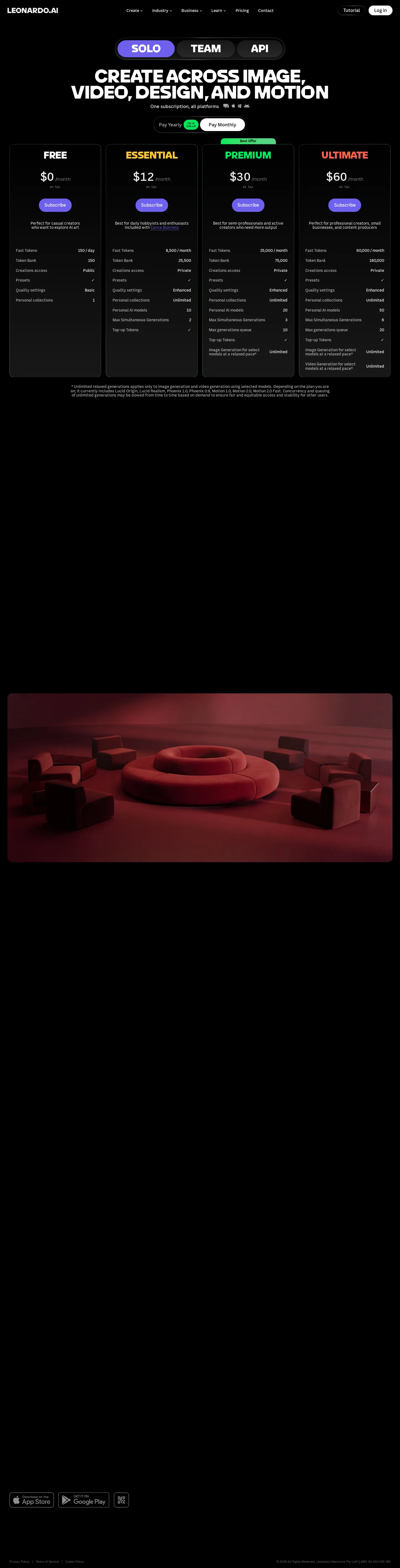
- Solo subscriptions — Free $0 (150 Fast Tokens/day), Essential $12/mo (8,500 tokens/mo), Premium $30/mo (25,000), Ultimate $60/mo (60,000). All ex. tax; paying yearly is up to 20% off.
- Token Bank (rollover) — Essential 25,500, Premium 75,000, Ultimate 180,000 (Free has a 150 bank, no rollover); unused monthly tokens carry over up to the per-plan cap.
- Team plans — Starter $72/mo ($24/seat, 75,000 shared tokens, 25,000/seat) and Growth $144/mo ($48/seat, 180,000 shared tokens, 60,000/seat), billed per seat against a shared pool.
- Unlimited “Relaxed Generation” — Premium adds unlimited relaxed image generation, and Ultimate unlimited relaxed image and video, on selected first-party models once the token pool is empty.
- Top-up packs — paid-only token packs that never expire and aren’t capped by rollover limits (used after Rollover and Fast Tokens).
- API (usage-based) — pay-as-you-go starting with $5 credit that never expires, no commitments, up to 10 concurrent generations; API Custom is a sales-led quote.
What makes this different: Leonardo wraps a credit-based billing layer (tokens priced by GPU cost) around a seat-plus-usage subscription, then softens the hard cap with a Rollover Bank and an “unlimited relaxed” escape valve — a margin-protecting hybrid of fixed allowance plus slow-queue volume rather than a pure flat plan.
Pricing by product
| Tier | Price | Included (tokens) | Key mechanics |
|---|---|---|---|
| Free | $0 /month | 150 Fast Tokens / day (150 bank) | Public creations; basic quality; 1 collection; no rollover |
| Essential | $12 /month | 8,500 / month; 25,500 Token Bank | Private; 10 personal models; 2 simultaneous gens; top-ups |
| Premium | $30 /month | 25,000 / month; 75,000 Token Bank | 20 models; 3 gens; unlimited relaxed image (select models) |
| Ultimate | $60 /month | 60,000 / month; 180,000 Token Bank | 50 models; 6 gens; unlimited relaxed image + video (select) |
| Team Starter | $72 /month ($24 /seat) | 75,000 Shared Tokens; 25,000 /seat | Shared pool; private team gens; per-seat billing |
| Team Growth | $144 /month ($48 /seat) | 180,000 Shared Tokens; 60,000 /seat | Train models on team tokens; higher shared pool |
| API (Pay as you go) | Start with $5 API credit | Pay per token used | No commitments; up to 10 concurrent; auto top-ups |
| API Custom | Contact us | Custom limits | Model-based discounts; dedicated support (sales-led) |
Sales motions across products: self-serve PLG across every Solo, Team and pay-as-you-go API tier — sign up, generate, and pay by subscription or consumed tokens — with a single sales-led path (API Custom / “Need a custom plan?”) for high-volume API workloads and tailored enterprise concurrency. Essential and above are also bundled with Canva Business, an embedded distribution motion through the parent product.
Hidden costs : What Leonardo.ai users actually pay
The sticker price on a Leonardo plan is the seat fee, but the number that actually moves your bill is how fast your token allowance evaporates — and tokens are priced by GPU cost, so the same plan buys wildly different output depending on what you do. Per Leonardo’s help center, a default 768x768 image costs about 1 token, but turning on quality pipelines multiplies that: roughly 8 tokens with Alchemy (about 16 with PhotoReal on), 5 tokens per upscale, and 2 tokens for a background removal. Video costs far more than images because it “requires significantly more GPU power” per the FAQ — and third-party models (Veo 3, Sora 2, Kling, Nano Banana) always consume tokens and never qualify for the unlimited relaxed escape valve.
Archetype A — an Essential hobbyist generating base images vs. polished art. Essential bundles 8,500 tokens/mo. At about 1 token per default image that is roughly 8,500 images; switch on Alchemy (about 8 tokens) and the same allowance buys closer to about 1,060 images; add upscales and background removal and it falls further. The effective cost-per-output below is computed from third-party/help-center token rates, not advertised prices, so treat it as approximate.
| Line item | Approx. token cost | Effective $-per-output on Essential ($12 / 8,500 tokens) |
|---|---|---|
| Default 768x768 image | ~1 token | ~$0.0014 / image |
| Alchemy image (PMv3 off) | ~8 tokens | ~$0.011 / image |
| Alchemy + PhotoReal image | ~16 tokens | ~$0.023 / image |
| Upscale | ~5 tokens | ~$0.007 / upscale |
| Background removal | ~2 tokens | ~$0.003 / op |
Archetype B — a Premium creator who blows past the monthly pool. Premium bundles 25,000 tokens/mo. A creator doing heavy Alchemy + upscale work can exhaust it mid-month — at which point first-party models drop to unlimited Relaxed Generation (free but slower, lower-priority queue) while third-party models and Flow State still need tokens, forcing Top-up packs (priced separately, never expire).
| Line item | Monthly cost |
|---|---|
| Premium seat | $30 |
| 25,000 bundled tokens | included |
| First-party overflow (Relaxed mode) | $0 — slower queue |
| Third-party / Flow State / video overflow | Top-up packs (à la carte, variable) |
| Effective monthly total | $30 + every third-party generation past the pool |
The lesson: on every paid tier the seat fee is a floor, not a ceiling for third-party and video work. Unlimited relaxed generation only covers selected first-party models, so the real bill driver is your mix of premium pipelines, video seconds and third-party models — exactly the upsell path toward Ultimate or recurring top-ups.
Want to estimate your own Leonardo.Ai bill? Use the Leonardo.ai pricing calculator to model your monthly cost based on plan, token allowance and generation mix.
Pricing evolution : Leonardo.ai pricing history and changes
Cadence
| Period | Price changes | Product / SKU additions | Notes |
|---|---|---|---|
| 2024 Q3 | 0 | Canva acquisition | Cash-and-stock deal (29 Jul 2024); plans kept running independently |
| 2025 | 0 | Solo / Team / API consolidation | Single token currency extended to image, video, design & motion |
| 2026 Q2 | 0 | Current capture | Solo $0-$60, Team $72-$144, $5 pay-as-you-go API; rollover + relaxed generation |
Tracked range: 2024–present. Leonardo publishes a public pricing page, so live figures are read from the 2026-06-11 capture; the acquisition and plan-consolidation milestones anchor the earlier timeline. Intermediate per-quarter price snapshots are not individually Wayback-verified on this network.
Notable changes
- 2024-07-29 — Canva acquired Leonardo.Ai in a cash-and-stock deal, taking all ~120 employees. Critically, Leonardo kept running as an independent consumer product with its own token-metered plans (rather than folding into Canva subscriptions), while its models powered Canva’s Magic Studio.
- 2025 — Plans consolidated into Solo (Free/Essential/Premium/Ultimate), Team (Starter/Growth) and API, with the single token currency extended to meter image, video, design and motion under “one subscription, all platforms.” Premium/Ultimate gained unlimited relaxed generation for selected first-party models.
- By 2026-06-11 — Live capture shows Solo at $0/$12/$30/$60, Team at $72/$144 (per-seat shared pools), and a pay-as-you-go API starting with $5 credit; Token Bank rollover and never-expiring top-up packs are standard on paid plans (source: captured leonardo.ai/pricing).
What’s unique : Leonardo.ai’s distinctive pricing mechanics
1. Tokens priced by GPU cost, not by output.
Leonardo’s tokens are explicitly GPU-cost units — “the more GPU load required, the more tokens are charged” — so one token never maps to one image. A default image is ~1 token; Alchemy-with-PhotoReal can be 16; video costs dramatically more. This lets Leonardo re-price the cost-of-goods layer per action without changing plan prices, the hallmark of well-run credit-based billing.
2. A Rollover Bank softens the monthly cliff.
Unlike most credit plans that forfeit unused allowance, Leonardo’s paid tiers carry leftover tokens into a Rollover Bank (cap by plan: 25,500 / 75,000 / 180,000), and Top-up packs never expire. That rewards bursty, project-based creators instead of penalizing them — a deliberate contrast to forfeit-on-reset rivals.
3. “Unlimited” that only covers first-party models.
Premium adds unlimited relaxed image generation and Ultimate unlimited relaxed image + video — but only on selected first-party models (Lucid, Phoenix, Motion), at a slower relaxed-queue rate, and only once your token pool is empty. Third-party models (Veo 3, Sora 2, Kling, Nano Banana) and Flow State always cost tokens, because Leonardo pays external APIs for them and can’t throttle them.
4. A subscription app and a pure-usage API in one token currency.
The self-serve app is seat-plus-bundled-tokens; the developer API is pure usage-based (start with $5 credit, pay per token, auto top-ups, up to 10 concurrent). Both meter in the same token ledger, so Leonardo runs one metering system across PLG creators and developers without maintaining two pricing models.
5. Bundled into the parent product.
Essential and above are “Included with Canva Business,” so Leonardo’s standalone tiers double as an upsell inside Canva — a distribution mechanic most independent gen-media tools don’t have.
Strengths & weaknesses
| Strengths | Weaknesses |
|---|---|
| Public, transparent pricing page with monthly/yearly toggle (up to 20% off) | Tokens are GPU-cost units, so the same plan buys very different output depending on settings — hard to predict |
| Rollover Bank + never-expiring top-up packs reward bursty, project-based usage | ”Unlimited” relaxed generation only covers selected first-party models — third-party & video still meter |
| Genuine ongoing free tier (150 tokens/day), not a time-limited trial | Free-tier images are public and Leonardo retains broad rights to them |
| Single token currency spans app and pay-as-you-go API ($5 starter credit) | Heavy Alchemy/upscale/video work forces recurring top-ups; seat fee is a floor, not a ceiling |
| Paid tiers grant full ownership/IP of generated images | Token-per-action costs live in the help center, not on the pricing page — buyers can’t self-estimate output up front |
Billing UX : Leonardo.ai billing controls and transparency
- Pay Yearly / Pay Monthly toggle — the pricing page exposes both billing terms side by side with an “up to 20% off” yearly badge before purchase.
- Token allowance with rollover — paid plans show an explicit monthly Fast Token budget plus a Token Bank capacity; unused tokens roll over up to the plan cap (Free resets daily with no rollover).
- Top-up packs — paid users can buy token packs that never expire and aren’t capped by rollover limits; top-ups are spent after Rollover and Fast Tokens, and require an active subscription to use.
- Relaxed Generation as overflow — once the pool hits zero, Premium/Ultimate keep generating selected first-party models in a slower relaxed queue rather than hard-stopping; third-party models and Flow State still require tokens.
- API auto top-ups & concurrency — the pay-as-you-go API recharges automatically to keep production running and supports up to 10 concurrent generations; the $5 starter credit never expires.
- Plan changes & tax — upgrades apply immediately and downgrades at cycle end; prices exclude tax (Stripe adds GST/VAT at checkout where applicable).
Strategic wins : Why Leonardo.ai’s pricing decisions worked
1. A GPU-cost token currency that re-prices itself
By metering in abstract tokens tied to GPU load, Leonardo can absorb the cost of new models (and pricier third-party APIs) without re-papering plans — the internal unit stays a token while the per-action cost flexes. This is the right answer to the value-metric problem in AI pricing: a stable plan price over a moving compute cost base.
2. Rollover + relaxed generation reduce bill-shock churn
Instead of forfeiting unused tokens, Leonardo banks them and offers an unlimited relaxed-queue overflow for first-party models — both of which blunt the all-or-nothing reset that drives churn in metered products. Related: thresholding and alerting on usage and bill shock and cost unpredictability.
3. One token ledger across PLG and developer GTM
Pricing the seat-based app and the pay-as-you-go API in the same token currency lets Leonardo serve creators and developers from one metering system, mirroring the multi-motion approach AI platforms converge on as they shift away from per-user licenses. See choosing the right usage metric.
4. Free tier and Canva bundling as twin acquisition funnels
A genuine 150-token/day free tier feeds bottom-up adoption, while “Included with Canva Business” pipes Leonardo to the parent’s enterprise base — two distribution funnels into the same paid plans.
Areas to improve : Gaps in Leonardo.ai’s pricing approach
1. Put token-per-action costs on the pricing page
The single biggest self-qualification gap is that how many tokens an image, upscale or video costs lives only in the help center, not on the pricing page. Because a token’s value varies by GPU cost, a buyer can’t map a plan to deliverables before paying — publishing a per-action token table (as Runway does with seconds-of-video) would let buyers self-estimate and reduce unpredictable-cost anxiety.
2. Scope the “unlimited” label to match the mechanics
“Unlimited relaxed generation” only covers selected first-party models at a slower queue, while third-party models and video keep metering. Putting the first-party-only and relaxed-rate caveats directly on the plan card — not in an FAQ footnote — would prevent the expectation mismatch that drives bill-shock and trust erosion.
3. Clarify free-tier ownership trade-offs up front
Free-tier images are public and Leonardo retains broad rights to them — a meaningful difference from paid full-ownership that’s buried in the ToS FAQ. Surfacing this on the Free plan card would set expectations honestly for commercial users. See choosing the right usage metric for value-framing patterns.
Monetization stack & signals : how Leonardo.ai builds & buys its revenue engine
Buys 3 Builds 1
Bought its payments spine from Stripe — Billing for recurring revenue, plus Checkout, Tax and Radar — so engineers could stay on the core generative-media platform, an explicit COO trade-off. The token/credit meter behind its own usage pricing is the one piece kept in-house.
-
“We need every engineer we have to be working on our core platform”
-
“Stripe Billing really allows us to streamline our backend efficiency so we can focus on our core product”
-
“Checkout is the company's 'bread and butter.'”
-
“Home | Leonardo.Ai Help Center — Leonardo's branded support center hosted on Intercom (intercom.help/leonardo-ai)”
Signals reviewed · derived from press & filings, product docs
Key takeaways
- Meter in a GPU-cost unit, sell in a subscription. Leonardo’s tokens float with compute cost so plan prices stay stable while per-action cost re-prices — the structural advantage credit currencies give compute-heavy AI products.
- Rollover banks turn metered plans into bursty-friendly subscriptions. Banking unused tokens (and never-expiring top-ups) blunts the forfeit-on-reset cliff that drives churn in most credit systems.
- “Unlimited” must disclose what it excludes. Relaxed generation covers only first-party models at a slow queue; third-party and video always meter, so the label outruns the mechanics unless caveated on the card.
- The same token ledger can power PLG and a developer API. One currency across the seat app and the $5-starter pay-as-you-go API keeps metering unified across two go-to-market motions.
- Acquisition can be a distribution channel, not a price reset. Canva kept Leonardo’s standalone token plans intact and bundled them into Canva Business — using ownership for distribution rather than collapsing the pricing.
UBP implications
- A floating credit unit lets GPU-bound businesses re-price COGS continuously. Because only the per-action token cost changes, Leonardo can absorb model and hardware cost shifts without renaming plans — a core benefit of credit-based billing.
- Rollover + relaxed-queue overflow is a middle path between flat-rate and pure usage. Banking unused allowance and offering unmetered slow-queue volume gives predictability without flat-rate margin risk — see usage-based pricing strategy.
- Shared metering can span motions if the governance differs. Leonardo runs one token unit through seat-bundled subscriptions, shared team pools and a pay-as-you-go API — the metering unit is shared, but allowances, rollover caps and spend behavior are tailored per buyer.
Sources
- Leonardo.Ai pricing page (accessed 2026-06-11) — live capture: Solo Free/$12/$30/$60, Team $72/$144, pay-as-you-go API ($5 credit)
- Leonardo.Ai Help Center — Token Usage (accessed 2026-06-11) — per-action token costs (default image ~1, Alchemy 8-16, upscale 5, background removal 2)
- Canva acquires Leonardo.ai — TechCrunch (accessed 2026-06-11) — cash-and-stock deal, ~120 employees, independent operation
- Welcome to Canva, Leonardo! — Canva Newsroom (accessed 2026-06-11) — acquisition announcement and Magic Studio integration
Bottom line
Leonardo.Ai runs a clean credit-based pricing system for generative media: a public, transparent ladder of token-metered subscriptions (Free $0, Essential $12, Premium $30, Ultimate $60, plus Team seats and a $5-starter pay-as-you-go API), all denominated in GPU-cost “tokens” rather than fixed outputs. Its smartest design choices — a Rollover Bank that banks unused allowance and “unlimited relaxed generation” as an overflow valve — soften the monthly cliff that plagues metered products, while Canva ownership turned into a distribution channel rather than a pricing reset. Its sharpest gaps are transparency ones: token-per-action costs live in the help center, not on the pricing page, and the “unlimited” label quietly excludes third-party models and video. Browse the pricing blueprint for more fully-researched company profiles.
Want to compare Leonardo.Ai against other generative-media and AI-platform companies? Browse the pricing blueprint.
Pricing timeline : Major events on a vertical axis
Each milestone below corresponds to a public pricing change, product launch, or material adjustment. Major events use a filled marker; minor adjustments use a faded one.
Solo $0-$60, Team $72-$144, $5 pay-as-you-go API
Captured leonardo.ai/pricing (USD, ex. tax): Free $0 (150 tokens/day), Essential $12/mo (8,500 tokens/mo), Premium $30/mo (25,000), Ultimate $60/mo (60,000); Team Starter $72/mo ($24/seat, 75,000 shared) and Growth $144/mo ($48/seat, 180,000 shared); pay-as-you-go API starting with $5 credit. Paying yearly is up to 20% off; rollover banks and top-up packs apply to paid plans.
Unified Solo/Team/API plans; multimodal token currency
Leonardo consolidated its plans into Solo (Free/Essential/Premium/Ultimate), Team (Starter/Growth) and API, and extended its single token currency to meter image, video, design and motion generation across one subscription. Premium/Ultimate added 'unlimited relaxed' generation for selected first-party models once the token pool runs out.
Acquired by Canva (cash-and-stock)
Canva acquired Leonardo.Ai in a cash-and-stock deal announced 29 July 2024, bringing all ~120 employees across. Leonardo continued to run independently with its own consumer plans while its models powered Canva's Magic Studio — so the standalone token-metered pricing persisted post-acquisition rather than folding into Canva subscriptions.
- · Leonardo.Ai calls its credit currency 'tokens', but they have nothing to do with LLM tokens — they are GPU-cost units, and a single token does not map to one image or one action: a default 768x768 image costs 1 token while an Alchemy-with-PhotoReal generation can cost 16.
- · Canva bought Leonardo.Ai in a cash-and-stock deal in July 2024 and took all ~120 staff, yet kept it running as an independent consumer product with its own token-metered plans — so the same pricing page survived the acquisition while Leonardo's models also powered Canva Magic Studio.
- · Premium and Ultimate plans are effectively 'unlimited with an asterisk': once your monthly token pool hits zero you keep generating on selected first-party models via 'Relaxed Generation' (a slower, lower-priority queue) — but third-party models like Veo 3, Sora 2 and Nano Banana always cost tokens and never go relaxed.
Questions & answers
- What is Leonardo.ai's pricing model?
- Leonardo.Ai is freemium plus per-seat subscriptions, all metered in tokens (its credit currency). Every image, video, upscale or edit deducts tokens based on its GPU cost, and each plan bundles a monthly token allowance: Free (150/day), Essential ($12/mo, 8,500/mo), Premium ($30/mo, 25,000/mo) and Ultimate ($60/mo, 60,000/mo). Team plans add shared token pools billed per seat, and a separate pay-as-you-go API bills purely per token used.
- Does Leonardo.ai offer a free tier?
- Yes. The Free plan is $0/month and grants 150 Fast Tokens that refresh daily (a 150-token bank, no rollover), public creations, basic quality and one personal collection. It is a genuine ongoing free tier rather than a time-limited trial — but free-tier images are publicly visible and Leonardo.Ai retains broad rights to them (you still get a royalty-free commercial-use licence).
- How much does Leonardo.ai cost per month?
- Solo paid plans are Essential at $12/month (8,500 tokens/mo), Premium at $30/month (25,000/mo) and Ultimate at $60/month (60,000/mo), each up to 20% cheaper paid yearly. Team plans are Starter at $72/month ($24/seat, 75,000 shared tokens) and Growth at $144/month ($48/seat, 180,000 shared tokens). All prices exclude tax.
- Is Leonardo.ai pricing usage-based or subscription?
- It is a hybrid. The web app is a subscription with a bundled monthly token allowance (usage-metered within the plan via tokens that vary by GPU cost per action), while the developer API is pure usage-based — you start with $5 of credit and pay only for what you consume. Paid plans also add Token Top-up packs (never expire) and a Rollover Bank that carries unused monthly tokens up to a per-plan cap.
- Can I use Leonardo.ai images commercially?
- Yes on every tier, but ownership differs. Paid subscribers retain full ownership, copyright and IP of generated images and can use them commercially. Free-tier users only get a non-exclusive, royalty-free licence to use their creations commercially — Leonardo.Ai itself retains rights to reproduce and distribute free-tier images, and they are public by default.