AI Summary
About
Linkup (linkup.so) is a web search API built for AI agents and LLM applications. Rather than returning ten blue links, its endpoints return grounded, structured web data — raw search results, an LLM-composed sourced answer, or a schema-shaped structured object — that developers drop directly into agents, RAG pipelines, and other LLM-powered systems. The product surface is four endpoints: Search (synchronous web search), Fetch (URL content extraction), Research (asynchronous deep research), and Extract (a closed-beta structured crawl), plus a Tasks wrapper that batches any of them.
The company sells almost entirely to developers and AI teams, and positions itself as production-grade infrastructure “for enterprise AI teams who face real consequences when the model is wrong.” Public case studies cite leading AI labs and global financial institutions, including secure deployment for one of the world’s largest railway operators. SOC 2 Type II and Zero Data Retention are advertised on every plan at no additional cost.
Linkup’s pricing is deliberately simple: a single pay-as-you-go model with no seats, no plan tiers, and no annual commitment. Usage draws down a prepaid credit balance that automatically refills to $20 every month, so the “free tier” is a recurring monthly allowance rather than a one-time trial. Enterprise is the only sales-led motion, layering custom pricing, private/BYO-cloud deployment, personalized indexes, and SSO onto the same per-request engine.
Pricing summary : per-request web search API on a prepaid credit balance
Linkup uses a pure usage-based pricing model with no subscription tiers, billed against a prepaid credit balance — a structure adjacent to a freemium model thanks to its recurring monthly credit. The bill is built from three dimensions:
- Per-request endpoint rate: Search costs $0.005 (standard/fast, raw results) to $0.05 (deep); Fetch costs $0.001–$0.01 depending on mode and JS rendering; Research costs $0.25–$2.50 by reasoning depth; the closed-beta Extract endpoint is variable (most tasks $2–$10, $10 minimum balance).
- Output-type premium: Within Search,
sourcedAnswerandstructuredoutputs carry a small LLM-composition premium ($0.006 standard, $0.055 deep) over rawsearchResults; within Fetch, adding aschemafor structured output adds a flat $0.001 on top of any mode/renderJs combination. - Prepaid balance: Every account holds a credit balance that auto-refills to $20 monthly (~4,000 standard searches); top-ups of $1,000+ earn bonus credits, and a 429 error is returned when the balance is exhausted.
What makes this different: there is no plan to choose and no seat to buy — the only lever is which endpoint and parameters you call, and the recurring $20 monthly refill makes the free allowance perpetual rather than a trial. Linkup also exposes agent-native x402 pay-per-request in USDC on Base, so an autonomous agent can transact with no account at all.
Pricing by product
Search endpoint (per request)
| Tier | Price | Included | Key mechanics |
|---|---|---|---|
| Fast / Standard — searchResults | $0.005 | Raw web search results, 1–3s latency, synchronous | Default agent search tool call |
| Fast / Standard — sourcedAnswer / structured | $0.006 | LLM-composed answer or schema-shaped object | Small premium for LLM composition |
| Deep — searchResults | $0.05 | Higher-recall search, 5–20s latency | 10x standard rate |
| Deep — sourcedAnswer / structured | $0.055 | Deep search with composed/structured output | Marketing page and billing docs now agree at $0.05–$0.055 |
Fetch endpoint (per request)
| Mode / rendering | Price | Included | Key mechanics |
|---|---|---|---|
| Standard, no JS render | $0.001 | Markdown-only URL content extraction | Cheapest call on the platform |
| Standard, with JS render | $0.005 | Markdown-only extraction from dynamic/SPA pages | JS rendering is 5x the standard no-JS rate |
| Pro, no JS render | $0.005 | Higher-fidelity extraction mode (added Aug 2026) | New mode: "pro" parameter, same price as standard+JS |
| Pro, with JS render | $0.01 | Pro-mode extraction from dynamic/SPA pages | Highest base Fetch rate |
+ structured output (schema) | +$0.001 | Adds a schema-shaped structured object | Flat surcharge on top of any mode/renderJs combo (max $0.011) |
Research and Extract endpoints (per request)
| Endpoint | Price | Included | Key mechanics |
|---|---|---|---|
| Research — S / M | $0.25 / $0.50 | Asynchronous deep research, 1–10 min | Priced by reasoningDepth |
| Research — L / XL | $1.50 / $2.50 | Deepest asynchronous research jobs | Highest fixed per-call price on the platform |
| Extract (closed beta) | Variable (~$2–$10) | Structured crawl; cost scales with complexity, returned as creditsUsed | $10 minimum account balance; failed tasks free |
Account plans (no tiers)
| Tier | Price | Included | Key mechanics |
|---|---|---|---|
| Free credit | $20/mo balance | $20 credit on signup, auto-refilled to $20 monthly (~4,000 standard searches) | Recurring allowance, no card to start |
| Pay-as-you-go | Per request | All endpoints at published per-request rates; charged only on success | Top-up $1,000+ for bonus credits |
| Enterprise | Custom | Personalized indexes, private / BYO-cloud deployment, user management, dashboards, SSO, HIPAA, SLA | Sales-led, custom pricing |
Tasks and x402 (alternate access)
| Mechanism | Price | Included | Key mechanics |
|---|---|---|---|
| Tasks | Same as endpoint | Each task billed exactly like its direct Search / Fetch / Research / Extract call | No separate task fee |
| x402 (USDC on Base) | $0.01 flat / request | Pay-per-request via x402 on /v1/search and /v1/fetch, no account or API key | $0.01 minimum; per-request on-chain settlement |
Sales motions across products: PLG / self-serve for all per-request endpoints and the $20 monthly credit; sales-led for Enterprise (custom pricing, private deployment).
Hidden costs : what an agent pipeline actually spends per month
The headline “$0.005 per search” and the free $20/month credit understate what a production agent pipeline spends once deep search, sourced answers, and research jobs enter the mix. Two real-world examples built from the published per-request rates:
RAG agent doing 50,000 sourced standard searches/month
| Line item | Monthly cost |
|---|---|
50,000 standard sourcedAnswer searches @ $0.006 | $300 |
| Less: $20 monthly free credit | −$20 |
| Total | $280 |
Using sourcedAnswer instead of raw searchResults adds 20% ($0.006 vs $0.005) — a small per-call premium that compounds to $50/month at this volume.
Research-heavy agent: deep search + async research
| Line item | Monthly cost |
|---|---|
10,000 deep sourcedAnswer searches @ $0.055 | $550 |
| 1,000 Research jobs @ $0.50 (M) | $500 |
| 20,000 Fetch calls (standard mode, with JS) @ $0.005 | $100 |
| Less: $20 monthly free credit | −$20 |
| Total | $1,130 |
Deep search and Research are where the bill concentrates: a single XL Research call ($2.50) costs as much as 500 standard searches, so endpoint and parameter selection — not search volume alone — drives spend.
Want to estimate your own Linkup bill? Use the Linkup pricing calculator to model your monthly cost based on search depth, output type, and Research/Fetch mix.
Pricing evolution : from search API to agent-native pay-per-request
Cadence
| Quarter | Price changes | Product / SKU additions | Notes |
|---|---|---|---|
| 2024 Q4 | 0 | 1 | Company founded (Paris); €3M pre-seed led by Seedcamp; Linkup launches as a licensed, content-partner-paid search API for LLMs. Earliest pricing surface not preserved by Wayback before March 2025. |
| 2025 Q1 | 0 | 0 | Earliest captured pricing (Wayback 2025-03-20): EUR three-plan layout — Free (€5/mo credit), Pay as you go (Standard €5/1,000, Deep €50/1,000), Custom. Held stable through March 2026. |
| 2026 Q1 | 0 | 1 | 2026-03-03 — $10M seed led by Gradient; /fast sub-second search API added. Pricing still on the EUR three-plan layout. |
| 2026 Q2 | 1 | 1 | 2026-05-05 x402 pay-per-request (USDC on Base) added and the page redesigned around endpoints (Fetch/Search/Research), replacing the Free / Pay-as-you-go / Custom plan cards; 2026-06-04 repriced to USD per-request against the $20 auto-refilling monthly credit (unit rate unchanged from the EUR layout). |
| 2026 Q3 | 1 | 1 | 2026-07-14 — closed-beta Extract endpoint added (variable structured-crawl cost, most tasks $2–$10, $10 minimum balance); marketing page’s Deep-search range corrected $0.05–$0.55 → $0.05–$0.055 to match the billing docs, a display correction not a repricing. 2026-08-28 — billing docs add a mode (standard/pro) dimension to Fetch plus a flat $0.001 schema surcharge, raising the top Fetch rate from $0.005 to $0.011; the marketing pricing page’s Fetch card was not updated to match, reopening the same docs-vs-marketing gap the July correction had just closed. |
Tracked range: 2024-11 (founding) – 2026-08-28. Pre-March-2025 pricing surfaces were not preserved by Wayback; quarters not listed above were verified stable (0 price changes, 0 SKU additions).
Notable changes
- 2026-08-28 — Linkup’s billing docs quietly repriced the Fetch endpoint: a new
modeparameter (standard/pro) doubles the with-JS rate from $0.005 to $0.01, and a flat $0.001 structured-output schema surcharge pushes the ceiling to $0.011 — while the marketing pricing page’s Fetch card still advertises the old $0.001–$0.005 range only. Separately, the Enterprise page added HIPAA to its compliance badge list alongside SOC 2 Type II, SSO, and Zero Data Retention (linkup.so/pricing, docs.linkup.so/pages/documentation/platform/pricing, linkup.so/product/enterprise). - 2026-07-14 — Linkup added a closed-beta Extract endpoint (structured crawl, variable cost — most tasks $2–$10, $10 minimum account balance) and corrected the marketing pricing page’s Deep-search range from $0.05–$0.55 down to $0.05–$0.055 to match the billing docs; the actual per-request rate charged did not change (linkup.so/pricing, docs.linkup.so).
- 2026-06-04 — First UsagePricing capture: USD per-request pricing against the $20 auto-refilling monthly credit — Search $0.005–$0.05, Fetch $0.001–$0.005, Research $0.25–$2.50, x402 $0.01 flat (linkup.so/pricing, docs.linkup.so).
- 2026-05-05 — x402 agent-native pay-per-request (USDC on Base, no account) added; the pricing page was redesigned around endpoints (Fetch/Search/Research), retiring the Free / Pay-as-you-go / Custom plan cards and introducing the “Run 4,000 queries for free” framing.
- 2026-03-03 — $10M seed led by Gradient (angels from Mistral, Datadog, Deel, Dataiku);
/fastsub-second search API launched. Pricing still on the EUR three-plan layout. - 2025-03 — Earliest captured pricing (Wayback): EUR three-plan layout — Free (€5/mo credit ≈ 1,000 standard / 100 deep queries), Pay as you go (Standard €5/1,000, Deep €50/1,000), and Custom.
- 2024-11-28 — €3M pre-seed led by Seedcamp; Linkup launches as an ethical, licensed alternative to web scraping for LLMs, paying content partners per access (TechCrunch, 2024-11-28).
What’s unique : agent-native pay-per-request and a refilling free credit
1. The free tier is a recurring monthly allowance, not a trial. Linkup’s $20 credit refills to $20 every month, so a low-volume developer can run roughly 4,000 standard searches per month indefinitely without ever paying. That reframes “free” from acquisition bait into a standing usage budget.
2. x402 lets agents pay with no account. Linkup exposes pay-per-request over the x402 protocol in USDC on Base, billed at a flat $0.01/request. An autonomous agent can call the API and settle on-chain without a human ever creating an account — a genuinely agent-native billing path.
3. Output type is a priced dimension, not just a flag. Choosing sourcedAnswer or structured over raw searchResults carries an explicit LLM-composition premium ($0.006 vs $0.005; $0.055 vs $0.05), making response shape a deliberate cost lever rather than a free convenience.
Strengths & weaknesses
| Strengths | Weaknesses |
|---|---|
| Dead-simple pricing: no seats, no tiers, no annual commit | Closed-beta Extract is variable-priced — no published ceiling, only a “$2–$10 most tasks” guide and a $10 minimum balance |
| Recurring $20 monthly free credit lowers adoption friction | No published volume discount schedule below the $1,000 top-up bonus |
| Charges only on successful requests; failures are free | Enterprise pricing fully gated — no anchor for large buyers |
| Agent-native x402 pay-per-request with no account | Rate limit fixed at 10 QPS per org without an Enterprise conversation |
| Marketing pricing page lags billing-docs repricing for a second time (Deep search, Jul 2026; Fetch, Aug 2026) — buyers who budget off the marketing page alone will under-price Fetch calls |
Billing UX : prepaid balance, top-ups, and consumption visibility
- Billing section in the Linkup app — add money to the prepaid balance and view current consumption.
- $20 monthly auto-refill — the credit balance is topped back up to $20 each month automatically; no action required.
- $1,000+ top-up bonus — adding $1,000 or more in a single top-up earns additional free credits.
- Charge-on-success only — no credit is deducted for failed requests (missing parameters, server errors, or no relevant results).
- 429 on exhaustion — when the balance runs out the API returns a 429 HTTP error until the account is topped up.
- Extract minimum balance — submitting a closed-beta Extract task requires a $10 minimum account balance; its variable cost is returned as
creditsUsedin the task output. - Fetch mode + schema parameters — Fetch billing is set via the
mode(standard/pro) andrenderJsrequest parameters, with an optionalschemafield adding a flat $0.001 to the resulting call. - Custom-needs contact —
[email protected]for custom billing arrangements;[email protected]for higher rate limits.
Strategic wins : pricing decisions that lower friction for AI builders
1. A refilling free credit beats a one-time trial for developer adoption
By topping the balance back to $20 every month, Linkup keeps low-volume developers on the platform without converting them to paid — and keeps them warm for the day their agent scales. This mirrors the perpetual-free-tier playbook more than a time-boxed trial.
2. Charging only on successful requests builds trust with agent builders
Agents retry, malform parameters, and hit empty results constantly. Not billing for failures removes a class of surprise charges that would otherwise erode confidence in a pure usage-based model.
3. Output-type premiums align price with cost
By pricing sourcedAnswer and structured above raw searchResults, Linkup recovers the LLM-composition cost exactly where it occurs instead of averaging it across all calls. This is the value-metric alignment that keeps a pure-usage model defensible as the underlying model costs shift.
Areas to improve : pricing clarity and large-buyer anchors
1. Make the closed-beta Extract cost predictable before general availability
Linkup closed its long-standing Deep-search discrepancy on 2026-07-14 — the marketing page now matches the billing docs at $0.05–$0.055 — but the newly added Extract endpoint reintroduces pricing opacity: cost is “variable,” most tasks land $2–$10, and the only guardrail is a $10 minimum balance with the charge revealed after the fact as creditsUsed. Before Extract exits closed beta, a published cost formula or per-complexity band would let teams budget a crawl the way they can already budget a Search call, in line with transparent enterprise pricing norms.
2. Publish a volume tier or anchor for Enterprise
Below the $1,000 top-up bonus there is no published volume curve, and Enterprise is fully gated. A simple “from $X/month” anchor or a posted volume discount band would help larger AI teams self-qualify before talking to sales, in line with transparent enterprise pricing norms.
3. Add spend caps and budget alerts to the prepaid balance
The prepaid model protects against runaway spend only by exhausting credit and returning a 429 — a blunt control. A configurable monthly spend cap and threshold alerts would let teams scale past the $20 refill without fear of a surprise top-up, a pattern covered in our spend-management guide.
4. Close the recurring marketing-page-vs-billing-docs gap for good
This is the second time in three months a repricing has landed in the billing docs without a matching update to the marketing pricing page: the Deep-search discrepancy was corrected on 2026-07-14, and by 2026-08-28 the docs had already moved ahead again — Fetch’s new mode parameter and schema surcharge push the top rate to $0.011 while the marketing page’s Fetch card still shows $0.001–$0.005. A single source of truth (or an automated sync check between the docs and the pricing page) would prevent a third recurrence, in line with transparent enterprise pricing norms.
Monetization stack & signals : how Linkup builds & buys its revenue engine
Buys 1 Builds 0 2 signal roles
Linkup buys only its CRM (Attio); the meter behind its per-request pricing names no billing vendor, and there is no CPQ/rev-rec footprint. The signal worth watching is the GTM-engineer and first-AE hires below: a $10M-seed pure-usage API standing up its first human sales-led motion onto a self-serve core.
- Attio CRM Job post Jun 2026
“Design and maintain integrations across our GTM stack (Attio, Slack, Notion, LinkedIn, internal APIs, etc.).”
-
“Each time you make a successful request to our API endpoints, an amount is subtracted from your account ... No credit is subtracted when an error occurs.”
- Founding GTM Engineer MonetizationGrowth seen Jun 22, 2026
Linkup's first revenue-systems hire builds the GTM engine in-house on Attio — usage-based lead scoring, CRM enrichment and churn detection — wiring product-usage signals (not billing data) into conversion and expansion. The monetization machine is being assembled around the self-serve usage funnel, not a CPQ/quote-to-cash stack.
“Build scalable growth systems — from outbound automation to usage-based lead scoring and CRM enrichment ... Build systems that support retention, expansion and customer-success outreach (e.g., detecting churn risk, triggering re-engagement).”
- Founding Sales RevOps seen Jun 22, 2026
Linkup's first account executive — the canonical sales-led-onto-a-self-serve-core inflection: a pure-usage API now layering a human sales motion (full-cycle, multi-stakeholder enterprise deals) on top of its $20-credit PLG funnel, with the AE explicitly shaping pricing from field feedback.
“Own the full sales cycle ... Contribute to GTM strategy, pricing, and messaging based on market feedback ... Build GTM playbooks for developer adoption, from first API call to paid usage.”
1 more matched role — supporting evidence
- Founding Forward Deployed Engineer Customer success seen Jun 22, 2026
Signals reviewed · derived from public job posts, product docs
Job postings fill and close over time — once a posting is filled we keep it as a dated citation (the quoted evidence remains); use View open roles for current listings.
Key takeaways
- A refilling free credit can replace a trial. Linkup’s $20 monthly auto-refill turns the free tier into a standing budget, keeping low-volume developers engaged without a conversion deadline.
- Make output shape a priced dimension. Charging a small premium for
sourcedAnswer/structuredover raw results aligns price with the LLM cost the response actually incurs. - Bill only on success in usage models. For APIs that agents call at scale, not charging for failures removes the single biggest source of bill-shock complaints.
- Keep the pricing page and billing docs in lockstep — twice is a pattern. Linkup corrected a 10x Deep-search discrepancy ($0.55 vs $0.055) between its marketing page and billing docs in July 2026, then by 2026-08-28 the same gap reopened on Fetch — docs show up to $0.011 (new
promode plus schema surcharge) while the marketing card still reads $0.001–$0.005. One premium-tier ambiguity is a slip; two in three months is a process gap that can undercut the simplicity the rest of a pure-usage model works hard to achieve. - Expose an agent-native payment path. x402 pay-per-request in USDC lets autonomous agents transact without an account — a forward bet on machine customers.
UBP implications
- Recurring free credits reframe the funnel. A monthly-refilling allowance blurs the line between freemium and pure usage, suggesting UBP vendors can use standing credits instead of trials to seed adoption.
- Parameters, not plans, become the price menu — and each new one is a drift risk. When endpoint and output-type selection drive the bill, the “pricing tiers” live in the API surface, pushing pricing strategy into product design; Linkup’s August 2026 Fetch repricing (a second
modeaxis plus aschemasurcharge) shows how easy it is to ship a new parameter to the billing docs and forget to update the human-facing price card. - Machine-payable APIs need machine-native billing. x402-style pay-per-request points to a future where usage-based pricing must settle with agents directly, not just human-held accounts.
Sources
- Linkup pricing page (accessed 2026-08-28)
- Linkup API pricing docs (accessed 2026-08-28)
- Linkup Enterprise (accessed 2026-08-28)
- Linkup rate limits docs (accessed 2026-08-28)
- Linkup x402 payment protocol docs (accessed 2026-08-28)
Bottom line
Linkup is one of the cleanest pure-usage stories in the corpus: no seats, no tiers, a recurring $20 monthly free credit, and per-request rates that range from $0.001 (Fetch, standard mode/no JS) to $2.50 (XL Research). The agent-native x402 path and charge-on-success policy show a vendor designing for machine customers; but the marketing-vs-docs gap that surfaced on Deep search in July 2026 reopened on Fetch by August 2026 (docs at up to $0.011, marketing page still at $0.001–$0.005), so alongside the variable-priced Extract closed beta, keeping the pricing page synced with the billing docs is now the clearer pattern worth watching.
Want to compare Linkup against other web search and data API pricing? Browse the pricing blueprint.
Pricing timeline : Major events on a vertical axis
Each milestone below corresponds to a public pricing change, product launch, or material adjustment. Major events use a filled marker; minor adjustments use a faded one.
Fetch endpoint repriced around a new 'pro' mode; HIPAA added to Enterprise
The billing docs add a second Fetch dimension — mode (standard/pro) alongside renderJs — plus a flat $0.001 surcharge for a structured-output schema: standard/no-JS stays $0.001 and standard/JS stays $0.005, but a new pro mode adds $0.005 (no JS) and $0.01 (with JS) price points, up to $0.011 with schema. The marketing pricing page's Fetch card still shows the old $0.001–$0.005 range only. Separately, the Enterprise page adds HIPAA to its compliance badges (alongside SOC 2 Type II, SSO, ZDR). Search, Research, Extract, and x402 rates unchanged.
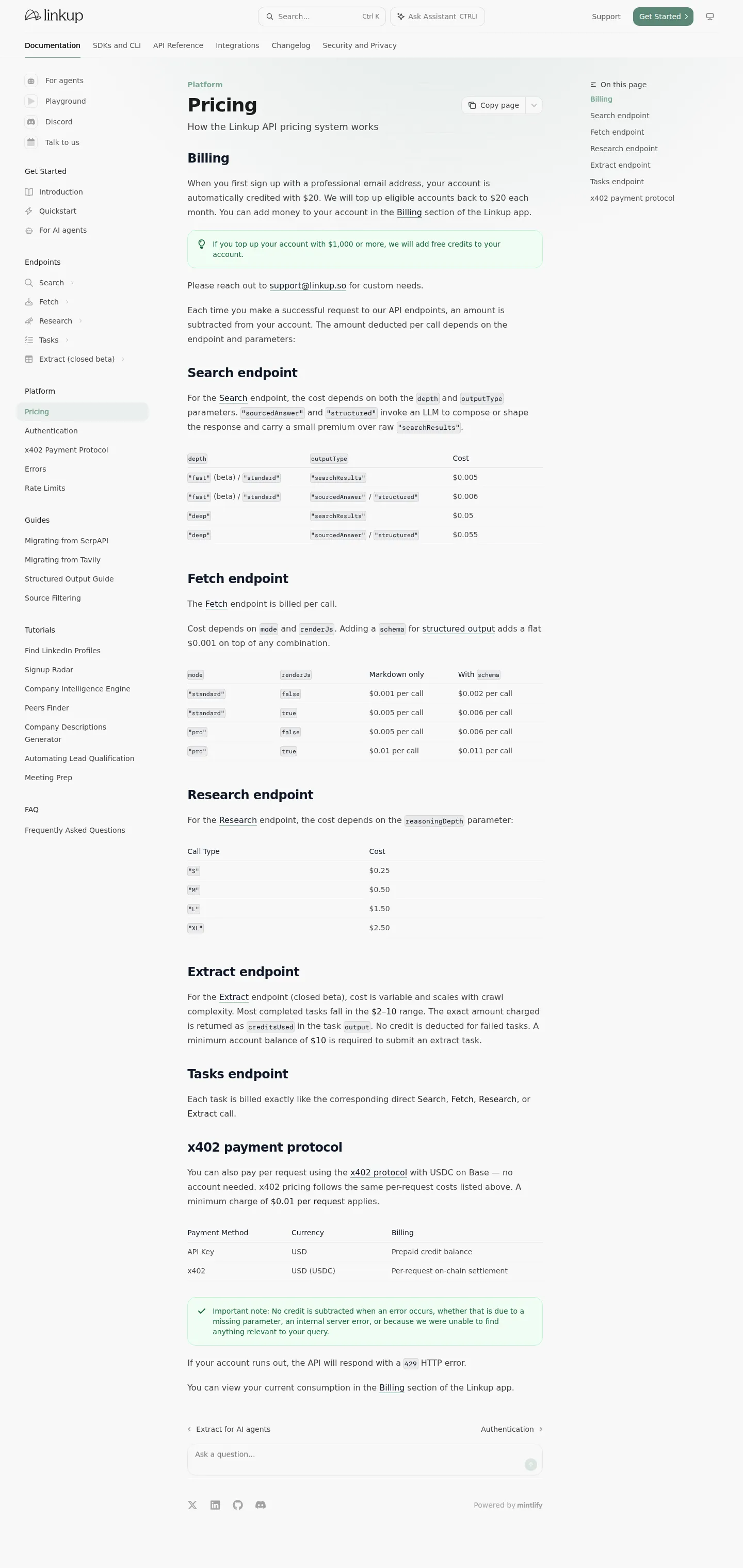
Extract endpoint (closed beta) added; Deep-search advertised range corrected
Linkup adds a closed-beta Extract endpoint (structured crawl, variable cost — most tasks $2–$10, $10 minimum balance) and corrects the marketing pricing page's Deep-search range from $0.05–$0.55 down to $0.05–$0.055, matching the billing docs. All other per-request rates unchanged.
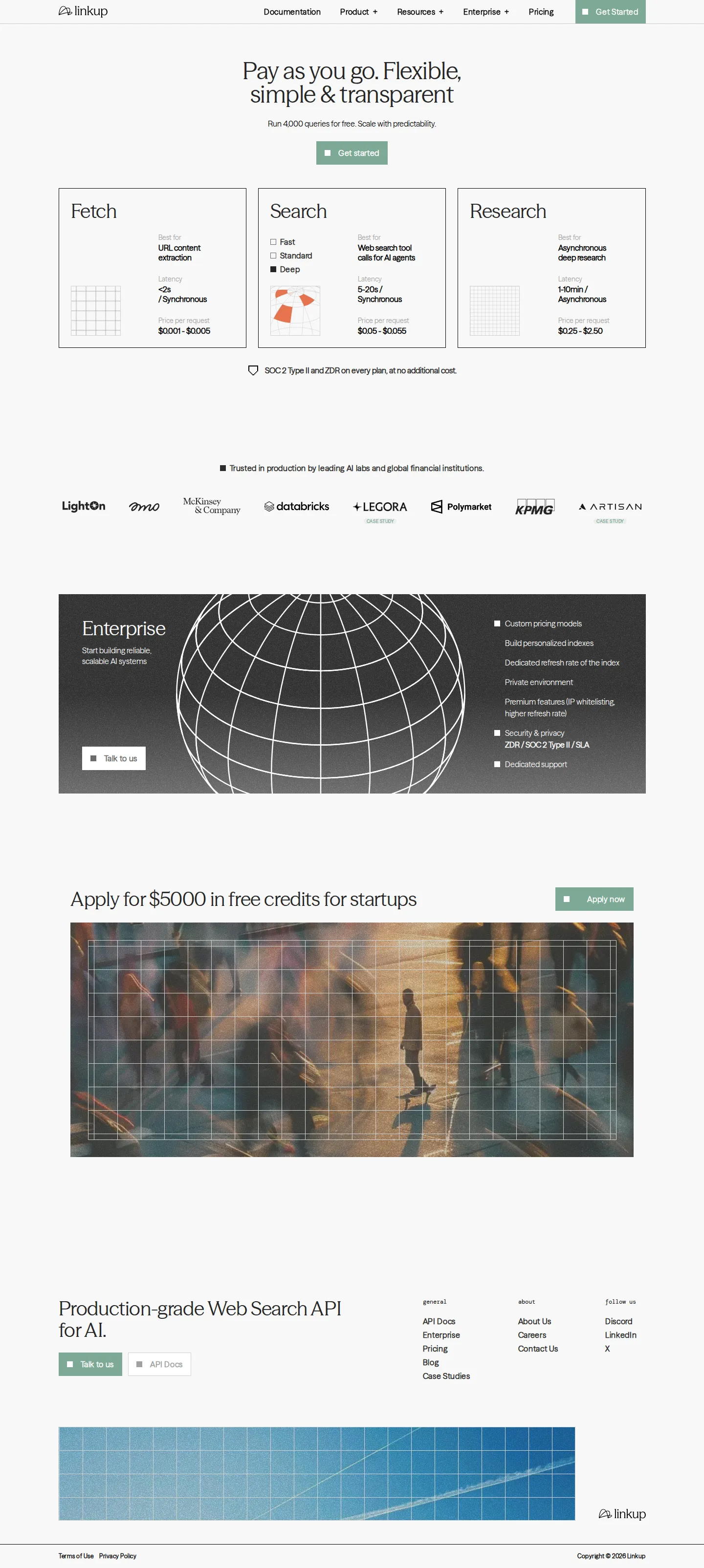
USD per-request pricing with $20 auto-refilling monthly credit
Current capture: prices presented in USD per request against a prepaid balance that refills to $20 monthly (~4,000 standard searches). Standard search $0.005–$0.006; deep search $0.05–$0.055; Fetch $0.001–$0.005; Research $0.25–$2.50 by reasoning depth; x402 at $0.01 flat. Startup credit grant is $5,000.
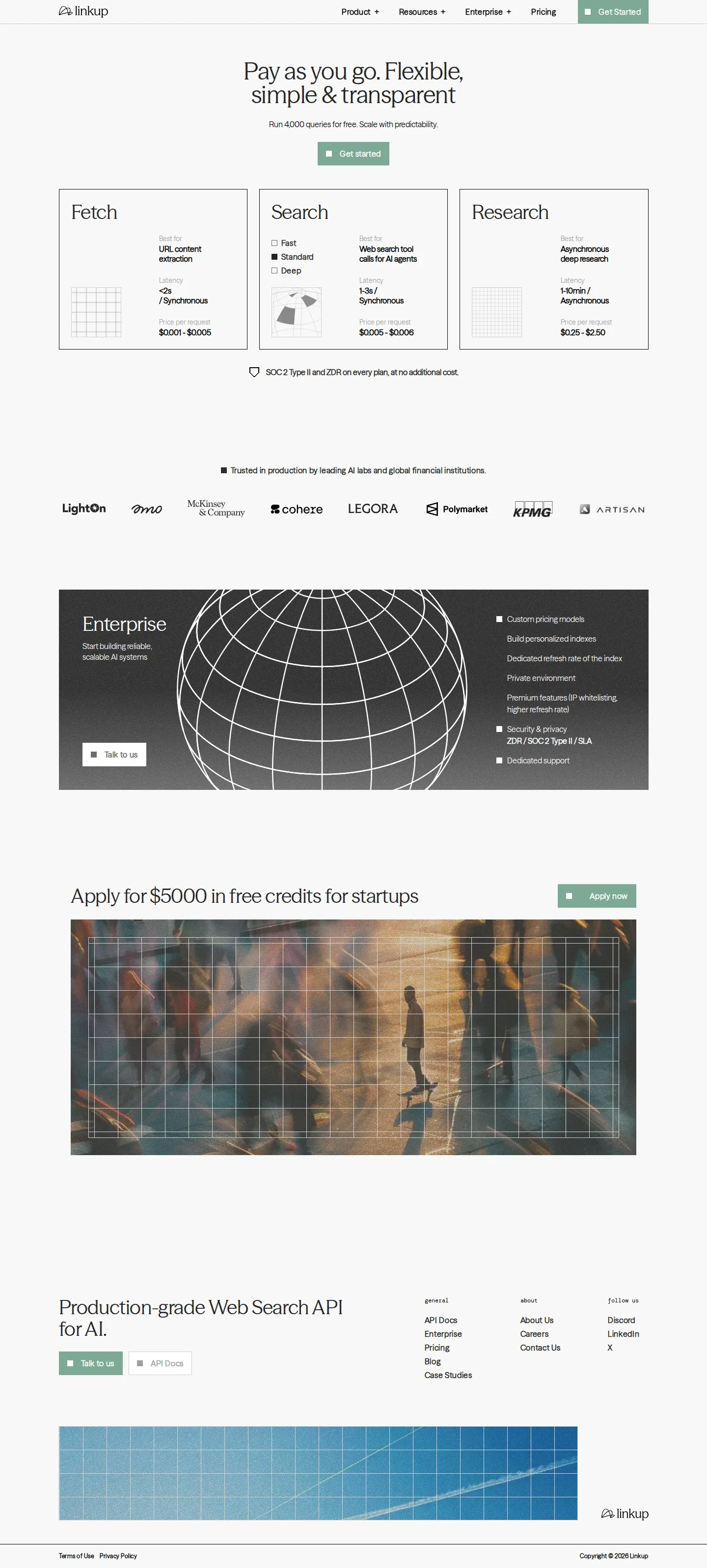
x402 agent-native pay-per-request; endpoint-centric pricing redesign
Linkup adds x402 (Coinbase's open payment protocol) support, letting agents pay per request in USDC on Base with no account (2026-05-05). By the 2026-05-08 snapshot the pricing page was redesigned around endpoints — Fetch, Search, Research — replacing the Free / Pay as you go / Custom plan cards; 'Run 4,000 queries for free' framing introduced.
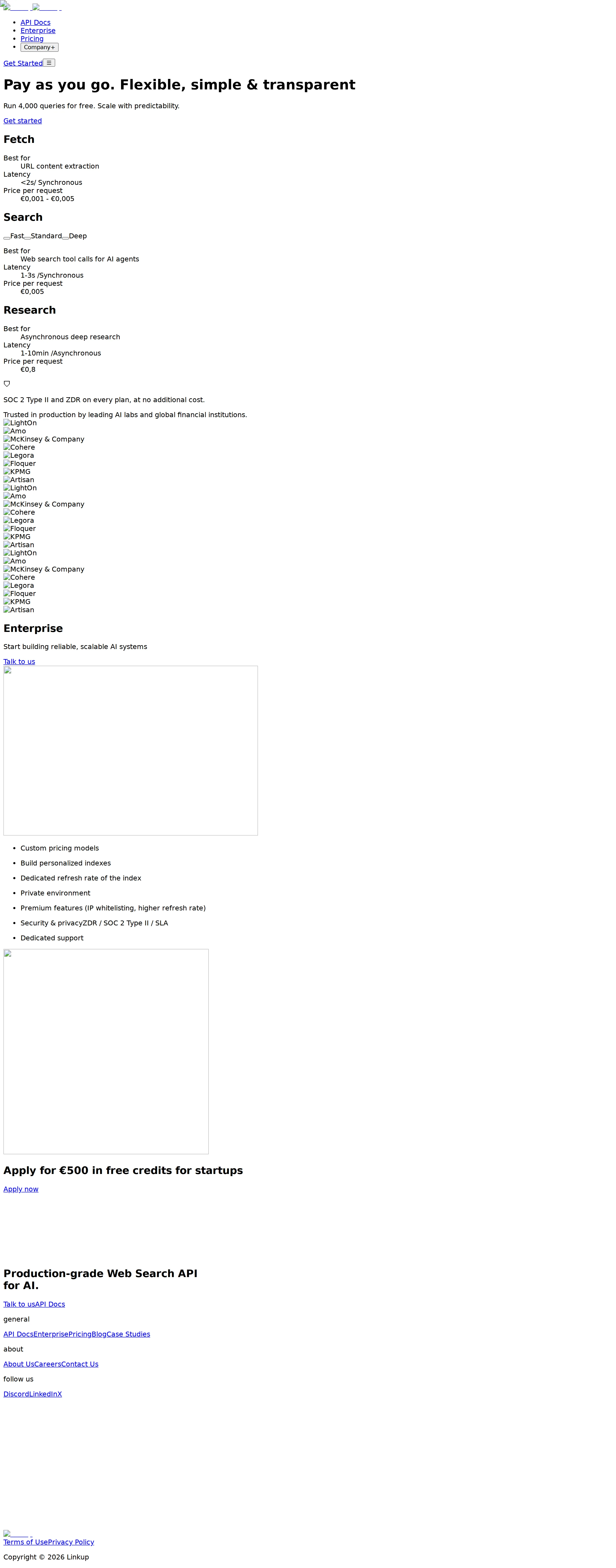
$10M seed led by Gradient; /fast sub-second search
Linkup announces a $10M seed led by Gradient with angels from Mistral, Datadog, Deel and Dataiku, plus the /fast 'sub-second' web search API and NY/SF/Paris hiring (linkup.so/blog, 2026-03-03). The 2026-03 pricing snapshot still showed the EUR three-plan layout (Standard €5/1,000, Deep €50/1,000).
EUR three-plan pricing: Free / Pay as you go / Custom
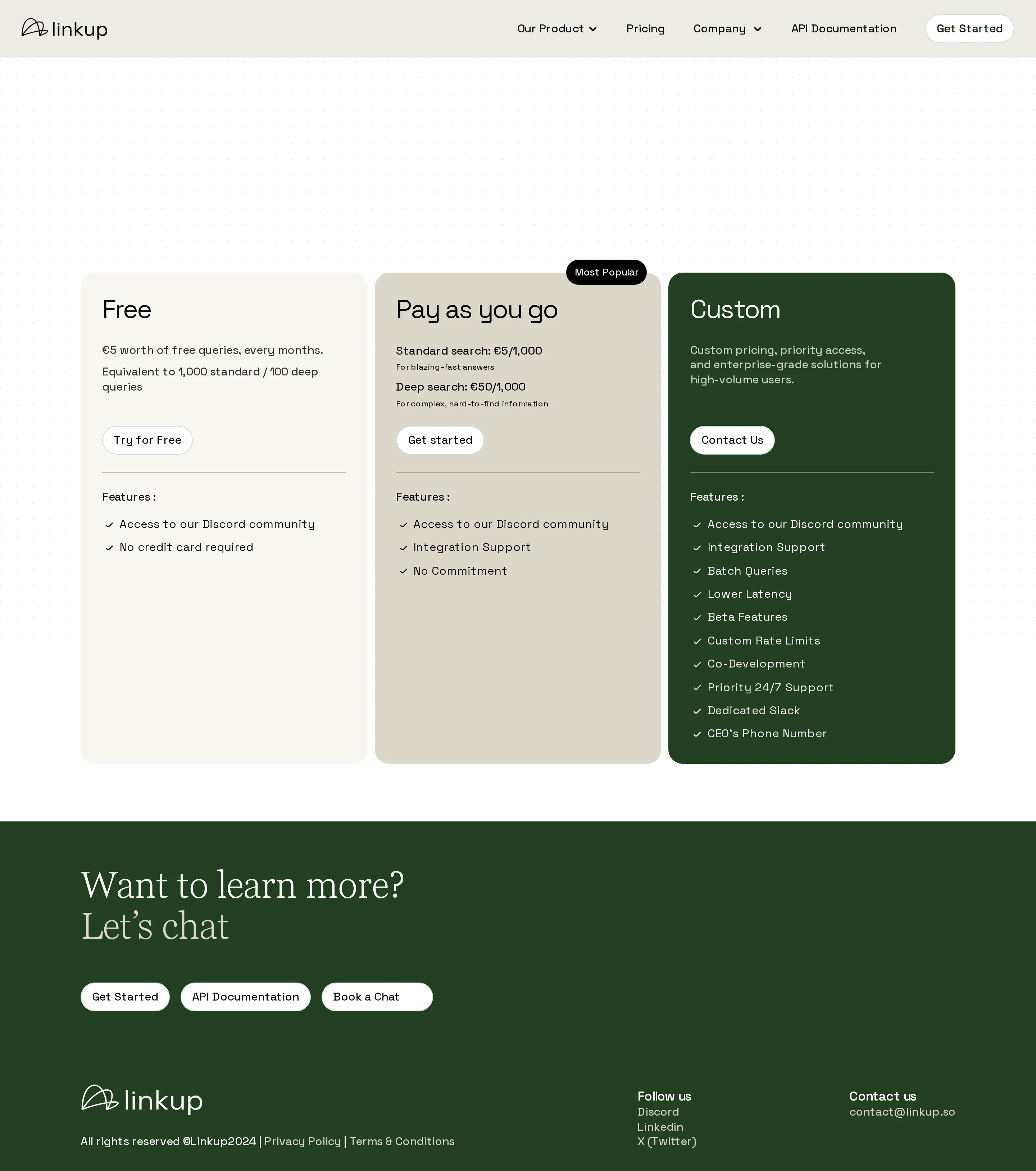
Earliest captured Wayback snapshot of linkup.so/pricing (2025-03-20) shows three named plans: Free (€5/month of credit ≈ 1,000 standard / 100 deep queries), Pay as you go (Standard search €5/1,000, Deep search €50/1,000), and Custom (contact sales). This EUR layout held stable through at least March 2026.
€3M pre-seed; content-licensing search API launches
Linkup (Paris, founded 2024) raises a €3M pre-seed led by Seedcamp to build an ethical, licensed alternative to web scraping for LLMs, paying content partners per access (TechCrunch, 2024-11-28). Earliest pricing surface not preserved by Wayback before March 2025.
- · Linkup gives every new account a $20 credit that auto-refills to $20 every month — a recurring free allowance (~4,000 standard searches) rather than a one-time trial.
- · Deep search costs 10x a standard search ($0.05 vs $0.005); a former discrepancy — the marketing pricing page advertised a Deep range up to $0.55 while the billing docs capped it at $0.055 — was corrected in July 2026, so both surfaces now read $0.05–$0.055.
- · Linkup supports the x402 protocol: AI agents can pay per request in USDC on Base with no account or API key, at a flat $0.01 per request.
Questions & answers
- How much does Linkup cost per search?
- A standard or fast search costs $0.005 per request for raw search results, or $0.006 when you use sourcedAnswer or structured output. A deep search costs $0.05 / $0.055 respectively.
- Does Linkup have a free tier?
- Yes. Every account is credited with $20 on signup and is topped back up to $20 every month — roughly 4,000 standard searches free per month. There is no separate free plan SKU.
- How does Linkup billing work?
- Linkup uses a prepaid credit balance. Each successful API request deducts an amount based on the endpoint and parameters; failed requests are never charged. If your balance runs out, the API returns a 429 error until you top up.
- What do the Linkup Fetch and Research endpoints cost?
- Fetch is priced by mode (standard or pro) and renderJs (JS rendering on/off): $0.001 (standard, no JS) up to $0.01 (pro, with JS), plus a flat $0.001 surcharge for a structured-output schema (max $0.011). The asynchronous Research endpoint is priced by reasoningDepth: $0.25 for S, $0.50 for M, $1.50 for L, and $2.50 for XL.
- Can AI agents pay Linkup without an account?
- Yes. Linkup supports the x402 protocol, letting agents pay per request in USDC on the Base network with no account or API key. x402 requests are billed at a flat $0.01 per request.
- Does Linkup offer volume discounts or enterprise pricing?
- Topping up $1,000 or more in a single payment earns bonus credits. Enterprise is sales-led with custom pricing, private deployment, personalized indexes, SSO and SLAs. Startups can apply for $5,000 in free credits.