AI Summary
About
Manus is a general AI agent that takes a natural-language goal and executes the whole multi-step task autonomously in the cloud — researching, analyzing, coding, deploying, and managing work across a user’s stack rather than just answering questions in a chat window. The product positions itself against assistant-style chatbots (its own marketing runs “VS ChatGPT”, “VS Lovable”, and “VS Replit” comparison pages), emphasizing that agents run tasks in parallel and return finished deliverables like slides, websites, images, and data analyses.
Manus went viral on March 6, 2025, when its invite-only launch demo drew more than a million views in 20 hours and access codes resold for thousands of dollars on Chinese platforms. It is built by Butterfly Effect, the team behind the Monica browser-extension assistant; the company raised a Series B led by Benchmark at roughly a $500 million valuation in April 2025, then relocated its headquarters to Singapore mid-2025 during a US CFIUS review of that investment. By December 2025 Manus reported $100M ARR and agreed to be acquired by Meta (reported at US$2–3 billion) — a deal China’s NDRC ultimately blocked on April 27, 2026. The live pricing surface now footers ”© 2026 Meta — bringing AI to businesses worldwide.”
Manus serves three audiences off one credit currency: individuals on self-serve credit-tiered plans, teams on a per-seat plan with a shared credit pool, and startups via a VC-referral program. Unlike seat-priced copilots or token-metered APIs, Manus meters the work itself in credits: a typical task consumes roughly 150 credits, and each plan simply buys a larger monthly credit pool. That makes Manus a useful reference point for the broader shift toward credit-based billing and outcome-shaped pricing for autonomous AI agents.
Pricing summary : how Manus’s credit-based AI agent pricing works
Manus uses a credit-based subscription model where every plan buys a monthly pool of credits, the single unit that meters all agent work, with a per-seat Team layer on top. There are four pricing dimensions:
- Monthly credit tier (individuals): $20/mo buys 4,000 credits, $40/mo buys 8,000 credits (the $40 tier is “customizable” with an adjustable credit dial), and $200/mo buys 40,000 credits and bundles a free Cloud Computer. Annual billing saves 17%, dropping the effective rates to $17 / $34 / $167 per month.
- Daily refresh credits: every paid plan also receives 300 “refresh credits” each day, a daily-reset bucket stacked on top of the monthly allowance; the Free tier gets a smaller daily refresh allowance.
- Per-seat Team credits, pooled: the Team plan bills per seat with each seat’s credits pooled across the whole team, so heavy users draw down lighter users’ unused credits before any overage; SSO and SCIM are $150/mo add-ons each.
- Metered Cloud Computer + add-on credits: persistent cloud sandboxes are billed separately (Basic $10, Standard $30, Advanced $50 per month), and add-on credit packs run from $20 (2,000 credits) to $1,000 (100,000 credits).
What makes this different: Manus prices the task, not the seat or the token — it converts every agent action into credits and tells users outright that a typical task costs about 150 credits, making the cost of autonomous work legible in a way seat-based tools never attempt. For a primer on the mechanics behind this approach, see our guide to prepaid credit models; for a peer agent that meters work similarly, compare Relevance AI’s pricing.
Pricing by product
Manus agent (Individual plans)
| Tier | Price (monthly · annual) | Included | Key mechanics |
|---|---|---|---|
| Free | $0 | Daily refresh credits, 1 concurrent task, limited scheduled tasks | Account default; pricing page leads with the paid tiers |
| Basic | $20 / mo · $17 / mo billed yearly | 4,000 credits/month, 300 refresh credits daily, 20 concurrent + 20 scheduled tasks | ”Standard monthly usage” entry tier |
| Plus | $40 / mo · $34 / mo billed yearly | 8,000 credits/month (adjustable dial), Wide Research scaled to plan, 300 refresh credits daily | ”Customizable monthly usage”; credit dial scales the price |
| Pro | $200 / mo · $167 / mo billed yearly | 40,000 credits/month, free Cloud Computer, in-depth research + batch slides + data analytics | ”Extended usage for productivity”; only tier with bundled Cloud Computer |
The Plus and Pro cards expose a credit-tier dropdown that scales credits and price together along a published ladder — e.g. $60/12,000 credits, $100/20,000 credits, $200/40,000 credits, up to $20,000/5,000,000 credits per month — so a single “individual” plan spans hobbyist to power-user volumes.
Manus for Teams & Business
| Tier | Price | Included | Key mechanics |
|---|---|---|---|
| Team | $20 / seat / mo (4,000 credits per seat; $200 / seat / yr saves 17%) | Pooled team credits, unlimited Chat mode, Manus 1.6 Agent mode, 20 concurrent + 20 scheduled tasks per member, admin dashboard, unified billing | Bill adjusts at next cycle as seats change; credits pooled across team; per-seat credit dial scales like the individual ladder |
| Team + SSO | +$150 / mo | Single sign-on add-on on top of Team | Add-on, not a separate plan |
| Team + SCIM | +$150 / mo | SCIM provisioning add-on on top of Team | Add-on, not a separate plan |
| Enterprise | Contact sales | ”Flexible plans for teams of all sizes — from startups to enterprise,” enterprise-grade security (SOC 2, ISO 27001) | Sales-led, quoted via “Contact sales” / “Get Team” |
Sales motions across products: PLG / self-serve for Free and the individual Basic / Plus / Pro tiers; self-serve for Team with sales-led “Contact sales” for Enterprise and the Startups program.
Credit mechanics: refresh credits, add-on packs, and Cloud Computer
Manus layers three credit mechanics on top of the monthly allowance:
| Mechanic | Detail |
|---|---|
| Typical task cost | ~150 credits per typical task (stated on the Team configurator) |
| Daily refresh | 300 refresh credits every day on paid plans (a daily-reset bucket separate from the monthly pool) |
| Add-on credit packs | $20 / 2,000 · $100 / 10,000 · $200 / 20,000 · $500 / 50,000 · $1,000 / 100,000 credits |
| Auto-purchase | Auto-top-up triggers below a credit threshold to prevent interruptions; add-on credits stay valid while the subscription is active |
| Cloud Computer | Basic $10 (2 vCPU / 1 GB) · Standard $30 (2 vCPU / 4 GB) · Advanced $50 (2 vCPU / 8 GB) per month; storage $0.10/GB; free on the $200 Pro tier |
Manus for Startups
Qualifying startups (less than 5 years old, having raised between $500,000 and $50 million, and backed by a partner VC or accelerator) receive 6 months of the Team plan for up to 20 seats — a package the page values at $4,800. Open applications are paused; access is currently by VC-partner referral only.
Hidden costs : what credit burn and Cloud Computer add to the headline price
The headline tier price is only the floor. Because a typical task costs ~150 credits — and community reports show complex tasks burning 900+ credits in a single run — the real bill is driven by how many tasks you run, plus the separately metered Cloud Computer that every plan except $200 Pro pays for. Two archetypes show how the extras stack up.
Archetype 1 — a solo power user on the $20 Basic plan running 50 tasks/month. The 4,000 monthly credits cover only ~26 typical tasks, so the remaining ~24 tasks (~3,600 credits) come from add-on packs, and a Standard Cloud Computer is needed for persistent work:
| Line item | Monthly cost |
|---|---|
| Basic plan (4,000 credits) | $20 |
| Add-on credits: 4,000 (2× $20 / 2,000 pack) | $40 |
| Cloud Computer (Standard, 2 vCPU / 4 GB) | $30 |
| Total | $90 |
At 50 tasks/month the add-on credits and Cloud Computer more than triple the $20 headline — the “$20 plan” is really ~$90 for a genuinely active solo user.
Archetype 2 — a 10-seat Team running ~400 tasks/month. Team pools 4,000 credits/seat, so 10 seats = 40,000 pooled credits (~266 typical tasks). Covering ~400 tasks needs ~60,000 credits — 20,000 of them from add-on packs — plus SSO for the org:
| Line item | Monthly cost |
|---|---|
| Team: 10 seats × $20 (40,000 pooled credits) | $200 |
| Add-on credits: 20,000 (2× $200 / 20,000 pack) | $400 |
| SSO add-on | $150 |
| Total | $750 |
So at moderate team volume the add-on credit packs ($400) alone exceed the entire $200 seat bill — credit burn, not seats, is the real cost driver, exactly the dynamic that triggered Manus’s 2025 pricing backlash.
Want to estimate your own Manus bill? Use the Manus pricing calculator to model your monthly cost based on credits consumed per task, add-on packs, and Cloud Computer usage.
Pricing evolution : the shift toward credit-metered agent work
Cadence
| Quarter | Price changes | Product / SKU additions | Notes |
|---|---|---|---|
| 2025 Q1 | 1 | 2 | Mar 6 invite-only launch (no public pricing); Mar 31 first paid plans $39 / $199 (3,900 / 19,900 credits) + iOS app |
| 2025 Q2 | 1 | 0 | May 12 waitlist removed, opens to public with 1,000 free + 300 daily credits; Benchmark round (~$500M valuation) reported in April |
| 2025 Q4 | 1 | 1 | Dedicated /pricing page live; re-cut $20 / $40 / $200 credit ladder + dial; annual “Save 17%” introduced; Team plan (Beta) |
| 2026 Q1 | 0 | 1 | Meta ownership reflected (“now part of Meta”, ”© 2026 Meta”); SSO / SCIM add-ons surfaced; structure otherwise stable |
| 2026 Q2 | 0 | 0 | Pricing stable; NDRC blocks the Meta acquisition (Apr 27) |
| 2026 Q3 | 0 | 0 | Pricing stable; Tencent leads a deal to unwind Meta’s ~$2B acquisition after Beijing’s block — ownership unresolved (FT, Jul 9) |
Tracked range: 2025-03–2026-06. Launch-era ($39 / $199) prices come from Bloomberg & TechCrunch coverage; the Q4 2025 onward credit-allocation and annual-discount facts are drawn from the dedicated /pricing and /team pages. Quarters not listed had no observed pricing activity.
Notable changes
- 2025-03-06 — Invite-only launch; the demo tops 1M views in 20 hours and invite codes resell for ¥50,000–¥100,000 (The Register, 2025-03-10).
- 2025-03-31 — First paid plans: $39/mo (3,900 credits, 2 concurrent) and $199/mo (19,900 credits, 5 concurrent), plus an iOS app and an upgrade to Claude 3.7 Sonnet (Bloomberg & TechCrunch, 2025-03-31).
- 2025-05-12 — Waitlist removed; Manus opens to the public with 1,000 free credits + 300 daily credits for all users.
- 2025-Q4 — Dedicated
/pricingpage goes live with the re-cut $20 / $40 / $200 ladder and a credit dial; the annual “Save 17%” discount appears between the October (“Save 0%”) and December snapshots. - 2026-Q1 — Following the December 2025 Meta acquisition, the pricing surface flips to “Manus is now part of Meta” / ”© 2026 Meta” (was ”© 2025 Manus AI · Singapore”); pricing itself is unchanged.
- 2026-07-09 — Tencent leads a deal to unwind Meta’s ~$2B acquisition after Chinese regulators intervened to block it (reported Jul 4), and moves to acquire Manus itself; ownership is unresolved. No pricing change is assertable yet — the eventual owner decides whether Manus stays globally purchasable or is repositioned for the domestic market (Financial Times, 2026-07-09).
The credit-burn backlash in detail
Manus’s March 2025 launch is one of the cleaner cautionary tales in agent pricing. The original tiers — $39/mo for 3,900 credits and $199/mo for 19,900 credits — looked generous until users learned that a single moderately complex task could consume 900+ credits and that Manus did not surface the credit cost before a task ran. On Reddit and HN, early users reported burning an entire month’s allowance on one task that returned no usable result, and credits expired at month’s end if unused. The community read was blunt — one HN commenter on a 2025 thread called the pricing “ridiculous” relative to task reliability.
The current ladder is a direct response: the $20 entry point lowers the trial barrier, the credit dial lets users size the pool to their workload, add-on packs with auto-purchase prevent hard stops mid-task, and Manus now states “a typical task uses ~150 credits” prominently on the Team configurator. The fix is real but partial — “~150 credits” is still an average with no per-action breakdown, so the underlying unpredictability that drove the backlash hasn’t been fully designed away (see Areas to improve).
What’s unique : pricing the task in credits, not the seat
One credit currency for every kind of work. Research, coding, slides, image generation, and data analysis all draw from the same monthly credit pool. There are no per-feature SKUs and no token math — the buyer reasons about a single number, “credits per month,” which is unusually legible for a tool that does this many different things. This is a textbook example of credit-based billing used as the primary meter rather than an overage backstop.
A published task-to-credit anchor. Manus states outright that “a typical task uses ~150 credits” on its Team configurator and live-previews “estimated tasks (~N)” as you size a plan. Most agent vendors hide the conversion between their internal unit and real work; Manus exposes it, turning an abstract credit balance into a tangible “how many jobs can I run” number.
A credit dial that spans hobbyist to enterprise on one plan. The Plus and Pro cards (and the Team per-seat allocation) carry a dropdown that scales credits and price together along a published ladder — $20 / 4,000 up to $20,000 / 5,000,000 credits per month. A single “individual” product therefore covers a 1,000× range of spend without ever changing plans, a hybrid move that collapses what most vendors split into many tiers.
Pooled team credits instead of per-seat entitlements. On Team, every billed seat contributes its credits to one shared balance, so heavy users draw on lighter users’ unused credits before any overage. This deliberately breaks the seat-based waste model where each license’s unused capacity simply evaporates.
A daily-reset bucket layered on the monthly pool. Every paid plan also gets 300 “refresh credits” each day on top of its monthly allowance — a small recurring grant that keeps light users productive without touching the monthly pool, and a subtle anti-churn mechanic distinct from the headline credit count.
Strengths & weaknesses
| Strengths | Weaknesses |
|---|---|
| Single, legible billing unit (credits) across all work types | Credit-per-task is an average (“~150”), with no pre-run cost shown — the original backlash trigger |
| Published task-to-credit anchor + “estimated tasks” preview | Complex tasks can burn 900+ credits and produce no usable result |
| Pooled team credits reduce per-seat waste | Cloud Computer is a separate $10–$50/mo metered cost on every plan but $200 Pro |
| Self-serve credit dial scales one product 1,000× across volumes | Add-on packs can dwarf the headline price for active users (see Hidden costs) |
| Auto-purchase + monthly credit grant reduce hard mid-task stops | Contested ownership (China → Singapore → Meta, now a Tencent-led unwind) clouds the long-term roadmap |
Billing UX : credit dials, pooled balances, and auto-top-up
- Monthly / Annually toggle — a single switch on the pricing page flips every card between monthly rates and “billed yearly” rates, surfacing the “Annually · Save 17%” discount inline ($20→$17, $40→$34, $200→$167 effective per month).
- Credit-tier dropdown — the Plus and Pro cards carry a “credits / month” selector (e.g. “8,000 credits / month”, “40,000 credits / month”) that scales the plan’s credit allowance and price together, so users size the plan to their workload without changing products.
- Team seat + credit configurator — the Team page lets owners pick the number of seats and the per-seat credit allocation, live-previews “Monthly cost”, “Monthly credits”, and “Estimated tasks (~N tasks)”, and notes that a typical task uses ~150 credits.
- Pooled team credit balance — every billed seat contributes credits to one shared pool, so heavy users draw on lighter users’ unused credits before any overage is incurred.
- Flexible mid-cycle seat changes — members can be added or removed anytime; the bill “adjusts at the next billing cycle to match your team size,” with no commitment required.
- Add-on credits + auto-purchase — owners and super admins buy add-on credit packs in Team settings → Billing and can enable auto-purchase to top up before credits run out; add-on credits stay valid as long as the subscription is active.
- Admin dashboard with usage stats — Team provides unified billing and an admin dashboard showing usage across members.
Strategic wins : where the credit model pays off
1. One credit currency makes a multi-tool agent legible
By metering research, coding, slides, images, and data work in the same credit unit, Manus lets a buyer reason about cost with a single number instead of a feature matrix. For a product that does this many different jobs, that is a real packaging win — it sidesteps the SKU sprawl that makes most platform pricing illegible, and it positions credits as a clean value metric rather than a billing afterthought.
2. Lowering the entry point answered the backlash directly
The original $39 floor priced out the curious and amplified the credit-burn complaints when even the entry plan ran dry. Re-cutting the ladder to a $20 entry plus a $0 self-serve free tier (1,000 credits + 300/day) turned a scarcity-gated, controversy-prone launch into a proper product-led funnel. The free tier is the top of that funnel; the dial is how users grow without a sales call.
3. The credit dial collapses many tiers into one product
Instead of Starter/Pro/Business/Enterprise rows, Manus ships one plan with a dropdown that scales from $20 to $20,000/mo. That is an elegant hybrid pricing structure: it removes upgrade friction (no migration, just a bigger pool) and lets a single page serve hobbyists and power users alike — useful for teams designing their own usage-based tiers.
4. Pooled team credits beat per-seat waste
Pooling every seat’s credits into one balance means an org pays for aggregate consumption, not per-license entitlements that expire unused. For buyers this is strictly better than seat-based licensing for spiky, uneven team usage — and it makes the Team plan an easy “just add members, billing adjusts next cycle” sell with no commitment.
Areas to improve : where credit pricing creates friction
1. Show the credit cost before a task runs
“~150 credits per typical task” is a single average for work that ranges from a quick lookup to a 900-credit research run, and the absence of a pre-run estimate is precisely what drove the 2025 backlash. The fix is a per-task cost preview (even a range) at submit time, plus a post-run breakdown of which actions consumed credits — the kind of transparent metering that turns credit anxiety into informed consent.
2. Make Cloud Computer’s mandatory cost explicit in the headline
Every plan except $200 Pro needs a $10–$50/mo Cloud Computer for persistent work, but the headline “$20” omits it, so the effective entry price is closer to $30–$70. Folding a baseline Cloud Computer into the lower tiers — or at minimum surfacing ”+ Cloud Computer from $10/mo” on each card — would prevent the bill-shock pattern documented in Hidden costs.
3. Reduce credit expiry friction
Monthly credits that expire at period end (a recurring complaint since launch) penalize bursty usage and amplify the feeling that credits are being “wasted.” Letting a capped portion of unused monthly credits roll over — the way add-on credits already persist while the subscription is active — would soften the harshest edge of the credit-burn model without giving away unlimited banking.
4. Clarify the post-Meta roadmap and data commitments
The entity has moved from China to Singapore to Meta ownership inside 18 months — and as of July 2026 that ownership is contested again: Chinese regulators blocked the Meta deal and Tencent is now leading an effort to unwind it and acquire Manus itself (FT, 2026-07-09), so the live footer’s ”© 2026 Meta” sits on top of an unresolved ownership question. This raises obvious concerns about data handling and product continuity that the pricing page doesn’t address. A clear, dated statement on who ultimately owns Manus, what that means for pricing stability, and the “we don’t train on your data” promise would de-risk the buying decision for teams.
Monetization stack & signals : how Manus builds & buys its revenue engine
Buys 3 Builds 1
Buys its entire money-movement spine from one vendor: Stripe runs billing, global checkout (31 currencies) and invoicing. Manus builds only the credit meter on top — the rails behind its credit pricing are Stripe's, not in-house.
-
“Manus meters every agent action in credits, the single billing unit; a typical task uses ~150 credits. The Stripe case study notes the model 'combined subscription and credit-based pricing' — the per-action credit logic is Manus's, the rails are Stripe's.”
-
“Manus implemented Stripe Billing to manage its subscription-based revenue model.”
-
“Manus began by implementing Stripe's Optimized Checkout Suite... card payments, Apple Pay, Google Pay, Alipay and Link... Manus now charges customers in 31 currencies. Over half of Manus' payment volume now flows through Link, Stripe's digital wallet.”
-
“The company also implemented Stripe Invoicing to streamline billing operations and track customer payments.”
Signals reviewed · derived from press & filings, product docs
Key takeaways
- Price the work, not the worker — but only if you can make the unit legible. Manus’s bet is that “credits per task” is a better value metric than seats or tokens for an autonomous agent. It works because Manus publishes the task-to-credit anchor; the same model fails the moment users can’t predict what a job will cost.
- A viral launch is not a pricing strategy. Manus’s March 2025 demo created enormous demand, but the $39/$199 credit-burn backlash shows that hype amplifies pricing mistakes. The lower-friction $0/$20 re-cut came after the damage, not before.
- Pre-run cost transparency is the make-or-break for credit pricing. Every Manus complaint traces back to one thing: not knowing the cost before running a task. Teams adopting credits should ship the estimate before the spend, not the invoice after.
- A single dial can replace a tier ladder. Manus serves a 1,000× spend range ($20–$20,000/mo) on one plan with a credit dropdown — eliminating upgrade migrations and letting one pricing page address hobbyists and enterprises alike.
- Pooled credits are a cleaner team model than per-seat entitlements. Charging for aggregate consumption instead of per-license capacity fits spiky, uneven team usage and removes the “wasted seat” problem that plagues seat-based SaaS.
UBP implications
- Credits work as a primary meter, not just an overage backstop. Manus shows a viable design where the entire plan is denominated in credits and seats/tokens disappear — a reference point for any vendor weighing credit-based billing as the headline unit rather than a top-up mechanism.
- Outcome-shaped pricing demands outcome-level transparency. The closer you price to “the task,” the more buyers expect to see and control the cost of each task. Task-metered models that don’t expose per-task cost convert credit balances into anxiety and churn.
- For autonomous agents, unpredictable per-task cost is the central UBP risk. When one task can cost 6× another with no warning, usage-based pricing stops feeling fair. The agent-pricing frontier will be won by whoever pairs credit metering with reliable, pre-run cost estimates.
Sources
- Manus pricing page (accessed 2026-06-02)
- Manus Team plan page (accessed 2026-06-02)
- Manus for Startups page (accessed 2026-06-02)
- Manus help center (accessed 2026-06-02)
- Manus help center — “What is the current membership pricing for Manus?” (accessed 2026-06-02)
- Manus help center — “What is the current SSO subscription pricing for Manus Team?” (accessed 2026-06-02)
- Manus updates / changelog (accessed 2026-06-02)
Bottom line
Manus prices the work, not the worker: every plan buys a monthly pool of credits, a typical agent task costs about 150 of them, and the only question that matters is how many tasks you intend to run. That makes Manus one of the cleanest examples of credit-metered pricing for autonomous AI agents — legible at the headline, but with Cloud Computer fees, daily refresh buckets, and pooled team credits hiding real complexity underneath.
Want to compare Manus against other AI agent and platform pricing? Browse the pricing blueprint.
Pricing timeline : Major events on a vertical axis
Each milestone below corresponds to a public pricing change, product launch, or material adjustment. Major events use a filled marker; minor adjustments use a faded one.
Credit-tiered plans, pooled-credit Team, and Cloud Computer add-ons
Current structure: individual credit tiers ($20 / $40 / $200 per month for 4,000 / 8,000 / 40,000 credits) on a dial that scales to $20,000/mo (5M credits), a Team plan at $20/seat/mo for 4,000 pooled credits/seat (SSO & SCIM $150/mo each), metered Cloud Computer ($10 / $30 / $50), and add-on credit packs ($20–$1,000). Annual billing saves 17%.
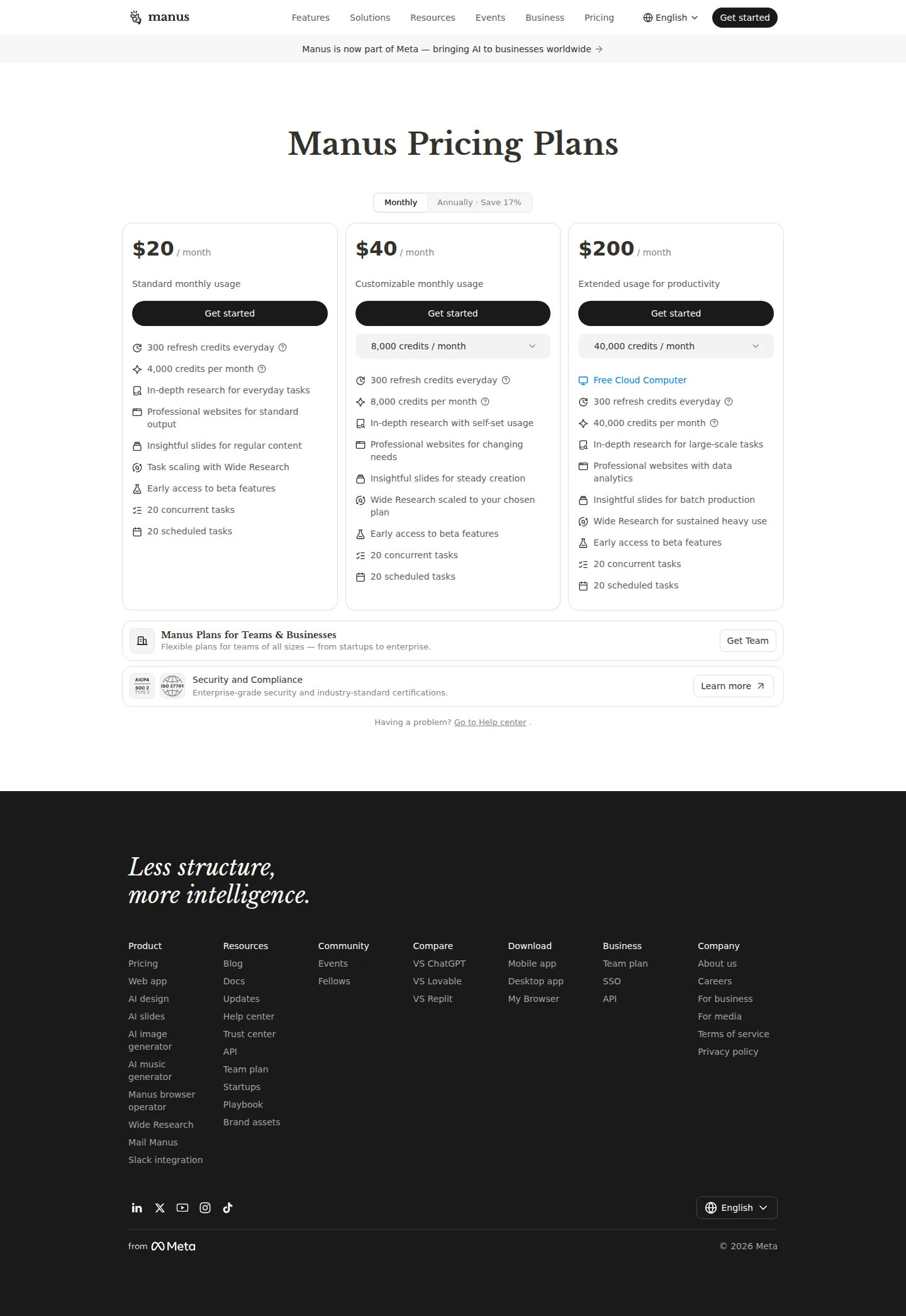
Meta ownership reflected across the pricing surface
Following the December 2025 acquisition, the pricing and team pages carry a 'Manus is now part of Meta' banner and a '© 2026 Meta' footer (replacing '© 2025 Manus AI · Singapore'). Pricing structure is unchanged. (Archived /pricing page, Feb–Mar 2026.)
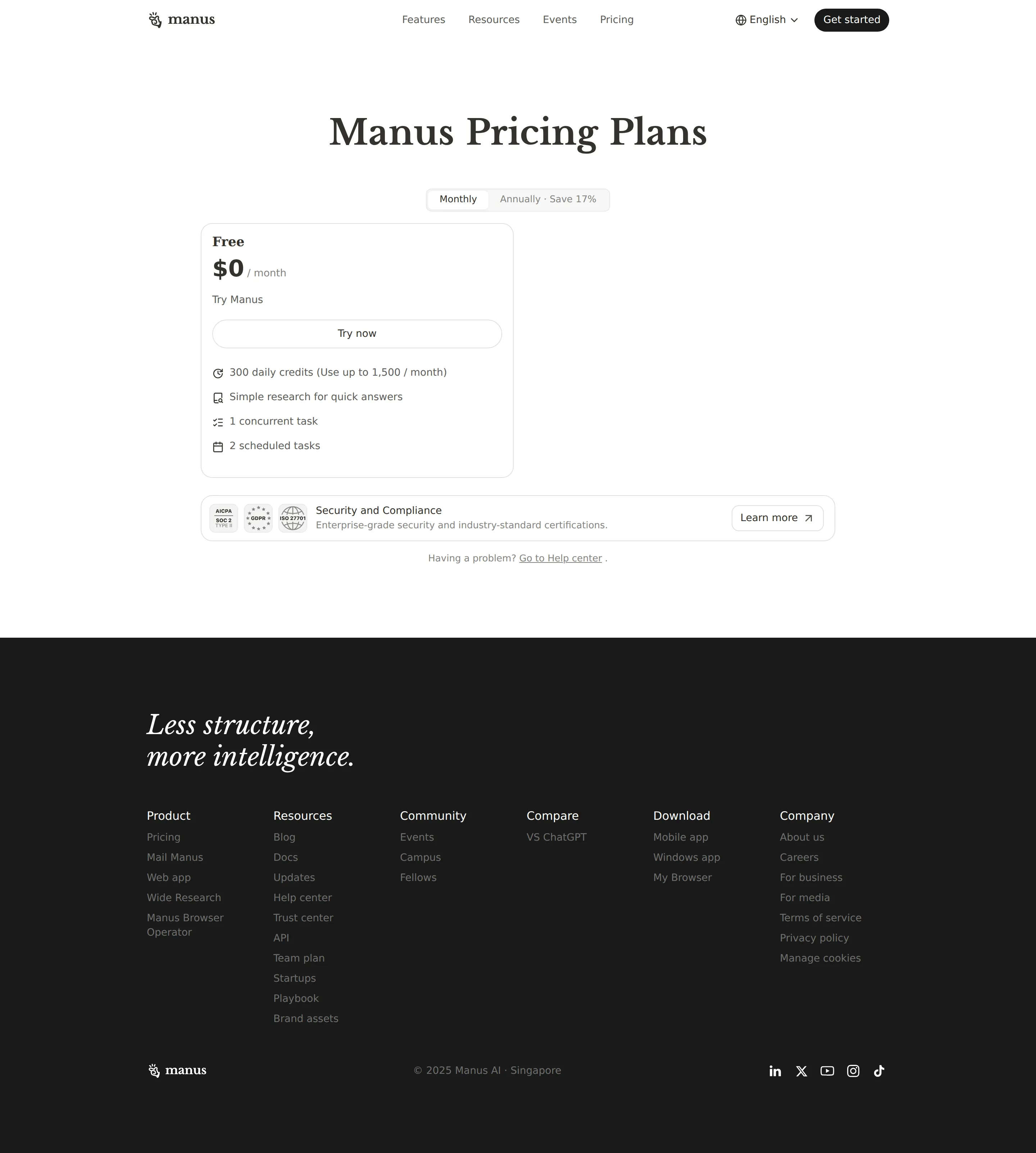
Annual 17% discount introduced; Free tier re-specced; $100M ARR
The annual toggle now reads 'Annually · Save 17%' and the Free card becomes '300 daily credits (use up to 1,500/mo), 1 concurrent + 2 scheduled tasks.' Team pools 4,000 credits/seat/mo. Manus reports $100M ARR. (Archived /pricing & /team pages, Dec 2025; Manus blog, 2025-12-28.)
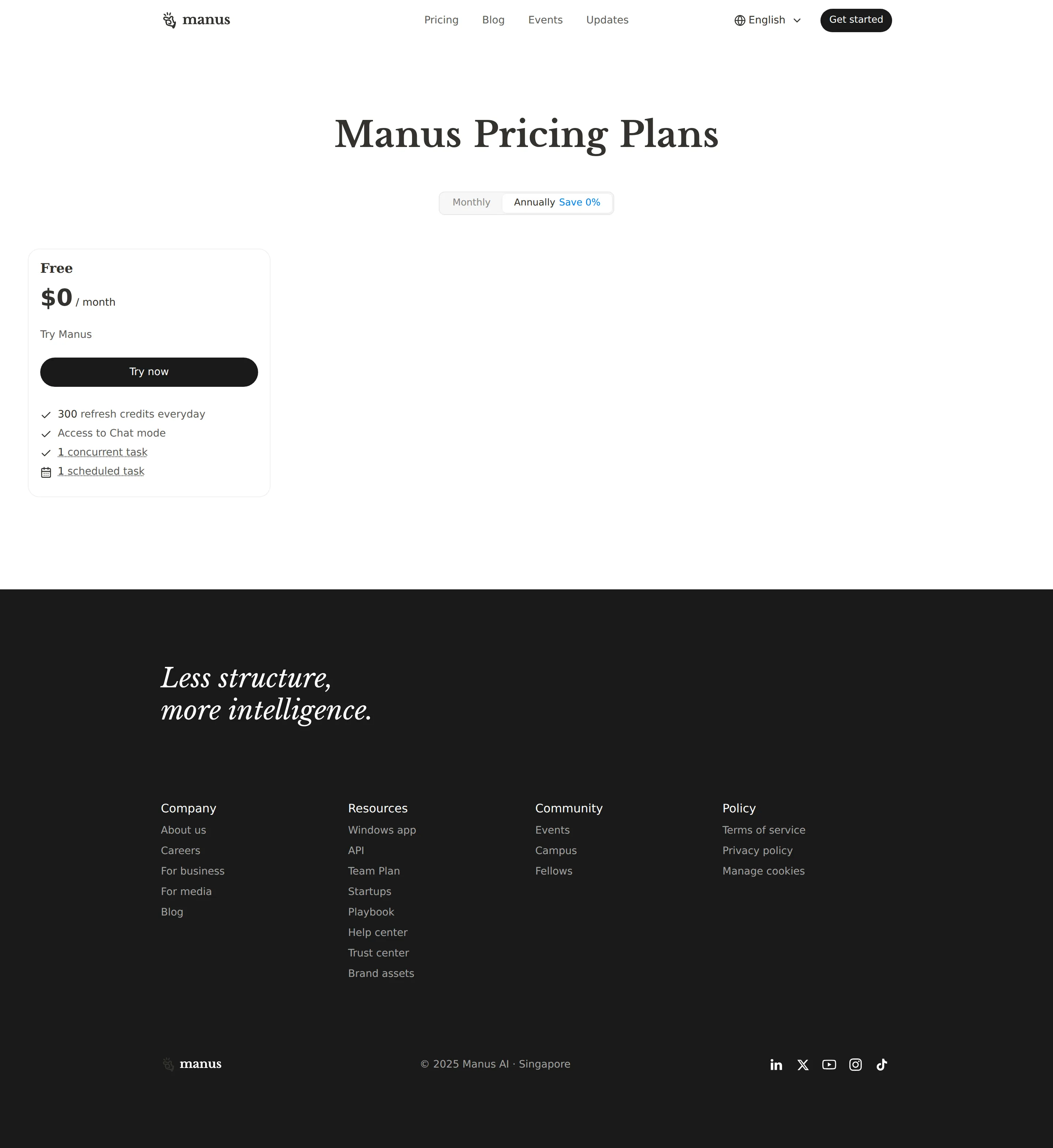
Re-cut credit ladder; Team plan in Beta; no annual discount yet
By October 2025 the dedicated /pricing page shows a $0 Free card (300 refresh credits/day, 1 concurrent + 1 scheduled task) and a 'Save 0%' annual toggle — annual billing exists but offers no discount yet. The Team Plan is labelled Beta. (Archived /pricing & /team pages, Oct 2025.)
Waitlist removed — opens to the public
Manus drops invite-only access, removes the waitlist, and offers 1,000 free credits plus 300 daily credits to all new users — moving from scarcity-gated beta to self-serve signup. (Manus announcement, May 2025.)
First paid plans: $39 Starter / $199 Pro (credit-metered)
Manus introduces paid subscriptions plus an iOS app: $39/mo for 3,900 credits and 2 concurrent tasks, $199/mo for 19,900 credits and 5 concurrent tasks. A typical task burns ~150+ credits, immediately triggering credit-burn complaints. (Bloomberg & TechCrunch, 2025-03-31.)
Invite-only launch (no public pricing)
Manus launches in invite-only beta on March 6, 2025; the demo video tops 1M views in 20 hours and invite codes resell for ¥50,000–¥100,000 on Chinese platforms. No public pricing yet — access is gated, with usage funded by trial credits. (Wikipedia; The Register, 2025-03-10.)
- · Manus launched invite-only on March 6, 2025; its demo video drew over a million views in 20 hours, and invite codes were resold on Chinese platforms for ¥50,000–¥100,000 (≈US$7,000–$13,800).
- · Manus prices everything in credits: a single typical agent task consumes roughly 150 credits, so the $20/mo plan's 4,000 monthly credits funds only ~26 typical tasks before add-on packs are needed.
- · At its March 2025 paid launch the entry plan was $39/mo for 3,900 credits and the top plan $199/mo for 19,900 credits; the current $20 / $40 / $200 ladder (4,000 / 8,000 / 40,000 credits) is a re-cut of that original scheme.
Questions & answers
- How much does Manus cost?
- Manus individual plans start at $20/mo for 4,000 credits, with a customizable $40/mo (8,000 credits) tier and a $200/mo tier for 40,000 credits plus a free Cloud Computer. Annual billing saves 17%.
- What is a Manus credit and how many does a task use?
- Credits are the single billing unit for Manus agent work. A typical task uses about 150 credits, so the $20 plan's 4,000 monthly credits funds roughly 26 typical tasks.
- Does Manus have a free tier?
- Yes. The free membership allows 1 concurrent task and limited scheduled tasks, with a daily refresh-credit allowance, but the pricing page leads with the $20 paid tier.
- How does Manus Team pricing work?
- Team starts at $20 per seat per month for 4,000 credits per seat, pooled across the whole team; the bill adjusts at the next cycle as you add or remove members. SSO and SCIM are optional $150/mo add-ons.
- What happened with Manus, Meta, and China?
- Manus (built by Butterfly Effect) launched in March 2025, raised a Benchmark-led round at a ~$500M valuation, relocated its HQ to Singapore during a US CFIUS review, and agreed to a Meta acquisition in December 2025 — but China's NDRC blocked the deal on April 27, 2026. In July 2026, Tencent was reported to be leading a deal to unwind Meta's acquisition and take over Manus, leaving the company's ownership unresolved. The pricing page still footers '© 2026 Meta.'
- What happens if I run out of credits?
- Team owners can buy add-on credit packs (from $20 for 2,000 credits up to $1,000 for 100,000 credits) in Billing settings, and can enable auto-purchase to avoid interruptions. Add-on credits stay valid while the subscription is active.