AI Summary
About
Relevance AI is a no-code platform for building AI agents and multi-agent “AI Workforces” that automate go-to-market and operations work across sales, marketing, customer success, and research functions. Founded in Australia (operated by OnSearch Pty Ltd) and best known for its packaged AI BDR agent and “Agents@Work” deployments, the company positions itself around decoupling business growth from headcount — letting domain experts, not engineers, deploy and govern fleets of agents that share context and hand off tasks to one another.
The company sells to a wide span of buyers, from solo GTM operators on the Pro plan to large enterprises like KPMG, Canva, Autodesk, Databricks, and Qualified running 35+ agents across an organization. It raised a $24M Series B led by Bessemer Venture Partners (6 May 2025) — with Insight Partners, King River Capital and Peak XV participating — bringing total funding to roughly $37M, and reported 40,000 AI agents registered on the platform in January 2025 alone. Relevance AI markets heavily on enterprise-grade governance: SOC 2 Type II, SSO/SCIM, RBAC, audit logs, approval gates for high-stakes actions, and automated agent evaluations.
Worth noting for context: the product began life as a “bring your data to life” analysis and visualization tool (vector search, AI clustering, Tableau-like charts) and pivoted to AI agents and the “AI Workforce” through 2024 — a repositioning that drove two full pricing rebuilds (see Pricing evolution).
Its competitive position sits between general agent-builder platforms and vertical GTM-automation tools. The pricing story is the differentiator: rather than a single opaque “credits” pool, Relevance AI separates the work its agents do (Actions) from the AI-model cost (Vendor Credits) and passes the latter through at wholesale with no markup — an explicit “we don’t tax intelligence” stance.
Pricing summary : how the Actions + Vendor Credits hybrid model works
Relevance AI runs a hybrid model: a seat-tiered subscription (Free, Pro from $19/mo, Team from $234/mo, Enterprise custom) layered on top of two independent usage meters. Each plan bundles a monthly allowance of both meters; you pay more by upgrading tiers or buying top-ups.
The two billing dimensions are:
- Actions — a flat charge each time a Tool runs. One tool execution = one Action, whether it sends a single email or runs a multi-step workflow, and failed runs still count. Plans bundle 200 (Free) to 7,000 (Team) Actions/month; top-ups cost $80 per 1,000 Actions.
- Vendor Credits — the raw cost of the underlying AI model and tool calls, passed through at wholesale with no markup. Plans bundle 1,000 (Free, one-time) to 35,000 (Team) Vendor Credits/month; top-ups cost $20 per 10,000 Vendor Credits. You can bring your own LLM keys on any paid plan to bypass this meter entirely.
- Seats and capacity — build users, end users, projects, concurrency, and history retention are gated by tier (1 build user on Free up to unlimited on Enterprise).
What makes this different: by splitting Actions from Vendor Credits and refusing to mark up model costs, Relevance AI turns the usually-hidden “AI passthrough” line into a transparent, indefinitely-rolling balance — a credit-based billing twist on the standard hybrid pricing model.
Pricing by product
The hero grid above is the canonical plan summary. The tables below give the full self-serve reference and the underlying credit mechanics.
AI Workforce platform (self-serve plans)
| Tier | Price | Included | Key mechanics |
|---|---|---|---|
| Free | $0 / mo | 200 Actions/mo; 1,000 Vendor Credits (one-time); 1 build user; 1 project; 1 workforce; 30-day history | Explore tier; no top-ups, no BYO LLM keys |
| Pro | From $19 /mo annual ($29 monthly) | 2,500 Actions/mo; 10,000 Vendor Credits/mo; 2 build users; 1 project; unlimited workforces; 90-day history | Solo GTM operators; BYO LLM keys, A/B testing, scheduling |
| Team | From $234 /mo annual ($349 monthly) | 7,000 Actions/mo; 35,000 Vendor Credits/mo; 5 build users; 45 end users; 5 projects | Most-featured self-serve tier; calling & meeting agents, analytics, priority support |
AI Workforce platform (Enterprise)
| Tier | Price | Included | Key mechanics |
|---|---|---|---|
| Enterprise | Custom | Custom Actions & Vendor Credits; unlimited users, projects & workforces; SSO (SAML), RBAC, audit logs; enterprise triggers (Salesforce, Snowflake, Zendesk); agent evaluations; dedicated account manager | Sales-led, quoted; “Talk to sales” |
Add-ons and top-ups (paid plans only)
| Item | Price | Mechanics |
|---|---|---|
| Extra Actions | $80 per 1,000 Actions | Bought in increments of 1,000; top-ups roll over to next billing cycle |
| Extra Vendor Credits | $20 per 10,000 Vendor Credits | Bought in increments of 10,000; roll over indefinitely while subscribed |
Sales motions across products: PLG / self-serve for Free, Pro, and Team (sign up and pay online); sales-led for Enterprise (custom Actions/Vendor-Credit quotes and security review).
Hidden costs : where Action top-ups quietly dominate the bill
A 5-seat Team plan looks like a flat $234/mo annual commitment, but an agent fleet that runs frequently will blow through both bundled meters. Consider a GTM team running outbound + enrichment agents at moderate volume:
| Line item | Monthly cost |
|---|---|
| Team plan (annual billing) | $234 |
| Extra Actions: 8,000 over the 7,000 bundle (8 × $80) | $640 |
| Extra Vendor Credits: 20,000 over the 35,000 bundle (2 × $20) | $40 |
| Total | $914 |
In this archetype the Action top-ups alone are nearly 3× the platform subscription — because Actions are charged per tool-run and a busy agent fleet executes many tools per task. By contrast, the Vendor Credit overage is small and predictable, and could be driven to $0 by bringing your own LLM keys.
A second archetype — a solo Pro operator ($19/mo annual) whose single research agent runs ~4,000 Actions/month — pays $19 + 2 × $80 (for 2,000 Actions over the 2,500 bundle) = $179/month, dominated almost entirely by Action top-ups rather than the base seat.
Want to estimate your own Relevance AI bill? Use the Relevance AI pricing calculator to model your monthly cost based on Actions, Vendor Credits, and seat tier.
Pricing evolution : from a data-analysis tool to a two-meter agent platform
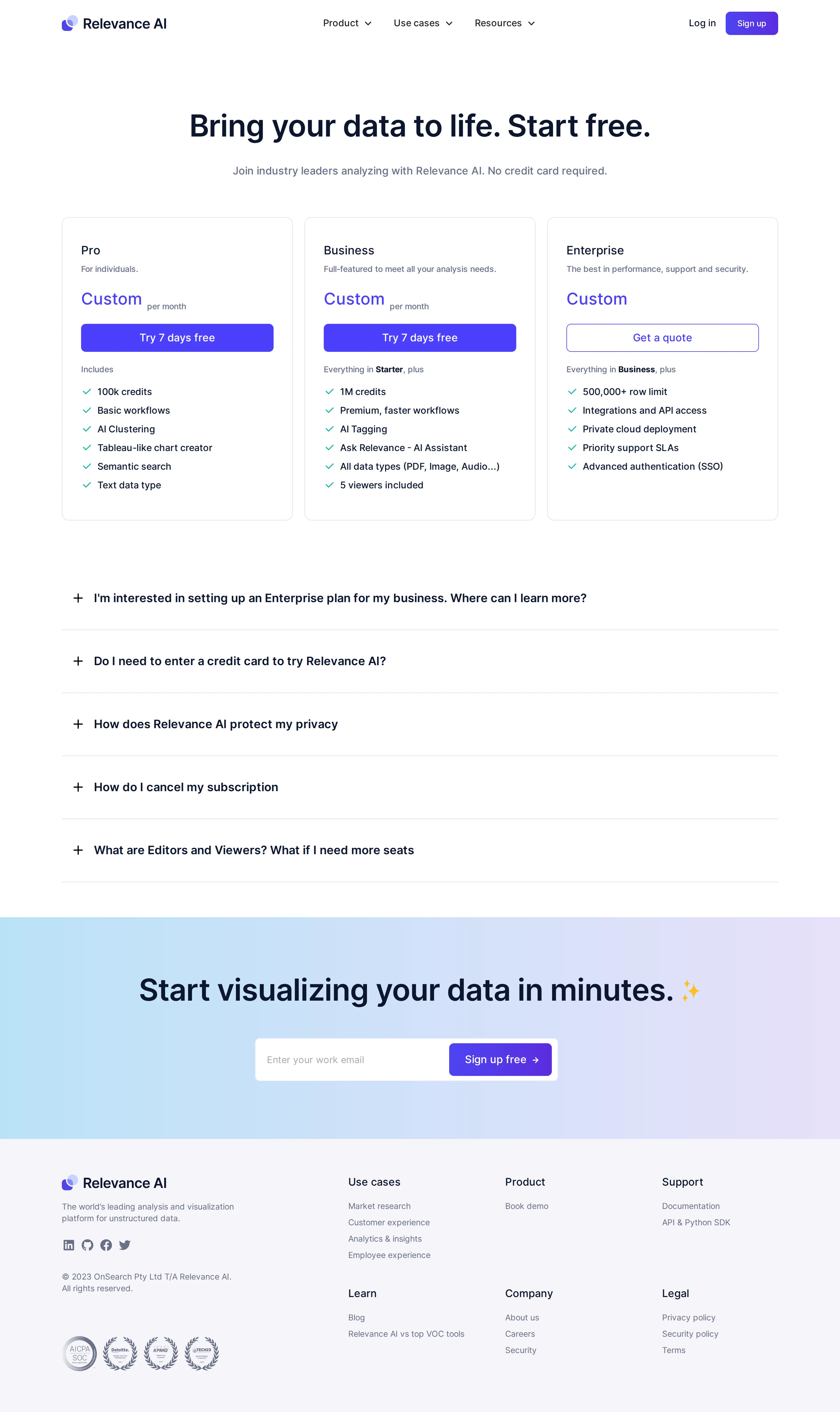
Relevance AI’s pricing has been rebuilt twice. It began (through 2023) as a “bring your data to life” analysis and visualization product — semantic search, AI clustering, Tableau-like charts — with all tiers priced “Custom.” In December 2023 it relaunched around AI agents with published prices and a single “credits” meter, then spent 2024 productizing agents (Multi-Agent System, the Bosh AI BDR) on a stable ladder. In September 2025 it rebuilt pricing again, splitting the credit pool into Actions and pass-through Vendor Credits and retiring the Business plan.
Cadence
| Quarter | Price changes | Product / SKU additions | Notes |
|---|---|---|---|
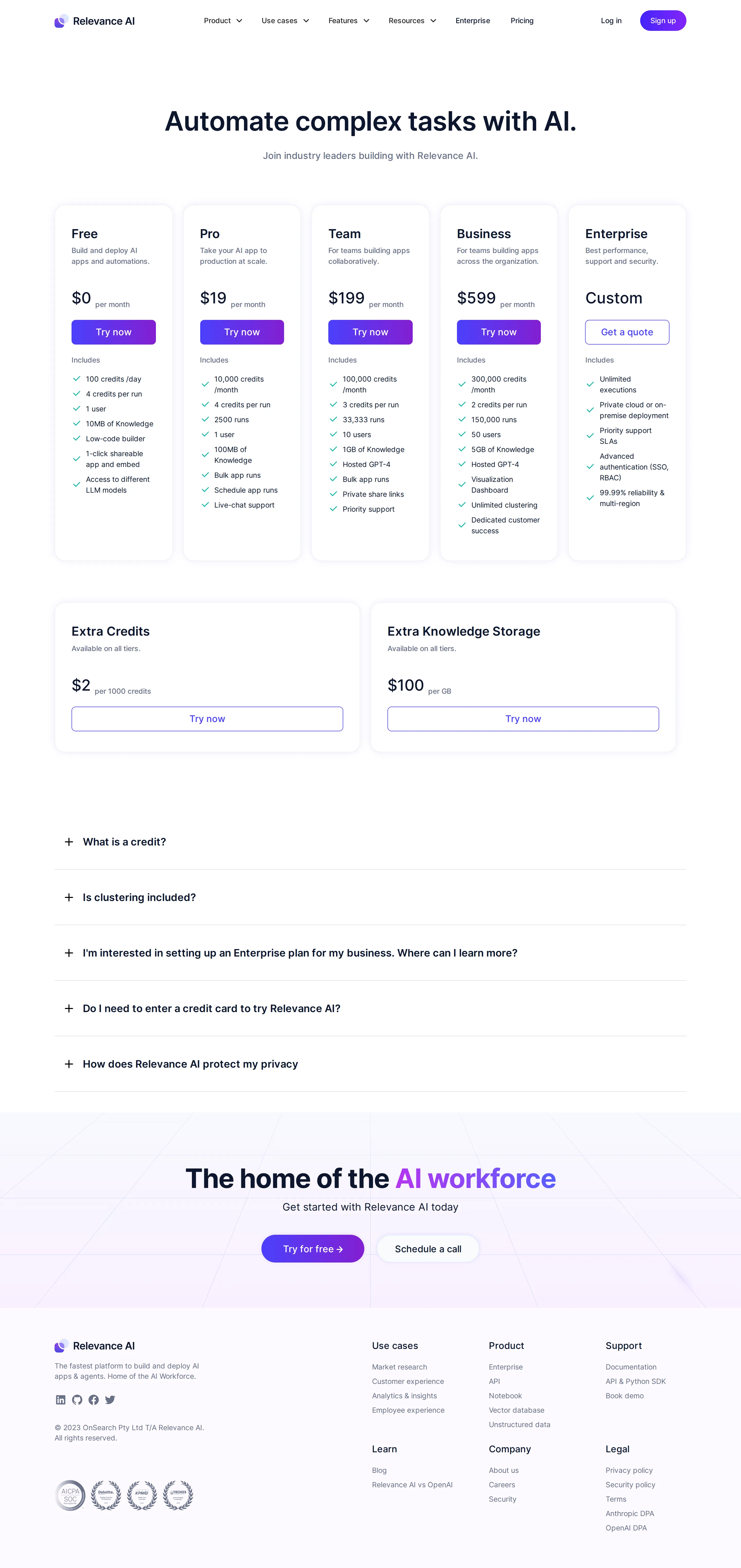
| 2023 Q4 | 5 | 1 | Agent-era relaunch: first published prices (Free / Pro $19 / Team $199 / Business $599 / Enterprise); single credit meter with +20% LLM markup |
| 2024 Q1 | 1 | 2 | $19 Pro tier dropped; Multi-Agent System + AI BDR/CSR templates introduced |
| 2024 Q2 | 0 | 1 | ”Bosh, the AI BDR” productized as a pricing card |
| 2024 Q4 | 0 | 1 | Extra-credit top-up repackaged $2/1,000 → $20/10,000 (rate flat); per-run credit lines removed from plan cards |
| 2025 Q3 | 1 | 2 | 8 September 2025 repackaging: single credit meter split into Actions + pass-through Vendor Credits; Business plan sunset; plan prices raised; indefinite Vendor Credit rollover |
| 2026 Q2 | 0 | 0 | Public pricing page restructured to lead with Enterprise; self-serve Free/Pro $19/Team $234 prices verified stable on docs |
Tracked range: 2023 Q1–2026 Q2 (archived /pricing snapshots 2023-03 → 2024-11 plus the live 2025 changelog and 2026 docs). Quarters not listed were verified stable (0 price changes, 0 SKU additions) within the captured evidence. The archived /pricing page for 2025 was not screenshot-able in this run; the September 2025 repackaging is sourced from Relevance AI’s own published change doc instead.
Notable changes
- 2023-12-06 — First transparent published pricing in the agent era: Free $0 / Pro $19 / Team $199 / Business $599 / Enterprise, on a single credits meter with a fixed per-run cost (4/3/2 credits by tier) and a +20% markup on LLM cost unless you brought your own API key; extra credits $2 per 1,000.
- 2024-03-13 — The $19 Pro tier was removed (ladder became Free / Team $199 / Business $599 / Enterprise); Multi-Agent System and premium agent templates (AI BDR, AI CSR) introduced.
- 2024-11-10 — Extra-credit top-up repackaged from $2 per 1,000 to $20 per 10,000 (effective rate unchanged at $0.002/credit) and per-run credit lines dropped from the cards — the packaging precursor to the later Vendor Credit top-up.
- 2025-09-08 — The single credits meter was split into Actions (flat per tool-run) and Vendor Credits (raw AI-model cost passed through at wholesale, no markup, rolling over indefinitely); the Business plan was sunset and customers grandfathered toward Team or Enterprise (downgrade window before 1 December 2025); Salesforce/Snowflake/Zendesk triggers became Enterprise-only; plan prices were raised.
- 2026-06-02 — Public
/pricingpage leads with an Enterprise “Talk to sales” card; self-serve Free / Pro $19 / Team $234 tiers and the Actions + Vendor Credits model live on the docs pricing surface; top-ups $80 per 1,000 Actions and $20 per 10,000 Vendor Credits.
The September 2025 repackaging in detail
The headline of the change was philosophical as much as mechanical: Relevance AI framed splitting Actions from Vendor Credits as a way to avoid “taxing intelligence.” Previously a single credits balance mixed the work agents performed with the AI-model cost of performing it — and the company explicitly charged a 20% markup on that model cost unless you supplied your own API key. By separating them, the company could pass model costs through at wholesale (Vendor Credits, now zero-markup) while charging a clear, trackable unit for agent work (Actions). It paired this with two pro-customer guarantees — Vendor Credits that roll over indefinitely while subscribed, and the option to bring your own LLM keys to skip Vendor Credits entirely — while raising headline plan prices, retiring the Business tier, and moving the heaviest enterprise integrations (Salesforce, Snowflake, Zendesk triggers) behind the Enterprise plan. The change landed roughly four months after the company’s $24M Series B (Bessemer-led, 6 May 2025), as it scaled from a data-analysis tool into an enterprise “AI Workforce” platform.
What’s unique : pass-through model costs and a two-meter credit split
No-markup pass-through on Vendor Credits. Where most AI platforms bury a margin in their “credits,” Relevance AI explicitly passes the underlying model cost through at wholesale. This makes the metered AI cost auditable and removes the usual incentive distrust around opaque token markups.
Two distinct usage meters, not one. Splitting Actions (agent work) from Vendor Credits (model cost) lets buyers reason about volume and intelligence separately. A workflow-heavy team can predict Action spend independent of which LLM their agents call.
Indefinite Vendor Credit rollover. Both bundled and purchased Vendor Credits roll over forever while subscribed — a sharp contrast to the use-it-or-lose-it monthly resets common in credit-based billing. Only base plan Actions reset.
Bring-your-own-LLM opt-out. On any paid plan, customers can supply their own API keys and bypass Vendor Credits entirely — effectively letting them remove one of the two metered dimensions from their bill.
Governance as the upsell to Enterprise. The self-serve ladder tops out at Team; SSO, RBAC, audit logs, agent evaluations, and enterprise triggers (Salesforce, Snowflake, Zendesk) are reserved for Enterprise, making security and control — not raw capacity — the primary reason to talk to sales.
Strengths & weaknesses
| Strengths | Weaknesses |
|---|---|
| Transparent, no-markup pass-through on AI-model costs builds trust | Two-meter model (Actions + Vendor Credits) is more cognitively complex than a single credit pool |
| Vendor Credits roll over indefinitely — generous and predictable | Public pricing page hides the self-serve tiers behind Enterprise; prices live only in the docs |
| Clear self-serve ladder (Free → Pro → Team) with online sign-up | Action top-ups at $80/1,000 can dominate the bill for busy agent fleets |
| BYO-LLM-keys option lets customers opt out of one metered dimension | Big jump from Team ($234) to Enterprise (custom) with no mid-market self-serve step |
| Strong enterprise governance story (SOC 2 Type II, SSO, RBAC, audit logs, agent evals) | Recent (Sept 2025) repackaging means grandfathered legacy plans still coexist, adding confusion |
| Dropped a 20% LLM markup (pre-2025) for a zero-margin pass-through — pricing moved toward the buyer | Two full pricing rebuilds (data-tool → agents in 2023, single-credit → two-meter in 2025) create a thin, churny price history for buyers to reason about |
Billing UX : in-platform credit counters, spend controls, and usage alerts
- Credit & Action Counter — a live counter in the bottom-left of the home screen showing remaining Actions and Vendor Credits over the plan allowance, color-coded green/red by headroom.
- Buy credits modal — admins click “Buy credits” to purchase Actions (increments of 1,000) and Vendor Credits (increments of 10,000) before renewal.
- Plan & Billing page — org-level usage breakdown by Agent, with a detailed view of credit expenses.
- Per-agent / per-run cost breakdown — clicking “Credits used” on an Agent run shows cost per Tool plus the Agent’s LLM cost and base run cost.
- Concurrency usage chart — a time-series area chart on the Plan & Billing page tracking simultaneous task load against the tier’s concurrent-task limit.
- Usage alerts and usage limits — email notifications at configurable thresholds, plus hard usage limits to cap spend.
- Spend controls — configurable automatic top-up limits so an account never runs out unexpectedly.
- Invoice management — in-platform download of invoices and receipts; organization name and details editable.
Strategic wins : pricing decisions that earned trust and clarity
1. Refusing to mark up model costs turns a liability into a trust signal
By passing Vendor Credits through at wholesale, Relevance AI removes the single biggest source of suspicion in AI pricing — the hidden token markup. This is a powerful differentiator in a market where buyers increasingly audit their AI cost passthrough, and it reframes the company as an ally against model-cost inflation rather than a reseller skimming margin. It is the kind of usage-based pricing packaging decision that signals confidence in the underlying value metric.
2. Splitting work from intelligence makes usage legible
Separating Actions (agent work) from Vendor Credits (model cost) lets customers forecast each independently — a clarity win that most single-pool credit-based billing systems lack, and a textbook example of picking a value metric the buyer actually understands. A clean unit also makes usage forecasting tractable for the customer. It also future-proofs pricing: model costs can fall without forcing a plan repricing, since they flow through the Vendor Credit meter.
3. Indefinite rollover lowers the risk of committing
Vendor Credits that never expire while subscribed remove the “use it or lose it” anxiety that pushes customers toward under-buying. This is a subtle pricing-psychology win that makes annual commitment feel safer.
4. Governance-gated Enterprise creates a clean sales-led upsell
Reserving SSO, RBAC, audit logs, and enterprise triggers for Enterprise gives the sales team a concrete, security-driven reason to engage — rather than relying on raw usage overage to force the conversation. It aligns the sales-led motion with the genuine enterprise buying trigger (the security review).
Areas to improve : visibility, the Team-to-Enterprise gap, and meter complexity
1. Surface the self-serve prices on the public pricing page
Today /pricing leads only with an Enterprise “Talk to sales” card; the Free/Pro/Team prices live in the documentation. Fix: restore a plan grid on the marketing pricing page so prospects don’t have to dig through docs — hiding prices erodes the very transparency the no-markup model is built to project.
2. Add a mid-market self-serve step between Team and Enterprise
The jump from Team ($234/mo) to custom Enterprise is steep, with no self-serve option for a 10–30 seat team that needs more capacity but not a sales process. Fix: introduce a higher self-serve “Scale” tier or published seat-based add-on so growing teams can expand without a quote.
3. Simplify the two-meter mental model at the point of purchase
Actions vs Vendor Credits is conceptually clean but adds cognitive load, especially for new users estimating cost. Fix: ship an in-product cost estimator that translates “how many agents running how often” into projected Actions and Vendor Credits, lowering the barrier to confident upgrades.
Monetization stack & signals : how Relevance AI builds & buys its revenue engine
Buys 2 Builds 1 2 open roles
Relevance AI is building its credit metering in-house rather than buying it whole. An open Sydney "Senior Software Engineer (Payments & Billing)" req frames the work as a greenfield "ownership of our core billing and payments system" tackling "high-volume event metering, token-based usage tracking, distributed workflows, multi-dimensional pricing" — the engine behind its Actions + pass-through Vendor Credits model — while integrating bought components for the edges, naming its "Billing Systems: Stripe (payments), Orb (usage-based billing)". The revenue org's other open investment is post-sale: a Customer Success Manager role in Barcelona.
-
“step up to the challenge of taking ownership of our core billing and payments system”
-
“Design and maintain reliable billing infrastructure integrating with Stripe and Orb. ... Billing Systems: Stripe (payments), Orb (usage-based billing)”
-
“Design and maintain reliable billing infrastructure integrating with Stripe and Orb. ... Billing Systems: Stripe (payments), Orb (usage-based billing)”
- Senior Software Engineer (Payments & Billing) Billing engineeringData platform Jun 17, 2026
- Customer Success Manager Customer success seen Jun 9, 2026
Signals reviewed · derived from public job posts
Job postings fill and close over time — once a posting is filled we keep it as a dated citation (the quoted evidence remains); use View open roles for current listings.
Key takeaways
- Passing model costs through at wholesale is a credible trust play. Relevance AI shows that refusing to mark up AI-model costs can be a marketing asset, not just a margin sacrifice — useful for any platform whose buyers fear opaque token markups.
- Separate the work from the intelligence. Splitting a single credit pool into Actions (work) and Vendor Credits (model cost) gives customers independent forecastability and insulates plan prices from model-cost swings.
- Rollover generosity de-risks commitment. Indefinite Vendor Credit rollover removes under-buying anxiety and makes annual plans easier to sell.
- Gate Enterprise on governance, not just capacity. Reserving SSO/RBAC/audit logs for the top tier ties the sales-led motion to the real enterprise trigger — the security review.
- Don’t hide your prices to look enterprise. Leading the public pricing page with “Talk to sales” while burying self-serve tiers in docs undercuts the transparency the rest of the model works to establish.
UBP implications
- Pass-through metering is emerging as an AI-pricing pattern. Relevance AI’s no-markup Vendor Credits show how platforms can isolate volatile model costs into a transparent, auditable passthrough line while keeping margin on the value-add (Actions) — a template other agent platforms are likely to copy.
- Per-outcome-ish units beat raw tokens for agent products. Charging per Action (a tool-run) rather than per token aligns the bill with work the buyer understands, a more durable value metric for agentic software than token consumption.
- Rollover policy is a strategic lever, not an afterthought. Indefinite rollover on the passthrough meter materially changes commitment behavior; UBP teams should treat expiry rules as a first-class pricing decision rather than a billing-system default.
Sources
- Relevance AI pricing page (accessed 2026-06-02)
- Relevance AI docs — Pricing (plan tiers & feature comparison) (accessed 2026-06-02)
- Relevance AI docs — Plans and credits (accessed 2026-06-02)
- Relevance AI docs — Pricing and packaging changes (new pricing) (accessed 2026-06-02)
- Relevance AI Enterprise (accessed 2026-06-02)
- UsagePricing Blueprint corpus (accessed 2026-06-02)
Bottom line
Relevance AI’s pricing is a study in turning AI’s most distrusted line item — the model-cost markup — into a trust signal: it splits agent work (Actions) from intelligence (no-markup Vendor Credits), rolls the latter over forever, and lets you bring your own keys to opt out entirely. The open questions are visibility (the self-serve prices hide in the docs) and the steep Team-to-Enterprise gap. Compare its approach with the rest of the UsagePricing Blueprint corpus.
Pricing timeline : Major events on a vertical axis
Each milestone below corresponds to a public pricing change, product launch, or material adjustment. Major events use a filled marker; minor adjustments use a faded one.
Current state verified: Free / Pro $19 / Team $234 + Enterprise; $80 per 1,000 Actions, $20 per 10,000 Vendor Credits
Public /pricing page now leads with an Enterprise 'Talk to sales' card; the self-serve Free, Pro (from $19/mo annual, $29 monthly) and Team (from $234/mo annual, $349 monthly) tiers plus the Actions + Vendor Credits mechanics live on the docs pricing page. Top-ups: Actions $80 per 1,000, Vendor Credits $20 per 10,000. Verified from relevanceai.com/docs/get-started/pricing.
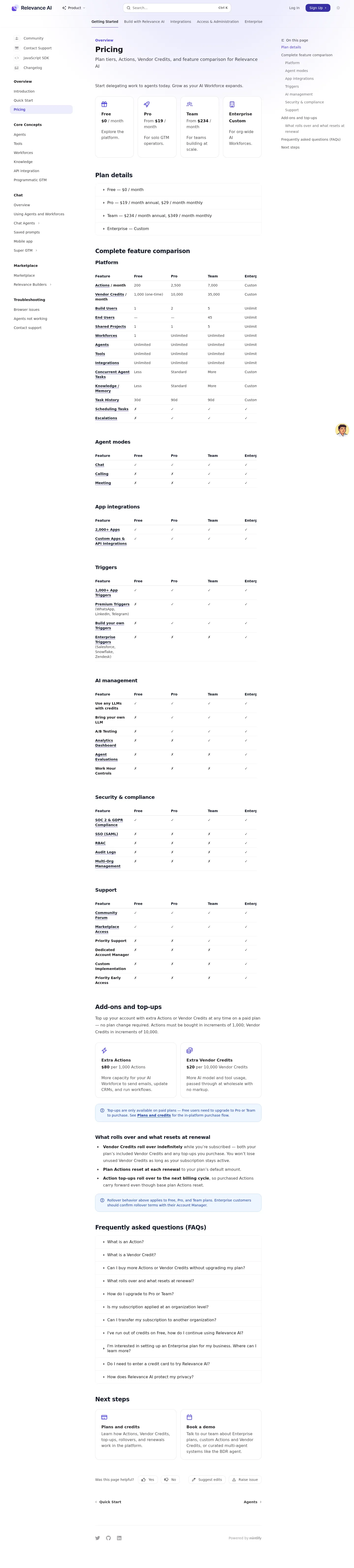
Credits split into Actions + pass-through Vendor Credits; Business plan sunset; prices raised
The single 'credits' meter was split into two: Actions (a flat charge per tool-run) and Vendor Credits (raw AI-model cost passed through at wholesale, zero markup — explicitly framed as not 'taxing intelligence'). Vendor Credits now roll over indefinitely while subscribed; BYO API keys bypass them entirely. The Business plan was sunset, with existing Business customers grandfathered toward Team or Enterprise (downgrade window referenced before 1 December 2025) and Salesforce/Snowflake/Zendesk triggers moved to Enterprise-only. Plan prices were raised. Documented in Relevance AI's 'Pricing and packaging changes' changelog (relevanceai.com/docs/admin/subscriptions/new-pricing).
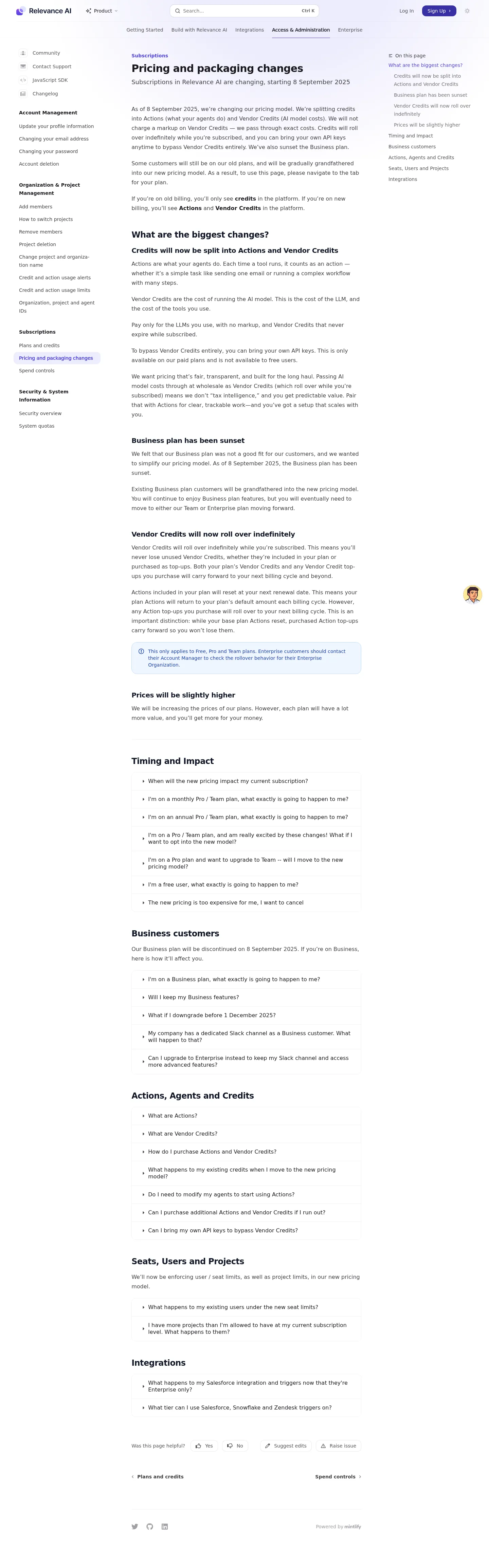
Extra credits repackaged from $2 / 1,000 to $20 / 10,000; per-run credit lines dropped
Effective per-credit price held flat ($0.002) but the top-up SKU was repackaged into 10,000-credit increments ($20 per 10,000), and the per-tier fixed-credits-per-run lines were removed from the plan cards — the packaging precursor to the 2025 Vendor Credit top-up. Tiers (Free / Team $199 / Business $599 / Bosh) otherwise stable across 2024-03 → 2024-11. Compare web.archive.org/web/20241005062144 ($2/1,000) vs web.archive.org/web/20241110021607 ($20/10,000).
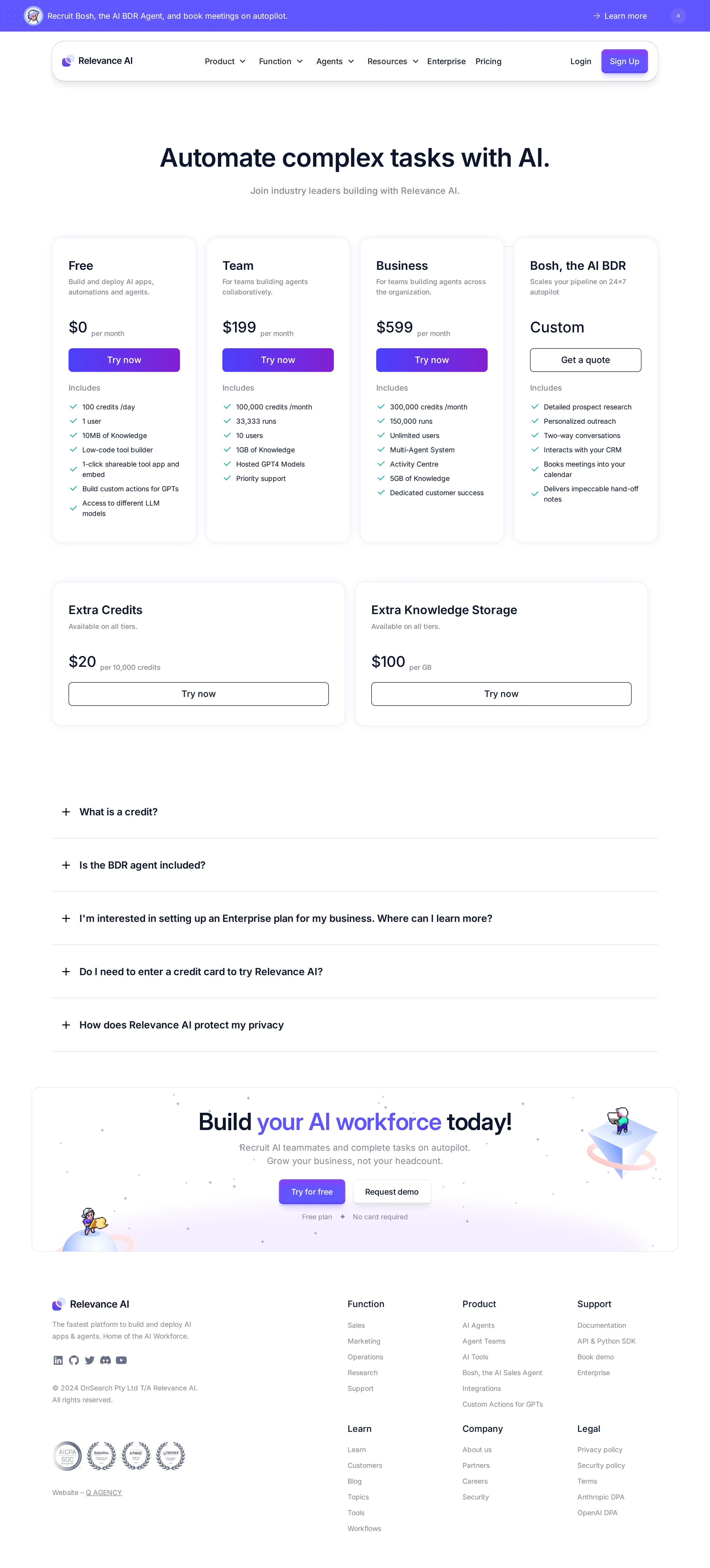
'Bosh, the AI BDR' becomes the fourth pricing card
The pricing grid replaced the Enterprise card slot with 'Bosh, the AI BDR' (custom, get-a-quote) — productizing the sales agent. Self-serve tiers Free / Team $199 / Business $599 and the single credit meter remained. Archived at web.archive.org/web/20240614022521.
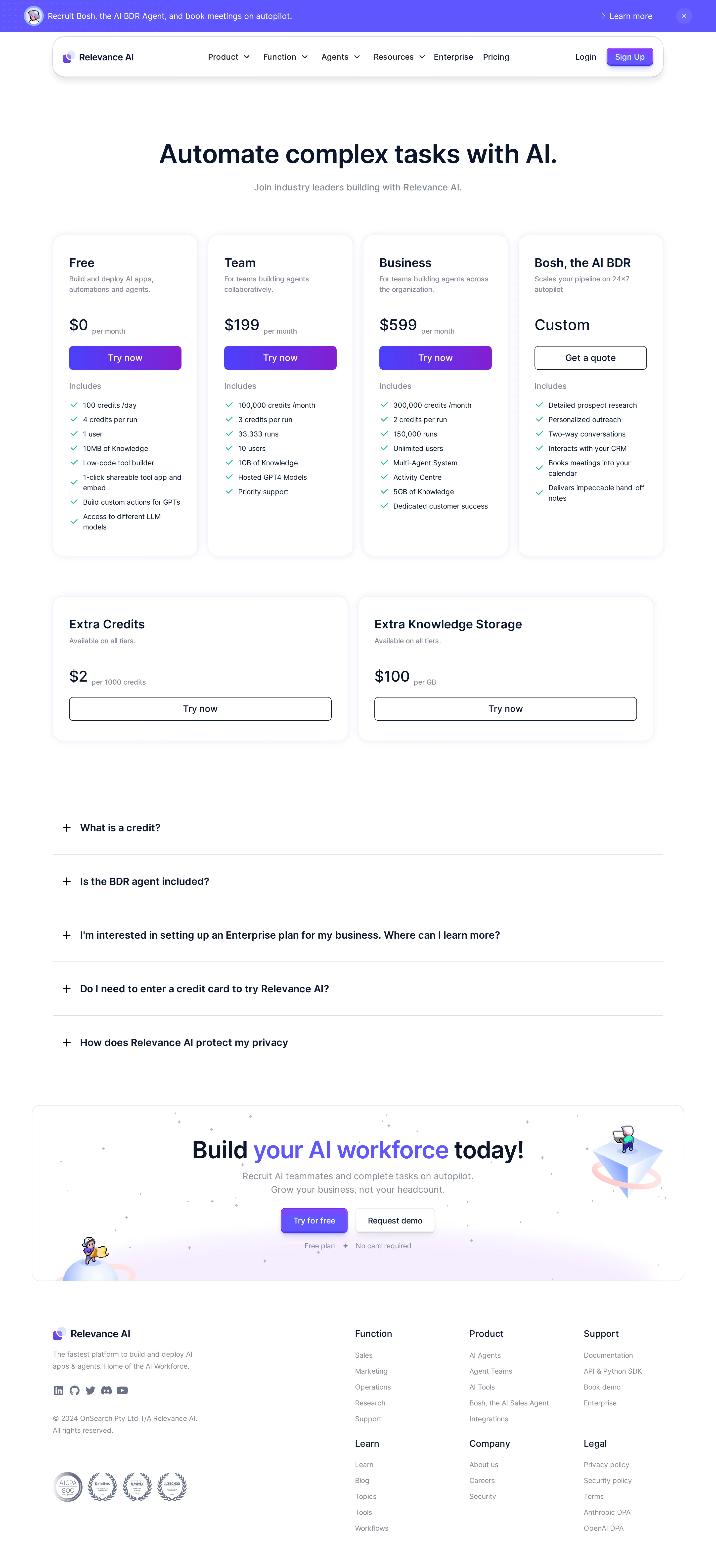
Pro tier dropped; Multi-Agent System and AI BDR introduced
The published ladder narrowed to Free / Team $199 / Business $599 / Enterprise (the $19 Pro tier was removed). Business gained 'Multi-Agent System' and 'Activity Centre'; Enterprise listed premium multi-agent templates (AI BDR, AI CSR). Credit model and $2/1,000 extra-credit price unchanged. Archived at web.archive.org/web/20240313142530.
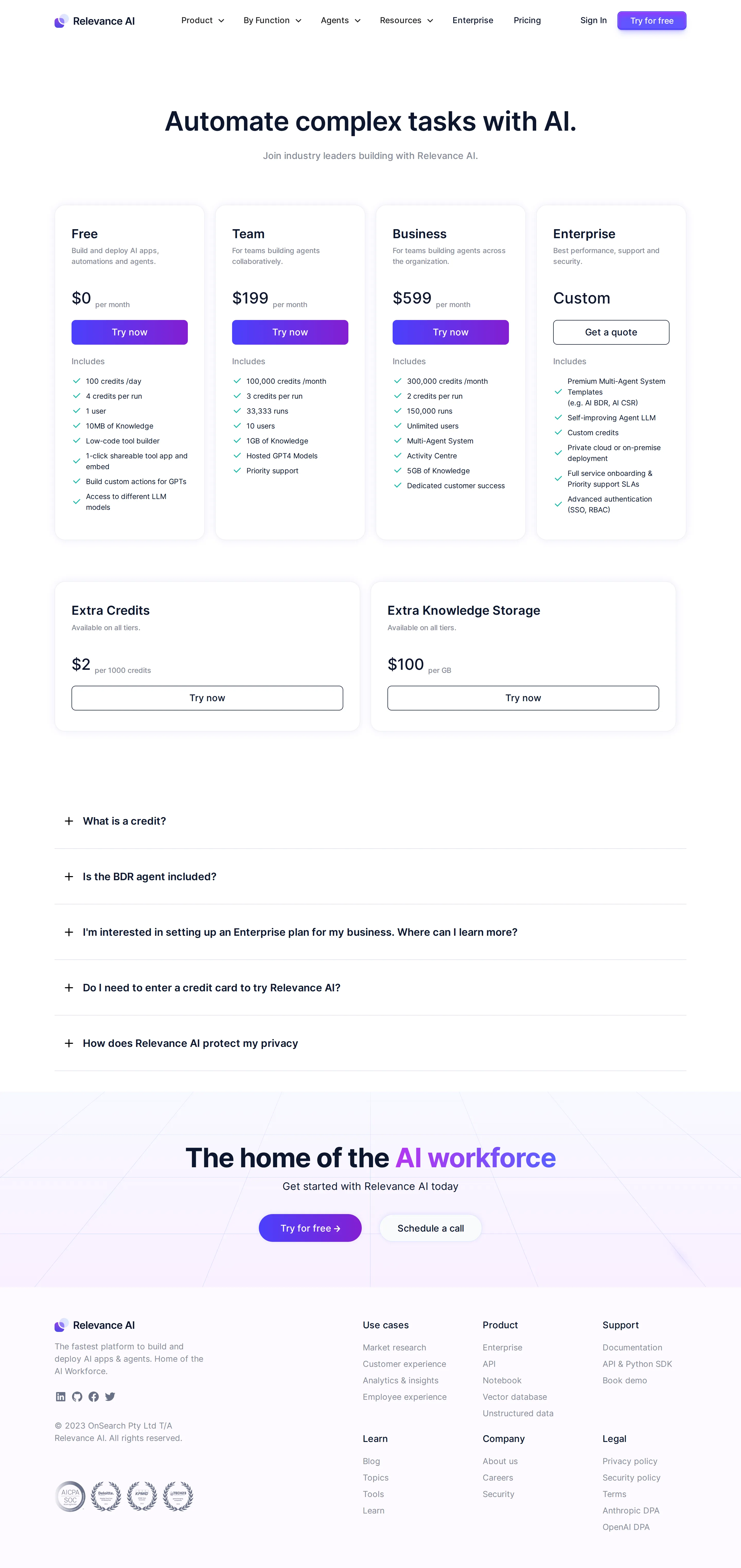
Agent-era relaunch: 5 published tiers (Free / Pro $19 / Team $199 / Business $599 / Enterprise)
Relevance AI repositioned to 'Automate complex tasks with AI' and published transparent prices for the first time: Free $0, Pro $19, Team $199, Business $599, Enterprise custom. A single 'credits' meter (e.g. 100k/mo on Pro) with a fixed-per-run cost (4/3/2 credits by tier) plus a +20% markup on LLM cost when not using your own API key; extra credits $2 per 1,000, knowledge $100/GB. Archived at web.archive.org/web/20231206070152.
Data-analysis era: Pro / Business / Enterprise, all 'Custom' priced
Pre-agent Relevance AI was a 'bring your data to life' analysis and visualization platform (semantic search, AI clustering, Tableau-like charts). Pricing page showed three tiers — Pro, Business, Enterprise — all priced 'Custom', with allowances framed as '100k / 1M credits'. Archived at web.archive.org/web/20230331085347.
- · Relevance AI splits its credit model in two: 'Actions' (a flat charge each time a tool runs) and 'Vendor Credits' (the raw AI-model cost), and it passes Vendor Credits through at wholesale with zero markup.
- · Vendor Credits roll over indefinitely while you stay subscribed — both the bundled allowance and any top-ups — a rare 'use-it-whenever' stance in usage-based pricing.
- · You can bring your own LLM API keys on any paid plan to bypass Vendor Credits entirely, so the platform effectively lets you opt out of one of its two metered dimensions.
Questions & answers
- How much does Relevance AI cost?
- Relevance AI has four tiers: Free ($0/mo, 200 Actions/mo), Pro (from $19/mo annual, or $29/mo monthly; 2,500 Actions/mo), Team (from $234/mo annual, or $349/mo monthly; 7,000 Actions/mo), and Enterprise (custom). Paid plans also include monthly Vendor Credits for AI-model costs.
- What is the difference between Actions and Vendor Credits?
- An Action is a single run of a Tool — each tool execution counts as one Action, even if it fails. Vendor Credits are the underlying cost of the AI model and tools, passed through at wholesale with no markup. The two are metered separately.
- Do Relevance AI credits roll over?
- Vendor Credits roll over indefinitely while you stay subscribed, including both bundled and purchased credits. Base plan Actions reset to the plan default each renewal, but purchased Action top-ups roll over to the next cycle.
- Can I use my own LLM API keys with Relevance AI?
- Yes. On any paid plan you can bring your own API keys to bypass Vendor Credits entirely and pay your model provider directly. This is not available to Free users.
- What does it cost to buy extra Actions or Vendor Credits?
- Extra Actions cost $80 per 1,000 Actions (bought in increments of 1,000). Extra Vendor Credits cost $20 per 10,000 Vendor Credits (bought in increments of 10,000). Top-ups are only available on paid plans.
- Is there a free version of Relevance AI?
- Yes. The Free plan is $0/month and includes 200 Actions per month, a one-time grant of 1,000 Vendor Credits, 1 build user, and 1 project. Free users cannot purchase top-ups or bring their own LLM keys.