AI Summary
About
Murf AI is an AI voice and text-to-speech (TTS) platform built around two surfaces: Murf Studio, a browser-based voiceover editor that turns scripts into studio-quality speech across 200+ voices and 30+ languages, and the Murf API, a developer endpoint for embedding the same speech synthesis, translation, dubbing, and voice-changer models into other applications and voice agents. The company also packages standalone products — AI Translation, AI Dubbing (Murf Dub), Transcription, Voice Cloning, and a Canva add-on — that share the underlying voice models.
Founded in October 2020 (Salt Lake City, Utah) by Sneha Roy, Ankur Edkie, and Divyanshu Pandey, Murf raised a $10M Series A led by Matrix Partners India in September 2022 — citing 22× ARR growth and 1M+ voiceover projects at the time — for around $11.5M total funding across its rounds. It serves a broad base from individual creators and freelancers producing e-learning, podcasts, and YouTube narration, through SMB marketing and training teams, up to enterprises that need security controls (HIPAA, GDPR, ISO 27001, SOC 2 Type II), SSO, and a master service agreement. The pricing page advertises being “trusted by over 300+ of the Fortune 2000,” positioning Murf against TTS peers like ElevenLabs, PlayHT, and WellSaid Labs while undercutting on its headline API rate of one cent per 1000 characters for the conversational Falcon model (launched November 2025).
The split between a flat-rate creator subscription and a pure pay-as-you-go API is the defining structural choice: Murf monetizes prosumers and content teams through Studio seats metered by annual voice-generation hours, and monetizes developers and voice-agent builders through metered per-character API usage with a recurring free-credit allowance.
Pricing summary : How Murf AI splits flat Studio plans from pay-as-you-go API usage
Murf AI uses a hybrid two-surface model with three pricing dimensions:
- Murf Studio subscriptions (flat, metered by hours/year): Free ($0), Creator at $19/mo ($228 billed annually), Business at $66/mo ($792 billed annually), and custom-quoted Enterprise. Each tier bundles a project cap, a voice-generation-hours-per-year allowance, and a single editor seat (Enterprise adds custom 5+ seats). Annual billing saves 33%.
- Murf API usage (pure pay-as-you-go, per 1000 characters): $0.01/1000 characters for the Falcon TTS model, $0.03/1000 characters for the Gen2 TTS model, $0.02/1000 characters for translation, and $0.10/minute for voice changer. Every account gets $10 free credit each month; purchased credit never expires.
- Murf Dub credits (pure pay-as-you-go, per credit): $0.25/credit, consuming 2 credits per minute per dubbed language, with a 100-credit free trial and an Enterprise tier for QA-assured dubbing and volume discounts.
What makes this different: Murf meters its creator subscriptions by voice-generation hours per year rather than per month, while running an entirely separate per-character pure-usage API alongside the seat-based subscription product.
Pricing by product
Murf Studio (subscription plans)
| Tier | Price | Included | Key mechanics |
|---|---|---|---|
| Free | $0 / mo | 10 projects, 10 min voice generation, 1 editor; no downloads, no commercial rights | ”Get started, no credit card required” |
| Creator | $19 / mo ($228 / yr) | 100 projects, 24 hrs/year voice generation, 1 editor, 200+ voices, unlimited downloads, commercial rights | Starter plan for individuals & freelancers |
| Business | $66 / mo ($792 / yr) | 500 projects, 96 hrs/year voice generation, 1 editor, business license, audio-to-text, 48 hrs transcription | ”Best Value” — high-usage business needs |
| Enterprise | Custom | Unlimited voice generation, custom editors (5+ seats), unlimited viewer seats, AI translation, SSO, MSA | Sales-led, quoted; HIPAA / SOC 2 / SSO |
Murf API (pay-as-you-go)
| Tier | Price | Included | Key mechanics |
|---|---|---|---|
| Free Trial | $0 ($10 free credit / month) | All API endpoints, 150+ voices in 35+ languages, 5 concurrent requests | ”No credit card required” |
| Pay as you go | From $0.01 / 1000 characters | Buy what you need; purchased credit never expires; up to 15 concurrent requests | Per-endpoint metering, priority support |
| Enterprise | Custom | Data residency, on-premise deployment, enterprise concurrency, SLA, MSA | Sales-led; volume discounts |
Murf API — per-endpoint rates
| Endpoint | Rate | Use case |
|---|---|---|
| Text to Speech (Falcon) | $0.01 / 1000 characters | Conversational AI, real-time voice agents (<130ms TTFA) |
| Text to Speech (Gen2) | $0.03 / 1000 characters | Studio-quality, expressive multimedia voiceovers |
| Translation | $0.02 / 1000 characters | Localize content across major global languages |
| Voice Changer | $0.10 / minute | Transform recordings into lifelike AI voices |
Murf Dub (pay-as-you-go credits)
| Tier | Price | Included | Key mechanics |
|---|---|---|---|
| Free | $0 (100 credits) | Automated dubbing, 2 projects at a time, standard support | 2 credits per minute per dub |
| Pay as you go | $0.25 / credit | No watermarks, 5 projects at a time; 2 credits per minute per language | Buy credits as needed |
| Enterprise | Custom | QA-assured dubbing, unlimited projects, SSO, MSA, volume discounts | Sales-led, quoted |
Sales motions across products: PLG / self-serve for Murf Studio Free/Creator/Business and the Murf API/Dub pay-as-you-go tiers; sales-led for all Enterprise tiers.
Hidden costs : Where the annual-hours cap and API per-character meter add up
The headline Studio prices understate cost in two ways: the voice-generation allowance is an annual hours bucket (so a heavy month can exhaust the year early), and the Murf API meters every 1000 characters separately from any Studio subscription.
A solo creator on Murf Studio Creator
| Line item | Monthly cost |
|---|---|
| Creator plan (billed annually, $228/yr) | $19 |
| Additional editor seat (Creator caps at 1) | not available — upgrade required |
| Effective monthly total | $19 |
Creator caps at a single editor seat and 24 hrs/year of voice generation; a creator who needs a second collaborator or more than ~2 hrs/month of audio must jump to Business at $66/mo, so the real cost step is the plan ceiling, not an overage line.
A voice-agent developer on the Murf API (Falcon)
| Line item | Monthly cost |
|---|---|
| 5,000,000 characters of Falcon TTS @ $0.01 / 1000 chars | $50 |
| Less $10 monthly free credit | −$10 |
| Effective monthly total | $40 |
At 5M characters/month, Falcon TTS runs $50 before the recurring $10 free credit nets it to $40 — but switching to the higher-fidelity Gen2 model triples the rate to $0.03/1000 characters ($150/month at the same volume), so model selection drives the bill more than volume tiers do.
Want to estimate your own Murf AI bill? Use the Murf AI pricing calculator to model your monthly cost based on Studio plan, voice-generation hours, and API characters per month.
Pricing evolution : From a four-tier Studio subscription to a metered API
Murf’s Studio pricing ran a stable Free / Basic / Pro / Enterprise structure for years, with the headline Basic ($13) and Pro ($26) rates holding remarkably flat while the Enterprise tier did all the moving — doubling, flipping to per-seat, then climbing and easing. The 2024–2025 shift to today’s Creator/Business names plus the standalone Murf API and Murf Dub is the structural break, but it lands in a Wayback blind spot: Murf’s pricing page is a JavaScript single-page app, and every archived snapshot from 2024-09 onward rendered as a blank skeleton or a spinner.
Cadence
| Quarter | Price changes | Product / SKU additions | Notes |
|---|---|---|---|
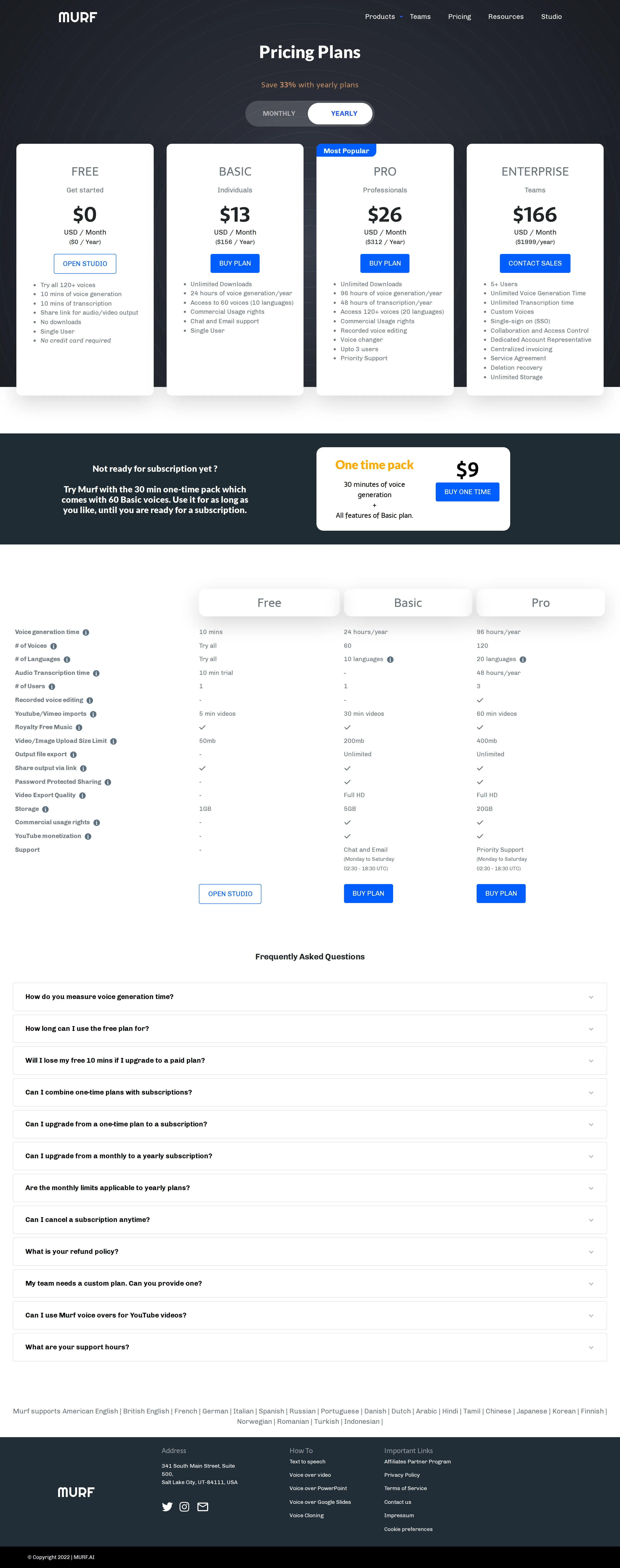
| 2022 Q2 | 1 | 0 | Enterprise roughly doubled from $83/mo ($996/yr) to $166/mo ($1999/yr) between the March and May archives; Basic $13 / Pro $26 flat. |
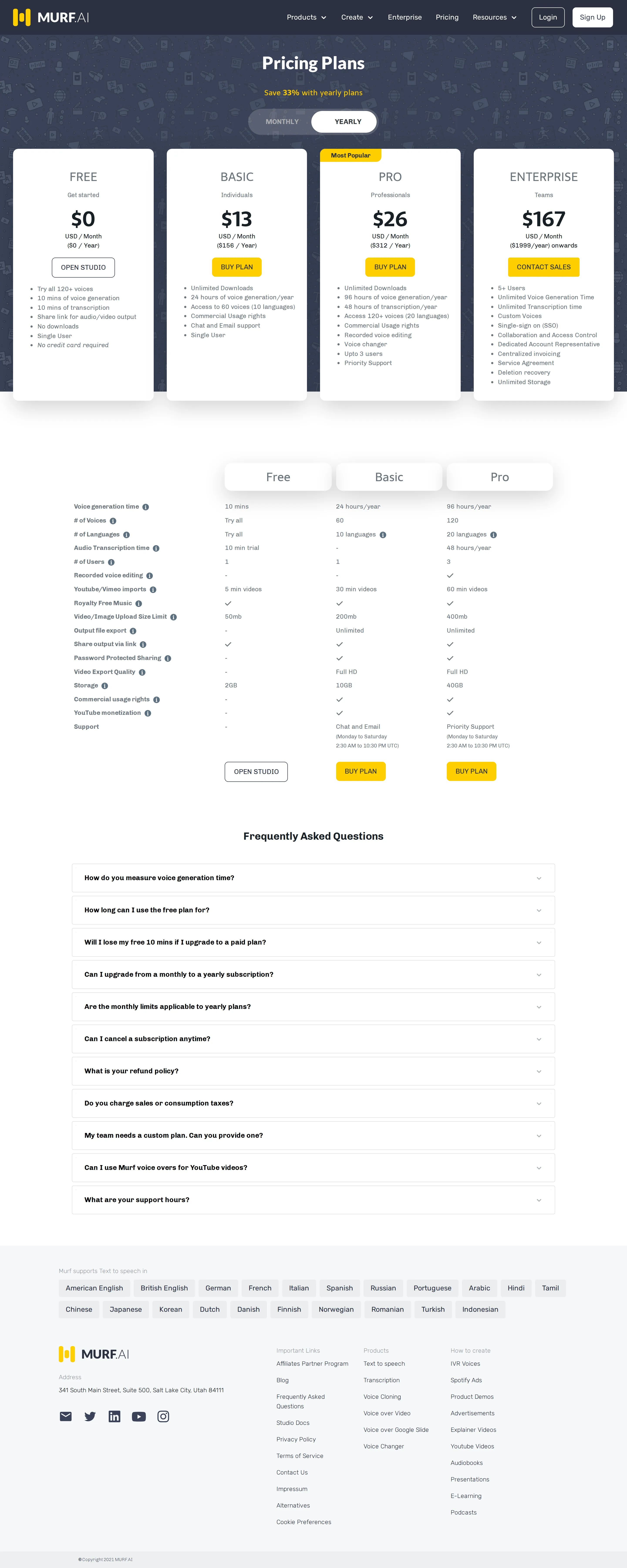
| 2022 Q4 | 1 | 0 | MURF.AI rebrand (dark theme → navy); Enterprise moves to a per-seat model at $167/mo for 5+ users. Series A ($10M) closed in September 2022. |
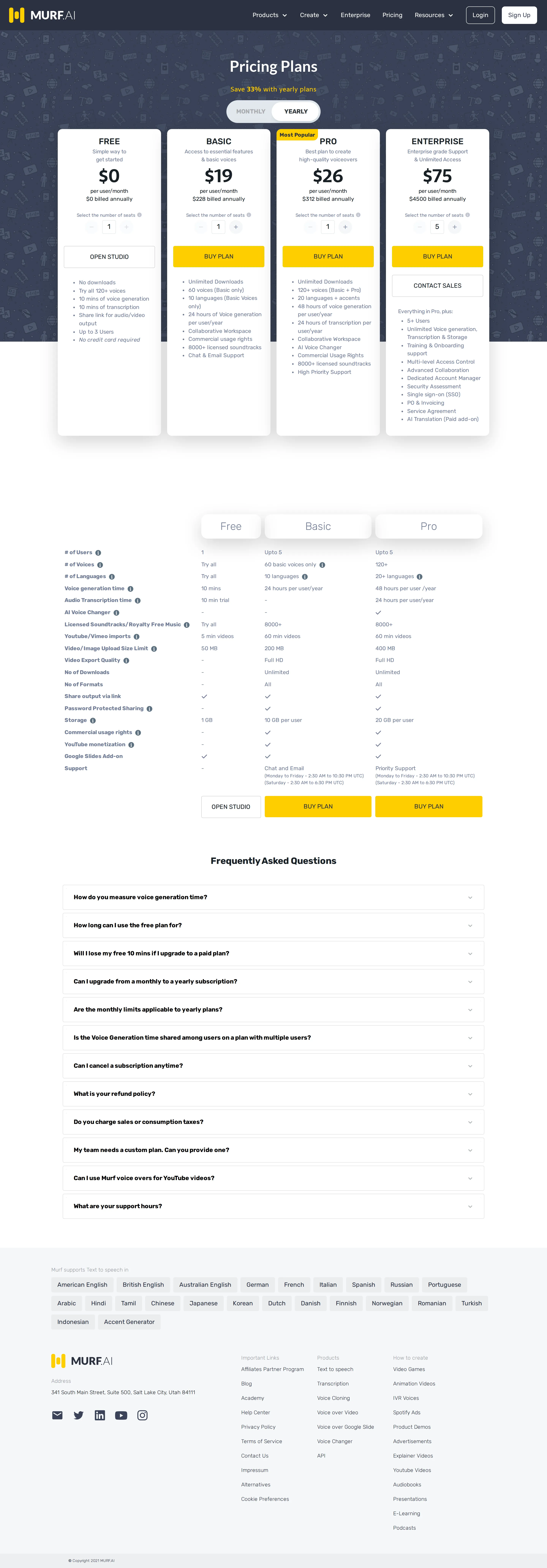
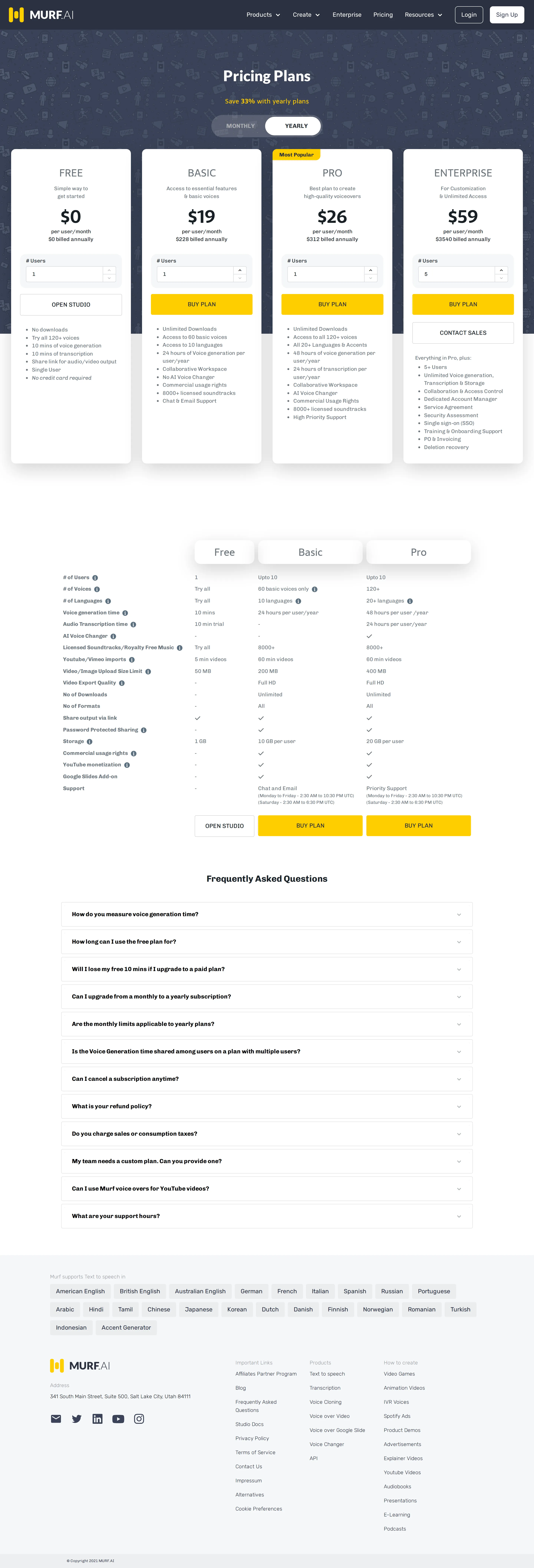
| 2023 Q1 | 2 | 0 | Basic raised $13 → $19/mo; Enterprise re-priced to a per-user $59/mo ($3540/yr at 5 users). |
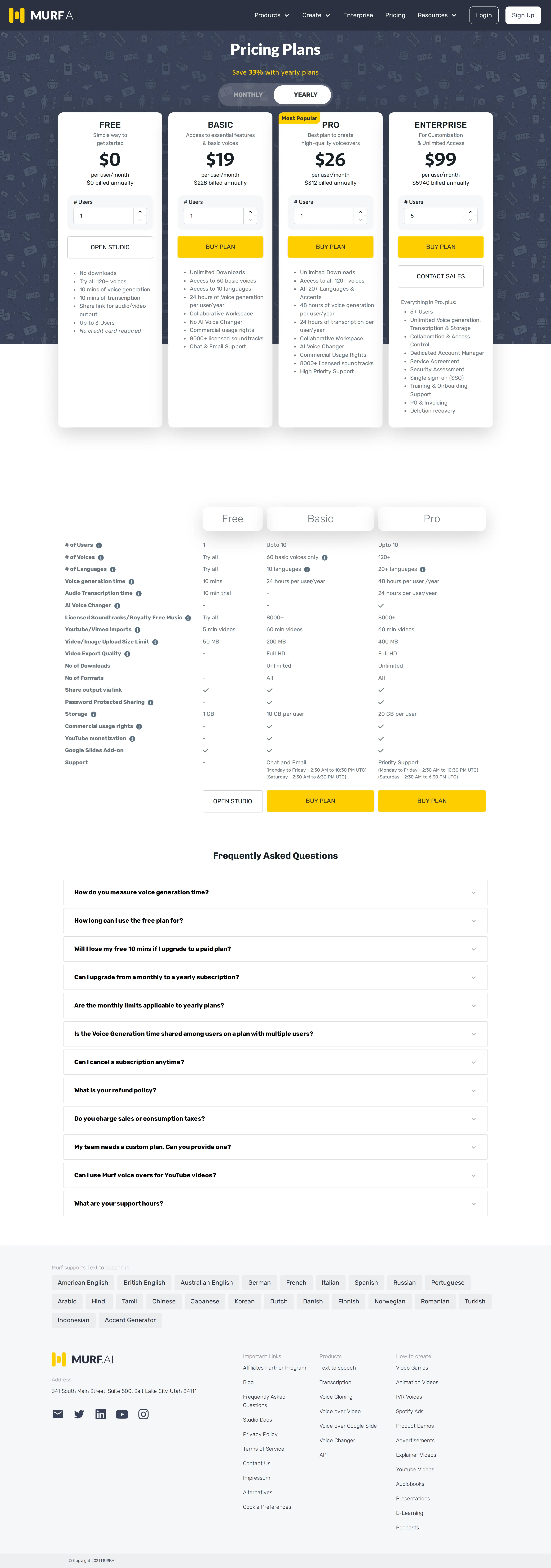
| 2023 Q2 | 1 | 0 | Enterprise per-seat rate climbed $59 → $99/user/mo. |
| 2023 Q4 | 1 | 0 | Enterprise eased back to $75/user/mo ($4500/yr) — the last cleanly archived Basic/Pro snapshot. |
| 2025 Q4 | — | 1 | Falcon real-time TTS model launched (Nov 2025) on the Murf API at $0.01/1000 characters; archive snapshots are JS skeletons (unverifiable). |
| 2026 Q2 | — | — | Live capture: Studio renamed to Free / Creator $19 / Business $66 / Enterprise custom, alongside the Murf API and Murf Dub. |
Tracked range: 2021-12–2026-06. The 2024-09 through 2026-02 archive snapshots are JS-rendered skeletons, so the Basic/Pro → Creator/Business rename date and any intervening Studio price changes are not archive-verifiable; quarters not listed showed no readable change in the archived snapshots.
Notable changes
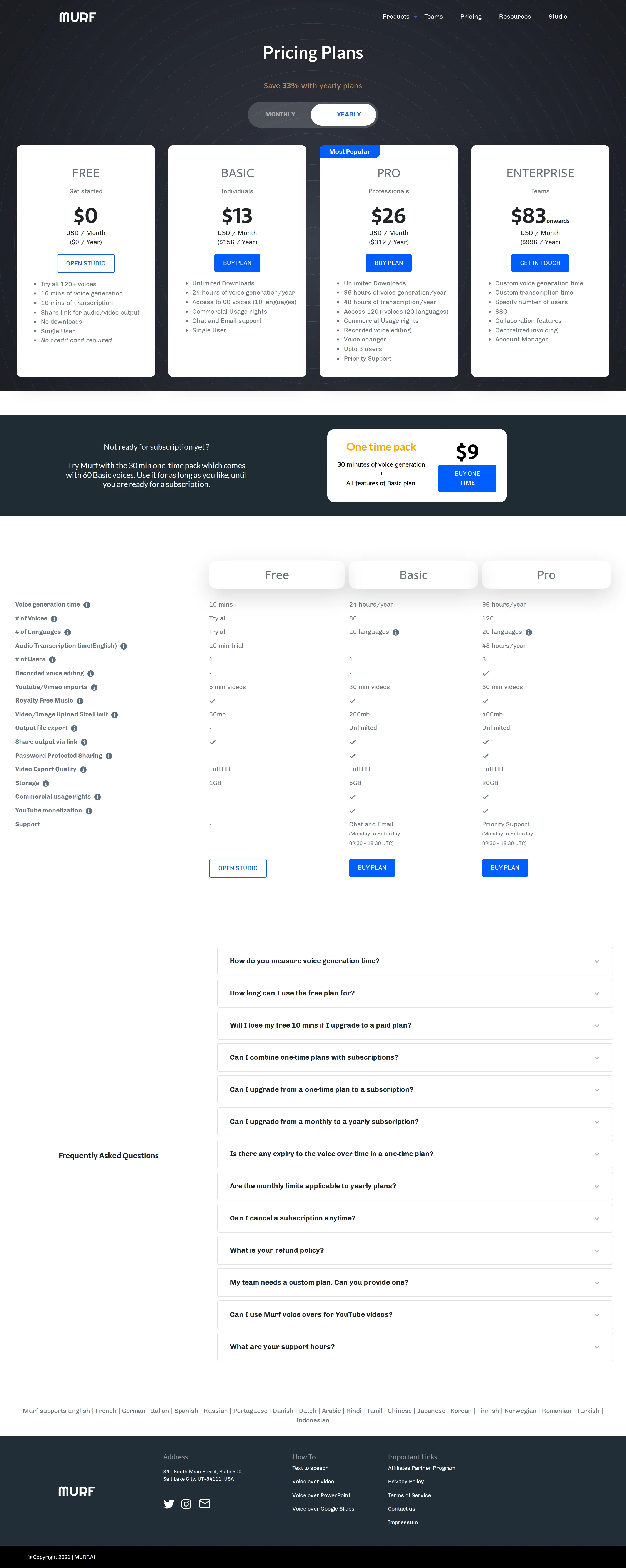
- 2021-12 — Earliest archived pricing: Free $0, Basic $13/mo, Pro $26/mo, Enterprise from $83/mo, metered by voice-generation hours per year (per the Wayback snapshot of murf.ai/pricing).
- 2022-05 — Enterprise roughly doubled from $83/mo to $166/mo while Basic/Pro held flat (Wayback).
- 2022-09 — Series A: Murf raised $10M led by Matrix Partners India, citing 22× ARR growth and 1M+ voiceover projects (murf.ai/blog/series-a-announcement).
- 2022-11 — MURF.AI rebrand; Enterprise becomes per-seat at $167/mo for 5+ users (Wayback).
- 2023-01 — Basic raised $13 → $19/mo; Enterprise re-priced to $59/user/mo (Wayback).
- 2023-06 → 2023-12 — Enterprise per-seat rate moved $59 → $99 → $75/user/mo across the year (Wayback).
- 2025-11 — Falcon real-time TTS model launched on the Murf API at $0.01/1000 characters, targeting sub-130ms time-to-first-audio voice agents.
- 2024–2025 (date not archive-verifiable) — Studio renamed Basic/Pro → Creator/Business and the standalone Murf API and Murf Dub products were added; all Wayback snapshots in this window are JS skeletons.
The 169-point Hacker News debut in detail
Murf’s text-to-speech product hit the Hacker News front page on 2023-01-01 with a 169-point, 95-comment thread — the most prominent community moment in its history and a useful demand signal for the Basic $19 / Pro $26 era. The discussion centered on voice quality and use cases rather than a pricing backlash, so it reads as adoption interest rather than a trust event over a price change. No community thread crossing the Reddit >2000-upvote bar surfaced for Murf pricing specifically.
What’s unique : Annual hours metering plus a one-cent conversational API
1. Voice generation is metered by hours per year, not per month. Creator includes 24 hrs/year and Business 96 hrs/year of voice generation — an annual bucket that rewards steady use but can be exhausted early by a burst month, an unusual choice versus the per-month minute quotas common among TTS competitors.
2. A separate one-cent conversational API runs alongside the Studio subscription. The Murf API prices its Falcon model at $0.01 per 1000 characters and advertises sub-130ms time-to-first-audio, deliberately targeting real-time voice agents with a pure pay-as-you-go meter rather than a seat.
3. Recurring free credit and never-expiring purchased credit lower API entry friction. Every API account gets $10 of free credit every month, purchased credit never expires, and early-stage startups can apply for $1,500 in free credits over three months — a credit posture closer to a developer platform than a creator app.
Strengths & weaknesses
| Strengths | Weaknesses |
|---|---|
| Clear, public, low-cost API rate ($0.01/1000 chars for Falcon) | Single editor seat on every paid Studio tier below Enterprise |
| Recurring $10/month free API credit + never-expiring purchased credit | Annual voice-generation hours bucket can be exhausted early by burst usage |
| Two clean motions (creator subscription vs developer pay-as-you-go) | Studio, API, and Dub are billed separately — no unified usage pool |
| Strong compliance posture (HIPAA, GDPR, ISO 27001, SOC 2 Type II) | Enterprise is fully sales-gated with no published price band |
Billing UX : Plan toggles, calculators, and credit-based metering controls
- Studio / Dub / API product tabs — the pricing page splits all three product lines under a single tab strip so buyers select the relevant billing model before seeing plans.
- Billed Monthly / Billed Yearly toggle — flips Studio plans between monthly and annual pricing, with a visible “Saved 33%” badge on annual.
- Murf API “Calculate Your Requirement” calculator — interactive sliders estimate cost per endpoint (Text-to-Speech, Translation, Voice Changer) by entering characters or minutes and showing a running total.
- Murf Dub credit calculator — estimates credit consumption and total cost from file duration in minutes and number of dubbed languages (2 credits per minute per language).
- Monthly free credit allowance — the Murf API surfaces a recurring “$10 FREE, every month” credit on the Free Trial tier, with purchased credit shown as never-expiring.
- Compare All Features table — an expandable feature matrix (Voices & Voice Controls, Business Hub, Usage Limits, Add-Ons, Security & Compliance, Support) compares Creator vs Business vs Enterprise inline.
Strategic wins : Why Murf’s two-motion pricing works
1. A one-cent API rate anchors Murf as the low-cost conversational TTS option
By publishing $0.01 per 1000 characters for Falcon and pairing it with sub-130ms latency, Murf gives voice-agent developers a legible, defensible headline number. This usage-based anchor is far easier to evaluate than competitors’ opaque character-bundle plans, and it widens the top of the developer funnel.
2. Recurring free credit converts curiosity into integration
The $10/month always-on credit plus a $1,500 startup grant means a developer can ship a prototype without ever entering a card. As covered in our work on usage grants and entitlements and the shift from entitlements to credits, recurring credit allowances reduce activation friction better than one-time trials.
3. Separating Studio seats from API usage keeps each motion clean
Murf avoids forcing creators to think about characters and developers to think about editor seats. Splitting the subscription and metered surfaces lets each audience price-shop on the dimension it cares about.
Areas to improve : Seat caps, annual buckets, and unified usage
1. Add a multi-seat option below Enterprise
Every paid Studio tier under Enterprise caps at a single editor seat, forcing small teams straight to a sales-led quote. A self-serve per-seat add-on on Business would capture SMB teams that today churn or share logins — a gap explored in our piece on AI companies shifting away from per-user licenses.
2. Offer a monthly voice-generation option, not only annual hours
The hours-per-year bucket can be exhausted early in a heavy month, creating a confusing mid-year wall. A published monthly equivalent (or rollover) would smooth the experience for steady producers.
3. Consider a unified credit wallet across Studio, API, and Dub
Today the three products bill on separate meters and currencies (hours, characters, credits). A shared wallet — discussed in our prepaid credits models guide and our take on unpredictable AI product costs — would let mixed-use customers consolidate spend and reduce purchasing friction.
Monetization stack & signals : how Murf AI builds & buys its revenue engine
Buys 1 Builds 0
Murf buys payments — its own affiliate terms name Stripe as the processor that receives customer charges — but runs its own per-character meter behind the Murf API, with no third-party metering vendor disclosed.
-
“Any payment received by Company through Stripe from a customer will result in a valid referral created and a payable Affiliate Fee, subject to verification and approval by Company.”
-
“Our Pay-as-you-go plan allows you to buy 10,000 characters at $1, with a minimum purchase amount of $2.”
Signals reviewed · derived from engineering blogs, product docs
Key takeaways
- Meter the dimension each audience already understands. Murf bills creators on a flat subscription and developers on per-character usage, so neither group has to reason about the other’s unit.
- A single legible headline rate beats opaque bundles. “$0.01 per 1000 characters” is instantly comparable, which matters more for adoption than a marginally cheaper but hard-to-parse bundle.
- Recurring free credit out-converts one-time trials. A $10/month always-on allowance keeps developers active far longer than a single expiring trial.
- Annual usage buckets are a double-edged tool. Hours-per-year rewards steady users but punishes bursty ones; pair it with rollover or a monthly view to avoid surprise walls.
- Compliance is a pricing lever at the enterprise edge. HIPAA, SOC 2, ISO 27001, SSO, and MSA are gated behind the custom Enterprise tier, turning trust requirements into upsell triggers.
UBP implications
- Per-character pricing makes TTS a true usage commodity. Charging by characters (and per minute for voice changer) converts speech synthesis into a metered utility that scales linearly with workload, the hallmark of mature usage-based pricing.
- Free credit allowances are becoming the default UBP on-ramp. A recurring monthly credit, rather than a time-boxed trial, is emerging as the standard way usage-priced platforms seed adoption.
- Hybrid subscription-plus-usage lets one company serve two buyers. Murf shows that a flat creator plan and a metered developer API can coexist under one brand without collapsing into a single confusing meter.
Sources
- Murf AI pricing page (accessed 2026-06-01)
- Murf API overview (accessed 2026-06-01)
- Murf API documentation (accessed 2026-06-01)
- Murf help center — API pay-as-you-go pricing (accessed 2026-06-01)
- Murf help center — API plans and limits (accessed 2026-06-01)
- Murf resources / blog (accessed 2026-06-01)
Bottom line
Murf AI runs a clean two-motion pricing model: flat Murf Studio subscriptions (Free, Creator $19/mo, Business $66/mo, Enterprise custom) metered by voice-generation hours per year for creators, and a pure pay-as-you-go Murf API from $0.01 per 1000 characters for developers — stitched together with recurring free credit and a strong compliance story at the enterprise edge.
Want to compare Murf AI against other AI voice and usage-based pricing? Browse the pricing blueprint.
Pricing timeline : Major events on a vertical axis
Each milestone below corresponds to a public pricing change, product launch, or material adjustment. Major events use a filled marker; minor adjustments use a faded one.
Creator/Business rebrand + Murf API and Murf Dub (current)
Studio tiers renamed and restructured: Free $0, Creator $19/mo ($228/yr), Business $66/mo ($792/yr), Enterprise custom. Murf added a pure pay-as-you-go API (Falcon TTS launched Nov 2025, $0.01/1000 chars; Gen2 $0.03; translation $0.02; voice changer $0.10/min; $10/mo free credit) and Murf Dub credits ($0.25/credit). The 2024-09 → 2026-02 Wayback snapshots are JS-rendered skeletons, so the exact rename date is not archive-verifiable.

Enterprise per-seat settles to $75/user
By 2023-12 (and confirmed 2024-01) Enterprise eased back to $75/user/mo ($4500/yr); Basic $19/Pro $26 still flat. This is the last cleanly archived Basic/Pro snapshot before Murf's pricing SPA stopped rendering in Wayback.
Enterprise per-seat rises $59 → $99/user
By 2023-06 the Enterprise per-user rate climbed to $99/mo ($5940/yr at 5 users); Basic $19/Pro $26 unchanged.
Basic raised $13 → $19; Enterprise re-priced to $59/user
Wayback (2023-01) shows Basic up from $13 to $19/mo ($228/yr); Pro held at $26/mo ($312/yr); Enterprise restructured to a per-user $59/mo ($3540/yr at 5 users).
MURF.AI rebrand; Enterprise becomes per-seat ($167/mo, 5+ users)
The pricing page moves from the dark 'MURF' theme to the navy 'MURF.AI' brand. Basic $13/Pro $26 unchanged; Enterprise listed at $167/mo ($1999/yr) for 5+ users with a per-seat selector. Series A ($10M, Matrix Partners India) closed 2022-09.
Enterprise roughly doubles to $166/mo
Wayback shows Enterprise jumping from $83/mo ($996/yr) in 2022-03 to $166/mo ($1999/yr) by 2022-05, while Free/Basic $13/Pro $26 held flat. The doubling lands shortly before the September 2022 Series A.
Four-tier Studio: Free / Basic $13 / Pro $26 / Enterprise $83
Earliest archived pricing (Wayback, dark 'MURF' theme): Free $0, Basic $13/mo ($156/yr, 24 hrs/yr voice generation, 60 voices/10 languages), Pro $26/mo ($312/yr, 96 hrs/yr, 120+ voices/20 languages), Enterprise from $83/mo ($996/yr, Teams).
- · Murf splits its pricing across two motions: the Studio app sells flat-rate subscriptions metered by voice-generation hours, while the Murf API is pure pay-as-you-go at $0.01 per 1000 characters for its Falcon model.
- · Murf Studio meters voice generation by time per year, not per month — Creator includes 24 hrs/year and Business 96 hrs/year of voice generation rather than a monthly minute bucket.
- · Murf API credits never expire once purchased, and every API account gets $10 of free credit refreshed every month; early-stage startups can apply for $1,500 in free credits over 3 months.
Questions & answers
- How much does Murf AI cost?
- Murf Studio has a free plan, a Creator plan at $19/mo ($228 billed annually), a Business plan at $66/mo ($792 billed annually), and a custom-quoted Enterprise plan. The separate Murf API is pay-as-you-go from $0.01 per 1000 characters.
- Does Murf AI have a free plan?
- Yes. Murf Studio's Free plan includes 10 projects, 10 minutes of voice generation, and 1 editor (no downloads, no commercial rights). The Murf API gives every account $10 of free credit each month.
- How is the Murf API priced?
- The Murf API is pay-as-you-go: $0.01 per 1000 characters for the Falcon TTS model, $0.03 per 1000 characters for the Gen2 TTS model, $0.02 per 1000 characters for translation, and $0.10 per minute for voice changer. Purchased credit never expires.
- How does Murf measure voice-generation time?
- Murf Studio meters voice generation by hours per year per plan — Creator includes 24 hrs/year and Business 96 hrs/year — alongside project caps and a single editor seat. Enterprise offers unlimited voice generation.
- What is Murf Dub and how is it priced?
- Murf Dub is Murf's automated dubbing product, priced in credits at $0.25 per credit on the pay-as-you-go plan, consuming 2 credits per minute per dubbed language. A free trial includes 100 credits.