AI Summary
About
Shortwave is an AI-native email client that sits on top of Gmail (and other email providers) to deliver an “AI executive assistant” experience — AI search, summaries, autocomplete, personalized writing, and inbox organization. It markets itself as “the world’s most advanced email AI” and targets everyone from solo founders boosting personal productivity to executives rolling the product out across entire organizations.
The company packages its product as a per-seat subscription with five customer-facing tiers (Free, Pro, Business, Premier, Max) plus a sales-quoted Enterprise band. Higher tiers do not unlock fundamentally different apps; instead they scale AI capacity — daily AI usage quota, AI search history depth, max threads per AI search, AI context tokens, and the number of AI-powered filters — alongside team-collaboration and support upgrades.
Shortwave also cross-sells a sister product, Tasklet, for 24/7 workflow automation (drafting replies, team comments, and connecting to 3,000+ apps). The two are billed separately. Public ARR, valuation, and headcount figures are not disclosed on the pricing surfaces captured.
Pricing summary : per-seat email AI tiers metered by AI usage quota
Shortwave uses a per-seat subscription where every paid tier is billed per person, per month (new subscriptions are billed monthly). There is no separate usage meter or overage bill — instead, each tier embeds a fixed AI capacity envelope, so “more usage” is sold by moving up a tier rather than by paying per token. The model has three practical dimensions:
- Seat price by tier: Free ($0), Pro ($18/seat/mo), Business ($30/seat/mo), Premier ($45/seat/mo), and Max ($120/seat/mo). Larger orgs with compliance needs can contact sales.
- AI capacity per tier: daily AI usage quota (Limited → Standard → More → 2x → 6x), AI search history (90 days → 3 years → 5 years → Unlimited), max threads per AI search (15 → 50 → 50 → 100 → 150), AI context tokens (Standard → 2x → 3x), and AI-powered filters (0 → 3 → 10 → 50).
- Team & seat mechanics: billing is tied to a “team”; you are billed upfront per seat, charged a prorated amount for seats added mid-cycle, and given prorated credit for seats removed. One paid seat covers all of that person’s email accounts on the same device for a single flat rate.
What makes this different: there is no metered overage at all — Shortwave converts “AI usage” into a fixed per-tier quota and sells more capacity exclusively by tier upgrade, a hybrid-feeling but structurally pure subscription that hides its usage dimension inside seat tiers.
Pricing by product
Shortwave splits its pricing page into two tabs — Individual (Free + Pro) and Business (Business / Premier / Max) — plus a sales-quoted Enterprise band for larger orgs. All prices below are per seat, billed monthly (new subscriptions are billed monthly per the billing docs); the page no longer exposes a separate annual toggle.
Shortwave email AI (Individual plans)
| Tier | Price | Included | Key mechanics |
|---|---|---|---|
| Free | $0 | Basic intelligence, limited AI usage quota, 90 days standard + AI search history, max 15 threads/AI search | Free forever; carries “Sent with Shortwave” signature |
| Pro | $18 /seat/mo | Standard intelligence, 3 years AI search history, max 50 threads, AI web browsing, personalized AI writing | ”Personal users who just need the basics” |
Shortwave email AI (Business plans)
| Tier | Price | Included | Key mechanics |
|---|---|---|---|
| Business | $30 /seat/mo | Standard intelligence, more AI usage, 5 years AI search history, max 50 threads, 3 AI filters, read statuses | ”Most popular” — everyday AI productivity |
| Premier | $45 /seat/mo | Everything in Business + advanced intelligence, 2x AI usage, unlimited AI search history, max 100 threads, 10 AI filters, 2x context tokens, premium support | Advanced intelligence for complex workflows |
| Max | $120 /seat/mo | Everything in Premier + expert intelligence, 6x AI usage, max 150 threads, 50 AI filters, 3x context tokens, live 1:1 training | Most powerful models & features |
| Enterprise | Contact sales | Advanced integration, compliance, security, or support requirements | Sales-led, custom-quoted |
Sales motions across products: PLG / self-serve for Free, Pro, Business, Premier, and Max (all self-checkout via Stripe); sales-led for Enterprise.
AI capacity ladder (what actually scales between tiers)
The tiers share one app — what changes is the AI capacity envelope. The shared comparison table on the pricing page sets these per-tier limits:
| Dimension | Free | Pro | Business | Premier | Max |
|---|---|---|---|---|---|
| AI intelligence level | Basic | Standard | Standard | Advanced | Expert |
| Daily AI usage quota | Limited | Standard | More | 2x more | 6x more |
| Max threads per AI search | 15 | 50 | 50 | 100 | 150 |
| AI search history | 90 days | 3 years | 5 years | Unlimited | Unlimited |
| Search context tokens | Limited | Standard | Standard | 2x | 3x |
| AI-powered filters | 0 | 0 | 3 | 10 | 50 |
Hidden costs : what teams actually pay per seat
Shortwave has no metered overage and no per-token bill, so there are no surprise usage charges. The “hidden” cost here is the opposite of most usage-based products: it is the tier-jump tax. Because AI capacity (daily AI usage quota, context tokens, threads, filters, search history) is sold only by moving up a tier, a single team member who hits the daily AI quota or needs unlimited search history can force the whole team onto a much pricier plan. Two real-world examples:
Heavy AI user who outgrows the daily quota
A power user on Business ($30/seat/mo) keeps exhausting the daily AI usage quota and wants unlimited AI search history plus more context tokens. There is no add-on to buy more quota — the only path is Premier ($45/seat/mo), or Max ($120/seat/mo) for the 6x quota. For a 10-person team where everyone moves up together (Shortwave requires all team members to share one plan), that is not a per-user upgrade but a team-wide one.
| Line item | Monthly cost |
|---|---|
| 10 seats on Business ($30/seat/mo) | $300 |
| Upgrade entire team to Premier (+$15/seat) to lift AI quota | +$150 |
| Total — Premier team of 10 | $450 |
| If instead the team needs Max (6x quota) | $1,200 |
The lesson: with one shared plan per team, one heavy AI user pulls everyone up a tier — the jump from Business to Max is a 4x bill increase ($300 → $1,200), not a marginal overage.
Individual who needs Google Workspace + more AI
A solo founder on Pro ($18/seat/mo) mostly needs the basics, but adding AI-powered filters, read statuses, and 5-year AI search means stepping up to Business ($30/seat/mo) — a 67% jump for one seat — and Premier ($45) if they want unlimited history. Billing is monthly and charged upfront at the start of each cycle, so a mid-tier jump takes effect on the next billing date.
Want to estimate your own Shortwave bill across seats and tiers? Use the Shortwave pricing calculator to model your monthly cost based on seat count and the AI-capacity tier your heaviest user needs.
Pricing evolution : how the email AI tiers took shape
Cadence
| Quarter | Price changes | Product / SKU additions | Notes |
|---|---|---|---|
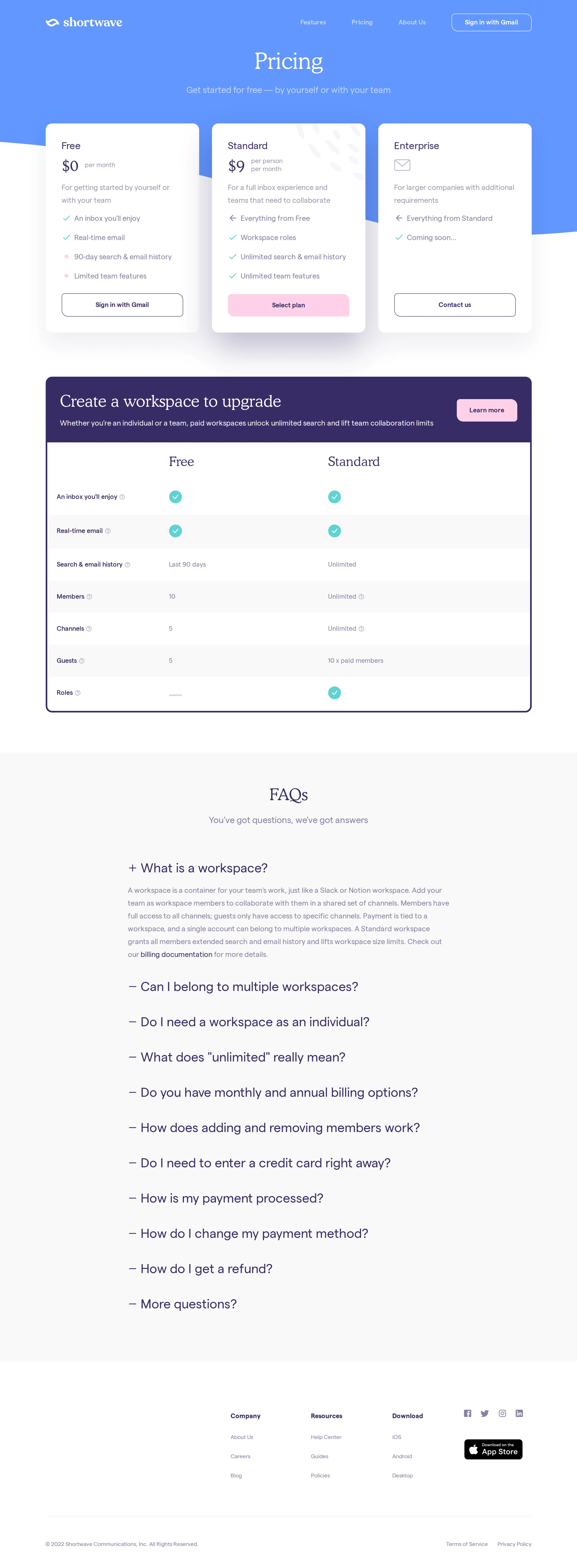
| 2022 Q1 | 1 | 1 | 2022-02-15 public launch: Free $0 / Standard $9 / Enterprise (coming soon), workspace/history paywall. |
| 2023 Q1 | 0 | 0 | AI summaries ship (2023-03) but pricing unchanged; “AI-enhanced workflow” listed for all plans. |
| 2024 Q1 | 1 | 1 | 2024-02 AI-metered ladder: Free / Personal $7 / Pro $14 / Business $24; annual billing introduced. |
| 2024 Q4 | 1 | 1 | 2024-11 per-seat language; Premier $36 added; Personal $7 retired (paid floor $7 → $14). |
| 2025 Q1 | 0 | 1 | AI-powered filters appear as a gating dimension (3 / 10 filters). |
| 2026 Q2 | 1 | 1 | 2026 Max $100 tier added with explicit daily AI usage quota (More / 2x / 6x); 2026-06-30 all paid tiers repriced up (Pro $14→$18, Business $24→$30, Premier $36→$45, Max $100→$120) and the annual toggle dropped to monthly-only. |
Tracked range: 2022-02 – 2026-06, from Wayback snapshots of shortwave.com/pricing and a 2026-06-30 capture. Quarters not listed were verified stable (0 changes, 0 additions).
Notable changes
- 2022-02-15 — Public launch at Free $0 / Standard $9/person/mo with a Slack-like model: you pay to unlock more than 90 days of email history and to lift team-collaboration limits. No AI tiering. (TechCrunch)
- 2023-03 — AI summaries and the AI executive assistant ship, but pricing stays Free / $9 Standard / Enterprise, monthly-only, per-Gmail-account. AI is a feature, not yet a meter. (TechCrunch)
- 2024-02 — First AI-metered lineup: Free / Personal $7 / Pro $14 / Business $24 + Enterprise, with annual billing and AI-search-history depth (1 / 3 / 5 years) as the headline gating dimension.
- 2024-11 — Shift to “per seat” billing with Individual/Business tabs; Premier added at $36/seat/mo; the $7 Personal tier retired, raising the paid floor to $14.
- 2026 — Max tier added at $100/seat/mo and the comparison table exposes an explicit daily AI usage quota (More / 2x / 6x), context-token multipliers, and max-threads-per-search as the primary metering levers.
- 2026-06-30 — Every paid tier repriced upward (Pro $14→$18, Business $24→$30, Premier $36→$45, Max $100→$120 per seat/mo) and the pricing page dropped its annual/monthly toggle; the billing docs now state “New subscriptions are billed monthly.” The tier lineup and AI-capacity ladder were otherwise unchanged.
The June 2026 repricing in detail
The 2026-06-30 change is the first time Shortwave moved price without moving packaging — every paid tier went up 20-29% while the five-tier lineup, the AI-capacity ladder, and the team mechanics stayed identical. The increases were not uniform: the entry Pro tier rose the most in percentage terms (29%, $14→$18), Business and Premier both rose 25% ($24→$30, $36→$45), and the top Max tier rose the least (20%, $100→$120). Raising the floor hardest is a deliberate signal — Shortwave is repricing the cost of entering the paid product faster than the cost of its power tier, narrowing the discount on simply getting in the door.
The quieter half of the change is the removal of the annual/monthly toggle. Where the page previously let buyers prepay for a discount, it now quotes a single per-seat monthly number and the billing docs confirm “new subscriptions are billed monthly.” That does two things at once: it lifts the effective price for anyone who would have taken the annual discount (the headline hike understates their increase), and it strips out the prepay-commitment lever Shortwave used to pull cash forward and lock in retention. For a young, fixed-tier model carrying rising AI cost-of-goods under the hood, repricing up while simplifying to monthly reads as a margin-defence move — exactly the latent risk this page has flagged since the quota baseline was first left unquantified.
What’s unique : AI capacity sold by tier, not by token
1. AI cost is sold as a daily quota, not per token. Most AI products that expose their cost meter it per request, per message, or per token. Shortwave does the opposite: it bundles AI into a fixed daily AI usage quota (“More” on Business, “2x” on Premier, “6x” on Max) and never bills overage. You raise capacity only by upgrading a tier. This trades the precision (and anxiety) of metered billing for a predictable seat price, at the cost of forcing a tier jump the moment a heavy user maxes out the quota.
2. Capacity scales on five quiet dimensions, not one headline number. Between tiers the app is identical — what changes is a stack of capacity knobs: daily AI usage quota, AI search-history depth (90 days → unlimited), max threads per AI search (15 → 150), search context tokens (Standard → 3x), and AI-powered filters (0 → 50). Shortwave sells “more AI” as a basket of limits rather than a single metric, which makes the tiers hard to comparison-shop but easy to defend as “more powerful.”
3. One seat covers all of a person’s inboxes, billed through a team. Billing is anchored to a “team,” but a single paid seat extends paid features to every email account that person signs in on the same device — so one flat per-seat rate, not per-mailbox. The team construct exists to pay for other people, with per-seat proration and a shared plan type for everyone, a structurally clean per-seat subscription inherited from the company’s original Slack-like workspace model.
Strengths & weaknesses
| Strengths | Weaknesses |
|---|---|
| Predictable per-seat pricing with zero metered overage — no token-bill surprises | ”More / 2x / 6x” daily AI usage quota is never quantified in absolute numbers, so buyers can’t size it |
| Generous free tier includes the AI assistant, removing the trial barrier | All team members must share one plan type, so one heavy user forces a team-wide upgrade |
| One seat covers all of a person’s email accounts at a flat rate | Annual prepay discount was removed (2026-06-30) — monthly-only billing raises the effective price for anyone who would have committed yearly |
| Transparent, public, self-serve checkout (Stripe) across four paid tiers | $18 → $120 spread across five tiers is hard to comparison-shop on AI capacity alone |
| Strong founder pedigree and HN credibility (ex-Inbox/Firebase team) | The latent cost-inflation risk is now live: the 2026-06-30 repricing lifted every paid tier 20-29% with no added capacity, so buyers are paying more for the same quota |
Billing UX : team-based seat management with Stripe self-checkout
- Settings > Members & Billing — the single console (in the web or Android apps) where owners/admins create and manage teams, add or remove seats, and upgrade or downgrade plans. New subscriptions are billed monthly per the billing docs.
- Manage plan → Stripe portal — “Manage plan” opens the Stripe customer portal, where invoices live under the Invoice history section and can each be downloaded as a PDF; Shortwave never handles card data directly.
- Per-seat proration — adding a seat mid-cycle charges a prorated amount for the time remaining; removing a seat issues a prorated credit on the next billing cycle.
- Team-anchored billing cycle — the billing date is set when a team first upgrades and every seat on the team is billed on that same date; new subscriptions are billed monthly and the plan is managed from Members & Billing.
- 14-day refund window — refunds for the full amount are honored if requested within 14 days of payment, via Settings > Support.
- One flat rate across accounts — a single paid seat extends paid features to all of that person’s email accounts signed in on the same device, with no per-account add-on.
Strategic wins : why the tiered-capacity model works
1. Hiding the usage meter inside seat tiers keeps revenue predictable on both sides
Shortwave’s biggest pricing win is refusing to pass raw AI cost through to the customer. By converting “AI usage” into a fixed daily quota that you raise only by upgrading, it gets the expansion revenue of usage-based pricing without the churn-inducing bill volatility. This is the classic tension explored in our guide to entitlements and usage grants: Shortwave chose entitlements (a fixed envelope per tier) over a live consumption meter, which is the right call for an email tool where users want a flat, forgettable subscription rather than a dashboard to watch. The broader industry drift from flat entitlements toward metered AI cost is covered in our entitlement-to-credits shift analysis.
2. A free tier that ships the AI assistant turns the product into its own funnel
Unlike most AI tools that gate the headline feature, Shortwave’s Free plan includes the AI executive assistant (just with a limited quota and 90-day history). That removes the “is the AI any good?” objection before checkout, letting the product do the selling. The paid tiers then upsell on capacity (history depth, quota, context tokens) rather than on access — picking the right thing to charge for is exactly the challenge in our value-metric problem in AI pricing piece, and Shortwave’s “sell capacity, not access” answer mirrors the two-tier intelligence pattern we see across AI products.
3. Inheriting a per-seat team model gives clean expansion math
Because billing was built around Slack-like teams from day one, Shortwave’s expansion is simply “add seats × upgrade tier” — both axes are self-serve and prorated. The result is a per-seat subscription that expands smoothly with headcount and with AI appetite, without ever needing to introduce a confusing second meter.
Areas to improve : gaps in usage-quota transparency
1. Quantify the daily AI usage quota
“More usage,” “2x more usage,” and “6x more usage” are relative to an undisclosed baseline, so a buyer literally cannot tell whether Business covers 50 or 500 AI actions a day. Fix: publish a concrete daily action count (or a typical-workload estimate) per tier, even as a range, so teams can self-select instead of upgrading reactively after hitting an invisible wall.
2. Soften the “whole team shares one plan” constraint
Requiring every team member to be on the same plan means one power user who needs Max’s 6x quota can drag a 10-person team from $300 to $1,200/mo. Fix: allow per-seat tier mixing (or a per-seat quota top-up add-on) so heavy users can be upgraded individually without a team-wide bill shock.
3. Make the AI-capacity comparison shoppable at a glance
The five paid dimensions (quota, history, threads, tokens, filters) are scattered across a long table, making it hard to map a use case to a tier. Fix: add a short “which tier is right for me?” decision guide keyed to concrete behaviors (“you do 20+ AI searches a day,” “you need 5+ year history”), reducing the friction of the $18 → $120 ladder.
Monetization stack & signals : how Shortwave builds & buys its revenue engine
Buys 2 Builds 0
Buys its entire payments + self-serve billing spine through Stripe, with no separate metering, CRM, or rev-rec vendor — tier upgrades are Stripe subscription-plan swaps, so the revenue engine is a pure buy.
Signals reviewed · derived from product docs
Key takeaways
- Five per-seat tiers, no overage. Shortwave is Free / Pro $18 / Business $30 / Premier $45 / Max $120 per seat/mo (billed monthly) plus a contact-sales Enterprise band. Every paid tier embeds a fixed AI envelope, and you pay more only by upgrading — there is no per-token or per-action bill anywhere.
- AI is metered by quota, sold by tier. The real value metric is a daily AI usage quota (More / 2x / 6x) bundled with search-history depth, context tokens, threads, and filters. This is usage-based packaging delivered through a subscription wrapper.
- The model is young and still inflating. As recently as 2022 Shortwave was a $9 flat email client; the AI ladder only appeared in 2024, Premier in late 2024, and the Max tier in 2026. The June 2026 across-the-board repricing (every paid tier up 20-29%, annual discount removed, no new capacity) confirms the trajectory — expect continued price and tier movement as AI costs and capabilities shift.
- One seat = all your inboxes; teams pay for others. A flat per-seat rate covers every account a person signs into on one device. Teams exist to pay for additional people, with per-seat proration and a 14-day refund window.
- The buyer’s risk is the tier jump, not the meter. Because all team members share one plan, a single heavy AI user can push the whole team up a tier — the operative cost question is “what tier does my heaviest user need?”, not “how many tokens will we burn?”
UBP implications
- Entitlements can deliver usage-based expansion without a live meter. Shortwave proves you can capture “heavier users pay more” with a tiered quota rather than a consumption counter — the right trade for a tool people want to forget about, where bill anxiety would hurt retention more than precision would help revenue. The choice of which capacity to gate on is the core decision in our guide to choosing the right usage metric.
- Relative quotas (“2x,” “6x”) are a packaging choice with a transparency cost. Hiding the absolute baseline lets a vendor adjust capacity quietly as AI costs move, but it also blocks buyers from sizing tiers — a tactic that works while trust is high and backfires the moment a quota is visibly cut.
- AI cost inflation is a latent margin risk under fixed-tier pricing. When the meter is hidden inside a flat seat price, rising model and context costs squeeze margin invisibly, and the vendor has two levers to defend unit economics: quietly shrink the undisclosed quota, or raise the headline seat price. Shortwave’s June 2026 move shows it reached for the visible lever first — a 20-29% price hike across every tier rather than a stealth quota cut — which preserves the quota’s credibility but spends buyer goodwill openly instead of silently.
Sources
- Shortwave pricing page (accessed 2026-06-30)
- Shortwave billing guide (docs) (accessed 2026-06-30)
- Shortwave changelog (accessed 2026-06-30)
- Shortwave blog (accessed 2026-06-30)
- pricing blueprint corpus
Bottom line
Shortwave is a textbook case of usage-based packaging wearing a subscription suit: it sells “more AI” by tier — a daily quota, deeper search history, more context tokens — yet never shows a meter or charges an overage. That keeps bills predictable and the free tier (which ships the AI assistant) doing the selling, but it also leaves the real value metric, the daily AI usage quota, deliberately unquantified. From a $9 flat email client in 2022 to a five-tier $0-$120 AI ladder in 2026, the trajectory is a clean illustration of how an AI product can monetize usage without ever exposing one.
Want to compare Shortwave against other AI email and productivity pricing? Browse the pricing blueprint.
Pricing timeline : Major events on a vertical axis
Each milestone below corresponds to a public pricing change, product launch, or material adjustment. Major events use a filled marker; minor adjustments use a faded one.
Headline prices raised ~20-29%; page moves to monthly-only billing
Shortwave repriced every paid tier upward and dropped the annual/monthly toggle so the pricing page now shows a single per-seat monthly price: Pro $18 (was $14), Business $30 (was $24), Premier $45 (was $36), and Max $120 (was $100) per seat/mo. The billing docs state 'New subscriptions are billed monthly.' The lineup, AI-capacity ladder (daily quota More/2x/6x, search history, threads, context tokens, filters), and team mechanics are otherwise unchanged; no standalone Enterprise card is shown on the page.

Max $100 tier + explicit daily AI usage quota
Five-tier lineup (as captured June 2026): Free, Pro ($14), Business ($24), Premier ($36), and Max ($100) per seat/mo billed annually, plus contact-sales Enterprise. A new $100 Max tier sits on top, and the comparison table now exposes an explicit daily AI usage quota (More / 2x / 6x), context-token multipliers (2x/3x), and max threads per AI search (50-150) as the headline metering dimensions. Sister product Tasklet is cross-sold for workflow automation.

Per-seat language + Premier $36 tier added; Personal $7 retired
The page shifted to 'per seat' billing with Individual/Business tabs, dropped the $7 Personal tier, and added a Premier tier at $36/seat/mo (unlimited AI search history, 2x context tokens, live 1:1 training). Paid floor effectively rose from $7 to $14. AI-powered filters appeared as a new gating dimension.

AI-metered ladder introduced — Free / Personal $7 / Pro $14 / Business $24
Shortwave replaced the two-tier model with a four-tier AI ladder plus Enterprise, moved to annual billing, and started metering AI by search-history depth: 1 year (Personal), 3 years (Pro), 5 years (Business). Personalized AI writing and Ghostwriter became tier-gated. This is the first time price scaled with AI capacity.

AI summaries ship; pricing still Free / $9 Standard / Enterprise
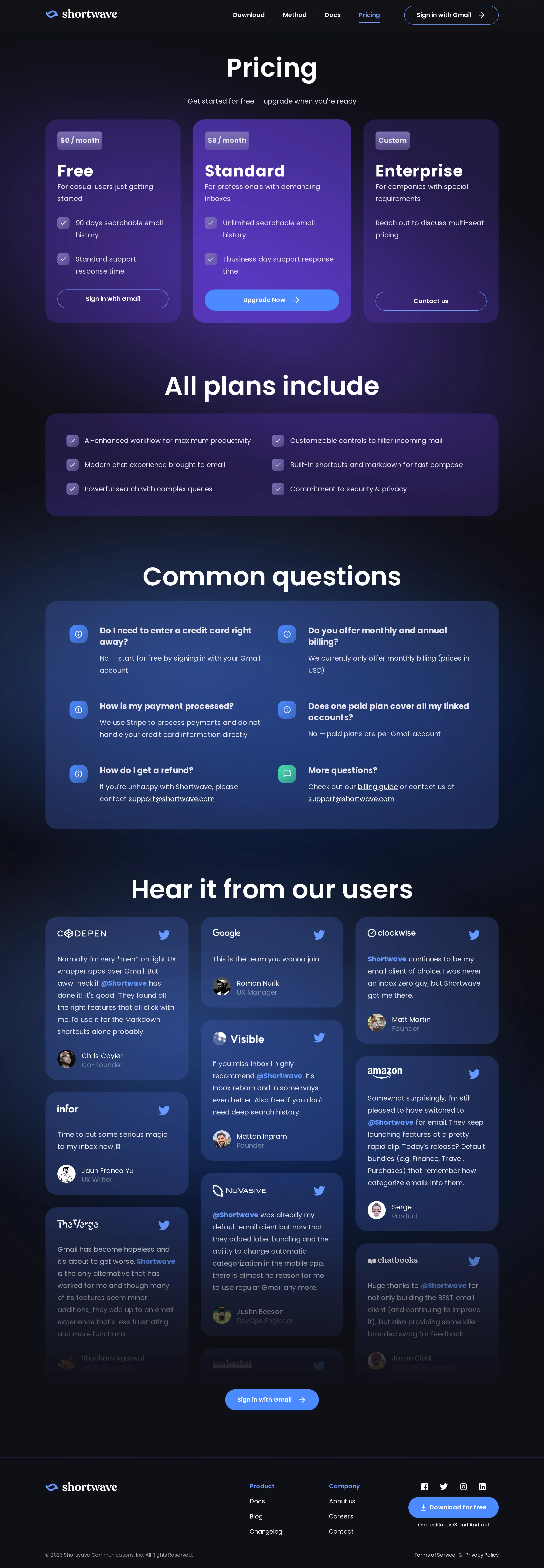
Shortwave began shipping GPT-powered features (AI summaries, then a full AI assistant), but the pricing page kept the simple Free / $9 Standard / Custom Enterprise structure with monthly-only billing and per-Gmail-account paid plans. 'AI-enhanced workflow' was listed as an all-plans feature, not a metered dimension. Source: https://techcrunch.com/2023/03/01/shortwave-email-app-introduces-ai-powered-summaries/
Public launch — Free + $9 Standard (Slack-like history paywall)
Shortwave launched publicly with a workspace model: Free ($0) and Standard ($9/person/mo) plus a 'coming soon' Enterprise tier. The paywall was email-history depth (90 days free vs unlimited paid) and team/collaboration limits (members, channels, guests) — not AI. Announced alongside a $9M Series A (USV + Lightspeed, closed April 2020). Source: https://techcrunch.com/2022/02/15/shortwave-gets-9m-to-bring-back-google-inbox/
- · Shortwave was built by ex-Google/Firebase engineers — co-founders Andrew Lee, Jacob Wenger, and Jonny Dimond — and is widely described as the spiritual successor to Google Inbox, which Google killed in 2019.
- · The $9 Standard plan that Shortwave launched with in 2022 had nothing to do with AI: per the founders' TechCrunch interview, it was a 'Slack-like' model where you paid only to unlock more than 90 days of email history.
- · Shortwave's 2022 'Show HN: Shortwave: Enjoy Your Inbox' launch thread hit 224 points and 123 comments — one of the strongest HN debuts for an email client in recent years.
Questions & answers
- How much does Shortwave cost in 2026?
- Shortwave has a free plan and four paid per-seat tiers: Pro at $18, Business at $30, Premier at $45, and Max at $120 per seat per month. New subscriptions are billed monthly. Larger orgs with compliance needs can contact sales.
- How does Shortwave's AI usage quota work?
- Instead of charging per token, Shortwave gives each tier a fixed daily AI usage quota. Business gets 'More usage,' Premier gets '2x more,' and Max gets '6x more.' There is no overage bill — to get more AI capacity you upgrade to a higher tier.
- Does one Shortwave seat cover all my email accounts?
- Yes. A single paid seat extends paid features to all of that person's email accounts signed in on the same device, at one flat rate. Teams are intended for paying for other people, not for one person's multiple accounts.
- How has Shortwave's pricing changed over time?
- At its 2022 launch Shortwave charged $0 Free and $9 Standard with no AI tiers. In 2024 it introduced an AI-metered ladder (Personal $7, Pro $14, Business $24), added a Premier tier in late 2024, and by mid-2026 raised the lineup to a monthly per-seat ladder — Pro $18, Business $30, Premier $45, Max $120 — with an explicit daily AI usage quota.
- Can I get a refund from Shortwave?
- Yes. Shortwave refunds the full amount if you contact support within 14 days of payment via Settings > Support. Removing a seat mid-cycle also issues a prorated credit on your next billing cycle.