AI Summary
About
Superhuman makes Superhuman Mail, an AI-native email client that layers a keyboard-driven, speed-obsessed interface and a growing set of AI features (Ask AI, Instant Reply, Auto Drafts, Auto Summarize, one-tap scheduling) on top of Gmail and Outlook. The product markets itself as “the most productive email app ever made” and is positioned squarely at high-performing teams — sales, GTM, and founder/operator workflows — promising roughly 4 saved hours per person per week, 3x more emails responded to, and shorter deal cycles.
Pricing is unusually simple for the category: a flat per-seat subscription across three tiers (Starter, Business, Enterprise) with no usage metering, no consumption credits, and no free tier — only a trial. The two self-serve tiers are list-priced and the Enterprise tier is contact-sales, gated behind a dedicated /products/mail/enterprise page that emphasizes SSO/SCIM, SOC 2 Type 2, GDPR compliance, centralized admin, and a dedicated Customer Success Manager.
The corporate story behind the brand is a roll-up. “Superhuman” is now the rebranded former Grammarly: Grammarly acquired Coda in 2024, then the original Superhuman email company (founded 2014 by Rahul Vohra) in July 2025, and in October 2025 renamed the entire company to Superhuman — uniting Grammarly’s writing assistant, Coda’s docs/workspaces, Superhuman Mail, and a new agent product, Superhuman Go, into a single AI-native “Superhuman Suite.” In February 2026 it acquired Porto-based AI-spreadsheet maker Rows — already tracked in this corpus — and is winding the standalone Rows product down by 2026-05-31, folding its technology into Coda.
This page covers Superhuman Mail specifically — the email seat plans at superhuman.com/pricing. The acquired surfaces (Grammarly, Coda, Go) are billed separately and are not packaged into the Mail tiers as of this capture; only the captured Mail pricing below is treated as verified fact. The roll-up context matters for pricing because it reframes a once-standalone premium email subscription as one module inside a consolidating productivity suite.
Pricing summary : flat per-seat email subscription, billed monthly or annually
Superhuman Mail uses a flat per-seat subscription with two dimensions:
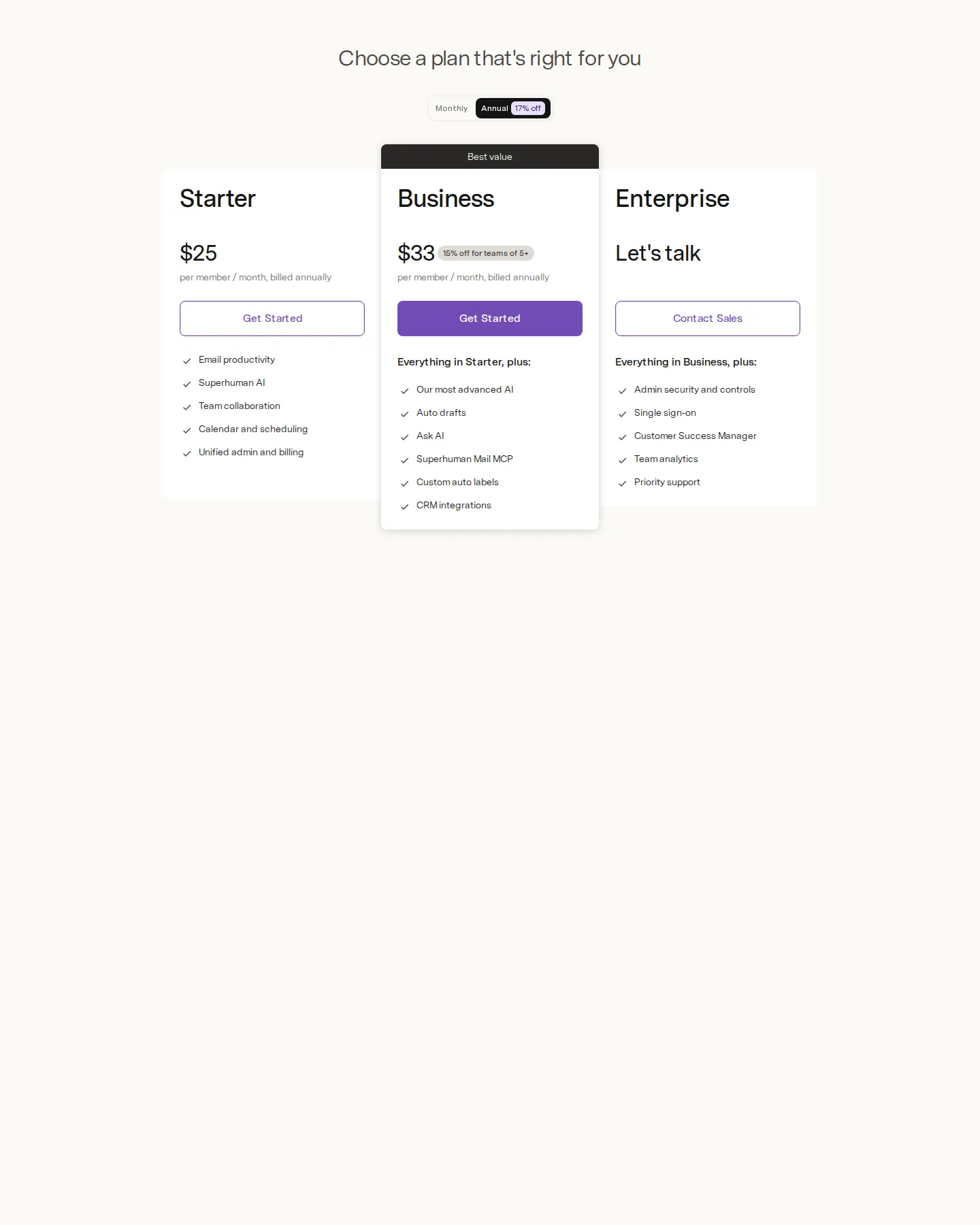
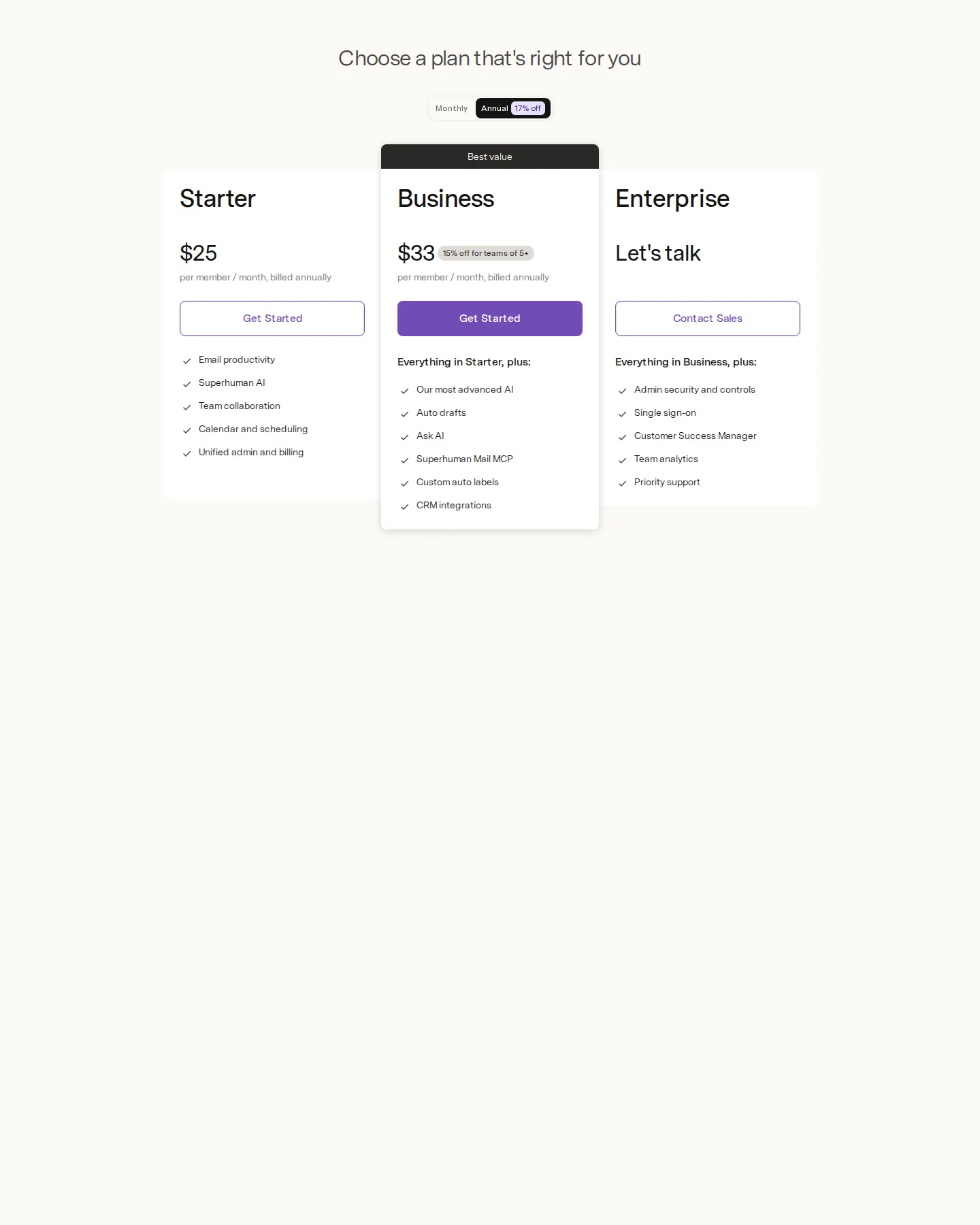
- Plan tier (seat price): Three tiers gate features, not capacity. Starter is $25/user/mo billed annually ($30/user/mo billed monthly). Business is $33/user/mo billed annually ($40/user/mo billed monthly) and is the highlighted tier. Enterprise carries no published price — it is “Let’s talk” / contact-sales only.
- Billing cadence (monthly vs. yearly): A Monthly/Yearly toggle sets the effective seat rate; the toggle itself is labeled “17% off” for Annual. The Business card’s highlight ribbon reads “Best value” on the Annual toggle and “Most popular” on the Monthly toggle — the copy changes with billing state. Business also carries a volume badge — “15% off for teams of 5+” (annual) / “Discount for 5+ accounts” (monthly) — and the page does not disclose what a smaller Business team pays.
- Page redesign (confirmed stable since 2026-08-04): superhuman.com/pricing renders a simplified three-card layout. The ~60-row feature-comparison matrix, customer testimonials, and FAQ that previously lived on this page remain gone; only short bullet lists remain per tier. Re-verified 2026-08-28 with no seat-price change.
What makes this different: There is no usage metering and no free tier — despite being an AI-heavy product, Superhuman charges a single predictable per-seat price with all AI features bundled into the tier rather than metered as credits or tokens. For how this contrasts with consumption-based approaches, see our guide to usage-based pricing models.
Pricing by product
Superhuman Mail (self-serve plans)
| Tier | Price (annual) | Included | Key mechanics |
|---|---|---|---|
| Starter | $25 / user / mo ($30/mo billed monthly) | Email productivity, Superhuman AI, Team collaboration, Calendar and scheduling, Unified admin and billing | Self-serve “Get Started”; Annual toggle labeled “17% off” |
| Business | $33 / user / mo ($40/mo billed monthly) | Everything in Starter, plus: Our most advanced AI, Auto drafts, Ask AI, Superhuman Mail MCP, Custom auto labels, CRM integrations | Self-serve “Get Started”; ribbon labeled “Best value” (Annual toggle) / “Most popular” (Monthly toggle); badge “15% off for teams of 5+” (annual) / “Discount for 5+ accounts” (monthly) — rate for teams under 5 not disclosed on-page |
Superhuman Mail (Enterprise)
| Tier | Price | Included | Key mechanics |
|---|---|---|---|
| Enterprise | Let’s talk | Everything in Business, plus: Admin security and controls, Single sign-on, Customer Success Manager, Team analytics, Priority support | Sales-led (“Contact Sales” on pricing page, “Contact sales” on the enterprise page); no list price; invoice billing available. Enterprise page now names BYOK (“Safeguard every message with enterprise-grade encryption, including BYOK, so you hold the keys to your own data”) as a named security control, newly disclosed as of the 2026-08-28 capture. |
Sales motions across products: self-serve for Starter and Business (sign up and pay online); sales-led for Enterprise (custom quote, “Contact Sales”).
Billing-cadence pricing (Monthly vs. Yearly)
The pricing page exposes a Monthly/Yearly toggle, labeled “17% off” for Annual. The seat prices above ($25 / $33) are the annual-billed rates; the monthly-billed rates are $30 (Starter) and $40 (Business). Enterprise pricing is not exposed on the toggle. As of the 2026-08-04 capture the page no longer shows struck-through list-year totals per card (seen in earlier captures) — only the per-month rate, the toggle-level “17% off” badge, and (new) a Business-only “15% off for teams of 5+” volume badge.
| Plan | Annual-billed (/user/mo) | Monthly-billed (/user/mo) | Implied annual savings |
|---|---|---|---|
| Starter | $25 | $30 | ~17% |
| Business | $33 | $40 | ~18% |
Hidden costs : what teams actually pay once you multiply by seats and skip the annual discount
Superhuman Mail has no usage meter, so there are no overage surprises — the “hidden” cost is structural: the per-seat price multiplies fast across a team, the AI features people actually want live on the pricier Business tier, and paying monthly quietly forfeits the 17–18% annual discount. Two representative bills:
A 10-person GTM team that wants the full AI (Business, annual)
| Line item | Monthly cost |
|---|---|
| 10 × Business seats @ $33/user/mo (annual-billed) | $330 |
| Total | $396/mo effective ($3,960/yr) |
To get Auto Drafts, Ask AI, and the “Most Advanced AI” — the features most teams sign up for — you must be on Business, not Starter. At 10 seats that is $3,960/year committed up front.
The same 10-person team paying monthly instead of annual
| Line item | Monthly cost |
|---|---|
| 10 × Business seats @ $40/user/mo (monthly list) | $400 |
| Annual discount forfeited (≈18%) | +$70/mo vs annual |
| Total | $400/mo ($4,800/yr) |
Choosing monthly billing for flexibility costs this team roughly $840 extra per year versus committing annually — the single largest avoidable line item on a Superhuman bill, since there is no usage metering to optimize.
Want to estimate your own Superhuman bill? Use the Superhuman pricing calculator to model your monthly cost based on seat count, Starter-vs-Business tier, and monthly-vs-annual billing.
Pricing evolution : from a flat $30 premium email to an AI-tiered module in a roll-up suite
Superhuman’s pricing arc has three acts: a long flat-price era ($30/user/mo), a 2024 AI repackage into the current $25/$33 two-tier structure, and a 2025–2026 corporate roll-up (acquired by Grammarly, which then rebranded itself Superhuman and bought Rows) that recast the standalone email subscription as one module inside a suite.
Cadence
| Quarter | Price changes | Product / SKU additions | Notes |
|---|---|---|---|
| 2023 Q1 | 0 | 0 | Team tiers at $25/user/mo annual (Starter / Growth / Enterprise), differing only by min-seat counts. |
| 2023 Q2 | 1 | 0 | Raised to the well-known flat $30/user/mo across Starter and Growth (2023-05 snapshot). |
| 2024 Q3 | 1 | 1 | Major AI repackage (~2024-08): Growth → Business, Starter cut to $25, Business set at $33, newest AI gated behind Business. |
| 2025 Q3 | 0 | 0 | 2025-07 — acquired by Grammarly; Mail seat pricing unchanged. |
| 2025 Q4 | 0 | 1 | 2025-10 — Grammarly renames company to Superhuman; Mail becomes “Superhuman Mail” inside the new Suite (adds Superhuman Go). |
| 2026 Q1 | 0 | 1 | 2026-02 — acquires Rows (AI spreadsheet); standalone Rows winds down by 2026-05-31. Mail seat pricing unchanged. |
| 2026 Q3 | 0 | 1 | 2026-07-08 — launches Superhuman Docs (AI-assisted document collaboration); new product surface, Mail seat pricing unchanged. |
Tracked range: 2023-01–2026-07. Quarters not listed above were verified stable (0 price changes, 0 SKU additions). The flat $30 era held from 2023-05 through 2024-07, confirmed across consecutive Wayback snapshots.
Notable changes
- 2023-05 — Team-tier seat price raised from $25 to the flat $30/user/mo (Wayback rendered snapshot).
- 2024-08 — Flat $30 replaced by tiered Starter $25 / Business $33; “Growth” renamed “Business”; Auto Drafts, Ask AI and “Most Advanced AI” moved behind the Business tier (verified across consecutive Wayback raw-HTML snapshots: 2024-07 still $30, 2024-08 already $25/$33).
- 2025-07 — Superhuman (email) acquired by Grammarly for an undisclosed sum (Grammarly company blog; TechCrunch coverage).
- 2025-10 — Grammarly rebrands the entire company to Superhuman, launching the four-product Suite (Grammarly, Coda, Mail, Go).
- 2026-02 — Superhuman acquires Rows; standalone Rows product winds down 2026-05-31 (Superhuman + Rows company blogs).
- 2026-07-08 — Superhuman launches Docs, extending from email into AI-assisted document collaboration; no change to Mail seat pricing (SiliconANGLE coverage). A new product surface absorbed into the suite rather than a new Mail SKU or meter.
The 2024 AI repackage in detail
The most consequential pricing move was not a headline price hike but a quiet restructuring around AI. For years Superhuman’s value story was speed and keyboard-first design at a flat $30. In August 2024 — almost a year before the Grammarly acquisition — it split that flat price into two tiers and used the gap to gate generative AI:
- Starter ($25, down from $30) keeps the speed/keyboard experience and baseline AI (Instant Reply, Auto Summarize) but not the newest agentic features.
- Business ($33, up from $30) adds Auto Drafts, Ask AI, “Our Most Advanced AI,” and CRM integrations (HubSpot, Salesforce).
The net effect was a price cut for light users and a price increase for anyone who wanted the AI — a textbook example of using a new tier to re-anchor willingness-to-pay around AI features rather than metering them as credits or tokens. The structure has held unchanged through the Grammarly acquisition, the rebrand, the Rows deal, and the July 2026 Docs launch — even as the suite keeps adding product surface, the Mail seat price has not moved.
What’s unique : bundled AI on a flat premium seat, no metering, famous PMF playbook
1. AI is bundled into the seat, not metered. Despite being marketed as an AI-native email client, Superhuman charges a single flat per-seat price with all AI (Auto Drafts, Ask AI, Auto Summarize, Instant Reply) included in the tier — no token counts, no credit pools, no per-action billing. This is the opposite of the credit-based billing and outcome-metering most AI tools have adopted; Superhuman keeps the bill predictable and absorbs the model-cost risk itself, betting that per-seat pricing and bundled AI beat consumption anxiety for premium buyers.
2. The price was reverse-engineered from willingness-to-pay, not cost. Superhuman famously set its flat $30 by asking users a Van Westendorp-style question — “at what monthly price would Superhuman be expensive, but you’d still buy it?” — and taking the median answer ($30), then rounding up off a “9” on a pricing expert’s advice. Few companies anchor a public price so explicitly to a survey of premium-buyer psychology rather than to COGS or competitor benchmarks.
3. A premium-only posture: no free tier, ever. There is no free plan and never has been — only a trial. In a category where Gmail and Outlook are free and most rivals run freemium, Superhuman deliberately refuses the free tier and uses a sales-coaching/onboarding motion (Group and VIP Productivity Coaching) as part of the product, treating onboarding as a paid, high-touch experience rather than self-serve friction.
4. A roll-up module, not a standalone app. Since the 2025 rebrand, Superhuman Mail is one tile in the subscription-priced Superhuman Suite (Grammarly + Coda + Mail + Go). That changes the strategic question from “is email worth $33/seat?” to “is the suite worth its combined seat cost?” — and explains why Mail’s own pricing has been left untouched through three corporate events.
Strengths & weaknesses
| Strengths | Weaknesses |
|---|---|
| Dead-simple, predictable bill — two list prices and a flat per-seat rate, no metering | Expensive vs. free Gmail/Outlook; the perennial “is it really worth $30+/seat?” debate (HN, Verge) |
| AI fully bundled into the seat — no token/credit anxiety, vendor absorbs model cost | No free tier at all — high commitment barrier; trial only |
| Clear AI upsell logic: the features people want sit on the $33 Business tier | Monthly billing forfeits ~17–18%; the real price is gated behind an annual commitment |
| Premium positioning + famous onboarding/PMF playbook drive strong retention | Pricing page covers only Mail; suite-level (Grammarly/Coda/Go) cost is opaque post-rebrand |
| Stable pricing through acquisition + rebrand signals low repricing risk for buyers | Roll-up uncertainty — acquired products (Rows) get sunset; suite packaging could shift seat economics |
Billing UX : Monthly/Yearly toggle, centralized billing, invoice for Enterprise
- Monthly / Yearly toggle — a segmented control on the pricing page switches every plan card between monthly and annual seat rates; the toggle itself is labeled “17% off” for Annual (redesigned 2026-08-04, replacing the earlier per-card struck-through list-year totals).
- Business-only volume badge — a new pill on the Business card reads “15% off for teams of 5+” (Annual view) / “Discount for 5+ accounts” (Monthly view); not present in earlier captures and the page does not disclose the rate below 5 seats.
- Unified admin and billing — listed as an included Starter-and-up feature; the Enterprise page separately describes “Centralized account management” — a single dashboard to manage accounts, permissions, and billing for teams from 50 to 5,000 seats.
- Payment methods — per the previously captured FAQ, all major credit cards plus Apple Pay and Google Pay for self-serve plans, with Enterprise able to additionally request to pay by invoice; the FAQ itself is no longer part of the redesigned pricing page as of this capture, so this detail was not re-verified today.
- Self-serve checkout vs. Contact Sales — Starter and Business carry “Get Started” self-serve checkout; Enterprise routes to “Contact Sales” (on the pricing page) or “Contact sales” / “Get started” (on the dedicated
/products/mail/enterprisepage) with no online checkout. - Billing-state-dependent ribbon copy — the Business card’s highlight ribbon reads “Best value” when the Annual toggle is active and “Most popular” when the Monthly toggle is active (confirmed 2026-08-28); the underlying seat prices ($25/$33 annual, $30/$40 monthly) are unchanged.
Strategic wins : pricing decisions other premium SaaS teams should study
1. Set the price by surveying willingness-to-pay, not cost
Superhuman’s $30 flat price came from asking premium buyers when the product would feel “expensive but still worth it” and taking the median — a discipline most teams skip in favor of cost-plus or competitor-matching. Pricing to perceived value is exactly the lesson in The value-metric problem in AI pricing and our guide to choosing the right usage metric: the right number lives in the buyer’s head, not your spreadsheet.
2. Used a new tier — not a meter — to monetize AI
When generative AI arrived, Superhuman resisted the industry reflex to bill it as tokens or credits. Instead, in August 2024 it split its flat price and parked the new AI on a higher Business tier, re-anchoring willingness-to-pay around AI while keeping the bill predictable. That sidesteps the bill-shock dynamic we cover in why AI companies are shifting away from per-user licenses — Superhuman keeps the per-user license and lets the tier, not a meter, capture the AI premium.
3. Turned onboarding into a paid, retention-driving asset
Rather than a frictionless free trial, Superhuman built a high-touch onboarding and “Productivity Coaching” motion into the product and the price. Combined with founder Rahul Vohra’s now-canonical PMF measurement (the “how disappointed would you be without it” survey), this produced the retention and word-of-mouth that justify a no-free-tier, premium stance. It’s a reminder that activation and the two-tier intelligence split can be a pricing lever, not just a UX one.
4. Kept Mail pricing rock-stable through three corporate events
Through the Grammarly acquisition, the company rebrand, and the Rows deal, Superhuman Mail’s $25/$33 seat prices did not move. Holding price steady through ownership change is itself a strategic win: it signals stability to buyers and avoids the trust hit that repricing-after-acquisition usually triggers.
Areas to improve : where the pricing leaves money or clarity on the table
1. The monthly-vs-annual gap is punitive and under-explained
A 10-seat team pays roughly $840/year more on monthly billing — a large, avoidable cost that the page surfaces only as a struck-through list price. Fix: show the explicit annual-vs-monthly dollar delta per team size at the point of decision, the way usage-priced vendors show projected spend, so buyers choose annual on purpose rather than overpaying by default.
2. Suite-level pricing is opaque after the rebrand
The page prices Superhuman Mail in isolation, but the company now sells a four-product Suite (Grammarly, Coda, Mail, Go). Buyers can’t easily reason about total cost of ownership across the suite. Fix: publish a suite/bundle price or a clear “Mail-only vs. Suite” comparison so the consolidation story has a transparent price tag, not just a marketing narrative.
3. No free tier limits the top of funnel against free incumbents
Competing against free Gmail and Outlook with a trial-only, no-free-tier model caps organic adoption and keeps Superhuman dependent on high-touch sales and word-of-mouth. Fix: consider a capped free “Lite” tier (speed features, no AI) that funnels into the $33 Business AI upsell — converting the current trial cliff into a freemium-style ladder without diluting the premium AI positioning.
4. AI value is gated by tier, not by usage — a missed expansion lever
Bundling all AI into a flat seat is predictable, but it leaves no usage-based expansion path: a power user who runs Ask AI 50× a day pays the same as one who never touches it. Fix: keep the flat seat but add an optional metered “AI boost” or higher-limit add-on for heavy agents, capturing more value from the heaviest users without breaking the simple base price.
Monetization stack & signals : how Superhuman builds & buys its revenue engine
Buys 2 Builds 0 1 signal role
Buys its CS and lifecycle-comms layer (Intercom, Iterable) and discloses no billing or payments vendor. The signal worth watching is the CS hire below: enterprise CS leadership chartered around multi-product net revenue retention as the four-product suite consolidates.
-
Superhuman is building enterprise CS leadership to manage net revenue retention across its four-product suite (Mail, Go, Docs, Grammarly) — the role's JD reveals the monetization frontier is cross-product expansion and retention, not a billing-engine build.
“Define the metrics that matter across multi-product adoption, net revenue retention, and health scores”
Signals reviewed · derived from public job posts, product docs
Job postings fill and close over time — once a posting is filled we keep it as a dated citation (the quoted evidence remains); use View open roles for current listings.
Key takeaways
- Price to willingness-to-pay, then commit. Superhuman’s flat $30 came from a buyer survey, not a cost model — and it held that price for years. The lesson: find the number buyers will pay, set it confidently, and resist constant tinkering.
- You can monetize AI with a tier instead of a meter. Superhuman captured the AI premium by adding a $33 Business tier and gating Auto Drafts/Ask AI behind it — not by counting tokens. For predictability-sensitive buyers, a feature-gated tier can beat consumption billing.
- A no-free-tier, premium stance can work — if onboarding does the selling. Superhuman replaced free-tier acquisition with a high-touch onboarding and PMF-measurement engine. The takeaway: premium pricing demands a deliberate activation motion, not just a better product.
- Hold price through ownership change to protect trust. Mail’s seat prices survived an acquisition, a full company rebrand, and another acquisition untouched. Stability is a feature buyers pay for; repricing-after-acquisition is a common, avoidable own-goal.
- Watch the monthly-vs-annual trap. The “real” price hides behind an annual commitment; monthly buyers silently overpay ~18%. Make the cheaper path the obvious one, or expect churn from buyers who feel penalized for flexibility.
UBP implications
- Bundled-AI-on-a-seat is a deliberate counter-move to consumption pricing. Superhuman shows that a premium vendor can absorb model costs and sell AI inside a flat seat — a hedge against the bill-shock and forecasting pain that drive buyers away from pure usage models. The trade-off is no usage-based expansion lever from heavy AI users.
- Feature-gated tiers are a viable alternative to metering AI value. Rather than charging per token or per resolution, Superhuman re-anchored willingness-to-pay by splitting one price into two and gating AI by tier. For products where predictability matters more than perfect value-capture, this is a legitimate UBP-adjacent design.
- Roll-ups complicate the unit of pricing. As standalone tools fold into suites (Grammarly + Coda + Mail + Go), the relevant pricing unit shifts from “per product seat” to “per suite seat,” and clean per-product comparisons erode. UBP strategists should expect consolidation to push pricing toward bundled seats and away from per-product meters.
Sources
- Superhuman Mail pricing page (accessed 2026-06-08)
- Superhuman Mail Enterprise page (accessed 2026-06-08)
- Superhuman company blog (accessed 2026-06-08)
- Superhuman to Acquire Rows — company blog (accessed 2026-06-08)
- Grammarly Rebrands Company as Superhuman — Grammarly blog (accessed 2026-06-08)
- Superhuman Suite — Help Center (accessed 2026-06-08)
Bottom line
Superhuman is the rare AI-heavy product that resists metering: a flat per-seat email subscription — $25 Starter, $33 Business, contact-sales Enterprise — that bundles all AI into the seat and bets predictability beats consumption pricing for premium buyers. Its pricing has stayed remarkably steady through a 2024 AI repackage and a 2025–2026 roll-up that turned the former Grammarly into the Superhuman Suite, leaving one open question: how long can a once-standalone $33 email seat stay priced in isolation inside a consolidating productivity suite?
Want to compare Superhuman against other productivity and email pricing? Browse the pricing blueprint.
Pricing timeline : Major events on a vertical axis
Each milestone below corresponds to a public pricing change, product launch, or material adjustment. Major events use a filled marker; minor adjustments use a faded one.
Re-verified: seat prices unchanged; Enterprise page now names BYOK
Re-captured superhuman.com/pricing and the Enterprise page. Seat prices confirmed unchanged (Starter $25/$30, Business $33/$40, Enterprise contact-sales). Two cosmetic-only findings: the Business card's highlight ribbon reads 'Best value' on Annual but 'Most popular' on Monthly (previously only the Annual state had been captured), and the Enterprise page now names BYOK explicitly in its encryption copy ('...enterprise-grade encryption, including BYOK, so you hold the keys to your own data'), alongside new 'Agents' and 'Superhuman Store' entries in the site's product nav.
Pricing page redesigned; seat prices confirmed unchanged
superhuman.com/pricing was rebuilt into a simplified three-card layout — the prior ~60-row feature-comparison matrix, testimonials, and FAQ were removed from the pricing page itself. Business tier gained a newly disclosed volume-discount badge ('15% off for teams of 5+' annual / 'Discount for 5+ accounts' monthly) not shown in prior captures; the page does not disclose the rate for smaller teams. Headline seat prices are unchanged: Starter $25/mo annual ($30 monthly), Business $33/mo annual ($40 monthly), Enterprise contact-sales.
Launches Superhuman Docs (no price change)
Superhuman launched Docs, extending from email into AI-assisted document collaboration (merging writing, AI and data). No change to Mail seat pricing — the per-seat subscription absorbed a new product surface rather than adding a separate SKU or a usage meter, the corpus's classic 'more surface, same seat price' move.
Facts captured — three-tier per-seat pricing
Captured superhuman.com/pricing: Starter $25/user/mo, Business $33/user/mo (both annual-billed), Enterprise contact-sales. Monthly/Yearly toggle present; annual saves 17–18%. Structure unchanged since the August 2024 repackage.

Acquires Rows (AI spreadsheet)
Superhuman acquired Porto-based AI-spreadsheet maker Rows to strengthen Coda; the standalone Rows product winds down by 2026-05-31. Reinforces the roll-up toward a unified productivity suite. No change to Mail seat pricing.
Grammarly renames company to Superhuman; Suite launches
Grammarly rebranded the entire company to Superhuman, uniting Grammarly, Coda, Mail (now 'Superhuman Mail'), and a new product Superhuman Go into one AI-native Suite. The email product's seat pricing ($25/$33) carried over unchanged.
Acquired by Grammarly
Grammarly acquired Superhuman (the email company) for an undisclosed sum, adding it to Grammarly + Coda (Coda was acquired in 2024). Mail pricing was unchanged by the deal.
AI repackage: flat $30 → tiered $25 / $33
Between July and August 2024 Superhuman repackaged: Growth was renamed Business, Starter was cut to $25/user/mo and Business set at $33/user/mo (annual $300/$396 vs list $360/$480), and newest AI (Auto Drafts, Ask AI, Most Advanced AI) was gated behind Business. Verified against consecutive Wayback raw-HTML snapshots (2024-07 = $30; 2024-08 = $25/$33).

Raised to the famous $30/user/mo
Snapshot shows Starter and Growth both at $30/user/mo — the well-documented flat $30 price Superhuman became known for. Structure stays Starter / Growth / Enterprise.

Team tiers at $25/user/mo (annual)
Wayback rendered snapshot shows Starter and Growth at $25/user/mo billed annually ($300/yr) plus a contact-sales Enterprise tier; min-seat counts differ (Starter 2 users, Growth 5, Enterprise 10).

- · Superhuman picked its famous $30/mo flat price by surveying users with the Van Westendorp question 'at what price would it be expensive but you'd still buy it' — the median answer was $30, and they rounded up off a '9' on a pricing expert's advice.
- · Founder Rahul Vohra ran a 450,000+ person invite-only waitlist and built a now-canonical product-market-fit engine around the metric 'how disappointed would you be if you could no longer use Superhuman' — targeting 40%+ 'very disappointed'.
- · Superhuman is now 'formerly Grammarly': Grammarly acquired Superhuman in July 2025, then in October 2025 renamed the entire company to Superhuman, folding Grammarly, Coda, Mail, and Go into one Suite.
Questions & answers
- How much does Superhuman Mail cost in 2026?
- Superhuman Mail is $25/user/mo (Starter) and $33/user/mo (Business) when billed annually, plus a contact-sales Enterprise tier. Monthly billing costs more — the annual prices reflect a 17–18% discount.
- Does Superhuman have a free tier?
- No. Superhuman Mail has no free plan — only a trial. Every tier is a paid per-seat subscription, which is unusual for an AI-heavy product.
- Is Superhuman still $30 a month?
- Not anymore. Superhuman charged a flat $30/user/mo for years, but in August 2024 it moved to a tiered model: Starter dropped to $25/user/mo and a new Business tier was set at $33/user/mo (both annual-billed).
- Is Superhuman the same company as Grammarly?
- Yes. Grammarly acquired Superhuman in July 2025 and in October 2025 renamed the entire company to Superhuman, uniting Grammarly, Coda, Superhuman Mail, and Superhuman Go under one brand and Suite.
- What did Superhuman acquire — Rows and Coda?
- Coda was acquired in 2024 and the original Superhuman email company in July 2025 (both under the Grammarly name). In February 2026, Superhuman acquired AI-spreadsheet maker Rows, which is winding down by May 31, 2026 with its tech folding into Coda.