AI Summary
About
Sweep AI is an AI coding assistant for JetBrains IDEs — IntelliJ IDEA, PyCharm, WebStorm, GoLand, PhpStorm, Rider, CLion, RubyMine and the rest of the JetBrains family. It delivers fast, context-aware autocomplete plus an in-IDE chat that can generate and edit code against your codebase, installed as a plugin from the JetBrains Marketplace.
That is not where Sweep started. The company (Y Combinator Summer 2023, founded by ex-Roblox engineers William Zeng and Kevin Lu) first shipped an autonomous GitHub issue-to-PR bot — an open-source “AI junior developer” that read a GitHub issue and opened a pull request to resolve it. That product earned roughly 7,600 GitHub stars and real attention, but the founders publicly concluded that reliable, end-to-end PR automation was “many years out.” They pivoted to a tool developers could trust every day right now: low-latency autocomplete for JetBrains, an editor family that had been comparatively underserved by AI assistants versus the VS Code / Cursor world. Sweep runs a custom inference stack tuned for sub-100ms suggestions and leans on JetBrains’ own code index for context.
That pivot is the key to reading Sweep’s pricing. The money model went from fuzzy, project-level automation (hard to meter, hard to price publicly) to a clean per-developer seat with a transparent rate card — the standard shape for an IDE assistant.
For current plans and to install the plugin, visit Sweep AI.
Pricing summary : How Sweep AI’s pricing model works
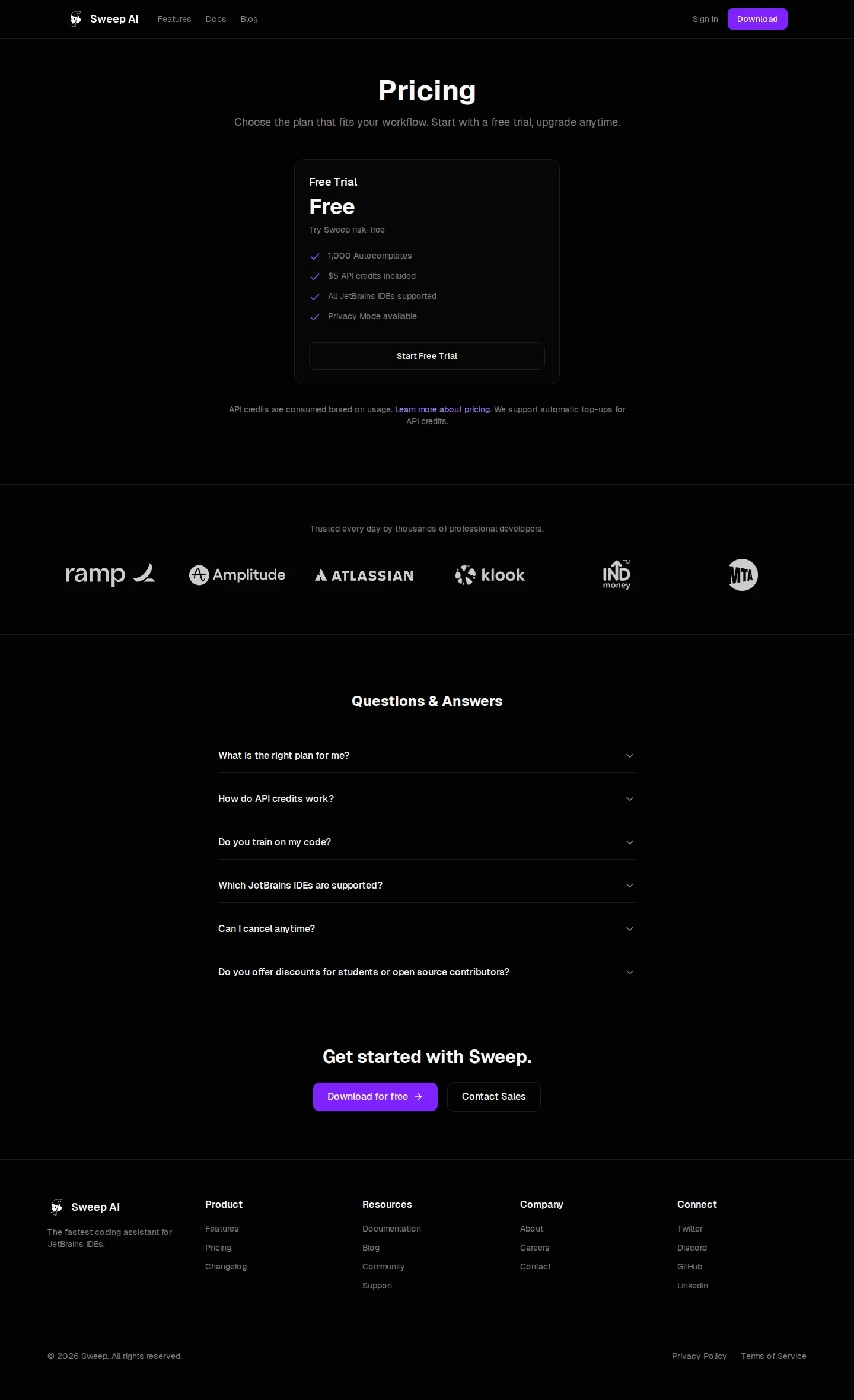
Sweep is freemium with a metered core. You start on a Free Trial — 1,000 autocompletes and $5 of included API credits, with all JetBrains IDEs and Privacy Mode available — then move to one of three flat monthly seats:
- Basic — $10/mo: unlimited autocomplete, smallest monthly API-credit allocation.
- Pro — $20/mo: unlimited autocomplete, more API credits, priority support. This is the highlighted “power user” plan.
- Ultra — $60/mo: unlimited autocomplete, the highest API-credit allocation.
The distinctive split: autocomplete is unlimited and free on every paid plan. API credits are only consumed by the heavier features — chat, code generation and advanced completions. Each plan ships a monthly credit allotment you watch in the Balance tab, and you can enable automatic top-ups so you never get cut off mid-task.
What makes this different: most coding assistants price one flat seat for everything (Copilot, Cursor) or meter every token. Sweep does both at once — it gives away the high-frequency, low-cost action (autocomplete) for free on paid tiers and reserves metering for the expensive, lower-frequency LLM calls. That makes the $10/$20/$60 ladder a floor: a quiet month stays at the seat price; a chat-heavy month with auto-top-up on can run above it.
Pricing by product
| Tier | Price | Included | Key mechanics |
|---|---|---|---|
| Free Trial | $0 | 1,000 autocompletes, $5 API credits, all JetBrains IDEs, Privacy Mode | One-time trial allotment; convert to paid when exhausted |
| Basic | $10/mo | Unlimited autocomplete, monthly API-credit allocation | Cheapest seat; credits cover chat/codegen, auto-top-up optional |
| Pro | $20/mo | Unlimited autocomplete, larger credit allocation, priority support | Highlighted plan for power users |
| Ultra | $60/mo | Unlimited autocomplete, highest credit allocation, priority support | Maximum AI throughput per seat |
Sales motions across products: self-serve / PLG end-to-end — download the plugin, start the Free Trial, upgrade in-app. There is no published Team or Enterprise rate card; volume and student/educator/open-source discounts are handled by emailing [email protected].
Hidden costs : What Sweep AI users actually pay
The seat price is honest, but the API credits are the variable you have to watch. Autocomplete being unlimited removes the usual coding-assistant bill-shock vector, but chat and code generation draw down a finite monthly allotment, and automatic top-ups mean the meter keeps running once the bundled credits are gone.
| Line item | Monthly cost |
|---|---|
| Base plan (Pro) | $20/mo |
| Autocomplete | Included (unlimited) |
| Chat / code generation | Drawn from bundled API credits |
| Credit overage (auto-top-up) | Variable — charged when bundled credits exhaust |
| Typical total (light chat use) | $20/mo |
| Heavy chat / codegen month | $20/mo + top-ups |
The practical guardrail is the Balance tab plus the choice to leave auto-top-up off — then Sweep degrades to free unlimited autocomplete when credits run out instead of billing you more. There are no seat minimums, no annual commitment, and cancellation is anytime with access through the end of the billing period.
Want to estimate your own Sweep AI bill? Use the Sweep AI pricing calculator to model your costs based on usage patterns.
Pricing evolution : Sweep AI pricing history and changes
Cadence
| Period | Price changes | Product / SKU additions | Notes |
|---|---|---|---|
| 2023 (S23) | n/a | Autonomous GitHub issue-to-PR bot | Open-source “AI junior dev”; ~7.6k GitHub stars; no settled rate card |
| 2024 | n/a | Pivot to JetBrains autocomplete plugin | Product reframed from project automation to per-developer IDE tooling |
| 2026 | Public 3-tier ladder live | Free Trial + Basic / Pro / Ultra | Seats with unlimited autocomplete + metered API credits |
Tracked range: 2023–present. The defining “change” is a product pivot, not a price cut — the move from issue-to-PR automation to an IDE assistant is what turned a hard-to-meter offering into a clean public seat ladder.
Notable changes
- 2023 (YC S23) — Launched as an autonomous GitHub issue-to-PR bot; gained traction (~7,600 GitHub stars) but no durable public pricing.
- 2024 — Pivoted to a JetBrains AI autocomplete assistant after deciding full PR autonomy was “many years out.”
- 2026-06-16 — Current rate card verified: Free Trial, Basic $10/mo, Pro $20/mo, Ultra $60/mo, all with unlimited autocomplete and metered API credits.
What’s unique : Sweep AI’s distinctive pricing mechanics
1. Unlimited autocomplete, metered everything-else. Rather than meter every AI action or charge one flat seat, Sweep gives away the high-frequency action (autocomplete) for free on paid plans and bills only the expensive LLM calls (chat, code generation) against credits. This aligns cost with the features that actually cost Sweep money to serve.
2. The seat price is a floor, not a cap. With bundled credits plus optional automatic top-ups, the $10/$20/$60 numbers are entry points. Light users sit at the seat price; heavy chat users pay more — a hybrid seat-plus-usage shape disguised as a simple subscription.
3. Pricing born from a pivot. Sweep’s clean per-seat card is the direct result of abandoning autonomous PR generation (which had no natural, meterable unit a buyer would trust) for IDE tooling (where “per developer per month” is the established, legible unit). The pricing legibility is itself a strategic outcome of the product decision.
Strengths & weaknesses
| Strengths | Weaknesses |
|---|---|
| Fully transparent public rate card — $10 / $20 / $60, no “contact us” wall | No published Team/Enterprise tier; org buyers must email sales |
| Unlimited autocomplete removes the usual per-completion bill-shock | API credits for chat/codegen are still a variable you must monitor |
| Genuine risk-free trial (1,000 completes + $5 credits) before paying | Auto-top-up can push spend past the headline seat price silently |
| JetBrains-native, sub-100ms latency where rivals are VS Code-first | JetBrains-only — no VS Code / Neovim coverage |
| Privacy Mode + student/OSS discounts widen the funnel | Pivot history means a shorter track record on the current product |
Billing UX : Sweep AI billing controls and transparency
- Billing controls — Self-serve upgrade/downgrade and cancel-anytime from account settings; access continues to the end of the billing period, with no long-term commitment or cancellation fee.
- Usage visibility — A Balance tab shows API-credit consumption; users configure whether and when automatic top-ups fire, which is the main spend lever.
- Payment options — Card-based self-serve subscription. Volume, student, educator and open-source discounts are arranged by emailing [email protected] rather than via a published enterprise rate card.
Strategic wins : Why Sweep AI’s pricing decisions worked
1. Choosing a unit the buyer already trusts
By pivoting to per-developer seats, Sweep adopted the unit JetBrains users already buy software in. That made the rate card instantly legible where its old issue-to-PR model had no clean, trustworthy meter. See usage-based pricing strategy for why metric choice drives adoption.
2. Giving away the cheap action to monetize the expensive one
Free unlimited autocomplete is a strong acquisition hook that also happens to be Sweep’s cheapest action to serve; metering only chat/codegen ties revenue to genuine cost. Related: how AI companies structure pricing and outcome-based pricing trends.
3. Transparency as competitive wedge
A fully public $10/$20/$60 ladder against rivals with murkier credit systems lowers buyer friction for individual developers — the exact self-serve audience Sweep targets. See choosing the right usage metric for context.
Areas to improve : Gaps in Sweep AI’s pricing approach
1. Credit allocations aren’t quantified on the page
The pricing page says each plan includes “more” or “highest” API credits but doesn’t publish the actual credit numbers per tier. Buyers can’t pre-compute when they’ll hit top-ups. See bill shock and cost unpredictability for why opaque allotments erode trust.
2. Auto-top-up can surprise heavy users
Because top-ups are automatic by default for power users, a chat-heavy sprint can exceed the seat price without an explicit prompt. Clearer caps or budget alerts would make the floor-vs-ceiling distinction obvious up front.
3. No self-serve team plan
There’s a gap between individual seats and “email sales.” A published Team tier with shared credit pools would capture small engineering teams that don’t want a sales conversation.
Monetization stack & signals : how Sweep AI builds & buys its revenue engine
Buys 0 Builds 1
Sweep builds the cost base it can't buy: serving completions on its own LLMs "for unmatched price" is what lets it give away unlimited autocomplete and meter only the expensive chat/codegen calls — a margin choice, not a packaging tweak.
-
“Sweep uses our own LLMs for unmatched price, performance, and security.”
- Payments Payments inferred
Signals reviewed · derived from product docs
Key takeaways
- Sweep’s pricing is freemium-with-a-meter: Free Trial, then Basic $10, Pro $20, Ultra $60, all with unlimited autocomplete plus metered API credits.
- The split is the strategy — give away the cheap, high-frequency action (autocomplete) and meter only the expensive LLM calls (chat, code generation).
- The seat price is a floor: automatic credit top-ups mean heavy users pay more than the headline number, so it’s a hybrid model wearing a subscription costume.
- The pricing is a product of a pivot: moving from an autonomous issue-to-PR bot to an IDE assistant gave Sweep a clean, trusted per-developer unit it never had before.
- Transparency is the wedge — a fully public rate card and a real risk-free trial target the self-serve JetBrains developer that bigger, sales-gated rivals under-serve.
UBP implications
- Meter the cost driver, not the engagement driver. Sweep’s free-unlimited-autocomplete + metered-chat split is a clean example of aligning the meter with marginal cost — a template for any AI product with one cheap high-frequency action and one expensive low-frequency one.
- A floor-price hybrid can read as “simple subscription.” Bundled credits plus auto-top-up let Sweep advertise $10/$20/$60 while still capturing usage upside; the lesson is to publish the bundled allotment so the hybrid stays honest.
- Pricing legibility can be a product decision. The pivot from un-meterable PR automation to per-seat IDE tooling shows that picking a product with an established unit of value can matter more for monetization than inventing a novel meter.
Sources
- Sweep AI pricing page (accessed 2026-06-16)
- Sweep AI official website (accessed 2026-06-16)
- Sweep on Y Combinator (accessed 2026-06-16)
Bottom line
Sweep AI is a JetBrains-native AI coding assistant that pivoted out of autonomous GitHub issue-to-PR automation into fast IDE autocomplete and chat. Its pricing is refreshingly transparent — a real risk-free trial, then $10 (Basic), $20 (Pro) or $60 (Ultra) per month, all with unlimited autocomplete and metered API credits for the heavier AI features. The seat price is a floor, not a ceiling: light users stay flat, chat-heavy users with auto-top-up pay more. Browse the pricing blueprint for fully-researched company profiles.
Want to compare Sweep AI against other Coding Assistants & Developer Tools companies? Browse the pricing blueprint.
Pricing timeline : Major events on a vertical axis
Each milestone below corresponds to a public pricing change, product launch, or material adjustment. Major events use a filled marker; minor adjustments use a faded one.
Free Trial + Basic/Pro/Ultra seats with API credits
Current public rate card: Free Trial (1,000 autocompletes, $5 credits), Basic $10/mo, Pro $20/mo, Ultra $60/mo. All paid plans get unlimited autocomplete; chat and code generation draw down metered, auto-top-up API credits.
Pivot to a JetBrains AI coding assistant
Deciding full PR-level autonomy was 'many years out,' the founders pivoted to a JetBrains autocomplete plugin with sub-100ms suggestions — shifting the product (and eventual pricing) from project-level automation to per-developer IDE tooling.
Launched as an autonomous GitHub issue-to-PR bot (YC S23)
Sweep debuted in 2023 as an open-source 'AI junior developer' that turned GitHub issues into pull requests, reaching ~7,600 GitHub stars. Monetization was early-stage and never settled into a public rate card.
- · Sweep started life as an autonomous GitHub issue-to-PR bot (YC Summer 2023) that hit ~7,600 GitHub stars before its founders concluded full autonomy was 'years out' and pivoted to a JetBrains autocomplete assistant.
- · Founded by ex-Roblox engineers William Zeng (senior MLE) and Kevin Lu (Waterloo CS), Sweep runs a custom inference stack tuned for sub-100ms completions to undercut Cursor-style latency.
- · Autocomplete is unlimited and free on every paid plan — Sweep only meters the expensive stuff (chat, code generation, advanced completions) against API credits, an unusual split for a coding assistant.
Questions & answers
- What is Sweep AI's pricing model?
- Sweep uses a freemium subscription with a usage twist. A Free Trial gives 1,000 autocompletes and $5 of API credits. Paid plans are flat monthly seats — Basic $10/mo, Pro $20/mo, Ultra $60/mo — each with unlimited autocomplete plus a monthly allocation of API credits that are consumed by chat and code generation.
- Does Sweep AI offer a free tier?
- There is a Free Trial (not a perpetual free tier): 1,000 autocompletes and $5 of included API credits, with all JetBrains IDEs and Privacy Mode supported. Once the trial credits and completions run out you move to a paid plan.
- How much does Sweep AI cost per month?
- Basic is $10/month, Pro is $20/month, and Ultra is $60/month. All three include unlimited autocomplete; the difference is the size of the monthly API-credit allocation (and priority support on Pro and above).
- How do Sweep's API credits work and can the bill exceed the seat price?
- API credits are spent on AI features like chat, code generation and advanced completions — autocomplete itself is unlimited and free on paid plans. Each plan includes a monthly credit allotment you can track in the Balance tab, and you can enable automatic top-ups. With auto top-up on, a heavy month can run above the $10/$20/$60 base, so the seat price is effectively a floor.