AI Summary
About
WellSaid Labs is a Seattle-based AI text-to-speech company whose Studio product turns scripts into lifelike voiceovers using a library of 280+ AI voices. It spun out of the Allen Institute for Artificial Intelligence (AI2) incubator in 2018 — co-founders Matt Hocking (CEO) and Michael Petrochuk met there — and raised a $10M Series A in July 2021 led by Fuse, with Voyager Capital, Qualcomm Ventures, and GoodFriends participating. It targets content teams — learning & development, marketing, creative agencies, and video production — that need studio-grade narration without booking human voice talent for every revision. The company positions ethical AI as a differentiator, marketing itself as “the only AI voiceover platform that pays 100% of our voice actors.”
The product is sold primarily to individual creators and small-to-midsize teams through self-serve plans, with a sales-led Enterprise tier for organizations that need full language coverage, SSO, SOC 2 compliance, and API access. WellSaid migrated its canonical domain from wellsaidlabs.com to wellsaid.io; the legacy domain 301-redirects to the new one. In mid-2026 the company rebuilt its plan ladder — adding two new low-end tiers (Starter $10/mo and Pro $33/mo, both annual-billed), retiring the single $50 Creative seat, and pushing the entry price far lower to compete against a crowded field of TTS rivals including ElevenLabs, Murf, Play.ht, and per-character cloud APIs.
Unlike pure usage-metered TTS APIs that bill per character or per minute, WellSaid packages capacity into tiered subscription plans with a fixed annual quota of downloaded audio minutes — a structure closer to creative SaaS than to a metered inference platform.
Pricing summary : How WellSaid’s per-seat voiceover plans are structured
WellSaid uses a tiered subscription model with an annual minute-quota capacity dimension layered on top:
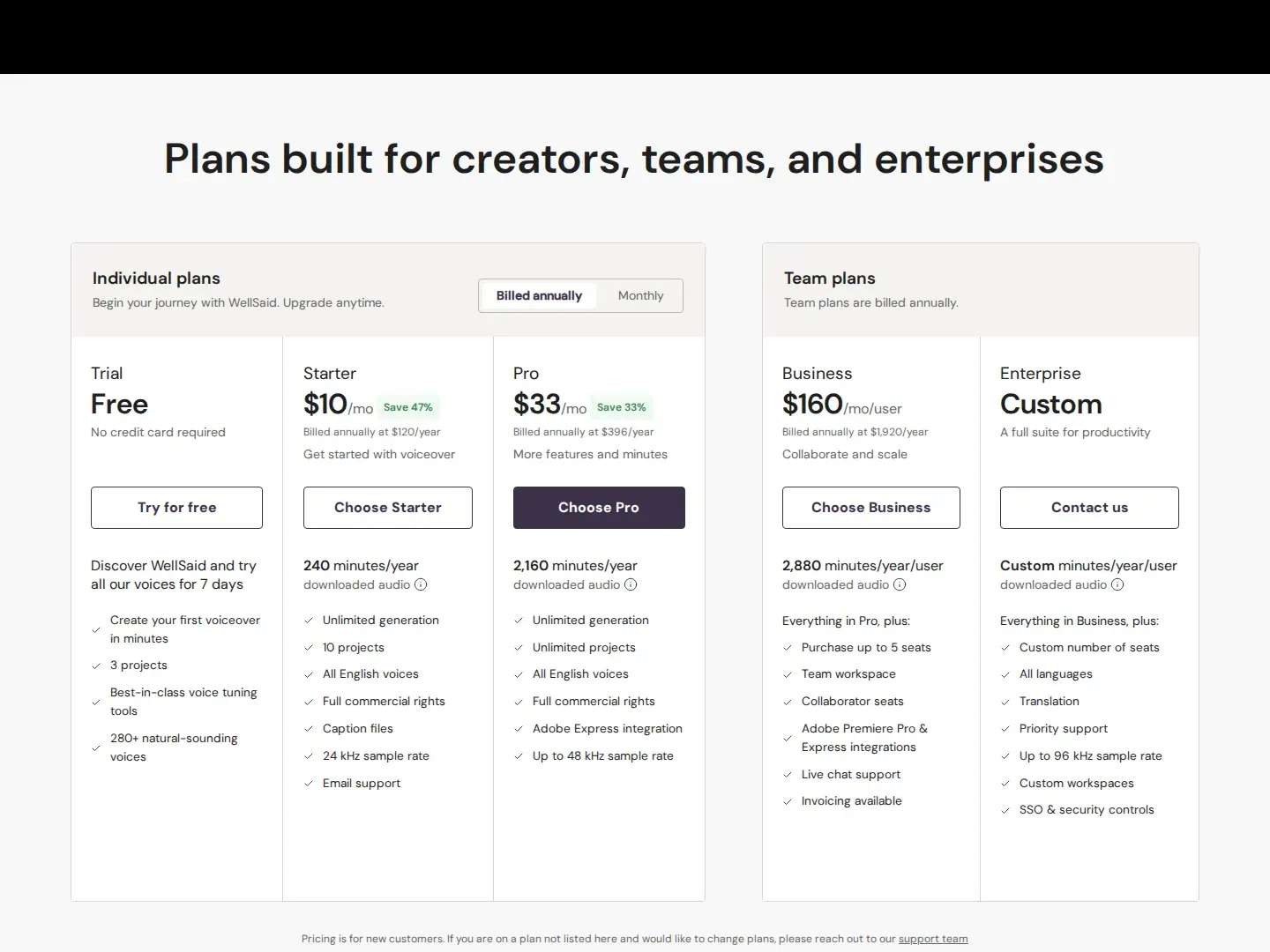
- Per-plan fee: Starter is $10/mo (billed annually at $120/year), Pro is $33/mo ($396/year), Business is $160/mo/user ($1,920/year/user), and Enterprise is custom-quoted. A free Trial (no credit card required) precedes upgrading to a paid plan. Starter and Pro advertise an annual discount (“Save $108/yr” and “Save $192/yr”) versus a higher monthly option; Business and Enterprise are annual-only.
- Annual minute quota per tier: Starter includes 240 minutes/year of downloaded audio, Pro 2,160/year, Business 2,880/year/user, and Enterprise a custom amount. As of 2026-08-11 the Trial itself now carries a 3 downloaded-minutes-per-month quota (no commercial rights on those downloads), replacing the prior “no downloads” free tier. Voice generation itself is unlimited on every tier — only downloaded audio counts against the quota. Starter and Pro also list an “Extra minutes available” self-serve top-up on the pricing page, though no per-minute overage rate is published.
- Seats by tier: Trial, Starter, and Pro are single-seat, Business covers 1 to 5 seats, and Enterprise offers a custom number of seats.
What makes this different: WellSaid resists the per-character / per-minute pay-as-you-go metering common to usage-based TTS APIs and instead sells fixed-capacity plans — the “usage” lever is an annual minutes-of-downloaded-audio quota, not a metered overage line, which keeps bills predictable but caps output hard at each tier.
Pricing by product
WellSaid Studio (Individual plans)
| Tier | Price | Included | Key mechanics |
|---|---|---|---|
| Trial | Free | 3 downloaded minutes/month (no commercial rights), 10 minutes generation, 3 projects, 280+ voices, voice tuning. No credit card required. | Ongoing free plan (no stated expiry); downloads not licensed for commercial use |
| Starter | $10/mo (annual; $120/year) | 240 minutes/year downloaded audio, unlimited generation, 10 projects, 1 seat, all English voices, full commercial rights, caption files, email support. | Entry plan; “Save $108/yr” vs monthly; 24 kHz, MP3 only; extra minutes available for purchase |
| Pro | $33/mo (annual; $396/year) | 2,160 minutes/year downloaded audio, unlimited generation, unlimited projects, 1 seat, all English voices, Adobe Express integration. | ”Save $192/yr” vs monthly; up to 48 kHz; the featured individual tier; extra minutes available for purchase |
WellSaid Studio (Team plans)
| Tier | Price | Included | Key mechanics |
|---|---|---|---|
| Business | $160/mo/user (annual; $1,920/year/user) | 2,880 minutes/year/user downloaded audio, 1 to 5 seats, unlimited projects, English library, MP3/WAV/OGG/TXT exports + SRT/VTT captions, Adobe Premiere Pro & Express integrations, team workspace, collaborator seats, live chat support, invoicing available. | Annual-only; self-serve team setup up to 5 seats; 24/48 kHz |
| Enterprise | Custom | Custom minutes/year/user, custom number of seats, unlimited projects, all languages + translation, up to 96 kHz, SSO, SOC 2 Type II reports, custom workspaces & access control, dedicated CSM, custom content moderation, API access. | Sales-led, quoted; everything in Business plus enterprise controls |
WellSaid API (bundled into Enterprise)
| Tier | Price | Included | Key mechanics |
|---|---|---|---|
| API (Enterprise) | Custom | Embed voice into LMS, apps, and IVR; sub-600ms latency; 9,000+ medical & 5,000+ legal terms built in; usage rights + content moderation. | No published per-character / per-minute rate; quoted as part of the Enterprise contract |
Sales motions across products: PLG / self-serve for Trial, Starter, Pro, and Business; sales-led for Enterprise and API access.
Hidden costs : What WellSaid teams actually pay at scale
The advertised per-seat headline understates total cost in two ways: the minute quota is a hard ceiling with no self-serve overage, so a creator or team that exceeds it must jump a whole tier (or call sales); and seat caps force the same jump once Pro’s single seat or Business’s five seats run out. Because there is no per-minute meter, the “hidden cost” here is not an overage line — it is the forced step-up to the next tier and its much larger commitment. That trade — flat predictability in exchange for a hard cliff — is the opposite of the bill-shock problem that metered AI products face, and it appeals to exactly the buyers who fear a runaway invoice.
Archetype 1 — A solo course creator on Pro who outgrows the quota. Pro is $33/mo/user (annual) = $396/year and includes 2,160 minutes/year of downloaded audio. A creator publishing two 10-lesson courses a quarter, iterating heavily, can blow past 2,160 finished minutes even though generation and retakes are free. There is no top-up SKU, and Pro is single-seat, so the only path up is Business:
| Line item | Annual cost |
|---|---|
| Pro seat ($33/mo, annual) | $396 |
| Overage path for >2,160 minutes/year | None — must upgrade |
| Forced upgrade to Business ($160/mo/user, annual) | $1,920 |
| Effective cost once quota is exceeded | $1,920 (4.8× the Pro price) |
The lesson: WellSaid’s predictability cuts both ways — there is no small metered overage to absorb a spike, so the marginal cost of the 2,161st minute is the full $1,524/year gap to the next tier.
Archetype 2 — A 6-person marketing team on Business. Business covers up to 5 seats at $160/mo/user. A 6th seat does not exist on Business — it triggers Enterprise (custom-quoted), so the team that “just needs one more login” leaves a transparent price for a sales call:
| Line item | Monthly cost |
|---|---|
| 5 × Business seats ($160/user/mo) | $800 |
| 6th seat on Business | Not available |
| Forced move to Enterprise | Custom (sales-quoted) |
| Transparent monthly cost before the seat cliff | $800 |
So at exactly the point a team scales past five people — or needs API access, SSO, or more than 2,880 minutes/year/user — pricing goes opaque. For teams budgeting around these cliffs, modeling seats and minute volume up front avoids a mid-year re-contract. See our guide on choosing the right value metric for why fixed-quota seats trade flexibility for predictability.
Want to estimate your own WellSaid bill? Use the WellSaid pricing calculator to model your monthly cost based on seats and downloaded-minute volume.
Pricing evolution : From wellsaidlabs.com to the wellsaid.io plan lineup
WellSaid’s pricing surface was archived continuously on wellsaidlabs.com/pricing from 2020 through January 2025, then on the new wellsaid.io/ai-voice-pricing domain. The structure changed far more often than the headline numbers: the same $49 / $99 / $199 monthly steps held from late 2020 all the way to the 2025 migration, while the capacity metric underneath them mutated repeatedly — from “audio clips” to “audio files” to “downloads” to “downloads/year.”
Cadence
| Quarter | Price changes | Product / SKU additions | Notes |
|---|---|---|---|
| 2020 Q2 | 0 | 1 | Earliest archive: 3-tier Trial / Creative $99 / Premium Team (quote), priced per seat, billed monthly. |
| 2020 Q4 | 1 | 2 | Restructured to 4 tiers — Maker $49 / Creative $99 / Producer $199 / Team (custom); Monthly/Yearly (10% off) toggle added. |
| 2021 Q2 | 0 | 0 | Capacity metric reframed to downloads + 1,000 chars/clip; “Voice Avatars” (4 / 15 / 15) and unlimited retakes introduced. Prices unchanged. |
| 2022 Q2 | 0 | 0 | Voice Avatar library grows (Creative/Producer to 50). $49 / $99 / $199 held. |
| 2023 Q1 | 0 | 0 | OGG/WAV export formats added beyond MP3; 53 Voice Avatars. Prices held. |
| 2024 Q1 | 0 | 1 | ”Team” relabelled Business ($199/user/mo); dedicated Enterprise tier added; chars/clip raised 1,000 → 5,000. |
| 2025 Q1 | 0 | 0 | Domain migration begins (301 redirects); rebuilt page drops the Maker tier, compresses to Creative $99 / Business $199 / Enterprise. |
| 2026 Q2 | 3 | 2 | wellsaid.io relaunch (early Q2): Creative $99 → $50, Business $199 → $160, download quota → annual cap. Ladder rebuild (late Q2): Starter $10 and Pro $33 added, Creative retired, capacity meter switched from downloads/year to minutes/year (240 / 2,160 / 2,880/user / custom). |
Tracked range: 2020-04–2026-06. Quarters not listed had no archived price or SKU change.
Notable changes
- 2020-04 — Earliest archived pricing: a 3-tier Trial / Creative $99 / Premium-Team lineup, priced per seat with unlimited audio clips on the paid tiers (Wayback
20200402). - 2020-12 — Expanded to four named tiers (Maker $49 / Creative $99 / Producer $199 / custom Team) with a Yearly-10%-off toggle (Wayback
20201205). - 2021-07 — WellSaid raised a $10M Series A led by Fuse (with Voyager Capital, Qualcomm Ventures, GoodFriends), per GeekWire; the pricing page kept its $49 / $99 / $199 steps unchanged.
- 2024-02 — Renamed “Team” to “Business,” added a sales-led “Enterprise” tier, and raised the per-clip character limit from 1,000 to 5,000 (Wayback
20240222). - 2025-01 — Canonical domain began 301-redirecting toward wellsaid.io; the rebuilt page dropped the entry-level Maker tier entirely (Wayback
20250115). - 2026-06 (early) — On wellsaid.io, Creative was cut from $99 to $50/mo/user and Business from $199 to $160/mo/user, and the download quota was reframed from per-user-per-month to a fixed annual cap.
- 2026-06-24 — Ladder rebuilt: Starter $10/mo ($120/year) and Pro $33/mo ($396/year) added below Business, the Creative tier retired, and the capacity meter switched from downloads/year to minutes/year of downloaded audio (Starter 240, Pro 2,160, Business 2,880/user, Enterprise custom); voice library grew to 280+.
The 2026 ladder rebuild in detail
For roughly five years (late 2020 → early 2025) WellSaid’s monthly seat prices were effectively frozen at $49 / $99 / $199 across every restructure — only the bundled capacity and feature lists moved. 2026 broke that frozen ladder twice in a single quarter, both times downward.
The early-Q2 wellsaid.io relaunch cut the headline Creative seat from $99 to $50 and Business from $199 to $160, and reframed the download allowance from per-user-per-month to a fixed annual cap (720 / 1,300 / 4,300 downloads/year). The 2026-06-24 ladder rebuild went much further: it retired the $50 Creative seat entirely and split the entry into two new tiers — Starter $10/mo ($120/year) and Pro $33/mo ($396/year) — dropping the effective floor from $50 to $10, an 80% cut at the entry in under a month. Business held at $160 and Enterprise stayed custom.
Cutting list price is rare in this corpus — most vendors raise prices or add usage meters as they scale — and doing it twice in one quarter reads as an urgent, defensive response to commoditizing TTS competition (ElevenLabs, Murf, Play.ht, and per-character cloud APIs) rather than a pricing-power play: a $50 floor still looked expensive next to rivals offering a free or near-free starting tier, so WellSaid built one. The 06-24 change also swapped the unit again — from downloads/year to minutes/year of downloaded audio (240 / 2,160 / 2,880/user / custom) — the fifth distinct capacity metric since 2020, and the first denominated in audio output rather than file count. Minutes map more directly to how a creative buyer thinks about a finished voiceover than an abstract “download,” so the switch is as much a comprehension play as a re-pricing one. For more on why repackaging the unit often matters more than the number, see the psychology of pricing.
What’s unique : Seat plans with download quotas, not metered minutes
1. Seats with a fixed minute quota instead of metered minutes. WellSaid prices by named-user seat and caps output with a fixed annual allowance of downloaded-audio minutes (240 / 2,160 / 2,880/user) rather than billing per character or per minute consumed. The unit is minutes, but it is a pre-paid bundle, not a meter — bills stay flat and predictable, yet heavy users hit a hard ceiling rather than paying linear overage. As of 2026-06-24 this is the fifth distinct capacity metric the product has used since 2020 (clips → files → downloads → downloads/year → minutes/year).
2. Generation is unlimited; only finished downloads consume quota. WellSaid meters the output you keep, not the work you do to get there — voice generation and retakes are unlimited, and only downloaded audio counts against the annual minute allowance. The quota rations delivered value rather than experimentation, which is why a single denominator can sit across all tiers without taxing iteration.
3. API is an Enterprise feature, not a product. WellSaid does not publish a standalone metered API price; API access is bundled into the custom-quoted Enterprise tier.
Strengths & weaknesses
| Strengths | Weaknesses |
|---|---|
| Predictable flat per-seat pricing with no surprise usage overage | Hard annual minute quotas cap output; no self-serve overage path |
| $10 Starter floor undercuts most paid TTS entry tiers | API pricing is gated entirely behind Enterprise sales |
| Unlimited generation and retakes don’t count against the quota | Starter/Pro are English-only and single-seat |
| Ethical-AI positioning (pays 100% of voice actors) | Pro-to-Business jumps from $33 to $160/seat — a ~5× step for the first team seat |
Billing UX : Plan toggles and quota controls on the pricing page
- Billed annually / Monthly toggle — a “Billed annually / Monthly” switch sits above the Individual plans (Starter, Pro); annual is the default and shows the discounted rate ($10/mo, $33/mo) with “Save $108/yr” / “Save $192/yr” callouts, while the monthly view shows $19/mo Starter (20 minutes/month) and $49/mo Pro (180 minutes/month). Business and Enterprise are labelled “billed annually” with no monthly option.
- “Compare all plans & features” table — a full feature matrix on the pricing page lays out downloaded minutes/year, generation, projects, seats, sample rates, export formats, integrations, security, and support SLAs side-by-side across all five tiers.
- Minute-quota counters — each paid plan states its annual “minutes/year downloaded audio” allowance (240 / 2,160 / 2,880/user / custom) as the primary capacity meter, with unlimited generation called out separately so only finished downloads consume quota; the free Trial now shows its own “3 download minutes per month (no commercial rights)” quota line, replacing the prior “No downloads” allowance.
- “Extra minutes available” self-serve top-up — Starter and Pro plan cards each carry an “Extra minutes available” line (no per-minute rate published on the pricing page), a new self-serve overage control not present on the 2026-06-24 capture.
- “Choose Pro” highlighted CTA — the Pro plan card carries the dark featured button, signalling it as the recommended individual tier.
- Sitewide “New plans are here” banner — a persistent top-of-page banner (“All with unlimited generation and commercial rights built-in”) links to a “Learn more” explainer, flagging the recent plan restructure across every page on the site, including Enterprise and Contact Sales.
- “Contact us” / “Book a demo” CTAs — Enterprise and API access route to a sales form (wellsaid.io/contact-sales, ai-voice-enterprise) rather than self-serve checkout.
- Legacy-plan footnote — the pricing page states “Pricing is for new customers. If you are on a plan not listed here and would like to change plans, please reach out to our support team,” signalling that existing customers on retired tiers (e.g. the pre-2026-06-24 Creative seat) are grandfathered outside the current ladder rather than auto-migrated.
Strategic wins : Why predictable seat pricing works for creative teams
1. Predictable per-seat pricing lowers buyer anxiety
Flat seat fees with no metered overage make budgeting trivial for creative and marketing teams, a deliberate contrast to per-character TTS APIs where a long script can produce a surprise bill. For a content team that values “I know exactly what this costs each month” over “I pay precisely for what I use,” a fixed seat with a known quota is the easier purchase order to sign. The five years of frozen $49 / $99 / $199 steps reinforced that stability as a brand promise.
2. Unlimited retakes remove the per-edit cost penalty
Because retakes never count against the download quota, teams can iterate on a script freely without watching a meter — a friction-removal choice that suits the iterative creative workflow. In TTS the first render is rarely the final one (pronunciation fixes, pacing, emphasis), so metering renders would tax exactly the behaviour the product wants to encourage. Charging only on download aligns the meter with delivered value, a pattern we explore in picking a value metric that aligns with customer value.
3. Driving the entry floor to $10 to meet commoditization head-on
2026 cut WellSaid’s list price twice in one quarter: the early-Q2 relaunch took Creative from $99 to $50 and Business from $199 to $160, then the 2026-06-24 rebuild retired Creative and opened a $10 Starter floor (with a $33 Pro above it) — a rare, and rapid, downward move in a corpus where most vendors raise prices over time. Against ElevenLabs, Murf, Play.ht, and per-character cloud APIs racing toward zero marginal cost, even a $50 seat looked hard to justify next to rivals with near-free entry tiers; a $10 starting point resets the comparison and gives the funnel a low-commitment first rung while keeping the predictable-seat story intact. It is a defensive, share-protecting pricing decision rather than a margin grab — a dynamic we cover in usage-based pricing for SaaS and AI products.
4. Ethical-AI positioning as a pricing-adjacent moat
WellSaid’s “pays 100% of voice actors” stance differentiates it from commodity TTS on trust rather than price, supporting premium seat fees even after the cut. For enterprise buyers in regulated or brand-sensitive contexts (training, healthcare, financial services), licensed-voice provenance and content moderation are procurement requirements, not nice-to-haves — which is exactly why those controls sit in the sales-led Enterprise tier.
Areas to improve : Gaps in quota flexibility and API transparency
1. Add a self-serve overage path for download quotas
Hard annual caps force a full-tier upgrade (or a sales call) the moment a creator exceeds the quota — as Archetype 1 shows, the 2,161st minute effectively costs the $1,524/year gap from Pro to Business. A pay-as-you-go top-up bundle (e.g. “extra 100 minutes for $X”) or a small metered overage rate would smooth that cliff and capture revenue from power users instead of pushing them to evaluate competitors. This is the classic case for a usage-based overage layer on top of a base plan.
2. Publish indicative API pricing
Gating all API pricing behind Enterprise sales blocks developer evaluation entirely — there is no published per-character or per-minute rate at all. Even an indicative rate band on the API page would let developers self-qualify and shorten the buyer journey, the way metered TTS rivals do. Bundling API access only into a custom-quoted Enterprise contract also forfeits the bottom-up, developer-led adoption motion that drives many infrastructure businesses; a published usage-based API tier would open that channel.
3. Soften the Pro-to-Business seat cliff
The 2026-06-24 rebuild filled the price gap below Business — Starter $10 and Pro $33 now ladder up to the single seat — but it left a sharper capacity-and-seat cliff at the top of the individual range. A solo creator who outgrows Pro’s single seat or its 2,160 minutes/year has nowhere to go but Business at $160/mo/user, a ~5× jump that also forces a move from a personal plan into a team workspace they may not need. A 2–3 seat “Studio” tier around $70–90 with a quota between Pro and Business would capture the growing-pair / small-agency segment that currently has to over-buy into Business or churn. Tiering that follows the customer’s growth curve, rather than forcing a 5× leap at the team boundary, is a recurring theme in how to package usage-based plans.
Monetization stack & signals : how WellSaid Labs builds & buys its revenue engine
Buys 2 Builds 0
Buys its entire monetization spine — Stripe handles self-serve subscription billing directly (no separate metering layer needed for its flat-quota model), Zendesk covers enterprise support. No dedicated usage-metering middleware disclosed, consistent with a fixed-quota subscription that never bills on raw consumption.
Signals reviewed · derived from engineering blogs, product docs
Key takeaways
-
Seat pricing with quotas can substitute for metered usage. WellSaid proves a creative-tools audience will accept fixed per-seat plans with download caps instead of per-minute metering when predictability matters more than linear scaling. The quota does the rationing that a meter would, without the billing complexity.
-
You can freeze the number and still re-price by moving the unit. From 2020 to 2025 the $49 / $99 / $199 steps never moved, yet WellSaid effectively re-priced repeatedly by changing the bundled capacity metric — clips, then files, then downloads, then downloads/year, and as of 2026-06-24 minutes/year of downloaded audio. Five denominators in six years: the headline is only one lever; the denominator is the other.
-
Cutting list price is a legitimate competitive tool, not just a sign of weakness. WellSaid dropped its entry floor from $50 to a $10 Starter within a single 2026 quarter — a deliberate response to commoditizing TTS rivals with near-free tiers; resetting the comparison can protect share more cheaply than out-marketing a dozen competitors at a stale price.
-
Hard caps without an overage path create a churn-or-upgrade fork. With no top-up SKU, a customer who exceeds the quota must either jump a full tier or leave — capturing neither the incremental revenue nor the goodwill that a graceful overage would. Predictability for the buyer can mean abandoned revenue for the vendor.
-
Auto-renewal billing is a trust surface, not just an ops detail. WellSaid’s 2.4/5 Trustpilot score is driven less by the product than by renewal-and-cancellation disputes — a reminder that billing UX and clear cancellation flows protect the brand as much as the pricing page does.
UBP implications
-
Quota-as-meter is a soft usage-based model. WellSaid’s annual minute quotas function as a usage dimension without the operational overhead of true metering — a pattern worth studying for teams wary of full usage-based billing. It captures the rationing benefit of a meter while keeping a single predictable invoice.
-
The unit you meter shapes how buyers value the plan. WellSaid has changed its capacity denominator five times — most recently (2026-06-24) from downloads/year to minutes/year of downloaded audio. Minutes map to a finished voiceover more intuitively than an abstract “download,” so the switch makes the same fixed-capacity model easier to reason about even though the rationing mechanic is unchanged. Choosing a value metric the buyer already thinks in can shift perceived value as much as the quota size itself.
-
Missing overage = forfeited expansion revenue. A pure fixed-capacity model leaves the most engaged customers with nowhere to spend; adding even a thin metered overage converts power users into expansion revenue instead of upgrade-or-churn decisions — the core argument for hybrid seat-plus-usage models.
Sources
- WellSaid Labs pricing page (accessed 2026-08-14)
- WellSaid Labs enterprise page (accessed 2026-08-14)
- WellSaid Labs API page (accessed 2026-06-24)
- WellSaid Labs contact sales (accessed 2026-08-14)
Bottom line
WellSaid Labs prices AI voiceover the way creative SaaS prices itself — flat per-seat plans with a fixed annual download quota instead of per-minute metering — trading linear scalability for bill predictability, with API access reserved for custom-quoted Enterprise deals.
Want to compare WellSaid against other AI media pricing? Browse the pricing blueprint.
Pricing timeline : Major events on a vertical axis
Each milestone below corresponds to a public pricing change, product launch, or material adjustment. Major events use a filled marker; minor adjustments use a faded one.
Ladder rebuilt: Starter $10 + Pro $33 added, Creative retired, meter switched to minutes/year
WellSaid replaced the single $50 Creative seat with two new low-end tiers — Starter $10/mo ($120/year) and Pro $33/mo ($396/year), both annual-billed — keeping Business at $160/mo/user ($1,920/year) and Enterprise custom. The capacity meter changed from downloads/year to minutes/year of downloaded audio: Starter 240, Pro 2,160, Business 2,880/user, Enterprise custom. Generation is unlimited; voice library grew to 280+.
wellsaid.io relaunch: Creative cut to $50, Business to $160, quota reframed per-year
On the new wellsaid.io domain, Creative dropped from $99 to $50/mo/user (annual) and Business from $199 to $160/mo/user; Enterprise stayed custom. The download quota was reframed from per-user-per-month to a fixed annual cap (720 / 1,300 / 4,300 downloads/year).
Domain migration begins; Maker dropped, lineup compresses to Creative / Business / Enterprise
wellsaidlabs.com/pricing starts 301-redirecting and the rebuilt page drops the entry Maker tier, leaving Creative $99/mo, Business $199/user/mo, and Enterprise (Contact Sales). Capacity stated as 'downloads per user' (250 / 750 / unlimited). (Wayback 2025-01-15)
Team renamed Business; dedicated Enterprise tier added; chars/clip 1,000 → 5,000
The custom 'Team' tier was relabelled 'Business' at $199/user/mo and a separate sales-led Enterprise tier was added. Character limit per clip raised from 1,000 to 5,000. Maker $49 / Creative $99 / Business $199 held; annual pricing $44 / $89 / $179. (Wayback 2024-02-22)
Capacity metric becomes downloads + chars/clip; Voice Avatars introduced
Same $49 / $99 / $199 price points, but capacity reframed to downloads (250 / 750 / 2,500), 1,000 chars/clip, and 'Voice Avatars' (4 on Maker, 15 on Creative/Producer). Unlimited retakes called out for the first time. (Wayback 2021-06-21)
Four-tier restructure: Maker $49 / Creative $99 / Producer $199 / Team
Lineup expanded to Maker $49/mo, Creative $99/mo (Most Popular), Producer $199/mo, and a custom Team tier, with a Monthly/Yearly (10% off) toggle. Capacity expressed as audio files + Projects + AI voices (250 / 750 / 2,500 files). (Wayback 2020-12-05)
Three-tier launch lineup: Trial / Creative $99 / Team
Earliest archived pricing on wellsaidlabs.com/pricing: a free Trial (1 seat, 50 audio clips), a 'Most Popular' Creative plan at $99/mo (1 seat, unlimited audio clips, 15 synthetic voices), and a Premium Team tier quoted on request. Priced per seat, billed monthly. (Wayback 2020-04-02)
- · WellSaid mid-2026 swapped its capacity meter from 'downloads/year' to 'minutes/year' of downloaded audio — Starter 240, Pro 2,160, Business 2,880/user, Enterprise custom — the fifth distinct capacity metric the product has used since 2020.
- · The June 2026 page introduced two brand-new low-end tiers, Starter $10/mo and Pro $33/mo (annual), replacing the single $50 Creative seat and rebuilding the ladder as Trial / Starter / Pro / Business / Enterprise.
- · Starter and Pro advertise their annual savings on the card itself — 'Save 47%' on Starter ($120/year) and 'Save 33%' on Pro ($396/year) — while Business ($1,920/year/user) and Enterprise are annual-only with no monthly option.
Questions & answers
- How much does WellSaid Labs cost?
- WellSaid offers a free 7-day Trial, a Starter plan at $10/mo (billed annually at $120/year), a Pro plan at $33/mo ($396/year), a Business plan at $160/mo/user ($1,920/year/user), and a custom-quoted Enterprise plan.
- Does WellSaid Labs have a free plan?
- WellSaid offers a free 7-day Trial with no credit card required and access to all voices, but no permanent free tier — after the trial you must pick a paid plan.
- How many minutes do WellSaid plans include?
- Plans bundle a fixed annual quota of downloaded audio minutes: Starter 240 minutes/year, Pro 2,160 minutes/year, Business 2,880 minutes/year per user, and Enterprise a custom amount. Voice generation itself is unlimited; only downloaded audio counts against the quota.
- Does WellSaid charge per minute or per character for its API?
- No published per-minute or per-character API rate exists. WellSaid bundles API access into the Enterprise plan, which is custom-quoted via sales.
- Did WellSaid Labs change its pricing in 2026?
- Yes. In mid-2026 WellSaid rebuilt its ladder — adding a $10/mo Starter and a $33/mo Pro tier below Business, retiring the single $50 Creative seat, and switching its capacity meter from downloads/year to minutes/year of downloaded audio.
- Who owns WellSaid Labs and how much has it raised?
- WellSaid Labs is a private Seattle company that spun out of the Allen Institute for AI (AI2) incubator in 2018. It raised a $10M Series A in July 2021 led by Fuse, with Voyager Capital, Qualcomm Ventures, and GoodFriends participating.