Hyperbolic splits compute into four surfaces with prepaid credits and a price lock
Hyperbolic now packages compute as On-Demand, Reserved, Private Cloud and Serverless Inference, funded by never-expiring prepaid credits with a $5 minimum and Auto Top-Up.
Two self-serve surfaces (GPU marketplace, serverless inference); reserved clusters and dedicated hosting were sales-quoted only.
Four documented surfaces — On-Demand (hourly, 99.5% SLA), Reserved (prepaid, self-serve from 1 week to 1 month), Private Cloud (custom contract), Serverless Inference (99.9% SLA) — plus separately metered storage volumes.
Proof of change
Hyperbolic's own wording, on the page where we captured it.
the cost per hour per GPU displayed during instance creation is locked in for the duration of the instance
Quoted from the capture below — these words appear on the page as shown, not paraphrased.
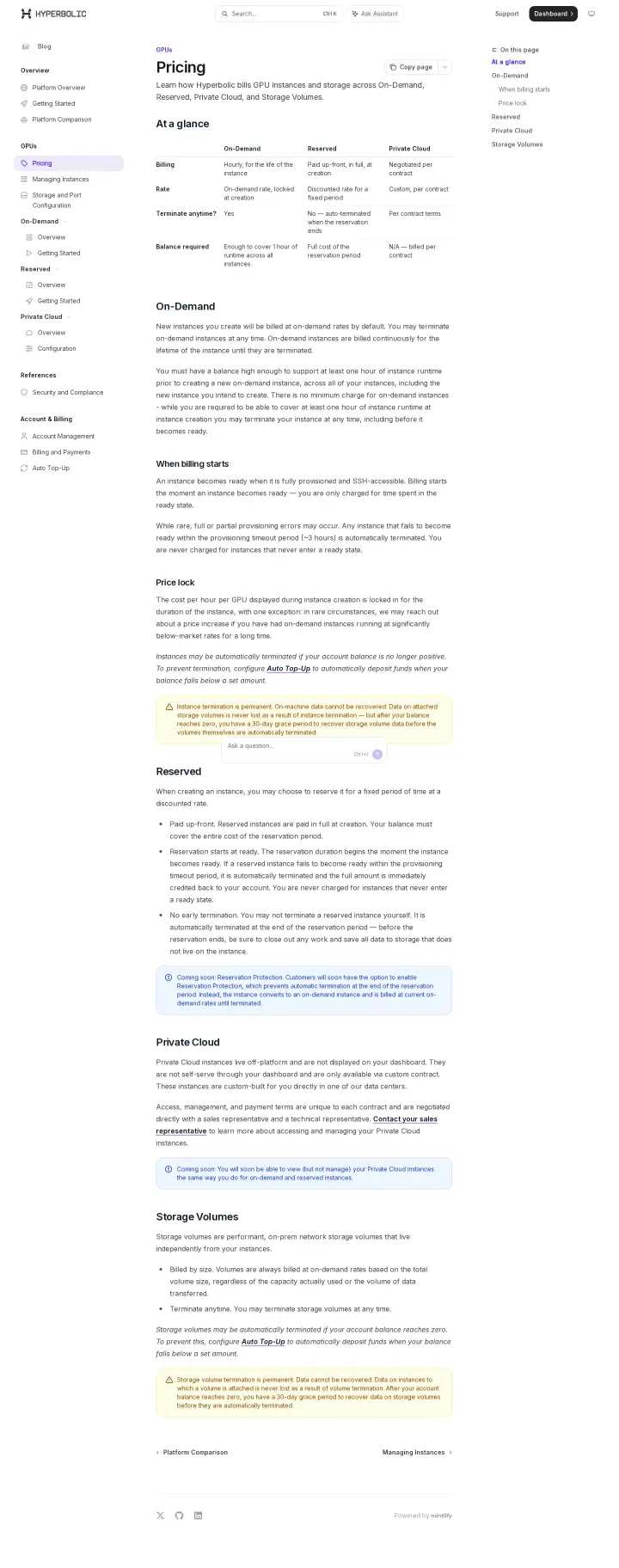
Showing the whole page as captured — scroll the panel, or open it at full size.
This is a single observation, not a before/after comparison — the change it describes has no visible transition to photograph, so we show the page that states it instead. The pixels are our own capture, unmodified.
Hyperbolic’s docs now formalise a commitment ladder that used to be a sales conversation. Reserved capacity is self-serve in-app at a discounted prepaid $/GPU/hour with terms from 1 week to 1 month (larger commitments still go through sales), paid in full up front with no early termination. Private Cloud is the sales-led tier: single-tenant, off-platform, negotiated per contract on multi-month to multi-year terms, and billed separately rather than from credits.
The money mechanics are newly explicit. Compute credits are purchased at a $5 minimum, are always 1:1 with dollars, and never expire; Auto Top-Up recharges a stored payment method when the balance falls below a customer-set threshold, evaluated every 10 minutes. On-demand instances require a balance covering at least one hour of runtime across all instances, with no minimum charge. Most notably, Hyperbolic now documents a price lock: “the cost per hour per GPU displayed during instance creation is locked in for the duration of the instance”, with one stated exception for long-running instances at significantly below-market rates. Storage volumes are metered hourly on provisioned capacity — “regardless of the capacity actually used or the volume of data transferred” — with a 30-day grace period to recover data after a balance hits zero.
Published on-demand starting rates move to H100 SXM $2.89, H200 $3.49 and B200 $5.99 per GPU-hour (catalog advertised from $0.20/GPU/hr), and the consumer-GPU per-hour rates are pulled from the page. Packaging is now four surfaces — On-Demand, Reserved, Private Cloud and Serverless Inference — funded by prepaid compute credits (minimum $5, never expiring) with Auto Top-Up, a per-instance price lock, and 99.5%/99.9% uptime SLAs. Serverless token rates are unchanged.