AI Summary
About
Artisan is an AI sales-automation company whose flagship product is Ava, an autonomous AI Business Development Representative (BDR/SDR). Ava finds and enriches B2B leads, runs deep web research, writes personalized outreach, sends multi-step campaigns across email and phone, handles replies and objections, and books meetings — replacing or augmenting the work of a human outbound rep. The company positions Ava explicitly as a hire (“Hire Ava, the AI BDR that books meetings on autopilot”), and it has repeatedly reshaped how it packages and prices that hire — as of mid-2026 its public plans are sales-gated Team, Scale, and Enterprise tiers sized by lead volume, with no published rate card.
Artisan sells primarily to startups, SMBs, and mid-market sales teams that want to automate top-of-funnel pipeline generation, with a sales-led Enterprise motion for larger accounts that need dedicated implementation, security controls, and custom credit volumes. It competes with both legacy outbound-data tools (Apollo, ZoomInfo, Clay) and the emerging wave of AI SDR agents.
Founded in 2023 by Jaspar Carmichael-Jack (CEO, 23 at the time of the Series A) and Sam Stallings (a former IBM product manager), Artisan went through Y Combinator’s Winter 2024 batch. It raised a $2.3M pre-seed, an $11.5M seed in September 2024 (led by angel investor Oliver Jung), and a $25M Series A in April 2025 led by Glade Brook Capital, with Y Combinator, HubSpot Ventures, Day One Ventures, and Fellows Fund participating. At the Series A the company reported roughly $5M ARR, around 250 customers, and 35 employees (hiring 22 more). Artisan is best known outside pricing circles for its October 2024 “Stop Hiring Humans” billboard campaign in San Francisco — a deliberately provocative growth play the company credits with lifting its local brand recognition from 5% to 70%.
Pricing summary : sales-gated tiers scoped to lead volume, mailboxes, and dialer seats
As of mid-2026 Artisan publishes no prices at all. Its pricing page is a fully sales-led rate card in which every tier reads “Pricing scoped on your plan · Talk to sales.” There are three published dimensions, all quoted per deal:
- Tier (the packaging): Team, Scale (“Most popular”), and Enterprise. Each tier carries a lead-contact volume band rather than a price — Team ~2,500 leads contacted/mo, Scale ~6,000 leads contacted/mo, and Enterprise a custom volume. No Free tier and no self-serve sign-up remain on the page.
- The sizing meter (lead volume + infrastructure): Artisan states plans are “sized to your lead volume, mailboxes, and dialer seats.” The headline meter is leads contacted per month (mapped in our taxonomy to a per-contact meter); credit volume and dialer seats are “tuned to your pipeline” during scoping but no per-unit rate is published.
- Add-ons bundled into the quote: Every plan includes the full platform (all campaign types, autonomous replies + meeting booking, 250M+ verified B2B contacts, Salesforce/HubSpot sync, CSM support) plus an AI dialer add-on billed per seat, and sending infrastructure (mailboxes) “sized to your motion” — all folded into the custom quote rather than shown as line items.
This is a sales-led custom-quote model with a usage layer (lead volume) underneath it, closer to a negotiated commitment contract than the self-serve credit pool Artisan briefly ran in early 2026.
What makes this different: Artisan has now retreated from public pricing twice in two years. Rather than anchor buyers to a dollar figure, it anchors each tier to a lead-contact volume (~2,500 / ~6,000 / custom) and pushes every prospect into a demo where the plan is scoped — a deliberate move from a transparent self-serve rate card back to a sales-gated motion.
Pricing by product
Artisan shows three sales-gated tiers on its pricing page. None carries a published price — each is marked “Pricing scoped on your plan · Talk to sales” — so the differentiators are the lead-contact volume band and the bundled service/feature set.
Ava (sales-gated plans)
| Tier | Price | Included | Key mechanics |
|---|---|---|---|
| Team | Custom | ~2,500 leads contacted/mo. Full platform: every campaign type, autonomous replies + meeting booking, 250M+ verified B2B contacts, Salesforce & HubSpot sync, CSM support & onboarding, AI dialer add-on (per seat). | ”For teams running their first serious outbound motion” |
| Scale | Custom | ~6,000 leads contacted/mo. Everything in Team, plus a dedicated CSM, CRM setup included, and priority support. | ”Most popular”; scoped to reps and segments |
| Enterprise | Custom | Custom lead volume. Everything in Scale, plus a forward-deployed strategist, full onboarding buildout, dedicated strategic support, and advanced security controls with audit logs. | Sales-led; “for custom volume, security, and rollout support” |
How plans are sized (the meter behind the quote)
| Dimension | What it drives | Notes |
|---|---|---|
| Lead volume | The headline band on each tier (~2,500 / ~6,000 / custom leads/mo) | The primary sizing input; “sized to your lead volume” |
| Mailboxes | Sending capacity, “sized to your motion” | Bundled into the quote, not shown as a line item |
| Dialer seats | AI dialer add-on, billed per seat | ”Credit volume and dialer seats tuned to your pipeline” |
| Credit volume | Underlying consumption for Ava’s actions | Referenced (“credit volume tuned to your pipeline”) but not publicly priced |
Sales motions across products: sales-led for all three tiers — every plan is custom-quoted through a demo, with no self-serve sign-up or published rate as of mid-2026.
Hidden costs : what teams actually pay beyond the headline tier fee
The biggest hidden cost with Artisan today is the pricing itself: as of mid-2026 there is no public rate card. The three live tiers — Team (~2,500 leads contacted/mo), Scale (~6,000 leads, “Most popular”), and Enterprise (custom) — are all quote-only, each scoped in a sales call with “Talk to sales.” There is no published per-seat price, no per-credit top-up rate, and no self-serve estimator, so a buyer cannot model the bill before the demo. The costs below are structural — you will hit them regardless of tier — but their dollar amounts are negotiated, not posted.
1. Volume scoped to your pipeline. The plans are sized by leads contacted per month, and Artisan “tunes” that volume to your pipeline during scoping. That makes the effective monthly cap — and the price of exceeding it — a negotiated line item rather than a published overage rate. If your outbound volume grows mid-contract, the cost of more capacity is set in a conversation, not on a page.
2. The AI dialer add-on, billed per seat. Phone outreach is not part of the base plan. The AI dialer is an add-on charged per seat on top of the tier fee, so a team that adds calling to its email motion layers a per-rep cost the headline quote does not include.
3. Sending infrastructure sized to your motion. Mailboxes and phone numbers scale with send volume and are provisioned to match your outbound. Because deliverability and telephony are pass-through costs that grow with usage, this line rises as you scale sends — independent of what the plan itself covers.
Because everything is quote-only, the practical advice is to price all three of these into the sales conversation up front, since none of them appears on a public page you can check afterward.
| Cost driver (beyond the base plan) | How it’s priced today |
|---|---|
| Lead volume above your tier’s scoped cap | Negotiated in scoping — no public overage rate |
| AI dialer for phone outreach | Per-seat add-on on top of the tier fee |
| Mailboxes + phone numbers (sending infra) | Sized to your send volume; pass-through, quote-only |
Historical note: For a few months in early 2026, alongside the Ava 2.0 launch, Artisan did publish a self-serve credit-pool rate card — a Free tier plus named Intern ($250/mo) and Employee ($600/mo) tiers, metered at roughly 20–22 credits per end-to-end prospect. Artisan pulled that public rate card by mid-2026 and reverted to the fully sales-gated lead-volume model described above. Those dollar figures are historical and are no longer plans a buyer can pick today.
Want to estimate your own Artisan bill? Use the Artisan pricing calculator to model your monthly cost based on tier, credit usage, and sending infrastructure.
Pricing evolution : from named-hire tiers to an outcome-anchored credit pool
Artisan’s pricing has swung through three distinct models in roughly two years: public lead-volume tiers, a fully sales-gated catalogue, and now a public credit pool. That is unusually high churn for such a young company, and it tracks the product’s own re-platforming (Ava → Ava 2.0).
Cadence
| Quarter | Price changes | Product / SKU additions | Notes |
|---|---|---|---|
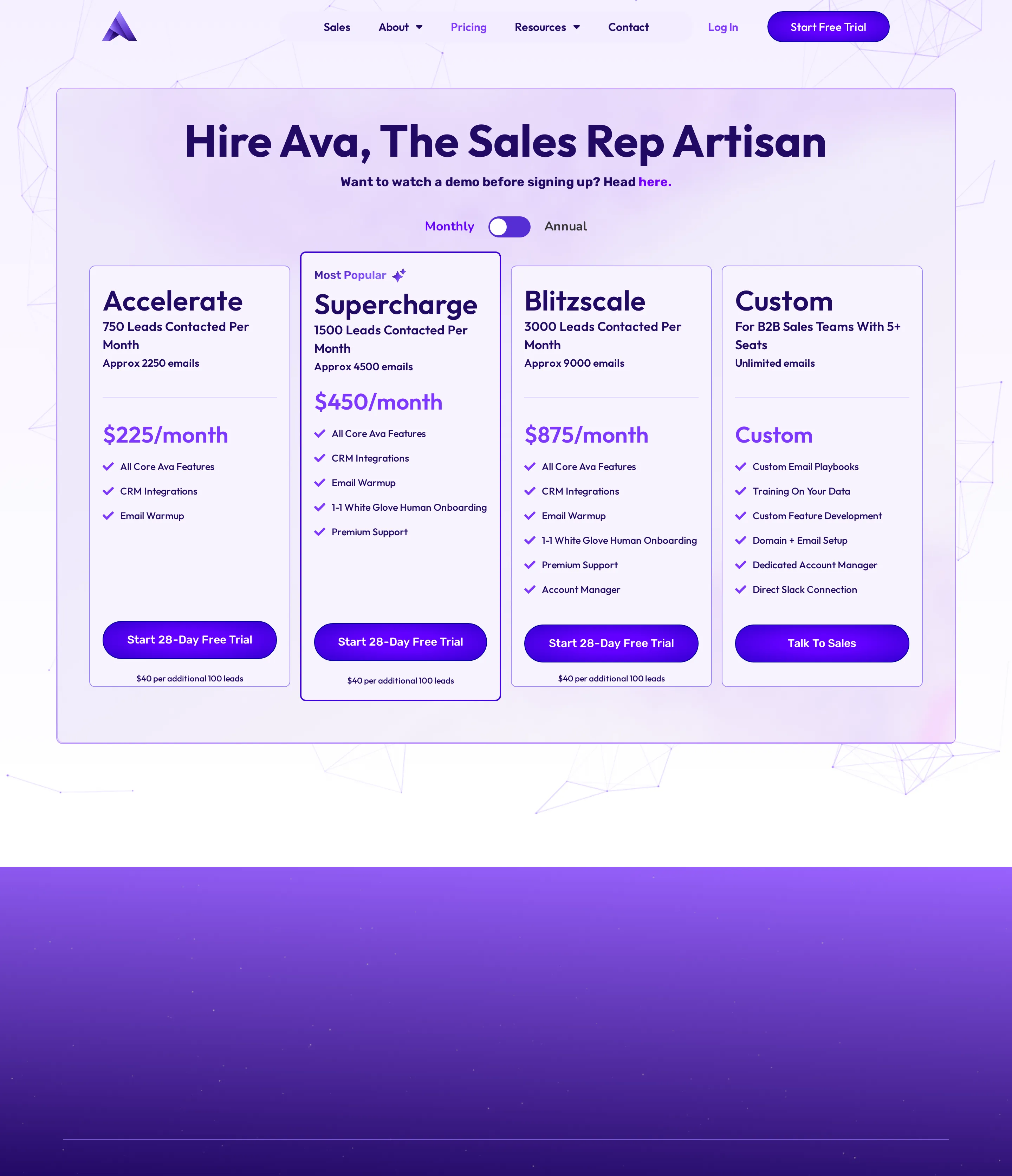
| 2024 Q1 | 0 | 0 | Public lead-volume tiers live: Accelerate $225, Supercharge $450, Blitzscale $875, Custom; $40 per extra 100 leads. |
| 2024 Q3 | 1 | 0 | 2024-08 — all public prices removed; pivot to sales-gated “Request Pricing” feature catalogue (lead-volume basis). |
| 2025 Q2 | 0 | 0 | $25M Series A banner appears site-wide; pricing page stays gated. |
| 2026 Q2 | 1 | 1 | Ava 2.0 launch re-publishes a public credit-pool rate card (Free / Intern $250 / Employee $600 / Enterprise). |
Tracked range: 2024-03 to 2026-06 (17 Wayback snapshots). Quarters not listed showed no change from the model in force at the time (gated 2024 Q4 through 2026 Q1).
Notable changes
- 2024-03 — Earliest captured rate card: lead-volume tiers Accelerate ($225/mo, $187 annual; 750 leads/~2,250 emails), Supercharge ($450/mo; 1,500 leads, “Most Popular”), Blitzscale ($875/mo; 3,000 leads), Custom (unlimited). Overage $40 per additional 100 leads.
- 2024-08 — Public prices removed entirely; the page became a “Request Pricing” catalogue stating Artisan is “priced based on the volume of leads you are doing outreach to,” split across BDR and AE seats. This gated model held through 2026-01.
- 2024-10 — “Stop Hiring Humans” billboard campaign launches in San Francisco (timed to TechCrunch Disrupt) — a growth event, not a price change, but the moment that defined Artisan’s public profile.
- 2025-04-09 — $25M Series A led by Glade Brook Capital; a site-wide funding banner appears, but pricing stays gated.
- 2026-05 — Ava 2.0 ships and the public rate card returns for the first time since mid-2024, now built on a credit pool with named Intern/Employee tiers and “Get early access” CTAs. Launch credit costs: website-visitor identification 5 credits, end-to-end campaign ~25/prospect.
- 2026-06 — CTAs switch from “early access” to “Start 30-day trial,” the “$300 free credits” trial banner returns, and two credit costs ease (website visitor 5→4, end-to-end campaign ~25→~22/prospect).
The model whiplash in detail
Artisan is a rare case of a company cycling through three pricing philosophies before reaching meaningful scale. The 2024 lead-volume tiers ($225/$450/$875) were a clean, transparent SMB rate card — but Artisan abandoned them within months, hiding everything behind “Request Pricing” as it leaned into a sales-led, lead-volume-negotiated motion. For roughly 18 months the pricing page carried no public number at all, even as the $25M Series A landed. The public credit-pool relaunch in 2026 is effectively a return to self-serve, re-expressed in the credit-based billing vocabulary that has become standard for AI agents. The lesson for buyers: Artisan’s pricing is young and has moved fast, so contract terms captured even a year ago may no longer reflect the current model.
What’s unique : pricing the AI BDR as a named hire
1. Tiers named after seniority, not seats. Artisan calls its paid plans Intern and Employee, reinforcing the “hire an AI BDR for a fraction of the cost” positioning rather than selling software seats.
2. Outcome ranges on every tier. Each plan advertises an expected band of positive replies per month (1–12, 4–30, 50+) alongside its credit allocation, anchoring the usage meter to a sales outcome — a softer version of the value-metric debate playing out across AI products and a recurring theme in usage-based pricing for SaaS and AI.
3. One credit pool absorbs heterogeneous agent work. Rather than separate meters for data, enrichment, personalization, and replies, Artisan collapses all of Ava’s actions into a single credit unit with published per-action costs (email enrichment 2, phone 10, website visitor 4, reply 2, full campaign ~22/prospect). This is the shift from entitlements to credits that lets a fast-changing agent re-price individual actions without re-papering the plan.
4. Sending infrastructure is deliberately unbundled. Mailboxes and phone numbers are billed separately in dollars outside the credit pool. That keeps the credit math clean and lets Artisan pass through volatile deliverability and telephony costs at cost — but it also means the headline tier fee understates the true bill, a tension explored in Hidden costs above.
Strengths & weaknesses
| Strengths | Weaknesses |
|---|---|
| Transparent public rate card for three of four tiers | Enterprise is fully contact-gated with no public price anchor |
| Usage credit pool maps cleanly to discrete, legible actions | Sending infrastructure (mailboxes, phone) billed separately can surprise |
| Outcome framing (positive replies/mo) sets buyer expectations | Annual credits do not roll over at term end — risk of forfeited spend |
| Freemium entry (300 credits) lowers trial friction | Power dialer is an extra per-seat add-on on top of the tier fee |
Billing UX : an audience toggle and “Talk to sales” on every tier
The mid-2026 revert stripped the self-serve billing controls (the credit estimator, monthly/annual toggle, per-credit purchase, and free-trial banner are all gone). What remains is a demo-scoping funnel:
- Startups / Businesses & Enterprises audience toggle — a segmented control above the plan grid. Both states currently render the same three tiers (Team / Scale / Enterprise); the toggle exists but does not change the displayed plans as of this capture.
- “Talk to sales” on every card — each tier’s only CTA is “Talk to sales”; there is no self-serve checkout, no “Start trial,” and no “Get started with credits” button on the pricing page.
- Lead-volume band as the on-card signal — instead of a price, each tier displays a “~2,500 / ~6,000 leads contacted/mo” band with an info tooltip, plus a bulleted “Everything in [lower tier], plus:” feature delta.
- Demo-based scoping — the FAQ describes a 30-minute walkthrough “tailored to your ICP and current stack” where Artisan “scope[s] the right plan together,” sized to lead volume, mailboxes, and dialer seats.
- White-glove rollout messaging — every plan advertises CSM support “from day one” in a shared Slack channel, with Enterprise adding a forward-deployed strategist who “builds and launches your rollout” — the service wrapper stands in for a self-serve onboarding flow.
Strategic wins : pricing decisions that reinforce the AI-hire narrative
1. Naming tiers Intern and Employee
The seniority-named tiers make the “pay a fraction of a human BDR” pitch concrete and reframe a software purchase as a hiring decision. See usage-based pricing fundamentals for how value-metric framing shapes willingness to pay.
2. A low-friction freemium on-ramp
A $0 Free plan with 300 credits plus a 10,000-credit ($300-value) 30-day trial lets buyers see Ava work before paying, which suits the self-serve PLG motion Artisan runs into the Intern and Employee tiers. See how the shift from entitlements to credits reshapes free-to-paid conversion.
3. Outcome ranges that pre-qualify the tier choice
By printing an expected positive-reply band on every tier (1–12, 4–30, 50+), Artisan lets buyers self-select the credit allocation that matches their pipeline goal, reducing pre-sale back-and-forth. See how to choose the right usage metric.
4. Re-self-serving the pricing without re-papering plans
Returning to a public rate card in 2026 (after ~18 months gated) restored a PLG funnel into Intern and Employee while keeping the credit pool as the elastic layer. Because actions are priced individually, Artisan can adjust a single cost — as it did when website-visitor identification moved 5→4 credits and end-to-end campaigns eased ~25→~22/prospect between the 2026-05 and 2026-06 captures — without touching the published tier prices. That decoupling of headline price from per-action cost is the core advantage of hybrid pricing models.
Areas to improve : where the pricing creates buyer friction
1. Surface the separately-billed sending infrastructure earlier
Mailboxes and phone numbers are billed in dollars outside the credit pool, but the rate card foregrounds only tier fees and credits. Adding indicative infrastructure costs to the credit estimator would reduce bill surprise. See the value metric problem in AI pricing for why hidden meters erode trust.
2. Reconsider annual credit forfeiture
Annual plans grant credits upfront but forfeit any unused balance at term end, which penalizes the seasonal or ramping teams most likely to buy annual. A partial rollover or grace window would soften the downside.
3. Publish an Enterprise price anchor
Enterprise is fully contact-gated with no public number, leaving buyers without a reference point above Employee’s $600/mo. A “starting at” figure or a credit-volume band would set expectations before the demo and improve the sales-led funnel.
Monetization stack & signals : how Artisan builds & buys its revenue engine
2 signal roles
Buys nothing it can source for its own meter — the credit pool and named-hire tiers are an in-house build. The inflection worth watching is the two hires below: a first-ever forward-deployed function layering a sales-led enterprise motion onto a CEO-led foundational growth hire's self-serve paywall machine.
- Forward Deployed Engineer RevOps seen Jan 29, 2026
A brand-new sales-team FDE function scoping per-customer 'what we replace, what we integrate with' against each account's Salesforce/HubSpot GTM stack from pre-sales through expansion — the canonical sales-led enterprise motion bolted onto the self-serve credit core.
- Growth Growth seen Aug 19, 2025
Foundational growth hire owning the self-serve funnel end to end — 'onboarding flows, paywall moments, and in-product upsell and expansion paths' — i.e. the conversion/expansion levers on the Free→Intern→Employee credit ladder, chartered to drive $7M→$25M ARR.
Signals reviewed · derived from public job posts
Job postings fill and close over time — once a posting is filled we keep it as a dated citation (the quoted evidence remains); use View open roles for current listings.
Key takeaways
- Name the value metric after the job, not the software. Artisan’s Intern/Employee tiers turn a SaaS subscription into a hiring decision, which can expand the budget line a buyer maps the spend against.
- Anchor usage tiers to outcomes. Advertising a positive-reply range per tier gives buyers a concrete yardstick for which credit allocation to choose.
- Keep the usage meter legible. Pricing discrete actions (2 credits to enrich an email, 10 for a phone) makes the credit pool easy to reason about.
- A pricing model is not permanent — and re-pricing has a cost. Artisan cycled through lead-volume tiers, a fully gated catalogue, and a credit pool in under two years. The flexibility helped it follow the product, but it also means every old contract and third-party teardown is quickly stale; teams that change models this fast should over-communicate to existing customers.
- Provocative growth marketing and pricing trust pull in opposite directions. The “Stop Hiring Humans” campaign bought brand recognition cheaply, but pairing a “replace your humans” message with a hidden (“Request Pricing”) rate card during the same period can leave buyers unsure what they are actually committing to — a reminder that pricing transparency is itself a brand signal.
UBP implications
- Credit pools can wrap multi-action AI agents. A single credit unit absorbs heterogeneous agent work (research, enrichment, replies), letting one meter cover many underlying costs. As the agent’s per-action economics shift, the vendor re-prices one action rather than the whole plan.
- Outcome bands soften pure-usage anxiety. Pairing a credit allocation with an expected-reply range reduces the metering uncertainty buyers fear in usage-based models, nudging AI pricing toward outcome framing without committing to true outcome-based billing.
- Unbundle volatile pass-through costs from the usage meter. Artisan keeps mailboxes and phone numbers out of the credit pool and bills them in dollars, isolating the credit math from telephony/deliverability volatility — a pattern AI products with real infrastructure costs can borrow to keep their core meter stable.
Sources
- Artisan pricing page (accessed 2026-08-27)
- Artisan request a demo (accessed 2026-08-27)
- Artisan startups solution page (accessed 2026-07-14)
- Artisan enterprise solution page (accessed 2026-07-15)
Bottom line
Artisan prices Ava like a hire — Free, Intern, then Employee — and meters the work underneath with a credit pool anchored to expected positive replies, while keeping Enterprise behind a demo form. The model is transparent and legible for self-serve buyers, with the main hidden cost being separately-billed mailboxes, phone numbers, and the per-seat power dialer.
Want to compare Artisan against other AI sales-automation pricing? Browse the pricing blueprint.
Pricing timeline : Major events on a vertical axis
Each milestone below corresponds to a public pricing change, product launch, or material adjustment. Major events use a filled marker; minor adjustments use a faded one.
Public prices pulled again — reverts to sales-gated lead-volume tiers
Artisan removed its public credit-pool rate card for the second time. The pricing page now shows three fully sales-gated tiers — Team (~2,500 leads contacted/mo), Scale (~6,000 leads contacted/mo, 'Most popular'), and Enterprise (custom volume) — each labelled 'Pricing scoped on your plan · Talk to sales' with no dollar figures, no Free tier, no published per-credit costs, and no credit estimator or plan-comparison table. Plans are now sized to lead volume, mailboxes, and dialer seats; the dialer is reframed as an 'AI dialer add-on, per seat'. A Startups / Businesses & Enterprises audience toggle appears but currently renders identical tiers.
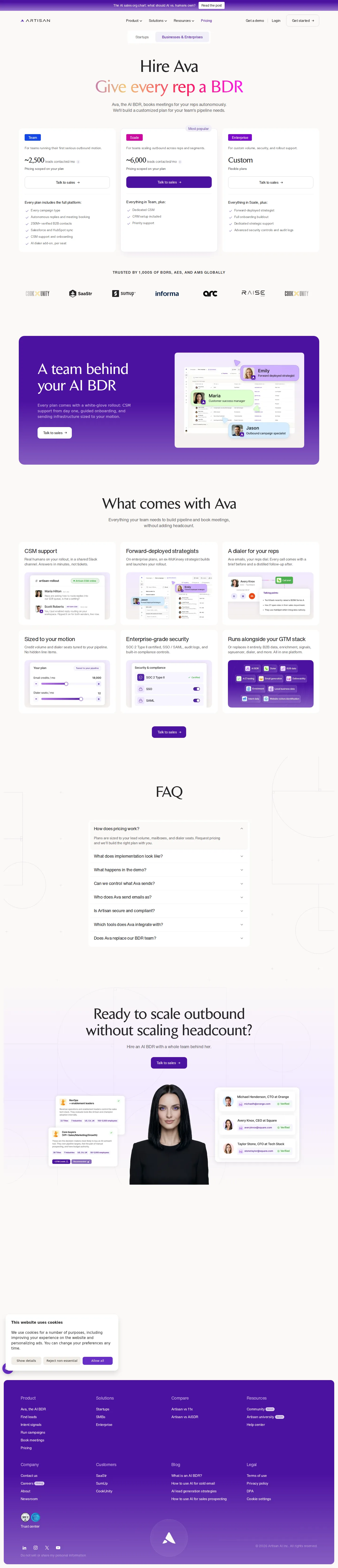
Public credit-pool rate card with $300 trial reinstated
Live public pricing: Free ($0, 300 credits/mo), Intern ($250/mo annual or $280 monthly, 12K credits), Employee ($600/mo annual or $660 monthly, 30K credits), custom Enterprise. CTAs moved from 'Get early access' to 'Start 30-day trial'; the end-to-end campaign rate eased to ~22 credits/prospect and website-visitor identification to 4 credits; the '10,000 free credits worth $300' trial banner returned.

Ava 2.0 — public credit-pool pricing returns (early access)
Artisan re-published a public rate card for the first time since mid-2024, tied to the 'Ava 2.0 is here' launch. Three named tiers (Free / Intern $250 / Employee $600) plus custom Enterprise, each with a monthly credit allocation and an advertised positive-reply band. Credit costs at launch: email enrichment 2, phone enrichment 10, website visitor 5, autonomous reply 2, end-to-end campaign ~25/prospect. CTAs read 'Get early access'.

Still fully sales-gated
Pricing page remained a 'Request Pricing' feature catalogue with no public numbers, stating Artisan is 'priced based on the volume of leads you are doing outreach to.' The public credit-pool rate card had not yet shipped.
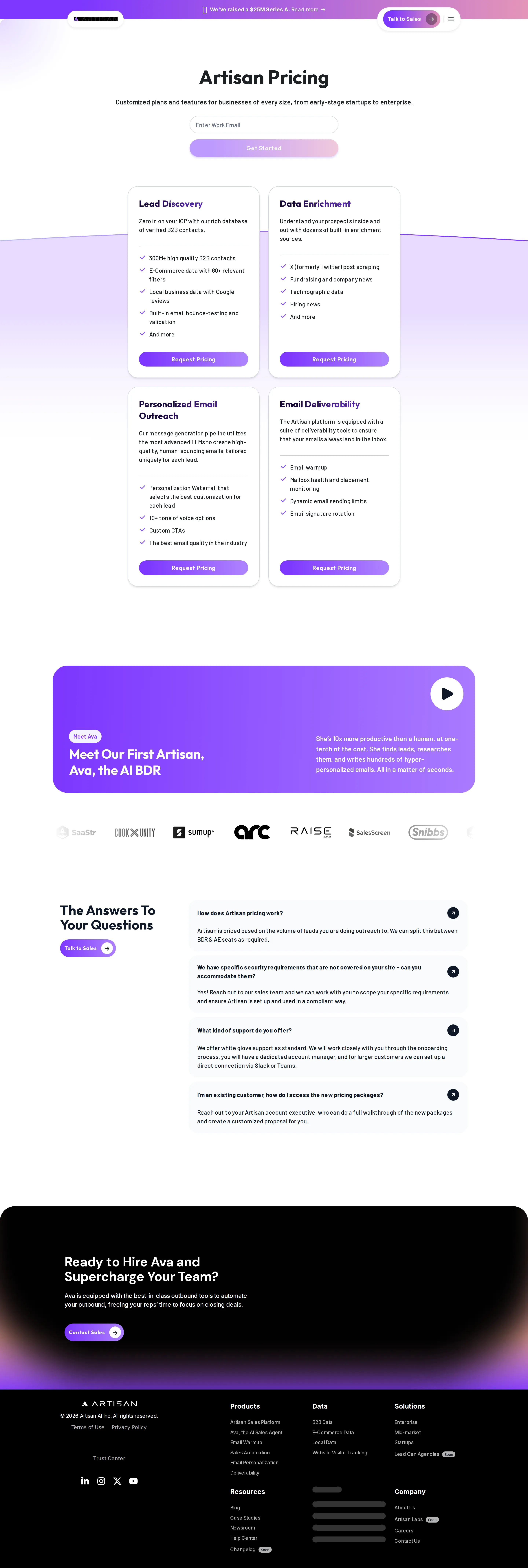
$25M Series A banner; pricing still gated
A 'We've raised a $25M Series A' banner appeared site-wide (round led by Glade Brook Capital, announced 2025-04-09), but the pricing page stayed fully sales-gated with 'Request Pricing' CTAs and the lead-volume FAQ unchanged.
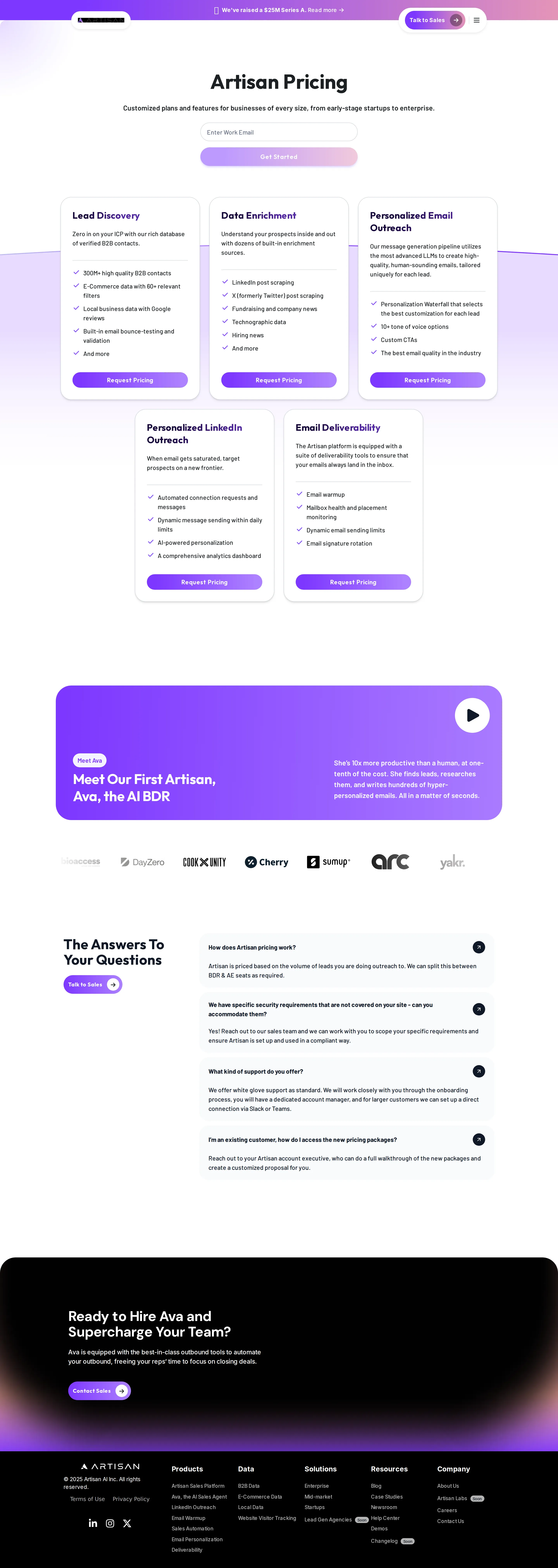
Public prices removed — pivot to sales-gated 'Request Pricing'
Artisan pulled all public tier prices and replaced them with a per-capability 'Request Pricing' feature catalogue. The FAQ stated pricing was now lead-volume-based and split across BDR and AE seats, and referenced 'new pricing packages' for existing customers. This gated model persisted through at least 2026-02.
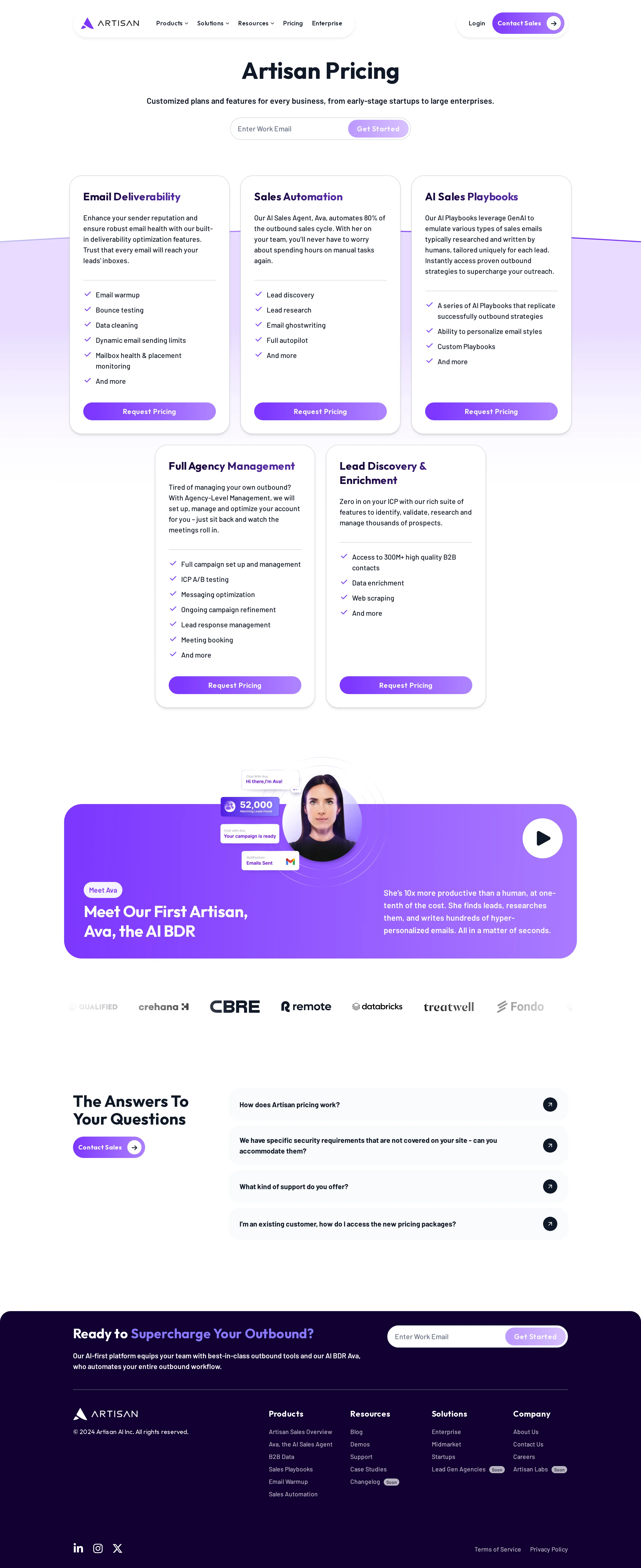
Original public lead-volume tiers (Accelerate / Supercharge / Blitzscale)
Earliest captured rate card used lead-contact volume tiers, not credits: Accelerate ($225/mo monthly or $187/mo annual, 750 leads/~2,250 emails), Supercharge ($450/mo, 1,500 leads/~4,500 emails, 'Most Popular'), Blitzscale ($875/mo, 3,000 leads/~9,000 emails), and a Custom tier with unlimited leads. Overage was $40 per additional 100 leads.
- · Artisan has pulled public pricing off its site twice: it launched in 2024 with public tiers, hid everything behind 'Request Pricing' by August 2024, briefly re-published a public credit-pool rate card in early 2026, then reverted again by mid-2026 to fully sales-gated Team / Scale / Enterprise plans.
- · As of mid-2026 Artisan's plans are sized by leads contacted per month — ~2,500/mo for Team and ~6,000/mo for Scale — with no published price on any tier; every card reads 'Pricing scoped on your plan · Talk to sales'.
- · Its October 2024 'Stop Hiring Humans' billboard campaign in San Francisco drew death threats and national press; the CEO later called it deliberate ragebait, and the company says it took SF brand recognition from 5% to 70%.
Questions & answers
- How much does Artisan's Ava cost?
- As of mid-2026 Artisan publishes no prices. Its pricing page shows three sales-gated tiers — Team (~2,500 leads contacted/mo), Scale (~6,000 leads contacted/mo), and Enterprise (custom volume) — each marked 'Pricing scoped on your plan · Talk to sales.' You get a quote through a demo, where the plan is sized to your lead volume, mailboxes, and dialer seats.
- Does Artisan have a free plan or free trial?
- No. The public pricing page no longer lists a Free plan or a self-serve free trial — the earlier '10,000 free credits worth $300' trial and the $0 Free tier were removed when Artisan reverted to sales-gated pricing. Access now starts with a demo and a custom quote.
- How does Artisan decide what to charge?
- Artisan says plans are 'sized to your lead volume, mailboxes, and dialer seats.' The headline meter on each tier is leads contacted per month (~2,500 for Team, ~6,000 for Scale), and credit volume plus dialer seats are tuned to your pipeline during scoping — but no per-unit rate is published.
- What is included in every Artisan plan?
- Every plan bundles the full platform: every campaign type, autonomous replies and meeting booking, 250M+ verified B2B contacts, Salesforce and HubSpot sync, CSM support and onboarding, and an AI dialer add-on billed per seat. Scale adds a dedicated CSM, CRM setup, and priority support; Enterprise adds a forward-deployed strategist, full onboarding buildout, and advanced security controls with audit logs.
- How has Artisan's pricing changed over time?
- Artisan launched in early 2024 with public lead-volume tiers (Accelerate $225, Supercharge $450, Blitzscale $875 per month), then removed all public prices in August 2024 for a sales-gated 'Request Pricing' model. It briefly re-published a public, self-serve credit-pool rate card (Free / Intern $250 / Employee $600) in early 2026 alongside Ava 2.0, then pulled public pricing again by mid-2026, reverting to sales-gated Team / Scale / Enterprise tiers sized by lead volume.