AI Summary
About
Bland AI is a San Francisco-based AI company founded in 2023 that operates an enterprise voice AI platform — enabling businesses to build, deploy, and scale AI-powered phone agents for both inbound and outbound calls. The company emerged from Y Combinator’s Summer 2023 batch and was co-founded by Isaiah Granet (CEO), with a mission to replace legacy enterprise phone infrastructure with programmable AI voice agents.
Bland positions itself squarely against the call center industry rather than against AI chatbot tools. Its API allows companies to initiate or receive millions of phone calls with AI agents that can follow complex conversation paths, perform live call transfers, send follow-up SMS messages, and integrate with CRMs and webhooks — all at a cost structure dramatically below traditional call center staffing.
By early 2026, Bland has raised $65M in total funding: a $16M Series A in August 2024 led by Scale Venture Partners (with angels including Twilio founder Jeff Lawson and PayPal co-founder Max Levchin), and a $40M Series B in February 2025 led by Emergence Capital. The company claims support for up to 1 million simultaneous calls — a scale claim that no other voice AI platform makes publicly. Customers span healthcare, financial services, real estate, and enterprise sales automation.
Bland competes most directly with Vapi and Retell AI in the developer-facing AI voice API category, while also competing with legacy enterprise telephony vendors (Nuance, Google CCAI, Genesys) at the high end. Its pricing page attacks those rivals head-on: it argues that a Vapi or Retell headline rate is “the platform fee only” (Vapi $0.05/min, Retell about $0.07/min) before you separately pay for LLM, STT, TTS and telephony, which puts most production stacks at roughly $0.13–$0.30/min on Vapi and $0.11–$0.25/min on Retell. Bland’s counter-offer is one bundled number for LLM, STT and TTS.
Compliance is a company-level claim rather than a plan feature: Bland states SOC 2 Type I and Type II, HIPAA-eligibility with a signed BAA, GDPR and PCI DSS, but the on-page plan comparison gates the contractual artefacts — BAA, SSO, JWT signatures and data residency — to Enterprise, and notes that compliance documentation is available under NDA on Enterprise.
Pricing summary : platform fee buys a lower talk-time rate, not included minutes
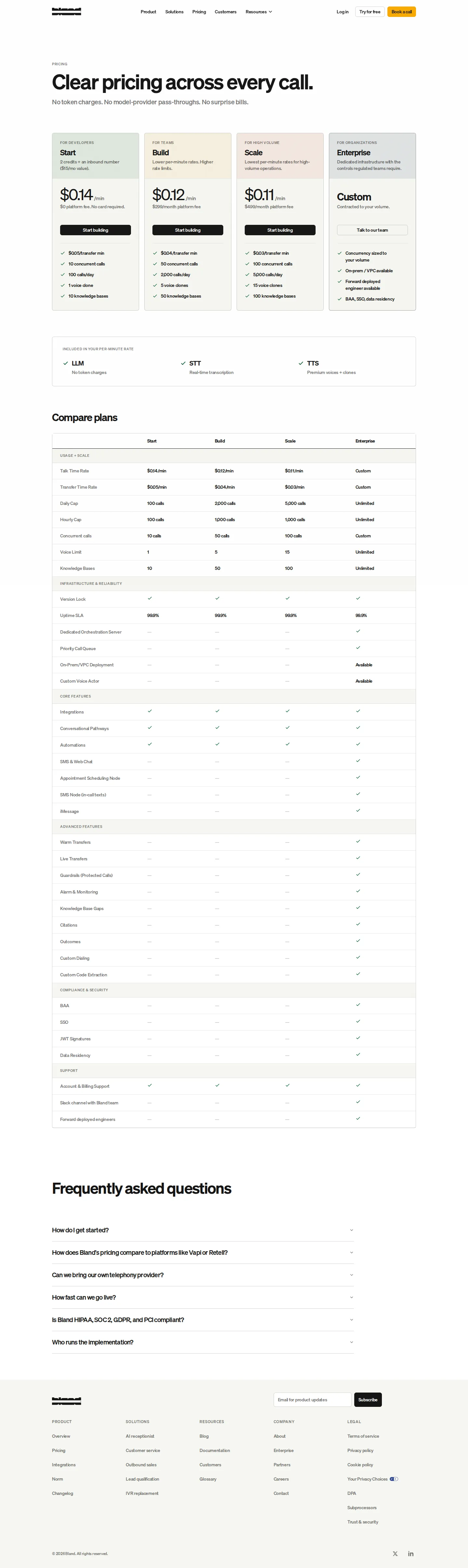
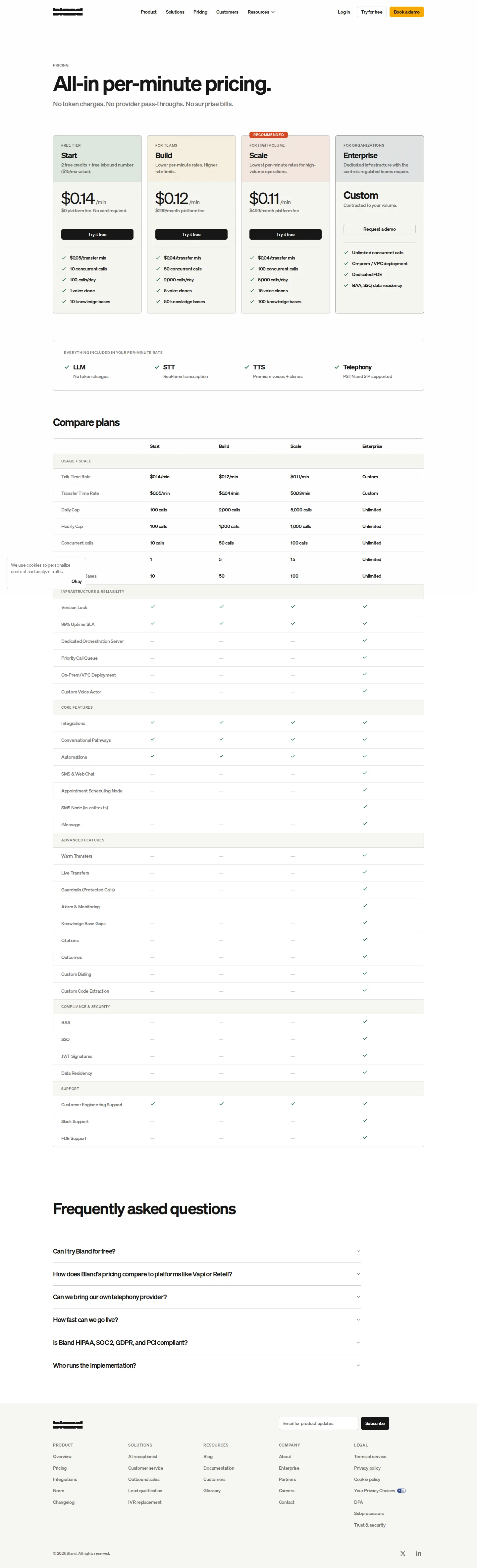
Bland runs a hybrid pricing model: a monthly platform fee that buys a lower per-minute talk-time rate plus higher rate limits, and metered usage that accrues on top. The platform fee does not include any minutes — Bland’s own wording is “$0 platform fee”, “$299/month platform fee”, “$499/month platform fee”, with the talk-time rate quoted separately as $0.14, $0.12 and $0.11 per minute respectively. Enterprise is “Custom — contracted to your volume.”
The bill is assembled from several independent meters:
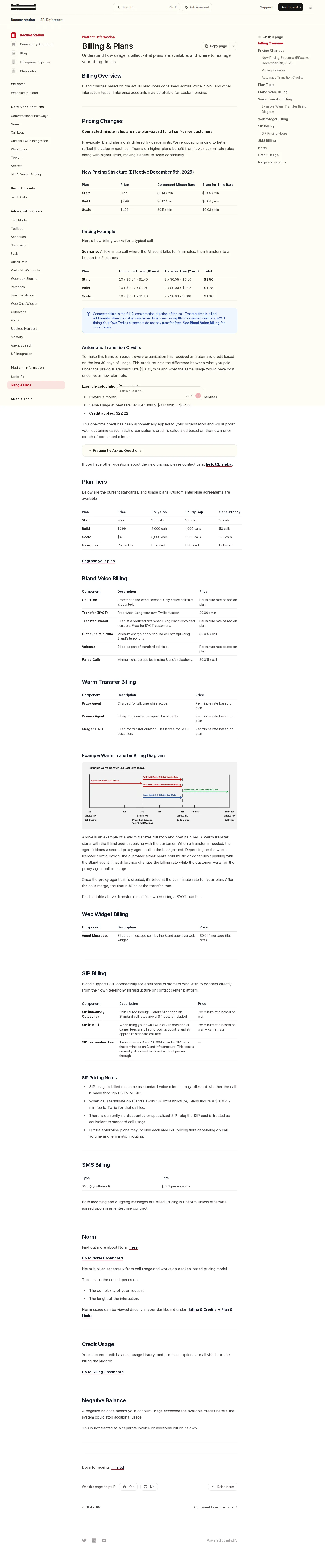
- Talk time — $0.14/min (Start), $0.12/min (Build), $0.11/min (Scale), custom on Enterprise. Prorated to the exact second; only active call time is counted, and voicemail is billed as standard call time.
- Transfer time on Bland-provided numbers — $0.05/min (Start), $0.04/min (Build), $0.03/min (Scale). $0.00/min for BYOT (Bring Your Own Twilio) customers.
- Outbound minimum — $0.015 per outbound call attempt placed on Bland’s telephony, and the same $0.015/call minimum on failed calls.
- SMS — $0.02 per message, incoming and outgoing alike.
- Web widget agent messages — $0.01 per message, a flat rate independent of plan (per-message billing).
- Norm — billed separately from call usage on a token-based model, priced by request complexity and interaction length.
- SIP — billed at the plan’s per-minute rate; BYOT SIP adds your own carrier rate. Bland absorbs the $0.004/min Twilio termination fee rather than passing it through.
Rate limits are the second thing the platform fee buys: daily caps (100 / 2,000 / 5,000 calls), hourly caps (100 / 1,000 / 1,000 calls), concurrency (10 / 50 / 100 calls), voice clones (1 / 5 / 15) and knowledge bases (10 / 50 / 100), all Unlimited on Enterprise except concurrency, which is “sized to your volume”. Every plan, including free Start, carries a stated 99.9% uptime SLA. New Start accounts get 2 credits plus an inbound number that Bland values at $15/mo, with no card required.
What makes this different: the per-minute rate is a partial bundle, not a full one. As of the July 2026 pricing page, it covers LLM, STT and TTS — “no token charges”, “no model-provider pass-throughs” — while telephony is billed separately, on your own carrier or Bland’s at pass-through cost. That is a narrower promise than the earlier all-in framing, and it means media-minute billing on Bland still requires a second carrier line item in any honest cost model.
Pricing by product
Voice agents (self-serve plans)
| Tier | Price | Included | Key mechanics |
|---|---|---|---|
| Start — “for developers” | Free ($0 platform fee) | 2 credits + an inbound number ($15/mo value); 100 calls/day, 100 calls/hour, 10 concurrent calls, 1 voice clone, 10 knowledge bases | $0.14/min talk time, $0.05/min transfer. No card required |
| Build — “for teams” | $299/month platform fee | 2,000 calls/day, 1,000 calls/hour, 50 concurrent calls, 5 voice clones, 50 knowledge bases | $0.12/min talk time, $0.04/min transfer. “Lower per-minute rates. Higher rate limits.” |
| Scale — “for high volume” | $499/month platform fee | 5,000 calls/day, 1,000 calls/hour, 100 concurrent calls, 15 voice clones, 100 knowledge bases | $0.11/min talk time, $0.03/min transfer. “Lowest per-minute rates for high-volume operations” |
| Enterprise — “for organizations” | Custom — “contracted to your volume” | Unlimited daily and hourly caps, unlimited voice clones and knowledge bases; concurrency “sized to your volume” | Custom talk-time and transfer rates; sales-led, on-prem/VPC available |
No plan includes any minutes: the platform fee buys a rate and a set of caps, and every connected second bills at the plan’s talk-time rate. All four tiers carry a stated 99.9% uptime SLA and version lock.
Voice usage rates
| Component | Rate | Notes |
|---|---|---|
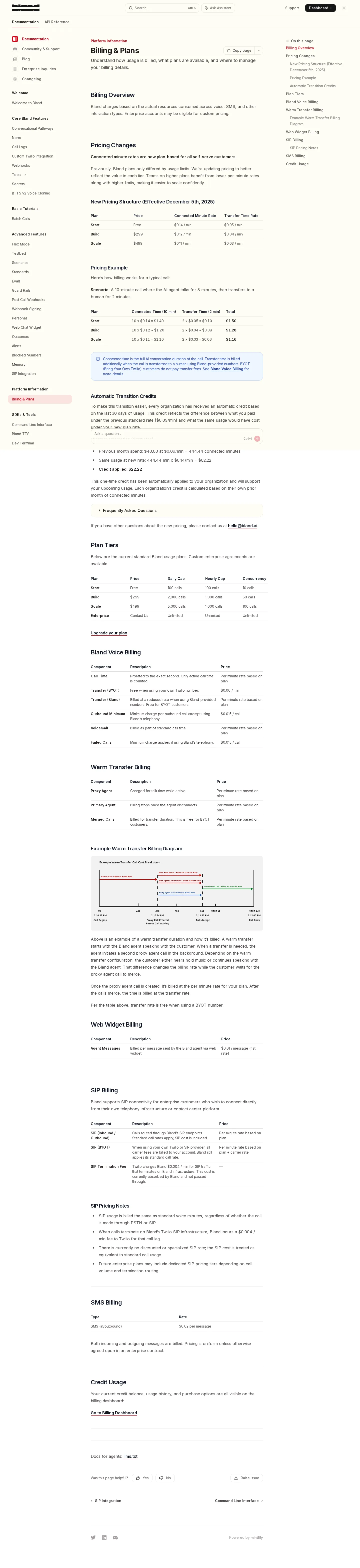
| Call time | Per-minute rate based on plan — $0.14 / $0.12 / $0.11 | ”Prorated to the exact second. Only active call time is counted.” |
| Transfer (Bland number) | $0.05 / $0.04 / $0.03 per min by plan | ”Billed at a reduced rate when using Bland-provided numbers” |
| Transfer (BYOT) | $0.00 / min | Free when using your own Twilio number |
| Outbound minimum | $0.015 / call | Minimum charge per outbound call attempt using Bland’s telephony |
| Failed calls | $0.015 / call | ”Minimum charge applies if using Bland’s telephony” |
| Voicemail | Per-minute rate based on plan | Billed as part of standard call time |
Warm transfer billing
| Component | Rate | Notes |
|---|---|---|
| Proxy agent | Per minute rate based on plan | Charged for talk time while active |
| Primary agent | Per minute rate based on plan | Billing stops once the agent disconnects |
| Merged calls | Per minute rate based on plan | Billed for transfer duration; free for BYOT customers |
SIP, messaging and Norm (separately metered)
| Product | Rate | Notes |
|---|---|---|
| SIP (inbound / outbound on Bland endpoints) | Per minute rate based on plan | ”Standard call rates apply; SIP cost is included.” Billed the same as standard voice minutes whether PSTN or SIP |
| SIP (BYOT) | Per minute rate based on plan + carrier rate | All carrier fees are billed to your own account |
| SIP termination fee | Not passed through | Twilio charges Bland $0.004/min for SIP traffic terminating on Bland infrastructure; “currently absorbed by Bland” |
| SMS (in/outbound) | $0.02 per message | Both incoming and outgoing billed; uniform “unless otherwise agreed upon in an enterprise contract” |
| Web widget agent messages | $0.01 / message (flat rate) | Billed per message sent by the Bland agent via the web widget |
| Norm | Token-based, billed separately from call usage | Cost depends on “the complexity of your request” and “the length of the interaction”; no public rate card |
Plan feature gates (from the on-page compare table)
| Capability | Start | Build | Scale | Enterprise |
|---|---|---|---|---|
| Version Lock · Uptime SLA | Yes · 99.9% | Yes · 99.9% | Yes · 99.9% | Yes · 99.9% |
| Integrations, Conversational Pathways, Automations | Yes | Yes | Yes | Yes |
| Account & Billing Support | Yes | Yes | Yes | Yes |
| SMS & Web Chat, Appointment Scheduling Node, SMS Node (in-call texts), iMessage | — | — | — | Yes |
| Warm/Live Transfers, Guardrails, Alarm & Monitoring, Knowledge Base Gaps, Citations, Outcomes, Custom Dialing, Custom Code Extraction | — | — | — | Yes |
| BAA, SSO, JWT Signatures, Data Residency | — | — | — | Yes |
| Dedicated Orchestration Server, Priority Call Queue | — | — | — | Yes |
| On-Prem/VPC Deployment, Custom Voice Actor | — | — | — | Available |
| Slack channel with Bland team, Forward deployed engineers | — | — | — | Yes |
Bland states its certifications at the company level — “SOC 2 Type I and Type II, HIPAA-eligible with a signed BAA, GDPR, and PCI DSS” — but the compare table gates the contractual artefacts (BAA, SSO, JWT signatures, data residency) to Enterprise, and the page adds that “compliance documentation is available under NDA on Enterprise.”
Sales motions across products: PLG / self-serve for Start, Build and Scale — sign up, no card required on Start, and start calling; sales-led for Enterprise, which is contracted to volume and follows a 28-day deployment framework with a forward-deployed engineering team.
Hidden costs : what surprises buyers beyond the per-minute rate
Archetype A: Small dev team on Start (free) plan doing outbound lead qualification
A 3-person startup testing Bland for outbound lead qualification, running 50 calls per day averaging 3 minutes each:
| Line item | Monthly cost |
|---|---|
| Connected minutes: 50 calls × 3 min × 30 days = 4,500 min × $0.14 | $630 |
| Outbound attempt fees: 50 attempts/day × 30 days × $0.015 | $22.50 |
| Transfer time (10% of calls → 1 min transfer avg) × $0.05 | $22.50 |
| Estimated total | ~$675/mo |
At this volume, switching to the Build plan ($299/mo + $0.12/min) reduces connected-time cost to $540 and total to ~$884 — more expensive overall at low volume, but the plan’s higher limits (2,000 calls/day, 50 concurrent) unlock production-scale capacity. The crossover point where Build becomes cheaper than Start is approximately 14,900 connected minutes per month.
Archetype B: Mid-market company on Scale plan running appointment reminders
A healthcare group on Scale ($499/mo) running automated appointment reminders with inbound confirmation handling — 2,000 outbound calls/day, 1.5 min average, 30-day month:
| Line item | Monthly cost |
|---|---|
| Scale plan subscription | $499 |
| Connected minutes: 2,000 × 1.5 min × 30 = 90,000 min × $0.11 | $9,900 |
| Outbound attempt fees: 2,000/day × 30 × $0.015 | $900 |
| SMS confirmations: 1,500/day × 30 × $0.02 | $900 |
| Transfer time (5% → 0.5 min avg via Bland numbers × $0.03) | $81 |
| Estimated total | ~$12,280/mo |
The outbound attempt fee ($900) represents nearly 7% of total spend and catches most buyers off guard — it accrues whether calls connect or not, meaning a low-answer-rate campaign (common in outbound sales) amplifies this cost dramatically. At a 30% connect rate, you’re paying $0.015 for every 3 calls just to connect one.
Use the Bland AI pricing calculator to model your exact monthly cost based on call volume, average duration, transfer rate, and SMS usage.
Pricing evolution : from a flat $0.09/min rate to tier-linked pricing with unbundled telephony
Cadence
| Quarter | Price changes | Product / SKU additions | Notes |
|---|---|---|---|
| 2023 Q2–Q3 | 0 | 1 | YC S23 launch; developer API at flat per-minute rate |
| 2024 Q3 | 0 | 1 | Series A ($16M); platform out of stealth; $0.09/min universal rate |
| 2025 Q1 | 0 | 1 | Series B ($40M); Enterprise plan formalized; compliance certifications added to all tiers |
| 2025 Q2 | 0 | 1 | Four-tier plan names (Start/Build/Scale/Enterprise) introduced with differentiated limits; $0.09/min still universal |
| 2025 Q4 | 1 | 0 | December 2025 pricing restructure: per-minute rates tied to plan tier; Start jumps to $0.14/min; Build $0.12/min; Scale $0.11/min |
| 2026 Q3 | 0 | 0 | Packaging change, not a price change: telephony dropped out of the per-minute bundle on 2026-07-21; every headline rate held. Same refresh: stated 99.9% uptime SLA replaces an unquantified “99% Uptime SLA” row, Enterprise concurrency re-labelled Unlimited → Custom, Scale card transfer rate corrected $0.04 → $0.03/min, and the billing docs added Norm and Negative Balance sections |
Tracked range: 2023 Q2–2026 Q3. Quarters not listed above were verified stable (0 price changes, 0 SKU additions).
Notable changes
- 2023 Q2 — Bland AI launched from YC S23 with a developer API for programmable AI phone calls. Initial pricing was usage-based at a flat per-minute rate.
- 2024-08-01 — Emerged from stealth with $16M Series A. Platform opened broadly. Per-minute rate publicly confirmed at $0.09/min flat, universal across all users.
- 2025-02-01 — $40M Series B (Emergence Capital). Enterprise plan launched, and Bland began stating HIPAA, SOC 2, GDPR and PCI DSS as company-level certifications. The certifications are claimed for the platform, not sold per tier — but the contractual artefacts that let a regulated buyer actually rely on them (BAA, SSO, JWT signatures, data residency) sit on Enterprise in every version of the compare table we hold.
- 2025 Q2 — Four-tier naming (Start/Build/Scale/Enterprise) introduced. Daily call limits and concurrency caps differentiated by plan. Per-minute rate still $0.09/min for all plans at this stage.
- 2025-12-05 — Major pricing restructure. Bland replaced the universal $0.09/min rate with plan-linked pricing. Start plan users saw a 55% per-minute increase ($0.09 → $0.14/min). Build moved to $0.12/min and Scale to $0.11/min. Transfer rates and outbound call attempt fees ($0.015/attempt) were formalized. All existing customers received a one-time account credit covering the rate difference on their prior 30 days of usage.
- 2026-07-21 — Telephony left the bundle. The “everything included in your per-minute rate” strip lost its fourth item and now lists LLM, STT and TTS only; the competitive FAQ was rewritten from “includes LLM, STT, TTS, and telephony in one number” to “covers the LLM, STT, and TTS in one number… Telephony is billed separately, on your own carrier or Bland’s at pass-through cost.” No headline rate moved. The same refresh replaced an unquantified “99% Uptime SLA” checkmark row with a stated 99.9% SLA on all four plans, re-labelled Enterprise concurrency from “Unlimited” to “Custom”, and corrected the Scale card’s transfer rate from $0.04 to $0.03/min so it matches the compare table.
The telephony unbundling in detail
The removed word is small; the claim it was holding up was not. Bland’s entire competitive argument on that page is that a Vapi or Retell headline rate is “the platform fee only” and that you then pay separately for LLM, STT, TTS and telephony. Bland’s counter used to be one number covering all four. It now covers three, which means Bland and its rivals differ by one line item rather than four — and the line item Bland kept out is the one buyers were most likely to assume was handled.
Three signals in the same capture show this was deliberate copy work, not a stray deletion:
- The page headline changed from “All-in per-minute pricing.” to “Clear pricing across every call.” The phrase that named the promise is gone.
- The sub-line narrowed from “No token charges. No provider pass-throughs.” to “No token charges. No model-provider pass-throughs.” The qualifier scopes the guarantee to the vendors Bland buys inference and voices from, leaving carriers outside it.
- The strip’s own label lost its first word: “EVERYTHING INCLUDED IN YOUR PER-MINUTE RATE” became “INCLUDED IN YOUR PER-MINUTE RATE.”
Read against the billing docs, this looks less like a take-back than a correction that was overdue. The BYOT answer on the May 2026 page already said customers “handle carrier costs directly and Bland charges only the per-minute AI rate,” and already described Bland’s built-in Twilio as available “at pass-through cost” — wording unchanged in July. So for anyone on their own carrier the bundle claim was never operative, and for anyone on Bland’s telephony the cost was already a pass-through. What changed on 2026-07-21 is that the marketing headline stopped contradicting the mechanics underneath it.
That still leaves buyers worse off than the page implied. There is no published carrier rate card, so the newly-visible telephony line is the one input to a Bland bill that cannot be modelled from public information — and it now sits alongside the $0.015/call outbound minimum, transfer time, $0.02/SMS, $0.01 per web-widget message, and Norm’s separately-metered token billing. The direction of travel across 2026 is consistent: the single number Bland sold in 2025 has been resolving into a stack of meters, one disclosure at a time.
What’s unique : differentiators in Bland AI’s pricing and platform
1. A three-quarters bundle: the AI stack is one rate, the carrier is not. Since 2026-07-21 Bland’s per-minute charge covers LLM inference, speech-to-text and text-to-speech in a single line item, with no token charges and no model-provider pass-throughs — but telephony is billed separately, on your own carrier or Bland’s at pass-through cost. That is still a materially simpler purchase than Vapi, where you pay the platform for orchestration, your LLM provider for tokens, your TTS provider for characters, and your carrier for minutes. It is no longer the one-number purchase the page advertised through May 2026, and the distinction matters because the component Bland unbundled is the only one whose unit cost it does not control. Bland’s remaining bundle is the all-inclusive usage metric approach applied precisely to the costs a software vendor can drive down over time.
2. Subscription tier as a rate-unlock mechanism rather than a feature gate. Most SaaS pricing uses tier upgrades to unlock features. Bland’s tier structure primarily unlocks a lower per-minute rate plus higher operational limits. The actual feature set (API access, webhooks, multilingual support, compliance) is available even on paid plans. This rate-lock mechanic is closer to a telecom volume contract than a traditional SaaS tier — and reflects Bland’s telephony infrastructure positioning.
3. Compliance stated at the company level, sold at the Enterprise level. Bland claims SOC 2 Type I and II, HIPAA-eligibility with a signed BAA, GDPR and PCI DSS as platform-wide facts rather than paid add-ons — a genuinely stronger posture than voice vendors that meter security features. But the compare table on the same page gates every artefact a regulated buyer needs to act on those claims — the BAA itself, SSO, JWT signatures and data residency — to Enterprise, and releases the compliance documentation under NDA on Enterprise only. So the certifications are baseline and the contract is not, which means a healthcare team can start building on Start but cannot go to production without a sales cycle. Read that as a qualification wedge rather than a compliance giveaway — see how AI companies are differentiating on trust for context.
4. BYOT (Bring Your Own Twilio) as a cost-reduction lever. Customers who provide their own Twilio phone numbers pay zero transfer fees when calls are handed off to humans — a meaningful saving for high-transfer workflows like sales qualification or appointment confirmation. This design choice lowers total cost for sophisticated buyers while maintaining revenue for those on Bland-provided numbers, a pricing architecture that rewards customer sophistication without penalizing entry-level users.
5. Scale claim of 1 million simultaneous calls signals infrastructure intent — with the pricing page now hedging it. No other voice AI API platform publicly claims simultaneous call capacity in the millions, and that claim positions Bland as a platform to replace call-center infrastructure rather than augment agents, with real implications for enterprise voice AI pricing strategy. Worth noting that the 2026-07-21 compare table quietly stopped promising it in the plan grid: Enterprise concurrency moved from “Unlimited” to “Custom”, and the Enterprise card from “Unlimited concurrent calls” to “Concurrency sized to your volume.” Capacity is now a contracted quantity you negotiate, not a published entitlement — the standard direction of travel once a vendor starts serving real enterprise load.
Strengths & weaknesses
| Strengths | Weaknesses |
|---|---|
| One rate still covers the whole AI stack — LLM, STT and TTS with no token charges or model-provider pass-throughs | Telephony left that bundle on 2026-07-21 and now bills separately at carrier or pass-through cost, with no published rate card to model it from |
| Certifications (SOC 2 I/II, HIPAA-eligibility, GDPR, PCI DSS) are stated platform-wide rather than metered as paid security add-ons | The BAA, SSO, JWT signatures and data residency are Enterprise-only, so regulated buyers cannot reach production self-serve |
| Self-serve access to Scale tier without a sales call | December 2025 rate hike hit Start plan users with a 55% per-minute increase — damaged trust among early developer adopters |
| BYOT/Twilio integration eliminates transfer fees, and Bland absorbs rather than passes through the $0.004/min Twilio SIP termination fee | Outbound call attempt fee ($0.015) catches buyers off-guard; compounds significantly at low answer rates |
| July 2026 replaced an unquantified “99% Uptime SLA” checkmark with a stated 99.9% SLA on all four plans, free Start included | No free minutes on any plan — even the free Start tier bills from the first second |
| Per-second proration and hard daily/hourly/concurrency caps instead of silent overage | Enterprise concurrency was re-labelled Unlimited → Custom in the same refresh, softening the headline scale claim |
Billing UX : developer experience managing Bland AI costs
- Billing Dashboard (“Credit Usage”) — The docs link straight to a Billing Dashboard where “your current credit balance, usage history, and purchase options are all visible.” Bland runs a prepaid credit balance rather than a monthly arrears invoice on self-serve plans.
- Billing & Credits → Plan & Limits — The named in-product path where Norm usage is broken out separately from call usage, so the token-billed assistant doesn’t disappear into the voice line.
- “Upgrade your plan” — A self-serve upgrade link sits directly under the Plan Tiers table in the billing docs; moving between Start, Build and Scale needs no sales contact.
- Per-second proration — Call time is “prorated to the exact second. Only active call time is counted”, so partial minutes are not rounded up.
- Negative Balance handling — Explicitly documented: a negative balance means usage exceeded available credits before the system could stop it, and it “is not treated as a separate invoice or additional bill on its own.”
- Daily, hourly and concurrency caps as hard rate limits — Every self-serve plan carries a daily cap, an hourly cap and a concurrency ceiling (100/100/10 on Start up to 5,000/1,000/100 on Scale). Capacity is capped rather than sold as overage.
- BYOT transfer waiver — Connecting your own Twilio number sets the transfer rate to $0.00/min, including on merged warm-transfer legs. Bland documents this as a first-class configuration, not an exception.
- Absorbed SIP termination fee — Bland discloses the $0.004/min Twilio termination cost it incurs and states it is “currently absorbed by Bland and not passed through” — an unusual piece of cost-pass-through transparency.
- Automatic Transition Credits (December 2025) — Every organization received a one-time credit equal to the difference between the old $0.09/min standard rate and their new plan rate across their prior 30 days of usage. The docs publish the worked example: $40.00 of spend at $0.09/min = 444.44 minutes, which at $0.14/min would be $62.22, so a $22.22 credit was applied.
- Enterprise NDA gate — Compliance documentation, and the BAA/SSO/JWT-signature/data-residency controls themselves, are Enterprise-only and released under NDA rather than self-serve.
Strategic wins : where Bland AI’s pricing decisions created durable advantage
1. All-in per-minute pricing won the acquisition argument — and Bland kept the profitable three-quarters of it
Bundling LLM, STT, TTS and telephony into one per-minute rate removed the multi-vendor billing complexity that slows voice AI adoption: a developer shipping an appointment-reminder bot never had to negotiate with OpenAI, ElevenLabs and Twilio separately, mirroring the platform bundling strategy Stripe and Twilio used in their own early growth phases. The win holds even after 2026-07-21, because the piece Bland gave back is the piece bundling served it worst. LLM, STT and TTS are inputs whose unit costs fall and can be substituted behind the abstraction; carrier minutes are a regulated floor Bland buys at roughly market and cannot engineer down. Retaining the bundle on the deflating components and passing through the rigid one is the version of this strategy that survives contact with margin.
2. Certifications-at-the-platform-level bought entry to regulated pilots without giving away the contract
Stating SOC 2 Type I and II, HIPAA-eligibility, GDPR and PCI DSS as company-wide facts — rather than metering them as security add-ons the way much of enterprise SaaS does — let Bland into healthcare, financial services and insurance evaluations that competitors could not enter without a contract first. But the compare table keeps the enforceable artefacts (BAA, SSO, JWT signatures, data residency) on Enterprise, and the compliance documentation itself under NDA on Enterprise. That is a sharper design than genuine compliance-as-baseline would have been: the claim clears the security questionnaire and gets Bland into the pilot, while production for a regulated workload still routes through a sales conversation. It works as an enterprise pricing wedge precisely because the free part is the qualification and the paid part is the liability.
3. Rate-linked subscription model created a clear retention and upsell path
By tying the monthly subscription fee to a lower per-minute rate, Bland created a natural economic upgrade trigger: as a team’s monthly call volume grows, the Build or Scale plan subscription fee becomes cheaper than the per-minute premium on the lower tier. This is mathematically transparent — developers can self-calculate their break-even minute count and upgrade exactly when it makes sense. This usage-based upgrade mechanic reduces sales friction while maintaining predictable expansion revenue — a significant improvement over feature-based tier gates that require sales involvement to justify.
4. YC + telephony-native angels created early enterprise credibility at seed stage
Bland’s investor base — Y Combinator, Jeff Lawson (Twilio founder), Max Levchin (PayPal co-founder) — gave the company enterprise telephony credibility that most early-stage AI startups lack. Jeff Lawson’s participation in particular communicated to enterprise buyers that Bland had access to deep telephony infrastructure knowledge, accelerating trust in a category where reliability and call quality are existential product requirements. This strategic investor selection as pricing signal helped Bland price enterprise plans at premium rates earlier than a typical early-stage API startup could sustain.
Areas to improve : gaps and friction in Bland AI’s pricing approach
1. The December 2025 Start plan rate hike damaged developer community trust
Bland’s decision to raise the Start plan per-minute rate by 55% (from $0.09 to $0.14/min) while simultaneously reducing rates for paid-plan customers created a perception that free-tier developers were subsidizing subscriber discounts. The one-time credit offset helped financially but did not address the trust damage of a unilateral rate change on what developers had treated as a stable baseline. A better approach: announce rate changes 90 days in advance with clear break-even calculators showing when upgrading to Build makes economic sense. Cost unpredictability is the most common complaint in developer-facing API billing, and surprise rate increases amplify it significantly.
2. The outbound call attempt fee creates a hidden cost trap for outbound sales use cases
The $0.015 flat fee per outbound call attempt — charged regardless of whether the call connects — is not prominently explained in Bland’s marketing materials. For high-volume outbound campaigns with typical answer rates of 10–30%, this fee represents $0.05 to $0.15 per actual connected call on top of the per-minute rate. At scale (e.g., 100,000 attempts/month), the attempt fee alone runs $1,500 — potentially exceeding the monthly subscription fee. Transparent pricing should surface this cost in the pricing calculator and the usage invoicing documentation rather than burying it in billing docs.
3. The telephony cost surface is now material and still unpriced
Bland charges a monthly fee per inbound phone number without publishing the rate, and as of 2026-07-21 the carrier minutes themselves sit outside the per-minute rate too — “your own carrier or Bland’s at pass-through cost,” with no figure attached to “pass-through.” Those two gaps used to be a rounding error next to a bundled rate; together they are now the only input to a Bland bill that a buyer cannot model from the public page at all. The fix is proportionate to the change that created it: publish a telephony rate card — number rental, inbound and outbound per-minute pass-through, even as a range — next to the talk-time rate. A vendor that already discloses the $0.004/min Twilio termination fee it absorbs has clearly decided transparency is part of the product; leaving the newly-unbundled component unpriced undercuts that for the inbound call handling use case specifically, where the number rental is unavoidable.
4. A change in what the rate buys was shipped as a copy edit
The 2026-07-21 unbundling narrowed the scope of the headline product without a changelog entry, an effective date, or a notice to existing accounts — the page simply reads differently than it did in May. Buyers who built a cost model on the “everything included” framing have no way to learn that the framing changed except by re-reading a marketing page they have no reason to revisit. This is the same failure mode as the December 2025 rate restructure, transposed from price to packaging, and it is the second time in eight months that a material change reached customers as a fait accompli. Bland already publishes a changelog and a billing-docs page with a dated “New Pricing Structure (Effective December 5th, 2025)” section; the fix is to hold packaging changes to that same standard — a dated entry, a stated effective date, and an in-product notice — because cost unpredictability is created as readily by a moving definition as by a moving number.
Monetization stack & signals : how Bland AI builds & buys its revenue engine
Buys 0 Builds 0 5 open roles
Bland's open roles skew to post-sale coverage — customer-success, growth, and lifecycle-marketing hires — rather than a dedicated monetization build. The only billing-tooling signal is a Customer Engineer asking for Stripe-or-similar experience, an inferred payments candidate.
- Technical Account Manager Customer success Apr 14, 2026
- Customer Success Manager Customer success Apr 14, 2026
- Customer Engineer Customer successBilling engineering Apr 14, 2026
- Growth Coordinator Growth seen Apr 14, 2026
- Content Marketing Lead Retention seen Apr 12, 2026
Signals reviewed · derived from public job posts
Job postings fill and close over time — once a posting is filled we keep it as a dated citation (the quoted evidence remains); use View open roles for current listings.
Key takeaways
-
Only bundle the inputs whose cost you can drive down. Bland bundled four components into one per-minute rate and, on 2026-07-21, unbundled exactly one: telephony — the only input priced by carriers rather than by Bland’s own engineering. If you are wrapping third-party costs into a single number, sort them by how much control you have over the unit cost before you decide what the number includes, because the rigid ones are the ones you will eventually have to break back out.
-
Check that your compare table tells the same story as your compliance marketing. Bland states SOC 2, HIPAA-eligibility, GDPR and PCI DSS platform-wide while gating the BAA, SSO and data residency to Enterprise — defensible commercially, but a regulated buyer reading both surfaces sees a claim and a contradiction rather than a claim and a price. If security posture is a company-level fact and the contractual artefacts are an Enterprise SKU, say so explicitly in the same table; buyers discount a promise far more heavily once they have caught it overstated.
-
Rate-linked subscriptions create transparent, self-calculating upsell moments. When customers can compute their own break-even minute count and upgrade themselves without a sales call, expansion revenue accrues automatically. This mechanic is more effective than feature-gated tiers for developer-led products where pricing transparency is a trust signal.
-
Changing what the price includes needs the same notice discipline as changing the price. The December 2025 restructure was financially reasonable but landed without warning; the July 2026 telephony unbundling raised the real cost of a Bland deployment without touching a single published number, and shipped as a silent copy edit. Treat scope changes as price changes in your release process — dated changelog entry, effective date, in-product notice — or your customers will learn about them from a bill.
-
Usage-only models need hard limits to protect buyers. Bland’s plan caps (daily calls, concurrency) reject excess traffic rather than billing overages — a billing design that prevents the runaway cost events that drive churn in API-first products. For any usage-based pricing model targeting developers, hard limits with clear rejection behavior outperform soft limits with overage billing.
UBP implications
-
Tier-as-rate-unlock is a telecom pattern being applied to AI infrastructure. Bland’s subscription-unlocks-lower-rate structure mirrors how mobile carriers and data center colocation providers price volume commitments. As AI infrastructure products mature, expect more platforms to adopt this hybrid pattern — subscription commitment plus metered usage — rather than pure seat-based or pure consumption models. The usage aggregation challenge in voice AI is unique: you’re metering seconds of time, not discrete tokens or requests.
-
Bundled usage meters fail along the seam where the vendor stops controlling unit cost. The conventional worry about all-in rates is that they trap a vendor when component costs fall — that Bland would be unable to pass through cheaper inference. Bland’s 2026-07-21 unbundling shows the opposite pressure binds first: the component it broke out was telephony, whose price is set by carriers and does not deflate, while the deflating components (LLM, STT, TTS) stayed inside the rate where falling costs accrue to Bland as margin. If you are designing a bundled meter, the durable line is between costs you can engineer down and costs you merely resell — the second group belongs outside the number from day one. See designing value metrics for frameworks on choosing the right billing unit.
-
Security is becoming a two-layer product: a free posture layer and a contracted liability layer. Bland gives away the certifications (SOC 2 Type I and II, HIPAA-eligibility, GDPR, PCI DSS) and sells the instruments that make them actionable — the BAA, SSO, JWT signatures, data residency, and the audit documentation itself, all Enterprise-only and NDA-gated. The split is economically coherent: certifications are a fixed cost already spent and amortized across everyone, while a signed BAA transfers real liability per customer and is therefore priced per customer. Expect more usage-priced AI infrastructure to converge on this shape rather than on either extreme, and expect buyers to start reading compare tables for the artefacts rather than the badges — the badge is a value metric input, but the contract is what actually clears procurement.
Sources
- Bland AI pricing page (accessed 2026-07-21)
- Bland AI billing documentation (accessed 2026-07-21)
- Bland AI changelog (accessed 2026-07-21)
- Bland AI Series B announcement (accessed 2026-05-29)
Bottom line
Bland AI still runs one of the cleaner hybrid models in voice AI — a platform fee that buys a lower talk-time rate and higher limits, per-second proration, hard caps instead of silent overage, and a single number covering LLM, STT and TTS with no token charges. What 2026 has revealed is that the number keeps getting narrower. December 2025 raised the Start rate 55% without notice; 2026-07-21 quietly moved telephony out of the bundle that Bland’s own competitive argument was built on, and the same refresh added Norm as a separately-metered token meter, softened Enterprise concurrency from Unlimited to Custom, and put a stated 99.9% SLA behind a previously vague checkmark. Individually these are small and several are honest corrections — the billing docs had described telephony as pass-through all along. Cumulatively they mark the transition from a marketing promise of one price to the reality of a metered telephony platform: seven separate charges, one of them still unpublished. Buyers should model Bland as infrastructure, not as a bundle, and price the carrier line themselves before signing.
Browse the full pricing blueprint to compare Bland AI against other AI infrastructure platforms, or see the Perplexity AI blueprint for a contrasting freemium + API pricing model in the AI platform category.
Pricing timeline : Major events on a vertical axis
Each milestone below corresponds to a public pricing change, product launch, or material adjustment. Major events use a filled marker; minor adjustments use a faded one.
Telephony Unbundled From the All-In Per-Minute Rate
Bland's pricing page dropped Telephony from the "included in your per-minute rate" list, leaving LLM, STT and TTS. The FAQ now states the per-minute rate "covers the LLM, STT, and TTS in one number" and that "Telephony is billed separately, on your own carrier or Bland's at pass-through cost." Plan prices were unchanged ($0.14 / $0.12 / $0.11 per minute; $0 / $299 / $499 platform fees). The compare table also moved to a stated 99.9% uptime SLA on every plan, re-labelled Enterprise concurrency from "Unlimited" to "Custom", and corrected the Scale card's transfer rate from $0.04 to $0.03/min to match the table. The billing docs added a Norm section — the assistant is billed separately on a token-based model — and a Negative Balance section.
Pricing Restructure — Per-Minute Rates Tied to Plan Tiers
Bland replaced its flat $0.09/min rate with plan-linked per-minute pricing: $0.14/min (Start), $0.12/min (Build), $0.11/min (Scale). Start plan users saw a 55% per-minute increase. All existing customers received a one-time account credit equal to the rate difference on their prior 30 days of usage. Transfer rates and outbound call attempt fees were formalized at the same time.
Four-Tier Plan Structure Introduced
Bland introduced the Start, Build, Scale, and Enterprise plan names, with differentiated daily call limits, concurrency caps, and voice clone allowances. Per-minute rate remained universally $0.09/min across all plans at this stage.
Series B ($40M) — Enterprise Platform Push
Bland closed a $40M Series B led by Emergence Capital with continued participation from Scale Venture Partners and Y Combinator, bringing total funding to $65M. Company rebranded focus toward enterprise telephony replacement and announced HIPAA, SOC 2, GDPR, and PCI DSS compliance across all plans.
Series A ($16M) — Emerged from Stealth
Bland AI emerged from stealth with a $16M Series A led by Scale Venture Partners, with participation from Y Combinator and angels including Max Levchin and Jeff Lawson. Platform opened to broader developer access. Flat per-minute pricing at $0.09/min applied universally.
Bland AI Launched (YC S23)
Bland AI launched as a developer API for programmable AI phone calls. Initial pricing was usage-based at a flat rate per connected minute. The company participated in Y Combinator Summer 2023.
- · Bland AI went from pre-seed to Series B in under ten months — one of the fastest fundraising sequences in the AI voice category. The company raised $65M total: a $16M Series A in August 2024 led by Scale Venture Partners, and a $40M Series B in February 2025 led by Emergence Capital.
- · In December 2025 Bland rewrote its pricing model from a single flat rate of $0.09/min (regardless of plan) to a tier-linked per-minute rate structure. Free (Start) plan users saw a 55% price increase — from $0.09 to $0.14/min — while higher-tier customers got rate reductions as compensation for their subscription commitment.
- · Bland claims support for up to 1 million simultaneous calls — a scale claim no other voice AI platform makes publicly. This positions the platform for large enterprise telephony replacement rather than boutique AI tooling.
Questions & answers
- How much does Bland AI cost per minute?
- Per-minute talk-time rates depend on your plan: $0.14/min on the free Start plan, $0.12/min on Build ($299/month platform fee), and $0.11/min on Scale ($499/month platform fee). Enterprise rates are contracted to volume. The rate covers LLM inference, speech-to-text and text-to-speech with no per-token charges; telephony is billed separately, on your own carrier or Bland's at pass-through cost.
- Does Bland AI have a free plan?
- Yes. The Start plan has a $0 platform fee and needs no card, and Bland gives new accounts 2 credits plus an inbound number it values at $15/mo. Limits are 100 calls per day, 100 calls per hour and 10 concurrent calls. There are no included minutes beyond the starter credits — connected call time bills at $0.14/min.
- What are the hidden costs of Bland AI beyond per-minute billing?
- Beyond talk time, Bland applies a $0.015/call minimum on outbound attempts and failed calls placed on its telephony, transfer-time fees of $0.05/$0.04/$0.03 per minute by plan on Bland-provided numbers (free for BYOT/Twilio users), $0.02 per SMS message, and $0.01 per web-widget agent message. Norm is billed separately on a token-based model, and telephony carrier costs sit outside the per-minute rate entirely.
- Is Bland AI HIPAA compliant?
- Bland states it is HIPAA-eligible with a signed BAA, plus SOC 2 Type I and Type II, GDPR and PCI DSS. In practice the BAA — along with SSO, JWT signatures and data residency — is an Enterprise-plan entitlement on the plan comparison table, and compliance documentation is available under NDA on Enterprise only.
- How does Bland AI pricing compare to Vapi and Retell AI?
- Bland bundles three of the four cost components into its $0.11–$0.14/min rate — LLM, speech-to-text and text-to-speech — and bills telephony separately, on your own carrier or Bland's at pass-through cost. Vapi and Retell unbundle all four, so a Bland comparison is now a three-line-item bundle against a four-line-item stack rather than one number against four. Bland's own page puts typical production stacks at roughly $0.13–$0.30/min on Vapi and $0.11–$0.25/min on Retell once every component is added.
- What changed in Bland AI's December 2025 pricing update?
- Bland moved from a universal $0.09/min flat rate to plan-linked per-minute pricing. The free Start plan jumped from $0.09 to $0.14/min (+55%). Build and Scale plans moved to $0.12 and $0.11/min respectively — reductions from $0.09 for paid subscribers. All existing users received a one-time account credit covering the rate difference on their prior 30 days of usage.