AI Summary
About
Continue.dev builds an open-source AI coding agent and IDE extension (VS Code and JetBrains) that lets developers create, run, and share custom AI agents wired to their own models and tools. The core extension is free and Apache-2.0 open-source; the company had monetized a hosted layer — model credits, agent management, and team governance — through three plans.
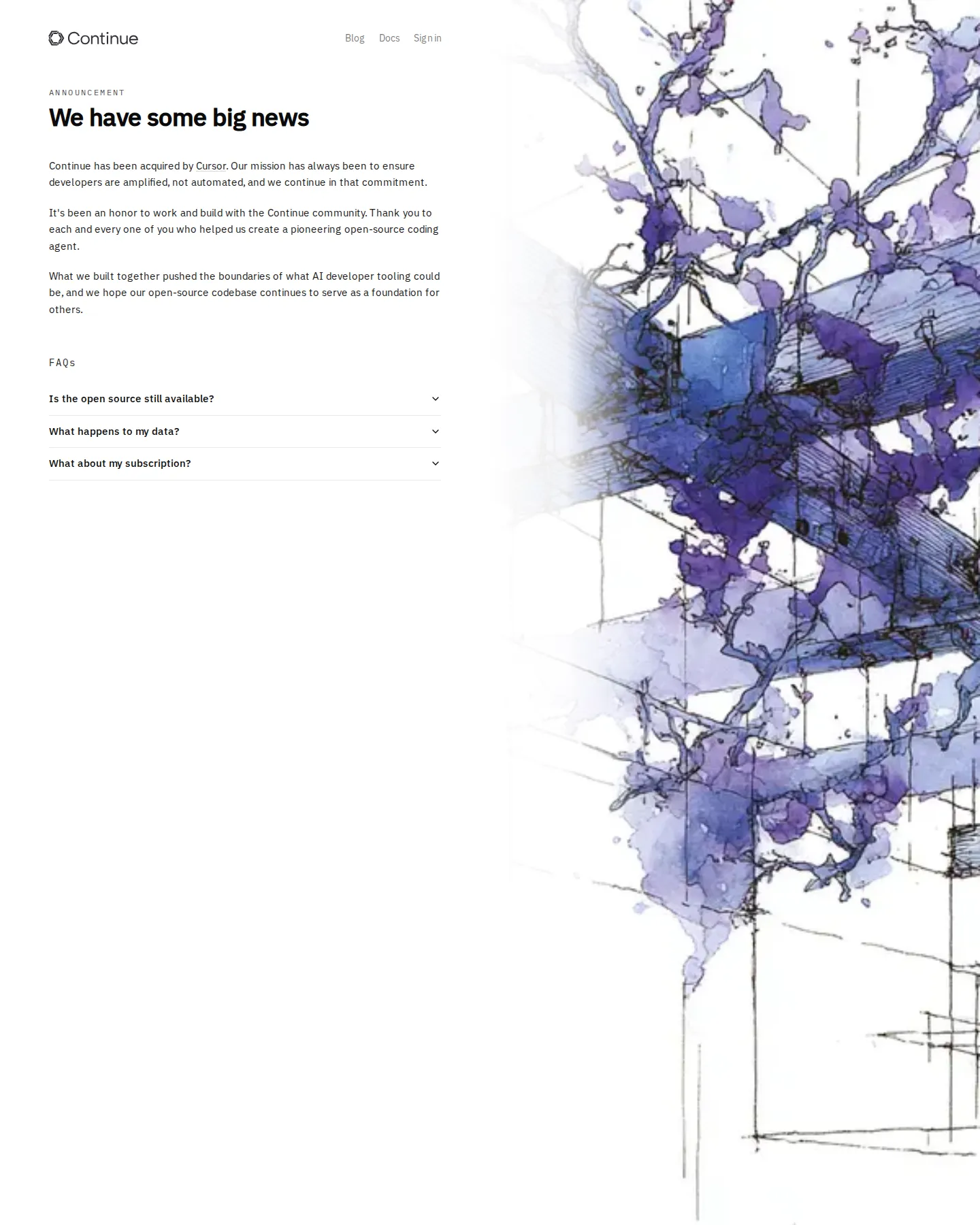
As of June 2026, Continue has been acquired by Cursor. The continue.dev/pricing page no longer shows any plans or prices — it now serves an acquisition announcement stating “Continue has been acquired by Cursor,” with collapsible FAQs covering whether the open source is still available, what happens to user data, and what happens to existing subscriptions. The page displays no Starter/Team/Company tiers and no token or seat prices.
Before the acquisition, pricing split along two axes — token-metered consumption for individuals and per-seat subscriptions for teams: an entry Starter plan with no monthly fee billing frontier-model usage pay-as-you-go, a per-seat Team plan bundling model credits, and a custom-quoted Company tier for enterprises needing SSO, BYOK, and SLAs. Those last-advertised figures are recorded in the Pricing evolution section below; they are no longer live on the pricing page. The open-source IDE extension itself remains free to self-host with your own model keys.
For the most current information on Continue.dev’s status and the Cursor acquisition, visit Continue.dev.
Pricing summary : How Continue.dev’s pricing model works
As of June 2026, Continue’s hosted pricing is no longer published — continue.dev/pricing serves an acquisition notice (“Continue has been acquired by Cursor”) with no plan prices. The model described below is the structure that was live up to the June 2026 capture; the specific last-advertised dollar figures now live in the Pricing evolution section (they are no longer on the page, so they are recorded as history rather than current rates).
Continue ran a hybrid model layered on top of a free open-source extension. Individuals paid only for what they consumed — frontier-model tokens on a per-token meter with no monthly fee. Teams moved to a per-seat subscription that bundled a block of model credits per seat, so the bill blended a fixed seat fee with metered model usage. Enterprises negotiated a custom commitment.
Billing dimensions that were in play:
- Model tokens — per-token metered usage, pay-as-you-go on Starter; also drawn against included/purchased credits on Team.
- Seats — per-seat monthly fee on Team.
- Bundled credits — a block of model credits included per Team seat each month.
- Custom commitment — Company tier added invoicing, BYOK, and SLA under a negotiated contract.
What made this different: The free, open-source core meant Continue monetized hosted convenience (model credits + agent management) rather than the IDE itself, and the Starter plan was unusual in having literally zero subscription floor. With the Cursor acquisition, that hosted layer’s pricing is no longer advertised; the open-source extension remains free to self-host.
Pricing by product
Continue Platform (status after Cursor acquisition)
The continue.dev/pricing page no longer publishes plan pricing. The table below records the plan structure and mechanics as last seen, with prices removed (the specific last-advertised dollar figures are in the Pricing evolution section, recorded as history). What remains live and free is the open-source IDE extension.
| Tier | Status | Included | Key mechanics |
|---|---|---|---|
| Open-source extension | Free, still available | Self-host with your own model keys | Apache-2.0 VS Code / JetBrains extension; BYO model API keys or local Ollama; no Continue charge |
| Starter (former) | No longer advertised | Was pay-as-you-go, no monthly fee | Create and run AI agents; connect Slack/Sentry/Snyk; buy credits for frontier models; input and output billed per token |
| Team (former) | No longer advertised | Was per-seat with included model credits | Everything in Starter; manage and share private agents; control which agents the team can use; Gmail/GitHub SSO login |
| Company (former) | No longer advertised | Was custom-quoted | Custom SSO (SAML/OIDC); bring your own API keys (BYOK); commitment, invoicing, and SLA |
The open-source Continue IDE extension (VS Code / JetBrains) remains free; the hosted Continue platform tiers (Starter / Team / Company) are no longer published following the acquisition by Cursor. An “What about my subscription?” FAQ on the announcement page covers the status of existing hosted subscriptions.
Sales motions across products: PLG / self-serve previously applied to Starter and Team (sign up and pay by token or seat); sales-led for Company (custom quote, invoicing, SLA). Hosted plan self-serve signup is no longer advertised post-acquisition.
Hidden costs : What Continue.dev users actually pay
Continue’s headline numbers look cheap, but the real bill is driven by model token consumption, not the seat fee. The $20/seat Team price is essentially a governance fee; the variable cost is whatever your developers burn against frontier models at $3 per million tokens. Agentic coding (multi-step plans, large-context edits, repeated reads) consumes tokens far faster than chat-only autocomplete, so the metered line is where bills grow.
The seat fee is half credit, half license. Each Team seat’s $20 includes $10 in model credits, so a developer who stays under $10 of model usage effectively pays a $10 net license. A developer running agents all day blows past the $10 credit and pays $3/M on everything above it — the same rate as Starter.
Worked example — 5-developer team, moderate agent use:
| Line item | Quantity | Monthly cost |
|---|---|---|
| Team seats | 5 × $20/seat | $100 |
| Included model credits | 5 × $10 (already in seat fee) | ($50 of usage covered) |
| Model token overage | ~10M tokens/dev above credit × 5 devs ≈ 50M tokens @ $3/M | $150 |
| Estimated total | $250/mo |
The same five developers on Starter (no seat fee) would pay only for tokens: at ~12M tokens/dev/month that is ~60M tokens × $3/M = $180/mo, but with no shared agents, SSO, or admin controls. Team’s premium buys governance, not cheaper tokens.
The BYOK escape hatch. Cost-sensitive teams can sidestep Continue’s $3/M metered credits entirely: the open-source extension lets you bring your own provider API keys (or run a local model via Ollama) so you pay your LLM provider directly and Continue’s hosted credits become optional. On the Company tier, BYOK is a first-class feature; on Starter/Team it is the open-source fallback. This makes Continue’s effective token cost a ceiling, not a floor.
Want to estimate your own Continue.dev bill? Use the Continue.dev pricing calculator to model seat fees plus token overage against your team’s usage.
Pricing evolution : Continue.dev pricing history and changes
Continue spent its first ~18 months as a pure free, open-source project with no paid plan at all. Monetization arrived in stages: a tiered model announced with Continue Hub in February 2025, a live pricing page in January 2026, and a quiet removal of the free individual tier by March 2026.
Cadence
| Quarter | Price changes | Product / SKU additions | Notes |
|---|---|---|---|
| 2023 Q3 | 0 | Open-source extension (free) | Show HN launch, YC S23; no paid plan |
| 2025 Q1 | 0 | Continue Hub; Solo/Teams/Enterprise tiers announced | 1.0 release + $3M seed; Solo tier free |
| 2026 Q1 | New paid page | Solo (Free) / Team ($20/seat) / Company (custom) goes live | First HTTP-200 pricing page (was 404 in Dec 2025) |
| 2026 Q1–Q2 | Solo Free → Starter $3/M tokens | Entry plan renamed and re-metered | Free individual tier removed on hosted platform |
| 2026 Q2 | Hosted pricing withdrawn | Pricing page replaced by acquisition notice | Continue acquired by Cursor; Starter/Team/Company tiers no longer published |
Tracked range: 2023–present. Historical inflection points sourced from Wayback Machine snapshots of continue.dev/pricing (2026-01-30, 2026-03-05, 2026-06-03) plus the 2026-06-24 live capture and TechCrunch / Hacker News coverage.
Notable changes
- 2023-07-26 — Launched as a free, open-source coding autopilot (Apache 2.0). No paid plan. Show HN hit 298 points / 103 comments.
- 2025-02-26 — Shipped 1.0 and launched Continue Hub with a $3M seed round (Heavybit). Introduced a tiered model: free Solo, Teams (multiplayer + admin), Enterprise (security, audit log, credential management). Source: TechCrunch.
- 2026-01-30 — First live pricing page. Three tiers: Solo (Free), Team ($20/seat/mo, $10 credits), Company (custom). The path was a 404 as recently as 2025-12-29.
- 2026-03-05 — Entry plan renamed Solo → Starter and switched from Free to $3 per million tokens, pay-as-you-go (input and output). This removed the free hosted individual tier; the open-source extension remained free.
- 2026-06-24 — Continue acquired by Cursor. continue.dev/pricing now serves an acquisition announcement (“Continue has been acquired by Cursor”) with no plan pricing — only collapsible FAQs on open-source availability, data, and subscription status. The last-advertised hosted prices before withdrawal were Starter $3/M tokens (PAYG, no monthly fee), Team $20/seat/mo with $10 included credits per seat, and Company custom. The open-source Apache-2.0 IDE extension remains free. Source: live capture of continue.dev/pricing, 2026-06-24.
The free-tier removal in detail
The most consequential change is the quietest. In the January 2026 pricing page, the individual plan was literally called Solo and priced Free — “for individuals getting started,” with BYO API keys or the option to buy credits. By the March 2026 snapshot the same column had been renamed Starter (“Try agents and get started”) and re-priced to $3 / million tokens, input and output, pay as you go. Nothing on the Team or Company tiers moved.
This is a textbook usage-based pivot: rather than gate the free tier with seat limits or feature caps, Continue simply attached a meter to the hosted convenience layer. A developer who brings their own keys (or runs Ollama locally through the open-source extension) still pays nothing to Continue; a developer who wants Continue’s managed frontier-model access now pays per token from the first request. The free software never went away — the free hosted usage did.
What’s unique : Continue.dev’s distinctive pricing mechanics
1. The product is free; only the convenience is metered. Unlike GitHub Copilot or Cursor — where the editor integration is the paid product — Continue’s IDE extension is Apache-2.0 open source and free forever. Continue monetizes a separate hosted layer (Continue Hub: model credits, shared private agents, governance). This means a determined team can run Continue at $0 to Continue by bringing their own model keys, and the paid plans compete on convenience and governance, not on access to the software.
2. A zero-floor metered entry plan. The Starter plan has no monthly minimum — not “$0 for limited use” but literally no subscription line at all. You pay $3 per million tokens, input and output combined, and nothing else. Most “free or cheap entry” coding tools either cap free usage hard or charge a flat $10–20/mo floor; Continue’s entry plan is pure pay-as-you-go on managed frontier models.
3. The seat fee doubles as a usage wallet. Team’s $20/seat isn’t a pure license — it bundles $10 of model credits, so half of each seat fee is pre-paid usage. The bill then blends a fixed seat component with metered token draw against (and beyond) that credit. It’s a hybrid where the “subscription” and “usage” halves are deliberately fused inside a single seat price, which keeps the headline simple while still scaling cost with consumption. See how AI companies blend seats and usage for the broader pattern.
Strengths & weaknesses
| Strengths | Weaknesses |
|---|---|
| Open-source (Apache 2.0) core means zero lock-in — teams can self-host with their own keys and pay Continue nothing | The free hosted individual tier was removed in early 2026 (Solo Free → Starter $3/M); newcomers expecting a free managed plan now hit a meter |
| Zero-floor Starter plan: pure pay-as-you-go at $3/M tokens, no subscription minimum | Token-metered billing makes agentic costs hard to predict — heavy multi-step agent runs can dwarf the $20 seat fee |
| Transparent, public, flat $3/M token rate (no per-model rate card to decode at the headline level) | Only two self-serve price points ($3/M and $20/seat); the jump to governance/SSO requires the custom Company tier |
| BYOK / local-model escape hatch caps effective cost — Continue’s credits are a ceiling, not a floor | The $10 included credit per seat is small; teams doing real agent work pay overage at the same $3/M rate, so Team isn’t cheaper per token than Starter |
| Hybrid seat-plus-credit Team plan keeps the headline simple while still scaling with usage | Enterprise security (SAML/OIDC SSO, audit, BYOK governance) is gated behind a sales-led custom quote with no public price |
Billing UX : Continue.dev billing controls and transparency
Note: as of June 2026 continue.dev/pricing serves an acquisition notice and no longer surfaces self-serve billing controls. The controls below were the hosted-platform billing surface as last documented; the acquisition FAQ now points existing customers to subscription-status answers instead.
- Acquisition FAQ on subscriptions — the current page exposes a “What about my subscription?” FAQ (alongside “Is the open source still available?” and “What happens to my data?”) to address existing hosted customers post-acquisition.
- Buy credits for frontier models — Starter let users purchase model credits directly to run paid frontier models on a pay-as-you-go basis.
- Per-seat included credits — each Team seat included a monthly block of model credits, visible against metered usage.
- Agent usage controls — Team admins could control which agents the team can use and manage/share private agents centrally.
- SSO login — Gmail/GitHub SSO on Team; Custom SSO via SAML or OIDC on Company.
- Bring your own API keys (BYOK) — Company tier let enterprises route model calls through their own provider keys; the open-source extension supports BYOK and local Ollama for free.
- Commitment & invoicing — Company tier added commitment-based invoicing and an SLA in place of self-serve card billing.
Strategic wins : Why Continue.dev’s pricing decisions worked
1. Open source as distribution, hosted convenience as revenue
Continue gave away the editor integration (Apache 2.0) to win developer trust and distribution — 32k+ GitHub stars and 2.4M+ VS Code installs by early 2026 — then monetized a separate hosted layer (Continue Hub) that the free users gradually want. This is the classic open-core split done cleanly: the thing developers evaluate is free and un-gated, so adoption is frictionless, and the paid product (managed credits, shared agents, governance) sells itself once a team forms around the free tool. See usage-based pricing strategy for why metering the convenience layer rather than the software lowers buyer resistance.
2. A token meter instead of a free-tier teardown
When Continue removed its free individual tier in early 2026, it didn’t claw back features or impose seat caps — it simply attached a $3/M-token meter to the hosted plan. Buyers who object can still pay $0 by bringing their own keys. That avoids the backlash that usually follows free-tier removals, because nothing was taken away — the free path just moved from “managed credits” to “your own keys.” This mirrors the broader shift from per-user licenses to consumption that’s reshaping developer-tool pricing.
3. Fusing the seat fee and the usage wallet
Team’s $20/seat bundling $10 of credits is a quiet design win: it gives buyers a predictable, comparable seat price (easy to budget against Copilot’s per-seat fee) while still letting cost scale with real usage. The seat fee anchors the value perception; the embedded credit absorbs light usage; overage captures heavy users at marginal cost. Picking the seat as the headline metric and tokens as the scaling metric is a deliberate value-metric choice — see choosing the right usage metric.
Areas to improve : Gaps in Continue.dev’s pricing approach
1. Token-metered agents invite bill shock
Agentic coding is token-hungry and bursty — a single large refactor or multi-step plan can consume millions of tokens. With $3/M billing and only $10 of included credit per seat, a heavy day can quietly produce a bill many times the seat fee, and there’s no obvious spend cap or budget alert surfaced on the public pricing page. Continue should ship visible per-seat/per-team spend caps and forecasting to avoid the bill-shock pattern that plagues consumption-priced AI tools.
2. The free-tier removal isn’t explained on the pricing page
The Solo→Starter change quietly converted “Free” to “$3/M tokens” with no migration note, changelog entry, or explanation visible on continue.dev/pricing. Developers who remember a free Solo plan now arrive to find a meter and no context. A short “what changed and why” note (and a clearer signpost that BYOK/self-host remains free) would reduce confusion and reinforce the open-source promise.
3. A two-point self-serve ladder with a large gap to Company
There are only two self-serve prices — $3/M and $20/seat — and then a cliff to a sales-led custom quote for anything involving SSO, audit, or BYOK governance. Mid-sized teams that need SAML or audit logging but aren’t ready for a negotiated contract have nowhere to land. A published “Business” price point between Team and Company (fixed SSO + spend controls at a transparent rate) would smooth the ladder.
Key takeaways
- The editor is free; the hosted layer is the product. Continue’s IDE extension is Apache-2.0 open source — you only pay for the managed Continue Hub layer (model credits, shared agents, governance), and BYOK/self-host stays free.
- Starter has no monthly floor. It’s pure pay-as-you-go at $3 per million tokens (input and output combined), with no subscription minimum — unusual among coding tools that gate or charge a flat entry fee.
- Team’s $20/seat is half license, half usage wallet. Each seat bundles $10 of model credits; usage beyond that is billed at the same $3/M as Starter, so Team buys governance, not cheaper tokens.
- The free hosted individual tier was removed in early 2026. The “Solo (Free)” plan visible in January 2026 became “Starter ($3/M tokens)” by March 2026 — a quiet conversion of free managed usage into a meter.
- For the AI-coding category, open-core + a metered convenience layer is a viable counter-model to Copilot/Cursor’s pay-for-the-editor approach: give away the integration, monetize the managed inference and team controls.
UBP implications
- Meter the convenience, not the software. Continue removed its free tier by attaching a token meter to the hosted layer rather than gating features — because a free self-host/BYOK path still exists, the change avoided the backlash a true free-tier teardown usually triggers. If you have an open-source core, this is the gentlest way to introduce usage pricing.
- Fuse the seat and the meter inside one price. Bundling $10 of usage credit into a $20 seat gives buyers a comparable, budgetable headline (seat) while cost still scales with consumption (tokens). Practitioners adding usage to a seat-based product can fuse the two into a single line to keep the headline simple.
- A zero-floor metered entry plan lowers the trial barrier. Starter’s “no monthly fee, $3/M tokens” removes the commitment of a subscription minimum, letting price-sensitive individuals try managed inference at marginal cost — a useful pattern for converting a free-software user base into paying usage customers.
Sources
- Continue.dev pricing page — now an acquisition notice (accessed 2026-06-24) — shows “Continue has been acquired by Cursor”, no plan pricing
- Continue.dev official website (accessed 2026-06-08)
- Continue documentation (accessed 2026-06-08)
- Continue blog (accessed 2026-06-08)
- Continue on GitHub (Apache 2.0) (accessed 2026-06-08)
Bottom line
Continue.dev is the open-source counter-model in the AI-coding space: give away the editor integration (Apache 2.0, 2.4M+ installs), monetize the hosted convenience layer. Its pricing is genuinely simple — a zero-floor Starter at $3/M tokens, a $20/seat Team that bundles $10 of credits, and a custom Company tier — but the simplicity hides a 2026 free-tier removal (Solo Free → Starter $3/M) and a token meter that can make heavy agent use cost far more than the seat fee. The honest pitch: if you bring your own keys or self-host, Continue can cost you nothing; if you want managed frontier-model access and team governance, you pay per token from the first request.
Want to compare Continue.dev against other AI-coding and developer-tools companies? Browse the pricing blueprint, or model your own bill with the Continue.dev pricing calculator.
Pricing timeline : Major events on a vertical axis
Each milestone below corresponds to a public pricing change, product launch, or material adjustment. Major events use a filled marker; minor adjustments use a faded one.
Continue acquired by Cursor — pricing page replaced by acquisition notice
continue.dev/pricing no longer shows any plans or prices; it now serves an acquisition announcement: 'Continue has been acquired by Cursor.' The page lists FAQ entries on open source, data, and subscriptions but displays no Starter/Team/Company tiers. The standalone hosted Continue pricing (Starter $3/M tokens, Team $20/seat, Company custom) is no longer advertised. Captured live 2026-06-24.
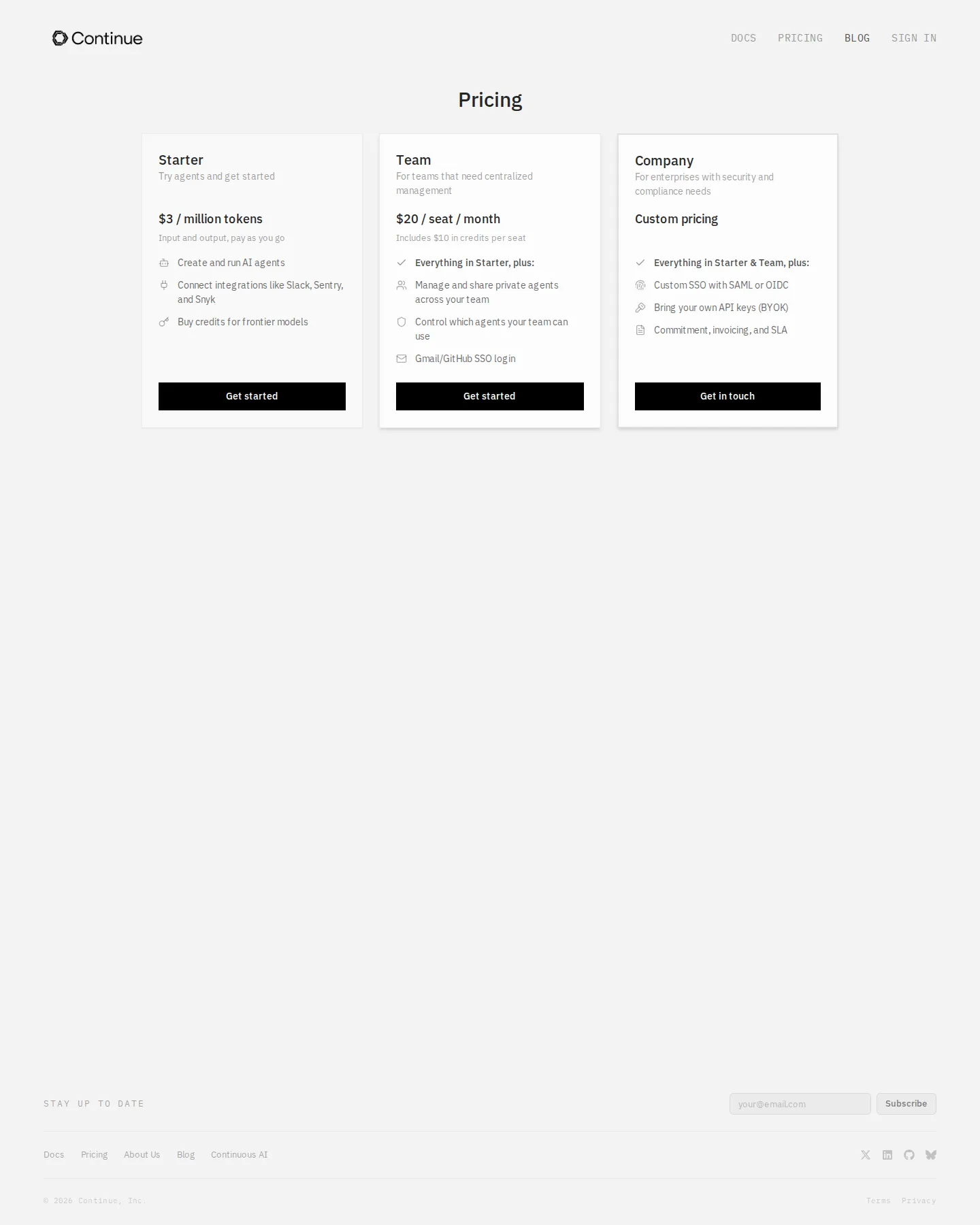
Three-tier plan structure captured
continue.dev/pricing shows Starter at $3/million tokens (PAYG, no monthly fee), Team at $20/seat/month with $10 included credits per seat, and custom-priced Company tier with SAML/OIDC SSO, BYOK, and SLA. Verified against live capture.
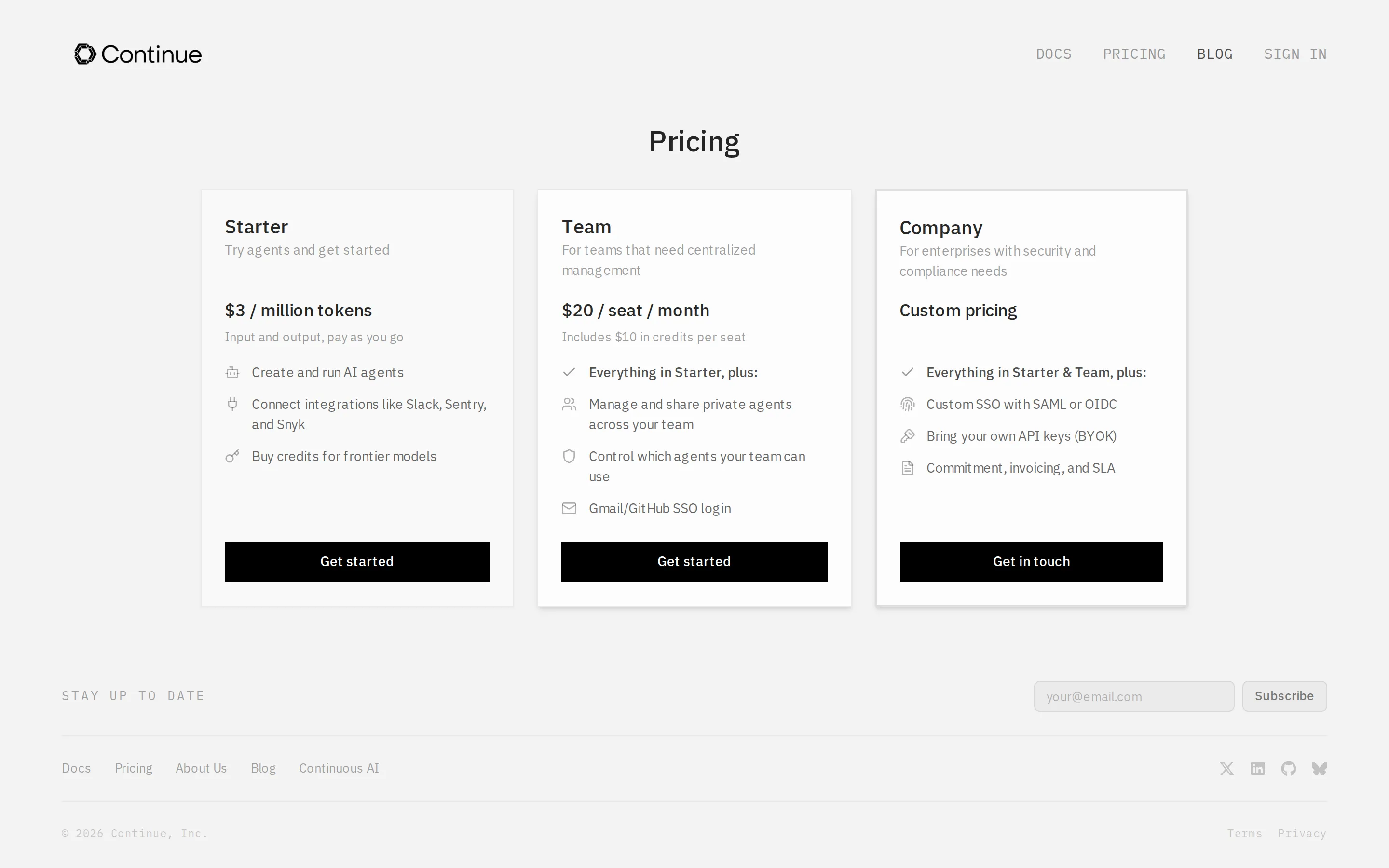
Free Solo tier replaced by metered $3/M-token Starter
Wayback snapshot shows the entry plan renamed from 'Solo' (Free) to 'Starter' priced at $3 per million tokens, input and output, pay-as-you-go. Team ($20/seat/mo, $10 credits) and Company (custom) unchanged. This removed the free individual tier on the hosted platform; the open-source extension stayed free. Source: web.archive.org snapshot 20260305 of continue.dev/pricing.
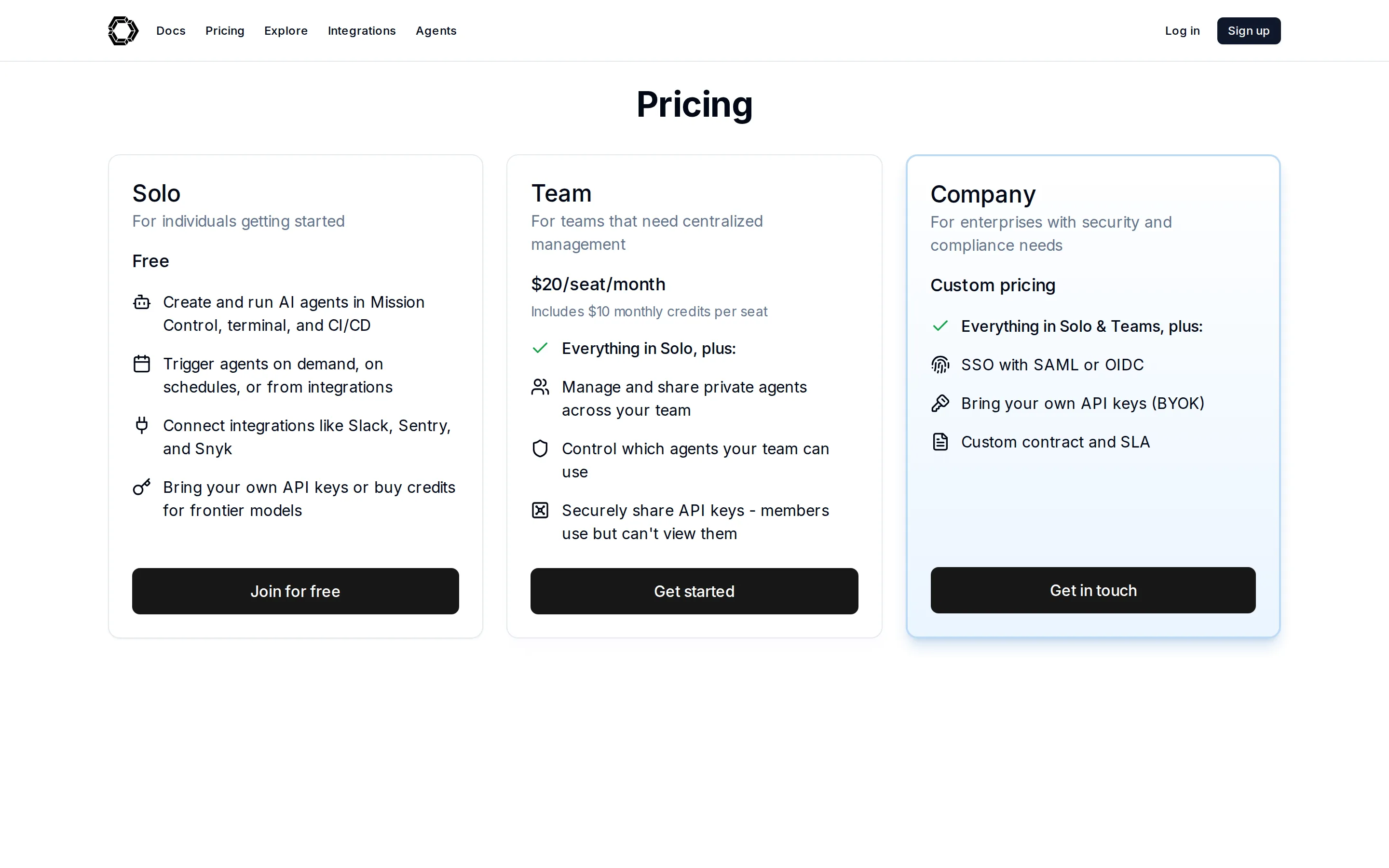
First paid pricing page goes live (Solo / Team / Company)
continue.dev/pricing first returns HTTP 200 (the 2025-12-29 capture was a 404). Entry plan 'Solo' is Free (BYO API keys or buy credits), Team is $20/seat/mo with $10 monthly credits per seat, Company is custom with SSO/BYOK/SLA. Source: web.archive.org snapshot 20260130 of continue.dev/pricing.
Continue 1.0 + Continue Hub launch with tiered Solo/Teams/Enterprise model
Alongside its 1.0 release and a $3M seed round (led by Heavybit), Continue announced Continue Hub and a tiered model: a free Solo tier for individuals, a Teams tier with multiplayer/admin controls, and an Enterprise tier with security, credential management and audit logging. Source: TechCrunch, 2025-02-26.
Launched as free open-source coding autopilot (Show HN, YC S23)
Continue debuted as a free, open-source AI coding autopilot (Apache 2.0) with no paid plan. Show HN reached 298 points / 103 comments. Y Combinator S23 batch; ~$2.1M seed followed post-YC. Monetization (Hub, credits) came later. Source: Hacker News, 2023-07-26.
- · Continue's core IDE extension (VS Code and JetBrains) is free and Apache-2.0 open-source — the company monetizes a hosted layer of model credits and agent management called Continue Hub, not the editor itself.
- · The Starter plan has no monthly subscription floor: developers pay only for frontier-model tokens at $3 per million (input and output combined), pay-as-you-go.
- · Each Team seat ($20/month) ships with $10 in model credits, so the bill blends a fixed seat fee with metered model usage — meaning roughly half of a seat's fee is a usage credit, not a license.
Questions & answers
- What is Continue.dev's pricing model?
- Continue uses a hybrid model on top of a free open-source extension: Starter is token-metered pay-as-you-go ($3 per million tokens), Team is a $20/seat/month subscription with $10 of included model credits per seat, and Company is custom-quoted for enterprises.
- Does Continue.dev offer a free tier?
- The core Continue IDE extension (VS Code and JetBrains) is free and open-source. On the hosted platform, the Starter plan has no monthly subscription fee — you pay only for model tokens at $3 per million, pay-as-you-go.
- How much does Continue.dev cost per month?
- Starter has no fixed monthly fee (usage billed at $3 per million tokens). Team is $20 per seat per month and includes $10 in model credits per seat. Company pricing is custom.
- Is Continue.dev pricing usage-based or subscription?
- Both. Starter is purely usage-based ($3 per million tokens). Team blends a $20/seat/month subscription with metered model usage drawn against $10 of included credits per seat. Company is a custom contract.
- Did Continue.dev get rid of its free plan?
- Continue removed its free individual 'Solo' tier in early 2026. When the paid pricing page first appeared in January 2026 the entry plan ('Solo') was Free; by March 2026 it had been renamed 'Starter' and switched to metered $3-per-million-token pay-as-you-go. The open-source IDE extension itself remains free.
- Is Continue.dev really open source?
- Yes. The core Continue IDE extension for VS Code and JetBrains is released under the Apache 2.0 license and is free to self-host with your own model API keys. The paid plans monetize the hosted Continue Hub layer — model credits, shared private agents, and team governance — not the editor.