AI Summary
About
Cursor is an AI-native code editor built by Anysphere, founded in 2022 by four MIT students (Michael Truell, Sualeh Asif, Arvid Lunnemark, Aman Sanger). The product launched publicly in March 2023 as a fork of Visual Studio Code with AI features baked in at the editor level rather than bolted on as an extension.
By early 2026 the company had crossed $2 billion in ARR, reached a $29.3 billion valuation (November 2025 round led by a16z, Thrive Capital, Benchmark), and grown to over 300 employees — making Cursor one of the fastest-revenue-ramping software companies on record.
The product competes with GitHub Copilot, Codeium, Continue, and Cline, but its pricing model is structurally different: where Copilot bundles AI into a flat seat fee, Cursor exposes underlying API costs to the user and takes margin on routing.
Pricing summary : How Cursor’s hybrid credit-pool model works
Cursor uses a hybrid model with seat fees plus two usage pools:
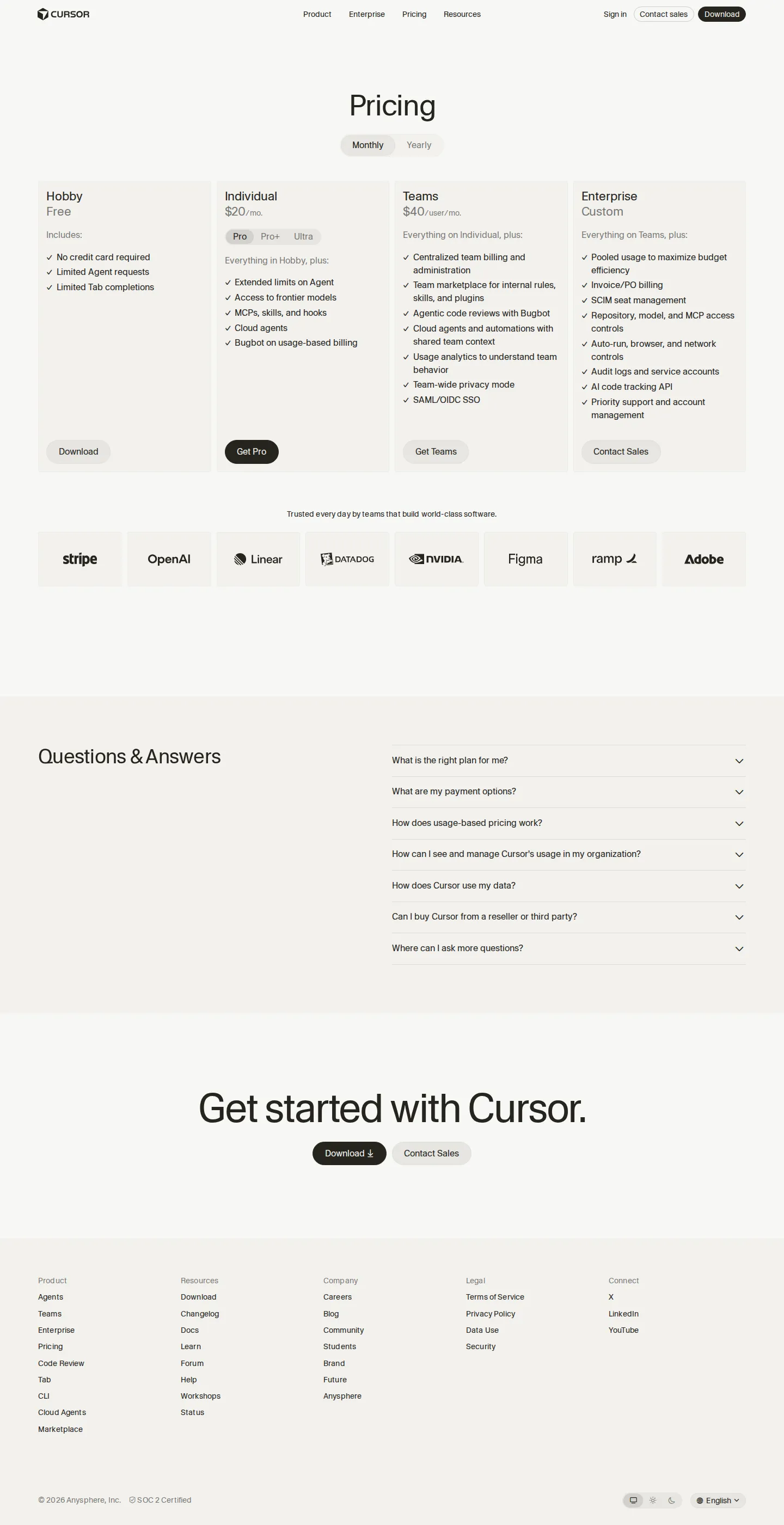
- Platform access (seat-based): Hobby is free, Pro / Pro Plus / Ultra are individual paid plans, Start is a lower-cost individual plan for developers in India (₹649/mo, tax inclusive), and Teams is now split into two per-seat tiers — Standard at $40/user/month and a new Premium seat at $120/user/month.
- AI usage (pool-based): Individual plans split usage into a Cursor Models pool (Cursor’s own router and models — currently Grok 4.5 and Composer 2.5) and an Other Models pool (third-party frontier models, charged at API rates). Cursor says each paid individual plan includes at least $20 of Other Models usage per month, with higher tiers including more; the Start plan does not include the Other Models pool at all.
What makes this different: Most AI coding tools bundle model usage into a flat seat fee. Cursor exposes the underlying token economics, shows separate pools for first-party (Cursor Models) and third-party (Other Models) usage, and now layers a usage-multiplier seat tier (Teams Premium) on top of its per-seat pricing rather than just raising the seat price outright.
See the plan grid at the top of this page for the full lineup. Plans split into individual (Start, Hobby, Pro, Pro Plus, Ultra) and business (Teams Standard/Premium, Enterprise) ladders.
Pricing by product
Editor (Individual plans)
| Tier | Price | Included | Key mechanics |
|---|---|---|---|
| Start | ₹649 / mo, tax inclusive | India only; generous usage of the Cursor Models pool (Grok 4.5 + Composer 2.5); Cloud Agents; Cursor for iOS; plugins, MCP servers, hooks, and skills | Excludes the Other Models pool, on-demand usage, Bugbot, Auto, Automations, and the Cursor SDK; upgrade to Pro for those |
| Hobby | $0 | No credit card required; limited Agent requests; access to Composer | Free starter tier |
| Pro | $20 / mo | $20 of Other Models usage; unlimited tab completions; extended agent usage limits; access to Bugbot and Cloud Agents | Most popular individual tier |
| Pro Plus | $60 / mo | $70 of Other Models usage; generous included usage | Mid-tier for heavy individual usage |
| Ultra | $200 / mo | $400 of Other Models usage; generous included usage | Heavy-user tier |
Editor (Business plans)
| Tier | Price | Included | Key mechanics |
|---|---|---|---|
| Teams (Standard) | $40 /user/mo | Centralized team billing and administration; team marketplace for internal rules, skills, and plugins; agentic code reviews with Bugbot; cloud agents and automations with shared team context; usage analytics; team-wide privacy mode; SAML / OIDC SSO | Self-serve team setup |
| Teams (Premium) | $120 /user/mo | Everything in Teams Standard, plus 5x Standard’s usage limits on Agent | Same admin features as Standard; higher-usage seat, self-serve |
| Enterprise | Custom | Everything in Teams plus pooled usage, invoice / PO billing, SCIM user management, AI code-tracking API, audit logs, granular admin controls, priority support | Sales-led, quoted |
Bugbot (code review, bundled into plan billing)
Bugbot no longer carries its own standalone per-seat price. Cursor’s live pricing page lists it only as an included feature: “Bugbot on usage-based billing” under Individual (Pro / Pro Plus / Ultra), metered from the same usage pool as the rest of the plan, and “Agentic code reviews with Bugbot” as an included Teams/Enterprise capability. Cursor’s Bugbot product page states a single “14-day free trial for all plans” — it does not publicly distinguish an individual-trial length from an org-wide-trial length, and no PR-per-month review cap is published.
Sales motions across products: PLG / self-serve for Start through Teams; sales-led for Enterprise.
Per-model pricing inside the usage pools
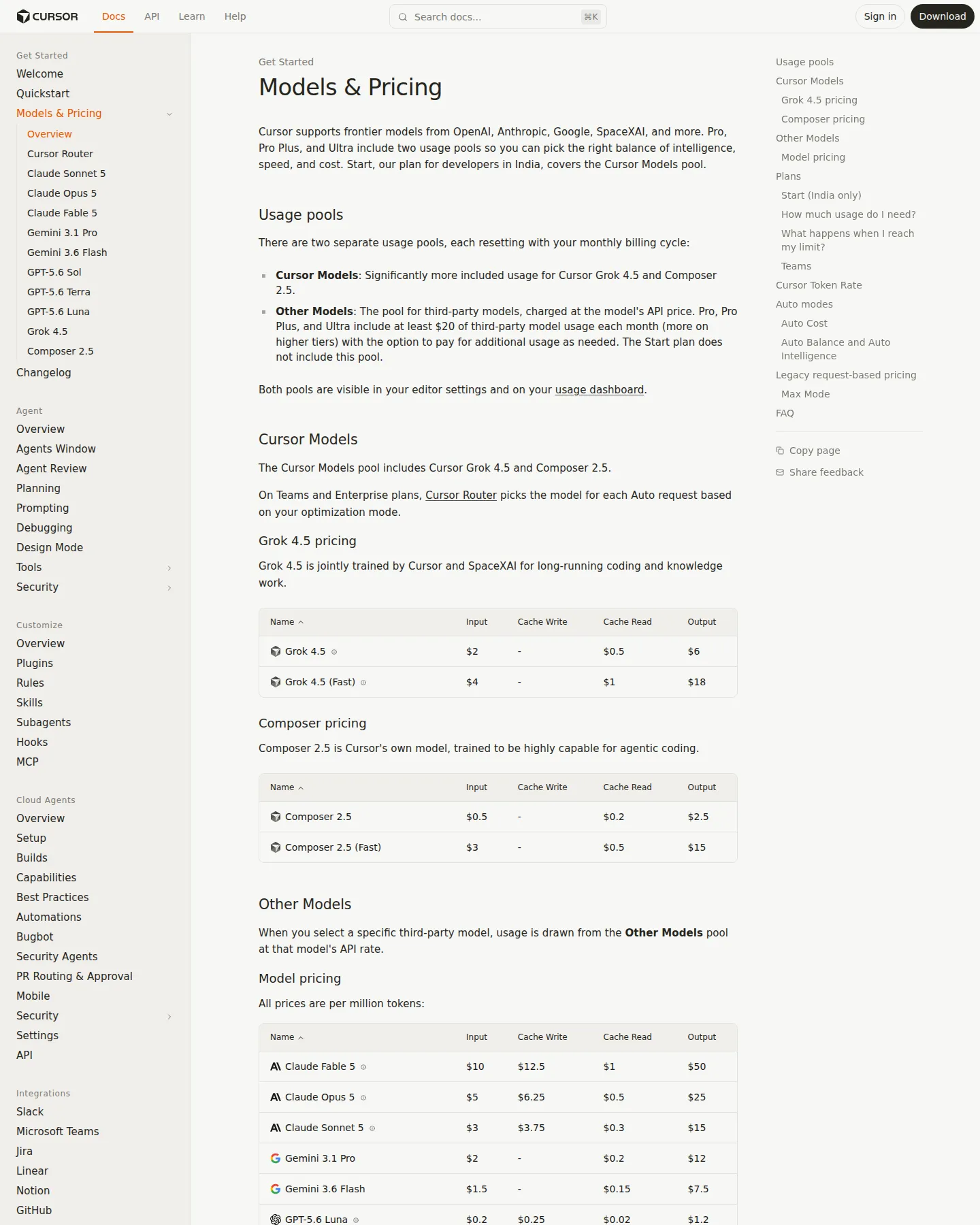
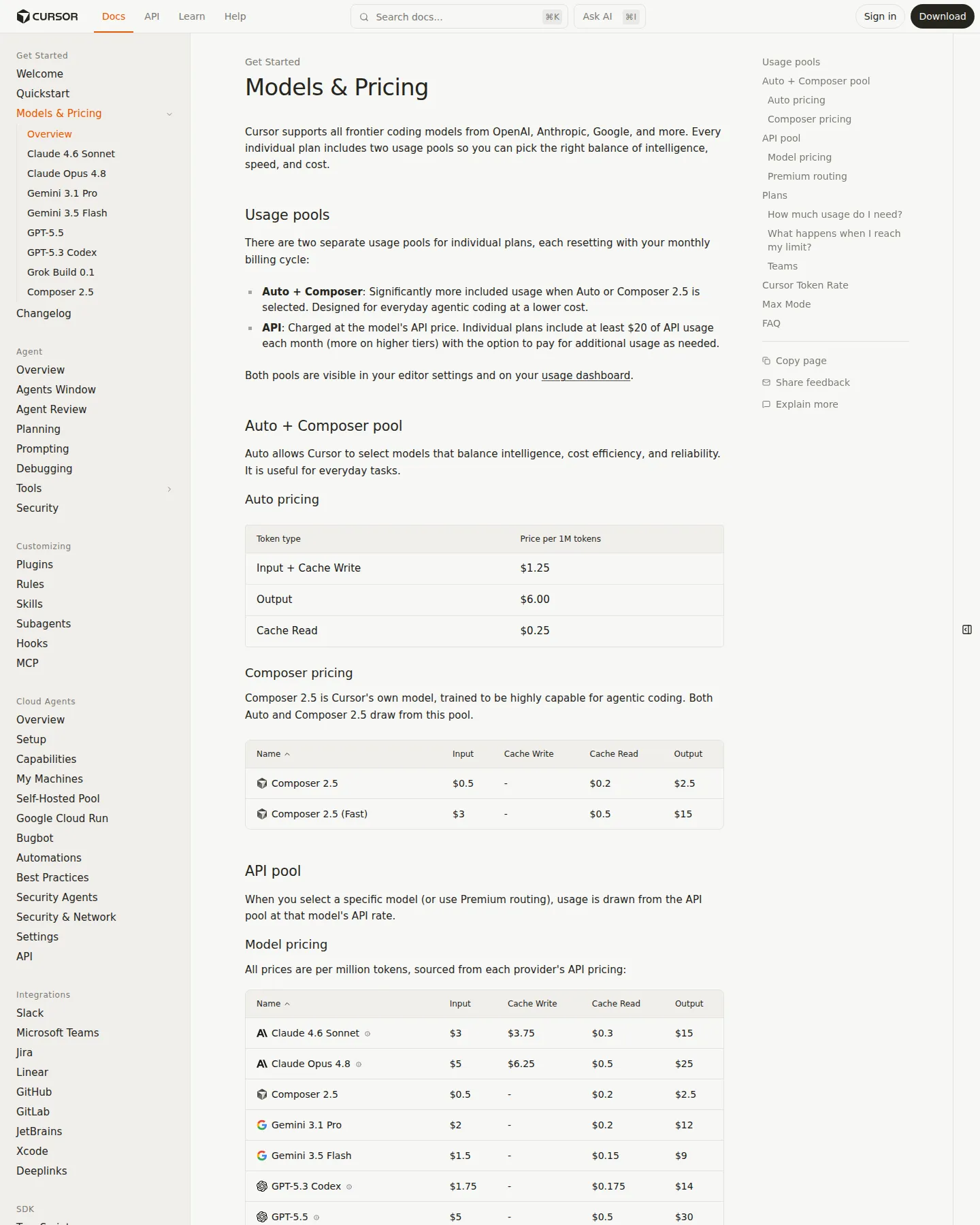
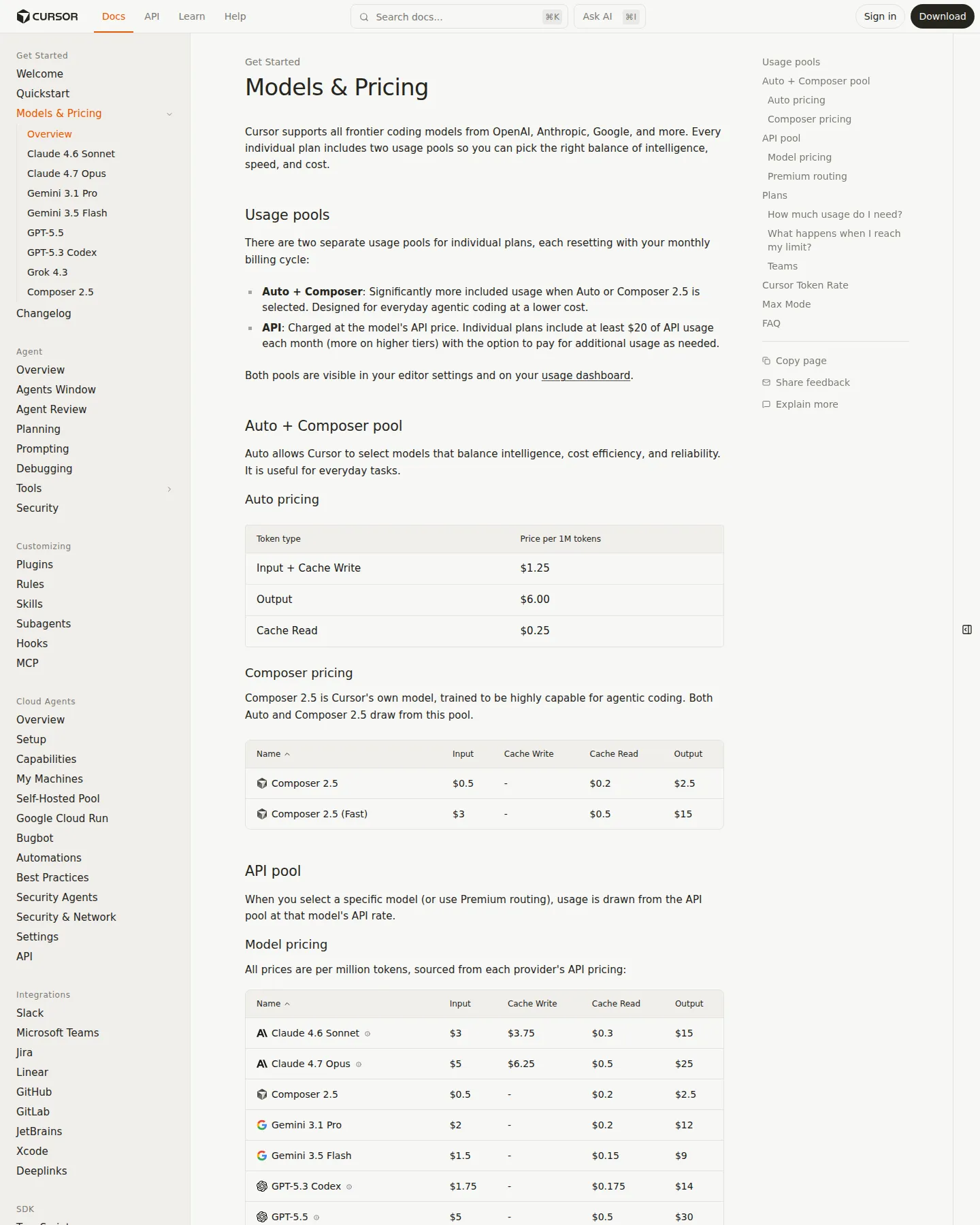
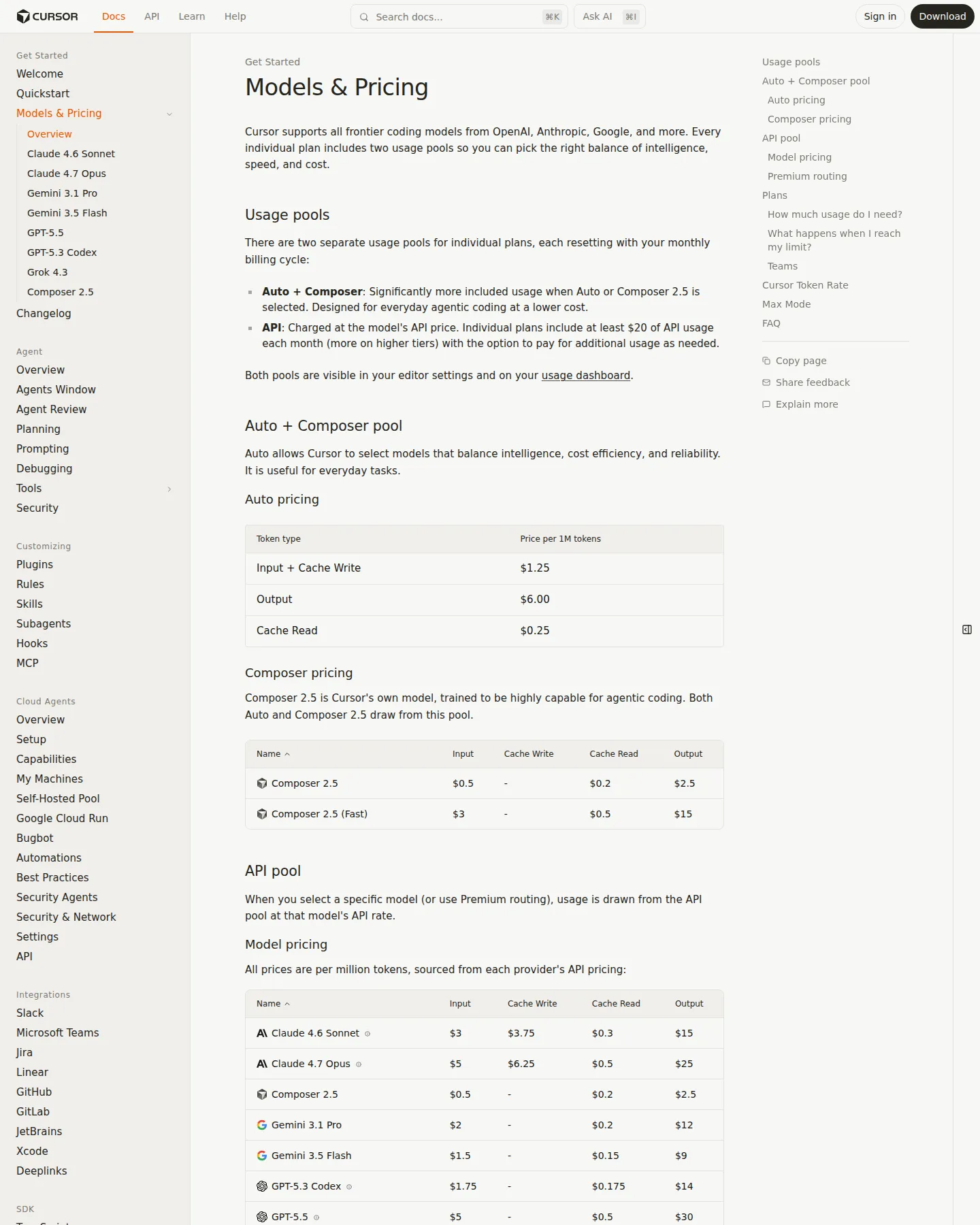
Cursor’s docs now name the two pools Cursor Models (Cursor’s own router and first-party models) and Other Models (third-party frontier models, billed at each provider’s API rate):
| Cursor Models pool | Input ($/1M) | Cache Write ($/1M) | Cache Read ($/1M) | Output ($/1M) |
|---|---|---|---|---|
| Grok 4.5 | $2 | - | $0.5 | $6 |
| Grok 4.5 (Fast) | $4 | - | $1 | $18 |
| Composer 2.5 | $0.5 | - | $0.2 | $2.5 |
| Composer 2.5 (Fast) | $3 | - | $0.5 | $15 |
| Other Models pool | Input ($/1M) | Cache Write ($/1M) | Cache Read ($/1M) | Output ($/1M) |
|---|---|---|---|---|
| Claude Fable 5 | $10 | $12.5 | $1 | $50 |
| Claude Opus 5 | $5 | $6.25 | $0.5 | $25 |
| Claude Sonnet 5 | $3 | $3.75 | $0.3 | $15 |
| Gemini 3.1 Pro | $2 | - | $0.2 | $12 |
| Gemini 3.6 Flash | $1.5 | - | $0.15 | $7.5 |
| GPT-5.6 Luna | $0.2 | $0.25 | $0.02 | $1.2 |
| GPT-5.6 Sol | $5 | $6.25 | $0.5 | $30 |
| GPT-5.6 Terra | $2 | $2.5 | $0.2 | $12 |
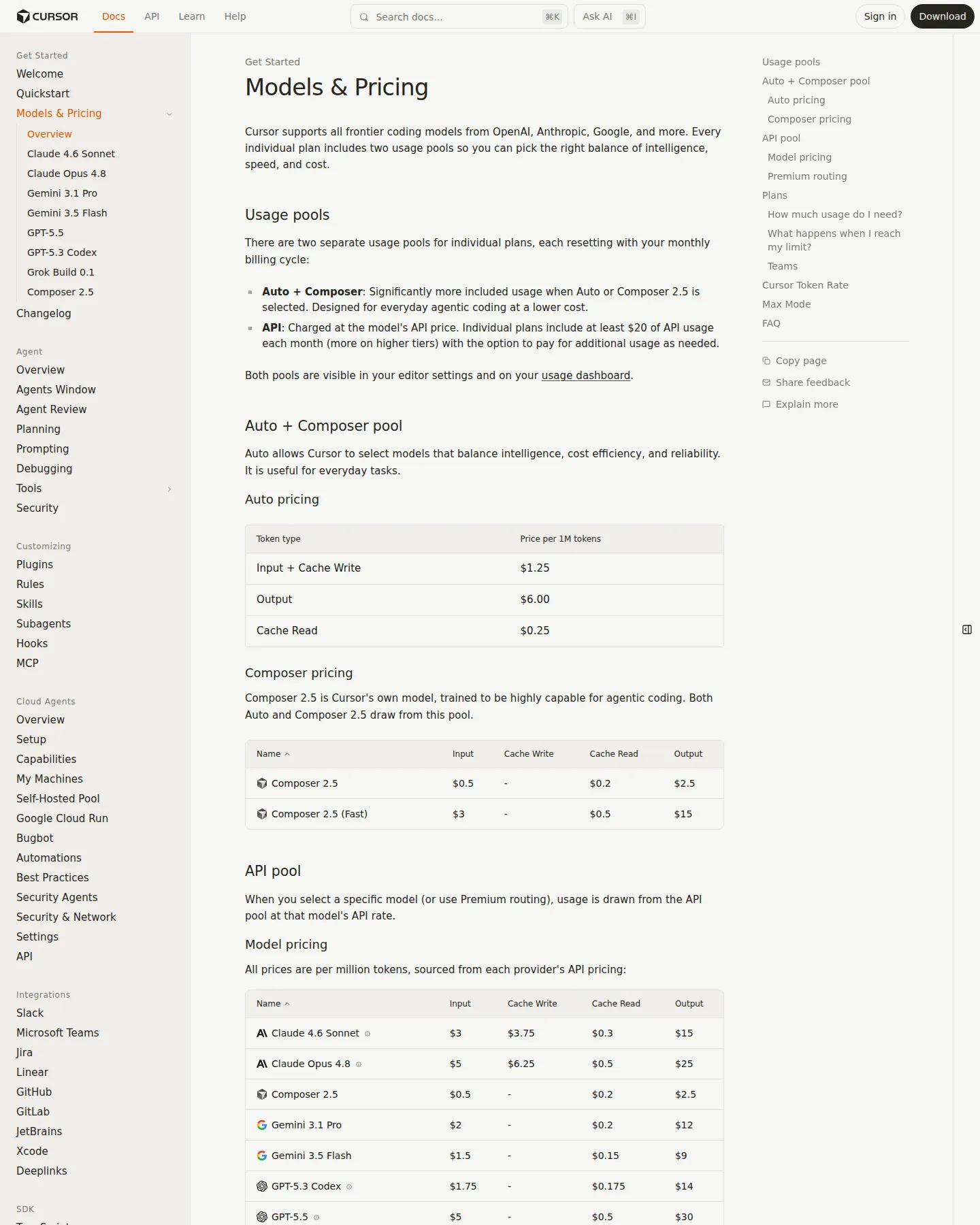
Auto is now three separate modes rather than one flat router: Auto Cost bills a fixed per-token rate ($1.25 input, $1.25 cache write, $0.25 cache read, $6 output) regardless of the model it routes to; Auto Balance and Auto Intelligence both bill at the selected model’s own API rate, based on actual usage. On Teams and Enterprise plans, non-Auto-Cost third-party model requests (direct selection, or Auto Balance/Auto Intelligence routing to a third-party model) add a Cursor Token Rate of $0.25/million tokens on top of the model’s API price; Auto Cost and all first-party Cursor models (Grok 4.5, Composer 2.5) are exempt. Opting into regional data residency adds a further 10% uplift on eligible Models’ pricing. Max Mode — available only on legacy request-based plans — extends the context window and bills at the model’s API rate plus a 20% surcharge.
A $20 Other Models pool covers roughly 65 Claude Opus 5 requests or 325 Composer 2.5 requests under typical workload assumptions (approximately) — a wide spread between Cursor’s own Composer model and the most expensive frontier models.
Hidden costs : What heavy individual and team users actually pay
The advertised $20/mo headline understates what heavy users actually pay. Two real-world examples:
Heavy individual developer (Claude Opus + multi-file refactors)
| Line item | Monthly cost |
|---|---|
| Pro plan base | $20 |
| Claude Opus 4.8 overage (~120 requests at avg $0.55/req) | $66 |
| GPT-5.3 Codex overage (~200 requests at avg $0.08/req) | $16 |
| Total | $102 |
A developer hitting Claude Opus daily for refactors and architecture pays roughly 5x the headline. The Ultra plan ($200 with 20x credits) becomes economically rational once monthly spend crosses ~$150 — but until you’ve spent that 5x premium for a few months, you don’t know you needed Ultra.
10-person Teams workspace
| Line item | Monthly cost |
|---|---|
| 10 seats × $40 | $400 |
| Pooled credit pool (10 × $20) | included |
| Premium model overage at moderate use (~$15/user) | $150 |
| Bugbot (3 reviewers × $40) | $120 |
| Total | $670 |
For teams, the per-user variance is the budgeting challenge: one engineer running long-context Opus sessions can spike a team bill by 30% in a week. See our usage-based pricing thresholds and alerting guide for how to architect spend governance for variable-cost AI tools.
Want to estimate your own Cursor bill? Use the Cursor pricing calculator to model your monthly cost based on plan, model mix, and request volume.
Pricing evolution : From generous Pro to the June 2025 credit reset
Cadence
| Quarter | Price changes | Product / SKU additions | Notes |
|---|---|---|---|
| 2024 Q4 | 1 | 0 | ”Fast/slow” terminology shifts to “premium requests”; o1-mini added as priced model |
| 2025 Q2 | 2 | 1 | May 13: pricing-mechanics tweak; Jun 16: Pro repricing + Ultra $200 introduced |
| 2025 Q3 | 1 | 2 | Jul 4: pricing apology + Pro plan further clarified; Bugbot launched (Aug); Pro+ $60 added (Sep) |
| 2026 Q3 | 1 | 0 | Aug 11: GPT-5.6 Luna cut ~80% and GPT-5.6 Terra cut ~20% in the Other Models pool (third-party API pass-through); plan-level pricing unchanged |
Tracked range: 2024 Q2 – 2026 Q3. Quarters not listed above were verified stable (0 price changes, 0 SKU additions).
Notable changes
- 2024 Q4 — Page wording shifts from “fast requests” to “premium requests”; o1-mini surfaces as a priced-model option. Plan prices unchanged.
- 2025-05-13 — Blog post: “Small improvements to pricing”. Usage-based models become payable from included quota; MAX long-context option moves from per-tool-call to API pricing. Framed as a transparency improvement.
- 2025-06-16 — Pro plan changes from “500 requests” to “$20 of model inference at API prices.” Ultra $200/mo introduced simultaneously (20× Pro credit pool). Existing users could opt to stay on the legacy 500-request method.
- 2025-07-04 — CEO Michael Truell publicly apologizes for the rollout’s unclear communication. Refunds offered for unexpected charges between mid-June and early July. Sets new policy: pricing changes flagged 30+ days in advance.
- 2025-08 — Teams pricing dropped fixed per-request costs and unified with individual-plan variable billing. Bugbot launched as separate $40/user/mo product.
- 2025-09 — Pro+ $60/mo introduced between Pro and Ultra (3× usage), filling the gap surfaced by the June/July incident reports.
- 2026-02 — Lineup formalised at Hobby / Pro / Pro+ / Ultra / Teams / Enterprise. Annual billing introduced at 20% discount.
- 2026-08-11 — Cursor’s docs cut GPT-5.6 Luna’s per-token rate roughly 80% (input $1 → $0.2, output $6 → $1.2 per million tokens) and GPT-5.6 Terra’s roughly 20% (input $2.5 → $2, output $15 → $12) inside the Other Models pool. Both are third-party model rates that Cursor bills at API cost, so the cut is a pass-through of OpenAI’s own pricing, not a Cursor-initiated discount; plan-level pricing was unchanged.
The June 2025 incident in detail
On June 16, 2025, Cursor switched from request-based to credit-based billing without a clear advance email to users. The new model meant:
- A multi-file refactor using Claude Opus could cost $5–$15 per session in credits, where previously it counted as a single “fast request.”
- Several high-profile users posted receipts showing daily charges of $10–$20 they hadn’t anticipated.
- One widely-shared thread documented a team whose $7,000 annual subscription was depleted in a single day of normal usage.
The July 4, 2025 apology committed to: (1) refunds for unexpected charges, (2) better in-product spending visibility, (3) email warnings before pricing changes. This response — the public apology + refund — became a reference point cited by Anthropic, OpenAI, and others when communicating their own pricing changes through 2025–2026.
What’s unique : Auto mode, transparent pass-through, six-plan stratification
1. Transparent pass-through. $1 of credits = $1 of underlying API cost. Most competitors bundle inference into seat fees; Cursor exposes it. This makes it the only consumer-facing AI tool where you can directly compare “what GPT-5 actually costs me” against the API. The mechanic runs in both directions: on 2026-08-11 Cursor’s docs cut GPT-5.6 Luna’s per-token rate ~80% and GPT-5.6 Terra’s ~20% in the Other Models pool, mirroring OpenAI’s own price move rather than pocketing the spread — proof the pass-through isn’t just marketing language.
2. Auto mode as a category innovation. A flat-rate router that absorbs model selection — users get unlimited usage and Cursor takes margin on routing arbitrage. No other major AI tool offers this primitive.
3. Credit pool denominated in dollars. Cursor’s “$20 includes $20 of credits” is unusually legible. Compare to Vercel ($20 credit but multi-dimensional metering across bandwidth, requests, CPU, memory) or Intercom ($0.99/resolution with no included quantity).
4. Six plans for one product surface. Most AI tools ship 3 tiers (free / pro / enterprise). Cursor ships six — the granularity reflects how steeply demand stratifies in AI coding ($20 casual users vs $200 power users vs custom enterprise).
Strengths & weaknesses
| Strengths | Weaknesses |
|---|---|
| Transparent credit-to-dollar mapping | Bills are hard to predict for new users |
| Auto mode aligns user and vendor incentives | June 2025 trust hit still cited in churn surveys |
| Six plans serve genuinely different user volumes | No commit-based discount for predictable workloads |
| Refund-then-fix posture rebuilt some trust | Premium model rates span up to 50x on input pricing (Luna $0.2 vs. Claude Fable 5 $10 per 1M tokens) — high cognitive load |
Billing UX : Dashboards, hard caps, and post-incident alerts
- Spending dashboard — shows real-time credit consumption per model, per day.
- Hard cap — users can set a maximum monthly spend; once hit, premium model requests fail (Auto mode continues).
- Email alerts at 50% / 75% / 100% of credit pool consumption (added post-July 2025 apology).
- No spend by default beyond plan — overages require explicit opt-in since the August 2025 update.
- Per-user spending visibility on Teams — admins see consumption breakdown by member.
Strategic wins : Why the credit pool and Auto mode landed despite the rollout
1. Auto mode aligns vendor and customer incentives
The flat-rate router takes margin only when Cursor’s routing decisions are good. Bad routing → Cursor eats the cost. This is the rare case where vendor profit and customer experience point the same direction. Most outcome-based pricing requires the vendor to define an “outcome”; Auto mode lets the underlying API cost define it.
2. The credit-pool model is honest
$1 credit = $1 underlying API cost is the most transparent unit economics in the AI tooling category. Compare against competitors that bundle inference into seat fees with implicit 2-5x markups (the token markup pattern is endemic). Cursor’s transparency is a defensible differentiator once trust is rebuilt.
3. Multi-year frontier-model deals fund the Ultra promise
The November 2025 Ultra launch wasn’t possible without negotiated commitments from OpenAI, Anthropic, Google, and xAI for predictable volume pricing. Competitors without those deals can’t offer “predictable price for very heavy usage.”
4. Refund-then-fix posture beat radio silence
The July 4 2025 apology + refund pattern is now the playbook for pricing change communication. The cost was real but bounded; the long-term trust dividend is significant.
Areas to improve : Annual commits, spend projections, Bugbot positioning
1. Lead with TCO scenarios, not plan cards
The pricing page shows the six plans without surfacing the real bill for archetypal users. A “heavy individual” archetype showing “$20 plan + $80 typical overage = $100/month” would set expectations honestly. Today the headline-vs-reality gap creates bill-shock churn.
2. Offer annual commit discounts on Pro/Pro+/Ultra
Finance-led buyers used to seeing 10–20% off-list for annual commitment have to choose between predictability and discount. Cursor offers neither. A simple “20% off when paid annually with rollover credits” would unlock the long-tail of teams currently sitting on legacy Pro.
3. Ship per-tier spending forecasts
The spending dashboard shows what you’ve spent. It doesn’t project what you’ll spend at current pace. A “your trajectory: $X by month-end” projection would let users course-correct before hitting the cap. See our guide to spend caps and alerting for what good predictability looks like.
4. Define the “Bugbot economics” publicly
Bugbot at $40/user/mo flat is unusual — typically per-user team pricing is the same or slightly less than individual. The flat $40 across team and individual suggests either Cursor wants to nudge individuals toward Teams for shared admin, or that Bugbot’s costs are dominated by per-PR inference rather than headcount. Make this explicit.
5. Standalone Bugbot product surface
Bugbot ships as a separate product but lacks a dedicated pricing page. Mirroring Intercom’s standalone Fin strategy, publishing a stand-alone Bugbot page that integrates with non-Cursor IDEs would unlock the long tail of teams who don’t want to switch editors.
Monetization stack & signals : how Cursor (Anysphere) builds & buys its revenue engine
Buys 1 Builds 1 4 open roles
Cursor is building its usage-metering pipeline in-house — raw usage events aggregated at the edge into invoiced amounts, with Stripe as the system of record for invoicing — while standing up a full enterprise revenue org (a dedicated Billing engineer, a Senior Staff Finance Systems engineer, ~10 RevOps roles, and 16+ customer-success / deployment roles). The pattern: own the metering layer that turns its seat-plus-usage-pool pricing into bills, and buy payments rather than build them.
-
“You will work across the billing stack — usage metering pipelines, subscription and entitlement systems, payment integrations, and the ledger layer — to make billing accurate, scalable, and reliable.”
-
“Implement usage and billing systems changes end-to-end, from updates in the UI and raw usage events at the edge to invoiced amounts in Stripe, including the metering pipeline, aggregation logic, entitlement enforcement, and ledger.”
- Software Engineer, Billing Billing engineering Jun 16, 2026
- Senior Staff Finance Systems Engineer RevOps Jun 16, 2026
- Sales Compensation Manager RevOps Jun 16, 2026
- Data Scientist, GTM RevOps Jun 16, 2026
- +29 more matched roles
Signals reviewed · derived from public job posts
Job postings fill and close over time — once a posting is filled we keep it as a dated citation (the quoted evidence remains); use View open roles for current listings.
Key takeaways
- Transparency requires communication. $1 credit = $1 API cost is honest, but Cursor’s June 2025 rollout proved that legibility without 30+ day announcement is functionally opaque.
- A flat-rate option absorbs unit-economic risk. Auto mode is what makes the variable credit pool palatable. Without it, the same pricing would feel hostile.
- Refund > defensiveness when you mispriced. Cursor lost ~$15M in refunds; competitors who tried to ride out similar episodes lost orders of magnitude more in churn.
- Six plans is not too many if user volume genuinely stratifies. The $20 / $60 / $200 / $400 spread reflects real consumption variance among professional developers, not synthetic upsell pressure.
- Charge for outcomes when possible, transparent inputs when not. Cursor’s mix is “Auto mode = outcome (working completion), per-model = transparent input.” A reasonable design when both modes coexist.
UBP implications
- Expose unit economics carefully — in both directions. Cursor’s credit-to-dollar mapping is legible, but the migration from “fast requests” to “credits” required users to relearn what their workflows cost, and transparency without communication isn’t transparency. The mechanic cuts both ways: when GPT-5.6 Luna’s underlying rate fell ~80% and GPT-5.6 Terra’s fell ~20% on 2026-08-11, Cursor’s Other Models pool reflected it immediately rather than pocketing the spread.
- Reserve a flat-rate option for predictability-seekers. Auto mode is the safety valve for users who don’t want to think about model choice. Without it, the credit pool would feel like an air-conditioner running with the meter on.
- Communicate pricing changes 30+ days in advance, in the unit your customer thinks in. The Cursor incident cost real trust partly because developers were moved from “requests” to token-based credits without warning — a unit shift as disorienting as the lack of notice. Every major AI tool that changed pricing in late 2025 cited Cursor’s playbook for what NOT to do.
Sources
- Cursor official pricing page (accessed 2026-08-15)
- Cursor docs: Models & Pricing (accessed 2026-08-11)
- Cursor docs: Account pricing (accessed 2026-08-15)
- Cursor Bugbot product page (accessed 2026-08-15)
- Cursor blog (accessed 2026-05-23)
- Cursor changelog (accessed 2026-05-23)
Bottom line
Cursor proved that variable pricing can work for developer tools — but only if the unit is something the user can actually reason about. The credit pool succeeded as a model. The June 2025 rollout failed as a communication. Every AI tool that follows now ships with 30-day notice, in-product spending visibility, and an Auto-mode safety valve — and that’s largely Cursor’s legacy.
Want to see how other AI coding tools compare? Browse the pricing blueprint for the full corpus.
Pricing timeline : Major events on a vertical axis
Each milestone below corresponds to a public pricing change, product launch, or material adjustment. Major events use a filled marker; minor adjustments use a faded one.
GPT-5.6 Luna and Terra Repriced in the Other Models Pool
Cursor's docs cut GPT-5.6 Luna's per-token rate roughly 80% (input $1 to $0.2, cache write $1.25 to $0.25, cache read $0.1 to $0.02, output $6 to $1.2 per million tokens) and GPT-5.6 Terra's roughly 20% (input $2.5 to $2, output $15 to $12), passing third-party API price cuts straight through to the dollar-denominated Other Models pool. Plan-level pricing was unchanged.
Six-Plan Structure Formalized
Lineup stabilized at Hobby (free), Pro ($20), Pro Plus ($60), Ultra ($200), Teams ($40/user), Enterprise (custom). Annual billing appears alongside monthly billing in the current UI.
Ultra Plan Introduced
$200/mo Ultra tier launched offering 20x Pro's credit pool plus priority access to new features. Positioned for heavy agent users.
Teams Moves to Variable Billing
Teams pricing dropped fixed per-request costs and moved to the same variable API-based billing as individual plans. Auto mode included usage was adjusted.
Public Apology + Refunds
CEO Michael Truell issued a public apology for the unclear rollout. Cursor offered refunds for unexpected charges incurred between mid-June and early July 2025.
Switch to Credit Pool Pricing
Pro plan $20/mo now includes a $20 credit pool tied to underlying API costs. Different models consume credits at different rates. Users could exceed the pool and incur overages. Rollout was rocky — many users hit unexpected daily charges of $10–$20.
Pro Plan at $20/month (Request-Based)
Generous tier with monthly allocation of 'fast' premium model requests plus unlimited 'slow' fallback. Considered one of the most generous in the AI tooling category.
Cursor Launch
Anysphere launches Cursor as a VS Code fork with inline command and chat. Initially free during private beta.
- · Cursor now shows two separate usage pools for individual plans: Auto + Composer and API, with the API pool tied to the selected model's API price.
- · Teams plans add a Cursor Token Rate of $0.25 per million tokens on non-Auto agent requests, while Auto stays exempt.
- · Legacy request-based plans still surface a 20% surcharge on Max Mode, which makes the pricing history unusually legible in the docs.
Questions & answers
- What are the two usage pools in Cursor's pricing?
- Cursor splits individual-plan usage into an Auto + Composer pool and an API pool. Auto and Composer are grouped into a lower-cost pool, while specific models draw from the API pool at the model's API price.
- How much API usage comes with Cursor's paid plans?
- Cursor says individual plans include at least $20 of API usage each month, with higher tiers including more. The live plan table shows Pro at $20/mo, Pro Plus at $60/mo with $70 of API usage, and Ultra at $200/mo with $400 of API usage.
- How does Cursor price teams usage?
- Teams is $40 per user per month. The docs add a Cursor Token Rate of $0.25 per million tokens on non-Auto agent requests, plus usage controls like privacy mode, centralized billing, and SSO.
- What is Cursor's Max Mode surcharge on older plans?
- On legacy request-based plans, Max Mode adds a 20% surcharge. On current individual plans, Max Mode is billed at the model's API rate.
- Do Cursor's per-model rates in the Other Models pool change over time?
- Yes. Cursor passes through each third-party provider's own API pricing, so rates move when the provider's rates move. On 2026-08-11, GPT-5.6 Luna's rate dropped about 80% (input $1 to $0.2, output $6 to $1.2 per million tokens) and GPT-5.6 Terra's dropped about 20%, both flowing straight into Cursor's dollar-denominated credit pool.