AI Summary
About
Docket is an AI Marketing Agent built by Docket Inc. that lives on a B2B company’s website and holds a real conversation with every visitor — greeting them, answering product questions, qualifying intent, and booking the right account executive on the spot. At its core is the Sales Knowledge Lake™, a proprietary knowledge architecture that ingests a company’s CRM, Gong call intelligence, Slack, Google Drive, Notion, SharePoint and 100+ other sources so the agent can answer accurately without hallucinating. Docket engages visitors across voice, text, slide and video conversations, and syncs full conversation context (pain points, qualification answers, next steps) back into Salesforce or HubSpot.
Docket was founded in 2023 in Palo Alto, California (567 University Ave) by Arjun Pillai (Co-Founder & CEO, formerly an executive at ZoomInfo) and Anoop Thomas Mathew (Co-Founder & CTO). The company is private and venture-backed — its Series A (July 2024) was led by investors including Mayfield and Foundation Capital — and it was named a Gartner Cool Vendor 2024. Named customers include Zenity, Whatfix and Demandbase.
Docket competes directly with the conversational-marketing category pioneered by Drift and Qualified, and explicitly positions itself as the successor as those incumbents wind down — running a dedicated migration program for teams leaving them. For the most current information, visit Docket.
Pricing summary : How Docket’s traffic-based, all-inclusive model works
Docket uses a tiered annual subscription metered on website traffic — the single value metric is monthly website visitors, not seats and not conversations. The model has two public dimensions:
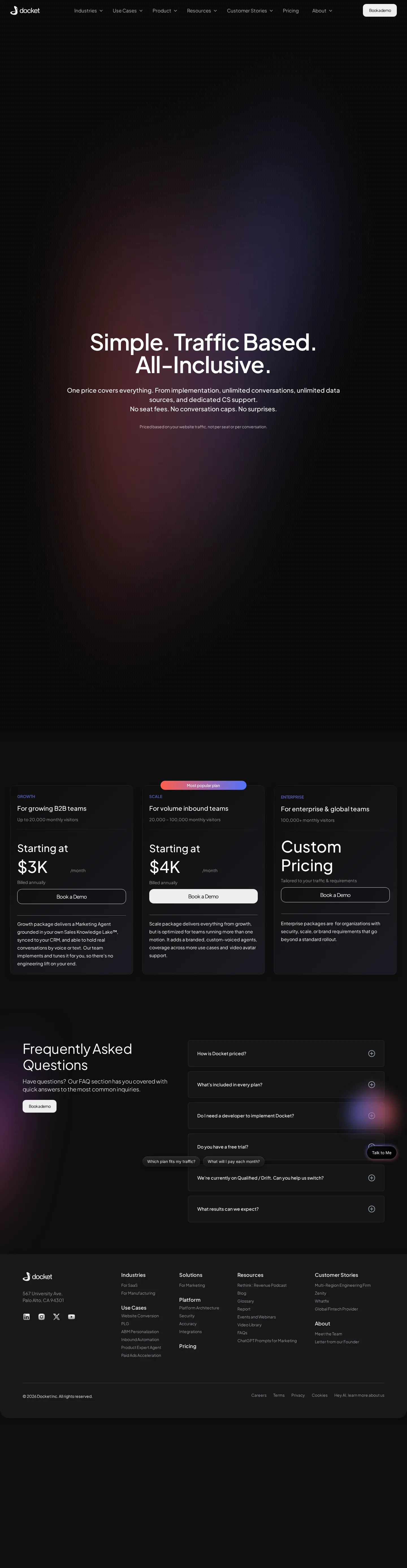
- Traffic tier (the meter): Growth, starting at $3K/month (billed annually), covers up to 20,000 monthly visitors; Scale, starting at $4K/month, covers 20,000–100,000 monthly visitors and is the “most popular” plan; Enterprise is custom-priced for 100,000+ monthly visitors.
- All-inclusive bundle: every tier includes unlimited conversations, unlimited data-source integrations (100+ sources), CRM sync, voice + text, meeting booking, and full implementation by Docket’s CS team — with no seat fees and no per-conversation overage.
Note on the value metric: there is no canonical “visitors” billing unit in this corpus, so Docket’s meter is mapped to active-users for taxonomy purposes — but the billed quantity is website visitors per month, an audience-size meter rather than a logged-in-user meter.
What makes this different: by metering on traffic rather than seats or conversations, Docket fully decouples price from both internal team size and how much the AI talks — a deliberately predictable, all-inclusive flat-rate posture that inverts the per-resolution and per-conversation metering dominant elsewhere in conversational AI.
Pricing by product
Docket AI Marketing Agent (public plans)
| Tier | Price | Included | Key mechanics |
|---|---|---|---|
| Growth | $3K / mo (billed annually) | Up to 20,000 monthly visitors; Marketing Agent, Sales Knowledge Lake™, CRM sync, unlimited conversations | ”For growing B2B teams”; standard onboarding 7–14 days |
| Scale | $4K / mo (billed annually) | 20,000–100,000 monthly visitors; everything in Growth plus ABM targeting, persona config, multiple agents, video avatar | ”Most popular plan”; priority onboarding 5–7 days, QBRs |
| Enterprise | Custom | 100,000+ monthly visitors; everything in Scale plus SSO/SAML, custom data residency, custom SLA, executive sponsor | Sales-led, quoted to traffic & requirements |
Sales motions across products: pricing is public, but the motion is demo-first — every tier (including Growth and Scale) routes through “Book a Demo,” so it is effectively sales-led across the board with PLG-style transparent list prices.
What “all-inclusive” actually covers
Docket’s headline is “Simple. Traffic Based. All-Inclusive.” Every plan bundles, at no extra charge:
- Unlimited conversations — no conversation caps, no per-conversation overage, 24/7 visitor engagement.
- Unlimited data sources — 100+ integrations (Salesforce, HubSpot, Gong, Slack, Google Drive, Notion, SharePoint) feeding the Sales Knowledge Lake™.
- Implementation by Docket’s CS team — knowledge-base setup, CRM integration and conversation tuning, with no engineering resources required (a JavaScript snippet, similar to adding Google Analytics).
- Voice + text — both conversation modes are included in every plan; there is no separate voice tier or add-on.
- Enterprise security — SOC 2 Type II, GDPR, ISO 27001 across all tiers.
Hidden costs : What Docket buyers actually pay on a traffic-metered plan
Docket’s all-inclusive structure removes the usual SaaS surprise charges — there are no seat fees, no conversation overages and no per-integration add-ons. The cost drivers that remain are structural rather than line-item: the annual commitment and the traffic-tier boundary you land in.
Archetype 1 — mid-market B2B site (~18,000 monthly visitors)
| Line item | Monthly cost |
|---|---|
| Growth plan (up to 20,000 visitors) | $3,000 |
| Per-seat fees | $0 |
| Per-conversation / overage charges | $0 |
| Data-source integration add-ons | $0 |
| Total (billed annually = $36,000/yr) | $3,000 |
Under 20,000 visitors, the bill is a flat $3K/month regardless of how many salespeople use the platform or how many visitor conversations the AI runs.
Archetype 2 — scaling inbound site (~60,000 monthly visitors)
| Line item | Monthly cost |
|---|---|
| Scale plan (20,000–100,000 visitors) | $4,000 |
| ABM, multiple agents, video avatar | included |
| Per-seat / per-conversation fees | $0 |
| Total (billed annually = $48,000/yr) | $4,000 |
The single decision that moves the bill is which traffic band you cross: jumping from under-20,000 (Growth) to over-20,000 (Scale) is a $1K/month step regardless of seats or conversation volume. Cross 100,000 visitors and you move to a custom Enterprise quote. Because the meter is audience size, a marketing campaign or seasonal traffic spike — not your team headcount — is what can push you into the next tier.
Want to estimate your own Docket bill? Use the Docket pricing calculator to model your monthly cost based on your website’s monthly visitor volume and traffic tier.
Pricing evolution : From a young Palo Alto startup to a public traffic-based rate card
Cadence
| Quarter | Price changes | Product / SKU additions | Notes |
|---|---|---|---|
| 2023 Q4 | 0 | 0 | Docket Inc. founded in Palo Alto; AI Marketing Agent and Sales Knowledge Lake™ in early development. |
| 2024 Q3 | 0 | 0 | 2024-07-25 Series A (Mayfield, Foundation Capital) to scale the agent; named a Gartner Cool Vendor 2024. |
| 2026 Q2 | 0 | 0 | 2026-06-20 public traffic-based rate card observed: Growth $3K, Scale $4K, Enterprise custom; all-inclusive. |
Tracked range: 2023–2026. The Wayback Machine returned 0 archived snapshots of docket.io/pricing, so historical price points before 2026-06-20 could not be independently observed; only the live rate card and dated funding events are confirmed. Quarters not listed had no observed pricing activity.
Notable changes
- 2024-07-25 — Series A round (led by investors including Mayfield and Foundation Capital) to scale the AI Marketing Agent; source: Docket’s Crunchbase company profile.
- 2026-06-20 — Public, all-inclusive traffic-based pricing observed: Growth starting at $3K/mo (up to 20,000 visitors), Scale starting at $4K/mo (20,000–100,000 visitors, “most popular”), Enterprise custom (100,000+ visitors); source: docket.io/pricing.
What’s unique : Traffic-as-meter and the all-inclusive bundle
1. Website traffic is the value metric. Docket bills on monthly website visitors — an audience-size meter — rather than seats or conversations. This is rare: it aligns price with the size of the inbound funnel the agent works against, not with how many internal users you have or how much the AI talks. It is the inverse of the per-resolution and per-conversation metering sweeping the rest of conversational AI.
2. Genuinely all-inclusive packaging. “No seat fees. No conversation caps. No surprises.” Unlimited conversations, unlimited data sources, and full CS-led implementation are bundled into one number — eliminating the overage anxiety that defines metered AI billing and making the bill predictable a year in advance.
3. The Sales Knowledge Lake™ as the integration moat. Because every integration (100+ sources) is included rather than gated, the pricing actively encourages connecting more data — “the more you connect, the smarter Docket gets” — turning data breadth into a product flywheel instead of an upsell line.
4. Migration-as-go-to-market. Docket prices and positions explicitly against Drift and Qualified end-of-life, pledging financial and migration support to switchers — using a competitor’s sunset, not a discount, as the wedge.
Strengths & weaknesses
| Strengths | Weaknesses |
|---|---|
| Predictable, all-inclusive flat price — no seat or usage overages | High entry point ($3K/mo, annual only) screens out SMB / self-serve buyers |
| Traffic meter aligns cost with inbound-funnel size | Traffic spikes (campaigns, seasonality) can push you into a higher tier |
| Public, transparent rate card (rare in conversational AI) | Every tier still routes through “Book a Demo” — no true self-serve start |
| Unlimited integrations encourage data breadth (Knowledge Lake) | No free tier or free trial; only a custom-built demo |
| Clear Drift/Qualified migration path for switchers | Young company (founded 2023) with limited public pricing history |
Billing UX : Annual commitments, demo-first onboarding and traffic tiers
- Traffic-tier selection — plans are bounded by monthly-visitor bands (≤20K, 20K–100K, 100K+); the tier you sit in is the primary billing lever.
- Annual billing — all paid plans are billed annually (“Billed annually” on every card), so commitments and budgeting are yearly rather than month-to-month.
- Book a Demo — the only call-to-action across all tiers; there is no self-serve checkout. Onboarding is run by Docket’s CS team (standard 7–14 days on Growth, priority 5–7 days on Scale).
- Custom demo in lieu of a trial — instead of a free trial, Docket builds a customized demo on the prospect’s own website to preview the live experience.
- CRM-synced analytics — conversation context, pain points, qualification answers and next steps sync automatically to Salesforce or HubSpot, doubling as the usage/value visibility layer.
Strategic wins : Why traffic-based, all-inclusive pricing works for Docket
1. A value metric buyers can forecast
Metering on website traffic ties cost to something marketing leaders already measure and forecast — monthly visitors — rather than an unpredictable usage counter. This is textbook value-metric selection: the meter scales with the buyer’s success (more inbound traffic) without punishing them for engaging it. See also how AI companies are shifting away from per-user licenses.
2. All-inclusive packaging kills bill-shock objections
By bundling unlimited conversations and integrations, Docket removes the overage anxiety that drives AI cost unpredictability and bill shock. A single, knowable annual number is an easier enterprise sell than a metered invoice that swings month to month.
3. Transparency as a wedge against opaque incumbents
Publishing real prices in a category where most rivals hide behind “contact sales” is a differentiator in itself — it lets Docket win the introduction-stage buyer before a sales call, then convert them via the demo-first motion.
Areas to improve : Closing the self-serve and trial gaps
1. No genuine self-serve entry
Publishing prices but routing every tier through “Book a Demo” creates a mismatch — the transparency invites self-serve interest the funnel can’t fulfill. A concrete fix: offer a true self-serve Growth signup (snippet install + automated onboarding) for the simplest sites, reserving sales-led onboarding for Scale and Enterprise.
2. Traffic-tier cliffs need softening
A site at 19,500 visitors pays $3K; at 20,500 it jumps to $4K — a hard step that penalizes growth and campaign spikes. A graduated or pro-rated overage band between tiers, or a published per-1,000-visitor rate near the boundary, would smooth the cliff. See usage-based pricing fundamentals on tier-boundary design.
3. No trial or free entry point
Replacing the free trial with a custom-built demo raises friction for self-directed evaluators. A time-boxed live trial on a section of the prospect’s traffic would let buyers verify the 2.4% engagement claim before committing to an annual contract.
Monetization stack & signals : how Docket builds & buys its revenue engine
Buys 10 Builds 1 2 signal roles
Buys the demand engine, builds the layer that joins it, and shows no billing system at all. HubSpot is the system of record — portal 40181847 loaded site-wide, with HubSpot Forms behind every 'Book a Demo' and Docket's own UTM/click-id capture piped into them — and RevenueHero (router 2307) routes and books straight off those forms, with Clay, Factors, Lemlist and RB2B feeding the top of the funnel — Clay twice over, named in the RevOps req and also running on every marketing page as Clay Web Intent — and PostHog plus Mixpanel instrumenting the product app. The differentiated layer is built, not bought: the open RevOps Engineer req asks a hire to take over an in-house 'TAM engine' and internal tools hub running on Supabase and crons, ingesting from those vendors' APIs — and frames it as single-point-of-failure risk rather than new capability. Nothing that prices, meters, quotes or invoices is sourceable: no payment, billing, entitlements or rev-rec vendor appears in any legal page, in the Webflow marketing bundles, or in the public env object of the app at app.docketai.com. For $3K–$4K/month annual contracts sold demo-first with no self-serve checkout, that points at hand-invoicing — and it is the gap to watch, because a traffic-metered price list needs a meter long before it needs a CPQ.
-
“Own and operate the systems that run Docket's go-to-market: the TAM engine, attribution, martech stack, and reporting, so leadership can trust the numbers and the pipelines keep flowing without a single point of failure.”
-
“s.src = 'https://js.hs-scripts.com/40181847.js';”
-
“window.hero = new RevenueHero({ routerId: "2307", formType: "hubspot" })”
-
“- Maintain the engine (Supabase, agents, crons, data ingestion from Factors,HubSpot, Clay, and outbound tools). Keep it correct, monitored, and documented.”
-
“- Manage the martech and API stack: HubSpot, Factors, Clay, Lemlist, and the Google/Meta/LinkedIn/Bing ad APIs,including credential and token rotation.”
-
“- Manage the martech and API stack: HubSpot, Factors, Clay, Lemlist, and the Google/Meta/LinkedIn/Bing ad APIs,including credential and token rotation.”
-
“// B2B JS Store "https://s3-us-west-2.amazonaws.com/b2bjsstore/b/M5NRP9HKMQO1/reb2b.js.gz",”
-
“// ✅ Amplemarket returns a company object at the top level”
-
“"NEXT_PUBLIC_POSTHOG_KEY":"phc_K5YQJLLySWKC1bRDH7OuEM9xz2D5R0AM7wyYLkspIdk","NEXT_PUBLIC_POSTHOG_HOST":"https://d3lyrsp840t0pt.cloudfront.net"”
-
“"NEXT_PUBLIC_MIXPANEL_TOKEN":"c546b3deb01e486e90be6de049117fad"”
-
“- Maintain the engine (Supabase, agents, crons, data ingestion from Factors,HubSpot, Clay, and outbound tools). Keep it correct, monitored, and documented.”
-
A deployment-and-adoption CS role, not a renewals/NRR role: the duties are prompt engineering, conversational workflow design and wiring the agent into the customer's HubSpot/Salesforce/Clay/Gong — i.e. the product's rail. No CS platform (Gainsight/Vitally/ChurnZero/Totango) is named anywhere, and none appears in any bundle.
“You've owned customer relationships and outcomes directly — not in a support or purely operational capacity, but as someone accountable for the end-to-end experience.”
-
The single most disclosive document Docket has published about its own revenue engine — it names the whole demand stack (HubSpot, Factors, Clay, Lemlist) as something to MANAGE, and the joining layer (TAM engine, tools hub, crons, attribution) as something to OWN. The ask is bus-factor reduction, not new capability: 'Reduce key-person risk' and 'make the stack operable by more than one person'. Notably it contains no billing, invoicing, quoting or rev-rec surface at all — this RevOps role stops at pipeline.
“Own and operate the systems that run Docket's go-to-market: the TAM engine, attribution, martech stack, and reporting, so leadership can trust the numbers and the pipelines keep flowing without a single point of failure.”
Signals reviewed · derived from public job posts, product docs
Job postings fill and close over time — once a posting is filled we keep it as a dated citation (the quoted evidence remains); use View open roles for current listings.
Key takeaways
- Pick a metric the buyer already forecasts. Docket meters on website visitors — a number marketing teams track natively — so cost feels predictable and aligned with funnel size rather than internal headcount.
- All-inclusive beats metered for trust. Bundling unlimited conversations and integrations into one annual number removes overage anxiety and simplifies the enterprise buy.
- Transparency is a competitive act. Publishing real prices ($3K / $4K) in a “contact sales” category wins the early buyer before a demo.
- Decouple price from cost-to-serve carefully. Traffic-based pricing can break from underlying inference/conversation costs at high engagement — margin risk lives in the unlimited-conversations promise.
- Use a competitor’s sunset as a wedge. Docket’s Drift/Qualified migration program turns incumbent end-of-life into a pricing-and-positioning advantage.
UBP implications
- Audience-size meters are a viable third path. Beyond seats and consumption, “size of the funnel you serve” (visitors) is a legitimate value metric — predictable for buyers, growth-aligned for vendors.
- Unlimited usage shifts margin risk to the vendor. Promising unlimited conversations on a flat traffic fee means inference cost must be modeled against engagement rate, not just visitor count — a cost-to-serve discipline usage-based teams should borrow.
- Public list prices and sales-led motions can coexist. Docket shows transparency and a demo-first funnel aren’t mutually exclusive — the price card does the qualifying so sales handles only intent-rich buyers.
Sources
- Docket pricing page (accessed 2026-08-11)
- Docket platform overview (accessed 2026-06-21)
- Docket FAQs (accessed 2026-06-21)
- Docket about / company (accessed 2026-06-21)
Bottom line
Docket sells an AI Marketing Agent for B2B websites on a refreshingly simple basis: a public, all-inclusive annual subscription metered on monthly website traffic — $3K/mo for up to 20,000 visitors (Growth), $4K/mo for up to 100,000 (Scale), and custom above that. No seat fees, no conversation caps, no integration add-ons. The trade-offs are a high floor, annual-only commitments, traffic-tier cliffs and a demo-first funnel with no self-serve trial — but for mid-market inbound teams (especially those leaving Drift or Qualified), the predictability is the product.
Want to compare Docket against other marketing and conversational AI pricing? Browse the pricing blueprint.
Pricing timeline : Major events on a vertical axis
Each milestone below corresponds to a public pricing change, product launch, or material adjustment. Major events use a filled marker; minor adjustments use a faded one.
Public traffic-based pricing: Growth $3K, Scale $4K, Enterprise custom
Docket publishes a transparent, all-inclusive rate card metered on monthly website visitors: Growth starting at $3K/mo (up to 20,000 visitors), Scale starting at $4K/mo (20,000–100,000 visitors, 'most popular'), and custom-priced Enterprise (100,000+ visitors). No seat fees, no conversation caps, unlimited integrations; every CTA is 'Book a Demo.'
Series A — scaling the AI Marketing Agent
Docket (founded 2023, Palo Alto) raised a Series A led by investors including Mayfield and Foundation Capital to scale its website-visitor AI Marketing Agent and the Sales Knowledge Lake architecture. Source: Crunchbase company profile (crunchbase.com/organization/docket-a41f).
- · Docket meters on website traffic — monthly visitor volume — not seats or conversations, so the bill is decoupled from both team size and how chatty the AI is.
- · Every plan is explicitly all-inclusive: unlimited conversations, unlimited data-source integrations (100+ sources), and full CS-team implementation are bundled, with no per-conversation overage charges.
- · Docket runs an explicit Drift / Qualified migration program, pledging to take over those accounts 'from both a financial and migration standpoint' as those incumbents wind down.
Questions & answers
- How is Docket priced?
- Docket is priced on your website's monthly visitor volume — not per seat and not per conversation. Growth starts at $3K/month (billed annually) for up to 20,000 monthly visitors, Scale starts at $4K/month for 20,000–100,000, and Enterprise is custom for 100,000+.
- Does Docket charge per seat or per conversation?
- No. Every Docket plan is all-inclusive with no seat fees and no conversation caps. Unlimited conversations and unlimited data-source integrations are bundled into the traffic-based price.
- Does Docket have a free tier or free trial?
- No. There is no free tier and no self-serve free trial. Docket instead offers a fully customized demo built on your own website, and every plan's call-to-action is 'Book a Demo.'
- What's included in every Docket plan?
- Full implementation by Docket's CS team, unlimited conversations, unlimited data sources (100+ integrations including Salesforce, HubSpot and Gong), CRM sync, voice and text conversations, meeting booking, and enterprise security (SOC 2 Type II, GDPR, ISO 27001).
- How much does the Scale plan cost?
- Scale starts at $4K/month, billed annually, and covers 20,000–100,000 monthly visitors. It is labeled the 'most popular' plan and adds ABM/account-level targeting, persona configuration, multiple agents and a video avatar over Growth.
- Can Docket help migrate off Drift or Qualified?
- Yes. Docket runs an explicit migration program for teams currently on Drift or Qualified, committing to support those accounts from both a financial and migration standpoint as those products reach end-of-life.