AI Summary
About
Elementor is the most-used website-builder plugin for WordPress. Its drag-and-drop visual editor lets creators, freelancers, and agencies design and manage WordPress sites without code. Elementor states it powers over 22 million sites and 13% of the web, and holds 6,500+ five-star reviews — positioning it as the default WordPress page-builder against Divi, Beaver Builder, and the native WordPress block editor.
The company sells three distinct product lines. First, the Elementor Pro plugin — the paid page-builder, licensed by the number of activated sites (a WordPress licensing convention rather than per-seat). Second, Elementor One, an all-in-one bundle that wraps Editor Pro together with AI generation, image optimization, web accessibility, email deliverability, site management, and cookie consent, all fed by a single monthly AI-credit pool. Third, Elementor Host, managed Google Cloud / Cloudflare Enterprise WordPress hosting sold as a separate subscription (the Editor license is not included).
Elementor serves individuals building a single site, freelancers and small agencies managing client portfolios, and — via a quote-only Enterprise tier with SSO, security audits, and a dedicated success manager — larger organizations standardizing on WordPress. Pricing is public, global (USD), and annual-only across the self-serve plans.
Pricing summary : per-site plugin licenses plus a bundled monthly AI-credit pool
Elementor uses a freemium, tiered subscription model with three billing dimensions:
- Per-site plugin license (flat subscription): Pro tiers are priced by the number of activated sites — Essential $5/mo (1 site), Advanced Solo $7/mo (1 site, more widgets), Advanced $9/mo (3 sites), and a newly observed Expert tier at $17/mo (25 sites) revealed via an in-card “Advanced / Expert” toggle. All billed annually. A free Elementor plugin (0 sites-limited features) sits below them.
- All-in-one bundle with a monthly AI-credit pool: Elementor One is $15/mo (intro; was $19, renews $228/yr) for 1 site and 25,000 monthly credits; One Agency is $36/mo (renews $540/yr) for unlimited sites and 350,000 monthly credits. Credits meter AI generation, image optimization, accessibility fixes, email deliverability, and cookie consent from one shared pool.
- Managed hosting (separate subscription): Elementor Host runs from $15/mo (10GB, single-site) to $110/mo (5 sites), metered on monthly visits, SSD storage, and bandwidth; an Enterprise band is quote-only.
What makes this different: rather than billing AI usage as metered overage, Elementor bundles a fixed monthly credit pool into a flat subscription — credits reset monthly with no rollover and no à-la-carte top-up, so running out pushes you to upgrade tiers rather than pay per unit.
Pricing by product
Elementor Pro plugin (per-site licenses, no AI credits)
All prices are annual-only (the “/mo” figure is the annual price ÷ 12). “0 One credits” means these tiers exclude the AI/optimization pool. As of the 2026-08-26 capture, the third plan card carries an in-card “Advanced / Expert” toggle — Expert is a newly observed tier, not a separate page.
| Tier | Price | Included | Key mechanics |
|---|---|---|---|
| Essential | $5 /mo | 1 site · 57 Editor Pro widgets · Theme Builder · 10 Cloud Templates. No Popup/Custom code/eCommerce. | Cheapest paid entry; billed $60/yr |
| Advanced Solo | $7 /mo | 1 site · 85 Editor Pro widgets · adds Popup, Custom code & CSS, eCommerce, Collaborative Notes · 20 templates. | Full Pro widget set on a single site; $84/yr |
| Advanced | $9 /mo | 3 sites · 85 Editor Pro widgets · same features as Advanced Solo · 30 templates. | Priced by site count — 3 sites; $108/yr |
| Expert | $17 /mo | 25 sites · 85 Editor Pro widgets · same feature set as Advanced · 5,000 Cloud Templates. | New tier for multi-site freelancers; billed $204/yr; toggled from the Advanced card |
A free Elementor Editor plugin (WordPress.org download) sits below Essential: core drag-and-drop widgets, no premium widgets/Theme Builder/AI.
Elementor One (Editor Pro + monthly AI-credit pool)
| Tier | Price | Included | Key mechanics |
|---|---|---|---|
| One | $15 /mo | 1 site · 25,000 monthly credits · all Pro widgets + AI generation, Image optimization, Site accessibility, Cookie consent, Email deliverability, Site management. | ”Best value” intro (was $19/mo, Save 21%); renews $228/yr |
| One Agency | $36 /mo | Unlimited sites · 350,000 monthly credits shared across client sites · 50,000 Cloud Templates · everything in One. | Intro (was $45/mo, Save 20%); renews $540/yr |
Elementor Host (managed WordPress hosting — separate subscription)
The Editor Pro license is not included in Host plans (connect an existing license or buy separately). Multi-site plans scale to 3/5/10/15/20 sites.
| Tier | Price | Included | Key mechanics |
|---|---|---|---|
| Host Cloud 10GB | $15 /mo | Single-site · 10,000 monthly visits · 10GB SSD · 10GB/mo bandwidth · 7 days’ backup · free domain + migration. | ”Best for eCommerce”; billed $180/yr |
| Host Cloud 5 Sites | $110 /mo | 5 sites · 150,000 monthly visits · 50GB SSD · 125GB/mo bandwidth · 45 days’ backup. | Multi-site agency tier; billed $1,320/yr |
| Enterprise | Custom | Auto-scaling, custom thresholds, SSO, security audits, platinum support, advisory sessions. | ”Let’s talk” — quote-only |
Enterprise solution (quote-only)
The dedicated Enterprise offering (/solutions/enterprises/) is a book-a-demo contact form with no public price: 99.99% uptime, Single Sign-On, security audits, a dedicated success manager, expert solutions architects, and centralized brand governance.
AI-credit consumption (Elementor One credit pool)
Credits are a single shared pool spent across capabilities. Consumption is dynamic and may change; unused credits do not roll over.
| Capability | Action | Credits per action |
|---|---|---|
| Editor Pro | Using the builder | 0 |
| Accessibility scans | 1 scan | 0 |
| Accessibility fixes | 1 AI accessibility fix | 20 |
| Image optimization | 1 image optimized | 10 |
| Email deliverability | 1 email delivery | 10 |
| Cookie consent | 1 consent | 1 |
| Cookie consent scans | 1 scan | 1 |
| AI Actions | 1 AI action (text/code/image/container) | 1–40** |
** AI Action credit cost varies by use case and prompt. At 25,000 monthly credits, the One tier covers roughly 2,500 image optimizations, or 1,250 accessibility fixes, or 25,000 cookie consents — whichever mix the customer chooses.
Sales motions across products: PLG / self-serve for the free plugin, all Pro/One tiers, and self-serve Host plans; sales-led for the Enterprise solution and Host Enterprise band.
Hidden costs : renewal step-ups, per-site scaling, and separate hosting
The advertised “$5/mo” and “$15/mo” headlines understate what a serious site or an agency actually pays, for three reasons: prices are annual-only (you pay the full year upfront), the low headline rates are intro prices that step up at renewal, and the AI-credit pool and hosting are separate line items. Two real-world examples show the shape of a full bill.
Archetype 1 — a solo creator who wants Pro + AI + hosting on one real site
| Line item | Monthly cost |
|---|---|
| Elementor One (1 site, 25,000 credits) — intro $180/yr | $15 |
| Elementor Host — Cloud 10GB single-site ($180/yr) | $15 |
| Renewal step-up on One (year 2: $228/yr vs $180 intro) | +$4 |
| Effective monthly (year 2, One + Host) | ~$34 |
The “$15/mo builder” becomes ~$34/mo once you add the separately-sold hosting and the year-two renewal — more than double the headline, and the whole year is billed upfront.
Archetype 2 — an agency running 40 client sites on One Agency
| Line item | Monthly cost |
|---|---|
| One Agency (unlimited sites, 350,000 credits) — renews $540/yr | $45 |
| Extra Host multi-site plan for the client sites (5 Sites tier) | $110 |
| AI overage risk once 350,000 credits are exhausted mid-month | Forced upgrade — no per-unit top-up |
| Effective monthly (One Agency + one Host plan) | ~$155+ |
At 350,000 credits, a single accessibility-heavy month (20 credits per AI fix) can drain the pool across a large client portfolio — and because there is no à-la-carte credit purchase, the only relief is jumping tiers or waiting for the monthly reset. The credit pool is an upsell lever, not a metered overage line.
Want to estimate your own Elementor bill? Use the Elementor pricing calculator to model your monthly cost based on site count, the One credit pool, and separate hosting.
Pricing evolution : from per-site plugin licenses to a bundled credit pool
Elementor’s pricing has undergone two structural rewrites in four years: from a per-site site-count ladder (2022), through a hosting-led plan grid (2025), to a credit-metered all-in-one bundle (2026).
Cadence
| Quarter | Price changes | Product / SKU additions | Notes |
|---|---|---|---|
| 2022 Q1 | 0 | 0 | Pro plugin sold as a site-count ladder: Essential $49/yr (1 site) → Agency $999/yr (1,000 sites); hosted Website $89/yr. |
| 2023 Q2 | 0 | 1 | Elementor AI launches — first native generative AI in a WordPress builder, text/code on a shared credit pool (~$2.99/mo). |
| 2025 Q1 | 1 | 1 | /pricing/ pivots to a hosting-led grid (Lite $2.99 → Grow $22.99/mo; 3/10/30-site hosting tiers); Pro ladder restructured. |
| 2026 Q1 | 1 | 1 | Elementor One launches — unified subscription with a monthly AI-credit pool; plugin tiers reset to $5 / $7 / $9. |
| 2026 Q3 | 0 | 1 | Expert ($17/mo, 25 sites) added to the Pro plugin ladder, gated behind a new in-card toggle; One Agency ($36/mo, unchanged) moved behind a matching toggle. |
Tracked range: 2022-01–2026-08. Quarters not listed above were verified stable (0 price changes, 0 SKU additions) or fell in gaps between the readable Wayback snapshots (2022-01, 2025-01) and the live capture.
Notable changes
- 2022-01 — Pro plugin priced by site count: Essential $49/yr (1 site), Expert $199/yr (25 sites), Studio $499/yr (100 sites), Agency $999/yr (1,000 sites), plus a hosted Elementor Website at $89/yr (Wayback snapshot, elementor.com/pricing/).
- 2023 Q2 — Elementor AI ships as the first native WordPress-builder AI, generating text and custom code from a shared credit pool (elementor.com/blog/introducing-elementor-ai/).
- 2025-01 — The pricing page leads with managed hosting (Lite $2.99 / Basic $9.99 / Business $19.99 / Grow $22.99 per month) and multi-site hosting at 3/10/30 sites; the plugin builder is shown as a secondary product (Wayback snapshot).
- 2026-01 — Elementor One launches, folding Editor Pro, AI, image optimization, accessibility, email, and cookie consent into one credit-metered subscription ($15/mo One, $36/mo One Agency); the legacy multi-site Pro ladder is retired in favor of “unlimited sites” for agencies (elementor.com/one/).
- 2026-06 — Elementor cut roughly 100 jobs (~30% of its workforce), citing AI reshaping website building — the same strategic shift that produced the credit-metered One bundle (Calcalist, 2026-06-30).
- 2026-08-26 — Elementor adds a 25-site Expert tier ($17/mo, billed $204/yr, 5,000 Cloud Templates) to the Pro plugin ladder, revealed via a new “Advanced / Expert” in-card toggle rather than a dedicated page; the existing $36/mo One Agency plan moves to a matching “One / One Agency” toggle, replacing the prior page-level “Building for myself” / “Building for others” segmented control (elementor.com/pricing/).
The move to a credit meter in detail
The through-line is a deliberate migration from counting websites to counting AI work. In 2022 Elementor’s value metric was the number of activated sites — an agency paid $999/yr precisely because it managed up to 1,000 of them. By 2026 that ladder is gone: One Agency offers unlimited sites, and the metered dimension is the credit pool (25,000 vs 350,000/mo). The pool spans AI generation, image optimization, accessibility fixes (20 credits each), email deliverability (10 each), and cookie consent (1 each), so a single monthly balance now stands in for what used to be five separate products. Critically, Elementor chose a fixed pool with no rollover and no top-up rather than pay-as-you-go overage — the buyer never sees a surprise usage invoice, but also cannot buy their way out of a shortfall without upgrading. That design converts AI cost pressure (visible in the June 2026 layoffs) into a clean tier-upgrade incentive.
The per-site metric isn’t dead, though: in August 2026 Elementor quietly reintroduced a 25-site “Expert” step at $17/mo — reviving both the name and the exact site count of its retired 2022 25-site tier — as an escape valve for freelancers who want more capacity without buying into the AI-credit accounting. The two metrics now run in parallel: sites for buyers who don’t need pooled AI credits, and the credit pool for buyers who do.
What’s unique : per-site licensing and a shared no-rollover credit pool
1. Per-site licensing, not per-seat. Elementor prices its Pro plugin by the number of activated WordPress sites — a licensing convention inherited from the plugin ecosystem rather than modern SaaS. In a corpus dominated by per-seat and per-usage models — and amid a broader shift away from per-user licenses — “you pay by how many sites carry the license” is genuinely unusual, and it maps cleanly to how freelancers and agencies actually think about their book of work. It also means a single user with three client sites pays more than a three-person team sharing one site. Elementor doubled down on the convention in August 2026, adding a 25-site Expert step ($17/mo) rather than pushing multi-site freelancers straight into the credit-pooled One bundle — evidence the per-site metric is a deliberate parallel track for buyers who don’t want AI-credit accounting, not a legacy holdover being phased out.
2. A fixed AI-credit pool instead of metered overage. Rather than bill AI usage as pay-as-you-go, Elementor bundles a fixed monthly credit pool into a flat subscription — 25,000 credits on One, 350,000 on One Agency. Because there is no rollover and no à-la-carte top-up, the pool behaves as a soft cap: exhausting it doesn’t generate an overage invoice, it generates an upgrade prompt. This is the opposite of the hybrid credit-pool-plus-overage pattern seen in AI-native tools, and it trades usage upside for billing predictability.
3. One credit pool absorbs five products. The One pool is spent across AI generation, image optimization (10 credits/image), accessibility fixes (20 credits/fix), email deliverability (10 credits/email), and cookie consent (1 credit) — capabilities Elementor previously sold, or would have sold, as separate add-ons. Collapsing five value-metrics into one shared balance lets the customer reallocate spend month to month (“heavy AI in June, heavy accessibility in July”) without changing plans, which is a real UX win over per-product quotas.
4. Intro-vs-renewal pricing stated on the card. One and One Agency display the discounted first-term price and the explicit renewal rate side by side (“was $19/mo, Save 21%… renews at $228/yr”). Surfacing the step-up on the pricing card — rather than burying it in fine print — is a transparency choice most subscription products avoid, even as the annual-only billing keeps the upfront commitment high.
Strengths & weaknesses
| Strengths | Weaknesses |
|---|---|
| Free plugin creates a wide top-of-funnel; 22M+ sites give unmatched WordPress distribution. | Prices are annual-only — no monthly billing means a full-year upfront commitment even at $5/mo. |
| Per-site licensing matches how freelancers and agencies actually scope work; the August 2026 Expert tier (25 sites, $17/mo) closes the prior gap between 3-site Advanced and unlimited-site One Agency. | Site-count licensing still penalizes solo users beyond 25 sites — the only escape is One Agency’s credit-pooled bundle, which forces AI-feature accounting even on buyers who don’t want it. |
| One credit pool is reallocatable across AI, images, accessibility, email — no per-product quotas. | AI credit costs are “dynamic and may change,” and consumption per AI Action spans a wide 1–40 range. |
| Intro and renewal prices are both shown on the card, so the step-up is disclosed upfront. | No à-la-carte credit top-up — running out forces a tier upgrade rather than a small metered charge. |
| Bundling five standalone tools into One lowers the effective price versus buying them separately. | Hosting is billed separately and excludes the Editor license, so a “complete” setup needs two subscriptions. |
| Public, transparent self-serve pricing across plugin, One, and most hosting tiers. | Enterprise and Host-Enterprise are quote-only, and the plugin ladder has churned twice since 2022. |
Billing UX : in-card plan toggles, per-site tiers, and a shared credit meter
- In-card “Advanced / Expert” toggle — the third Pro-plugin card switches in place between Advanced ($9/mo, 3 sites) and a newly observed Expert tier ($17/mo, 25 sites, 5,000 Cloud Templates), without leaving the pricing grid. This replaces the page-level “Building for myself” / “Building for others” segmented control seen in the prior capture — that control no longer appears on the live page.
- In-card “One / One Agency” toggle — the fourth card switches between One ($15/mo, 1 site, 25,000 credits) and One Agency ($36/mo, unlimited sites, 350,000 credits shared across clients), the same mechanism used for the Expert tier.
- Intro-vs-renewal price disclosure — One and One Agency show the discounted first-term price alongside the explicit renewal rate (“was $19/mo, Save 21%… Renews at regular rate $228/yr”), so the step-up at renewal is stated upfront.
- “Valued at $X/yr” line items — the One plan itemizes the standalone value of bundled capabilities (Image optimization valued at $60/yr, Site accessibility at $120/yr, Email deliverability at $60/yr) to justify the bundle price.
- Shared monthly credit pool — a single credit balance is spent across AI, image optimization, accessibility, email, and cookie consent; it resets monthly with no rollover, and running out prompts a tier upgrade rather than a metered top-up.
- “Compare features” table + 30-day money-back guarantee — an expandable feature matrix sits under the cards; the guarantee applies to annual plans only (all self-serve plans are annual-billed).
- Prorated Pro→One upgrade — upgrading from an existing Pro license to One credits the remaining subscription value toward One (you pay only the difference), handled inside the my.elementor account.
Strategic wins : bundling optimization tools into one credit subscription
1. Bundling five products behind one credit pool raised ARPU without a price-per-product fight
Instead of nickel-and-diming customers with separate quotas for AI, image optimization, accessibility, email, and cookie consent, Elementor One folds all five into a single monthly balance. The customer sees one price and one pool they can reallocate; Elementor captures the willingness-to-pay of the whole stack in a single subscription. This is textbook good-better-best packaging applied to a suite of formerly-standalone tools, and it sidesteps the friction of pricing each capability individually.
2. Choosing a fixed pool over metered overage bought billing predictability
By capping the credit pool with no rollover and no top-up, Elementor avoided the biggest risk of usage-based pricing — surprise invoices that erode trust. Buyers know their maximum monthly cost upfront, which suits the freelancer and small-agency base that dislikes variable bills. The trade-off is real (no usage upside for Elementor), but for a self-serve, price-sensitive audience it removes a major adoption objection.
3. Disclosing renewal prices on the pricing card builds trust in a category full of dark patterns
One and One Agency show the intro price and the renewal rate together (“was $19/mo… renews $228/yr”). In a market where hosting and plugin vendors routinely hide the year-two step-up, surfacing it on the card is a differentiator that reduces churn-driving surprises. It signals confidence that the renewal price is defensible on value — a lesson other subscription teams can borrow when they confront their own surprise-renewal and bill-shock risk.
4. Keeping a genuinely free plugin sustains the widest WordPress funnel
The free Elementor plugin on WordPress.org is the top of a funnel that has reached 22M+ sites. That distribution is the moat: every free install is a candidate to upgrade to Pro, then to One, then to Host. Anchoring the whole ladder on a real free tier — not a time-limited trial — is what lets Elementor monetize a fraction of an enormous base rather than a majority of a small one.
5. Patching the site-count gap without diluting the credit-pool growth story
In August 2026 Elementor added a 25-site Expert tier ($17/mo, $204/yr) between the 3-site Advanced plan and the credit-metered One bundle — but kept it gated behind an in-card toggle rather than a headline card. That placement lets Elementor capture freelancers who want more sites but not AI features, avoiding a forced upsell into One’s credit accounting, while keeping the default page narrative focused on One and One Agency as the recommended path. It’s a low-risk way to plug a real packaging gap without rewriting the growth story.
Areas to improve : credit-cost opacity and no annual/monthly toggle
1. Publish a stable, itemized credit-cost table instead of “dynamic and may change”
The per-action credit costs (10 for an image, 20 for an accessibility fix, 1–40 for an AI Action) are the numbers a buyer needs to size a plan, yet Elementor labels them “dynamic and may change” and gives AI Actions a 40× range. A buyer cannot forecast whether 25,000 credits is a month’s worth or a week’s. Fix: version the credit-cost table with an effective date and a 30-day change-notice commitment, and publish typical-usage worked examples (as this analysis had to reconstruct) so buyers can self-size.
2. Offer an à-la-carte credit top-up for occasional overflow
Because there is no way to buy extra credits, a customer who exhausts the pool three days early must either wait for the reset or jump a whole tier. That is a blunt instrument for a soft, recurring problem. Fix: add a small metered top-up (e.g. blocks of 10,000 credits) so occasional overflow doesn’t force a permanent tier change — capturing incremental revenue while removing a real friction point, exactly the credit top-up pattern other pooled-credit vendors use.
3. Add a monthly billing option, or make the annual-only commitment clearer
Every self-serve plan is annual-only, but the pricing cards lead with a “/mo” figure — a mismatch that can surprise buyers at checkout when they see the full-year charge. Fix: either introduce a genuine monthly plan (at the usual ~20% premium) or label the cards “billed annually — $X charged today” more prominently, so the commitment is unambiguous before checkout.
4. Decouple the Editor license story from hosting to reduce “two subscriptions” confusion
A creator who buys Elementor Host still needs a separate Editor Pro or One license, which is easy to miss given how tightly Elementor markets the two together. Fix: offer a clearly-labeled Host+One combined SKU with a single price, so the “complete website” bundle is one line item rather than two subscriptions the buyer must assemble.
5. Surface the Expert and One Agency tiers without requiring a toggle click
As of August 2026, two of the six self-serve plans — Expert (25 sites, $17/mo) and One Agency (unlimited sites, $36/mo) — are invisible on first page-load, hidden behind in-card “Advanced / Expert” and “One / One Agency” toggles. A buyer scanning the default grid sees only four options and can easily miss that a mid-tier or agency-scale plan exists at all. Fix: default-expand both toggles for returning agency-segment traffic, or list all six tiers in the initial grid and let the toggle serve as a plan-count reducer for first-time visitors instead of the only path to discovery.
Monetization stack & signals : how Elementor builds & buys its revenue engine
Buys 8 Builds 0
Buys the revenue engine off the shelf — payments, chargeback recovery, ERP, support and lifecycle messaging are all named vendors. The only unattributed piece is the AI-credit meter Elementor One actually sells; its one open role is not revenue-side.
-
“You can use PayPal or Credit Card to pay for Elementor Pro... You can choose to pay with Paypal, or by Credit Card (via Stripe).”
-
“We accept all major credit cards and PayPal. Subscriptions are billed annually, and you receive a 30-day money-back guarantee.”
-
“Zuora | Online payment processing | EU”
-
“Netsuite | ERP services | Republic of Ireland”
-
“Priority | ERP services | USA”
-
“Chargeflow | Disputes Chargeback automation | USA”
-
“Kustomer | Customer service CRM platform | USA”
-
“Braze | Customer engagement platform | USA”
-
“Elementor One replaces separate quotas with a single, flexible credit pool that adapts to your workflow... AI Actions measure the usage of generative AI features like text, code, image, and container creation. The exact number of credits for each AI Action varies based on the use case and prompt.”
Signals reviewed · derived from press & filings, product docs
Key takeaways
- A fixed credit pool can deliver “AI pricing” without usage-based billing risk. Elementor meters AI internally (credits per action) but charges a flat subscription, so customers get predictable bills and the vendor avoids overage disputes. For price-sensitive, self-serve audiences, the certainty is worth more than the usage upside.
- Bundling standalone products into one reallocatable pool beats per-product quotas. Collapsing five separate tools into a single credit balance the customer can steer month to month reduces packaging friction and captures the whole stack’s willingness-to-pay in one price.
- Your value metric can outlive its usefulness — but you don’t have to retire it completely. Elementor’s per-site ladder made sense in 2022 but broke down as AI became the cost driver; retiring the 1,000-site Agency tier for “unlimited sites + a credit pool” shows how to re-anchor a metric when the underlying economics move. Yet the August 2026 Expert tier shows the old metric can survive as a parallel track for buyers who don’t want the new one — sites for utility, credits for AI.
- Disclosing renewal prices upfront is a cheap trust win. Showing intro and renewal rates on the same card costs nothing and defuses the single biggest source of subscription resentment. Most competitors don’t, which makes it a differentiator.
- A real free tier, not a trial, is what sustains a giant funnel. Elementor monetizes a slice of 22M+ sites precisely because the free plugin is permanent and useful. The free tier is the distribution engine, not a lead-gen gimmick.
UBP implications
- “Metered internally, flat externally” is an emerging AI-pricing pattern. Elementor shows you can build a genuine per-action credit meter and still present a flat subscription — the usage machinery drives packaging and upsell thresholds, not the invoice. Expect more incumbents to adopt this credit-pool-as-soft-cap shape rather than pure pay-as-you-go for AI features with unpredictable costs.
- No-rollover, no-top-up pools convert usage pressure into tier upgrades. When the pool is a hard monthly cap with no purchase escape hatch, running out is an upgrade signal by design. This trades incremental usage revenue for a cleaner expansion motion — a deliberate choice UBP strategists should weigh against the overage model.
- Legacy per-unit ladders will keep collapsing into pooled bundles as AI cost enters the mix — but rarely all the way. Elementor’s shift from per-site counting to a shared AI-credit pool is a template for horizontal-SaaS incumbents whose old value metric no longer tracks the real cost driver, and the winning move is often one reallocatable pool rather than a longer list of per-feature quotas. Elementor’s own August 2026 move complicates a clean read of that collapse, though: it reintroduced a 25-site per-unit tier alongside the pool, suggesting the endpoint isn’t full consolidation but a two-track model — a simple per-unit ladder for buyers who don’t need AI, and a pooled credit bundle for those who do.
Sources
- Elementor pricing page (accessed 2026-08-09)
- Elementor One (accessed 2026-08-09)
- Elementor Pro plans (accessed 2026-08-09)
- Elementor Host (managed WordPress hosting) (accessed 2026-08-09)
- Elementor Enterprise solutions (accessed 2026-08-09)
- Introducing Elementor AI (company blog) (accessed 2026-08-09)
- Elementor One — independent price-validation cross-check of credit-pool sizes, site counts, and billing cadence (accessed 2026-08-26)
- Elementor pricing page — embedded product catalog data — independent price-validation cross-check of every Pro/One/One Agency SKU against the live plan-card display (accessed 2026-08-26)
- Elementor Host — embedded product catalog data + AI-credit usage table — independent price-validation cross-check of Host SKUs and the credit-cost table (accessed 2026-08-26)
Bottom line
Elementor is a per-site licensing story that quietly became an AI-credit story. It still charges by the number of WordPress sites a license activates — but the growth engine is now Elementor One, a flat subscription wrapped around a fixed, no-rollover monthly credit pool that meters AI generation, image optimization, accessibility, email, and cookie consent from one shared balance. It’s a clean example of “metered internally, flat externally”: all the machinery of usage-based pricing, none of the surprise invoices — with the deliberate trade-off that when you run out of credits, the only exit is a tier upgrade.
Want to compare Elementor against other horizontal-SaaS and website-builder pricing? Browse the pricing blueprint.
Pricing timeline : Major events on a vertical axis
Each milestone below corresponds to a public pricing change, product launch, or material adjustment. Major events use a filled marker; minor adjustments use a faded one.
A 25-site 'Expert' tier reappears behind an in-card toggle
Elementor added Expert, a 25-site Pro-plugin tier at $17/mo (billed $204/yr, 5,000 Cloud Templates), slotted between the 3-site Advanced plan and the credit-metered One bundle. It surfaces only via a new 'Advanced / Expert' in-card toggle, replacing the prior page-level 'Building for myself' / 'Building for others' segmented control; the unchanged $36/mo One Agency plan moved to a matching 'One / One Agency' toggle on its own card.
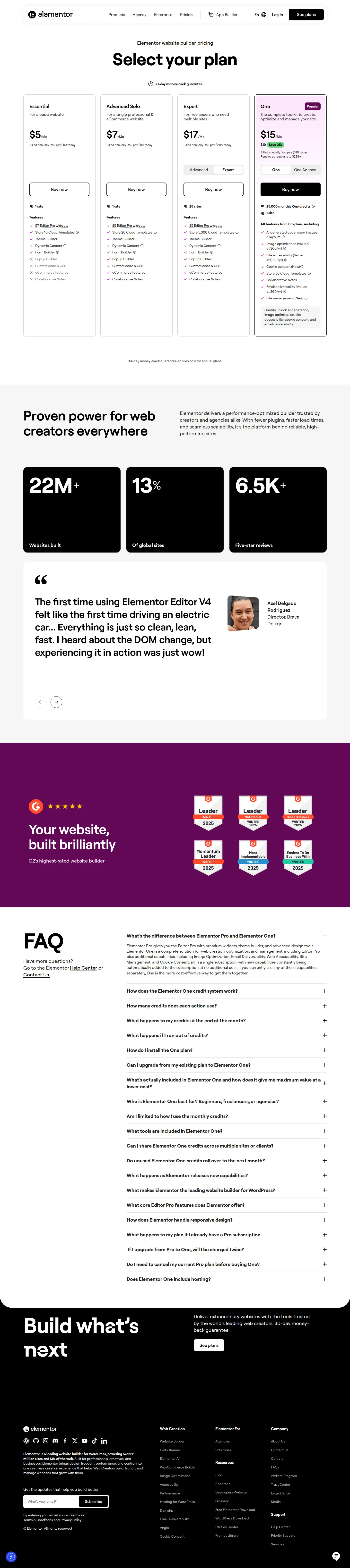
Current state — per-site licenses plus the One credit bundle
Elementor sells Pro plugin tiers priced by number of sites (Essential $5/mo to Advanced $9/mo, billed annually), an Elementor One bundle at $15/mo carrying a 25,000-credit monthly AI pool, and a One Agency tier at $36/mo with 350,000 credits and unlimited sites. AI credits reset monthly and do not roll over. Hosting is a separate subscription on /hosting/.
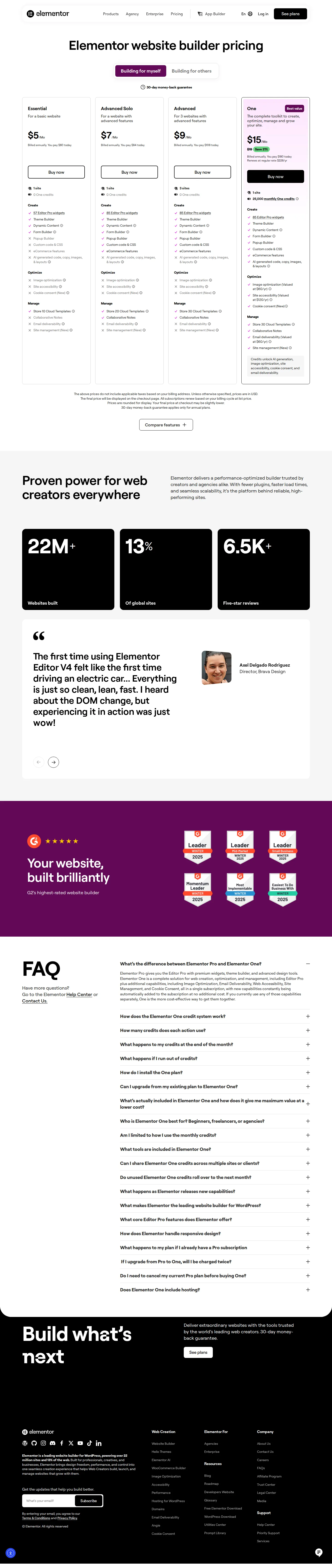
Elementor One unifies the stack behind a monthly AI-credit pool
Elementor One launched as an all-in-one subscription bundling Editor Pro with AI generation, image optimization, accessibility, email deliverability, site management, and cookie consent behind one monthly credit pool — One at $15/mo (25,000 credits) and One Agency at $36/mo (350,000 credits, unlimited sites). Plugin tiers were reset to Essential $5 / Advanced Solo $7 / Advanced $9. Source: elementor.com/one/.
Pricing page pivots to a hosting-led plan grid
By early 2025 the /pricing/ page led with managed hosting plans — Lite $2.99/mo, Basic $9.99/mo (Popular), Business $19.99/mo, and Grow $22.99/mo — with multi-site hosting at 3/10/30 sites (Grow/Scale/Ultimate) and the Editor Pro builder shown as a secondary product. Elementor cited 18M+ sites and 10.9% of the web.

Elementor AI launches — native WordPress AI on a shared credit pool
Elementor shipped the first native generative-AI integration inside a WordPress builder (Q2 2023), generating and improving text and custom code from a shared credit pool. The standalone Elementor AI subscription was priced around $2.99/mo ($35.88/yr). Source: elementor.com/blog/introducing-elementor-ai/.
Per-site Pro plugin ladder (Essential → Agency)
The /pricing/ page sold the Elementor Pro plugin as a site-count ladder: Essential US$49/yr (1 site), Expert US$199/yr (25 sites), Studio US$499/yr (100 sites), and Agency US$999/yr (1,000 sites), alongside a hosted Elementor Website at US$89/yr. Elementor cited 8M+ web creators at the time.

- · Elementor prices its Pro plugin by the number of activated WordPress sites, not by seats — a licensing convention rare in the modern SaaS corpus where per-seat and per-usage dominate.
- · In 2022 Elementor's top Agency tier covered 1,000 sites for $999/year; by 2026 the multi-site ladder was scrapped in favor of an 'unlimited sites' One Agency bundle at $540/year.
- · Elementor AI (Q2 2023) was the first native generative-AI integration shipped inside a WordPress builder — text and custom-code generation drawn from a shared credit pool.
Questions & answers
- How does Elementor pricing work?
- Elementor is freemium: a free WordPress plugin sits below paid Pro tiers priced by number of activated sites — Essential $5/mo (1 site) through Advanced $9/mo (3 sites) up to a 25-site Expert tier at $17/mo, all billed annually. Elementor One bundles Pro with AI and optimization tools behind a monthly credit pool, and Elementor Host is a separate managed-hosting subscription.
- What are Elementor One credits and do they roll over?
- Elementor One credits are a single shared monthly pool spent across AI generation, image optimization, accessibility fixes, email deliverability, and cookie consent. One includes 25,000 credits/mo and One Agency 350,000/mo. Credits reset each month and do not roll over; there is no à-la-carte top-up, so running out means upgrading tiers.
- How much does Elementor One cost versus the Pro plugin?
- Elementor One is $15/mo (intro; renews $228/yr) for 1 site with 25,000 monthly credits, while One Agency is $36/mo (renews $540/yr) for unlimited sites with 350,000 credits. The plain Pro plugin (Essential/Advanced Solo/Advanced/Expert, $5–$17/mo) carries 0 credits and excludes the AI and optimization tools.
- Is Elementor hosting included with the plugin license?
- No. Elementor Host is a separate subscription (from $15/mo single-site to $110/mo for 5 sites) metered on monthly visits, SSD storage, and bandwidth. Host plans do not include the Editor Pro license — you connect an existing license or buy one separately.
- Can I bill Elementor monthly instead of annually?
- No. Elementor's self-serve Pro, One, and Host plans are annual-only — the advertised '/mo' figure is the annual price divided by twelve. Annual plans carry a 30-day money-back guarantee.
- What happens to my Pro subscription if I upgrade to Elementor One?
- Upgrading from Pro to One is a prorated upgrade, not a separate purchase: the remaining value of your current annual Pro subscription is credited toward One, and you pay only the difference. If you cancel Pro first, that credit is forfeited.