AI Summary
About
Essential AI is a San Francisco foundation-model lab founded in 2023 by Ashish Vaswani and Niki Parmar — two of the eight co-authors of the 2017 “Attention Is All You Need” paper that introduced the Transformer, the architecture underneath virtually every modern large language model. Both are ex-Google Brain researchers, and that pedigree is the company’s central asset: Essential AI is positioned as a frontier research lab building what it calls the “Enterprise Brain” — full-stack AI products that “quickly learn to increase productivity by automating time-consuming and monotonous workflows” inside large organizations.
The company emerged from stealth in December 2023 with a $56.5M Series A led by March Capital, joined by an unusual roster of strategic backers — Google, NVIDIA, and AMD (three chip-and-cloud giants that rarely co-invest in the same round) plus Thrive Capital, Franklin Venture Partners, and KB Investment — on top of an earlier ~$8.3M seed led by Thrive Capital, for roughly $65M raised to date. Valuation has not been disclosed.
Crucially for a pricing blueprint: Essential AI publishes no pricing of any kind. The website (essential.ai) exposes only About, Research, Careers, and News, with a single commercial call-to-action — “Talk to us” / “Let’s Talk” — routing to [email protected]. There is no plan grid, no per-token rate card, and no self-serve checkout; essential.ai/pricing returns a 404. What the lab does put in public are open research artifacts released for free: the Essential-Web v1.0 dataset (24 trillion tokens, #1 on Hugging Face) and the Rnj-1 open-weight model family (8B base + instruct). So this page documents what is honestly known — the company, its funding, its open releases, and its sales-led commercial posture — rather than inventing numbers the company has never published.
Pricing summary : a sales-only lab with free open research on the side
Essential AI runs a sales-led, no-public-price commercial model. There is no subscription, no published per-token API, and no self-serve tier to evaluate. The dimensions, such as they can be observed, are:
- Enterprise engagements — quoted bespoke via “Talk to us” (
[email protected]). No floor price, packaging, or SKU is disclosed. This is the company’s revenue surface: full-stack “Enterprise Brain” workflow-automation products built on its own models, scoped and priced per customer. - Open-weight models (free) — the Rnj-1 family (8B base + instruct, plus the newer Rnj-1.5-instruct shipped in mid-2026 and an Rnj-1-instruct GGUF build, five models in all) ships as open weights on Hugging Face and is hosted on Together AI. Essential AI sets no per-token price for any of them; any inference cost you incur is charged by your host, not by Essential AI.
- Open dataset (free) — Essential-Web v1.0, a 24-trillion-token annotated web dataset, is a free download. It is a distribution-and-talent asset, not a priced product.
What makes this different: unlike peers such as Mistral AI or OpenAI that pair open or hosted models with a public per-token rate card, Essential AI deliberately publishes no commercial price — it gives the artifacts away and keeps the monetized “Enterprise Brain” entirely behind a sales conversation. The price you can see is $0 (the open releases); the price you pay is whatever sales quotes.
Pricing by product
| Surface | Price | Included | Key mechanics |
|---|---|---|---|
| Enterprise “Enterprise Brain” products | Talk to us (no public price) | Full-stack workflow-automation AI on Essential AI’s own models; deployment & support negotiated | Sales-led; bespoke quote per engagement; contact [email protected] |
| Rnj-1 / Rnj-1.5 (8B base + instruct) | Free (open weights) | Code / STEM / agentic model, 32k context; five open models incl. Rnj-1.5-instruct on Hugging Face; hosted on Together AI | Open weights — inference metered by your chosen host, not Essential AI |
| Essential-Web v1.0 | Free | 24-trillion-token web dataset with a 12-category document taxonomy | Free download on Hugging Face; research artifact, not a product |
Sales motions across products: fully sales-led for the only revenue-bearing surface (enterprise deployments, quoted via “Talk to us”). The free open releases have no sales motion at all — they are self-serve downloads governed by their model/dataset licenses, not commercial SKUs.
Hidden costs : What Essential AI users actually pay
Because Essential AI publishes no price, the “real bill” question splits in two — and neither side has a list price the buyer can read in advance.
Path 1 — buying the enterprise product. Everything is in the quote. With no published floor, no packaging tiers, and no worked examples, a prospective buyer cannot estimate cost without a sales conversation. The hidden cost here is evaluation friction: scoping, a custom contract, and likely a deployment/services component priced per engagement. There is no calculator a buyer can self-serve against.
Path 2 — running the free open models yourself. Rnj-1’s weights are free, but inference is not. If you self-host, you pay for GPUs; if you run it on a third-party host such as Together AI, you pay that host’s per-token rate (which Essential AI neither sets nor publishes). The “free model” therefore carries a real, host-dependent compute cost that lives entirely outside Essential AI’s economics.
| Line item | Cost |
|---|---|
| Enterprise deployment | Not disclosed — quoted per engagement |
| Rnj-1 weights | $0 (open download) |
| Rnj-1 inference (self-host or third-party host) | Your host’s per-token / per-GPU rate — external to Essential AI |
| Essential-Web v1.0 dataset | $0 (free download) |
| Estimated total | Unquantifiable from public data — depends on the sales quote and your inference host |
Want to model what an Essential AI engagement or an Rnj-1 inference workload might cost? There’s no published rate to plug in, but you can sketch scenarios with the Essential AI pricing calculator, and compare hosted token rates for an 8B open model across providers with the AI token pricing tracker — Essential AI itself publishes no rate of its own.
Pricing evolution : Essential AI pricing history and changes
Essential AI has never had a public price to change. Its “pricing evolution” is really a commercial-posture evolution: stealth lab, then funded enterprise-product builder, then prolific open-research publisher — all while keeping its actual commercial offering behind “Talk to us.” The milestones below are reconstructed from primary announcements and a live 2026-06-11 site check.
Cadence
| Quarter | Price changes | Product / SKU additions | Notes |
|---|---|---|---|
| 2023 Q4 | 0 | 0 | Emerges from stealth with $56.5M Series A; sales-led from day one, no public price |
| 2025 Q2 | 0 | 1 (free artifact) | Essential-Web v1.0 (24T-token dataset) released free; reaches #1 on Hugging Face |
| 2025 Q4 | 0 | 1 (free artifact) | Rnj-1 (8B open-weight base + instruct) released free on Hugging Face / Together AI |
| 2026 Q2 | 0 | 0 | Live check: still no public pricing; site is About/Research/Careers/News + “Talk to us” |
Tracked range: 2023 Q4–2026 Q2. Zero public price changes across the company’s life — there has never been a published price to revise. Quarters not listed had no relevant public event.
Notable changes
- 2023-12 — Emerges from stealth with a $56.5M Series A led by March Capital (Google, NVIDIA, AMD, Thrive, Franklin Venture Partners, KB Investment), on top of an ~$8.3M Thrive seed. Stated goal: the “Enterprise Brain.” Sales-led; no price card (BusinessWire).
- 2025-06 — Essential-Web v1.0 (24-trillion-token annotated dataset) released free; hits #1 on Hugging Face (arXiv:2506.14111).
- 2025-12-05 — Rnj-1 8B open-weight base + instruct family launches free on Hugging Face and Together AI; optimized for code/STEM/agentic (essential.ai/research/rnj-1).
- 2026-06-11 — Live check confirms no public pricing:
essential.ai/pricing404s; the only commercial CTA is “Talk to us” ([email protected]).
What’s unique : Essential AI’s distinctive pricing mechanics
1. The price is the absence of a price. Where most foundation-model labs anchor on a public per-token rate or a seat price, Essential AI publishes nothing commercial — no tiers, no floor, no calculator. The entire monetized surface (“Enterprise Brain” workflow automation) sits behind a single “Talk to us” CTA. For a sales-led enterprise lab selling bespoke deployments, opacity is the deliberate packaging: every deal is scoped and quoted, so there is no list price to commoditize against.
2. Free artifacts, invisible product. Essential AI inverts the usual open-core split. It releases genuinely valuable assets for free — a #1-on-Hugging-Face 24-trillion-token dataset and an 8B open-weight model — while charging nothing for them, then monetizes the product layer it builds on top, which it never shows publicly. The free releases function as distribution, credibility, and recruiting; the revenue lives entirely off-page.
3. Founder-pedigree as the value metric. With Transformer co-authors at the helm and Google/NVIDIA/AMD on the cap table, Essential AI’s enterprise pitch leans on research credibility rather than a published price-performance table. The “value metric” a buyer is implicitly underwriting is access to a frontier research team’s workflow-automation products — which is exactly the kind of thing that resists a public unit price. (For how to pick a metric when the deliverable is an outcome rather than a unit, see choosing the right usage metric.)
Strengths & weaknesses
| Strengths | Weaknesses |
|---|---|
| Genuinely free, high-value open artifacts (24T-token dataset, 8B open model) build credibility and adoption without a paywall | Zero public pricing — no floor, no packaging, no calculator — so buyers can’t evaluate cost without a sales call |
| Sales-led model lets each enterprise deal be scoped and quoted to value, not boxed into rigid tiers | High evaluation friction for mid-market buyers who can’t justify a sales conversation |
| Transformer-author pedigree + Google/NVIDIA/AMD backing is a powerful enterprise trust signal | Opaque commercial offering — it’s unclear publicly what is even being sold or how it’s metered |
| Open Rnj-1 weights give would-be customers a credible, free way to try the underlying tech | Running the “free” model still costs real inference money via third-party hosts — the $0 headline is partial |
| No public price to commoditize against protects margin and negotiating posture | No transparency makes it impossible to benchmark against priced peers like Mistral or OpenAI |
Billing UX : Essential AI billing controls and transparency
- Billing controls — None are public. There is no self-serve dashboard, no usage meter, and no plan-management UI exposed on the site; commercial terms are handled entirely through a sales relationship.
- Usage visibility — Not applicable to the free artifacts (downloaded outright). For the open model, any usage metering and spend visibility live in whatever host you run Rnj-1 on (e.g. Together AI), not in an Essential AI console.
- Payment options — Not disclosed. Enterprise engagements are presumably invoiced under custom contracts negotiated via
[email protected]; no card checkout or public billing portal exists. - Transparency — Deliberately low on the commercial side and high on the research side: the company is unusually open with weights and data, and unusually closed about price.
Strategic wins : Why Essential AI’s pricing decisions worked
1. Free artifacts as enterprise distribution
By releasing Essential-Web v1.0 and Rnj-1 for free, Essential AI buys credibility, developer mindshare, and recruiting reach without discounting its actual product — because the actual product was never on the price sheet. The free things seed the funnel; the paid thing stays in the sales conversation. This is the open-core idea taken to its logical end, and it mirrors how other AI companies are rethinking what they meter.
2. No list price, no commoditization
For a lab selling bespoke “Enterprise Brain” deployments, publishing a rate card would invite line-by-line comparison with cheaper hosted models. By quoting every deal, Essential AI keeps pricing tied to delivered value and protects its negotiating position — a defensible stance when the offering is a custom workflow-automation system, not a fungible token. See usage-based pricing strategy for when metering the outcome beats metering the unit.
3. Pedigree over price-performance tables
With Transformer co-authors and three chip/cloud strategics backing it, Essential AI can lead enterprise conversations with research credibility rather than a price-performance benchmark. That lets it sell into accounts on trust and capability, where a published price would only invite a race to the bottom against commodity inference. Related: outcome-based pricing trends.
Areas to improve : Gaps in Essential AI’s pricing approach
1. Publish something — even a starting point
A fully dark price page (a literal 404) maximizes evaluation friction. Even a single worked example, a “starts at” anchor, or a one-line description of how engagements are priced (per workflow? per deployment? per seat?) would let mid-market buyers self-qualify instead of bouncing. The total opacity invites exactly the cost-unpredictability anxiety that scares buyers off.
2. Clarify the free-model cost story
The open Rnj-1 release is a genuine asset, but “free weights” quietly shifts real inference cost onto the user’s host. A first-party hosted endpoint with a published per-token rate — or at least clear guidance on expected inference cost — would make the open release more usable and give Essential AI a transparent, self-serve on-ramp that could feed enterprise pipeline.
3. Show what’s actually for sale
The site says little publicly about the “Enterprise Brain” as a purchasable product — its shape, its metering, or its packaging. Surfacing even a high-level product/pricing structure (as priced peers do) would shorten the evaluation cycle and reduce reliance on a cold sales call for every interested buyer. Compare how other AI companies stage enterprise transparency.
Key takeaways
- No public price is itself a pricing decision. Essential AI publishes zero commercial pricing and routes everything through “Talk to us” — a deliberate, sales-led posture, not an oversight. For bespoke enterprise products, opacity protects margin and negotiating leverage.
- Free artifacts ≠ free product. The 24T-token dataset and 8B open model are genuinely free, but they are distribution and credibility assets — the monetized “Enterprise Brain” sits entirely off the public site.
- “Free model” still costs money to run. Rnj-1’s weights are free, yet inference is billed by whatever host you use (e.g. Together AI). The $0 headline only covers the artifact, not its operation.
- Pedigree can substitute for a price-performance table. Transformer-author founders plus Google/NVIDIA/AMD backing let Essential AI sell on trust and capability rather than a published rate — viable precisely because the offering is custom, not commodity.
- Total opacity is a double-edged sword. It shields the company from commoditization but maximizes buyer friction; the obvious improvement is a minimal public anchor without giving up the bespoke-quote model.
UBP implications
- Some products are best priced by not publishing a price. When the offering is a bespoke, outcome-shaped deployment rather than a fungible unit, a public rate card can do more harm (commoditization) than good. UBP practitioners should match transparency to fungibility — meter and publish commodities; quote and conceal bespoke outcomes.
- Open releases can be a go-to-market layer, not a pricing layer. Essential AI shows that giving artifacts away free can drive distribution and trust without ever touching the revenue model — the free thing and the priced thing live on separate planes. The lesson: decide deliberately which assets are funnel and which are revenue.
- “Free” almost always relocates a cost rather than removing it. Free weights push inference onto the customer’s host. UBP designers should be explicit about where the metered cost actually lands, because a $0 headline that hides a per-token operating cost erodes trust the moment the buyer’s host invoice arrives.
Sources
- Essential AI — official site (no pricing page; “Talk to us” CTA) (accessed 2026-06-11)
- Essential AI — Rnj-1 research / model release (accessed 2026-06-11)
- Essential AI on Hugging Face — Rnj-1 models & Essential-Web dataset (accessed 2026-06-11)
- Essential-Web v1.0: 24T tokens of organized web data (arXiv:2506.14111) (accessed 2026-06-11)
- Essential AI Raises $56.5M Series A to Build the Enterprise Brain (BusinessWire) (accessed 2026-06-11)
- Essential AI emerges from stealth with backing from Google, Nvidia and AMD (VentureBeat) (accessed 2026-06-11)
- Browse the pricing blueprint corpus
Bottom line
Essential AI is the clearest sales-only case in the foundation-model corpus: a San Francisco lab run by Transformer co-authors Ashish Vaswani and Niki Parmar, ~$65M raised (Google/NVIDIA/AMD-backed), that publishes no price for anything. Its commercial “Enterprise Brain” sits entirely behind “Talk to us” — essential.ai/pricing is a literal 404 — while its monetizable-looking artifacts (the 24-trillion-token Essential-Web dataset and the 8B open-weight Rnj-1 family) are given away free. The bet: open research buys credibility and distribution, and bespoke quoting protects a custom enterprise offering from being commoditized against cheap hosted tokens. The cost of that bet is maximum buyer friction and zero public benchmarkability.
Want to compare Essential AI against foundation-model peers that do publish prices? See Mistral AI and OpenAI, or browse the full pricing blueprint.
Pricing timeline : Major events on a vertical axis
Each milestone below corresponds to a public pricing change, product launch, or material adjustment. Major events use a filled marker; minor adjustments use a faded one.
Live re-check: still no public pricing; free model family adds Rnj-1.5-instruct
Verified on 2026-07-23: essential.ai still publishes no pricing — the site is About / Research / Careers / News + a 'Talk to us' CTA to [email protected], and essential.ai/contact now 404s too. Commercial posture unchanged (sales-only, no rate card). The free open-weight family on Hugging Face has grown to five models — the newest is Rnj-1.5-instruct (8B, updated May 2026), alongside Rnj-1 base/instruct, an Rnj-1-instruct GGUF build and eai-distill-0.5b — plus 21 free datasets (Essential-Web v1.0, eai-taxonomy splits). All still free; Essential AI sets no per-token price. (Evidence: 2026-07-23-main.webp, 2026-07-23-huggingface-models-datasets.webp.)
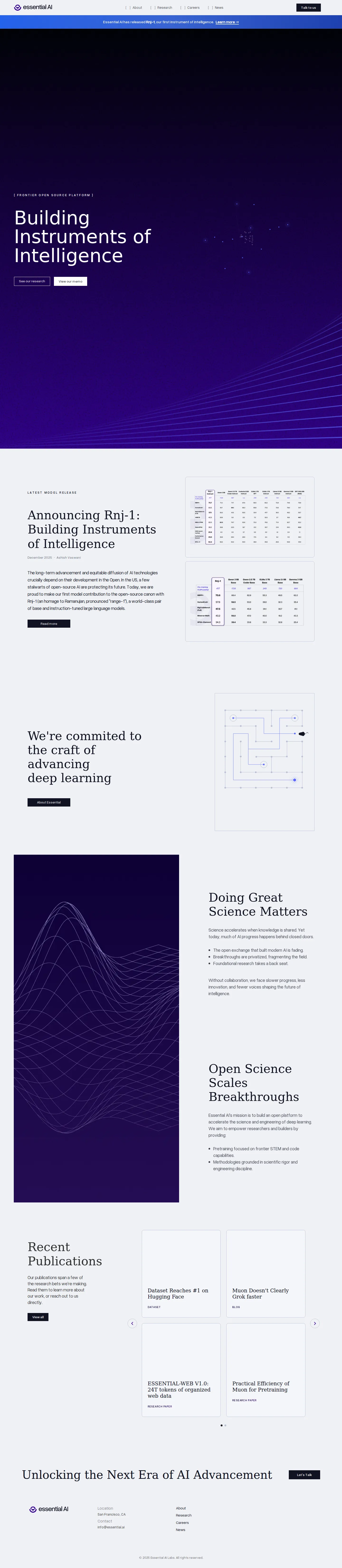
Live check: still no public pricing — sales-only
Verified on 2026-06-11: essential.ai/pricing returns a 404; the site exposes only About / Research / Careers / News plus a 'Talk to us' / 'Let's Talk' CTA to [email protected]. No plan grid, no rate card, no self-serve. price_transparency = sales-only, has_free_tier = false. (Evidence: 2026-06-11-pricing-validated.txt second source — no priceable screenshot exists because there is no pricing surface.)
Rnj-1 open-weight model family launches (8B), free on Hugging Face
Essential AI ships Rnj-1, an 8B-parameter dense base + instruction-tuned model pair trained from scratch (≈Gemma-3 architecture, 32k context via YaRN), optimized for code, STEM and agentic tool-calling. Released as open weights on Hugging Face and hosted on Together AI. Essential AI itself sets no per-token price — third-party hosts meter inference. (Source: essential.ai/research/rnj-1.)
Essential-Web v1.0 released free — 24T-token annotated dataset
Essential AI publishes Essential-Web v1.0, a 24-trillion-token web dataset where every document carries a 12-category taxonomy (topic, format, complexity, quality). It reaches #1 on Hugging Face. Released free for research — a goodwill / talent-and-distribution play, not a priced product (arXiv:2506.14111).
Emerges from stealth with $56.5M Series A — no public pricing
Essential AI, founded by Transformer co-authors Ashish Vaswani and Niki Parmar, exits stealth with a $56.5M Series A led by March Capital (with Google, NVIDIA, AMD, Thrive Capital, Franklin Venture Partners and KB Investment), on top of an earlier ~$8.3M Thrive-led seed. The stated goal is the 'Enterprise Brain' — full-stack AI products that automate monotonous enterprise workflows. No price card is published; the company is sales-led from day one. (Source: BusinessWire, VentureBeat, 2023-12.)
- · Essential AI's two founders, Ashish Vaswani and Niki Parmar, are co-authors of the 2017 'Attention Is All You Need' paper — the eight-author paper that introduced the Transformer architecture underpinning virtually every modern LLM.
- · Despite raising ~$65M and shipping a 24-trillion-token dataset and an 8B open-weight model, Essential AI publishes no price for any of it: essential.ai/pricing 404s and the site's only commercial button is 'Talk to us'.
- · Its $56.5M Series A is one of the few rounds backed simultaneously by Google, NVIDIA and AMD — three chip-and-cloud giants that rarely co-invest — alongside lead March Capital and Thrive Capital.
Questions & answers
- What is Essential AI's pricing model?
- Essential AI publishes no pricing. Its site has no plan grid, no per-token rate card, and no self-serve checkout — essential.ai/pricing returns a 404. The only commercial path is 'Talk to us' ([email protected]), so enterprise engagements are custom-quoted by sales.
- Does Essential AI offer a free tier?
- There is no free product tier to sign up for, but Essential AI releases substantial artifacts for free: the Essential-Web v1.0 dataset (24 trillion tokens) and the Rnj-1 open-weight model family (8B base + instruct) are both downloadable on Hugging Face at no cost.
- How much does Essential AI cost per month?
- There is no published monthly price. As a sales-led enterprise lab, Essential AI scopes and quotes each engagement individually; pricing is not disclosed publicly. Running its open Rnj-1 models incurs only third-party inference cost (e.g. via Together AI), not an Essential AI subscription.
- Is Essential AI pricing usage-based or subscription?
- Neither is published. Essential AI is sales-led with no public self-serve SKU. Commercial engagements are quoted bespoke. The open Rnj-1 weights, if self-hosted or run on a third-party host, are billed by that host per token — a usage cost that is external to Essential AI.
- Can I use Essential AI's models for free?
- Yes. Rnj-1 (base and instruct, 8B) ships as open weights on Hugging Face and is also hosted on Together AI, and the Essential-Web v1.0 dataset is freely downloadable — so the research artifacts are free to use even though the company itself sells no public-priced product.
- Who founded Essential AI?
- Ashish Vaswani and Niki Parmar, two co-authors of the 2017 'Attention Is All You Need' paper that introduced the Transformer architecture. Both are ex-Google Brain researchers; they founded Essential AI in San Francisco in 2023.