AI Summary
About
Exa (legally Exa Labs Inc.) is an applied AI lab building a web search API designed for AI agents rather than humans. It launched in 2022 as Metaphor Systems (Y Combinator S21) — its embeddings-based search engine drew a 151-point Hacker News thread in November 2022 — and rebranded to Exa (exa.ai) in January 2024 to signal that AI systems, not people, would be the dominant consumers of search. Its endpoints — Search, Contents, Deep Search, Agent, and Monitors — return token-efficient page text, highlights, and structured, citation-grounded answers that LLMs and agents can consume directly. Founders Will Bryk (CEO) and Jeff Wang frame the mission as building “a perfect search engine” so that “every AI has the highest quality information.”
The company sells primarily to developers and AI-product teams who embed search into coding agents, chatbots, research workflows, voice agents, and enrichment pipelines. Cursor is a named customer using Exa to pull the latest docs for more accurate code generation. Exa competes with general web-search APIs (Bing-style search, Brave, Tavily, You.com) and with retrieval layers bundled into LLM platforms, differentiating on latency control (configurable 180ms–1s), result quality for AI consumption, and a pay-as-you-go pricing model with no seats.
Exa is venture-backed and has scaled valuation fast: an $85M Series B led by Benchmark at a reported $700M valuation (September 2025), followed by a $250M Series C led by a16z at a reported $2.2B valuation (May 2026), with prior investors including Lightspeed, NVIDIA’s NVentures, and Y Combinator. The May 2025 “Launch HN: Websets” thread drew 412 points, a signal of strong developer attention to its products. As a developer-first infrastructure company, its go-to-market is product-led and self-serve at the low end, with a sales-led Enterprise motion for high-volume, custom-index, and zero-data-retention requirements.
Pricing summary : How Exa meters its AI search API by endpoint
Exa uses pure usage-based pricing layered on a pay-as-you-go credit balance, with a free tier and a Custom Enterprise plan. There are no seats and no monthly minimum — you load credits and are charged per request as you call each endpoint. As of the current pricing-page layout, Exa also names three account tiers — Starter (free), Developer (pay-as-you-go), and Enterprise (custom) — that gate integrations, compliance, and per-second rate limits on top of the same per-request rates. The price varies by endpoint and by how much work each request does:
- Per-endpoint request rates: Search is $7 / 1k requests, Deep Search $12 / 1k, Deep-Reasoning Search $15 / 1k, Monitors $15 / 1k, and Answer $5 / 1k. Contents is billed by pages crawled at $1 / 1k pages.
- Result-count and summary surcharges: The base price covers up to 10 results; each result above 10 adds $1 / 1k requests on Search, Deep Search, Deep-Reasoning Search, and Monitors (not billed on Answer), and AI page summaries add $1 / 1k pages on Search, Deep Search, Deep-Reasoning Search, Contents, and Monitors (not billed on Answer).
- Agent per-run pricing: The Agent endpoint bills either on auto effort — metered as Agent Compute Units at $0.10/ACU plus $0.005/search and contact-enrichment fees ($0.02/email, $0.07/phone) — or on a fixed-effort mode: $0.012 (Minimal) / $0.025 (Low) / $0.10 (Medium) / $0.50 (High) / $1.00 (X-high) per request.
- Free tier and credits: New accounts get $20 in free credits at signup, and every Free Tier account gets $10 in free credits every month with no payment method required (monthly credits expire and do not roll over).
- Tier-gated rate limits: Starter is capped at 5 Search QPS / 3 Agent concurrency; Developer raises that to 10 Search QPS / 25 Agent concurrency plus SOC 2 Type II certification; Enterprise offers custom Search QPS and Agent concurrency plus SOC 2 Type II + HIPAA, SSO for the dashboard, and a dedicated Slack support channel. A higher credit balance alone does not raise rate limits.
What makes this different: Exa exposes the cost of each retrieval primitive separately — request, extra result, page crawl, page summary, compute unit, enrichment — so the bill is built from per-endpoint usage-based pricing units rather than a single blended seat fee, which is the hallmark of API-first credit-based infrastructure billing.
Pricing by product
Account tiers (Starter / Developer / Enterprise)
| Tier | Price | Rate limits | Compliance & support | Data & integrations |
|---|---|---|---|---|
| Starter (Free) | $0 — $20 signup credit + $10/month, no card required | 5 Search QPS · 3 Agent concurrency | — | MCP server access, Claude Connector, ChatGPT plugin, 50+ integrations, access to all endpoints; Web, People, Company, and Scholarly-works indexes |
| Developer (Pay as you go) | Per-request rates, no commitment | 10 Search QPS · 25 Agent concurrency | SOC 2 Type II; pay via card or bank account; standard email support | Everything in Starter, plus self-serve Exa Connect data providers |
| Enterprise | Custom | Custom Search QPS & Agent concurrency | SOC 2 Type II and HIPAA; Zero Data Retention; custom MSA and DPA; SSO for Exa Dashboard; dedicated Slack support channel; enterprise SLAs; monthly invoicing | Everything in Developer, plus custom/tailored indexes, premium Exa Connect providers, bring-your-own data provider, up to 1,000 results per search |
Core search endpoints (per-request pricing)
| Tier | Price | Included | Key mechanics |
|---|---|---|---|
| Free Tier | Free | $20 in free credits at signup; $10 in free credits every month, no card required | Self-serve sign-up; monthly credits expire, no rollover |
| Search | $7 / 1k requests | Real-time web search, webpage text + highlights, configurable latency 180ms–1s, ≤10 results | Lowest paid step; about $0.007 per call |
| Deep Search | $12–15 / 1k requests | Multi-step agent workflows, structured-output answers, web-grounded citations | Deep-Reasoning Search variant is $15 / 1k |
| Monitors | $15 / 1k requests | Scheduled searches at a set cadence, fresh-event detection, webhook updates | Cron-style monitoring billed as requests |
| Answer | $5 / 1k requests | Direct answers from the web | Listed in the endpoint pricing table |
| Contents | $1 / 1k pages | Full-page contents for LLM context, token-efficient highlights, configurable livecrawl | Billed per page (per content type), not per request |
| Enterprise | Custom | Up to 1,000 results/search, custom Search QPS & Agent concurrency, custom index, SOC 2 + HIPAA, SSO, dedicated Slack support, SLAs, Zero Data Retention | Sales-led; monthly invoicing |
Endpoint pricing detail (surcharges above the base rate)
| Charge | Search | Deep Search | Deep-Reasoning Search | Contents | Monitors | Answer |
|---|---|---|---|---|---|---|
| Base price, up to 10 results (per 1k requests) | $7 | $12 | $15 | $1 (per 1k pages) | $15 | $5 |
| Cost per additional result above 10 (per 1k req) | $1 | $1 | $1 | — | $1 | not billed |
| AI page summaries (per 1k pages) | $1 | $1 | $1 | $1 | $1 | not billed |
Answer’s additional-result and AI-page-summary surcharges show as not billed on the current pricing table (both were listed at $1 as of the prior capture).
Agent endpoint (per-run pricing)
By default Agent uses effort: auto — compute and tool usage scale to the task and are metered. You can instead choose a fixed-effort mode for predictable per-request pricing.
| Component | Rate | Notes |
|---|---|---|
| Agent Compute Units | $0.10 / ACU | Auto-effort compute metering |
| Search tool calls | $0.005 / search | Tool usage inside an agent run |
| Email contact enrichment | $0.02 / email | Billed separately from effort modes |
| Phone contact enrichment | $0.07 / phone number | Billed separately from effort modes |
| Fixed effort — Minimal | $0.012 / request | Lowest predictable per-request price |
| Fixed effort — Low | $0.025 / request | Predictable per-request price |
| Fixed effort — Medium | $0.10 / request | Predictable per-request price |
| Fixed effort — High | $0.50 / request | Predictable per-request price |
| Fixed effort — X-high | $1.00 / request | Highest predictable per-request price |
Exa Connect (third-party data providers)
Exa Connect pulls live data from specialized third-party providers through a single Exa integration; usage is billed on top of Agent usage.
| Access | Providers |
|---|---|
| Self-serve | Jinko, Financial Datasets, Affiliate.com, Particle, Fiber.ai, Baselayer, Similarweb |
| Available on request | ZoomInfo, Crunchbase, Harmonic, DefinitiveHealthcare |
No separate contracts or API key are required for self-serve providers, and bring-your-own-key is supported for any data provider.
Grants and programs
| Program | Offer | Notes |
|---|---|---|
| Startup and Education Grants | $1000 worth of free credits | ”Build comprehensive web search into your startup or education project — for free.” Via Contact Us. |
Sales motions across products: PLG / self-serve for the Starter (Free) and Developer (Pay as you go) account tiers and all per-request endpoints (Search, Deep Search, Agent, Contents, Monitors, Answer); sales-led for Enterprise (custom Search QPS & Agent concurrency, custom index, Zero Data Retention, monthly invoicing) and for Startup/Education grants.
Hidden costs : what an agent workload really costs beyond the $7 headline
The advertised “$7 / 1k requests” understates real cost once an agent returns extra results, crawls full pages, or runs enrichment. A representative example (to be expanded in full research):
Coding agent pulling docs at scale
| Line item | Monthly cost |
|---|---|
| 500k Search requests @ $7 / 1k | $3,500 |
| Additional results above 10 (250k req) @ $1 / 1k | $250 |
| Contents: 1M pages @ $1 / 1k pages | $1,000 |
| Total | $4,750 |
The per-page Contents charge and the extra-result surcharge can together rival the base Search spend, so result count and crawl depth are the real cost levers.
Want to estimate your own Exa bill? Use the Exa pricing calculator to model your monthly cost based on requests per endpoint, results per request, pages crawled, and Agent effort mode.
Pricing evolution : from a single search rate to per-endpoint metering
Exa’s pricing has moved through three distinct regimes in roughly two years: flat monthly subscription tiers (early 2024), pure pay-as-you-go credits (mid-2024 onward), and per-endpoint cards as the API surface fanned out into Search, Deep Search, Contents, Answer, Monitors, and Agent.
Cadence
| Quarter | Price changes | Product / SKU additions | Notes |
|---|---|---|---|
| 2024 Q1 | 1 | 0 | Rebrand from Metaphor to Exa; tiered subscriptions visible — Wanderer $100/mo, Wanderer+ $250/mo, Enterprise Custom. |
| 2024 Q2 | 1 | 1 | Free Hacker tier ($0) added; Wanderer plans move to usage rates ($10/1k searches, $1.5/1k content) with $50–$250/mo minimums. |
| 2024 Q3 | 1 | 0 | Subscription tiers dropped for pure pay-as-you-go credits ($10 free credits); $15/1k neural search, $25/1k for 26–100 results, $1/1k content. |
| 2025 Q1 | 1 | 0 | ”API Pricing” restructure: Search $5/1k (Auto/Neural 1–25), Keyword $2.5/1k; Contents split into Text/Highlights/Summary at $1 each; Websets toggle. |
| 2025 Q2 | 0 | 2 | Answer ($5/1k answers) and Research endpoints (exa-research / exa-research-pro, $5–$10) added. Search held at $5/1k. |
| 2025 Q4 | 0 | 1 | Deep Search added at $15/1k as a distinct Search row. |
| 2026 Q2 | 1 | 1 | Endpoint-card redesign; base Search raised $5 → $7/1k; Deep $12–15, Contents $1, Monitors $15, Answer $5; Agent per-run pricing introduced. |
| 2026 Q3 | 2 | 1 | (07-14) Free tier expanded 1,000 → 20,000 req/mo; Agent recut — new Minimal mode ($0.012), X-high $2.00 → $1.00, ACU repriced to $0.10, in-agent search $0.007 → $0.005. (07-24) Free tier reframed as credits: onboarding $10 → $20, monthly $7 → $10, card requirement dropped. Core endpoint rates unchanged all quarter. |
Tracked range: 2024-01 to 2026-07 (Wayback Machine snapshots of exa.ai/pricing, monthly-sampled). Quarters not listed were verified stable (0 price changes, 0 SKU additions).
Notable changes
- 2024-01 — Metaphor renamed to Exa (exa.ai) alongside the “highlights” launch; pricing was flat monthly subscriptions (Wanderer $100/mo, Wanderer+ $250/mo). See the Announcing Exa post.
- 2024-04 — Free $0 “Hacker” tier added and Wanderer plans converted to metered per-1k rates with a monthly minimum.
- 2024-07 — Named subscription tiers retired in favor of pure pay-as-you-go credits with $10 in free credits; no seats, no minimum.
- 2025-01 — Search restructured into Auto/Neural/Keyword at $5/1k (1–25 results); Contents split into Text/Highlights/Summary at $1 each.
- 2025-06 — Answer ($5/1k) and Research endpoints added — the lineage that became today’s Deep Search and Agent.
- 2025-12 — Deep Search appears at $15/1k.
- 2026-04 — Per-endpoint card redesign; base Search raised from $5 to $7/1k, with Cursor cited as a customer using Exa Search for fresher docs.
- 2026-07-14 — Free tier expanded 20× (1,000 → 20,000 requests/month) and the Agent endpoint recut: a new Minimal fixed-effort mode ($0.012/request) brought the lineup to five modes, X-high was halved ($2.00 → $1.00), in-agent search fell to $0.005/search, and Agent Compute Units were repriced to $0.10/ACU. Core endpoints (Search $7, Deep $12–15, Contents $1, Monitors $15, Answer $5) held steady — the move targeted top-of-funnel trial volume and Agent pricing, not the paid search rates.
- 2026-07-24 — Free Tier reframed from a request quota to a credit model: the pricing page and billing docs dropped the “20,000 requests/month” language, the one-time signup credit doubled $10 → $20, and the recurring monthly credit rose $7 → $10 while dropping the requirement for a payment method on file (previously card-only). Paid endpoint rates were unchanged.
What’s unique : per-primitive metering for AI retrieval
1. Every retrieval primitive is its own price. Exa charges separately for a request, each result above 10, each crawled page, each AI page summary, each compute unit, and each enrichment. That makes the cost of an agent workflow legible at the unit level rather than hidden inside a blended subscription.
2. Per-1k-request quoting. Headline numbers like “$7” are per 1,000 requests, normalizing tiny per-call prices (about $0.007) into readable figures while keeping the model purely usage-based.
3. Dual Agent pricing. The Agent endpoint lets buyers choose between variable auto-effort metering (ACUs plus tool fees) and five fixed-effort flat rates ($0.012–$1.00 per run). The July 2026 recut widened the fixed-effort lineup at the bottom (a new $0.012 Minimal mode) while halving the top (X-high $2.00 → $1.00), so predictability-seekers get both a cheaper floor and a cheaper ceiling.
4. A model that walked away from subscriptions. Exa started in 2024 with flat monthly tiers (Wanderer $100/mo, Wanderer+ $250/mo) and deliberately retired them within months for pure pay-as-you-go credits. Few infrastructure vendors abandon a working subscription page; Exa’s choice signals conviction that an agent-consumed API should be billed per call, not per seat.
Strengths & weaknesses
| Strengths | Weaknesses |
|---|---|
| Transparent, public per-endpoint rates with no seats or minimum | Many billing dimensions (request, result, page, summary, ACU) raise estimation complexity |
| Free-tier credits doubled and no longer gated behind a card — $20 signup + $10/month for every account, not just carded ones (2026-07-24) | Monthly credits still expire with no rollover, and the retired 20,000-req/month quota funded far more volume than the $10 credit does at published rates |
| Pay-as-you-go credits with auto-recharge controls | Deep Search quoted as a $12-15 range rather than a single price |
| Enterprise path for ZDR, custom index, and postpaid invoicing | Per-additional-result and per-page charges can surprise heavy users |
Billing UX : pay-as-you-go credits, auto recharge, and Stripe invoices
- Credit balance (Billing page) — Exa runs a pay-as-you-go credit system; your remaining balance is shown on the Billing page in the dashboard, and API requests are blocked when the balance runs out.
- Add credits (Stripe) — Team owners can add credits at any time from the Billing page; payments are processed through Stripe.
- Auto recharge — Automatically tops up the balance using three settings: recharge amount (min $5, max $10,000), recharge threshold (the balance level that triggers a top-up), and an optional monthly maximum to cap auto-recharge spend.
- Free tier and monthly credits — New accounts receive $20 in free credits at signup, and every Free Tier account receives $10 in free credits at the start of each calendar month with no payment method required (these expire at month-end and do not roll over).
- Receipts and invoice history — Email receipts for purchases and auto-recharges are sent from [email protected]; full invoice history is viewable on the Billing page.
- Enterprise postpaid invoicing — Postpaid invoice billing is available only on Enterprise plans (contact [email protected]); high-volume users are advised to pre-load balance and raise the recharge amount.
- Tier-gated rate limits (Rate Limits doc + pricing page) — Default per-endpoint limits:
/search10 QPS,/contents100 QPS,/answer10 QPS. Account tiers further gate Search QPS and Agent concurrency (Starter 5 QPS/3 concurrency, Developer 10 QPS/25 concurrency, Enterprise custom); a higher credit balance does not raise rate limits — contact [email protected] to raise them.
Strategic wins : pricing decisions that fit an API-first buyer
1. Pure usage with no seats removes adoption friction
By billing only on requests and credits, Exa lets a developer go from sign-up to first call without a sales conversation or a seat purchase — the canonical usage-based pricing motion for developer infrastructure.
2. A generous free tier plus renewable credits keep low-volume users active
The 2026-07-14 expansion of the free tier’s request quota (1,000 → 20,000/month) widened the top of the product-led growth funnel, and the 2026-07-24 update replaced that quota entirely with pure dollar credits — the signup credit doubled to $20 and the monthly credit rose to $10, now granted to every account rather than only ones with a card on file. Dropping the card gate removes the last friction point before a developer can run recurring evaluation traffic indefinitely, though at published per-request rates the credit ceiling (Exa’s own docs peg the $20 signup credit at roughly 2,800 searches) is narrower than the retired 20,000-request headline implied.
3. Prepaid credits with auto-recharge protect cash flow
Charging against a prepaid Stripe balance with optional auto-recharge means Exa collects before it serves, avoiding the receivables risk of postpaid metering — a pattern explored in our usage invoicing and billing-cycles guide. Postpaid invoicing stays gated behind Enterprise contracts, where credit risk is underwritten.
Areas to improve : making a multi-dimensional bill easier to forecast
1. Publish a single Deep Search price or a clear range driver
Deep Search is quoted as “$12-15 / 1k requests,” which forces buyers to guess. Naming the variable that moves the price (for example reasoning depth) — or exposing it in a calculator — would reduce AI bill-shock and cost unpredictability and improve threshold and alert planning.
2. Surface a live cost estimator for the surcharge dimensions
Extra-result and per-page charges are easy to overlook. An in-dashboard estimator that projects monthly spend from request volume, result count, and crawl depth would reduce bill shock.
3. Let unused monthly free credits roll over for active accounts
The monthly credit (raised from $7 to $10 on 2026-07-24) still expires at month-end and does not roll over, which penalizes bursty developers who skip a month. Since that same update dropped the card requirement for every Free Tier account, a rollover window (or a small carryover cap) open to all accounts — not just previously-carded ones — would reward retention without materially changing the free-tier economics of usage-based SaaS.
4. Restore a usage-equivalent now that the request quota is gone
Dropping the “20,000 requests/month” language on 2026-07-24 removed a concrete number developers could plan against. A short worked example on the pricing page — for instance, spelling out that the $20 signup credit covers roughly 2,800 Search calls or 20,000 Contents pages — would restore that legibility without reintroducing a hard quota, sitting naturally beside the per-endpoint rate cards the page already uses.
Monetization stack & signals : how Exa builds & buys its revenue engine
Buys 1 Builds 0 5 open roles
Exa runs its money layer on Stripe — even the pay-as-you-go credit balance behind its usage pricing is Stripe's. Its GTM hires (Head of Sales Development, growth) layer a sales motion onto a self-serve developer core.
- Growth Engineer Growth seen May 20, 2026
- Digital Growth Lead Growth seen May 20, 2026
- Head of Sales Development RevOps seen May 20, 2026
- Product Marketing RevOps seen May 20, 2026
- Data Partnerships Data platform seen Nov 5, 2025
Signals reviewed · derived from public job posts, product docs
Job postings fill and close over time — once a posting is filled we keep it as a dated citation (the quoted evidence remains); use View open roles for current listings.
Key takeaways
- Price the primitive, not the persona. Exa charges per request, result, page, and compute unit rather than per user. That fits an API where the buyer is an agent, not a seat.
- Per-1k quoting makes micro-prices readable. Quoting “$7 / 1k” instead of “$0.007 each” keeps the model usage-based while staying legible on a pricing page.
- Free recurring credits beat a one-time trial — and removing the card gate makes them universal. Exa raised its monthly credit from $7 to $10 and dropped the card-on-file requirement on 2026-07-24, so recurring evaluation traffic is now sustained for every account, not just ones with a payment method attached.
- Offer both metered and flat per-run pricing. Exa Agent lets buyers pick auto-effort metering or fixed-effort flat rates, serving both cost-optimizers and predictability-seekers.
- Reserve postpaid invoicing for Enterprise. Prepaid credits via Stripe keep cash-flow risk low, while postpaid billing is gated behind a sales contract.
UBP implications
- Unbundled retrieval pricing sets a reference point. Exa charging separately for search, contents, summaries, and enrichment gives the market a template for metering AI retrieval at the primitive level. It nudges competitors toward more granular, transparent unit economics.
- Result count is a legitimate value metric. Treating “results above 10” as a billable dimension shows that output volume — not just calls — can anchor usage-based pricing. The metric travels well to any retrieval or generation API.
- Free credits as a renewable funnel — and a stress test for flat quotas. Monthly expiring dollar credits are a usage-based analogue of a freemium tier that converts evaluators without committing the vendor to an open-ended free plan; Exa’s 2026-07-24 shift away from a blanket “20,000 requests/month” quota toward pure credits shows why a single request count can’t hold steady value once endpoints are priced unevenly (Search costs 7x more per unit than Contents).
Sources
- Exa pricing page (accessed 2026-06-01)
- Exa billing documentation (accessed 2026-06-01)
- Exa about page (accessed 2026-06-01)
Bottom line
Exa prices its AI search API the way it expects agents to consume it — one primitive at a time. Search at $7 per 1k requests, Contents at $1 per 1k pages, Deep Search at $12-15, and an Agent endpoint that bills per run all sit on a prepaid credit balance with no seats and no minimum, while Enterprise unlocks custom limits, zero data retention, and postpaid invoicing. The trade-off is a bill assembled from many small dimensions, which rewards transparency but demands a calculator to forecast.
Want to compare Exa against other usage-based AI infrastructure pricing? Browse the pricing blueprint.
Pricing timeline : Major events on a vertical axis
Each milestone below corresponds to a public pricing change, product launch, or material adjustment. Major events use a filled marker; minor adjustments use a faded one.
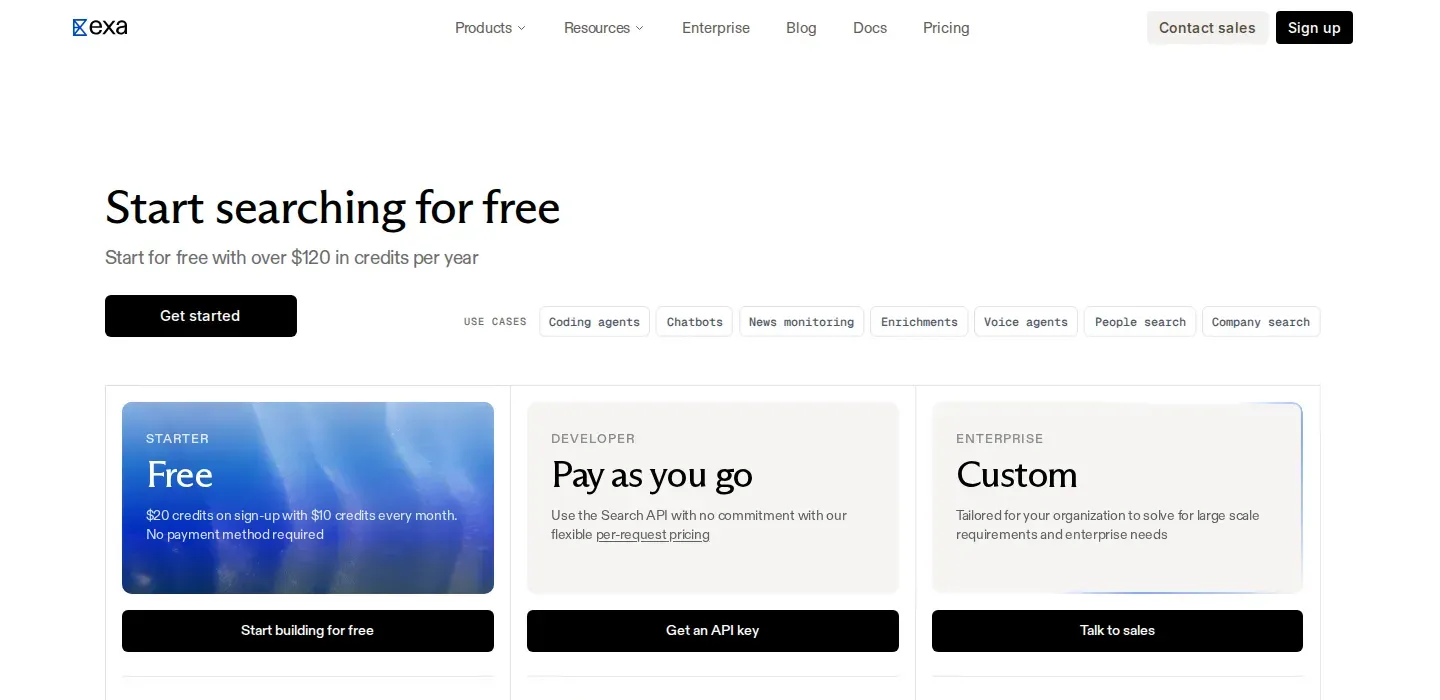
Pricing page restructured into Starter / Developer / Enterprise account tiers with explicit rate limits
The single Free-Tier card plus a separate Enterprise block was replaced with a three-column comparison of named account tiers — STARTER (Free), DEVELOPER (Pay as you go), and ENTERPRISE (Custom) — each now disclosing Search QPS and Agent-concurrency caps (Starter 5 QPS/3 concurrency, Developer 10 QPS/25 concurrency, Enterprise custom) and gated features (Developer adds SOC 2 Type II; Enterprise adds SOC 2 + HIPAA, custom MSA/DPA, SSO for the dashboard, and a dedicated Slack support channel). A dedicated 'Exa Connect pricing' section also went live, listing self-serve (Jinko, Financial Datasets, Affiliate.com, Particle, Fiber.ai, Baselayer, Similarweb) versus available-on-request (ZoomInfo, Crunchbase, Harmonic, DefinitiveHealthcare) data providers. On the endpoint-pricing table, the Answer endpoint's per-additional-result and AI-page-summary surcharges dropped from $1/1k to not billed ('-'). Core per-request rates (Search $7, Deep Search $12-15, Contents $1, Monitors $15, Answer $5, Agent $0.012-$1.00) were unchanged. Exact live date unconfirmed — last seen unchanged 2026-07-29, first observed in this form 2026-08-26.
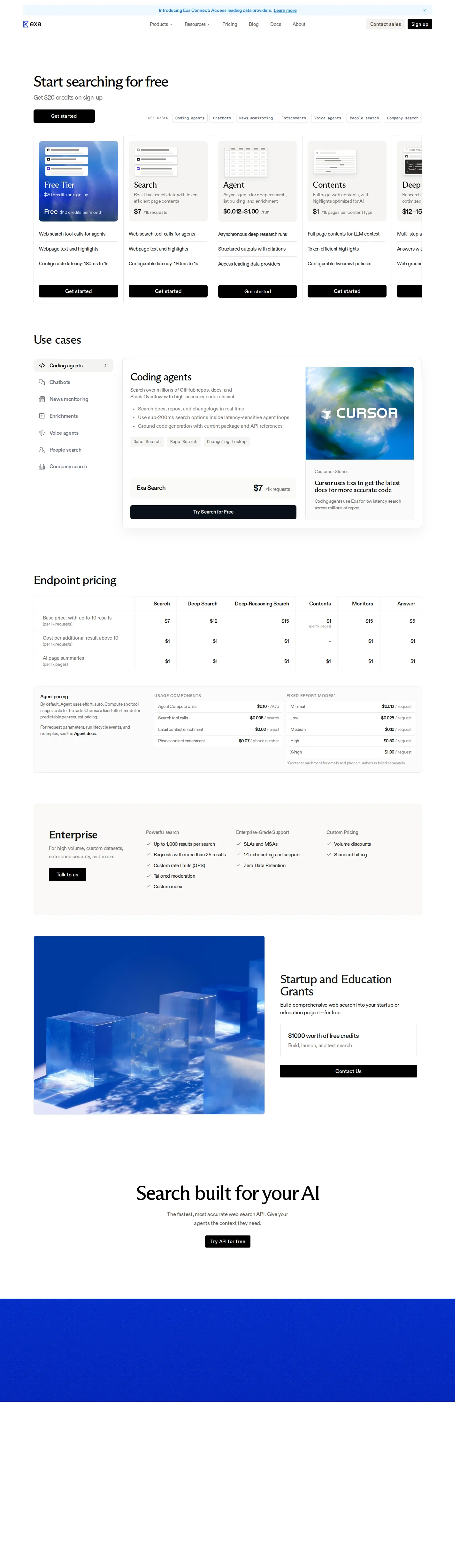
Free tier reframed as pure credits; monthly credit raised and card requirement dropped
The pricing page and billing docs dropped the explicit '20,000 requests/month' framing for the Free Tier in favor of a pure dollar-credit model: the one-time signup credit doubled from $10 to $20, and the recurring monthly credit rose from $7 to $10 — now available to every Free Tier account rather than only accounts with a payment method on file. Paid endpoint rates (Search $7, Deep Search $12-15, Contents $1, Monitors $15, Answer $5, Agent) were unchanged.
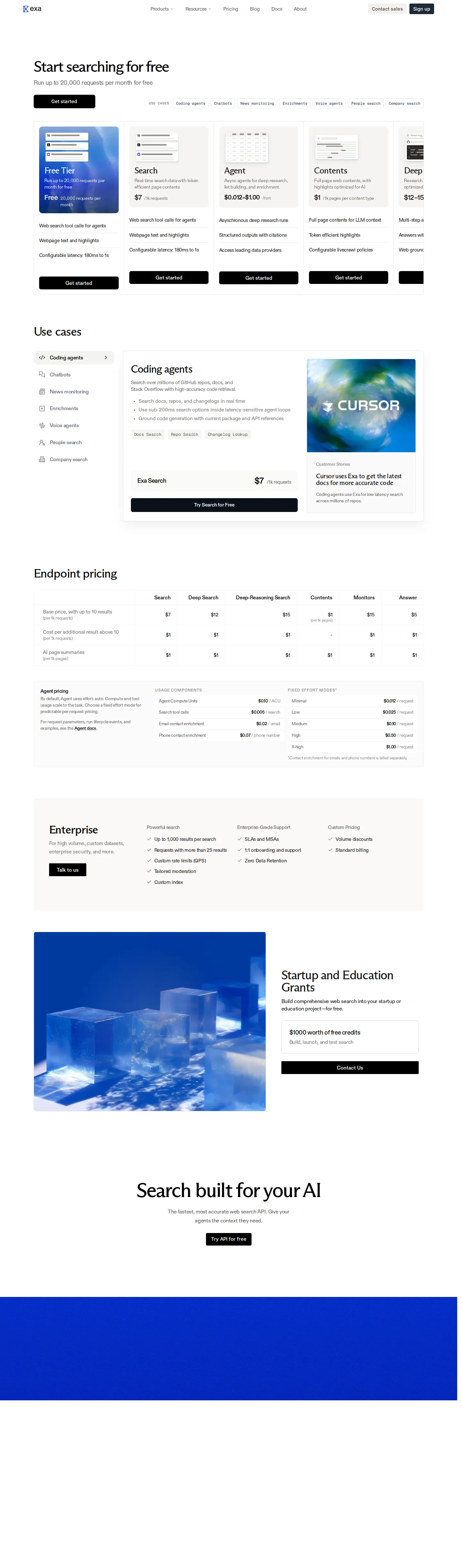
Free tier expanded 20× and Agent pricing recut
The free tier jumped from 1,000 to 20,000 requests per month. The Agent endpoint was repriced: the headline range moved from $0.025–$2.00 to $0.012–$1.00 per run, a new Minimal fixed-effort mode ($0.012/request) was added, X-high dropped from $2.00 to $1.00, Agent Compute Units are now $0.10/ACU, and in-agent search tool calls fell from $0.007 to $0.005/search. Core endpoint rates (Search $7, Deep $12-15, Contents $1, Monitors $15, Answer $5) held steady.
Per-endpoint usage pricing with Agent and free monthly credits
Pricing page lists per-1k-request rates for Search ($7), Deep Search ($12-15), Contents ($1/1k pages), Monitors ($15) and Answer ($5), an Agent endpoint billed per run ($0.025-$2.00) or on Agent Compute Units, a free tier ($10 onboarding credits plus $7/month with a card on file), and a Custom-priced Enterprise plan.

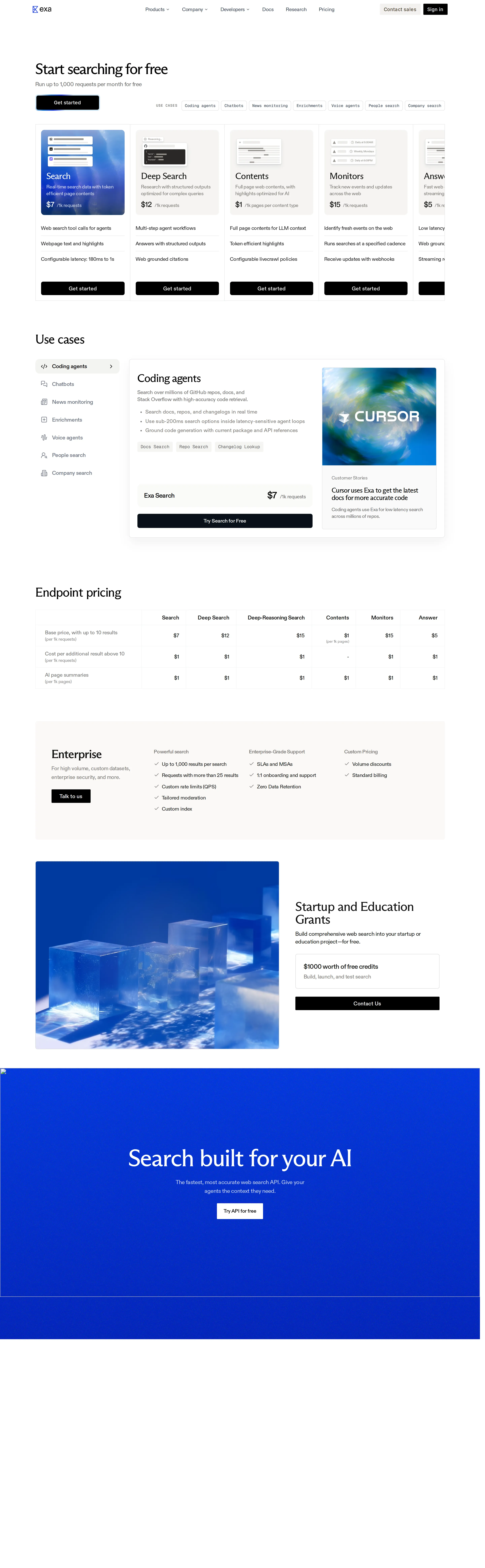
Endpoint-card redesign; base Search raised to $7/1k
The page moved to per-endpoint cards at the current rates: Search $7/1k requests (up from $5), Deep $12/1k (Deep-Reasoning $15), Contents $1/1k pages per content type, Monitors $15/1k requests, and Answer $5/1k. A 'Coding agents' use case showcased Cursor using Exa Search at $7/1k for more accurate docs.
Deep Search added at $15/1k
The Search section consolidated Fast/auto/neural into a single $5/1k (1-25 results) / $25/1k (26-100) row and introduced a separate Deep row at $15/1k requests for multi-step research. Contents stayed at $1/1k pages across Text, Highlights, and Summary.

Answer and Research endpoints added
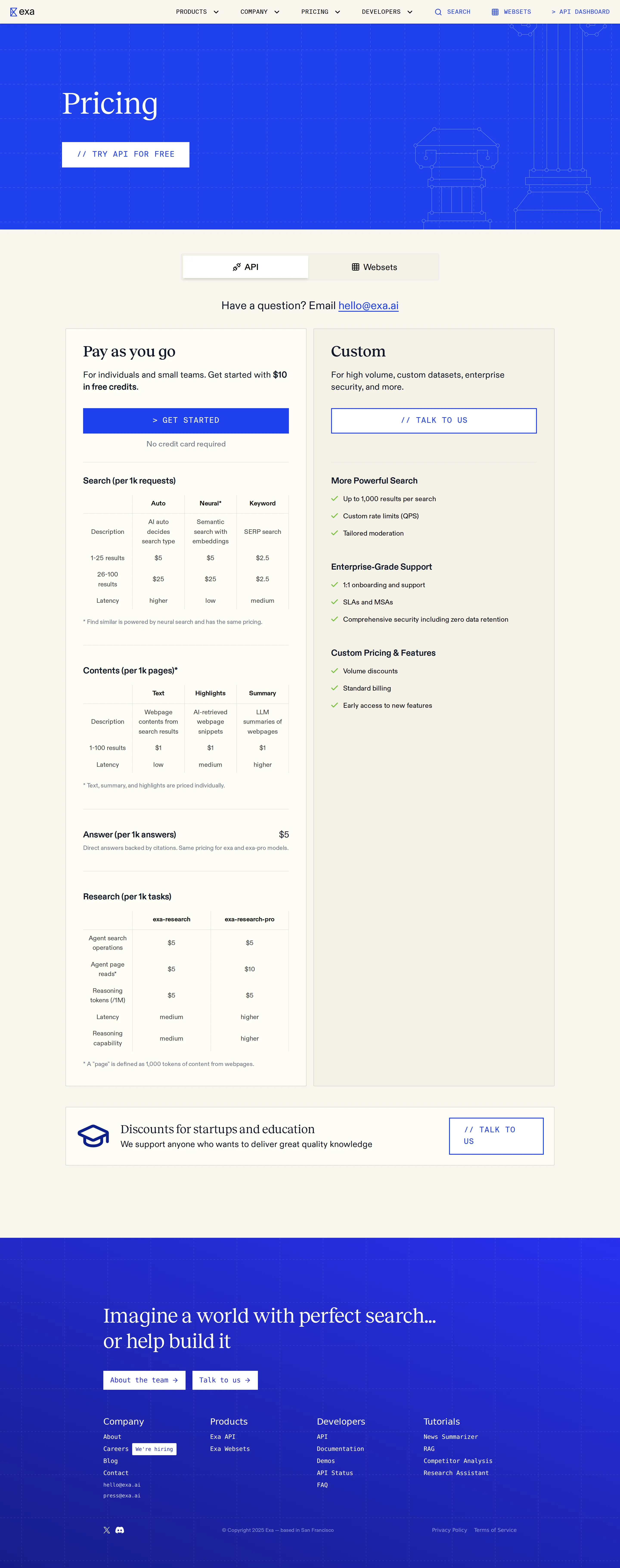
A new Answer endpoint ($5/1k answers, 'direct answers backed by citations') and a Research (per 1k tasks) table appeared, listing exa-research ($5 agent search ops, $5 page reads, $5 reasoning tokens/1M) and exa-research-pro ($5/$10/$5). Search held at $5/1k for 1-25 results. This is the precursor to today's Deep Search and Agent endpoints.
Structured 'API Pricing' tables and a Websets toggle
The page reorganized into an 'API Pricing' block with a Search (per 1k requests) table split into Auto/Neural/Keyword columns — Auto and Neural at $5/1k (1-25 results) and $25/1k (26-100), Keyword at $2.5/1k — plus a Contents (per 1k pages) table charging Text, Highlights, and Summary at $1 each. A 'Looking for Websets pricing?' banner separated the API product from Websets.
Subscription tiers dropped for pure pay-as-you-go credits
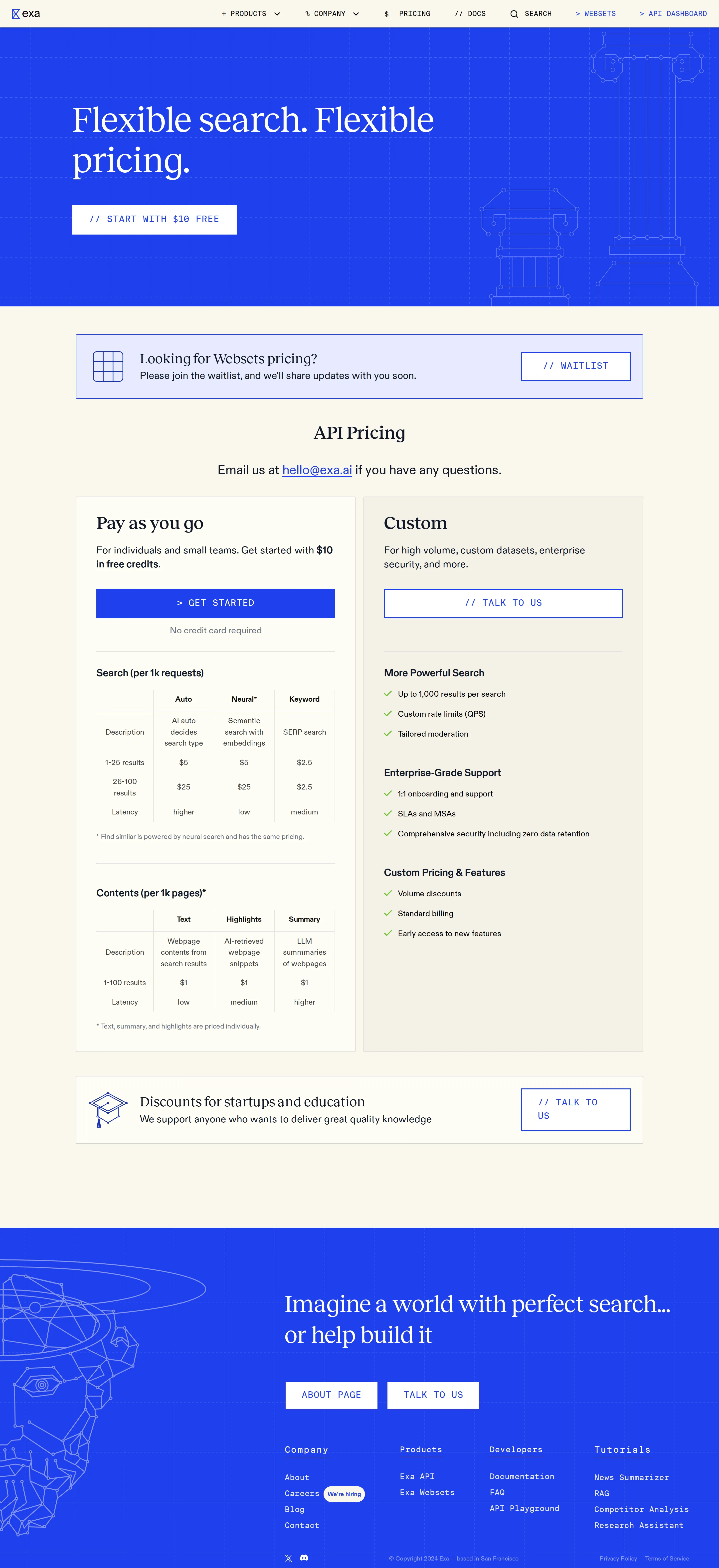
Exa retired the named Wanderer subscription tiers and switched to 'Flexible search. Flexible pricing' — a pay-as-you-go credit model with $10 in free credits and just two columns (Pay as you go, Custom). Visible rates: $15/1k neural searches (1-25 results), $25/1k (26-100 results), $2.5/1k keyword searches, and $1/1k pieces of content. No more monthly minimums or seats.

Free 'Hacker' tier added; Wanderer plans move to usage rates plus a minimum
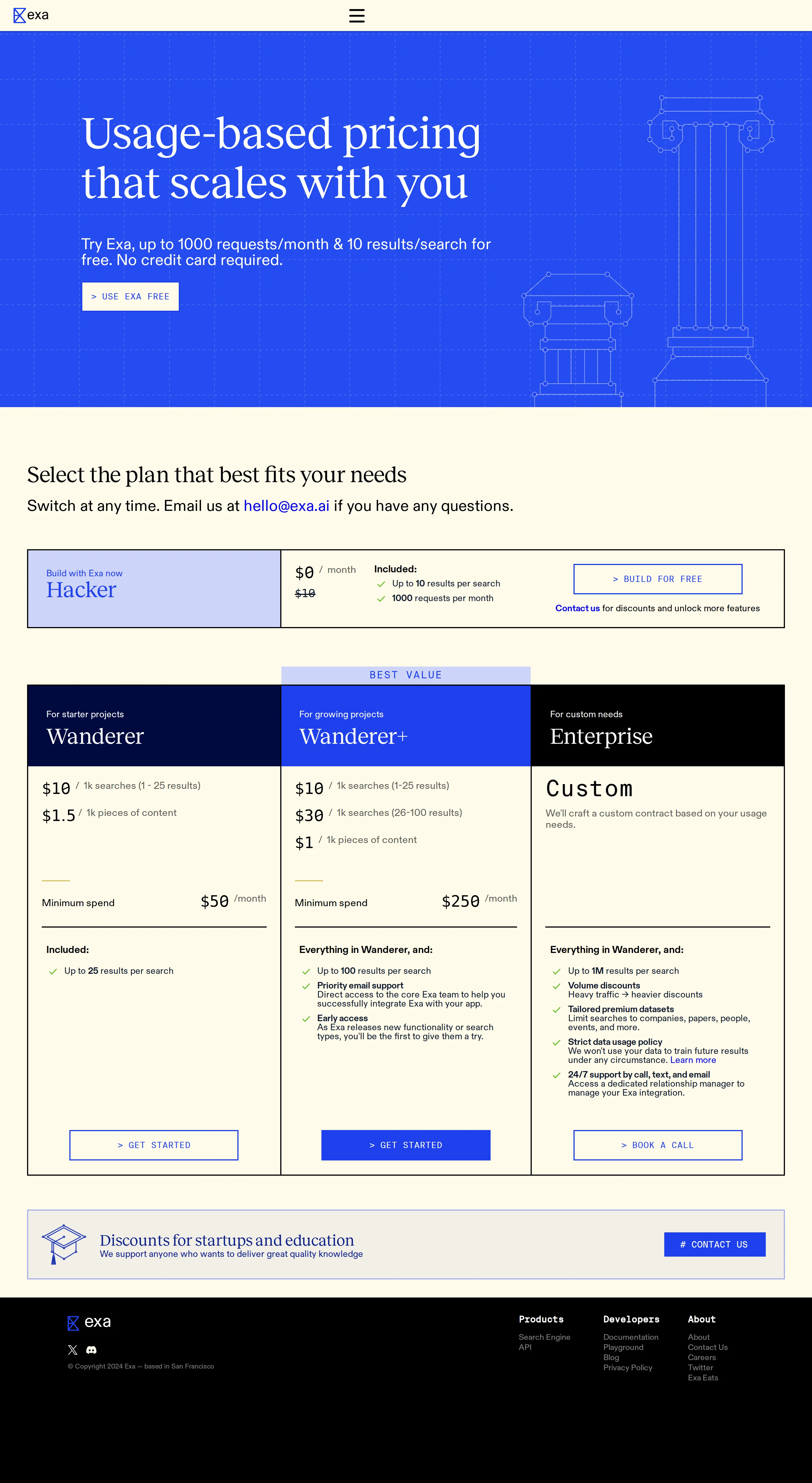
A free Hacker tier ($0, up to 1,000 requests/month) appeared, and the Wanderer plans shifted from flat fees to usage rates with a monthly minimum: Wanderer billed $10/1k searches (1-25 results) and $1.5/1k pieces of content with a $50/month minimum, while Wanderer+ added a $30/1k tier for 26-100 results at a $250/month minimum. This is the first appearance of metered per-request rates on the page.
Metaphor rebrands to Exa on a tiered subscription model
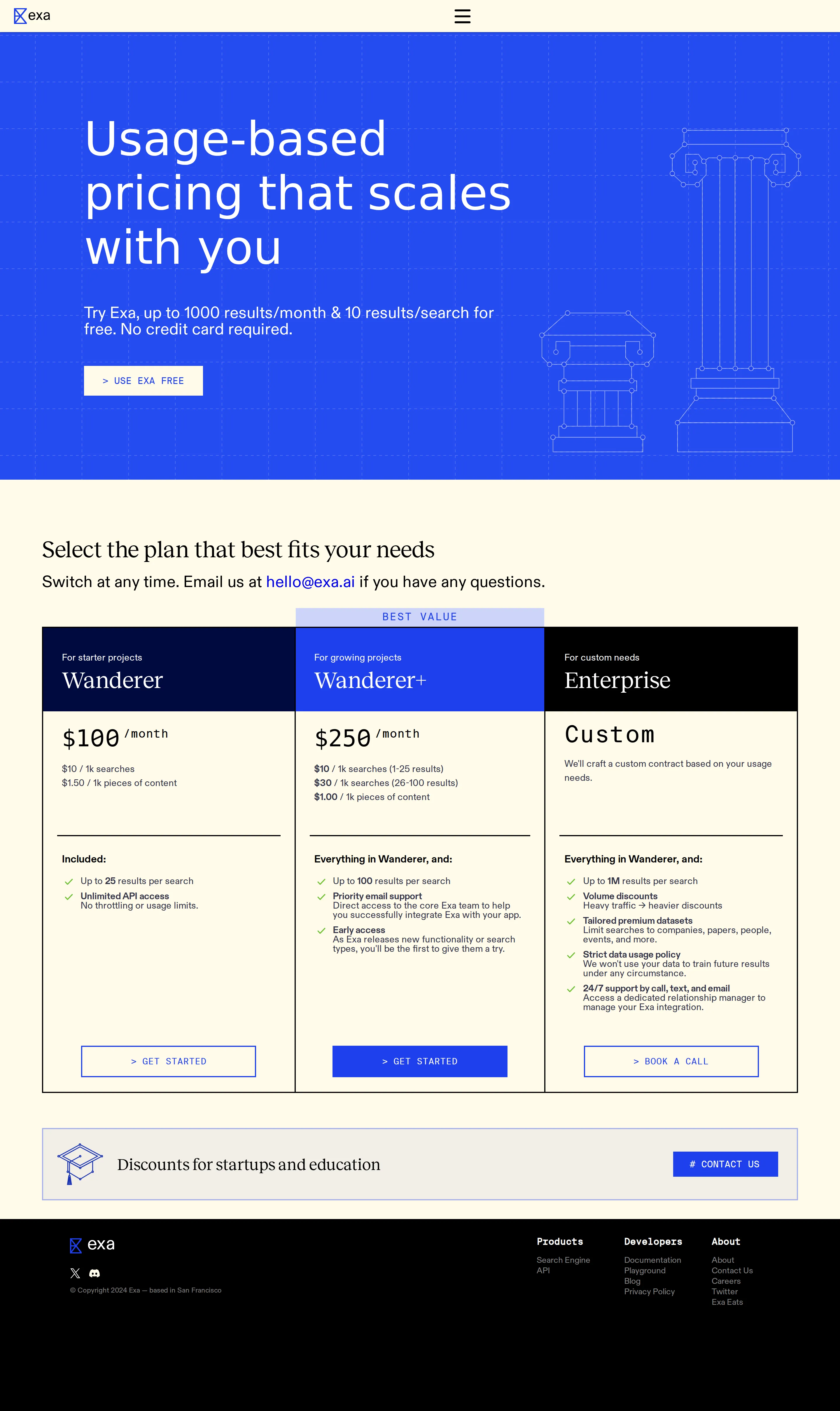
After renaming from Metaphor to Exa (exa.ai), the pricing page sold flat monthly subscriptions: Wanderer at $100/month (10 results/search, unlimited API, for starter projects), Wanderer+ at $250/month (for growing projects, priority email support, early access), and Enterprise Custom. The headline read 'Usage-based pricing that scales with you,' but the visible plans were seat-style monthly fees rather than per-request metering.
- · Exa prices its API per 1,000 requests rather than per request, so the headline Search $7 actually means about $0.007 per call.
- · Returning more than 10 results per request triggers a separate per-additional-result charge ($1 per 1k requests on most endpoints), so result count is its own billing dimension.
- · Exa Agent can bill on auto effort (compute scales to the task) or one of five fixed-effort modes from $0.012 (Minimal) to $1.00 (X-high) per request for predictable pricing.
Questions & answers
- How much does the Exa search API cost?
- Exa standard Search is $7 per 1,000 requests (about $0.007 per call) for results with up to 10 items. Deep Search is $12-15 per 1k requests, Contents is $1 per 1k pages, and Monitors is $15 per 1k requests.
- Does Exa have a free tier?
- Yes. New accounts receive $20 in free credits at signup, and every Free Tier account receives $10 in free credits at the start of each calendar month — no payment method required. The monthly credits expire at month-end and do not roll over.
- How is the Exa Agent endpoint priced?
- Agent uses effort auto by default, where compute and tool usage scale to the task and are metered as Agent Compute Units ($0.10/ACU) plus per-search ($0.005) and per-enrichment fees. You can instead pick a fixed-effort mode — Minimal $0.012, Low $0.025, Medium $0.10, High $0.50, or X-high $1.00 per request — for predictable pricing.
- Does Exa charge extra for more search results?
- Yes. The base price covers up to 10 results. Returning more than 10 results adds a per-additional-result charge of $1 per 1k requests on Search, Deep Search, Deep-Reasoning Search, Monitors, and Answer.
- How does Exa billing and Enterprise pricing work?
- Exa runs a pay-as-you-go credit system through Stripe — you load credits and are charged as you use the API, with optional auto-recharge. Postpaid invoice billing, volume discounts, custom rate limits, and Zero Data Retention are available on Enterprise plans by contacting [email protected].