AI Summary
About
Fathom is an AI meeting notetaker that automatically records, transcribes, and summarizes video calls across Zoom, Google Meet, and Microsoft Teams. Its assistant generates instant call summaries, AI action items, and follow-up emails, and lets users search and ask questions (“Ask Fathom”) across every recorded conversation. The product targets individuals, sales and revenue teams, and fast-moving startups who turn customer calls, demos, and investor updates into searchable team knowledge.
Fathom competes directly with Gong, Fireflies, Otter, and Granola, and leans heavily on a generous free tier as its primary acquisition engine — the Free plan offers unlimited recordings, transcriptions, and AI summaries at $0 forever. Paid plans layer on advanced AI insights, team collaboration, and CRM/coaching features for revenue organizations.
Founded in 2020 by former UserVoice founder Richard White and headquartered in San Francisco, Fathom launched publicly on the Zoom App Marketplace in August 2021 as a free notetaker, raised a $4.7M seed round (announced January 2022; backers included Character, Zoom’s own Apps Fund, and angels such as Naval Ravikant), and followed with a $17M Series A led by Telescope Partners on September 19, 2024 — notable for raising $2M of the round from its own users through a Wefunder crowdfunding campaign. The company has reported revenue growth of roughly 90x and usage growth of ~20x over a two-year window, reaching an estimated ~$30M in revenue in 2025 on a team of about 100 people. Its closest comparables are Gong (enterprise revenue intelligence), Fireflies and Otter (horizontal notetakers), and Granola (the design-forward newcomer).
The company also runs go-to-market programs aimed at early-stage growth: a Qualified Portfolio Partner Program that gives startups affiliated with any of its 77 listed VC and accelerator partners (Y Combinator, TinySeed, a16z speedrun, Telescope, Susa Ventures, Berkeley SkyDeck, and more) up to two years free on Fathom Team or Business, a nonprofit program offering 10 free seats, and a competitive-switch offer that gives Gong customers Fathom Business free for the remainder of their existing contract plus data migration. The defining commercial fact is the free tier: Fathom leads with a genuinely unlimited free plan and converts on advanced AI, collaboration, and revenue-team features rather than on a metered usage wall.
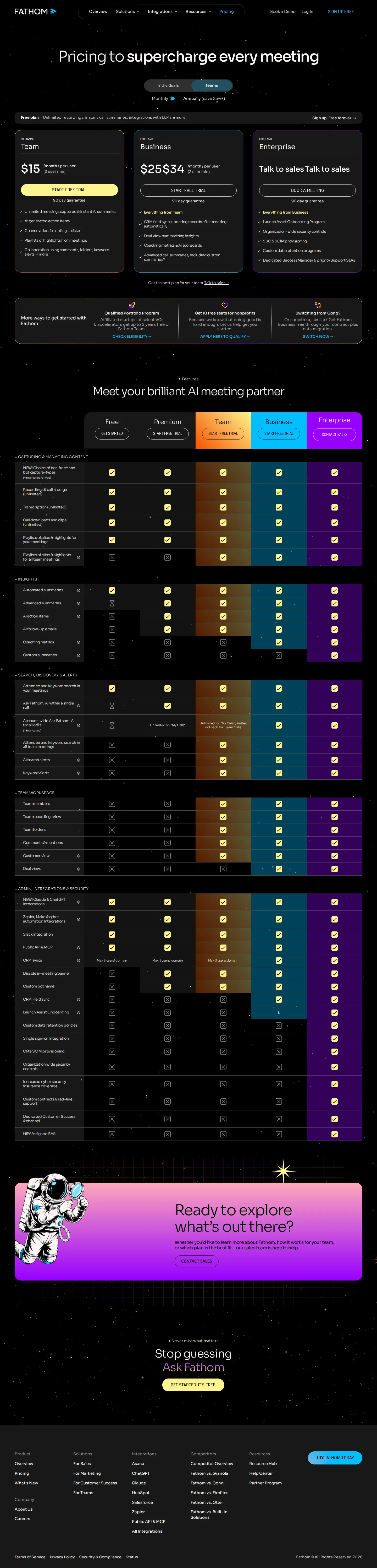
As of the July 2026 pricing page, the ladder has a fourth paid rung. Fathom added a quote-only Enterprise tier above Business and moved its security and governance features up into it: single sign-on (previously a Team-plan feature), Okta SCIM provisioning, organization-wide security controls, custom data retention programs, custom contracts and red-line support, increased cyber-insurance coverage, a signed HIPAA BAA, and a dedicated Success Manager with priority support SLAs are all Enterprise-only. Headline seat prices did not move — the change is packaging, not price.
Pricing summary : How Fathom’s seat-based freemium model works
Fathom uses a seat-based freemium model: a free-forever individual plan plus three published per-user paid tiers and a quote-only Enterprise tier, with no usage metering, overage, or credit pool. Seats are the only billing unit. Pricing has five steps:
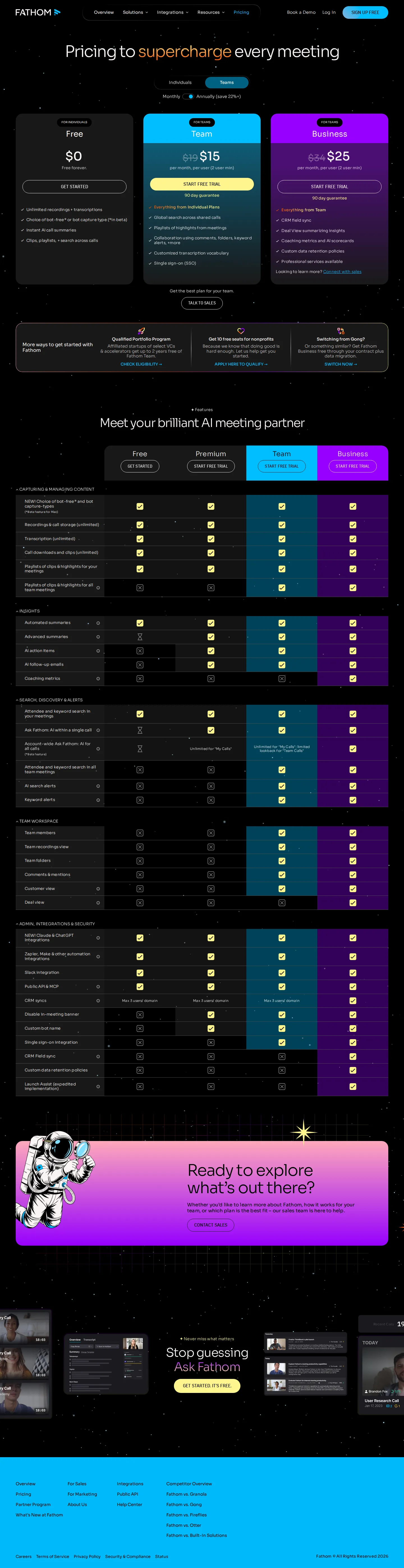
- Free ($0): Free forever for individuals — unlimited recordings and transcriptions, choice of bot-free (beta) or bot capture, instant AI call summaries, clips, playlists, and search across calls. The comparison table marks advanced summaries and Ask Fathom as limited on Free, not unavailable.
- Premium ($20/user/mo, $16 annual): The individual upgrade — advanced call summaries, AI-generated action items, a conversational meeting assistant, and a custom meeting bot.
- Team ($19/user/mo, $15 annual, 2-user minimum): The shared-workspace plan — global search across calls, playlists of meeting highlights, and collaboration via comments, folders, and keyword alerts. Team also unlocks the team workspace (team recordings view, folders, mentions) and account-wide Ask Fathom with limited lookback on “Team Calls”.
- Business ($34/user/mo, $25 annual, 2-user minimum): The revenue-team plan — CRM field sync that updates records after meetings, Deal View, coaching metrics and AI scorecards, and unrestricted CRM syncs (Free, Premium, and Team are capped at “Max 3 users/domain”). The Business card advertises “Advanced call summaries, including custom summaries*”; the comparison table below marks the Custom summaries row as Enterprise-only, so treat the Business claim as caveated by that asterisk.
- Enterprise (Talk to sales): Everything from Business plus the Launch Assist Onboarding Program, organization-wide security controls, SSO and Okta SCIM provisioning, custom data retention programs, and a dedicated Success Manager with priority support SLAs. The comparison table adds increased cyber-security insurance coverage, custom contracts and red-line support, and a signed HIPAA BAA to the Enterprise column.
The billing toggle advertises “Annually (save 25%+)”; on the published cards the annual rates are $16 (Premium), $15 (Team), and $25 (Business). Because the model is purely per-seat with a free baseline, this Fathom approach reflects a classic seat-based pricing model rather than usage-metered billing.
What makes this different: The Team plan ($19/user) is priced below the individual Premium plan ($20/user) — Fathom deliberately makes the per-user team rate cheaper than the solo upgrade to pull individuals into shared, stickier workspaces. And single sign-on, which used to ship with Team, now sits only in the unpriced Enterprise tier.
Pricing by product
Fathom (Individual plans)
| Tier | Price | Included | Key mechanics |
|---|---|---|---|
| Free | $0 — “Free forever.” | Unlimited recordings + transcriptions; choice of bot-free (in beta) or bot capture; instant AI call summaries; clips, playlists + search across calls | Free forever; primary acquisition engine. Advanced summaries and Ask Fathom are marked limited on Free in the comparison table |
| Premium | $20 /user/mo ($16 annual) | Everything from Free plus advanced call summaries, AI-generated action items, conversational meeting assistant, custom meeting bot | Solo power-user upgrade; 90-day guarantee; “Start free trial” CTA |
Fathom (Team plans)
| Tier | Price | Included | Key mechanics |
|---|---|---|---|
| Team | $19 /user/mo ($15 annual) | Everything from Premium plus global search across calls, playlists of meeting highlights, collaboration (comments, folders, keyword alerts), team workspace + team folders | 2-user minimum; priced below solo Premium; CRM syncs capped at “Max 3 users/domain” |
| Business | $34 /user/mo ($25 annual) | Everything from Team plus CRM field sync (auto-updates records after meetings), Deal View, coaching metrics & AI scorecards, “advanced call summaries, including custom summaries*“ | 2-user minimum; uncapped CRM syncs; Launch Assist onboarding is marked ”$” (paid add-on), not included |
| Enterprise | Talk to sales | Everything from Business plus Launch Assist Onboarding Program, organization-wide security controls, SSO & SCIM provisioning, custom data retention programs, dedicated Success Manager & priority support SLAs | Quote-only (“Book a meeting”); comparison table also lists increased cyber-insurance coverage, custom contracts & red-line support, and a signed HIPAA BAA |
*The Business card’s “including custom summaries” carries an asterisk; the plan-comparison table marks the Custom summaries row as available on Enterprise only.
Entitlements that differ by tier (from the comparison table)
| Capability | Free | Premium | Team | Business | Enterprise |
|---|---|---|---|---|---|
| Advanced summaries | Limited | Included | Included | Included | Included |
| Account-wide Ask Fathom (beta) | Limited | Unlimited for “My Calls” | Unlimited for “My Calls”; limited lookback for “Team Calls” | Included | Included |
| CRM syncs | Max 3 users/domain | Max 3 users/domain | Max 3 users/domain | Included | Included |
| Coaching metrics | — | — | — | Included | Included |
| Custom summaries | — | — | — | — | Included |
| Launch Assist Onboarding | — | — | — | Paid (”$“) | Included |
| Single sign-on / Okta SCIM | — | — | — | — | Included |
| Custom data retention policies | — | — | — | — | Included |
| HIPAA signed BAA | — | — | — | — | Included |
Startup, nonprofit & switch programs
| Program | Offer | Key mechanics |
|---|---|---|
| Qualified Portfolio Partner | ”Special pricing on Fathom Team and Business plans (up to 2 years free!)” for companies backed by any of the program’s 77 listed VC / accelerator partners | ”Check your eligibility” gate; sales-assisted |
| Nonprofit program | 10 free seats | ”Apply here to qualify” |
| Gong switch offer | Fathom Business free through the remainder of an existing Gong-style contract, plus data migration | Competitive-displacement, sales-led |
Sales motions across products: PLG / self-serve for Free, Premium, Team, and Business; sales-led for Enterprise and for the partner, nonprofit, and competitive-switch programs.
Hidden costs : What a real Fathom team actually pays per month
Fathom has no usage meter, no overage, and no credit pool, so there is no bill-shock cliff the way there is on token- or execution-metered tools. The “hidden” cost is structural instead: the 2-user minimum on Team and Business, the seat-multiplier as a team grows, and the gap between the headline free plan and what a working revenue team actually needs to pay for. Two archetypes show where the real spend lands.
Archetype 1 — a 10-person sales team on Business
A revenue team wants CRM field sync, Deal View, and AI coaching scorecards — all Business-tier features. Business is per-seat with a 2-user floor, so the bill scales linearly with headcount:
| Line item | Monthly cost (annual billing) |
|---|---|
| Business — 10 seats @ $25/user (annual) | $250 |
| Same 10 seats billed monthly @ $34/user | $340 |
| Annual-billing premium captured | $90/mo saved by prepaying |
The lesson: because every paid tier is pure per-seat, the only levers on a Fathom bill are seat count and billing cadence — there is no usage line to optimize, so the annual commitment (advertised at 25%+ off) is the single biggest discount available.
Archetype 2 — an individual who outgrows Free
The free plan is unlimited on recordings and transcripts, but advanced AI summaries, AI action items, and the conversational assistant sit behind Premium; third-party reviews in 2026 report the free tier’s advanced AI summaries are capped (around 5 calls/month) while basic summaries stay unlimited. A solo power user who lives in those features pays:
| Line item | Monthly cost |
|---|---|
| Premium — 1 seat (annual @ $16/user) | $16 |
| Same seat billed monthly @ $20/user | $20 |
| Free → Premium step | $16–20/mo for the AI layer |
The lesson: Fathom’s free plan is generous enough that the upgrade trigger is feature depth (advanced AI, action items, Ask Fathom across calls), not a usage wall — a softer, less resented conversion path than the bill-shock model of metered tools.
Want to estimate your own Fathom bill? Use the Fathom pricing calculator to model your monthly cost based on seats and plan tier.
Pricing evolution : How Fathom’s plan structure has changed over time
Fathom’s pre-2026 pricing history is reconstructed from dated company milestones (launch, funding) and third-party pricing reviews; historical dollar figures that could not be independently confirmed are marked unknown rather than guessed. What is well-documented is the shape of the model: a free-first launch that stayed free-first through two funding rounds, then layered paid individual, team, and revenue tiers on top as the company scaled toward ~$30M revenue. From 2026-06-02 the timeline runs on direct captures of the live pricing page — and the first structural move those captures caught, on 2026-07-22, rebuilt the top of the ladder without moving a single published price.
Cadence
| Quarter | Price changes | Product / SKU additions | Notes |
|---|---|---|---|
| 2021 Q3 | 0 | 1 | 2021-08: Fathom launches free on the Zoom App Marketplace — a free-forever AI notetaker, no paid tier surfaced. |
| 2022 Q1 | 0 | 0 | 2022-01: $4.7M seed round (Character, Zoom Apps Fund, angels). Model stays free-first; first revenue ~Aug 2022. |
| 2024 Q3 | unknown | unknown | 2024-09-19: $17M Series A (Telescope Partners; $2M via Wefunder). Paid per-seat tiers established around this growth phase; exact card prices not archived. |
| 2025 Q4 | unknown | 1 | Bot-free capture enters beta for Mac; reviews note advanced free-tier AI summaries tightened (≈5/month) while basic summaries stay unlimited. Headline plan prices not independently archived. |
| 2026 Q2 | 0 | 0 | Baseline capture 2026-06-02: Free $0, Premium $20 ($16 annual), Team $19 ($15 annual), Business $34 ($25 annual); 22%+ annual saving advertised; 2-user min on Team/Business. SSO ships on the Team card. |
| 2026 Q3 | 0 | 1 | 2026-07-22: quote-only Enterprise tier added. Zero price movement — but SSO leaves Team, custom data retention leaves Business, and Launch Assist onboarding drops to a paid ”$” add-on on Business. Annual badge restated 22%+ → 25%+ on unchanged annual rates. |
Tracked range: 2021-08 – 2026-07. Quarters not listed above were verified stable (0 changes, 0 additions) or had no documented pricing activity. “unknown” cells mark periods where the model’s shape is documented but exact dollar figures were never archived and are not guessed.
Notable changes
- 2021-08 — Fathom launches free on the Zoom App Marketplace; the free-forever tier is the entire go-to-market. (TechCrunch.)
- 2022-01 — $4.7M seed round announced; pricing remains free-first through 2022. (TechCrunch.)
- 2024-09-19 — $17M Series A led by Telescope Partners, with $2M crowdfunded from users via Wefunder; revenue reported up ~90x over two years. Paid per-seat tiers are the conversion layer on top of free. (BusinessWire.)
- 2025 — Bot-free local capture ships in beta (Mac); third-party reviews report the free plan’s advanced AI summaries capped at ~5/month while recording, transcription, and basic summaries stay unlimited.
- 2026-06-02 — Baseline capture: Free / Premium $20 / Team $19 / Business $34 (monthly), with annual billing at $16 / $15 / $25 and a stated 22%+ saving. Single sign-on and customized transcription vocabulary are listed on the $19 Team card; custom data retention policies sit on Business.
- 2026-07-22 — A packaging change with no price change. Fathom added a fifth plan — a quote-only Enterprise tier — and migrated its security and governance entitlements up into it. Single sign-on, which shipped on the $19 Team card seven weeks earlier, is now Enterprise-only alongside Okta SCIM provisioning, organization-wide security controls, increased cyber-insurance coverage, custom contracts and red-line support, and a signed HIPAA BAA; custom data retention moved from Business to Enterprise; and Launch Assist onboarding fell from a Business checkmark to a paid ”$” add-on. Every published seat rate is byte-identical to June ($0 / $20 / $19 / $34 monthly, $16 / $15 / $25 annual), while the annual toggle’s claim moved from “save 22%+” to “save 25%+” on rates that did not move. The Qualified Portfolio Partner Program was unchanged across the two captures — 77 listed partners and “up to 2 years free” on Team and Business in both.
The July 2026 entitlement migration in detail
Nothing on Fathom’s price cards changed on 2026-07-22, which is exactly why the change matters. The company raised the effective price of compliance without touching a published price of anything.
Before the change, a two-person startup that needed single sign-on could buy it self-serve for $15/user/month annually on Team — SSO was a line item on the cheapest multi-seat card. After the change, that same buyer has no self-serve path to SSO at all: the only plan carrying it is quote-only. The published ladder is unchanged for buyers who never needed governance, and structurally closed for buyers who did. That is a much sharper move than a headline increase, because it is invisible on the pricing page to everyone except the segment being repriced — and it is invisible in a price-tracking diff too, which is why the seat-rate columns above read “0 price changes” for a quarter in which Fathom’s most compliance-sensitive buyers saw their cost go from $15/seat to “talk to sales.”
Two supporting edits point the same direction. Launch Assist onboarding was a Business inclusion in June and is a paid ”$” add-on in July, which converts a bundled implementation service into a separate revenue line for exactly the accounts most likely to need help rolling out. And the annual-savings badge was restated from “save 22%+” to “save 25%+” on annual rates that are unchanged — $16, $15, and $25 in both captures. The 25% figure is arithmetically defensible against the top of the range (Business at $25 vs $34 is a 26% discount), so this reads as marketing recalibration rather than a real change in the annual incentive; buyers comparing the two captures should not treat the badge as evidence that annual billing got cheaper.
There is no offsetting move at the other end of the funnel. The Qualified Portfolio Partner Program is byte-identical across the two captures — 77 listed VC and accelerator partners, “up to 2 years free” on Team and Business — and the free plan’s own entitlements did not change either. Governance got narrower at the top while nothing got wider at the bottom, which makes this a one-directional tightening and a costlier one for the self-serve mid-market team caught in between.
What’s unique : Distinctive mechanics in Fathom’s pricing
1. A genuinely unlimited free tier as the entire top of funnel. Most “freemium” notetakers cap minutes, meetings, or transcript history; Fathom’s Free plan offers unlimited recordings, transcriptions, and instant AI summaries forever. The free plan isn’t a trial or a teaser — it’s a complete product, and it was Fathom’s only go-to-market for the first year after launch. That makes free the acquisition engine and pushes the entire monetization burden onto feature depth rather than a usage ceiling.
2. The Team plan is priced below the individual Premium plan. Premium (individual) is $20/user/mo while Team is $19/user/mo — Fathom deliberately makes the per-seat team rate cheaper than the solo upgrade. This inverts the usual “teams pay more” instinct and is a pull toward shared, multi-seat workspaces, which are far stickier and harder to churn than a single seat. It’s a textbook value-metric and packaging choice: price the option you want buyers to pick lower than the one you don’t.
3. Conversion is by feature depth, not by a usage wall. Because volume is unlimited even on free, users never hit a metered cliff that forces an upgrade. Instead, the upgrade triggers are advanced AI summaries, AI action items, the conversational “Ask Fathom” assistant across all calls, CRM sync, and coaching — capabilities, not quotas. This is the opposite of the bill-shock dynamic that makes metered AI tools feel adversarial, and it reframes paid plans as “more power,” not “stop being throttled.”
4. Programmatic free distribution for startups, nonprofits, and switchers. Beyond the public free tier, Fathom layers three sales-assisted free programs: up to 2 years free for portfolio companies of its 77 listed VC/accelerator partners (Y Combinator, TinySeed, a16z speedrun, Telescope, Susa Ventures, Berkeley SkyDeck, and more), 10 free seats for nonprofits, and Business free through the end of an existing Gong-style contract for switchers. Each is a targeted land motion that seeds future paid expansion inside high-growth accounts — and the portfolio offer covers Business as well as Team, so the free window reaches the CRM-and-coaching tier that a funded startup’s sales team actually wants.
5. No usage meter at all — pure per-seat, no overage. Unlike token-, minute-, or execution-metered AI products, Fathom carries no consumption dimension: the bill is purely seats × tier × cadence. That makes spend perfectly predictable, which is increasingly rare for an AI-native product and a deliberate contrast with the usage-metered SaaS model most of its category peers (Gong-style minutes, per-call analysis) drift toward.
6. Security is the paywall, and as of July 2026 it has no published price. On 2026-07-22 Fathom moved single sign-on off the $19 Team card and consolidated it with Okta SCIM, org-wide security controls, custom data retention, custom contracts, and a signed HIPAA BAA into a quote-only Enterprise tier. In a seat model with no meter, entitlement placement is the pricing lever — and Fathom just used it to convert the one requirement a compliance-driven buyer cannot negotiate away into the trigger for a sales conversation. It is the sharpest form of value-metric selection available to an unmetered product: charge on who has to say yes, not on how much they use.
Strengths & weaknesses
| Strengths | Weaknesses |
|---|---|
| Genuinely unlimited free tier — best-in-class top-of-funnel | Free advanced AI summaries reportedly capped (~5/mo), softening the “unlimited” claim |
| Pure per-seat pricing means perfectly predictable bills, no overage | No usage-based path for light/occasional users — it’s full seat price or free |
| Team ($19) priced below Premium ($20) pulls users into sticky workspaces | 2-user minimum on Team and Business blocks a single power-user from those features |
| Transparent, public pricing on all four self-serve tiers | Business ($34) nearly doubles Team ($19) — a steep step for CRM/coaching features |
| Strong annual discount (advertised 25%+) rewards commitment | Revenue-team depth (Gong-class coaching) is thinner than dedicated rivals |
| Programmatic free deals for startups, nonprofits, and switchers — now covering Business, from 35 partner VCs | Bot-free local capture still in beta and Mac-only as of 2026 |
| Held every published seat price flat through the July 2026 restructure | SSO left the $19 Team card on 2026-07-22 — governance now has no self-serve price at all |
| Enterprise tier gives regulated buyers one place to get HIPAA, SCIM, retention, and red-lines | Launch Assist onboarding was repriced from a Business inclusion to a paid ”$” add-on |
Billing UX : Plan toggles, trials, and seat minimums
- Individuals / Teams segment tabs — the pricing page splits plans into an “Individuals” view (Free, Premium, Team) and a “Teams” view (Team, Business, Enterprise). “Teams” is the default tab, so the Enterprise card is what a first-time visitor sees.
- Monthly / Annually billing toggle — a switch labeled “Annually (save 25%+)” reprices every paid plan to its annual rate ($16 Premium, $15 Team, $25 Business), rendered next to the struck-through monthly figure on each card.
- Free-plan banner instead of a card — in the Teams view the free tier collapses to a full-width strip (“Free plan — Unlimited recordings, instant call summaries, integrations with LLMs & more · Sign up. Free forever. →”), keeping the three paid cards visually dominant.
- Start Free Trial buttons — Premium, Team, and Business each launch a free trial; the Team CTA in the Individuals view reads “Start Free Team Trial (2+ users)”. Enterprise swaps the trial for “Book a meeting” / “Contact sales”.
- 90-day guarantee — every plan card, including Enterprise, carries a “90 day guarantee” label as a risk-reversal control.
- 2-user minimum enforcement — Team, Business, and Enterprise cards state “/month / per user (2 user min)”, setting the floor seat count at checkout.
- Five-column plan comparison table — a “Meet your brilliant AI meeting partner” matrix spans Free · Premium · Team · Business · Enterprise, with tooltip info icons per row and non-binary cells (“Max 3 users/domain”, limited-lookback markers, and a ”$” cell marking Launch Assist Onboarding as paid on Business).
- Eligibility checkers — the Qualified Portfolio Partner, nonprofit, and Gong-switch programs each route through their own “Check eligibility” / “Apply here to qualify” / “Switch now” gating flow rather than self-serve checkout.
Strategic wins : Why Fathom’s pricing decisions worked
1. Making free the entire product, not a teaser
Fathom launched with free as its only offer and kept it genuinely unlimited on recording and transcription, which let it grow distribution explosively before monetizing — revenue reportedly climbed ~90x over two years off that base. A complete free product is a far stronger acquisition flywheel than a time- or meeting-capped trial, and it positions every paid feature as additive rather than as the removal of an artificial limit. This is the freemium-done-right playbook: give away the core, charge for depth.
2. Pricing Team below Premium to engineer multi-seat lock-in
By setting Team at $19/user versus Premium at $20/user, Fathom makes the collaborative, multi-seat plan the rational individual choice the moment a second user appears — and shared workspaces churn far less than solo seats. Deliberately under-pricing the option you want chosen is a sharp value-metric and packaging move that quietly steers the account toward the stickier, expandable product.
3. Predictable per-seat pricing as an AI-era differentiator
While most AI-native tools meter tokens, minutes, or calls and expose buyers to volatile bills, Fathom charges flat per-seat with no usage line at all — spend is seats × tier and nothing else. In a category where cost unpredictability drives bill shock, a perfectly forecastable invoice is itself a feature, especially for finance teams approving the line item.
4. Targeted free programs to land high-growth accounts
The Qualified Portfolio Partner Program (up to 2 years free for 35 VCs’ and accelerators’ portfolios), 10 free nonprofit seats, and the Gong competitive-switch offer are all land motions that plant Fathom inside accounts likely to scale — startups that will add seats, and switchers already paying for an enterprise rival. It’s a usage-based-SaaS land-and-expand logic applied to seats: get in free, expand as the team grows. The 2026-07-22 extension of that offer to Business is the sharper version of the same bet: give the funded startup the CRM-sync and coaching tier free for two years, and the expansion conversation starts from the top of the self-serve ladder rather than the bottom.
5. Restructuring the ladder without repricing it
On 2026-07-22 Fathom added an Enterprise tier and pulled SSO, SCIM, custom data retention, and its HIPAA BAA into it — while leaving Free $0, Premium $20, Team $19, and Business $34 exactly where they were. That combination is deliberate and effective. Existing self-serve customers see no invoice change and have no renewal-time reason to re-shop, so the move generates none of the churn risk a headline increase carries. Meanwhile the buyers with the least price sensitivity in the entire base — the ones who need a signed BAA and red-line support before legal will approve anything — are routed into a negotiation where Fathom sets the number. Capturing willingness-to-pay from a compliance segment while holding the public price list frozen is about as clean a packaging move as a seat-based product can execute.
Areas to improve : Pricing gaps and proposed fixes
1. Be explicit about free-tier AI limits on the pricing page
Third-party reviews report the free plan’s advanced AI summaries are capped (~5/month) while the pricing page still leads with “instant AI call summaries” and an unlimited framing. Quiet tightening of a headline “free forever” promise erodes trust. The fix: state the exact free-tier AI quota on the plan card itself (e.g. “5 advanced summaries/mo, unlimited basic”), the same transparency the better usage-invoicing playbooks apply to any metered allowance — so the upgrade trigger is honest, not discovered after adoption.
2. Soften the Team-to-Business cliff
Business ($34/user) is nearly 1.8x Team ($19/user), and the only thing many buyers want from it is CRM sync or coaching for a subset of seats. A 79% per-seat jump for one or two features is a churn and downgrade risk. The fix: offer the revenue-team capabilities as a per-seat add-on on Team, or introduce a mid tier, so a team doesn’t have to re-price every seat to Business just to give its closers Deal View and scorecards.
3. Add a path for light or occasional paying users
The model is binary: free (unlimited volume, limited AI) or full seat price. There is no low-commitment paid step for someone who wants advanced AI on just a handful of calls a month. The fix: a lightweight metered or credit-based add-on (advanced summaries by the pack) would capture willingness-to-pay between free and a full Premium seat, and surfacing it with usage thresholds and alerts would keep it predictable — monetizing the long tail of users who never justify a $20 seat but would pay something.
4. Put a self-serve price on single sign-on
The 2026-07-22 restructure left the 10-to-50-seat mid-market with nowhere to go. That buyer had SSO on Team at $15/user annually in the June capture; in July the only plan carrying it is quote-only. A 20-person company whose IT policy mandates SSO is now a sales-qualified lead whether or not it wants to be, and the practical outcome for many of them is not an Enterprise contract — it is staying on Team without SSO, or leaving. Gating a security control behind an unpriced tier also inverts the incentive every security team is trying to create: it makes the safe configuration the expensive one. The fix: keep the deep governance stack (SCIM, custom retention, HIPAA BAA, red-lines) as the genuine Enterprise wall, but publish SSO as either a Business-tier inclusion or a flat per-account add-on with a number attached. Fathom’s whole differentiator is that a buyer can price the product without talking to anyone — this is the one place that promise now breaks.
5. Say what Launch Assist costs
Launch Assist onboarding moved from a Business inclusion to a ”$” cell in the comparison matrix on 2026-07-22, and the matrix never resolves what ”$” means. An unpriced symbol in a table whose entire job is comparison is the same problem as an unpriced tier, in miniature: a buyer modelling a Business rollout now has a known seat cost and an unknown implementation cost. The fix is a one-line disclosure — a flat fee, a per-seat rate, or a range — next to the marker, consistent with the invoicing transparency Fathom already applies to seats.
Key takeaways
- A complete free product beats a capped trial as a growth engine. Fathom made free genuinely unlimited on its core function and grew distribution before monetizing, reportedly ~90x revenue growth over two years. The free tier carries the acquisition load so paid plans only ever have to sell more, not unblock.
- You can price the plan you want chosen below the one you don’t. Team at $19 undercuts individual Premium at $20, deliberately steering buyers into multi-seat workspaces that churn far less. Packaging psychology, not just cost-plus, drives the gradient.
- Convert on depth, not on a wall. Because volume is unlimited, upgrades are triggered by advanced AI, collaboration, and CRM/coaching features rather than by hitting a meter — a far less adversarial conversion than metered AI tools.
- Predictable per-seat billing is a real feature — but watch the ladder, not just the rate. With no token or minute meter, a Fathom invoice is purely seats × tier × cadence, a genuine differentiator when peers expose buyers to volatile usage bills. The flip side surfaced on 2026-07-22: when there is no meter to turn, the only pricing lever left is which rung a feature sits on, and Fathom took single sign-on from $15/user/month on Team to “talk to sales” without touching a published number. A price diff would have registered nothing.
- Free is also a targeted weapon. Beyond the public tier, Fathom uses programmatic free deals (35 VC and accelerator portfolios, nonprofits, Gong switchers) to land high-growth accounts that expand into paid seats later — and since 2026-07-22 the portfolio offer covers Business, not just Team.
UBP implications
- Not every AI product needs a usage meter — but unmetered pricing has to be tracked differently. Fathom proves a category can stay seat-based and unmetered even when the underlying cost (transcription, LLM summarization) is consumption-driven; absorbing variable cost internally and charging a predictable seat price is a viable alternative to passing volatility to the buyer. The trade-off is that change becomes invisible. A usage-based vendor announces a move in units and cents that any buyer can diff, whereas Fathom materially repriced its compliance-driven segment on 2026-07-22 — single sign-on from $15/user/month to unpriced — with every published figure held constant. Procurement and FinOps processes that watch headline rates alone will miss this class of change entirely; capture the full entitlement matrix at renewal, not just the price card.
- Freemium and usage-based pricing solve the same job differently. Where usage-based models let light users pay little and heavy users pay more, Fathom’s unlimited-free + per-seat split makes volume free and charges for capability — a reminder that the value metric can be features rather than consumption, and that in an unmetered model the choice of which rung an entitlement sits on is the pricing decision.
- The gap a seat model leaves is the light-but-willing user. A purely binary free/full-seat structure leaves money on the table from users who’d pay a small metered amount but never a full seat — exactly the segment a usage-based or credit add-on is built to monetize, and the clearest place a seat-only model could borrow from UBP.
Sources
- Fathom pricing page (accessed 2026-07-23)
- Fathom Qualified Portfolio Partner Program (accessed 2026-07-23)
- Fathom Help Center — “What does Fathom cost?” (accessed 2026-07-23)
- Fathom Help Center — Team Edition (accessed 2026-07-23)
- Fathom What’s New / changelog (accessed 2026-06-02)
- Fathom blog (accessed 2026-06-02)
Browse the full pricing blueprint to compare Fathom against other companies.
Bottom line
Fathom prices an AI meeting notetaker the old-fashioned way — pure per-seat with a genuinely unlimited free tier — and lets that free product do the growing while paid Premium, Team, and Business tiers monetize feature depth rather than a usage wall. The clever moves are packaging ones: free as the whole product, Team priced below Premium to pull buyers into sticky multi-seat workspaces, and targeted free programs to land high-growth accounts. The July 2026 restructure is the same instinct pointed upmarket — an Enterprise tier assembled entirely out of features that used to sit lower on the ladder, holding every published price flat while the cost of single sign-on went from $15/user/month to a sales call. The bill stayed predictable; the compliance path stopped being. Fathom’s bet remains that predictable seats plus a generous free baseline beats squeezing every call, but the mid-market team that needs SSO and the light-but-willing user who never justifies a full seat are now the two segments its price list has no answer for.
Want to compare Fathom against other meeting-intelligence pricing? Browse the pricing blueprint.
Pricing timeline : Major events on a vertical axis
Each milestone below corresponds to a public pricing change, product launch, or material adjustment. Major events use a filled marker; minor adjustments use a faded one.
Enterprise tier added; SSO and data retention move out of Team/Business
Fathom's pricing page added a fourth paid tier — a quote-only Enterprise plan ('Talk to sales') covering Launch Assist onboarding, organization-wide security controls, SSO & Okta SCIM provisioning, custom data retention programs, a signed HIPAA BAA, and a dedicated Success Manager with priority SLAs. Headline prices did not move (Free $0, Premium $20/$16, Team $19/$15, Business $34/$25), but the governance stack moved up a rung: single sign-on left the $19 Team card, custom data retention left Business, and Launch Assist onboarding fell from a Business inclusion to a paid '$' add-on. In effect Fathom repriced compliance from $15/user/mo to 'talk to sales' without changing a published number. The annual-savings badge also moved from 'save 22%+' to 'save 25%+' on unchanged annual rates. The Qualified Portfolio Partner Program did not move: it listed 77 partners and offered 'up to 2 years free' on Team and Business in both the June and July captures.
Current plan structure: Free, Premium, Team, Business
Fathom lists a $0 Free plan, $20/user/mo Premium ($16 annual) for individuals, $19/user/mo Team ($15 annual, 2-user min), and $34/user/mo Business ($25 annual), with 22%+ savings on annual billing. Reported revenue reached ~$30M in 2025 on a ~100-person team.
$17M Series A led by Telescope Partners
Fathom announced a $17M Series A led by Telescope Partners on 2024-09-19, with $2M of the round raised from its own users via a Wefunder crowdfunding campaign. The company reported revenue up ~90x and usage up ~20x over the prior two years, reaching ~$10M ARR in 2024. (TechCrunch / BusinessWire, 2024-09-19.)
$4.7M seed round
Fathom raised a $4.7M seed round (announced January 2022) backed by Character, Zoom's own Apps Fund, and angels including Naval Ravikant. Pricing stayed free-first; the company reported its first dollar of revenue around August 2022, a year after launch. (TechCrunch, 2022-01-24.)
Launch on the Zoom App Marketplace — free AI notetaker
Fathom (founded 2020 by ex-UserVoice founder Richard White) launched publicly on the Zoom App Marketplace in August 2021 as a free AI notetaker, recording, transcribing, and summarizing Zoom calls at no cost. The free-forever tier was the entire go-to-market from day one. (TechCrunch, Fathom company history.)
- · Fathom's Team plan ($19/user) is priced below its individual Premium plan ($20/user) — the per-user team rate undercuts the solo upgrade once you have 2+ users.
- · The Free tier is genuinely unlimited on capture: unlimited recordings, transcriptions, and instant AI call summaries forever, with no meeting or minute cap — the comparison table only marks *advanced* summaries and Ask Fathom as limited on Free.
- · VC- and accelerator-backed startups from the program's 77 listed partners (including Y Combinator, TinySeed, a16z speedrun, and Telescope) can get up to 2 years free of Fathom Team or Business via the Qualified Portfolio Partner Program.
Questions & answers
- Is Fathom really free?
- Yes. Fathom's Free plan is $0 forever and includes unlimited recordings, transcriptions, and instant AI call summaries with no meeting or minute cap.
- How much does Fathom Premium cost?
- Fathom Premium is $20 per user per month billed monthly, or $16 per user per month billed annually. It adds advanced summaries, AI action items, and a conversational meeting assistant.
- What is the difference between Fathom Team and Business?
- Team ($19/user/mo, $15 annual, 2-user minimum) adds global search across calls, playlists, and team collaboration. Business ($34/user/mo, $25 annual) adds CRM field sync, Deal View, and coaching metrics with AI scorecards.
- Does Fathom have an Enterprise plan?
- Yes. Fathom added a quote-only Enterprise tier ('Talk to sales') that includes everything in Business plus the Launch Assist onboarding program, organization-wide security controls, SSO and Okta SCIM provisioning, custom data retention programs, and a dedicated Success Manager with priority support SLAs. Single sign-on is Enterprise-only as of the July 2026 pricing page.
- Did Fathom raise its prices in July 2026?
- No published price changed. Fathom's 2026-07-22 pricing update kept Free at $0, Premium at $20 per user per month, Team at $19, and Business at $34, with annual rates of $16, $15, and $25 unchanged. The change was to packaging: single sign-on moved from the Team plan to a new quote-only Enterprise tier, custom data retention moved from Business to Enterprise, and Launch Assist onboarding became a paid add-on on Business. Buyers who need single sign-on effectively went from a $15 per user per month self-serve plan to a sales conversation with no published price.
- Does Fathom offer discounts for startups or nonprofits?
- Yes. Startups affiliated with any of the 77 VC and accelerator partners listed on Fathom's Qualified Portfolio Partner Program page can get up to 2 years free on Fathom Team or Business, and nonprofits can apply for 10 free seats.