AI Summary
About
Finout makes an enterprise FinOps / cloud cost-observability platform that helps companies “easily allocate, manage and reduce their cloud spending across their entire infrastructure.” Its core is MegaBill, a unified cost layer that ingests spend from AWS, GCP, Azure and OCI, plus Kubernetes, Snowflake, Databricks and — increasingly — LLM/AI APIs (OpenAI, Anthropic), and normalizes it into one model. On top of that sit Virtual Tags (and AI-powered VTags) for allocation, shared-cost splitting, financial plans, anomaly detection, FinOps dashboards, and CostGuard for cost optimization. The current positioning is “FinOps for the agentic era” — extending classic cloud cost management into AI spend.
Finout sells to finance teams and DevOps/platform leaders as a sales-led, enterprise product: there is no self-serve signup, and every pricing tier routes to “Request a quote” or “Book a demo.” Its differentiator versus older tools (CloudHealth, Cloudability) is the MegaBill unified layer and a deliberately predictable, flat pricing model — the company leans on cost certainty as a selling point for the very finance buyers it serves.
For the most current information, visit Finout.
Pricing summary : How Finout’s pricing model works
Finout charges a flat annual fee tiered by committed (forecasted) cloud spend — deliberately not a per-usage meter. The live pricing page states it plainly: “Flat fee pricing based on tiers of committed spend,” and that Finout “charges a yearly fee based on cloud spend” that is “transparent” and “locked-in,” with “no surprise overage charges.” The whole pitch is cost certainty for finance teams: your Finout bill is a function of which committed-spend tier you fall into, a proxy for the size of the cloud estate Finout monitors — it does not swing with day-to-day usage.
There are three tiers — Business, Pro, Enterprise — and all three are “Request a quote” (the page posts no dollar figures). Third-party sources (CloudZero, G2) report Business at roughly ~$1,000/month (up to ~$500k annual cloud spend, 2 cost centers), Pro at roughly ~$2,000/month (up to ~$2M, 3 cost centers), and Enterprise custom (unlimited spend, cost centers and retention). The effective rate is often described as ~1% of the cloud bill. All plans include unlimited users; SOC 2 reporting is Pro+, and monthly business reviews are Enterprise-only.
The important caveat: Finout publishes no list price. Every tier is gated behind a quote, so the ~$1,000 / ~$2,000 figures are third-party-reported (and they vary by source — G2 lists a “starting at $500” figure that disagrees with CloudZero’s ~$1,000/mo), not official Finout rates. Treat them as approximate.
What makes this different: a cost-control product that is itself priced for predictability — a flat, committed-spend fee rather than a percentage that floats with consumption. Finout sells the same cost certainty it provides, and even pre-empts the sticker objection with a pricing-page FAQ: “I have very large bills, won’t you be too expensive?”
Pricing by product
| Tier | Price | Included | Key mechanics |
|---|---|---|---|
| Business | ~$1,000/mo (reported) | Up to ~$500k cloud spend; 2 cost centers; 1-yr retention; unlimited users | Flat annual fee by committed spend; cost-per-customer add-on +~$250; Kubernetes connection +~25% |
| Pro | ~$2,000/mo (reported) | Up to ~$2M cloud spend; 3 cost centers; SOC 2 reporting; unlimited users | Flat annual fee by committed spend; cost-per-customer add-on +~$500 |
| Enterprise | Custom (quoted) | Unlimited spend, cost centers & retention; cost-per-customer included; monthly business reviews | Sales-led annual contract; all integrations, no surcharge |
Sales motions across products: sales-led across every tier — Business, Pro and Enterprise are all “Request a quote” / “Book a demo,” with no self-serve signup. The tier is chosen by your committed/forecasted cloud spend, and unit-economics (cost-per-customer) plus Kubernetes connections are paid levers on the lower tiers that are bundled in on Enterprise.
Hidden costs : What Finout users actually pay
Because Finout is a flat committed-spend subscription, there are no per-event or per-API-call overage meters to blow up your bill — by design. The real cost drivers are which spend tier you land in, the paid add-ons on the lower tiers, and the gap between a quoted list figure and a negotiated enterprise rate. Two things bite specifically: the cost-per-customer (unit economics) feature — the metric most SaaS finance teams actually want — is a paid add-on on Business/Pro, and a Kubernetes connection carries a reported ~25% price increase on lower tiers.
The figures below are illustrative, third-party-reported estimates (Finout posts no list price), shown to ballpark a Pro-tier annual cost — not official quotes:
| Line item | Annual cost (illustrative, reported) |
|---|---|
| Pro base (up to ~$2M cloud spend) | |
| Cost-per-customer (unit economics) add-on | |
| Kubernetes connection uplift (~25% on base) | ~$6,000/yr |
| Illustrative Pro total | ~$36,000/yr |
Against a ~$2M cloud bill, that ~$36k works out to roughly ~1.8% of monitored spend — in the ballpark of the often-cited “~1% of the cloud bill,” and the kind of math Finout’s own FAQ (“won’t you be too expensive?”) is built to answer. The headline $1,000/$2,000 numbers are third-party-reported and disagree across sources (G2 cites “starting at $500”), so a real quote can land higher or lower and is typically negotiated at the enterprise level by committed spend and contract length.
Want to estimate your own Finout bill? Use the Finout pricing calculator to model your costs based on cloud spend and add-ons.
Pricing evolution : Finout pricing history and changes
Cadence
| Period | Price changes | Product / SKU additions | Notes |
|---|---|---|---|
| 2021–2023 | Quoted enterprise pricing | MegaBill, Virtual Tags, CostGuard | Sales-led from launch; no public list |
| 2024 | Tiered committed-spend model surfaced | Business / Pro / Enterprise tiers; cost-per-customer add-on | Flat annual fee by committed spend; still quote-only |
| 2025–2026 | Model unchanged in shape | AI cost management; OpenAI / Anthropic integrations (“FinOps for the agentic era”) | Extends cost coverage to LLM spend; pricing stays flat committed-spend |
Tracked range: 2021–present. Finout publishes no dollar list price (all tiers are “Request a quote”), so the timeline anchors on the live 2026-07-23 capture of the model wording and tier structure, plus consistent third-party pricing reports (CloudZero, G2) for the ~$1,000 / ~$2,000 figures.
Notable changes
- 2021 — Finout launches as an enterprise FinOps platform built around MegaBill and Virtual Tags, sold sales-led from day one.
- 2024 — Pricing settles into a flat annual fee tiered by committed cloud spend with three quoted tiers (Business / Pro / Enterprise); cost-per-customer unit economics becomes a paid add-on on the lower tiers.
- 2025–2026 — Finout adds AI cost management and native OpenAI / Anthropic integrations (“FinOps for the agentic era”), extending coverage to LLM spend while keeping the flat committed-spend pricing shape unchanged.
What’s unique : Finout’s distinctive pricing mechanics
1. A cost-control tool priced for cost certainty.
Finout exists to tame variable cloud bills — and it prices itself the same way: a flat annual fee tiered by committed spend with “no surprise overage charges.” That is a deliberate contrast to consumption-metered tooling and a credibility play with the finance buyers it sells to.
2. Price scales with the bill watched, not with usage.
The tier you pay for is set by your committed/forecasted cloud spend (up to ~$500k, up to ~$2M, unlimited) — a proxy for estate size — rather than per-event ingestion or per-seat counts. Users are unlimited on every plan, so seats are explicitly not the meter.
3. Unit economics is a paid lever.
The cost-per-customer capability — the metric SaaS finance teams most want — is a paid add-on (reported +~$250 Business, +~$500 Pro) and only bundled free on Enterprise, nudging serious unit-economics buyers up-tier.
4. Quote-only across the board.
Unlike self-serve FinOps tools, every tier is “Request a quote.” There is no published list price and no self-serve signup, keeping all real pricing inside a sales conversation tuned to committed spend and contract length.
Strengths & weaknesses
| Strengths | Weaknesses |
|---|---|
| Flat committed-spend fee → predictable, budgetable cost (no overage shocks) | No published list price — every tier is “Request a quote” |
| Unlimited users on all tiers (seats never the meter) | ~$1,000 / ~$2,000 figures are third-party-reported and disagree across sources |
| MegaBill unifies cloud + Kubernetes + SaaS + LLM spend in one layer | Cost-per-customer (unit economics) gated as a paid add-on on lower tiers |
| AI cost management (OpenAI/Anthropic) keeps it relevant for agentic spend | Kubernetes connection adds ~25% on lower tiers |
| Pricing model matches how finance buyers budget | No self-serve / free tier — enterprise sales cycle to even price-qualify |
Billing UX : Finout billing controls and transparency
- Billing controls — Pricing is set by a quoted annual contract keyed to your committed/forecasted cloud-spend tier; there is no self-serve signup, so the main “control” is which tier (and which add-ons) you negotiate. Because the fee is flat, there is no usage dial to watch month-to-month.
- Usage visibility — Finout’s product is itself a cost-visibility layer (MegaBill, FinOps dashboards, anomaly detection, CostGuard), but that visibility is into your cloud spend, not into your Finout bill — the Finout fee is fixed by tier, so there is little Finout-side usage to monitor.
- Payment options — Enterprise/annual invoicing under a custom contract; Finout is also available via the AWS Marketplace, which lets buyers transact and draw down committed cloud spend. Billing terms are not published publicly and are settled at quote stage.
Strategic wins : Why Finout’s pricing decisions worked
1. Selling cost certainty by practising it
Pricing the product as a flat, committed-spend fee — not a floating percentage — lets Finout sell predictability to the exact finance buyers who hate bill shock. The model is the demo. See how AI companies structure pricing.
2. Tiering by the bill, not by seats
Anchoring price to committed cloud spend (a proxy for value delivered) while keeping users unlimited removes the per-seat friction that slows platform adoption, and scales revenue with the size of the estate Finout monitors. Related: choosing the right usage metric.
3. Quote-only protects enterprise margin
Keeping every tier behind “Request a quote” preserves negotiating room on large multi-cloud deals and lets Finout price by committed spend and contract length rather than a public number rivals can undercut. See outcome-based pricing trends.
Areas to improve : Gaps in Finout’s pricing approach
1. No public price list
The “transparent, locked-in” pricing message sits awkwardly with the fact that no dollar figure is published — buyers rely on third-party reports (CloudZero, G2) that disagree. A published Business/Pro list price would shorten self-qualification. See bill shock and cost unpredictability.
2. Unit economics gated behind add-ons
Cost-per-customer is the metric most finance teams want, yet it is a paid add-on (~$250 / ~$500) on Business/Pro and only free on Enterprise — which can feel like the core value is up-sold.
3. No self-serve entry
With every tier quote-only and no free tier, even small teams must enter a sales cycle just to learn a price, slowing mid-market self-qualification against more transparent competitors.
Monetization stack & signals : how Finout builds & buys its revenue engine
No monetization-stack vendor is currently sourceable for Finout: its flat, quote-only committed-spend model carries no per-usage meter on its own bill, so no billing/metering build is evidenced, and the live careers board shows only sales and engineering roles — no open revenue-operations posting to source a CRM from.
Signals reviewed · derived from public sources
Key takeaways
- Price the control product for control. Finout charges a flat committed-spend fee with no overage — selling the same cost certainty it delivers, which lands with finance buyers.
- Tier by the bill watched, not by seats. Committed cloud spend (up to ~$500k / ~$2M / unlimited) sets the tier; users are unlimited, so seats are never the meter.
- Gating unit economics is a real up-sell lever. Cost-per-customer is a paid add-on on lower tiers and free only on Enterprise — a deliberate nudge up-tier.
- Quote-only is a margin choice with a transparency cost. No public list preserves negotiating room but forces buyers onto third-party-reported
$1,000/$2,000 figures that disagree. - FinOps pricing is bending toward AI spend. Finout’s “FinOps for the agentic era” pivot (OpenAI/Anthropic coverage) keeps the flat committed-spend model while extending it to LLM costs.
UBP implications
- Committed-spend tiers are a usage proxy without the volatility. Pricing by forecasted cloud spend captures account value while giving buyers a flat, predictable bill — a middle path between pure subscription and pure usage. See usage-based pricing strategy.
- “No overage” is a positioning weapon for cost tools. When your product fights bill shock, a flat fee is itself marketing — the absence of a meter is the message, not a missing feature.
- Gated add-ons monetize the metric customers want most. Putting cost-per-customer behind upper tiers shows how a single high-demand capability can drive expansion without changing the headline model.
Sources
- Finout pricing page (accessed 2026-07-23) — live capture: “Flat fee pricing based on tiers of committed spend”; Business / Pro / Enterprise, all “Request a quote”; no dollar figures posted
- Finout homepage — “FinOps for the agentic era” (accessed 2026-07-23) — MegaBill, Virtual Tags, OpenAI/Anthropic + cloud integrations
- Finout Pricing Breakdown — CloudZero (accessed 2026-06-10) — reports Business
$1,000/mo (≤$500k spend), Pro$2,000/mo (≤$2M), Enterprise custom; cost-per-customer +$250 / +$500 - Finout Pricing 2026 — G2 (accessed 2026-06-10) — “3 pricing plans starting at $500”; cost-per-customer add-on
- Finout Pricing 2026 — TrustRadius (accessed 2026-06-10) — lists pricing as “Request a quote” (gated)
- Finout — AWS Marketplace listing (accessed 2026-06-10) — Enterprise-grade FinOps, unified cloud + AI cost intelligence
Bottom line
Finout is an enterprise cloud + AI cost-observability (FinOps) platform that prices itself the way it pitches: a flat annual fee tiered by committed cloud spend, with “no surprise overage charges” — cost certainty sold to the finance buyers who want it. Third-party sources report Business at roughly ~$1,000/month (up to ~$500k spend) and Pro at roughly ~$2,000/month (up to ~$2M), with Enterprise custom and an effective rate often described as ~1% of the cloud bill, but Finout publishes no list price — every tier is “Request a quote,” so those figures are third-party-reported and disagree across sources. Unit economics (cost-per-customer) is a paid add-on on the lower tiers, and there is no free or self-serve entry. Browse the pricing blueprint for more fully-researched company profiles.
Want to compare Finout against other FinOps and observability companies? Browse the pricing blueprint.
Pricing timeline : Major events on a vertical axis
Each milestone below corresponds to a public pricing change, product launch, or material adjustment. Major events use a filled marker; minor adjustments use a faded one.
AI cost management added; flat committed-spend model retained
Live capture shows Finout positioning around 'FinOps for the agentic era' — adding AI cost management and native integrations for OpenAI and Anthropic alongside cloud (AWS/GCP/Azure/OCI), Kubernetes, Snowflake and Databricks. Pricing is unchanged in shape: 'Flat fee pricing based on tiers of committed spend,' a yearly fee based on cloud spend, three quoted tiers, no public list.
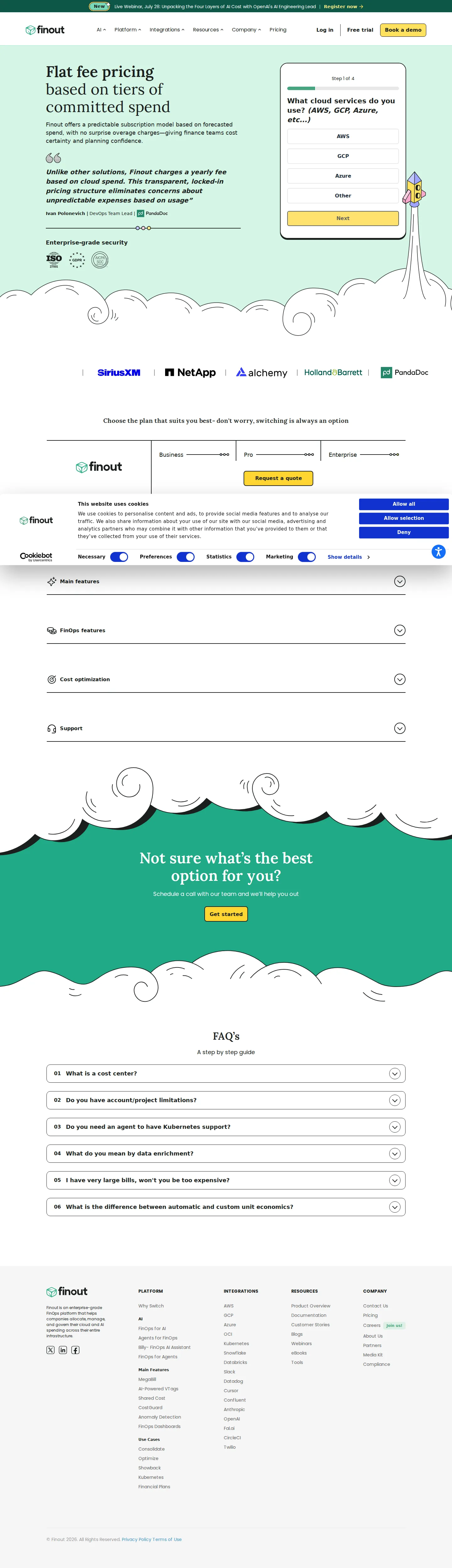
Tiered committed-spend pricing (Business / Pro / Enterprise)
Finout's pricing settled into a flat annual fee tiered by committed/forecasted cloud spend, presented as three tiers — Business, Pro, Enterprise — all 'Request a quote.' Third-party reports place Business ~$1,000/mo (up to ~$500k spend) and Pro ~$2,000/mo (up to ~$2M), with cost-per-customer unit-economics as a paid add-on on the lower tiers.
Founded as an enterprise FinOps / cloud cost platform
Finout launched (Tel Aviv / NYC) as an enterprise cloud cost-management platform built around 'MegaBill' — a unified cost layer that ingests AWS, GCP, Azure, Kubernetes, Snowflake and SaaS spend — and Virtual Tags for allocation. From the start it sold to finance + DevOps as a quoted, sales-led enterprise tool rather than a self-serve product.
- · Finout flips the usual FinOps script: a tool that exists to make your variable cloud bill predictable is itself sold as a flat, locked-in annual fee — explicitly 'based on tiers of committed spend' with 'no surprise overage charges,' so the cost-control product practises what it preaches.
- · The price scales with the size of the bill Finout watches, not with usage — third-party reports put it near ~1% of cloud spend (Business ~$1,000/mo up to ~$500k, Pro ~$2,000/mo up to ~$2M). The pricing page even pre-empts the obvious objection with an FAQ: 'I have very large bills, won't you be too expensive?'
- · Unit economics is a paid lever, not a free feature: the cost-per-customer capability reportedly adds ~$250 on Business and ~$500 on Pro, and is only bundled free on Enterprise — so the metric most SaaS finance teams actually want (cost per customer) is gated behind the upper tiers.
Questions & answers
- What is Finout's pricing model?
- Finout charges a flat annual subscription tiered by your committed (forecasted) cloud spend — not a per-usage meter. The live pricing page states 'Flat fee pricing based on tiers of committed spend' and that Finout 'charges a yearly fee based on cloud spend' with no surprise overage charges. There are three tiers: Business, Pro and Enterprise, each behind a 'Request a quote' CTA. Third-party sources report Business at roughly ~$1,000/month and Pro at roughly ~$2,000/month, with Enterprise custom — an effective rate often described as ~1% of the cloud bill. Finout publishes no list price, so those figures are third-party-reported.
- Does Finout offer a free tier?
- No. Finout has no free plan — it is an enterprise, sales-led FinOps tool and every tier (Business, Pro, Enterprise) is quoted via 'Request a quote.' A free trial / proof-of-value is available through sales, but there is no self-serve free tier the way consumer SaaS offers one.
- How much does Finout cost per month?
- Finout does not publish prices — all three tiers are 'Request a quote.' Third-party sources (CloudZero, G2) report Business at roughly ~$1,000/month (covering up to ~$500k of annual cloud spend) and Pro at roughly ~$2,000/month (up to ~$2M), with Enterprise custom for unlimited spend. The cost-per-customer add-on reportedly adds ~$250 (Business) / ~$500 (Pro). Treat all of these as approximate, third-party-reported figures rather than official rates.
- Is Finout pricing usage-based or subscription?
- It is a subscription tiered by committed cloud spend — deliberately NOT consumption-metered. Finout's whole pitch is cost certainty: a locked-in flat annual fee based on your forecasted cloud bill, with 'no surprise overage charges.' The bill scales with which committed-spend tier you fall into (a proxy for the size of the cloud estate Finout monitors), but it does not move with day-to-day usage the way a per-event or per-API-call meter would.