AI Summary
About
Galileo is an AI observability, evaluation, and guardrails platform for teams building LLM applications and multi-agent systems. Founded around 2021 in San Francisco (originally at rungalileo.io) and led by co-founder and CEO Vikram Chatterji, it pairs full agent-graph tracing (every trace, tool call, and failure mode) with an eval engine — including its Luna small-language-model judges — and runtime guardrails through Galileo Protect. The pitch on the pricing page is “AI observability and evaluations to help you ship faster,” spanning prompting, fine-tuning, and production monitoring.
The company sells to developers and platform teams who need to measure and trust agent behaviour in production. Its pricing page cites enterprise logos including NTT, Comcast, ServiceTitan, Five9, and HP, and customer quotes from Writer, Cisco’s Outshift, Ema, NVIDIA, MongoDB, CrewAI, HP, and Clearwater Analytics. Galileo raised a $45M Series B led by Scale Venture Partners on 2024-10-15 (with Databricks Ventures, Premji Invest, Amex Ventures, Citi Ventures, ServiceNow, and SentinelOne participating), bringing total funding to $68M and citing 834% revenue growth since the start of 2024.
In 2026 Galileo became a Cisco property: Cisco announced its intent to acquire the company on 2026-04-09 to extend its Splunk Observability Cloud, and the deal closed on 2026-05-22. As of this capture the site logo carries a “now part of CISCO” lockup. Galileo competes in the AI-evals and LLM-observability category alongside tools like LangSmith, Arize, Braintrust, and Langfuse. Its differentiating bet is metering on observability volume (traces) while leaving users and custom evals unlimited — so the bill tracks how much an AI system is run and watched, not how many people log in.
Pricing summary : How Galileo’s trace-metered observability pricing works
Galileo uses a freemium, trace-metered model with a flat platform base on the paid tier and three dimensions:
- Free tier ($0/month): 5,000 traces per month, unlimited users, and unlimited custom evals — aimed at developers and small teams experimenting.
- Pro tier ($100/month): “Everything in Free plus” 50,000 traces per month, Standard RBAC, advanced analytics & insights, and dedicated Slack support. A page footnote states “Pricing scales based on number of traces,” so $100 is a base that grows with usage rather than a hard cap.
- Enterprise tier (Contact us): “Everything in Pro plus” unlimited traces, custom rate limits, hosted/VPC/on-prem deployment, enterprise-grade RBAC and SSO, real-time guardrails, a dedicated CSM, low-latency dedicated inference servers, and 24/7 support — quoted by sales.
What makes this different: the value metric is the trace as a usage unit, not seats or tokens — both Free and Pro keep users and custom evals unlimited, so Galileo’s bill scales with how heavily an AI system is observed, a freemium ladder that climbs on volume rather than headcount. Metering on an execution event like a trace is exactly the pattern our usage-metric selection guide and usage-event tracking guide describe.
Pricing by product
Galileo platform (self-serve plans)
| Tier | Price | Included | Key mechanics |
|---|---|---|---|
| Free | $0 | 5,000 traces/month, unlimited users, unlimited custom evals | Free for everyone; “Get started for free” self-serve |
| Pro | $100 / mo | Everything in Free plus 50,000 traces/month, Standard RBAC, advanced analytics & insights, Slack support | ”Pricing scales based on number of traces”; CTA is “Book a Demo” |
Galileo platform (Enterprise plan)
| Tier | Price | Included | Key mechanics |
|---|---|---|---|
| Enterprise | Contact us | Everything in Pro plus unlimited traces, custom rate limits, hosted/VPC/on-prem deploy, enterprise-grade RBAC + SSO, dedicated CSM, real-time guardrails, 24/7 support, dedicated inference | Sales-led, quoted via “Book a Demo” |
Sales motions across products: PLG / self-serve for the Free plan; sales-assisted (“Book a Demo”) for Pro and sales-led for Enterprise.
Hidden costs : What trace overage means beyond the $100 Pro headline
The advertised $100/month Pro headline understates what a busy production team pays, because the page explicitly notes “Pricing scales based on number of traces.” Galileo does not publish a per-trace overage rate, so the exact incremental cost above 50,000 traces is unknown from the public page and must be quoted. The illustrative table below sets the publicly-known base; overage is shown as a sales-quoted line item.
Mid-size team running a multi-agent app in production
| Line item | Monthly cost |
|---|---|
| Pro plan base (includes 50,000 traces) | $100 |
| Traces beyond 50,000 (agent runs fan out to many traces) | Quoted (unknown rate) |
| Enterprise upgrade if unlimited traces / VPC required | Custom |
| Total (base, before trace overage) | $100+ |
Because multi-agent systems emit many traces per user task, trace volume — not user count — is the variable that pushes a team from Pro into Enterprise. The public page does not disclose the per-trace price above the 50,000 included, so heavy users should treat $100 as a floor.
Want to estimate your own Galileo bill? Use the Galileo pricing calculator to model your monthly cost based on monthly trace volume across Free, Pro, and Enterprise.
Pricing evolution : From a two-tier free/Enterprise page to a $100 Pro plan and a Cisco acquisition
Cadence
| Quarter | Price changes | Product / SKU additions | Notes |
|---|---|---|---|
| 2024 Q4 | 0 | 0 | $45M Series B closed 2024-10-15 (Scale Venture Partners; total funding $68M). Pricing page still showed the two-tier Developer/Enterprise structure. |
| 2025 Q3 | 0 | 0 | Pricing page stable: free Developer plan (5,000 traces, up to 3 users, 1 org) + custom Enterprise. No published mid-tier price. |
| 2025 Q4 | 1 | 1 | 2025-10 redesign: added a $100/mo Pro tier (50,000 traces, “scales based on number of traces”); free tier moved from a 3-user cap to unlimited users; dark theme + NTT/Comcast/ServiceTitan/Five9/HP logos. |
| 2026 Q2 | 0 | 0 | ”Real-time guardrails” dropped from the Pro card (Enterprise-only) by 2026-04. Cisco announced intent to acquire 2026-04-09; deal closed 2026-05-22; “now part of CISCO” lockup added. Prices unchanged. |
Tracked range: 2024-10–2026-06 (Wayback monthly snapshots of galileo.ai/pricing run 2025-04 through 2026-04). Quarters not listed were verified stable (0 price changes, 0 SKU additions); the 2025-07 snapshot was a JS skeleton and was excluded.
Notable changes
- 2024-10-15 — $45M Series B led by Scale Venture Partners brings total funding to $68M (Galileo Series B announcement); no pricing-page change accompanied the raise.
- 2025-09 — Last verified two-tier snapshot: free Developer plan (5,000 traces, up to 3 users) + custom Enterprise, with no published mid-tier price (Wayback
galileo.ai/pricing2025-09). - 2025-10 — Pro $100/mo introduced and the free tier’s 3-user cap lifted to unlimited users, alongside a dark site redesign (Wayback
galileo.ai/pricing2025-10). - 2026-04 — “Real-time guardrails” removed from the Pro feature list and reserved for Enterprise (Wayback
galileo.ai/pricing2026-04). - 2026-04-09 → 2026-05-22 — Cisco announced intent to acquire Galileo on 2026-04-09 and closed the deal on 2026-05-22, after which galileo.ai added a “now part of CISCO” lockup. Trace-metered Free / Pro $100 / Enterprise pricing was unchanged.
The Cisco acquisition in detail
Galileo’s most consequential 2026 change was corporate, not packaging. On 2026-04-09 Cisco announced its intent to acquire Galileo to extend Splunk Observability Cloud’s AI agent monitoring with Galileo’s evals and runtime guardrails; the deal closed on 2026-05-22. Terms were not disclosed. Crucially for buyers, the trace-metered three-tier structure (Free / $100 Pro / custom Enterprise) survived the acquisition intact through this capture — the only visible change on the pricing surface is the “now part of CISCO” lockup, which appeared after the close rather than at announcement (the 2026-04-10 Wayback snapshot still shows the bare “Galileo” logo). Whether Cisco eventually folds Galileo billing into Splunk/enterprise agreements is the open question this page will track.
What’s unique : Trace-metered pricing with unlimited users and evals
1. The trace is the value metric, not the seat. Galileo meters on traces per month (5,000 Free, 50,000 Pro, unlimited Enterprise) while keeping users unlimited on both Free and Pro. That decouples the bill from team size and ties it to how much an AI system is actually run and observed.
2. Unlimited custom evals on the free plan. Even the $0 tier advertises unlimited custom evals — Galileo gives away the eval-authoring surface and monetizes the observability throughput that running those evals at scale generates.
3. A flat Pro base that “scales based on number of traces.” Rather than a pure per-trace meter, Pro sets a $100 base bundling 50,000 traces and then scales with volume. It’s a hybrid of flat platform fee and usage, with the overage rate held back for a quote.
Strengths & weaknesses
| Strengths | Weaknesses |
|---|---|
| Clear $0 → $100 → custom ladder is easy to understand | Per-trace overage rate above 50,000 is not published |
| Trace metering aligns cost with observability usage, not headcount | Pro’s only CTA is “Book a Demo,” blurring the self-serve promise |
| Unlimited users and unlimited custom evals on Free and Pro | No published annual price despite a “Billed yearly — Save 33%” toggle |
| Enterprise covers VPC/on-prem, SSO, guardrails, dedicated inference | Enterprise inclusions are listed but entirely unpriced |
Billing UX : The named controls on Galileo’s pricing surface
- “Billed yearly — Save 33%” toggle — a switch on the Pro card advertising a 33% annual saving; the displayed $100/month headline does not change when toggled, and no separate monthly figure is surfaced.
- Trace allowance per tier — the metered control: 5,000 (Free), 50,000 (Pro), unlimited (Enterprise) traces per month.
- “Pricing scales based on number of traces” footnote — the explicit usage-scaling notice attached to the Pro price.
- “Get started for free” vs “Book a Demo” CTAs — Free is self-serve sign-up; Pro and Enterprise route to a demo booking rather than online checkout.
- Standard RBAC (Pro) / enterprise-grade RBAC + SSO (Enterprise) — named access-control tiers that gate the upgrade path.
Strategic wins : Why Galileo’s trace-metered packaging works
1. Metering on traces instead of seats aligns price with value
By charging on traces rather than users, Galileo’s bill grows with the thing customers actually get value from — observability of agent runs. This avoids the seat-count friction that drove AI companies to shift off per-user licenses and matches the value-metric selection principle of pricing on the unit the buyer cares about.
2. A generous, legible free tier drives product-led adoption
5,000 traces, unlimited users, and unlimited custom evals on a $0 plan lowers the barrier for developers to instrument an app and see value before paying — a textbook freemium on-ramp into the $100 Pro tier. It mirrors the entry-tier playbook covered in our usage-based pricing for SaaS and AI breakdown.
3. Bundling Enterprise-only deployment and security into the top tier protects the quote
Hosted/VPC/on-prem deployment, SSO, real-time guardrails, dedicated inference, and a CSM are reserved for Enterprise. Concentrating the controls regulated and large buyers need in the unpriced tier preserves Galileo’s pricing power on exactly the deals where a usage-based migration in SaaS adds the most margin.
Areas to improve : Where Galileo’s pricing transparency falls short
1. Publish the per-trace overage rate
Pro says pricing “scales based on number of traces” but never states the rate above 50,000 traces, leaving buyers unable to forecast spend. Publishing a per-1,000-trace overage price — as transparent usage-based vendors do — would let teams self-qualify before booking a demo.
2. Make the annual toggle do something visible
The “Billed yearly — Save 33%” switch implies a discounted annual price, but the displayed $100/month headline does not change when toggled. Showing the actual annual figure (or the discounted monthly-equivalent) would make the saving credible instead of decorative.
3. Add a self-serve checkout path for Pro
Pro is positioned as a self-serve growth tier yet its only CTA is “Book a Demo,” forcing a sales touch on a $100 plan. Adding online checkout — and an upfront pricing calculator to aid conversion — would let the Free-to-Pro upgrade happen without a human in the loop and reduce friction at the exact moment a developer is ready to pay.
Monetization stack & signals : how Galileo builds & buys its revenue engine
No independent revenue-org signal: post-acquisition (closed 2026-05-22) Galileo's careers board carries zero open roles as its monetization folds into Cisco/Splunk.
Signals reviewed · derived from public sources
Key takeaways
- Pick a value metric that scales with usage, not headcount. Galileo meters on traces and keeps users unlimited, so the bill tracks how much the product is used. Other teams should ask what unit grows with delivered value.
- A legible three-tier ladder converts. Free → $100 Pro → custom Enterprise is instantly understandable; clarity at the entry tiers earns the right to quote the top tier.
- State your overage rate. “Scales based on number of traces” without a published rate creates forecasting anxiety; transparency here is a conversion lever.
- Give away the authoring surface, charge for throughput. Unlimited custom evals on Free lets users build value first and pay as volume grows.
- Don’t ship a toggle that does nothing. An annual switch that leaves the price unchanged undercuts trust; make discounts visible.
UBP implications
- The “trace” is emerging as a native AI-observability meter. Galileo’s bet that traces (not tokens or seats) are the right unit signals a category converging on execution-volume metering for agent systems.
- Flat-base-plus-usage softens the move into pure metering. Bundling 50,000 traces into a $100 base, then scaling, blends predictability with usage alignment — a hybrid pattern other UBP adopters can copy.
- Unlimited users de-risks expansion. Removing seat caps means usage growth, not procurement, drives expansion revenue — a structurally cleaner land-and-expand motion for usage-based products.
Sources
- Galileo pricing page (accessed 2026-06-04)
- Galileo book-a-demo / contact-sales page (accessed 2026-06-04)
- Galileo blog (accessed 2026-06-04)
- Galileo pricing page — Internet Archive snapshot, 2026-04-10 — independent second source confirming Free $0/5,000 traces, Pro $100/mo/50,000 traces, and custom Enterprise (accessed 2026-06-04)
Compare Galileo against other AI observability and evals pricing in the pricing blueprint.
Bottom line
Galileo prices AI observability the way the workload behaves: a free 5,000-trace on-ramp, a $100/month Pro plan that scales with trace volume, and a custom Enterprise tier for unlimited scale, VPC deployment, and guardrails — all metered on traces rather than seats, with users and custom evals left unlimited. The structure is clean and easy to read; the open question is the unpublished per-trace overage rate above 50,000 and an annual toggle that, today, changes nothing on screen.
Pricing timeline : Major events on a vertical axis
Each milestone below corresponds to a public pricing change, product launch, or material adjustment. Major events use a filled marker; minor adjustments use a faded one.
Free / Pro / Enterprise trace-metered tiers (now part of Cisco)
Current capture: a three-tier trace-metered structure — Free ($0, 5,000 traces/mo), Pro ($100/mo, 50,000 traces/mo, scales with trace volume), and custom Enterprise (unlimited traces). A 'Billed yearly — Save 33%' toggle is shown on the Pro card. The logo now carries a 'now part of CISCO' lockup following the 2026-05-22 close.
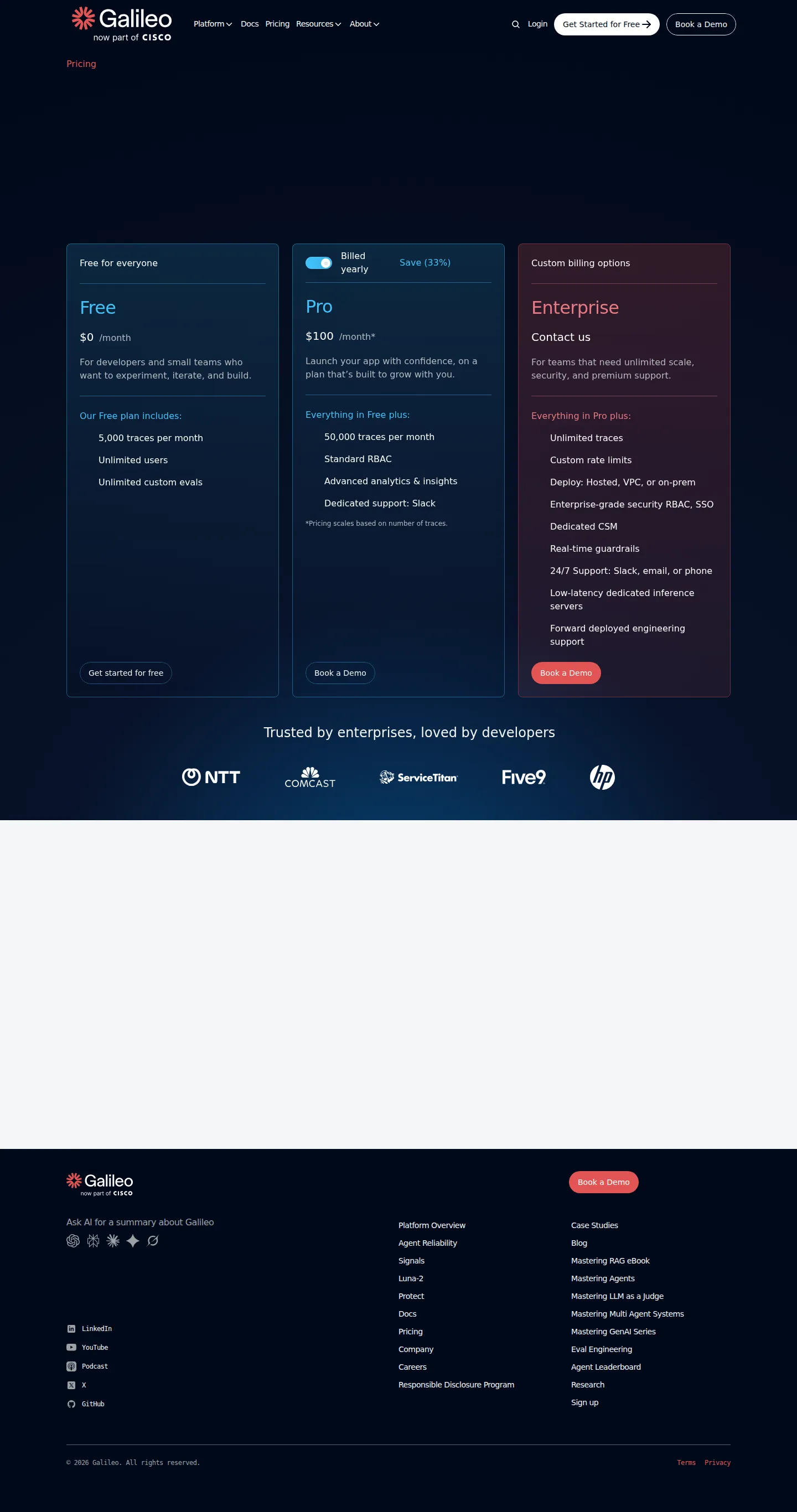
Cisco announces intent to acquire Galileo
Cisco announced its intent to acquire Galileo on 2026-04-09 to extend Splunk Observability Cloud's AI agent monitoring; terms were undisclosed. The deal closed on 2026-05-22. No pricing change accompanied the announcement — the Free / Pro $100 / Enterprise structure stayed intact.
Real-time guardrails moved off the Pro card
By the 2026-04 Wayback snapshot, 'Real-time guardrails' no longer appears in the Pro feature list (it had been listed under Pro in the 2025-10 through 2026-03 snapshots) and is now Enterprise-only. Free / Pro $100 / Enterprise tier prices and trace allowances were unchanged.
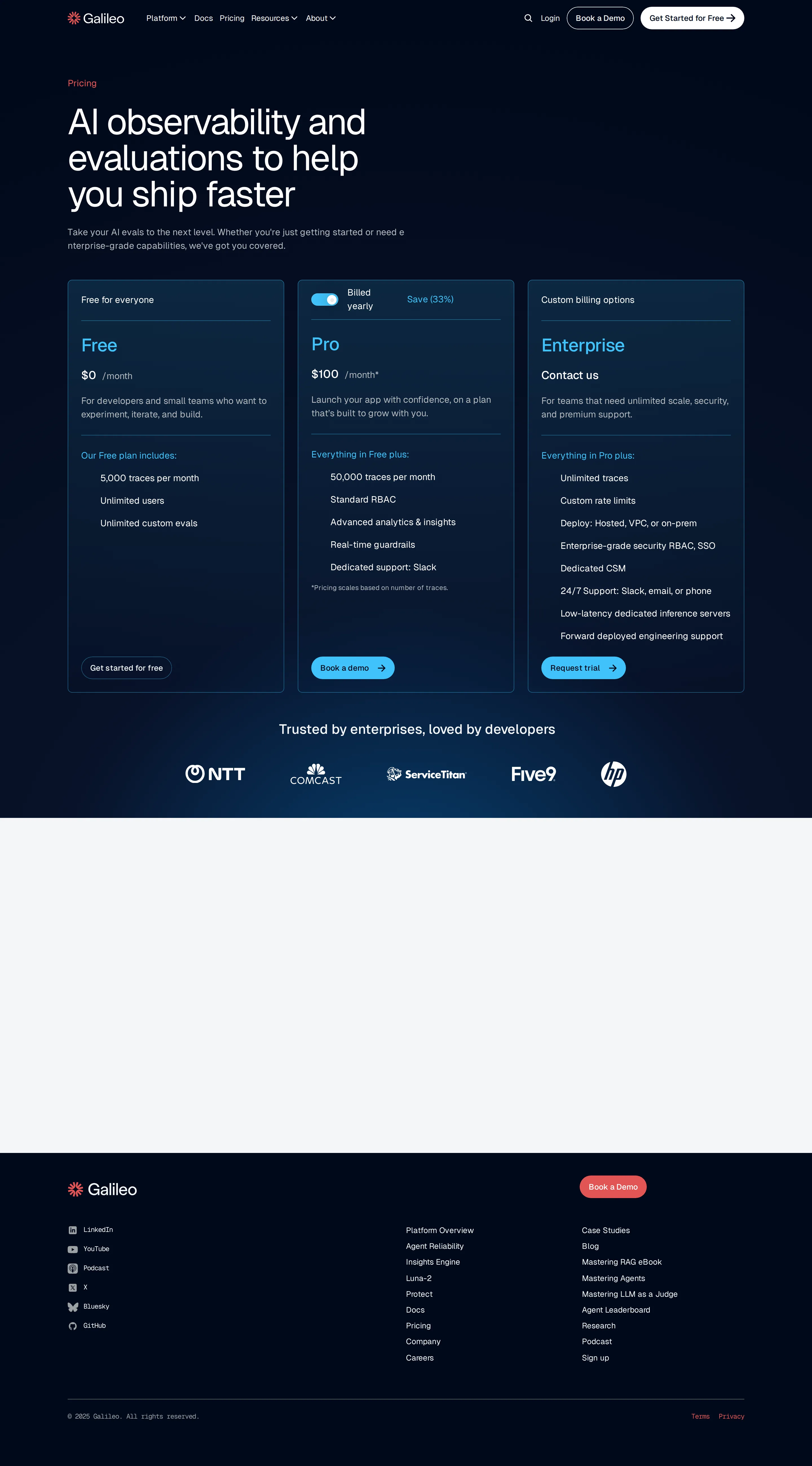
Pro $100/mo introduced; free user cap removed; dark redesign
Between the 2025-09 and 2025-10 Wayback snapshots Galileo repackaged into three tiers: Free ($0, 5,000 traces/mo, now unlimited users and unlimited custom evals — up from a 3-user cap), Pro ($100/mo, 50,000 traces/mo, Standard RBAC, 'Pricing scales based on number of traces'), and custom Enterprise. The page was redesigned to a dark theme with NTT, Comcast, ServiceTitan, Five9, and HP logos.
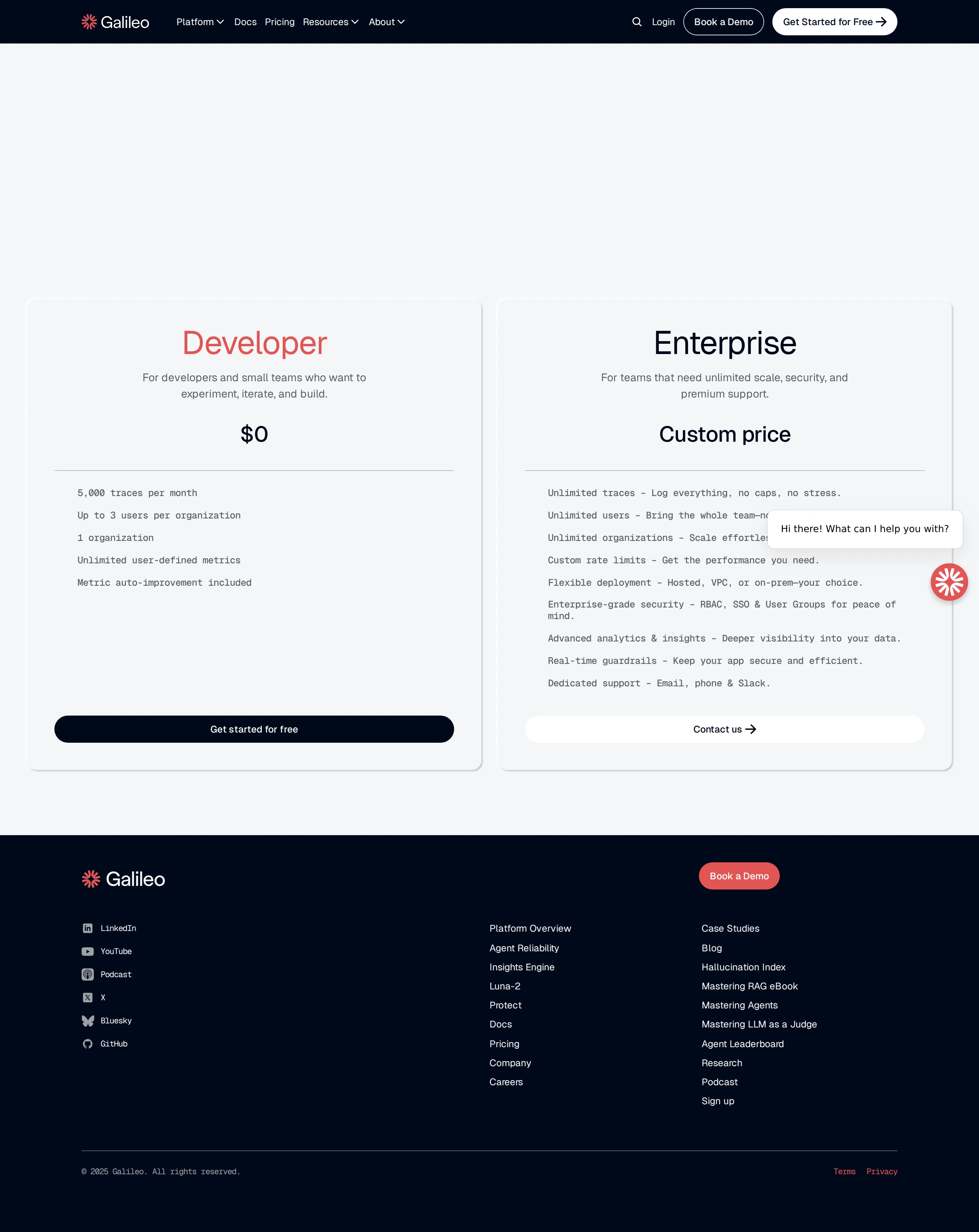
Two-tier era: free Developer + custom Enterprise
Through at least September 2025 the pricing page (galileo.ai/pricing, captured via Wayback) showed only two plans: a free Developer plan (5,000 traces/mo, up to 3 users per organization, 1 organization, unlimited user-defined metrics) and a custom-priced Enterprise plan (unlimited traces/users/orgs, VPC/on-prem, RBAC + SSO, real-time guardrails). There was no published mid-tier price.
$45M Series B
Galileo raised a $45M Series B led by Scale Venture Partners (with Databricks Ventures, Premji Invest, Amex Ventures, Citi Ventures, ServiceNow, and SentinelOne), bringing total funding to $68M. No pricing-page change accompanied the raise; the public page still showed the two-tier Developer/Enterprise structure.
- · Cisco acquired Galileo: it announced intent on 2026-04-09 and closed the deal on 2026-05-22, after which galileo.ai added a 'now part of CISCO' lockup to its logo.
- · Galileo had no public mid-tier price until late 2025: through September 2025 the page showed only a free Developer plan (capped at 3 users) and a custom Enterprise plan — the $100/mo Pro tier appeared in the October 2025 redesign.
- · When Pro launched, Galileo also lifted the free tier's 3-user cap to unlimited users and switched its metered unit framing from 'user-defined metrics' to 'custom evals' plus a 5,000-trace allowance.
Questions & answers
- How much does Galileo cost?
- Galileo offers a Free plan at $0/month (5,000 traces), a Pro plan at $100/month (50,000 traces), and a custom-quoted Enterprise plan with unlimited traces.
- What is a 'trace' in Galileo's pricing, and does it charge per seat?
- A trace is the unit Galileo meters on — one recorded execution/observability event for an LLM or agent run. Free includes 5,000 traces/month, Pro 50,000, and Enterprise is unlimited. Galileo does not charge per seat: both Free and Pro advertise unlimited users, so the bill scales with traces, not headcount.
- What does Galileo's Enterprise plan include?
- Enterprise is contact-us pricing and adds unlimited traces, custom rate limits, hosted/VPC/on-prem deployment, enterprise-grade RBAC and SSO, real-time guardrails, a dedicated CSM, and 24/7 support.
- Is Galileo owned by Cisco?
- Yes. Cisco announced its intent to acquire Galileo on 2026-04-09 and closed the deal on 2026-05-22. Galileo extends Cisco's Splunk Observability Cloud, and galileo.ai now shows a 'now part of CISCO' lockup. The Free / Pro $100 / Enterprise pricing has not changed as a result.
- When did Galileo add the $100 Pro plan?
- The $100/month Pro tier first appeared in Galileo's October 2025 pricing redesign. Before that — through at least September 2025 — the page showed only a free Developer plan (capped at 3 users) and a custom Enterprise plan, with no published mid-tier price.
- How much funding has Galileo raised?
- Galileo raised a $45M Series B led by Scale Venture Partners on 2024-10-15, bringing total funding to $68M, before being acquired by Cisco in 2026.