AI Summary
About
Gamma (Gamma Tech, Inc.) is an AI-native tool for generating presentations, documents, websites, social posts and images from a prompt. The core unit of work is a “card,” and AI generation is metered through a monthly credit allowance that scales with the plan. Gamma markets to individuals (Free, Plus, Pro, Ultra) and to workspaces (Team, Business), with self-serve checkout throughout — the help center is explicit that “Gamma for Teams and Gamma for Business are both completely self-serviceable.”
Pricing is published publicly, but with a currency wrinkle worth stating up front: gamma.app/pricing localizes its displayed currency by client-side geo-IP and exposes no currency selector, and it returns a Cloudflare bot-challenge / HTTP 403 to scripted fetches. The live 2026-06-11 capture rendered EUR for the Individual tiers, so Plus, Pro and Ultra appear here in euros (€10, €24, €86 per seat per month). Gamma’s non-geo-localized help center does state official USD figures for the workspace plans — Team $240/seat and Business $480/seat (billed annually) — and for add-on credits (1,500 credits for $6); those USD numbers are used here and second-sourced in the capture validation file. The company states it is a SOC 2 Type II compliant organization and links a Trust Center from the pricing page.
For the most current information on Gamma’s pricing and market position, visit Gamma.
Pricing summary : How Gamma’s pricing model works
Gamma prices on two dimensions: a per-seat monthly subscription (the plan you pick) and a monthly AI-credit allowance bundled with each paid tier. Seats are what you pay for; credits are the metered unit that gates the premium AI features. Crucially, the page footnote scopes that meter narrowly — “Unlimited AI creations refers to everyday use under fair use. Premium features (Agent, advanced models, & API) require credits” — so routine slide and doc generation does not burn credits, only the expensive surfaces do.
Billing dimensions captured:
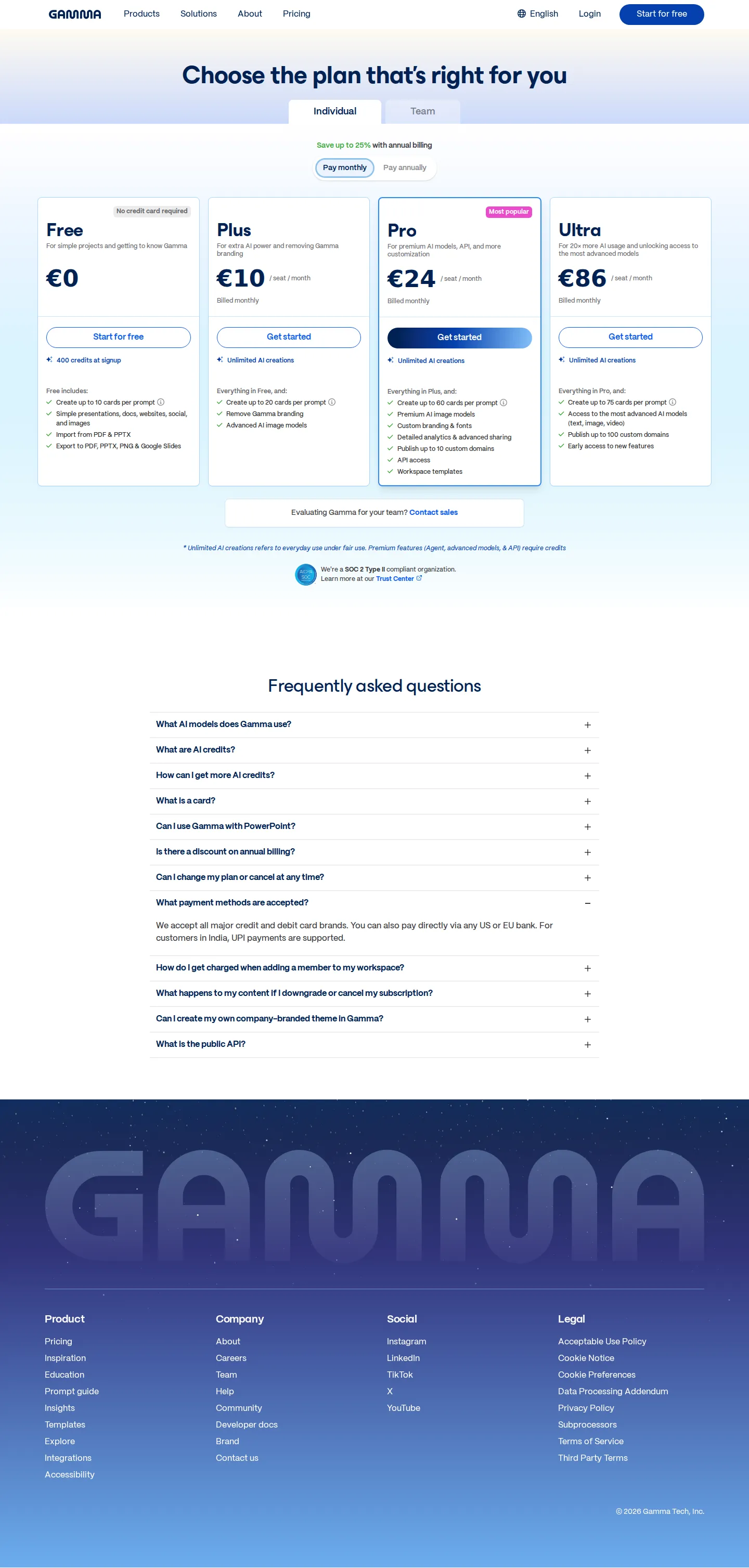
- Per-seat subscription (Individual) — Free €0, Plus €10/seat/mo, Pro €24/seat/mo, Ultra €86/seat/mo (billed monthly; EUR as rendered by the geo-locked page). No seat minimum.
- Per-seat subscription (workspaces, USD) — Team $240/seat (2-seat minimum), Business $480/seat (10-seat minimum), billed annually; the per-member-billing article frames this as a “$20/month plan.”
- Monthly credit allowance — Team 6,000 credits/seat, Business 10,000 credits/seat; Individual paid tiers add a recurring monthly pool while Free gets a one-time 400-credit signup grant.
- “Cards per prompt” — a soft cap on how much one AI generation can produce, rising by tier: 10 → 20 → 60 → 75.
- Add-on credits — 1,500 credits for $6, the only increment, via auto-recharge or one-time purchase (paid subscribers only).
- Annual discount — “Save up to 25% with annual billing.”
What makes this different: Gamma wraps a credit-based usage meter around conventional per-seat SaaS, but unusually it scopes the meter to premium AI only (Agent, advanced models, API) and leaves everyday generation unlimited under fair use. The headline price stays predictable while genuine GPU-cost surfaces are governed separately by credit depletion — a freemium-plus-credits hybrid rather than pure pay-per-output.
Pricing by product
Prices below are transcribed from the evidence captured on 2026-06-11. Individual tiers (Free, Plus, Pro, Ultra) are in EUR (€) because gamma.app/pricing localizes currency by client-side geo-IP, rendered EUR from this capture, and exposes no currency selector. Team and Business are in official USD ($) as published on Gamma’s non-geo-localized help center (“$240/seat (2 seat min)” and “$480/seat (10 seat min)”). Where Gamma does not publish a USD figure for the Individual tiers, it is left in EUR rather than converted (per the no-guessing rule).
Gamma (Individual plans, EUR — billed monthly)
| Tier | Price | Included (credits & cards) | Key mechanics |
|---|---|---|---|
| Free | €0 | 400 credits at signup (one-time) · up to 10 cards/prompt | No credit card; export to PDF/PPTX/PNG/Google Slides; “Made with Gamma” badge |
| Plus | €10 /seat/mo | Recurring monthly credits · up to 20 cards/prompt | Remove Gamma branding; advanced AI image models; unlimited creations (fair use) |
| Pro (most popular) | €24 /seat/mo | Recurring monthly credits · up to 60 cards/prompt | API access; custom branding & fonts; detailed analytics; up to 10 custom domains |
| Ultra | €86 /seat/mo | Recurring monthly credits · up to 75 cards/prompt | Most advanced AI models (text, image, video); up to 100 custom domains; early access |
Gamma (workspace plans, official USD — billed annually)
| Tier | Price | Included (credits) | Key mechanics |
|---|---|---|---|
| Team | $240 /seat (2-seat min) | 6,000 monthly credits / seat | Everything in Pro + centralized billing, custom company theme, shared folders & admin controls, 10 custom domains |
| Business | $480 /seat (10-seat min) | 10,000 monthly credits / seat | Everything in Team + SSO authentication, SOC 2 documentation on request, most advanced AI models, 100 custom domains |
The per-member-billing article confirms the monthly equivalent with a “$20/month plan” example (“2 users → total monthly bill will be $40”). ACH payment requires a minimum purchase of 25 licenses, and teams over 100 people are routed to a contact form (no public price for that band). Add-on credits are sold at 1,500 credits for $6 (the only increment) to paid subscribers, via auto-recharge or one-time purchase.
Sales motions across products: PLG / self-serve for Free, Plus, Pro, Ultra, Team and Business (all carry “Start for free” / “Get started” buttons and are “completely self-serviceable”); larger teams (100+ seats) are routed to a contact form for a custom arrangement.
Hidden costs : What Gamma users actually pay
The sticker price on a Gamma plan is the seat fee, but the number that moves a heavy user’s bill is credit depletion on the premium surfaces — Agent, advanced/Ultra models and the API. Everyday creation is free under fair use, so light users effectively never see the meter; the cost appears when a workspace leans on Agent or the most advanced models and burns through the monthly allowance. Add-on credits then refill at 1,500 for $6, which works out to roughly 0.4 cents per credit (computed, not advertised).
Archetype A — a single Pro user who runs Agent heavily. Pro’s seat fee is fixed, but once the bundled monthly credits run out, Agent and premium-model use draws on top-ups at 1,500 for $6. Because one-time purchases are gated to “when you’re under your plan’s rollover limit,” a heavy month means repeated $6 buys.
| Line item | Monthly cost |
|---|---|
| Pro seat (1 user) | €24 |
| Bundled monthly credits | included |
| Two add-on credit packs (3,000 credits) | about $12 (computed from 1,500 for $6) |
| Effective monthly total | €24 seat + ~$12 in top-ups |
Archetype B — a 10-seat Business workspace. Per-member billing charges every active seat, and credits are not pooled — each member has their own balance and triggers their own auto-recharge. A team that all hits the threshold in the same week multiplies the top-up, not just the seat fee.
| Line item | Annual cost (computed) |
|---|---|
| 10 × Business seats at $480/seat | about $4,800/yr (computed: 10 × $480) |
| Bundled 10,000 credits/seat | included |
| Per-member auto-recharge (3 seats × one $6 pack) | about $18 in a heavy month (computed: $6 × 3) |
| Effective total | ~$4,800/yr + per-member top-ups |
The lesson: Gamma’s per-seat sticker is predictable, but two design choices add variable cost — per-member billing (each seat is charged, and credits don’t pool) and non-pooled auto-recharge (each member who drops below threshold triggers a separate $6 charge). For workspaces, the real budgeting unit is “seats × likely top-ups,” not just seats.
Want to estimate your own Gamma bill? Use the Gamma pricing calculator to model your costs based on seats, plan and add-on credit usage.
Pricing evolution : Gamma pricing history and changes
Cadence
| Quarter | Price changes | Product / SKU additions | Notes |
|---|---|---|---|
| 2026 Q2 | 0 | 2 | Help center (April 2026) documents self-serve Team & Business workspace tiers and formalizes add-on credits (1,500 for $6) plus 2x rollover caps |
| 2026 Q2 | 0 | 0 | Live capture: Individual Free €0 / Plus €10 / Pro €24 / Ultra €86, “Save up to 25% with annual billing”; credit meter scoped to Agent, advanced models and API |
Tracked range: 2026–present. Earlier snapshots are not yet individually Wayback-verified from this network; the two 2026-Q2 endpoints above are read from captured surfaces (live pricing page + help-center articles).
Notable changes
- 2026-04-14 — Gamma’s help center (updated April 2026) documents self-serviceable Team ($240/seat, 2-seat min, 6,000 monthly credits, 10 custom domains) and Business ($480/seat, 10-seat min, 10,000 monthly credits, 100 custom domains) workspace plans, both using per-member billing through Stripe (source: captured
help-teams-business). - 2026-04-20 — Add-on credits formalized at 1,500 for $6 (only increment) with per-plan rollover caps at 2x the monthly allocation (Plus 2,000, Pro 8,000, Ultra 40,000, Teams 12,000, Business 20,000); purchased credits never expire while subscribed (source: captured
help-purchase-credits). - By 2026-06-11 — Live Individual pricing: Free €0, Plus €10, Pro €24, Ultra €86/seat/mo; “Unlimited AI creations” scoped so only Agent, advanced models and API require credits; page remains geo-IP-locked to EUR (source: captured
gamma.app/pricing).
What’s unique : Gamma’s distinctive pricing mechanics
1. The credit meter is scoped to premium AI, not the whole product.
Most credit-based tools meter every generation. Gamma instead makes everyday creation “unlimited under fair use” and reserves credits for the genuinely expensive surfaces — Agent, advanced/Ultra models and the API. This is a deliberate value-metric choice: the meter sits where GPU cost actually concentrates, so casual users perceive a flat plan while power users pay for the heavy compute they trigger.
2. “Cards per prompt” is a soft, non-monetary upgrade lever.
Alongside credits, Gamma gates each tier by how many cards a single AI prompt can produce (10 → 20 → 60 → 75). It is not billed, but it is a clean, legible reason to upgrade that is independent of the credit meter — a second axis of differentiation that buyers can reason about without doing credit math.
3. Per-member billing with non-pooled, per-seat credits.
Workspace plans charge for each active member and assign credits per user — balances are not shared, and auto-recharge fires per member. The help center is explicit: three teammates dropping below threshold means “$6 x 3 = $18.” That keeps accounting simple per seat but means a workspace’s top-up cost scales with how many individuals run hot, not the team average.
4. Credits roll over up to 2x, with a real expiry rule.
Unused monthly credits roll over to a cap of 2x the monthly allocation, and purchased credits “never expire” while subscribed — but on cancel, all credits (monthly, rollover, purchased) expire at the end of the billing period. That rollover cushion softens the all-or-nothing reset many credit systems impose, while the cancel-expiry rule keeps credits tethered to an active subscription.
Strengths & weaknesses
| Strengths | Weaknesses |
|---|---|
| Credit meter scoped to premium AI only — casual users get a predictable flat plan, not a per-generation charge | Pricing page is geo-IP-locked with no currency selector, so the Individual USD prices aren’t reliably visible to non-local buyers |
| Clean four-tier Individual ladder + two self-serve workspace tiers, all with public prices and no-card free start | Per-member, non-pooled credits mean a workspace’s top-up cost scales with the heaviest individuals, not the team average |
| Rollover up to 2x the monthly allowance softens the usual credit-reset waste | Free plan’s 400 credits are one-time only and free users cannot buy add-ons — the only fix is upgrading |
| ”Cards per prompt” gives a legible, non-monetary upgrade reason independent of the credit meter | ”Unlimited AI creations” carries a fair-use asterisk that only the page footnote clarifies |
| Workspace plans are fully self-serviceable (Stripe), with centralized billing and clear seat minimums | Add-on credits sell only in 1,500 increments and one-time buys are gated to single-user workspaces |
Billing UX : Gamma billing controls and transparency
- Monthly / annual billing toggle — the pricing page exposes a “Pay monthly” / “Pay annually” switch, with annual advertised as “Save up to 25% with annual billing.”
- Individual vs Team tabs — a top-level “Individual” / “Team” tab strip separates the two plan families, each rendering its own card set.
- Free-tier signup with no card — the Free plan shows “No credit card required,” lowering friction for self-serve start, with 400 credits granted at signup.
- Credit-based usage metering — each paid plan states a monthly credit allowance (6,000 per seat on Team, 10,000 per seat on Business), and the FAQ documents “What are AI credits?” and “How can I get more AI credits?”
- Add-on credit purchase — paid subscribers top up at 1,500 credits for $6 via auto-recharge (admin-set balance threshold, any workspace) or one-time purchase (single-user workspaces only); credits are not pooled across members.
- Per-member billing — workspace plans charge for each active user; the help center example is a “$20/month plan” where “2 users → total monthly bill will be $40,” and adding a member generates a subsequent prorated bill.
- Rollover caps & expiry — unused credits roll over to 2x the monthly allocation; purchased credits never expire while subscribed, but all credits expire at the end of the billing period if you cancel (account then moves to Free).
- Currency is geo-IP-locked with no override — Gamma renders pricing-page currency from a client-side geo/IP lookup with no on-page currency selector; the 2026-06-11 capture rendered EUR. Official USD figures for Team, Business and add-on credits are sourced from the non-geo-localized help center.
- Stripe-managed invoices — billing is managed through Stripe (“Manage subscription in Stripe”), with payment via major cards, US/EU bank transfer, and UPI for India; ACH requires a 25-license minimum.
Strategic wins : Why Gamma’s pricing decisions worked
1. Metering only the expensive surface keeps the funnel frictionless
By making routine creation “unlimited under fair use” and charging credits only for Agent, advanced models and the API, Gamma removes the per-generation anxiety that depresses adoption in credit tools, while still protecting margin on the GPU-heavy features. It is a precise answer to the value-metric problem in AI pricing: meter where cost lives, not where usage lives. See choosing the right usage metric.
2. Self-serve workspace tiers remove the enterprise sales tax
Gamma made Team and Business “completely self-serviceable” through Stripe, with published prices and visible seat minimums, so a manager can stand up a workspace without a sales call. That keeps the land-and-expand motion entirely PLG up to 100 seats, reserving humans only for the largest rollouts.
3. A two-axis upgrade story (credits + cards) gives clean reasons to pay
Pairing the credit allowance with a non-monetary “cards per prompt” cap means Gamma can nudge upgrades on either axis — more premium-AI headroom or bigger single generations — without forcing buyers into credit arithmetic. Two legible levers convert better than one opaque meter, echoing prepaid-credit best practices.
Areas to improve : Gaps in Gamma’s pricing approach
1. Fix the geo-IP currency lock or add a currency selector
The single biggest transparency gap is that gamma.app/pricing renders currency purely from geo-IP with no override, so the Individual USD prices simply are not reliably visible to many buyers (and bot-walls scripted access). Publishing a currency toggle, or at least listing USD/EUR side by side in the help center, would remove a genuine friction point in cross-border evaluation — the kind of opacity that fuels cost-comparison anxiety.
2. Make the “unlimited / fair use” boundary explicit on the card
“Unlimited AI creations” is true only under a fair-use clause spelled out in a page footnote, with credits gating Agent/advanced models/API. Putting that scope directly on each plan card — “unlimited standard creation; credits meter Agent + advanced models + API” — would prevent the expectation mismatch that drives bill-shock and trust erosion.
3. Soften the non-pooled credit model for teams
Because workspace credits are assigned per member and never pooled, a team where a few people run hot pays repeated per-seat top-ups while other seats’ allowances sit idle. An optional shared workspace credit pool, or at least clear per-member thresholding and alerts, would cut wasted allowance and reduce surprise per-member recharges.
Monetization stack & signals : how Gamma builds & buys its revenue engine
Buys 5 Builds 0 7 open roles
Gamma's metering-to-revenue path runs on bought infrastructure — an event pipeline "from Kafka ingestion through Snowflake analytics," a GTM Engineer wiring "product usage data to HubSpot" for PQL signals, and support in Intercom. Hiring weight sits in customer-success and retention/growth, fitting a freemium-credit PLG motion.
-
“Own and evolve our end-to-end event pipeline architecture, from Kafka ingestion through Snowflake analytics, setting technical direction for data infrastructure”
- Kafka Data platform Job post Nov 2025
“Own and evolve our end-to-end event pipeline architecture, from Kafka ingestion through Snowflake analytics”
-
“Design and implement data pipelines from product usage data to HubSpot, enabling sales and CS teams to see real-time engagement, usage trends, and expansion signals”
-
“Respond to technical customer inquiries and support escalations via email and chat in Intercom”
-
“Proficiency with dbt, Terraform, and working knowledge of data governance, privacy compliance (GDPR, CCPA), and security best practices”
- Senior Lifecycle Marketing Manager RetentionGrowth May 22, 2026
- Software Engineer, Growth Retention May 22, 2026
- Customer Success Manager Customer success Apr 18, 2026
- Senior Solutions Architect Customer success Apr 18, 2026
- Account Executive Customer success Apr 18, 2026
- GTM Engineer GrowthRevOps seen Nov 9, 2025
- Revenue Operations Manager RevOpsMonetizationDeal desk seen Nov 9, 2025
- +18 more matched roles
Signals reviewed · derived from public job posts
Job postings fill and close over time — once a posting is filled we keep it as a dated citation (the quoted evidence remains); use View open roles for current listings.
Key takeaways
- Meter where cost concentrates, not where usage happens. Gamma keeps everyday creation unlimited and charges credits only for Agent, advanced models and the API — protecting margin on GPU-heavy features while keeping the adoption funnel friction-free.
- A bundled credit allowance makes usage pricing feel like a subscription — until the premium surfaces drain it. The seat fee is predictable; the variable cost shows up only when a user leans on the metered features, so be explicit about where that line sits.
- Per-member, non-pooled credits simplify accounting but shift cost to the heaviest seats. Each member is billed and recharged individually, so a workspace’s real budget is “seats × likely top-ups,” not a flat per-seat figure.
- Two upgrade axes convert better than one. Pairing a credit meter with a non-monetary “cards per prompt” cap gives buyers a legible reason to pay without forcing credit math.
- Geo-locking your prices is a self-inflicted transparency cost. Rendering currency from geo-IP with no selector makes the published price invisible to many buyers and pushes USD figures into the help center — a cross-border friction worth fixing.
UBP implications
- Scoping a credit meter to premium features is a powerful middle path between flat-rate and pure usage. Gamma proves you can advertise “unlimited” while still metering the genuinely expensive surfaces — UBP practitioners can put the meter precisely on the cost driver and leave the rest flat.
- Non-pooled per-member credits trade simplicity for waste. Assigning credits per seat keeps billing clean but strands unused allowance and multiplies top-ups; teams designing credit systems should weigh pooling against per-seat accounting deliberately.
- Rollover caps are an underused fairness lever. A 2x-allocation rollover plus “purchased credits never expire while subscribed” softens the all-or-nothing reset that drives credit-tool churn — a small mechanic with outsized trust value.
Sources
- Gamma pricing page — geo-IP-locked; rendered EUR (Free €0, Plus €10, Pro €24, Ultra €86) and bot-walls scripted fetches (accessed 2026-06-11)
- Gamma help center — “What options does Gamma offer for teams and business?” — official USD: Team “$240/seat (2 seat min)”, Business “$480/seat (10 seat min)” (accessed 2026-06-11)
- Gamma help center — “What does per-member billing mean in Gamma?” — per-member billing “$20/month plan … total monthly bill will be $40” (accessed 2026-06-11)
- Gamma help center — “How do I purchase more credits?” — add-on “1,500 credits for $6” and 2x rollover caps (accessed 2026-06-11)
Bottom line
Gamma runs one of the more thoughtful credit models in generative media: a per-seat freemium ladder whose meter is scoped to the premium AI surfaces (Agent, advanced models, API) rather than every generation, so casual users get a predictable flat plan while power users pay for the GPU-heavy work they trigger. Its sharpest design choices — premium-only metering, a 2x rollover cushion, and self-serviceable workspace tiers — are genuinely buyer-friendly; its sharpest liabilities are a geo-IP currency lock that hides the published Individual prices and a non-pooled per-member credit model that strands allowance and multiplies top-ups for teams. The pricing is honest where it counts and opaque where it shouldn’t be.
Want to compare Gamma against other generative-media and AI-platform companies? Browse the pricing blueprint.
Pricing timeline : Major events on a vertical axis
Each milestone below corresponds to a public pricing change, product launch, or material adjustment. Major events use a filled marker; minor adjustments use a faded one.
Current Individual plans + credit-metered AI
Live gamma.app/pricing capture (Individual tab, monthly): Free €0 (400 signup credits, up to 10 cards/prompt), Plus €10/seat/mo (up to 20 cards), Pro €24/seat/mo (up to 60 cards, API access, 10 custom domains), Ultra €86/seat/mo (up to 75 cards, most advanced models, 100 custom domains). 'Save up to 25% with annual billing.' Page is geo-IP-locked and rendered EUR; USD Team/Business/add-on figures second-sourced from the non-geo-localized help center.
Credit rollover caps + add-on credit purchases formalized
Help center documents add-on credits at 1,500 for $6 (sold only in 1,500 increments) via auto-recharge or one-time purchase, plus per-plan rollover caps at 2x the monthly allocation (Plus 2,000, Pro 8,000, Ultra 40,000, Teams 12,000, Business 20,000). Purchased credits never expire while subscribed; all credits expire at the end of the billing period on cancel.
Self-serve Team & Business workspace plans
Gamma's help center (updated April 2026) documents two self-serviceable workspace tiers: Team at $240/seat (2-seat minimum, 6,000 monthly credits, 10 custom domains, centralized billing + custom company theme) and Business at $480/seat (10-seat minimum, 10,000 monthly credits, 100 custom domains, SSO + SOC 2 documentation on request). Both use per-member billing through Stripe.
- · Gamma's 'unlimited AI creations' has an asterisk: everyday generation is unlimited under fair use, but the premium features that actually cost money — Agent, advanced/Ultra models and the API — are the only things that burn credits. The credit meter sits on the expensive surface, not the whole product.
- · The Free plan's 400 credits are a one-time signup grant, not a monthly refill — paid tiers are the only way to get a recurring monthly credit allowance, and free users cannot buy add-on credits at all without upgrading.
- · Gamma renders pricing-page currency purely from a client-side geo-IP lookup with no override and no on-page currency selector — even a US-classified capture saw EUR — so the only place its USD Individual prices are guaranteed is behind that geo wall, while Team/Business USD figures live in the (non-localized) help center.
Questions & answers
- What is Gamma's pricing model?
- Gamma is a per-seat freemium subscription with a usage meter layered on top. You pick a plan (Free, Plus, Pro, Ultra on Individual; Team or Business for workspaces), and each paid plan bundles a monthly pool of AI 'credits' that gate Agent, premium/Ultra models and API access. Routine creations are unlimited under fair use; credits only burn on the premium AI features. Add-on credits are sold at 1,500 for $6.
- Does Gamma offer a free tier?
- Yes. The Free plan is €0 (no credit card required) and grants 400 credits at signup, up to 10 cards per AI prompt, import from PDF/PPTX and export to PDF/PPTX/PNG/Google Slides. It carries a 'Made with Gamma' badge and uses standard AI models; removing the branding and unlocking advanced models requires the paid Plus tier.
- How much does Gamma cost per month?
- On the Individual tab the live page rendered Plus at €10/seat/month, Pro at €24/seat/month and Ultra at €86/seat/month (billed monthly). For workspaces, Gamma's help center lists Team at $240/seat and Business at $480/seat (billed annually), which the per-member-billing example states as a '$20/month plan'. Annual billing saves up to 25%.
- Is Gamma pricing usage-based or subscription?
- It is a hybrid. The base is a per-seat subscription, but AI consumption is metered separately through monthly credits, and you can top up at 1,500 credits for $6. Unlike a pure pay-per-output tool, credits only meter the premium AI features (Agent, advanced models, API) — everyday slide and doc creation is unlimited under fair use.
- Can I use Gamma commercially and remove the branding?
- Removing the 'Made with Gamma' badge requires a paid plan (Plus and up). Custom branding, fonts and custom domains arrive on Pro; the most advanced AI models and 100 custom domains are on Ultra/Business. Free users keep the badge and cannot purchase add-on credits without upgrading.