AI Summary
About
Glean (Glean Technologies, Inc., San Francisco, CA) sells a horizontal “Work AI” platform for the enterprise — a permission-aware layer that connects a company’s knowledge, systems, and context so AI can operate at enterprise scale. The platform spans workplace search, an assistant, data analysis, deep research, a prompt library, and an agent stack (Agent Builder, Agent Orchestration, Agent Library, Agentic Engine) on top of connectors to tools like Slack, Google Drive, Jira, Confluence, SharePoint, GitHub, and Salesforce.
Glean is a serious scale player, not an early-stage startup. It crossed $100M ARR in the fiscal year ending January 31, 2025 — under three years after launch — and reported roughly $300M ARR by 2026, tripling in about 15 months (CNBC, TechCrunch). In June 2025 it raised a $150M Series F led by Wellington Management at a $7.2B valuation, with Sequoia, Kleiner Perkins, Lightspeed, Coatue, General Catalyst, ICONIQ, and Sapphire among existing backers. Named deployments include Booking.com (14,000 employees), Zillow, TIME, Ericsson, and GCash. Glean positions heavily on enterprise security and governance — its homepage lists SOC 2 Type II, ISO 27001, ISO 42001, HIPAA, GDPR, and TX-RAMP Level 2, alongside permission-aware access and full query/answer observability. It competes directly with Microsoft 365 Copilot, ChatGPT Enterprise, and Claude Enterprise, all of which it calls out by name in its own comparison navigation.
Glean does not publish a seat price. As of the 2026-08-28 check, glean.com/pricing still returns a 301 redirect to the homepage, and the only conversion path is “Get a Demo”. The commercial model, however, is no longer a black box — and it is now two models. Glean’s documentation at docs.glean.com/glean-enterprise-flex-pricing (footer now reads “Last updated on Aug 21, 2026”) describes Enterprise Flex: per-user, per-month seats deployed to every employee, plus a pooled allowance of pay-per-use FlexCredits, with a thirteen-line credit rate card covering everything from Adaptive Reasoning Mode queries to per-minute Meeting Notes and Client API calls. A separate page at docs.glean.com/glean-core-suite-pricing describes Glean Core Suite: a per-user seat covering search, connectors, Protect, and agent building, with model consumption billed as Glean Model Hub Usage on an upfront commit — and that rate card is denominated in dollars, at published per-million-token provider rates. The seat price is gated on both. For a quote, visit Glean.
Pricing summary : gated hybrid of per-user seats plus pooled FlexCredits
Glean’s seat price is gated and quote-based, but the structure is documented — twice. Per Glean’s own Enterprise Flex docs, the flagship model is a hybrid: a per-user, per-month Enterprise Flex seat licensed to every employee, plus a pooled allowance of pay-per-use FlexCredits that meter advanced AI features. A parallel Glean Core Suite page documents the alternative: the same per-user seat, but with model consumption billed as Model Hub Usage at provider API rates published in dollars per million tokens. glean.com/pricing 301-redirects to the homepage, and the only CTA is “Get a Demo”.
- Sales motion — Sales-led only. The single conversion CTA across the site is “Get a Demo”; no self-serve signup or online checkout exists.
- Two documented packagings — Enterprise Flex (seat + pooled FlexCredits) and Glean Core Suite (seat + Model Hub Usage on an upfront commit). Glean’s usage-limits docs treat these as distinct plan types: usage is denominated “in FlexCredits on Enterprise Flex plans and in dollars (Model Hub Usage cost) on Glean Core Suite plans.” A third, legacy Glean Enterprise plan is still being migrated off.
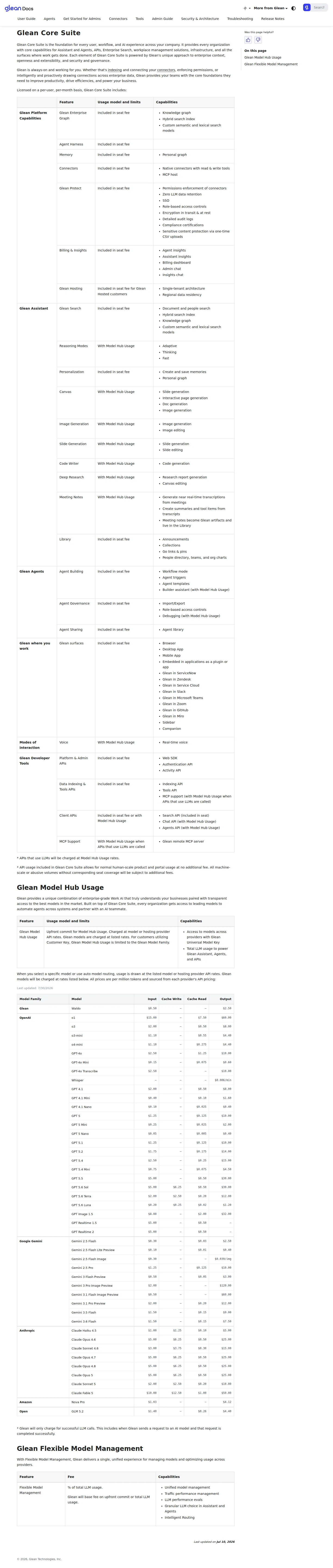
- Published token rates (Core Suite) — Model Hub Usage is charged “at model or hosting provider API rates”, per million tokens, in a table Glean maintains itself (inline table stamp now reads 2026-08-24): Glean Waldo $0.50 in / $2.50 out, GPT 5 $1.25 / $10.00, GPT 5.6 Sol $5.00 / $30.00, Claude Opus 4.8 $5.00 / $25.00, Claude Sonnet 5 $2.00 / $10.00, Gemini 2.5 Flash $0.30 / $2.50. Glean “will only charge for successful LLM calls.” The July 30 refresh cut GPT 5.6 Terra 20% (now $2.00 in / $12.00 out) and GPT 5.6 Luna 80% (now $0.20 in / $1.20 out) — the first published price decreases tracked on this card. The August 5 refresh expanded the card itself: it added GPT-4o Mini TTS and a Deepgram Nova-3 Multilingual per-minute rate ($0.0117/min output), and split GPT Realtime 1.5/2/2.1 from one ambiguous per-token row into three modality-specific lines — Audio $32.00 in / $64.00 out, Text $4.00 in / $16.00-$24.00 out, Image $5.00 in — the first time Glean has disclosed real-time voice-model token pricing on this card. As of the 2026-08-28 check, every previously-published rate on this card remains unchanged since 2026-08-05; the only addition is still the 2026-08-26-observed Nemotron 3 Ultra line ($0.60 in / $2.40 out). Flexible Model Management carries its own fee, quoted as a ”% of total LLM usage”.
- Seat dimension — Per-user, per-month seats “designed to be deployed to every employee in your organization” (docs). No public rate is disclosed; third-party trackers publish estimated per-user figures (see Hidden costs), but Glean confirms nothing.
- Usage dimension — Pooled, org-level FlexCredits across thirteen metered capabilities. The docs disclose typical 50th/90th-percentile consumption (a Fast Mode query ~3-15 credits; a Thinking Mode premium-model query ~35-120; a Deep Research run ~33-144; a Glean Agent run ~7-114) but never the dollar value of a credit.
- Included allowances — Fast Mode queries, Basic Search, Collections, Go Links, the People Directory, and agent creation/testing/sharing are unlimited on a seat. Thinking Mode and Adaptive Reasoning Mode on standard models are included up to 100 queries/user/week; excess consumes FlexCredits at the current rate card. Caveat: a Thinking query consuming more than 30 FlexCredits is counted as multiple queries against that allowance.
- Surface-dependent metering — The same action prices differently by surface: a Basic Search Query is 0 credits (unlimited) from Glean Assistant or embedded apps but 1 FlexCredit from the Client APIs. Platform, Admin, Indexing, and Tools APIs are unlimited.
- Time and session meters — Meeting Notes bill per minute (~9-18 credits) and Voice Sessions per session (~3-26 credits), so two dimensions of the bill are clock-driven rather than query-driven.
- Site-wide annual fees — Glean Protect+ (sensitive-content models, auto-remediation, prompt-injection/jailbreak protection) and Premium Support (24x7, 1-hour critical-issue SLA) are each “licensed site-wide as an annual fee”, separate from seats and credits. Base Glean Protect is bundled into the platform, not separately licensed.
- Discount lever — Seats and FlexCredits are discounted for customers who supply their own LLM keys and/or self-host Glean in a private cloud instance, compensating for the compute and model infrastructure the customer bears.
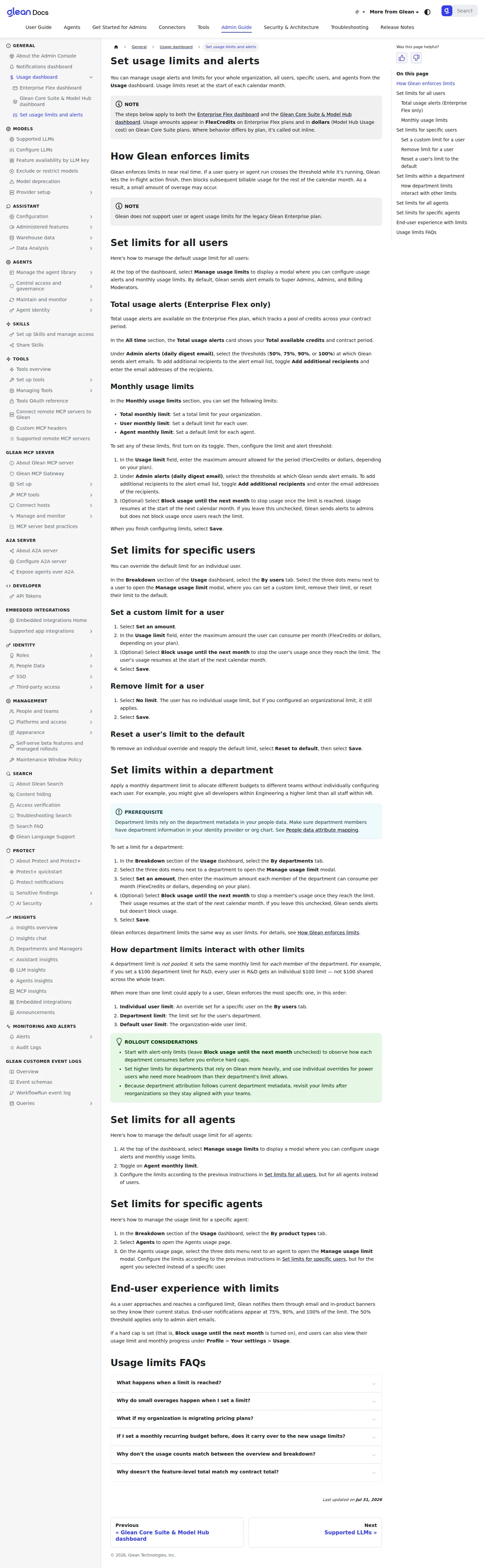
- Spend controls — As of 2026-07-15, admins can set total monthly, per-user, and per-agent usage limits with individual overrides, and optionally enforce them as hard caps (“Block usage until the next month”). As of 2026-07-31, a fourth limit tier — per-department — sits between the per-user override and the org-wide default. See Billing UX.
- Free tier — None. No free plan, trial price, or freemium tier is advertised.
- Price transparency —
gated. The seat rate, the dollar value of a FlexCredit, the Model Hub commit size, the Flexible Model Management percentage, and both site-wide annual fees are all quote-only. The per-token Model Hub rates are the one published exception.
What makes this different: Most enterprise vendors gate the price but publish a tier ladder. Glean inverts this — it publishes the consumption mechanics in exhaustive detail (a thirteen-line credit rate card with p50/p90 consumption, weekly allowances, model tiers, top-up packs) while withholding the seat rate. Sharper still, it runs two rate cards with opposite denominations: the same underlying models are opaque credits on Enterprise Flex and transparent dollars-per-million-tokens on Core Suite. You can model exactly how you’ll be charged, and on Core Suite even how much the model layer costs — but never what a seat costs.
Pricing by product
Glean markets a single horizontal Work AI platform rather than separately-priced SKUs, and no seat carries a published dollar price. What Glean does publish is two complete commercial structures: Enterprise Flex (per-user seats plus pooled FlexCredits) and Glean Core Suite (per-user seats plus dollar-denominated Model Hub Usage). Both are documented in Glean’s own docs and both cover the whole platform.
Glean Enterprise Flex (the commercial model)
| Tier | Price | Included | Key mechanics |
|---|---|---|---|
| Enterprise Flex Seat | Custom (per-user/mo) | Unlimited Fast Mode queries and search, Collections & Go Links, People Directory, agent creation/testing/sharing, plus 100/user/week Thinking and Adaptive Reasoning queries on standard models | ”Deployed to every employee”; includes a base FlexCredit pool for the org |
| FlexCredits (pooled usage) | Custom (consumption) | Premium-model reasoning, Voice Sessions, Meeting Notes, Code Writer, Image and Slide Generation, Deep Research, agent runs | Org-level pooled pay-per-use; top-up via FlexCredit Packs; org/user/agent monthly limits with optional hard block |
| Developer Tools | Custom (usage-based) | Client APIs (Search, Chat, Agents), MCP Server, agent toolkits; Platform/Admin/Indexing/Tools APIs unlimited | Client API calls consume FlexCredits from the same pooled allowance |
| Glean Protect+ | Custom (annual) | Sensitive content models, dashboards and auto-remediation; prompt injection, jailbreak and toxic content protection | ”Licensed site-wide as an annual fee” — base Glean Protect is included in the platform |
| Premium Support | Custom (annual) | 24x7 availability; 1-hour critical issue response SLA | ”Licensed site-wide as an annual fee” |
FlexCredit rate card (from Glean docs)
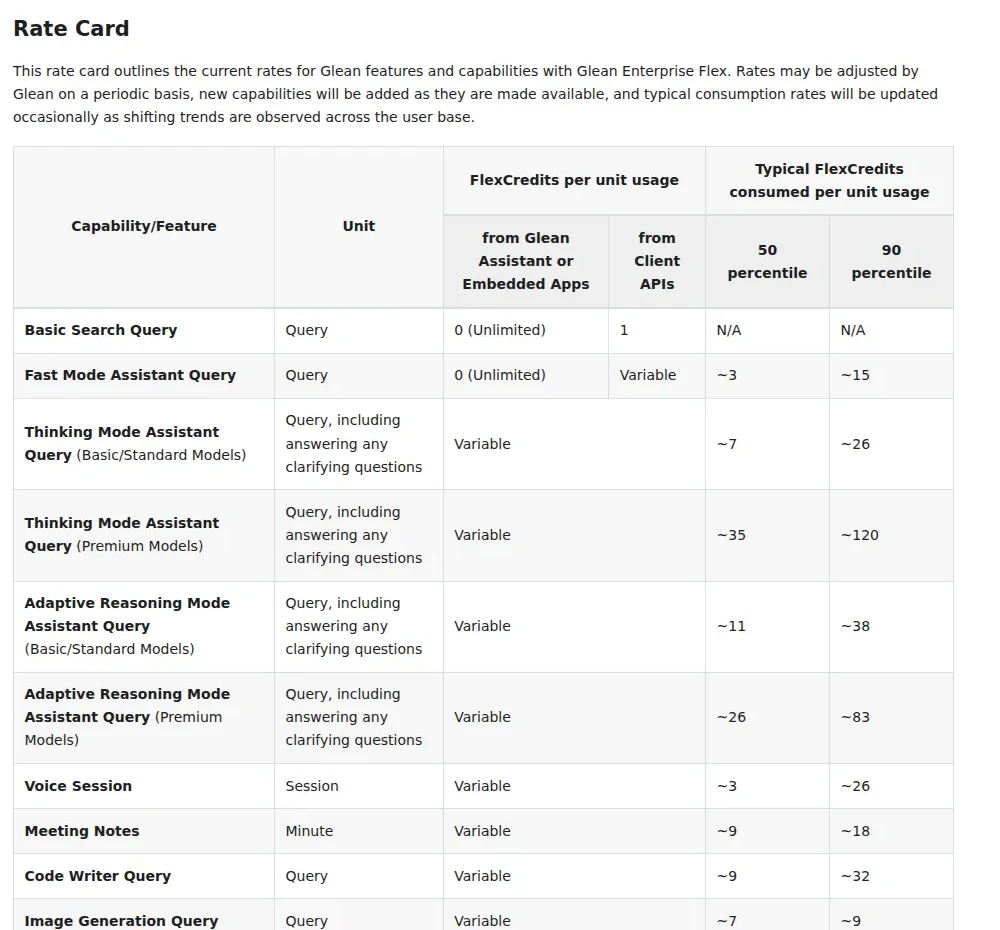
These are the credit-consumption figures Glean publishes in its Enterprise Flex docs. Every metered capability is “Variable” per unit; the two columns are Glean’s own typical 50th and 90th percentile consumption. The dollar value of one FlexCredit is not disclosed, so these convert to spend only after a quote.
| Capability | Unit | Typical (p50 / p90) | Notes |
|---|---|---|---|
| Basic Search Query | Query | N/A | 0 (unlimited) in-product; 1 FlexCredit from Client APIs |
| Fast Mode Assistant Query | Query | ~3 / ~15 | 0 (unlimited) in-product; variable from Client APIs |
| Thinking Mode Query (basic/standard models) | Query, incl. clarifying answers | ~7 / ~26 | Included up to 100/user/week*; excess consumes credits |
| Thinking Mode Query (premium models) | Query, incl. clarifying answers | ~35 / ~120 | Always consumes credits |
| Adaptive Reasoning Mode Query (basic/standard) | Query, incl. clarifying answers | ~11 / ~38 | Included up to 100/user/week*; excess consumes credits |
| Adaptive Reasoning Mode Query (premium) | Query, incl. clarifying answers | ~26 / ~83 | Always consumes credits |
| Voice Session | Session | ~3 / ~26 | Session-metered, not per query |
| Meeting Notes | Minute | ~9 / ~18 | Clock-metered; desktop app only |
| Code Writer Query | Query | ~9 / ~32 | Code generation |
| Image Generation Query | Query | ~7 / ~9 | Tightest spread on the card |
| Slide Generation Query | Query | ~45 / ~142 | Canvas only |
| Deep Research Run | Run | ~33 / ~144 | Report generation + Canvas editing |
| Glean Agent Run | Run | ~7 / ~114 | Scales with connectors, steps, memory, tools, model tier |
*Glean’s footnote: a Thinking query consuming more than 30 FlexCredits “will be counted as multiple queries” against the weekly allowance; one prompt-and-response is a single query, follow-ups count as additional queries, and answers to the model’s clarifying questions stay inside the original query. Assistant queries that route to an agent consume FlexCredits for the agent run.
Glean Core Suite + Model Hub Usage (the dollar-denominated alternative)
Glean documents a second packaging at docs.glean.com/glean-core-suite-pricing. Glean Core Suite is “licensed on a per-user, per-month basis” and bundles the Enterprise Graph, Agent Harness, Memory, connectors, Glean Protect, Billing & Insights, Glean Search, personalization, Library, agent building/governance/sharing, all Glean surfaces, and the Platform, Admin, Indexing and Tools APIs — all “included in seat fee”. Everything model-driven sits outside the seat and runs on Model Hub Usage.
| Component | Price | Included | Key mechanics |
|---|---|---|---|
| Glean Core Suite seat | Custom (per-user/mo) | Search, graph, memory, connectors, Protect, Library, Billing & Insights, agent building/governance/sharing, all surfaces, Platform/Admin/Indexing/Tools APIs, Search API | Seat rate not published; “human-scale” API usage included, machine-scale volumes incur additional fees |
| Glean Model Hub Usage | Per million tokens, at provider API rates | Reasoning modes, Canvas, image/slide generation, Code Writer, Deep Research, Meeting Notes, voice, Chat API, Agents API, LLM-backed MCP | ”Upfront commit for Model Hub Usage”; charged at listed model/hosting-provider rates; only successful LLM calls are billed |
| Flexible Model Management | Custom (”% of total LLM usage”) | Unified model management, traffic performance management, LLM evals, granular model choice, intelligent routing | Fee based on “upfront commit or total LLM usage” |
These are the only dollar figures Glean publishes anywhere. All rates are per million tokens, “sourced from each provider’s API pricing”; the table’s inline stamp now reads “Last updated: 8/24/2026” (page footer separately reads “Last updated on Aug 5, 2026”). The July 30 refresh cut two OpenAI rates — GPT 5.6 Terra to $2.00 in / $12.00 out (-20%), GPT 5.6 Luna to $0.20 in / $1.20 out (-80%) — while every other previously-published model price is unchanged. The August 5 refresh expanded the card: it added a GPT-4o Mini TTS row and a Deepgram Nova-3 Multilingual per-minute rate, and it split GPT Realtime 1.5, 2, and 2.1 out of a single ambiguous per-token row into three modality-specific lines (Audio, Text, Image) — disclosing real-time audio token pricing for the first time. The 2026-08-26 and 2026-08-28 rechecks both found every previously-published rate on this card unchanged, with one addition — a new Nemotron 3 Ultra row ($0.60 in / $2.40 out), first observed 2026-08-26. A representative slice:
| Model family | Model | Input | Cache write | Cache read | Output |
|---|---|---|---|---|---|
| Glean | Waldo | $0.50 | — | — | $2.50 |
| OpenAI | GPT 5 | $1.25 | — | $0.125 | $10.00 |
| OpenAI | GPT 5 Nano | $0.05 | — | $0.005 | $0.40 |
| OpenAI | GPT 5.2 | $1.75 | — | $0.175 | $14.00 |
| OpenAI | GPT 5.6 Sol | $5.00 | $6.25 | $0.50 | $30.00 |
| OpenAI | GPT 5.6 Terra | $2.00 | $2.50 | $0.20 | $12.00 |
| OpenAI | GPT 5.6 Luna | $0.20 | $0.25 | $0.02 | $1.20 |
| OpenAI | o1 | $15.00 | — | $7.50 | $60.00 |
| OpenAI | Whisper | — | — | — | $0.006/min |
| OpenAI | GPT-4o Mini TTS (text in) | $0.60 | — | — | — |
| OpenAI | GPT-4o Mini TTS (audio out) | — | — | — | $12.00 |
| OpenAI | GPT Realtime 2.1 (Audio) | $32.00 | — | $0.40 | $64.00 |
| OpenAI | GPT Realtime 2.1 (Text) | $4.00 | — | $0.40 | $24.00 |
| OpenAI | GPT Realtime 2.1 (Image) | $5.00 | — | $0.50 | — |
| Deepgram | Nova-3 Multilingual (2 channels) | — | — | — | $0.0117/min |
| Google Gemini | Gemini 2.5 Flash | $0.30 | — | $0.03 | $2.50 |
| Google Gemini | Gemini 2.5 Pro | $1.25 | — | $0.125 | $10.00 |
| Google Gemini | Gemini 3 Pro Image Preview | $2.00 | — | — | $120.00 |
| Google Gemini | Gemini 3.6 Flash | $1.50 | — | $0.15 | $7.50 |
| Anthropic | Claude Haiku 4.5 | $1.00 | $1.25 | $0.10 | $5.00 |
| Anthropic | Claude Sonnet 5 | $2.00 | $2.50 | $0.20 | $10.00 |
| Anthropic | Claude Opus 4.8 | $5.00 | $6.25 | $0.50 | $25.00 |
| Anthropic | Claude Fable 5 | $10.00 | $12.50 | $1.00 | $50.00 |
| Amazon | Nova Pro | $1.03 | — | — | $4.12 |
| Open | GLM 5.2 | $1.40 | — | $0.26 | $4.40 |
| Open | Nemotron 3 Ultra | $0.60 | — | $0.12 | $2.40 |
Glean’s footnote: “Glean will only charge for successful LLM calls. This includes when Glean sends a request to an AI model and that request is completed successfully.” For customers using their own Customer Key, “Glean Model Hub Usage is limited to the Glean Model Family.”
The strategic read: Core Suite passes model cost through at provider list price and monetises the seat, the routing layer (Flexible Model Management), and the commit. Enterprise Flex does the opposite — it wraps that same model cost in FlexCredits whose dollar value is never disclosed, so Glean’s margin on the model layer is visible on one plan and invisible on the other.
Model tiers (what triggers a charge)
Glean sorts models into Basic, Standard, and Premium “based on their reasoning capabilities and overall cost to run”. Basic and Standard models in Fast Mode are included in the seat; Premium models incur FlexCredits, including when Glean’s auto model selector picks one — though all Premium models can be disabled in the admin console.
| Model tier | Example models named in the docs | Billing effect |
|---|---|---|
| Basic | GPT 5 mini/nano, GPT 4.1 mini/nano, o3-mini, Gemini 2.5 Flash, Claude 4.5 Haiku, Amazon Nova Pro 1.0, DeepSeek R-1, Glean Waldo | Included in Fast Mode on a seat |
| Standard | GPT 5.6 Luna, GPT 5.4 mini, GPT 5.2 / 5.1 / 5 / 4.1 / 4o, o3, o4-mini, Gemini 3.1 Pro, Gemini 2.5 Pro, GLM 5.2, Nemotron 3 Ultra | Included in Fast Mode; 100/user/week in Thinking and Adaptive Reasoning modes |
| Premium | GPT 5.6 Sol/Terra, GPT 5.5, GPT 5.4, o1, GPT Image 2, Nano Banana Pro, Gemini 3.6 Flash, Claude 4.8/4.7/4.6 Opus, Claude 5 Sonnet, Claude 5 Fable | Always consumes FlexCredits; disableable in the admin console |
Glean notes “model tier for each model is subject to change” — the tier assignment, not just the rate card, is a lever Glean can move. Confirmed example: GPT 5.6 Luna moved from Premium to Standard between the 2026-07-29 and 2026-08-04 checks (docs footer now reads “Last updated on Aug 4, 2026”), while GLM 5.2 quietly dropped its “(beta)” label.
Legacy Glean Enterprise customers
Customers still on the older Glean Enterprise contract keep access to a subset of Enterprise Flex capabilities “at Glean’s discretion” through the length of their current term, at which point they “will need to move entirely to Glean Enterprise Flex”. Any FlexCredit balance granted before the upgrade does not carry entitlement to those features; the base credit allocation arrives with the Enterprise Flex seat.
| Item | Legacy Glean Enterprise | Enterprise Flex |
|---|---|---|
| Advanced/Glean Agent Run | ~150 / ~450 credits (“Advanced Glean Agent Run”) | ~7 / ~114 credits (“Glean Agent Run”) |
| Premium-model access | Provided at Glean’s discretion only | Standard entitlement, metered by FlexCredits |
| Base credit pool | Balance does not entitle Flex features | Base allocation included with each seat |
| Term | Access lapses at end of current term | Ongoing |
Sales motions across products: sales-led for all products — Glean is demo-gated with no self-serve checkout.
Hidden costs : seat minimums, FlexCredit burn, and support fees
Because Glean publishes no seat price and no dollar value for a FlexCredit, the costs below blend Glean’s confirmed structure (seats + pooled FlexCredits, support fees) with third-party estimated rates (gosearch.ai, Metronome, Workativ). Treat the dollar amounts as illustrative, not vendor-confirmed — only the shape of the bill is documented by Glean. (On Glean Core Suite the model layer is the exception: Model Hub Usage is billed at the published per-million-token provider rates in the table above, so that slice of the bill can be modelled precisely — but the seat and the commit still cannot.)
A 200-person enterprise rolling Glean out org-wide, with moderate use of premium AI and a few production agents, would see a bill built roughly like this (estimates):
| Line item | Monthly cost (est.) |
|---|---|
| 200 Enterprise Flex seats @ ~$50/user (third-party est.) | ~$10,000 |
| AI add-on @ ~$15/user (third-party est.) | ~$3,000 |
| FlexCredit overage above the base pool (premium Thinking Mode + agent runs) | ~$2,000-5,000 |
| Premium support (~10-12% of license, reported) | ~$1,500-2,000 |
| Estimated total | ~$16,500-20,000/mo |
The non-obvious traps: (1) seats are licensed for every employee, so you cannot quietly limit Glean to a power-user subset without renegotiating; (2) FlexCredits are pooled at the org level, so a handful of heavy agent-builders or premium-model users can drain the shared allowance and trigger top-up purchases for everyone; and (3) reported support fees run ~10-12% of the license and are described as non-negotiable, a line that buyers routinely forget when modeling total cost of ownership. This is the same bill-shock and cost-unpredictability pattern that dogs metered AI products generally — pooled credits make per-team attribution hard.
Want to estimate your own Glean bill? Use the Glean pricing calculator to model seats, the base FlexCredit pool, and premium-query overage. (Dollar inputs are third-party estimates until you have a Glean quote.)
Pricing evolution : from gated per-seat search to two parallel rate cards
Glean has kept its seat price gated for essentially its entire history: glean.com/pricing redirects to the homepage and has never carried a rate card, so there are no usable archived pricing snapshots to trace a per-seat dollar timeline from. What is traceable is the shift in commercial model — from a per-seat enterprise-search license, to the seat-plus-FlexCredits hybrid that prices the agent era as metered consumption, to the July 2026 split into two parallel packagings that meter the same models in opposite denominations. The rate cards now live in the docs, not on the pricing page.
Cadence
| Quarter | Price changes | Product / SKU additions | Notes |
|---|---|---|---|
| 2025 Q1 | 0 (public) | 1 | Glean Agents launched as a horizontal agent environment; ARR crosses $100M (FY ending 2025-01-31) |
| 2025 Q2 | 0 (public) | 0 | 2025-06-10: $150M Series F at $7.2B valuation (CNBC/TechCrunch); pricing stays gated |
| 2026 Q2 | 0 (public) | 1 | Enterprise Flex (per-user seats + pooled FlexCredits) documented in Glean docs; ~$300M ARR reported |
| 2026 Q3 | 2 (public) | 13 | 2026-07-22: FlexCredit rate card expands to 13 metered lines — six newly metered capabilities (Adaptive Reasoning standard/premium, Voice Sessions, per-minute Meeting Notes, Code Writer, Image Generation) plus Glean Protect+ and Premium Support restated as separate site-wide annual fees; Deep Research and Glean Agent runs move from “variable” to quantified; legacy Glean Enterprise placed on a migrate-by-term-end path. 2026-07-21: Glean Core Suite documented as a second packaging, publishing Glean’s first public dollar rates — a per-million-token Model Hub table plus a ”% of total LLM usage” Flexible Model Management fee. 2026-07-15: org/user/agent usage limits with an optional hard cap replace the soft monthly budget. 2026-07-30: Core Suite Model Hub table cuts GPT 5.6 Terra ~20% and GPT 5.6 Luna ~80% per million tokens — Glean’s first published rate decreases — and the Enterprise Flex model-tier table (footer now dated 2026-08-04) moves Luna from Premium to Standard while GLM 5.2 loses its “(beta)” tag. 2026-07-31: usage-limits docs add a fourth spend-control tier, per-department monthly limits |
Tracked range: 2025-2026. No seat price has ever been published, so “price changes” counts public rate-card moves: the 2026-07-21 Core Suite Model Hub token table went live, then the 2026-07-30 refresh delivered Glean’s first published rate decreases. Model and SKU shifts are tracked alongside.
Notable changes
- 2025-Q1 — Glean Agents launched, adding an agent/agentic SKU that the later FlexCredit model meters per run (Glean blog).
- 2025-06-10 — $150M Series F at a $7.2B valuation led by Wellington Management (CNBC, TechCrunch); pricing posture unchanged.
- 2026 — Glean reaches ~$300M ARR; Enterprise Flex (seats + pooled pay-per-use FlexCredits) is documented at docs.glean.com, confirming a hybrid model while keeping all dollar figures gated.
- 2026-07-22 — The Enterprise Flex docs (last updated 2026-07-21) expand the rate card from a handful of query types to thirteen metered lines, introducing three billing shapes Glean had never published before: per-minute (Meeting Notes ~9/~18), per-session (Voice Sessions ~3/~26), and per-API-call (Client APIs). Deep Research (~33/~144) and Glean Agent runs (~7/~114) move from “variable” to quantified, Glean Protect+ and Premium Support become separately-stated site-wide annual fees, and legacy Glean Enterprise customers are given a discretionary-access-then-migrate path where an Advanced Agent Run costs ~150/~450 credits. Still no dollar value for a FlexCredit.
- 2026-07-15 — Glean shipped enforceable usage limits, replacing the soft recurring monthly budget: total monthly, per-user, and per-agent limits set in the Usage dashboard with individual overrides, and an optional “Block usage until the next month” hard cap. Amounts are denominated in FlexCredits on Enterprise Flex and in dollars on Core Suite. Legacy Glean Enterprise is excluded, and previously configured monthly budgets do not carry over.
- 2026-07-21 — Glean published Glean Core Suite, a second commercial packaging: a per-user seat covering search, connectors, Protect and agent building, with all model-driven capabilities billed as Model Hub Usage on an upfront commit “at model or hosting provider API rates”. The accompanying per-million-token table is the first set of dollar figures Glean has ever published (Waldo $0.50/$2.50, GPT 5 $1.25/$10.00, Claude Opus 4.8 $5.00/$25.00, o1 $15.00/$60.00), alongside a Flexible Model Management fee quoted as a ”% of total LLM usage”. The seat rate remains gated.
- 2026-07-30 — The Core Suite Model Hub table (last updated 2026-07-30) delivers its first published price cuts: GPT 5.6 Terra falls ~20% (input $2.50→$2.00, output $15.00→$12.00) and GPT 5.6 Luna falls ~80% (input $1.00→$0.20, output $6.00→$1.20) per million tokens. In the same window the Enterprise Flex model-tier docs (footer now dated 2026-08-04) reclassify GPT 5.6 Luna from Premium to Standard — folding it into the included 100/user/week Thinking and Adaptive Reasoning allowance instead of always drawing FlexCredits — and GLM 5.2 loses its “(beta)” label (Glean Core Suite pricing docs, Glean Enterprise Flex pricing docs).
- 2026-07-31 — Glean’s usage-limits docs ship a fourth spend-control tier: a per-department monthly limit that is not pooled (the same cap applies to every member of the department) and is enforced between an individual per-user override and the org-wide default user limit, requiring department metadata from the identity provider or org chart (Glean usage-limits docs).
The gated-pricing posture in detail
Glean is a clean case study in deliberate pricing opacity. There is no “Starter / Pro / Enterprise — Contact sales” ladder, no “from $X/user” floor, and not even a standing pricing page — the URL itself redirects. Yet Glean simultaneously publishes granular consumption mechanics (credit costs per query type, weekly Thinking-Mode allowances, FlexCredit Packs, org/user/agent usage limits). The strategy: let prospects model how they’ll be metered to build confidence in the agentic value story, while reserving the seat rate for a sales conversation where seat count, commit size, and discount can be negotiated together. It works — Glean tripled ARR to ~$300M without ever publishing a seat price.
The 2026-07-22 expansion pushes this further rather than reversing it. Glean now discloses 50th- and 90th-percentile consumption for thirteen separate capabilities — more granular usage data than most vendors publish even when their prices are public — and in the same breath reserves the right to move it: “rates may be adjusted by Glean on a periodic basis … and typical consumption rates will be updated occasionally,” with model-tier assignment likewise “subject to change.” Both halves of the effective price are therefore vendor-controlled: the dollar value of a credit (never published) and how many credits a given action burns (published, but revisable). Buyers get an unusually good model of the meter and no lock on the rate.
The July 30, 2026 refresh made the point concrete on the other rate card. GPT 5.6 Terra and Luna dropped 20% and 80% per million tokens on the very table that supplies Core Suite’s “transparent” dollar rates, and the Enterprise Flex model-tier table quietly moved Luna from Premium to Standard on the same pass — proof that the published, dollar-denominated side of Glean’s pricing is exactly as revisable as the opaque credit side, on Glean’s own schedule and with no changelog attached to either doc.
The legacy Enterprise migration in detail
The July docs also make the older Glean Enterprise contract a dead end. Customers on it keep a subset of Enterprise Flex capabilities “at Glean’s discretion” through the length of their current term and then “will need to move entirely to Glean Enterprise Flex” — a forced migration at renewal rather than a mid-term repricing. Two mechanics make it more than paperwork. First, any FlexCredit balance granted before the upgrade “does not entitle you to these features,” so accumulated credits are not a bridge; the entitlement arrives with the new seat. Second, the legacy rate card prices an Advanced Glean Agent Run at ~150/~450 credits against ~7/~114 for the Enterprise Flex Glean Agent Run — an order-of-magnitude gap in credit consumption for the workload both contracts are converging on.
The buyer read: for a legacy customer, agent adoption is economically punitive until they migrate, which makes the migration look voluntary while the rate card does the pushing. Because Glean publishes no dollar value for a credit, a legacy customer cannot independently confirm whether the Flex rate card is cheaper in dollars or merely cheaper in credits — the renewal is a repricing event that has to be negotiated on Glean’s numbers.
What’s unique : two published rate cards, one gated seat price
1. Mechanics public — to the percentile — seat price private, and the pricing page is a redirect. Glean inverts the usual enterprise pattern. Most vendors publish a tier ladder and gate the price; Glean publishes detailed credit-based billing mechanics while gating the seat rate, and glean.com/pricing 301-redirects to the homepage rather than carrying even a “Contact sales” shell — the only path to a number is “Get a Demo”. The 2026-07-22 rate card takes the disclosure side to an extreme few vendors match: thirteen capabilities, each with Glean’s own 50th- and 90th-percentile consumption, so a buyer can model both a typical month and a bad one — in credits. The dollar value of a credit is still quote-only, and Glean states rates “may be adjusted … on a periodic basis,” so the disclosed mechanics are a model, not a guarantee.
2. Two rate cards, opposite denominations. The sharpest tell is that Glean prices the same underlying models two different ways depending on the plan. On Enterprise Flex the model layer is abstracted into FlexCredits whose dollar value is never disclosed; on Glean Core Suite it is passed through at published provider list rates per million token, billed only on successful calls. Glean’s own usage-limits docs state the split plainly — usage appears “in FlexCredits on Enterprise Flex plans and in dollars (Model Hub Usage cost) on Glean Core Suite plans.” One plan hides Glean’s model-layer margin; the other makes it arithmetic. That arithmetic isn’t static, either: the July 30, 2026 refresh cut GPT 5.6 Terra 20% and GPT 5.6 Luna 80% per million tokens, Glean’s first published price decrease on either card — the transparent plan is still a moving target, just a visible one.
3. One credit unit, four meter shapes — and a price that depends on the surface. As of the July rate card FlexCredits meter per query, per minute (Meeting Notes ~9/~18), per session (Voice Sessions ~3/~26), and per API call — heterogeneous workloads that would normally each need their own SKU and their own invoice line, collapsed into one pooled balance. The sharper mechanic is that identical work prices differently by where it originates: a Basic Search Query is 0 credits and unlimited inside Glean Assistant and embedded apps but costs 1 FlexCredit through the Client APIs, and Fast Mode is free in-product but “variable” via API. Surface-dependent metering is rare in the corpus; it puts a team wiring Glean in as the context layer for its own agents on a different cost curve than a team doing identical work in the Assistant.
4. Org-wide by design, on both dimensions. Seats are explicitly “designed to be deployed to every employee,” and FlexCredits are pooled at the organization level rather than allocated per user. That symmetry is the hybrid’s point — broad seat base, shared usage layer — but it cuts both ways: a few heavy agent-builders draw down the same pool everyone else uses, which makes per-team cost attribution and chargeback genuinely hard.
5. Efficiency framed as a pricing argument. Glean markets “pre-connected enterprise context reduces token waste and lowers the cost to scale AI,” claiming ~30% fewer tokens than off-the-shelf MCP tools. It sells lower cost-to-serve as a reason to buy — a shift away from raw per-seat licensing toward value-and-efficiency framing.
Strengths & weaknesses
| Strengths | Weaknesses |
|---|---|
| Hybrid captures broad org-wide seat coverage plus agent/premium-AI upside via pooled FlexCredits — high ACV and land-and-expand (~$300M ARR, tripled in ~15 months) | No public seat price on either plan — every prospect must enter a sales cycle to learn what a user costs |
| Consumption documented to the percentile — 13 capabilities with p50 and p90 burn, so buyers can model a bad month, not just a typical one | Pricing page is a redirect, and the published mechanics are revisable — confirmed 2026-07-30/31, when Model Hub rates for GPT 5.6 Terra and Luna moved (-20%/-80%) and Luna’s tier flipped Premium→Standard with no version number or changelog attached |
| One credit unit absorbs per-query, per-minute, per-session, and per-API-call meters, so new capabilities ship as a rate-card row rather than a new SKU | Pooled org-level credits make per-team chargeback hard, and surface-dependent API metering lets a single integration draw down the shared pool |
| Core Suite offers a genuinely transparent alternative — model cost passed through at published provider list rates, billed only on successful LLM calls | Two parallel plan structures (Flex vs Core Suite) with no published comparison, so buyers cannot tell which is cheaper without quoting both |
| Usage dashboard now enforces rather than warns — org, per-user and per-agent monthly limits with an optional “Block usage until the next month” hard cap (2026-07-15) | Caps are opt-in, near-real-time (Glean warns “a small amount of overage may occur”), denominated in credits rather than dollars on Flex, and unsupported on legacy Glean Enterprise |
| Strong governance posture (SOC 2 II, ISO 27001/42001, HIPAA, GDPR, TX-RAMP) and an efficiency narrative (~30% fewer tokens) differentiate vs. raw Copilot/ChatGPT seats | Protect+ and Premium Support are separate site-wide annual fees, and a reported ~100-seat minimum puts Glean out of reach for the smb segment it tags |
Billing UX : Glean billing controls and transparency
There is no self-serve billing portal, plan picker, or checkout flow — purchase happens entirely through sales. But once a customer is on Enterprise Flex, Glean’s docs describe a genuine in-product cost-governance surface, the FlexCredits dashboard:
- Usage dashboard — A “Usage overview” shows credits consumed against total available, with a “Trends” panel for daily/weekly consumption. Enterprise Flex sees FlexCredits; Core Suite sees dollars of Model Hub Usage cost. This is the primary spend-visibility control.
- Total usage alerts (Enterprise Flex only) — Admins can set daily-digest alert thresholds at 50%, 75%, 90%, or 100% of total available credits across the contract period.
- Monthly usage limits — Three separate limits: a total monthly limit for the org, a default per-user monthly limit, and a default per-agent monthly limit, each with its own alert thresholds. Limits reset at the start of each calendar month.
- Per-department limits (added 2026-07-31) — A fourth cap: admins set a monthly limit “for each member of the department” from a new By departments tab in the Breakdown panel. It is explicitly not pooled — a $100 department limit gives every member of that department their own $100 cap, not a $100 shared pool — and relies on department metadata from the identity provider or org chart. When more than one limit could apply to a user, Glean enforces the most specific: individual user override, then department limit, then the org-wide default user limit. Glean’s own rollout guidance recommends alert-only limits before enabling hard caps.
- Per-user and per-agent overrides — Any individual user or agent can be given a custom limit, set to “No limit”, or reset to the default, from the Breakdown panel of the Usage dashboard.
- Hard cap (“Block usage until the next month”) — Each limit can be enforced rather than merely alerted. Left unchecked, Glean “sends alerts to admins but does not block usage”; checked, it stops billable usage until the next calendar month. Enforcement is near-real-time, so a small overage can occur — Glean “lets the in-flight action finish, then blocks subsequent billable usage.” On Enterprise Flex, capped users keep basic chat; premium and billable models are blocked.
- End-user visibility — Users are notified by email and in-product banner at 75%, 90%, and 100% of their limit (the 50% threshold is admin-only), and under a hard cap can see their own usage at Profile > Your settings > Usage.
- Alert recipients — An “Add additional recipients” toggle extends notifications beyond Super Admins, Admins, and Billing Moderators.
- Data export — The Breakdown panel exports underlying usage data as CSV.
- Feature-level breakdown — Granular consumption visibility organized by product type and model, so admins can see which capabilities drive FlexCredit burn.
- Premium-model kill switch — Per the Enterprise Flex docs, “all Premium models can be disabled in the admin console.” Because Premium models are the main FlexCredit trigger — and Glean’s auto model selector can route to one on its own — this toggle is the closest thing Glean offers to a hard spend control.
- Auto model selector — Glean picks the model per task “balancing reasoning capabilities, cost efficiency, and reliability”; when it auto-selects a Premium model, FlexCredits are consumed. Cost exposure is therefore partly delegated to Glean’s router unless the admin disables Premium.
- FlexCredit Packs — Additional credits “can be added at any time as needed by purchasing additional FlexCredit Packs”, so a depleted pool is topped up as a purchase rather than an automatic overage invoice.
- BYO-key / self-host discount — Seats and FlexCredits are discounted for customers who supply their own LLM keys and/or self-host Glean in a private cloud, which doubles as a cost-control lever for orgs with existing model commitments.
- Remaining gaps — Caps are opt-in, not on by default, and enforcement is near-real-time rather than absolute, so Glean explicitly warns “a small amount of overage may occur.” Usage limits are not supported at all on the legacy Glean Enterprise plan, and if you had previously configured a recurring monthly budget it does not carry over — “you need to reconfigure those alerts as usage limits.” The >30-credit “counted as multiple queries” rule also means the included weekly allowance can be consumed faster than the query count suggests. And because the dollar value of a FlexCredit is never disclosed, an Enterprise Flex cap is a cap in credits, not in money.
- No public billing surface — There is no plan selector, monthly/annual toggle, seat counter, or online checkout.
glean.com/pricingredirects to the homepage, so price discovery and contracting happen through sales, not a portal. - Payment & invoicing — Not disclosed. Payment methods, contract terms, and invoicing cadence are handled through enterprise sales.
Strategic wins : why gating prices while publishing mechanics works
1. Seat-plus-credits captures the agent upside without spooking buyers
The Enterprise Flex hybrid pairs a predictable per-user seat with pooled FlexCredits that monetize the volatile, high-value agent and premium-AI workloads. Buyers get budget-able seats; Glean gets consumption upside as agent usage scales. This is a textbook hybrid pricing model execution — see our introduction to usage-based pricing for why the seat base de-risks the metered layer.
2. Org-wide seat deployment maximizes ACV and stickiness
By designing seats “for every employee,” Glean anchors high six- and seven-figure contracts rather than per-power-user adoption. Combined with permission-aware indexing of all company knowledge, this makes the platform deeply embedded and hard to rip out, fueling ARR that tripled to ~$300M in ~15 months. It is a deliberate move away from narrow per-user licensing toward platform-wide value capture.
3. Publishing consumption mechanics builds confidence without conceding price
Glean discloses how FlexCredits are consumed — and since 2026-07-22, at p50 and p90 across thirteen capabilities — so technical buyers can model usage, yet it withholds the credit’s dollar value. Publishing the 90th percentile is the shrewd part: volunteering the bad case pre-empts the “what happens when it runs away?” objection that stalls metered deals, without conceding a single pricing lever (seat count, commit, discount). It is a sophisticated answer to the choosing the right usage metric problem: meter on credits, sell on outcomes.
4. One meter unit made four new billing shapes a documentation change
Meeting Notes bill per minute, Voice Sessions per session, Client API calls per call, everything else per query — but all four settle in FlexCredits against one pooled balance. On 2026-07-22 Glean shipped three billing shapes it had never metered publicly before without adding a SKU, a contract amendment, or a second invoice line; the change was a rate-card row, not a repackaging. That is the durable argument for an abstract credit unit over direct metering: it buys the vendor the right to monetize new modalities at the speed of a docs update, which is exactly the flexibility a usage-based pricing rollout usually lacks.
5. Efficiency narrative reframes the cost conversation
Rather than competing on seat price against Copilot or ChatGPT Enterprise, Glean argues it lowers total cost-to-serve (~30% fewer tokens than off-the-shelf MCP tools). This shifts the buyer from “what’s your per-seat price?” to “what’s our total AI spend?” — aligning with the broader outcome- and efficiency-based pricing shift.
Areas to improve : transparency, caps, and SMB access
1. Publish a “from $X/user” floor to reduce qualification friction
A complete redirect on the pricing page forces every curious buyer into a demo before learning any anchor. Multiple third-party teardowns explicitly note buyers “want more transparency.” A simple published floor (e.g., “Enterprise Flex starts at $X/user/mo, 100-seat minimum”) would qualify prospects earlier without conceding negotiation leverage — exactly the kind of anchor that prevents bill shock and cost-unpredictability anxiety from killing deals before sales engages.
2. Finish the spend-control story: cap per API client, and cap in dollars
Glean closed the biggest gap here on 2026-07-15, when soft budgets gave way to real org, per-user, and per-agent monthly limits with an optional “Block usage until the next month” hard cap, and added a fourth granularity — per-department limits — on 2026-07-31. Three gaps remain. First, there is still no per-API-client limit — Client API calls draw from the same pooled balance, so a single misbehaving integration built on the Search or Agents API can burn org credits with no human in the loop, and the per-agent limit only covers Glean-built agents. Second, on Enterprise Flex the cap is denominated in credits, not dollars, so a finance team can guarantee a credit ceiling without knowing what that ceiling costs — the Core Suite dashboard, which shows dollars, proves Glean can do it. Third, enforcement is opt-in and near-real-time, and legacy Glean Enterprise gets no limits at all. Closing these would complete the predictability story at the heart of usage-based budgeting.
3. Offer a published, lower-friction tier for mid-market and SMB
Glean tags smb and midmarket segments, but a reported ~100-seat minimum and demo-only motion effectively exclude them. A self-serve or published mid-market tier — even a capped seat count with a fixed FlexCredit pool — would open a segment Glean currently leaves to competitors, while protecting the enterprise sales motion for large accounts.
4. Version the rate card and commit to notice before consumption rates move
The 2026-07-22 card is Glean’s most detailed pricing artifact, and it carries no version number, no effective date, and no change log — only a statement that rates “may be adjusted by Glean on a periodic basis” and that model-tier assignment is “subject to change.” This is no longer hypothetical: on 2026-07-30 the Core Suite Model Hub table cut GPT 5.6 Terra and Luna 20% and 80% respectively, and the Enterprise Flex model-tier table moved Luna from Premium to Standard, with no changelog entry on either doc — a buyer who priced a deployment against the prior rates has no page to check the diff against. Since the credit price is already private, a silent rate-card revision or a model quietly reclassified between tiers changes what a customer pays with nothing for them to point at, in either direction. Publishing a versioned card with an effective date, a diff against the prior version, and a contractual notice period would cost Glean no pricing leverage while turning its best transparency asset into something a finance team can actually rely on — the same discipline we argue for in usage-based invoicing and billing cycles.
Monetization stack & signals : how Glean builds & buys its revenue engine
Buys 1 Builds 0 1 signal role
Buys its revenue spine — Salesforce CRM plus CPQ/quote-to-cash — and the price itself lives in a human deal desk, not a published tier ladder. The signal worth watching is the deal-desk hire below: it owns where Glean's gated rate card actually gets set.
-
“Improve the quote-to-cash workflow (e.g., CPQ, Salesforce, order forms, SKUs). … Hands-on experience with Salesforce; exposure to CPQ and quote-to-cash systems.”
- CPQ CPQ inferred Job post Dec 2025
“Improve the quote-to-cash workflow (e.g., CPQ, Salesforce, order forms, SKUs).”
- Deal Desk Manager Deal desk seen Dec 2, 2025
Glean runs a human deal desk as the pricing-control plane for its gated, quote-only motion — non-standard terms, discount/approval matrices and SKU/order-form structuring are owned here, on a Salesforce + CPQ quote-to-cash spine. The gated rate card is administered by people, not a self-serve meter.
“Serve as the connective tissue between Sales, Finance, Legal, and RevOps. … Own the end-to-end deal review process for non-standard terms … build and maintain pricing and discount frameworks, approval matrices, and playbooks.”
Signals reviewed · derived from public job posts
Job postings fill and close over time — once a posting is filled we keep it as a dated citation (the quoted evidence remains); use View open roles for current listings.
Key takeaways
- Gating the seat price did not slow growth. Glean tripled ARR to ~$300M while never publishing what a user costs — evidence that for high-ACV enterprise AI, a strong value/governance story and a sales-led motion can outweigh the conversion cost of pricing opacity.
- You can publish mechanics without publishing prices — and volunteering the bad case helps. Glean’s July 2026 rate card gives p50 and p90 consumption for thirteen capabilities while still withholding the credit’s dollar value. Disclosing the 90th percentile pre-empts the runaway-cost objection that kills metered deals, at zero cost to negotiating leverage.
- Hybrid de-risks the metered layer. A predictable per-user seat base makes the volatile agent/premium-AI usage layer palatable; buyers commit to seats they can budget, and the vendor captures consumption upside as usage scales.
- Pooled credits trade attribution for simplicity. Org-level pooling makes a single base-pool commit easy to sell but makes per-team chargeback hard — a real cost-governance tradeoff finance teams must plan around.
- Included allowances can drain faster than they look. Glean includes 100 Thinking/Adaptive Reasoning queries per user per week, but a query burning more than 30 FlexCredits “will be counted as multiple queries” — so the allowance is really a credit budget wearing a query label. If you dress a usage cap in a unit your customer doesn’t control, expect the support ticket. Glean eventually conceded the point: in July 2026 it replaced soft budgets and threshold alerts with enforceable org, per-user, and per-agent caps — monitoring was never the hard ceiling finance had been asking for.
UBP implications
- The credit’s real job is absorbing incompatible meters. Glean’s July 2026 card bills per query, per minute, per session, and per API call — yet all four settle in one pooled FlexCredit balance, so adding a voice or transcription modality cost a rate-card row instead of a new SKU. Expect credit pools to spread not because they price agents better, but because they let a platform meter modalities that share no natural unit.
- Seat + pool is the pragmatic enterprise hybrid. A broad seat base for predictability plus a pooled consumption allowance for upside is emerging as the standard enterprise-AI shape — see the hybrid pricing model for why this beats pure-usage in sales-led motions.
- Transparency is a spectrum, and metering transparency is the cheap half. Glean is fully opaque on the seat price yet publishes p50/p90 consumption for thirteen capabilities — and, on Core Suite, passes model cost through at published per-token provider rates. It concedes transparency exactly where the cost is someone else’s (the model provider’s) and withholds it where its own margin lives. UBP teams should decouple the two decisions: publishing how you charge builds trust even when you gate how much, but a rate card with no version, effective date, or notice period is a marketing artifact, not a commitment. Glean proved the point on 2026-07-30, cutting two Model Hub token rates by 20% and 80% with no version bump or changelog to reference.
Sources
- Glean official website (accessed 2026-07-23)
- Glean “pricing” URL — confirmed still returning HTTP 301 to
https://www.glean.com/; no public pricing page exists (accessed 2026-07-23) - Glean Enterprise Flex pricing docs — confirms per-user seats + pooled FlexCredits, the 13-line FlexCredit rate card, model tiers, and the legacy Glean Enterprise migration path; page last updated 2026-07-21 (accessed 2026-07-23)
- Glean Core Suite pricing docs — the second commercial packaging: per-user Core Suite seat, Glean Model Hub Usage on an upfront commit at published per-million-token provider rates, and the Flexible Model Management ”% of total LLM usage” fee; model rate table last updated 2026-07-21 (accessed 2026-07-23)
- Glean “Set usage limits and alerts” docs — total/per-user/per-agent monthly limits, per-user and per-agent overrides, 50/75/90/100% alert thresholds, and the “Block usage until the next month” hard cap; confirms FlexCredit vs dollar denomination by plan (accessed 2026-07-23)
- Glean FlexCredits dashboard docs — usage overview, trends, feature- and model-level breakdown, CSV export (accessed 2026-07-23)
- Glean release notes — 2026-07-15 entries introducing per-user/per-agent FlexCredit usage limits and per-user usage visibility in the Billing Console (accessed 2026-07-23)
- Glean Series F announcement — $150M Series F, $7.2B valuation (accessed 2026-05-31)
Note: per-seat and add-on dollar figures referenced in this analysis (~$45-50/user, ~$15 AI add-on, ~10-12% support, ~100-seat minimum) are third-party estimates from teardowns (gosearch.ai, Metronome, Workativ) cited inline, not vendor-confirmed pricing. The per-million-token Model Hub rates are vendor-published; the seat rate, the dollar value of a FlexCredit, the Model Hub commit size, and the Flexible Model Management percentage are not.
Bottom line
Glean is a ~$300M-ARR, $7.2B-valued enterprise Work AI platform that keeps its seat price entirely gated while documenting its mechanics in ever-greater detail: per-user Enterprise Flex seats deployed org-wide, plus pooled pay-per-use FlexCredits now covering thirteen metered capabilities across per-query, per-minute, per-session, and per-API-call meters. July 2026 widened the disclosure twice over — a 13-line credit rate card, and a parallel Glean Core Suite packaging that finally puts dollars on the page, passing model cost through at published per-million-token provider rates. Yet the number that decides the contract never appears on either. You can model exactly how you’ll be charged, down to the 90th percentile, and on Core Suite even price the model layer to the cent — and still only sales can tell you what a user costs. It’s the clearest case study yet that, for high-ACV enterprise AI, transparent mechanics matter more than transparent prices — and a reminder that mechanics the vendor can revise at will are a model, not a guarantee, proven on 2026-07-30 when two Model Hub rates moved by up to 80% overnight with no changelog attached.
Want to compare Glean against other enterprise AI and usage-based pricing players? Browse the pricing blueprint.
Pricing timeline : Major events on a vertical axis
Each milestone below corresponds to a public pricing change, product launch, or material adjustment. Major events use a filled marker; minor adjustments use a faded one.
Per-department FlexCredit/dollar usage limits ship
Glean's usage-limits docs add a fourth cap tier: admins can now set a monthly usage limit per department (not pooled — the same cap applies to every member), enforced between an individual per-user override and the org-wide default user limit. Requires department metadata from the identity provider or org chart; Glean's own guidance recommends alert-only limits before enabling hard caps.
Model Hub rates cut for GPT 5.6 Terra and Luna; Luna moves to Standard tier
Glean's Model Hub Usage table (docs.glean.com/glean-core-suite-pricing, last updated 2026-07-30) cut GPT 5.6 Terra ~20% (input $2.50→$2.00, output $15.00→$12.00) and GPT 5.6 Luna ~80% (input $1.00→$0.20, output $6.00→$1.20) per million tokens — the first published price decreases on this card. The Enterprise Flex model-tier docs (footer now dated 2026-08-04) also moved GPT 5.6 Luna from Premium to Standard, so it now falls inside the included 100/user/week Thinking and Adaptive Reasoning allowance instead of always consuming FlexCredits. GLM 5.2 lost its '(beta)' label in the same pass.
Enterprise Flex rate card expands to 13 metered capabilities
Glean's Enterprise Flex docs (last updated 2026-07-21) now publish a 13-line FlexCredit rate card. New metered dimensions since the May capture: Adaptive Reasoning Mode queries (~11/~38 standard, ~26/~83 premium), Voice Sessions (~3/~26 per session), Meeting Notes billed per minute (~9/~18), Code Writer (~9/~32), Image Generation (~7/~9), Deep Research runs (~33/~144), Glean Agent runs (~7/~114), and Client API calls (a Basic Search Query costs 1 FlexCredit via API but 0 in-product). Glean Protect+ and Premium Support are now stated as separate site-wide annual fees, and legacy Glean Enterprise customers are on a discretionary migration path to Enterprise Flex, where Advanced Agent Runs consume ~150/~450 credits. Seats and FlexCredits are discounted for customers who bring their own LLM keys or self-host. Still no dollar value for a FlexCredit, and still no seat price.
Glean Core Suite published with per-token dollar rates
Second-source validation found a second, separately documented commercial model at docs.glean.com/glean-core-suite-pricing (page updated 2026-07-10; model rate table updated 2026-07-21). Glean Core Suite is a per-user, per-month seat covering search, connectors, Protect, Library, agent building and governance, with reasoning modes, Canvas, image/slide generation, Code Writer, Deep Research, Meeting Notes, voice, and the Chat/Agents APIs billed as Glean Model Hub Usage on an upfront commit. Model Hub Usage is charged at model or hosting-provider API rates, published per million tokens — the first dollar figures Glean has ever exposed publicly (e.g. Claude Opus 4.8 $5.00 in / $25.00 out, GPT 5.6 Sol $5.00 / $30.00, GPT 5 $1.25 / $10.00, Gemini 2.5 Flash $0.30 / $2.50, Waldo $0.50 / $2.50). Flexible Model Management is billed as a percentage of total LLM usage. Glean charges only for successful LLM calls. Seat price remains gated.
Hard spend caps and per-user/per-agent usage limits ship
Glean replaced the soft recurring monthly budget with configurable usage limits: total monthly, per-user, and per-agent limits set in the Usage dashboard, with individual overrides and an optional 'Block usage until the next month' hard cap. Amounts are denominated in FlexCredits on Enterprise Flex and in dollars on Core Suite. Enforcement is near-real-time (in-flight actions finish, so small overages occur); Enterprise Flex users keep basic chat after a limit is reached while premium and billable models are blocked. Admin alerts at 50/75/90/100%, end-user notifications at 75/90/100%. Not supported on the legacy Glean Enterprise plan. Previously configured monthly budgets do not carry over.
Pricing confirmed gated (no public page)
Capture confirms glean.com/pricing 301-redirects to the homepage. No public plan tiers, per-seat figures, or 'Contact sales' price bands are displayed anywhere. The only conversion path is 'Get a Demo'. Pricing is fully quote-based and sales-led.

Enterprise Flex (seats + FlexCredits) documented
Glean's official docs (docs.glean.com/glean-enterprise-flex-pricing) confirm a hybrid model: per-user, per-month Enterprise Flex seats deployed to every employee, plus a pooled allowance of pay-per-use FlexCredits for advanced AI. No dollar figures are shown; ~$45-50/user base + ~$15 AI add-on are third-party estimates only. Glean reported $300M ARR by 2026.
$150M Series F at $7.2B valuation
Glean raised $150M Series F led by Wellington Management at a $7.2B valuation (CNBC/TechCrunch, 2025-06-10), ~9 months after its prior raise. ARR had crossed $100M in the fiscal year ending 2025-01-31. The raise funded the agent platform push but did not change Glean's gated, sales-led pricing posture.
- · Glean's pricing page is the redirect: glean.com/pricing 301s straight to the homepage, so the company has effectively no public pricing surface to archive — Wayback holds no usable pricing snapshots.
- · Glean tripled ARR from ~$100M to ~$300M in roughly 15 months while keeping pricing entirely gated — a counter-example to the 'transparency drives growth' thesis.
- · Glean's own docs disclose credit-consumption ranges (e.g. a Thinking Mode premium query ~35-120 FlexCredits) but never the dollar value of a credit — you can model exactly how many credits you'll burn without being able to convert one credit into money.
Questions & answers
- What is Glean's pricing model?
- Glean is sales-led and documents two commercial models. Enterprise Flex licenses per-user, per-month seats for every employee plus a pooled allowance of pay-per-use FlexCredits. Glean Core Suite licenses per-user seats plus Model Hub Usage billed at published per-million-token rates. The seat price itself is never published.
- Does Glean publish public pricing?
- Partly. glean.com/pricing still 301-redirects to the homepage and no per-seat rate appears on any public surface, so every contract is custom-quoted through sales. But Glean's docs do publish two full rate cards: the Enterprise Flex FlexCredit consumption table, and the Glean Core Suite Model Hub table of per-million-token dollar rates.
- How much does Glean cost per user?
- Glean does not confirm a per-user seat price on either Enterprise Flex or Core Suite. Third-party trackers report roughly $45–50/user/month plus a ~$15/user/month AI add-on with a ~100-seat minimum (~$60K/year floor), but these are unverified estimates, not vendor pricing.
- What is Glean Model Hub Usage priced at?
- Glean Core Suite bills model consumption at the model or hosting provider's own API rates, published per million tokens (last updated 2026-07-30). Examples: Claude Opus 4.8 $5.00 input / $25.00 output, GPT 5.6 Sol $5.00 / $30.00, GPT 5 $1.25 / $10.00, Gemini 2.5 Flash $0.30 / $2.50, and Glean's Waldo $0.50 / $2.50. The July 30, 2026 update cut GPT 5.6 Terra to $2.00 / $12.00 (-20%) and GPT 5.6 Luna to $0.20 / $1.20 (-80%) — the first published decreases on this card. Glean charges only for successful LLM calls.
- Can Glean admins cap FlexCredit spend?
- Yes. As of July 2026, admins set total monthly, per-user, and per-agent usage limits in the Usage dashboard, with per-user and per-agent overrides, and can enable 'Block usage until the next month' as a hard cap. As of July 31, 2026, a fourth tier — a per-department monthly limit, not pooled — sits between an individual override and the org-wide default. Enterprise Flex users keep basic chat after a limit is hit; premium and billable models are blocked. Usage limits are not supported on the legacy Glean Enterprise plan.
- What are Glean FlexCredits and what do they meter?
- FlexCredits are pooled, organization-level pay-per-use credits. Glean's Enterprise Flex rate card meters Thinking Mode and Adaptive Reasoning Mode queries, Voice Sessions, Meeting Notes minutes, Code Writer, Image Generation, Slide Generation, Deep Research runs, Glean Agent runs, and Client API calls; Basic Search and Fast Mode are unlimited from the Assistant. Typical burn: a Fast Mode query ~3–15 credits, a premium-model Thinking query ~35–120, Slide Generation ~45–142, a Deep Research run ~33–144, a Glean Agent run ~7–114.