AI Summary
About
Granola is the AI notepad built for people in back-to-back meetings. Instead of dropping a bot into your call, Granola runs as a Mac (and now iPhone) app that listens, lets you jot bare notes, then uses AI to enhance them into clean, queryable summaries seconds after you hang up. It added AI chat across meetings and a mobile app, positioning itself as a personal meeting memory rather than a transcription service.
The company was founded in 2023 and is based in London (Shoreditch). It launched publicly in May 2024 and grew fast on word-of-mouth from operators and founders — Nat Friedman, Guillermo Rauch, and others were early public fans. Funding tracked the hype: a $20M Series A in October 2024, a further raise of ~$43M in May 2025, and a $125M Series C in March 2026 at a $1.5B valuation (led by Index Ventures with Kleiner Perkins, Lightspeed, Spark, and angels Nat Friedman and Daniel Gross). That round marked Granola’s pivot from a personal notetaker to an “enterprise AI app” that puts a company’s meeting context to work. Brex publicly endorsed it as a trusted tool in its AI-native rebuild.
For current plans and rates, see Granola’s pricing page.
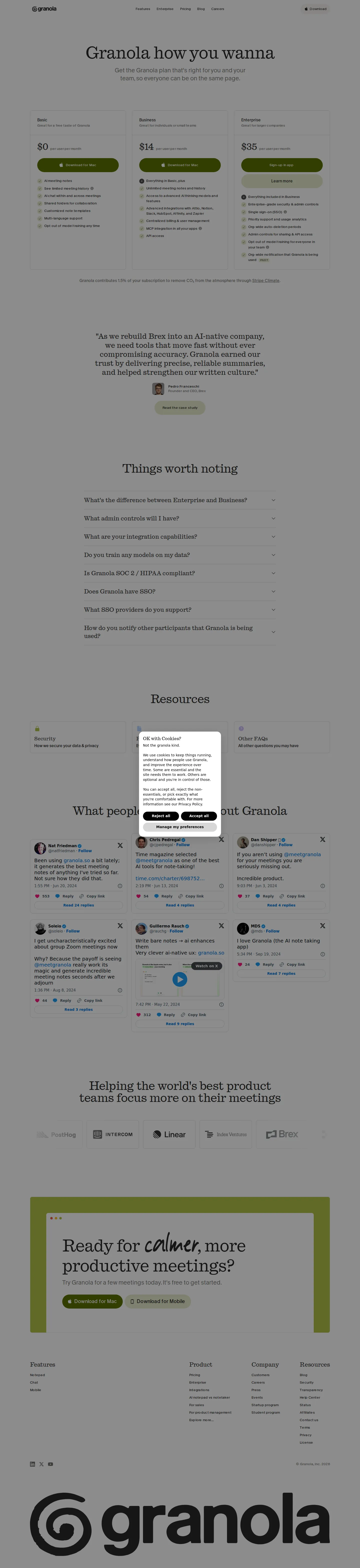
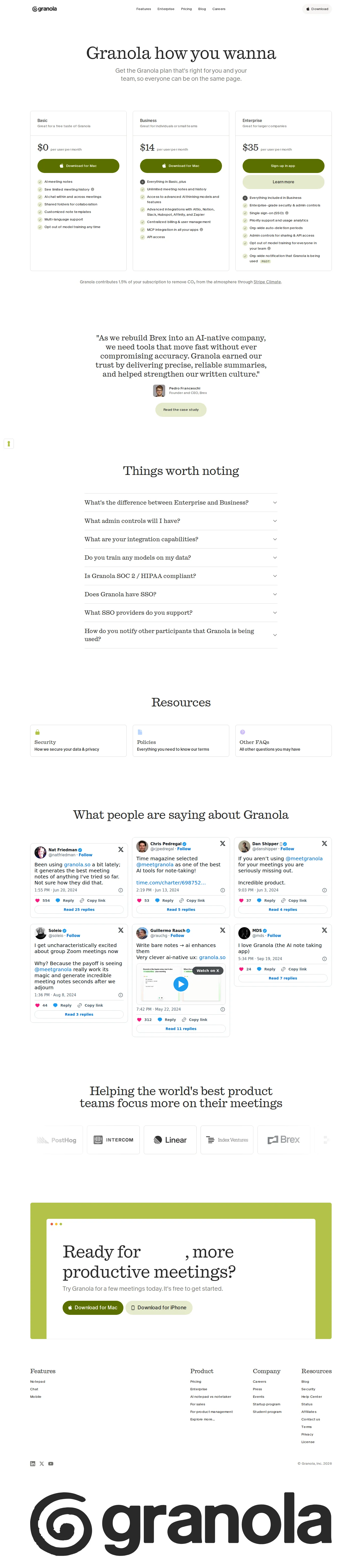
Pricing summary : How Granola’s pricing model works
Granola prices per seat, not per meeting. You pick a plan, pay a flat monthly fee per user, and record as many meetings as you want — there’s no per-minute, per-meeting, or token metering on paid plans. That’s a deliberate contrast to transcription tools that meter minutes.
The structure is freemium with two published paid tiers:
- Basic — $0/user/mo. The free taste. AI notes, AI chat, shared folders, templates, multi-language. The catch: a 25-meeting lifetime cap (not monthly) and only 14-day history, with no integrations.
- Business — $14/user/mo. Unlimited notes and history, advanced AI thinking models, integrations (Attio, Notion, Slack, HubSpot, Affinity, Zapier), API + MCP access, and centralized billing.
- Enterprise — $35/user/mo. Everything in Business plus SSO, enterprise security and admin controls, org-wide auto-deletion, priority support, usage analytics, and team-wide model-training opt-out.
Third-party rate-card aggregators (costbench, meetjamie) also report an Individual tier at $18/user/mo for a single user with unlimited notes but no team features; the live granola.ai/pricing page surfaces Basic/Business/Enterprise. Pricing is fully public.
What makes this different: no usage metering and no annual discount — Granola charges the same monthly rate year-round. The only real usage limit anywhere in the model is the 25-meeting lifetime cap that gates the free tier.
Pricing by product
| Tier | Price | Included | Key mechanics |
|---|---|---|---|
| Basic | $0/user/mo | AI notes, AI chat, shared folders, templates, multi-language | Hard-capped at 25 lifetime meetings; 14-day history; no integrations |
| Individual | $18/user/mo (3rd-party reported) | Unlimited notes & history, advanced AI models | Single user, no team features; not surfaced on the live pricing page |
| Business | $14/user/mo | Everything in Basic + unlimited notes, integrations, API + MCP, centralized billing | Flat per-seat, billed monthly, no annual discount |
| Enterprise | $35/user/mo | Everything in Business + SSO, security/admin controls, priority support, analytics | Per-seat; SSO reported to require a ~100-user minimum |
Sales motions across products: self-serve / PLG for Basic and Business (download the app, upgrade in-product), with a sales-led motion (“Sign-up in app” + “Learn more”) layered on for Enterprise. Pricing is published, so even the enterprise tier has a public list rate. For metric-choice context see choosing the right usage metric.
Hidden costs : What Granola users actually pay
There are no usage overages — that’s the whole point of seat pricing — but a few things surprise people:
- The free tier runs out permanently. The 25-meeting cap is lifetime, not monthly. For anyone in back-to-back meetings, that’s a week or two, then it’s $14/user/mo to keep recording.
- No annual discount. Most SaaS gives 15–20% off for paying yearly; Granola doesn’t, so your effective annual cost is just 12× the monthly rate.
- Integrations and API are paywalled to Business. If you want Slack, Notion, HubSpot, or MCP/API access, Basic won’t do — you’re on the $14 plan minimum.
- SSO sits in Enterprise. Teams needing SSO jump from $14 to $35/user/mo, and SSO is reported to carry a ~100-user minimum.
| Line item | Monthly cost (10-person team) |
|---|---|
| Business plan, 10 seats @ $14 | $140 |
| Usage overages | $0 (no metering) |
| Annual discount | $0 (none offered) |
| Estimated total | $140/mo ($1,680/yr) |
Want to estimate your own Granola bill? Use the Granola pricing calculator to model your costs based on seat count.
Pricing evolution : Granola pricing history and changes
Cadence
| Period | Price changes | Product / SKU additions | Notes |
|---|---|---|---|
| 2024 (launch) | 1 | 1 (flat paid plan) | Free for 25 meetings, then flat $10/mo |
| 2025 | 1 | 2 (Business, Enterprise) | Restructured flat plan into tiers; paid caps dropped |
| 2026 | 0 | iPhone app, enterprise push | $14 / $35 holding; Individual $18 reported by aggregators |
Tracked range: 2024–present.
Notable changes
- 2024-05-22 — Public launch. One simple plan: free for the first 25 meetings, then $10/user/mo.
- ~2025 — Restructured into a tiered model: free Basic (25-meeting lifetime cap), Business at $14/user/mo, Enterprise at $35/user/mo. Paid plans dropped usage caps entirely. Effectively a +40% bump on the entry paid price ($10 → $14) in exchange for unlimited usage and integrations.
- 2026-03 — $125M Series C at a $1.5B valuation; explicit pivot from notetaker to enterprise AI app, which is why Enterprise controls (SSO, admin, analytics) got fleshed out.
What’s unique : Granola’s distinctive pricing mechanics
1. Lifetime free cap, not monthly. Most freemium tools reset limits monthly. Granola’s 25 meetings are a once-ever allowance — a sharp, deliberate forcing function that converts heavy meeting-goers fast without metering anyone.
2. Pure seat pricing in a metered category. Competitors meter transcription minutes or charge per recorded meeting. Granola charges a flat per-user fee and lets you record unlimited meetings, betting that simplicity and predictability beat consumption pricing for buyers who hate bill shock.
3. No annual discount — and public enterprise pricing. Granola publishes a hard $35/user/mo Enterprise list rate (rare; most peers say “contact us”) and declines the usual annual prepay discount. Both choices keep pricing legible and remove a negotiation lever, trading some deal flexibility for trust and self-serve velocity.
Strengths & weaknesses
| Strengths | Weaknesses |
|---|---|
| Flat per-seat pricing — predictable, no minute metering or bill shock | Free tier is a hard 25-meeting lifetime wall; runs out fast for heavy users |
| Public list price even at Enterprise ($35/user/mo) | No annual discount, so no reward for committing |
| Generous paid feature set (unlimited notes, integrations, API/MCP) at $14 | Integrations and API gated entirely behind paid Business |
| Strong word-of-mouth; trusted by operators (Brex, Nat Friedman) | SSO reserved for $35 Enterprise with a reported ~100-seat minimum |
| Mac + iPhone, no meeting-bot intrusion | Plan lineup is slightly confusing — Individual ($18) reported by aggregators but not on the main page |
Billing UX : Granola billing controls and transparency
- Billing controls — Self-serve: download the Mac/iPhone app, start free, upgrade in-product. Business adds centralized billing and user management; Enterprise adds admin controls for sharing and API access.
- Usage visibility — Minimal by design, because there’s nothing to meter on paid plans. Free users effectively track against the 25-meeting cap; Enterprise gets usage analytics for admins.
- Payment options — Monthly per-seat billing; no annual prepay option/discount surfaced. Granola routes 1.5% of subscription revenue to Stripe Climate carbon removal.
Strategic wins : Why Granola’s pricing decisions worked
1. Seat pricing as a trust signal
By charging a flat per-user fee instead of metering minutes, Granola removed the single biggest objection to AI tools — unpredictable bills. Buyers know exactly what 10 seats cost. See how AI companies are moving past per-user licenses for where this sits in the broader shift.
2. The lifetime free cap as a conversion engine
A 25-meeting lifetime allowance lets anyone fully evaluate the product, then converts heavy users almost automatically — no nagging, no monthly reset to game. It’s PLG done with a hard, honest wall. Related: outcome-based and value-aligned pricing trends.
3. Publishing enterprise pricing to keep velocity
Most peers hide enterprise rates behind sales. Granola’s public $35/user/mo Enterprise price keeps the self-serve motion intact even upmarket and signals confidence. See choosing the right usage metric for why metric choice and transparency reinforce each other.
Areas to improve : Gaps in Granola’s pricing approach
1. The free wall is steep for the core user
Granola’s own audience — people in back-to-back meetings — burns 25 meetings in days. A hard lifetime cap with no monthly free allowance can feel abrupt versus rivals’ recurring free minutes. See bill shock and cost unpredictability for adjacent friction patterns.
2. Plan lineup is muddy
The live page shows Basic/Business/Enterprise, while aggregators report a separate $18 Individual tier — and $18 sitting above the $14 Business price is genuinely confusing. A clearer, single canonical lineup would help self-serve buyers.
3. No annual option at all
Skipping annual billing removes a commitment lever and means no reward for loyal customers — and no annual cash-flow predictability for Granola. Even a modest annual plan would expand the menu without complicating the model.
Monetization stack & signals : how Granola builds & buys its revenue engine
Buys 1 Builds 0 3 open roles
Granola buys its revenue stack: subscription payments run on Stripe (its pricing page routes 1.5% of every subscription through Stripe Climate). Its first RevOps Lead, GTM Engineer, and CSM hires signal a sales-led motion being layered onto a self-serve, flat-seat core that needs no usage meter.
- Revenue Operations Lead - US RevOps seen Jun 17, 2026
- GTM Engineer RevOps seen Jun 17, 2026
- Customer Success Manager Customer success seen Jun 9, 2026
Signals reviewed · derived from public job posts, product docs
Job postings fill and close over time — once a posting is filled we keep it as a dated citation (the quoted evidence remains); use View open roles for current listings.
Key takeaways
- Granola prices per seat, not per meeting — flat $14 (Business) / $35 (Enterprise) per user, monthly, with no usage metering on paid plans.
- The free tier is a 25-meeting lifetime cap, not monthly — a deliberate, hard conversion wall with 14-day history and no integrations.
- No annual discount — the same monthly rate applies year-round, an unusual SaaS choice that trades a commitment lever for simplicity.
- Enterprise pricing is public ($35/user/mo with SSO), keeping a self-serve feel even upmarket; SSO reportedly needs ~100 seats.
- Granola is moving from notetaker to enterprise AI app, backed by a $125M Series C at a $1.5B valuation — expect the Enterprise tier to keep accreting controls.
UBP implications
- Flat seat pricing can win in a metered category when the buyer’s top fear is unpredictable cost — Granola sells predictability as a feature.
- A lifetime free cap is an under-used conversion mechanic — it gives a full evaluation while converting power users automatically, without monthly-reset gaming.
- Transparency scales upmarket — publishing an enterprise list price preserves self-serve velocity and trust even as you chase larger accounts.
Sources
- Granola pricing page (accessed 2026-06-15)
- Granola enterprise page (accessed 2026-06-15)
- TechCrunch — Granola raises $125M at $1.5B valuation (accessed 2026-06-15)
- costbench — Granola Pricing 2026 (accessed 2026-06-15)
Bottom line
Granola sells predictability: a flat $14/user/mo Business plan and a public $35/user/mo Enterprise plan, with no per-meeting metering and no annual discount. The free Basic tier is a hard 25-meeting lifetime wall that converts heavy meeting-goers fast. Backed by a $125M Series C at a $1.5B valuation, Granola is pushing from personal notetaker into enterprise AI — and its legible, fully public pricing is part of how it keeps self-serve growth intact while moving upmarket. Browse the pricing blueprint for more fully-researched company profiles.
Want to compare Granola against other meeting-AI and productivity companies? Browse the pricing blueprint.
Pricing timeline : Major events on a vertical axis
Each milestone below corresponds to a public pricing change, product launch, or material adjustment. Major events use a filled marker; minor adjustments use a faded one.
Plans re-verified — no change
Current live pricing reconfirmed: free Basic, Business $14/user/mo, Enterprise $35/user/mo. No pricing or packaging changes since June 2026.
Plans verified — Basic $0 / Business $14 / Enterprise $35
Current live pricing confirmed: free Basic, Business $14/user/mo, Enterprise $35/user/mo. Aggregators also report an Individual tier at $18/user/mo. No annual discount offered.
Restructured into tiered Business / Enterprise plans
The flat $10/mo plan gave way to a tiered model: free Basic (25-meeting lifetime cap), Business at $14/user/mo, and Enterprise at $35/user/mo. Paid plans dropped usage caps entirely.
Public launch — free for 25 meetings, then $10/mo
Granola launched publicly with a single flat plan: free for the first 25 meetings, then $10/user/month. No tiering — one paid SKU.
- · Granola's free plan is capped at 25 meetings for the LIFETIME of your account — not 25 per month. Once you hit it, you upgrade or stop recording.
- · Granola charges the same monthly rate whether you pay monthly or yearly — there is no annual discount, which is unusual for SaaS.
- · Granola launched in May 2024 at a flat $10/month and reached a $1.5B valuation on a $125M Series C in March 2026 — roughly three years from founding.
Questions & answers
- What is Granola's pricing model?
- Granola uses freemium plus flat per-seat subscription. A free Basic plan is capped at 25 lifetime meetings; paid Business is $14/user/month and Enterprise is $35/user/month. There is no per-meeting, per-minute, or token metering — once you pay, meeting notes are unlimited.
- Does Granola offer a free tier?
- Yes. The free Basic plan gives you AI meeting notes, AI chat, shared folders, and templates — but it is hard-capped at 25 meetings for the lifetime of your account (not 25 per month) with only 14-day history and no integrations. After 25 meetings you must upgrade.
- How much does Granola cost per month?
- Business is $14 per user per month and Enterprise is $35 per user per month, both billed monthly with no annual discount. Third-party aggregators also report an Individual single-user plan at $18 per user per month.
- Is Granola pricing usage-based or subscription?
- It is subscription, seat-based — not usage-based. Granola charges a flat monthly fee per user and does not meter meetings, minutes, or transcription volume on paid plans. The only usage limit is the 25-meeting lifetime cap on the free tier.