AI Summary
About
Harvey is a generative-AI platform built for legal and professional-services work — drafting, contract analysis, legal research, and multi-step workflow automation across its Assistant, Vault, Knowledge, Workflows, and Word Add-In products. It targets the world’s most demanding legal teams, and its public customer roster (shown on the demo page) includes large law firms and enterprises such as Gleiss Lutz, Vinson & Elkins, Schönherr, Deutsche Telekom, KKR, and Bridgewater. Co-founder Winston Weinberg is a former litigator at O’Melveny & Myers, and that practitioner credibility helped Harvey reach more than 100,000 lawyers across 1,300+ organizations, including 45+ AmLaw 100 firms.
By the numbers, Harvey is one of the fastest-scaling vertical-AI companies on record: it crossed $100M ARR in August 2025 (roughly three years after founding), reported approximately $190M–$195M ARR by early 2026, and raised $200M at an $11B valuation in March 2026 co-led by GIC and Sequoia — up from an $8B valuation only three months earlier (per CNBC and Sacra). It competes most directly with Thomson Reuters CoCounsel and an emerging field of legal-AI challengers.
Harvey sells exclusively through an enterprise, sales-led motion. As captured on 2026-05-30, the company publishes no pricing page — harvey.ai/pricing returns HTTP 404 and there is no “Pricing” or “Plans” link anywhere in the site navigation. The only commercial surface is a “Book a demo” / contact-sales form. Every figure in the sections below that carries a dollar amount is a third-party estimate, clearly attributed and explicitly not confirmed by Harvey — which has publicly disputed such estimates.
Pricing summary : How Harvey’s pricing model works
Harvey’s pricing is fully gated. There is no public rate card, no self-serve checkout, and no free tier — the only path to a price is to book a demo through harvey.ai/contact-sales and receive a custom enterprise quote. No monthly price, per-seat rate, or usage unit is disclosed anywhere on the public site as of 2026-05-30. The model is best classified as per-seat subscription on annual commitments, sold through a sales-led motion.
- Sales motion: enterprise, sales-led only (demo → quote). No PLG or self-serve path exists.
- Published price: none.
harvey.ai/pricingreturns a 404; the public site is a demo-request funnel. - Reported (not confirmed) billing dimensions: per-seat, annual term, with seat minimums. Third-party sources cite roughly 20–25 seat minimums and conflicting per-lawyer figures (some reports quote a monthly four-figure rate, others a yearly four-figure base) — estimates that disagree with each other and that Harvey has called “wildly off.” See the reported-figures table under Hidden costs for the attributed numbers.
What makes this different: Unlike many AI tools that lead with a transparent self-serve tier, Harvey runs a 100% quote-based enterprise motion with zero price transparency — and actively contests the third-party numbers that circulate in its place, a posture few peer vendors take publicly.
Pricing by product
Harvey does not break pricing out by product. The platform spans several products — Assistant, Vault, Knowledge, Workflows, and a Word Add-In — but all are sold together under a single enterprise agreement with no per-product price published.
Harvey platform (the only plan)
| Tier | Price | Included | Key mechanics |
|---|---|---|---|
| Enterprise (only plan) | Custom — contact sales | Full platform: Assistant, Vault, Knowledge, Workflows, Word Add-In; scope set per contract | Sales-led; quote issued after a demo. No self-serve, no free tier, no published rate. Annual term with seat minimums (reported ~20–25). |
Sales motions across products: sales-led only — every product is bundled into one quoted enterprise agreement. There is no PLG / self-serve motion at Harvey. For the conflicting third-party per-seat estimates, see Hidden costs below — none are Harvey-confirmed.
Hidden costs : What Harvey users actually pay
Because Harvey discloses no rates, the “hidden costs” of a Harvey deal are best understood as the structural commitments a gated, seat-minimum, annual-contract model forces — not line-item overages. Every dollar figure in this section is a third-party reported estimate, not a Harvey quote, and the estimates conflict with one another.
Reported per-seat figures (third-party estimates — NOT confirmed by Harvey)
The only numbers in circulation come from third parties; Harvey publishes nothing and has publicly called such estimates “wildly off.” Treat this as reported market chatter, not vendor pricing:
| Source (reported) | Figure (as reported) | Basis |
|---|---|---|
| Artificial Lawyer | approximately a four-figure dollar base per seat per year (“Starter”) | Editorial estimate, June 2025 |
| eesel AI (citing forum chatter) | roughly a four-figure dollar rate per lawyer per month | Aggregated user/forum estimates |
| Sacra | a four-figure monthly per-lawyer rate with 12-month commitments, ~20-seat minimum | Market intelligence note |
| AI Vortex / Costbench | low-to-mid four figures per seat per month; tens-to-hundreds of thousands per firm per year | Sales-contract analysis |
| Toolsforhumans.ai | a sub-four-figure annual per-lawyer figure (flagged a “major outlier”) | Outlier estimate |
The order-of-magnitude disagreement between the “per-year” and “per-month” camps is itself the headline finding: nobody outside Harvey’s sales process knows the real number, which is exactly the position gated pricing is designed to create. The June 2025 LexisNexis content partnership is expected by third parties to push all-in seat cost up (one editorial projected a roughly 30–40% uplift on 2026 contracts) — a projection Harvey disputes.
Modeled bills (scenarios from reported estimates — not quotes)
Archetype 1 — a 25-attorney mid-market firm adopting Harvey at the reported low end. Using the frequently-cited ”~$1,200 per lawyer per month” figure and a ~25-seat minimum:
| Line item | Monthly cost (reported-estimate basis) |
|---|---|
| 25 seats × ~$1,200/seat/mo (reported) | ~$30,000 |
| Implementation / onboarding (reported as extra) | not separately disclosed |
| Premium content (post-LexisNexis bundle uplift, reported ~30–40%) | potential +$9,000–$12,000 |
| Estimated total (reported-basis only) |
The lesson: even at the reported low end, the 20–25 seat minimum is the real hidden cost — a firm cannot buy three seats to pilot, so the entry ticket is six figures annually before any usage discussion.
Archetype 2 — an AmLaw 100 deployment at the reported high end. Using the “$1,500–$2,000+ per seat/month” figures circulating for large firms across, say, 100 attorneys:
| Line item | Monthly cost (reported-estimate basis) |
|---|---|
| 100 seats × ~$1,750/seat/mo (reported midpoint) | ~$175,000 |
| LexisNexis primary-law content bundle (reported per-retrieval economics) | folded into seat price, expected to rise |
| Estimated total (reported-basis only) |
The lesson: the second hidden cost is content economics. Since June 2025 Harvey reportedly pays LexisNexis per retrieval, shifting some of its own cost base to usage — which third parties expect it to pass through as higher seat prices over time, even though the customer still sees a flat per-seat bill. See why usage-based input costs reshape pricing and the move away from flat per-user licenses.
Want to estimate your own Harvey bill? Use the Harvey pricing calculator to model scenarios across seat count and reported per-seat ranges — remembering that every figure is a third-party estimate, not a Harvey quote.
Pricing evolution : Harvey pricing history and changes
Harvey has never published a rate card, so there is no public price history to trace — the pricing surface has been gated since launch. What is observable is the structural and content-bundling activity that moves Harvey’s underlying cost base and, by extension, its negotiated seat prices.
Cadence
| Quarter | Price changes | Product / SKU additions | Notes |
|---|---|---|---|
| 2025 Q2 | unknown | 1 | 2025-06-18: LexisNexis primary-law content partnership; third parties report it introduces per-retrieval cost economics expected to lift seat prices. Public per-seat rate: unknown (never disclosed). |
| 2025 Q3 | unknown | 0 | Crossed $100M ARR (Aug 2025). No public price disclosed. |
| 2026 Q1 | unknown | 0 | ~$190M–$195M ARR reported; $8B → $11B valuation path. No public price disclosed. |
| 2026 Q3 | unknown | 1 | 2026-07-16: Acquired Benchmark (AI platform for investment firms), Harvey’s third acquisition in seven months — extends the addressable buyer beyond law firms into the financial-services buy side. No public price disclosed; pricing remains sales-led. |
Tracked range: 2025–present. Harvey publishes no rate card, so per-quarter price values are recorded as unknown rather than estimated. Only structural/content events are dated.
Notable changes
- 2025-06-18 — Harvey announces a LexisNexis partnership bundling primary-law content; Artificial Lawyer estimated a meaningful all-in seat-cost increase, and Harvey publicly disputed the figures as “wildly off.”
- 2025-08 — Harvey crosses $100M ARR roughly three years after founding (per Sacra).
- 2025-12 — A16Z-led round at an $8B valuation ($160M raised), per TechCrunch.
- 2026-03-25 — $200M growth round at an $11B valuation co-led by GIC and Sequoia (CNBC). None of these milestones came with any public pricing disclosure.
- 2026-07-16 — Harvey acquires Benchmark, an AI platform for US investment firms and its third acquisition in seven months (reported by Law.com and Business Insider; Latham & Watkins confirmed its advisory role on 2026-07-17). It extends Harvey’s addressable buyer beyond law firms into financial services. There is no observable list-price change — pricing stays gated and sales-led — but the move widens the set of personas any future published packaging would have to serve, deepening rather than resolving the pricing opacity.
The “wildly off” pricing dispute in detail
In June 2025, Artificial Lawyer modeled how the LexisNexis content bundle might reshape Harvey’s per-seat economics, projecting that all-in seat cost could climb by roughly one-third (≈$400–$600 per lawyer per year) and that a premium tier could approach ~$3,000 to stay below CoCounsel + Westlaw. Harvey responded on the record that the assumptions were “wildly off,” while still declining to share actual rates. This exchange is the single most concrete public signal about Harvey pricing — and it confirms the gating thesis: the only thing Harvey will say about its prices is that the public estimates are wrong.
What’s unique : Harvey’s distinctive pricing mechanics
1. Zero price transparency, by design. Harvey publishes nothing — not a tier list, not a “starting at” anchor, not a contact-sales table with a hidden range. harvey.ai/pricing is a 404 and the commercial surface is a bare demo form. This is more opaque than most sales-led enterprise vendors, which usually expose at least a published “Enterprise — contact us” tier alongside self-serve plans.
2. Per-seat economics layered over usage-based input costs. The customer sees a flat per-seat subscription, but since the June 2025 LexisNexis deal Harvey reportedly pays per content retrieval underneath. That hybrid — flat price to the buyer, metered cost to the vendor — is a classic margin-management pattern that pushes seat prices up over time without ever exposing usage to the customer.
3. Actively contesting third-party pricing estimates. Most gated vendors stay silent when bloggers reverse-engineer their prices. Harvey instead went on record calling Artificial Lawyer’s estimates “wildly off” — a deliberate move to suppress price anchoring in the market while still revealing nothing concrete.
4. Six-figure entry ticket via seat minimums. Reported 20–25 seat minimums on annual terms mean there is no small-pilot path: the smallest realistic deal is roughly $300K/year even at the reported low end. The minimum is the moat — it filters out everyone but firms that can commit a full practice group.
5. Premium positioning anchored to substitution cost. Reported high-end figures (~$1,500–$2,000+/seat/month) are positioned to sit just under the combined cost of incumbent stacks like CoCounsel + Westlaw, so the pitch is “cheaper than the legacy bundle, far more capable” — value framed against substitution rather than against a published list price.
Strengths & weaknesses
| Strengths | Weaknesses |
|---|---|
| Gated pricing preserves negotiating leverage and lets each firm be quoted by size and scope | Zero transparency makes budgeting impossible without engaging sales — high friction for the merely curious |
| Per-seat model is simple and predictable for the buyer (flat seat cost, no metered surprises) | Reported 20–25 seat minimum locks out small firms and pilots; six-figure entry ticket |
| Premium positioning under the CoCounsel + Westlaw substitution cost is a clean value story | Per-retrieval content economics (LexisNexis) put upward pressure on seat prices over time |
| Practitioner-led credibility (ex-litigator founder, 45+ AmLaw 100 firms) supports premium rates | Conflicting public estimates ($1,200/seat/year vs $1,200/seat/month) create market confusion Harvey must actively rebut |
| Flat seat price hides vendor-side usage volatility from the customer’s bill | No free or trial tier means no PLG funnel — every deal requires expensive human sales effort |
Billing UX : Harvey billing controls and transparency
- No self-serve billing surface — there is no public sign-up, checkout, or account/billing portal exposed; the only commercial control on the public site is the “Book a demo” form at
harvey.ai/contact-sales. - Demo-request funnel — the contact page is a single lead-capture form (it failed to load client-side in our capture, showing “Unable to load form. Please try again.”), with no pricing, plan selector, or seat calculator.
- Customer-proof, not pricing — the demo page surfaces enterprise logos (Gleiss Lutz, Vinson & Elkins, KKR, Bridgewater, Deutsche Telekom) in place of any rate card, signalling an enterprise-trust motion rather than transparent billing.
- In-product billing controls — any usage dashboards, spend caps, or invoicing terms live behind the enterprise agreement and are not observable publicly; left for the research stage.
Strategic wins : Why Harvey’s pricing decisions worked
1. Gating pricing to protect premium positioning
By publishing no rate card, Harvey avoids anchoring against cheaper legal-AI challengers and keeps every negotiation on a value-vs-substitution-cost footing rather than a feature-for-dollar comparison. For a category where the alternative is the expensive CoCounsel + Westlaw bundle, “cheaper than your legacy stack” is a stronger frame than any list price. See usage-based pricing strategy for why anchoring control matters.
2. Per-seat simplicity over metered complexity
Harvey could have exposed token or query metering to customers; instead it sells a flat per-seat subscription and absorbs the usage volatility itself. Lawyers hate unpredictable bills, and a flat seat cost is far easier for a firm’s finance team to approve than a metered AI bill. This is the opposite bet from the outcome- and usage-based trend — and for legal buyers it works.
3. Seat minimums as a qualification filter
Reported 20–25 seat minimums on annual terms turn pricing into a sales-qualification tool: the floor price is high enough that only serious, full-practice-group buyers engage, which keeps Harvey’s expensive sales-led motion focused on deals worth closing. It is a deliberate trade of TAM breadth for deal quality and ACV.
4. Owning the pricing narrative by rebutting estimates
Rather than letting third-party numbers calcify into “the price of Harvey,” the company publicly contests them. Calling estimates “wildly off” costs nothing, reveals nothing, and prevents competitors from undercutting a number Harvey never actually set. See choosing the right usage metric for how value framing beats published rates in enterprise sales.
Areas to improve : Gaps in Harvey’s pricing approach
1. Publish a directional anchor for mid-market firms
Total opacity filters out smaller firms that could become future AmLaw customers but won’t engage sales without a ballpark. A published “Enterprise starts at ~$X/seat, N-seat minimum” range — even a wide one — would qualify mid-market interest earlier without sacrificing negotiating room, and would blunt the conflicting third-party estimates that currently fill the vacuum. See bill shock and cost unpredictability for why buyers fear the unknown more than the high.
2. Offer a real pilot path below the seat minimum
The reported 20–25 seat floor means there is no low-commitment way to validate Harvey on a single matter or practice group. A capped, time-boxed pilot tier (even at a premium per-seat rate) would convert curiosity into adoption and de-risk the six-figure annual decision for cautious GCs.
3. Make content-cost pass-through legible
If LexisNexis per-retrieval economics are driving seat prices up, customers will eventually want to understand what they are paying for. A transparent (even if optional) usage view showing retrieval volume would pre-empt the “why did renewal go up 30%?” conversation. See the shift away from flat per-user licenses for how hidden usage costs erode trust at renewal.
Monetization stack & signals : how Harvey builds & buys its revenue engine
Buys 6 Builds 0 11 open roles
Harvey buys its entire revenue stack — Salesforce CRM, NetSuite as revenue system-of-record, Snowflake + dbt for finance data — and is hiring an integration layer to wire it across the Lead-to-Cash lifecycle. Investment skews hard to enterprise customer-success over monetization engineering, fitting its gated, sales-led, per-seat motion with no self-serve billing surface.
-
“Harvey's Enterprise Integrations team sits within IT and is responsible for connecting and automating Harvey's core corporate systems — Salesforce, NetSuite, Workday, Marketo, and our data warehouse”
-
“connecting and automating Harvey's core corporate systems — Salesforce, NetSuite, Workday, Marketo, and our data warehouse”
- Marketo Analytics Job post May 2026
“Harvey's core corporate systems — Salesforce, NetSuite, Workday, Marketo, and our data warehouse”
-
“Build and maintain integrations between Harvey's core enterprise systems (Salesforce, NetSuite, Workday, Marketo, Snowflake) using iPaaS platforms and custom code”
-
“Design and build scalable data models and pipelines using dbt to transform raw data into clean, reliable assets that power company-wide financial analytics and decision-making”
-
“Preferred Qualifications: Experience with Salesforce CPQ and the Lead-to-Cash or Quote-to-Cash lifecycle”
-
“Experience with modern BI tools like (Looker/Omni, or similar)”
- Staff Product Manager, New Verticals Monetization Jun 18, 2026
- Founding Product Growth Lead Monetization Jun 18, 2026
- GTM Strategy & Analytics RevOps Jun 18, 2026
- GTM Technology Product Owner — Growth RevOps Jun 18, 2026
- Director, Corporate Systems RevOps Jun 18, 2026
- Corporate Business Development Manager RevOps Jun 18, 2026
- Integration Engineer (Lead-to-Cash / Quote-to-Cash) Deal desk Jun 18, 2026
- Head of Customer Success, Enterprise Customer success Jun 18, 2026
- Enterprise Customer Success Manager, EMEA Customer success Jun 18, 2026
- Technical Account Manager Customer success Jun 18, 2026
- Senior Analytics Engineer, Finance Data platform Jun 18, 2026
- +47 more matched roles
Signals reviewed · derived from public job posts
Job postings fill and close over time — once a posting is filled we keep it as a dated citation (the quoted evidence remains); use View open roles for current listings.
Key takeaways
- Opacity is a viable strategy in high-trust enterprise categories. When buyers are large firms negotiating per-deal and the alternative is an expensive incumbent bundle, a published price helps competitors more than customers. Harvey shows you can scale to $190M+ ARR with zero public pricing.
- Flat per-seat pricing beats metering when the buyer fears unpredictability. Legal finance teams approve a flat seat cost far more readily than a metered AI bill. Absorbing usage volatility vendor-side is a feature, not a cost.
- Seat minimums double as a sales-qualification filter. A high floor (~20–25 seats) keeps an expensive sales motion pointed only at deals worth closing, trading TAM breadth for ACV and deal quality.
- Own your price narrative even when you publish nothing. Publicly rebutting third-party estimates (“wildly off”) costs nothing and prevents a number you never set from becoming “your price” in the market.
- Premium positioning works best when anchored to substitution cost. Pricing just under CoCounsel + Westlaw lets Harvey frame value as “cheaper than your legacy stack, far more capable” — a stronger frame than any list price comparison.
UBP implications
- Usage can live on the cost side without touching the customer’s bill. Harvey’s reported per-retrieval LexisNexis economics show a hybrid where the vendor is metered but the buyer pays a flat seat price — usage-based pricing as a margin tool, not a billing model.
- Not every AI category should expose metering to buyers. For risk-averse, high-trust verticals like legal, flat per-seat predictability is a stronger value-metric choice than tokens or queries — a reminder that the right usage metric is buyer-dependent.
- Vendor-side usage costs eventually surface as price pressure. When input costs are metered (per-retrieval content), seat prices drift upward at renewal even under a flat model — UBP practitioners should plan for that pass-through and the trust conversation it triggers.
Sources
- Harvey official website (accessed 2026-05-31)
- Harvey “Book a demo” / contact-sales page (accessed 2026-05-31)
- Harvey platform overview (accessed 2026-05-31)
- Harvey blog — $11B valuation growth round (accessed 2026-05-31)
harvey.ai/pricingreturns HTTP 404 — no public pricing page exists (verified 2026-05-30 via live capture).
Reported per-seat figures, funding/ARR milestones, and the LexisNexis pricing dispute are sourced from third-party press and analysis (CNBC, TechCrunch, Sacra, Artificial Lawyer, eesel AI) and are cited inline in the relevant sections. They are reported estimates, not Harvey-confirmed pricing.
Bottom line
Harvey is the breakout legal-AI platform — $190M+ ARR, an $11B valuation, and 45+ AmLaw 100 firms — sold entirely behind a gate. It publishes no rate card, runs a 100% sales-led per-seat motion with reported 20–25 seat minimums, and actively rebuts the third-party estimates ($1,000–$2,000+/lawyer figures) that circulate in place of a price. The pricing story isn’t a number; it’s the deliberate absence of one, paired with premium positioning under the incumbent CoCounsel + Westlaw bundle. Every dollar figure here is a reported estimate, not a Harvey quote.
Want to compare Harvey against other gated, sales-led AI vendors? Browse the pricing blueprint.
Pricing timeline : Major events on a vertical axis
Each milestone below corresponds to a public pricing change, product launch, or material adjustment. Major events use a filled marker; minor adjustments use a faded one.
No public pricing surface — fully gated
Live capture confirms Harvey publishes no rate card: harvey.ai/pricing returns HTTP 404 and the only commercial surface is a book-a-demo form at harvey.ai/contact-sales showing enterprise logos in place of any price. No per-seat or usage rate appears anywhere on the public site.
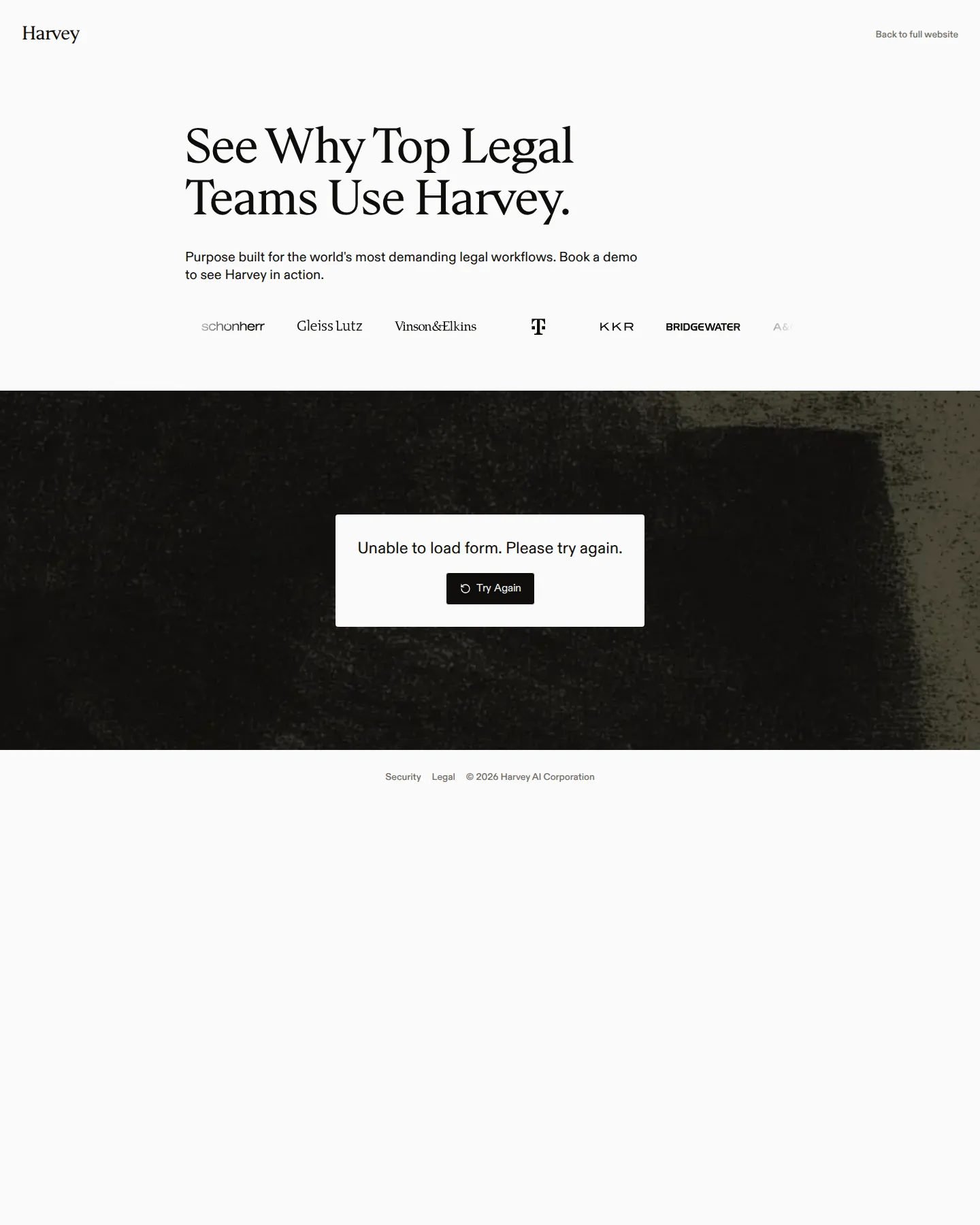
- · Harvey publishes no pricing page at all — harvey.ai/pricing returns a 404, and the public site is a pure demo-request funnel with enterprise logos where a rate card would be.
- · When Artificial Lawyer estimated Harvey's per-seat economics after the LexisNexis deal, Harvey publicly pushed back, calling the assumptions 'wildly off' while still declining to share actual rates.
- · Harvey crossed $100M ARR in August 2025 — roughly three years after founding — and reported ~$190M+ ARR by early 2026, on its way to an $11B valuation in March 2026.
Questions & answers
- What is Harvey's pricing model?
- Harvey uses a gated, enterprise, sales-led model. There is no public rate card and no self-serve checkout — every deal is quoted after a demo at harvey.ai/contact-sales. Billing is per-seat, typically on an annual commitment.
- Does Harvey offer a free tier?
- No. There is no free tier, no trial sign-up, and no self-serve plan on the public site. Access requires an enterprise contract negotiated with sales, and third-party sources report seat minimums of roughly 20 to 25 users.
- How much does Harvey cost per seat?
- Harvey does not publish prices. Third-party estimates vary widely and conflict — figures from $1,000 to $2,000+ per lawyer per month and a separate ~$1,200 per seat per year base have all been reported. Harvey called such estimates wildly off and declined to confirm rates.
- Is Harvey pricing usage-based or subscription?
- It is primarily per-seat subscription priced on annual contracts, not metered usage billing. However, the June 2025 LexisNexis partnership introduced per-retrieval cost economics behind the scenes that third parties expect to raise seat prices over time.
- Why doesn't Harvey publish its pricing?
- Harvey targets large law firms and corporate legal teams where deals are negotiated per firm by size, scope, and product mix. Gated pricing lets it tailor quotes, protect premium positioning, and avoid anchoring against competitors like CoCounsel.