AI Summary
About
Intercom Fin is the AI agent built by Intercom — the customer-service and engagement platform founded in 2011 — and trained specifically for customer service. Launched in July 2023 on top of GPT-4, Fin resolves customer conversations end to end across email, live chat, phone and in-app channels. Fin can run as part of the full Intercom suite or standalone on a third-party helpdesk such as Salesforce or Zendesk.
Fin matters disproportionately for pricing analysis because it popularized the outcome-based model for AI support: instead of charging per seat or per conversation, Intercom charges only when Fin actually resolves an issue. That single decision — a flat $0.99 per resolution — has become the reference point the entire CX-agent category (Decagon, Sierra, Forethought, Zendesk) is now measured against.
For the most current information, see Fin pricing.
Pricing summary : How Intercom Fin’s pricing model works
Fin has two stacked components: an outcome meter and an optional seat subscription.
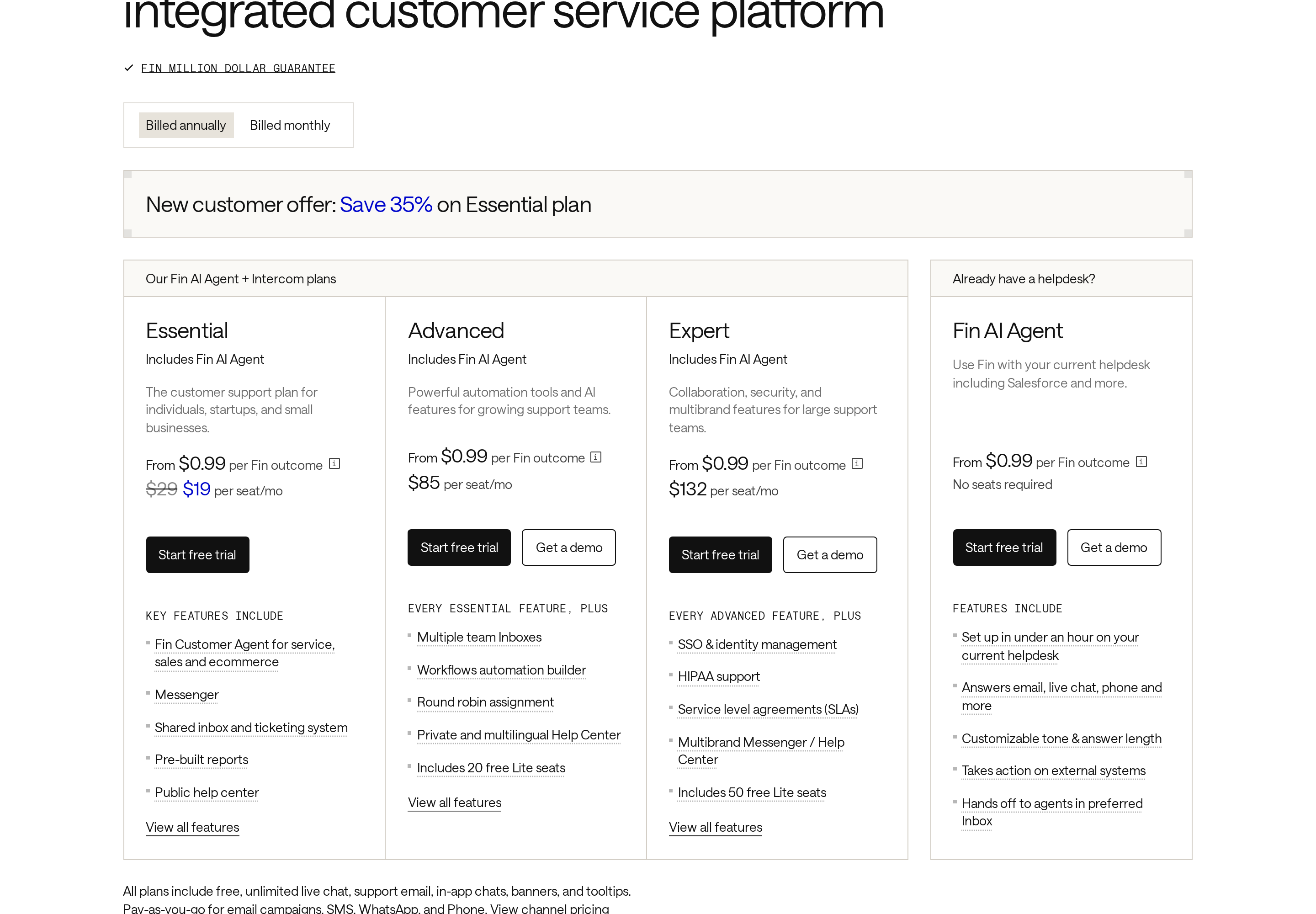
- The outcome meter is the headline: $0.99 per Fin outcome (resolution). Per Intercom, an outcome is billed when “Fin resolves the issue end to end, or successfully executes a Procedure you’ve configured to end in a handoff to a human or a workflow.” Conversations Fin cannot resolve are not charged.
- The seat subscription applies only if you adopt the Intercom platform. Three tiers — Essential ($29/seat/mo), Advanced ($85/seat/mo), Expert ($132/seat/mo) when billed annually — determine the human agent experience; all three include Fin and bill outcomes at the same $0.99. Billed monthly, the same tiers cost more: Essential $39, Advanced $99, Expert $139. As of this capture a limited-time new-customer offer takes 35% off Essential annual (down to $19/seat/mo) and 25% off monthly (down to $29/seat/mo).
- Standalone, Fin needs no seats at all: $0.99 per outcome on your current helpdesk (50-outcome/month minimum).
What makes this different: Intercom decoupled the AI from the seat. You can pay Intercom $0.99 per resolution while your humans live entirely inside Salesforce or Zendesk — Intercom turned a competitor’s helpdesk into a Fin distribution surface. The outcome price is flat and public, which is unusual: most enterprise CX-AI vendors keep per-resolution rates behind a sales call.
Pricing by product
| Plan | Price (annual) | Price (monthly) | Outcome price | Best for |
|---|---|---|---|---|
| Fin standalone (any helpdesk) | No seats required | No seats required | $0.99 per outcome (min. 50 outcomes/mo) | Teams keeping Salesforce/Zendesk |
| Essential | $29 per seat/mo | $39 per seat/mo | $0.99 per Fin outcome | Startups & small businesses |
| Advanced | $85 per seat/mo | $99 per seat/mo | $0.99 per Fin outcome | Growing support teams |
| Expert | $132 per seat/mo | $139 per seat/mo | $0.99 per Fin outcome | Large support teams (SSO, HIPAA, SLAs) |
Sales motions across products: PLG / self-serve for Essential and Advanced (free trial, pay by card); sales-led for Expert and large deployments.
Seat prices shown both ways; the lower number is billed annually. A limited-time new-customer offer takes 35% off Essential annual ($29 → $19/seat/mo) and 25% off monthly ($39 → $29/seat/mo). All plans include free, unlimited live chat, support email, in-app chats, banners and tooltips. Email campaigns, SMS, WhatsApp and Phone are pay-as-you-go on top. Startups can apply for the Early Stage Program (93% off Intercom plus a full year of Fin free).
Add-ons
| Add-on | Price | Includes |
|---|---|---|
| Pro | $99 /mo | CX Score, Topics, Monitors, Custom Scorecards; analysis of 1,000 conversations/mo |
| Copilot (bundled with Intercom) | $29 per agent/mo | In-inbox AI assistant, unlimited usage; free in 10 Copilot + 10 AI-translation conversations/agent/mo |
| Copilot (Fin standalone surface) | $35 per user/mo | Same assistant, priced higher when bought via fin.ai/pricing rather than the bundled Intercom plan |
| Proactive Support Plus | $99 /mo | Posts, Checklists, Product Tours, Surveys; 500 messages sent/mo |
Sales motions: PLG / self-serve for Essential and Advanced (start a free trial, pay by card); sales-led for Expert and large deployments.
Hidden costs : What Intercom Fin users actually pay
The advertised $0.99 is clean, but a real bill stacks several meters. Example: a 10-agent team on Advanced resolving 3,000 conversations/mo with Fin.
| Line item | Monthly cost |
|---|---|
| 10 Advanced seats ($85) | $850 |
| 3,000 Fin outcomes @ $0.99 | $2,970 |
| Copilot ($29/agent × 10) | $290 |
| Pay-as-you-go channels (SMS/WhatsApp/Phone) | Variable |
| Estimated total | ~$4,110 + channels |
Want to estimate your own Intercom Fin bill? Use the Intercom Fin pricing calculator to model resolutions, seats and add-ons.
For the mechanics of metering and invoicing usage like this, see usage invoicing and billing cycles. The watch-outs: (1) the outcome meter scales with success — the better Fin works, the more you pay, so high-deflection teams can see Fin costs exceed seat costs; (2) add-ons (Pro, Copilot, Proactive) are separate line items; (3) channels are pay-as-you-go beyond included messaging.
Pricing evolution : Intercom Fin pricing history and changes
Cadence
| Period | Price changes | Product / SKU additions | Notes |
|---|---|---|---|
| 2023 | Fin launches at $0.99/resolution | Fin AI Agent | Defined the outcome-based category |
| 2024 | $0.99 held | Fin standalone on third-party helpdesks | Decoupled outcomes from seats |
| 2026 | $0.99 held | Pro / Copilot / Proactive add-ons | Stable headline; richer add-on stack |
Tracked range: 2023–present. The $0.99 outcome price has been remarkably stable since launch.
Notable changes
- 2023-07 — Fin launches at $0.99 per resolution, establishing the outcome-based benchmark.
- 2024-10 — Fin made available standalone on existing helpdesks with no Intercom seats required.
- 2026-06-11 — Pricing confirmed: $0.99 per outcome across Essential/Advanced/Expert plus standalone; Fin million-dollar guarantee headlined.
What’s unique : Intercom Fin’s distinctive pricing mechanics
1. Flat, public per-resolution price. $0.99 per outcome is published — a rarity in enterprise CX AI, where rivals keep per-resolution rates behind sales. It made Fin the category’s price anchor.
2. Pay only for success. Billing fires only on end-to-end resolution or a configured procedure ending in handoff. Unresolved conversations are free, aligning Intercom’s revenue with the customer’s stated value metric.
3. AI unbundled from seats. Standalone Fin runs on Salesforce or Zendesk with no Intercom seats — Intercom monetizes the outcome even when the human workflow lives on a competitor’s platform.
Strengths & weaknesses
| Strengths | Weaknesses |
|---|---|
| Transparent, flat $0.99 outcome price — easy to model | Cost scales with Fin’s success; high-volume deflection can be expensive |
| Pay-for-success aligns vendor and buyer incentives | ”Resolution” definition is vendor-controlled; disputes possible at the margin |
| Standalone option avoids platform lock-in | Add-ons + pay-as-you-go channels make total bill multi-meter |
Billing UX : Intercom Fin billing controls and transparency
- Billing-period toggle — The pricing page has a “Billed annually / Billed monthly” switch; annual is the lower number on every seat tier (Essential $29 vs $39, Advanced $85 vs $99, Expert $132 vs $139).
- Usage controls — Per the pricing page, Fin usage is managed with “configurable alerts, limits, and real-time reporting”; outcome counts and resolution rates are surfaced in Intercom reporting.
- Billing controls — Self-serve sign-up with a free trial; pay by card for Essential/Advanced. Add-ons are included during the free trial and can be added or removed anytime.
- Estimators — A cost-estimate tool (“Get an estimate based on your needs”) and an ROI calculator are offered on the pricing page.
- Discount programs — A limited-time new-customer offer (35% off Essential annual, 25% off monthly) and an Early Stage startup program (93% off Intercom plus a full year of Fin free) are surfaced inline.
- Payment options — Card for self-serve; invoice/sales-assisted billing for Expert and enterprise. Local-currency payment is supported. Seats billed annually (monthly available); the Fin million-dollar guarantee underwrites outcome value.
Strategic wins : Why Intercom Fin’s pricing decisions worked
1. Owning the category anchor
By publishing $0.99 per resolution first, Intercom set the number every competitor now references. See outcome-based pricing trends.
2. Aligning price with the buyer’s metric
Charging only on resolution maps revenue to the value support leaders actually buy — deflected tickets. Related: choosing the right usage metric and how AI companies are shifting from per-user licenses.
3. Distribution via competitors’ helpdesks
Standalone Fin lets Intercom monetize accounts that will never leave Salesforce or Zendesk — expanding the addressable base without a platform migration.
Areas to improve : Gaps in Intercom Fin’s pricing approach
1. Bill predictability at scale
Because the meter rewards success, fast-growing deflection can produce a larger-than-expected Fin line item. See bill shock and cost unpredictability.
2. Resolution-definition transparency
The exact boundary of a billable “outcome” is vendor-defined; buyers want clearer audit trails on what did and didn’t count.
3. Multi-meter complexity
Seats + outcomes + add-ons + pay-as-you-go channels mean the simple $0.99 headline understates total cost; clearer all-in modeling would help.
Monetization stack & signals : how Intercom Fin builds & buys its revenue engine
Buys 7 Builds 0 15 open roles
Intercom buys its monetization stack — Stripe Billing meters and invoices the $0.99 outcome, Salesforce CPQ quotes it — but staffs a dedicated Team Billing plus a Pricing & Packaging engineering group building the internal APIs that wire those vendors into the outcome meter.
-
“Partner with Senior and Staff Engineers to shape and execute the technical strategy across subscription management, metering, invoicing, and integrations (e.g., Stripe Billing).”
-
“...the integrations that wire pricing intent into billing reality across Stripe, Salesforce CPQ, and internal APIs.”
-
“...integrations that wire pricing intent into billing reality across Stripe, Salesforce CPQ, and internal APIs.”
-
“Own and continuously improve operational systems and tools - such as RocketLane and Salesforce - that power day-to-day execution.”
-
“You have built robust, scalable integrations between billing and an ERP system, preferably Netsuite.”
-
“dbt and Snowflake experience are a big plus.”
-
“Experience with orchestration tools (e.g., DBT, Airflow) for deploying reliable data workflows.”
- Enterprise Customer Success Manager Customer success Jun 16, 2026
- Scaled Customer Success Manager Customer success Jun 16, 2026
- Senior Customer Success Manager Customer success Jun 16, 2026
- Senior Deal Desk Manager MonetizationDeal desk Jun 12, 2026
- Senior Analytics Engineer Data platform Jun 12, 2026
- Senior GTM Data Analyst Data platform Jun 12, 2026
- Director, Sales Strategy & Planning RevOps Jun 2, 2026
- Senior Manager, AI Product Sales Strategy & Operations RevOps Jun 2, 2026
- Professional Services Operations Manager RevOps Jun 2, 2026
- Senior Engineering Manager - Team Billing Billing engineeringMonetization Jun 1, 2026
- Senior Product Engineer - Pricing & Packaging Billing engineeringMonetization Jun 1, 2026
- Staff Product Engineer - Growth Monetization Jun 1, 2026
- Relationship Manager, MidMarket Retention Jun 1, 2026
- Account Manager (Commercial) Retention Jun 1, 2026
- Manager, Relationship Managers (MidMarket) Retention Jun 1, 2026
Signals reviewed · derived from public job posts
Job postings fill and close over time — once a posting is filled we keep it as a dated citation (the quoted evidence remains); use View open roles for current listings.
Key takeaways
- $0.99 per resolution is the canonical outcome price — the benchmark for the whole AI-support category.
- You pay only when Fin succeeds — unresolved conversations are free.
- Fin runs standalone or bundled — no Intercom seats required to use the outcome meter.
- Seats add platform value at $29 / $85 / $132 per agent/mo, all including Fin.
- Total cost is multi-meter — model seats, outcomes, add-ons and channels together.
UBP implications
- Outcome metering aligns incentives but transfers volume risk to the buyer as the agent improves.
- A flat, public per-outcome price is a powerful go-to-market wedge in a sales-led category.
- Decoupling the AI meter from the seat lets vendors monetize accounts on rival platforms — a distribution lesson for any usage-based product.
Sources
- Fin pricing page (accessed 2026-06-30)
- Intercom pricing page (accessed 2026-06-30)
- Fin AI Agent overview (accessed 2026-06-30)
- Captured pricing text:
public/images/blueprint/intercom-fin/2026-06-30-Intercom pricing.txt,public/images/blueprint/intercom-fin/2026-06-30-Fin pricing.txt
Bottom line
Intercom Fin is the reference implementation of outcome-based AI-support pricing: a flat, public $0.99 per resolution, billed only on success, usable standalone or atop $29–$132 Intercom seats. It is the number the rest of the CX-agent market is benchmarked against. Browse the pricing blueprint for more fully-researched profiles.
Want to compare Intercom Fin against other customer-service AI companies? Browse the pricing blueprint.
Pricing timeline : Major events on a vertical axis
Each milestone below corresponds to a public pricing change, product launch, or material adjustment. Major events use a filled marker; minor adjustments use a faded one.
List prices held; new-customer Essential promo
Re-capture confirms $0.99 per outcome and Essential/Advanced/Expert seats unchanged ($29/$85/$132 annual; $39/$99/$139 monthly). A limited-time new-customer offer (35% off Essential annual to $19, 25% off monthly to $29) and a startup program ($6,500 Fin AI + 93% off) are now headlined.
Outcome definition + bundle confirmed
Pricing page confirms $0.99 per Fin outcome across Essential ($29), Advanced ($85) and Expert ($132) seat tiers, plus standalone no-seat option and the Fin million-dollar guarantee.
Fin standalone on third-party helpdesks
Fin made available to run on existing helpdesks (Salesforce, Zendesk, etc.) at $0.99 per outcome with no Intercom seats required, decoupling the outcome meter from the platform subscription.
Fin launches at $0.99 per resolution
Intercom introduced Fin (GPT-4 powered) with a then-novel flat $0.99-per-resolution outcome price, helping define the outcome-based pricing category for AI support agents.
- · Fin's $0.99-per-resolution launch in 2023 is widely credited with kicking off the outcome-based pricing wave in AI customer support.
- · Fin only bills for resolved issues — unresolved conversations are free, aligning Intercom's revenue with customer-stated value.
- · Fin can be deployed standalone on Salesforce or Zendesk with no Intercom seats, turning a platform competitor's helpdesk into a Fin distribution channel.
Questions & answers
- What is Intercom Fin's pricing model?
- Fin is outcome-based: you pay $0.99 per resolution (called a 'Fin outcome'). It can run standalone on your existing helpdesk with no seats required, or bundled with Intercom's Essential/Advanced/Expert per-seat plans.
- How much does Intercom Fin cost per resolution?
- $0.99 per Fin outcome. A resolution is counted only when Fin resolves the issue end to end or successfully executes a configured procedure that ends in a handoff to a human or a workflow.
- Does Intercom Fin require buying Intercom seats?
- No. Fin can be used standalone with helpdesks like Salesforce and Zendesk at $0.99 per outcome with no seats required. If you want the full Intercom platform, seats start at $29/mo (Essential).
- What counts as a Fin resolution?
- Per Intercom, an outcome is billed when 'Fin resolves the issue end to end, or successfully executes a Procedure you've configured to end in a handoff to a human or a workflow.' Conversations Fin cannot resolve are not charged.