AI Summary
About
Iterable is an AI-powered cross-channel customer engagement platform for enterprise marketing teams. From a single system it orchestrates messaging across Email, SMS, Web, In-App, OTT and Push, turning warehouse and behavioral data into personalized lifecycle campaigns. Its own positioning line: “the AI customer engagement platform built for enterprise scale, loved by teams, and trusted by global brands.”
The customer base skews to well-known consumer brands operating at scale — Nando’s, Credit Karma, The Washington Post, Morning Brew, Redfin, Therabody and RealSelf all appear as reference logos. This enterprise focus shapes the go-to-market: there is no self-serve signup, no free tier, and no public price grid. Prospects enter through a “Book a demo” or “Talk to Sales” flow whose stated purpose is to “get a pricing estimate.”
On scale: Iterable is a venture-backed private company founded in San Francisco in 2013 by Andrew Boni and Justin Zhu. It has raised roughly $310M across its rounds — a $50M Series C (March 2019), a $60M Series D (December 2019), and a $200M Series E (June 2021) that valued the company at $2 billion (led by Silver Lake and Adams Street). It is a recognized G2 Marketing Automation Leader, rated 4.5 stars across roughly 691 reviews, with G2 itself listing its price as simply “on request.”
Competitively, Iterable sits alongside Braze, Klaviyo, and legacy marketing clouds (Salesforce/Adobe) in the cross-channel engagement category. Its current wedge is “Nova Intelligence,” an agentic-AI layer (Nova Agent, Predictive Audiences, Send Time Decisioning, Brand Affinity, Channel Decisioning) bundled into the platform rather than sold as a separate AI add-on. Unlike Klaviyo — which publishes a self-serve, contact-based price grid — Iterable keeps every number behind a sales conversation, closer to Braze’s enterprise, quote-led motion.
Pricing summary : How Iterable’s quote-only, sales-negotiated pricing works
Iterable uses a quote-only packaged-subscription model. There is no published price anywhere — the effective pricing surface is a “Talk to Sales” form — so the model is described by its two negotiation dimensions:
- Audience size (MAU): Packages are sized by the number of monthly active users / contacts a brand engages. This is the primary lever that moves a quote up or down; no per-MAU rate is published.
- Channel breadth: The contract scopes which of the six channels — Email, SMS, Web, In-App, OTT, Push — are in play, plus the level of the Nova Intelligence AI layer bundled in. Broader channel coverage and higher AI entitlements land you in a higher package (Growth → Premier → Enterprise per Iterable’s sales collateral).
What makes this different: Unlike self-serve peers such as Klaviyo that expose a public MAU/contact-based grid, Iterable keeps every number behind sales — even its “pricing estimate” is gated — betting that enterprise buyers value a packaged, negotiated sales-led deal over a transparent public grid. The value metric it negotiates around is closest to active-user (MAU) pricing wrapped inside a subscription package.
Pricing by product
Iterable is sold as a single platform, not separately-priced product lines, and no price is published for any tier. The table below documents the packaging observed in Iterable’s sales materials and site — all figures are quote-only.
Iterable platform (packaged tiers)
| Tier | Price | Included | Key mechanics |
|---|---|---|---|
| Growth | Contact us | Cross-channel messaging (Email, SMS, Web, In-App, OTT, Push) packaged for a defined MAU band | Sales-led, quoted; entry package in Iterable’s collateral |
| Premier | Contact us | Everything in Growth plus higher MAU/channel entitlements and Nova Intelligence AI bundled | Sales-led, quoted; mid package |
| Enterprise | Contact us | Everything in Premier plus enterprise data & scale, advanced governance and support | Sales-led, quoted; annual commitment |
Sales motions across products: none self-serve — every tier is sales-led / quoted via the “Talk to Sales” form.
Nova Intelligence (AI) — bundled, not separately priced
Iterable’s AI capabilities ship under the Nova Intelligence brand and are presented as part of the platform, with no standalone AI price visible:
| AI capability | What it does | Pricing |
|---|---|---|
| Nova Agent | Agentic AI that generates copy/handlebars logic, builds journeys and runs experiments | Bundled into platform; Contact us |
| Nova Predictive Audiences | Predicts churn risk and high-value opportunities to target before customers disengage | Bundled into platform; Contact us |
| Send Time Decisioning | Automatically picks optimal send time per individual | Bundled into platform; Contact us |
| Brand Affinity | Scores individual affinity to guide targeting | Bundled into platform; Contact us |
| Channel Decisioning | Automatically picks optimal channel and frequency per individual in real time | Bundled into platform; Contact us |
Nova Intelligence entitlements vary by negotiated package (referenced as bundled from Premier upward in Iterable’s collateral); no per-feature or per-inference AI price is published.
Hidden costs : The cost drivers a quote won’t show upfront
Because Iterable publishes no prices, the “hidden cost” here is the opacity itself — a buyer cannot self-estimate a bill and must model total cost of ownership around the levers below. There are no public dollar figures to tabulate; the drivers that move a negotiated quote are:
Enterprise cross-channel deployment (cost drivers)
| Line item | Cost driver |
|---|---|
| Base platform package | Sized by MAU band + channels in scope (Growth/Premier/Enterprise) |
| Additional channels (SMS, OTT, Push) | Broader channel activation can push you into a higher package |
| MAU growth over the contract term | Audience growth mid-term is the main lever for true-ups/upsell |
| Nova Intelligence (AI) entitlements | Higher AI tiers bundle from Premier upward; scope negotiated |
| Onboarding / implementation & support | Enterprise deals typically carry services and premium support |
The lesson: with no published rate card, Iterable’s real cost is a negotiated annual commitment where MAU growth and channel/AI scope — not a visible per-unit price — determine the number.
Want to estimate your own Iterable bill? Use the Iterable pricing calculator to model cost by monthly active users and channel mix while you request a quote.
Pricing evolution : A decade of quote-only pricing, from founding to the Nova AI era
Iterable has been sales-led and quote-only since its 2013 founding — there is no archival record of a public price grid. What has evolved is scale (a $200M Series E in 2021 at a $2B valuation) and packaging (the AI stack consolidating under the “Nova Intelligence” brand), not the underlying no-published-price posture. Wayback snapshots of the contact-sales page in May 2026 and June 2026 show the identical “Talk to Sales” quote form with no prices, confirming the posture is stable rather than newly adopted.
Cadence
| Quarter | Price changes | Product / SKU additions | Notes |
|---|---|---|---|
| 2021 Q2 | 0 | 0 | 2021-06 $200M Series E at a $2B valuation (Silver Lake, Adams Street), ~a month after cofounder-CEO Justin Zhu’s ouster; pricing stays fully quote-only |
| 2026 Q3 | 0 | 1 | 2026-07-12 capture: still fully quote-only (no public grid); AI consolidated + bundled under the Nova Intelligence brand |
Tracked range: 2013–2026-07-12. No public price grid has ever been published, so there are no dollar-value price changes to track; quarters not listed had no observed packaging change. Historical cadence is sparse because pricing is negotiated per contract rather than posted.
Notable changes
- 2013 — Iterable founded by Andrew Boni and Justin Zhu; enterprise, sales-led, quote-only from the start.
- 2021-06 — $200M Series E at a $2 billion valuation (led by Silver Lake and Adams Street), announced ~a month after cofounder-CEO Justin Zhu’s departure; the raise funds an up-market push but no public pricing follows (source: Forbes, 2021-06-15).
- 2026-07-12 — Blueprint capture: Iterable confirmed sales-only with no public price grid; AI features consolidated and bundled under the “Nova Intelligence” layer (Nova Agent, Predictive Audiences, Send Time Decisioning, Brand Affinity, Channel Decisioning).
The 2021 CEO ouster in detail
Iterable’s most-covered corporate event is not a price move but a leadership one. In spring 2021 the company terminated cofounder-CEO Justin Zhu, citing “multiple violations of Iterable’s Employee Handbook, policies and values”; Bloomberg later reported the termination was tied primarily to Zhu having microdosed LSD before a 2019 meeting, and Zhu’s representatives questioned potential anti-Asian bias in the decision. Cofounder Andrew Boni stepped in as CEO and, roughly a month later, closed the $200M Series E at a $2B valuation with talk of an IPO in 18–24 months. The episode matters to a pricing blueprint because it bracketed the moment Iterable scaled hardest into the enterprise — and that up-market push reinforced, rather than relaxed, the fully sales-gated, no-public-price model the company still runs today.
What’s unique : Full price opacity plus bundled agentic AI
1. Zero published pricing — even the “estimate” is gated. Iterable exposes no price grid at all; /pricing and /plans 404, and the only pricing surface is a “Talk to Sales” form whose first promise is to “get a pricing estimate.” That is a stronger form of gating than most enterprise SaaS, which usually publish entry-tier prices and reserve only the top tier for sales.
2. AI bundled, not surcharged. Where many vendors are launching separately-metered AI SKUs, Iterable folds its entire AI stack into the platform under one “Nova Intelligence” brand — Nova Agent, Predictive Audiences, Send Time Decisioning, Brand Affinity, Channel Decisioning — with no visible standalone AI price.
3. Packaging by MAU + channels, not seats. The negotiation dimensions are audience size and channel breadth across six channels, aligning cost with reach rather than user headcount — a value metric closer to usage-based principles than pure seat-based licensing.
Strengths & weaknesses
| Strengths | Weaknesses |
|---|---|
| Single contract spans six channels (Email/SMS/Web/In-App/OTT/Push) | No public pricing — buyers cannot self-estimate cost |
| AI (Nova Intelligence) bundled rather than surcharged | No free tier or self-serve entry; every deal is sales-led |
| Packaging aligned to reach (MAU + channels), not seat count | Opaque tier boundaries; Growth/Premier/Enterprise unpriced |
| Strong enterprise reference base (Credit Karma, WaPo, Redfin) | High-touch motion raises evaluation friction for smaller teams |
Billing UX : The sales-gated quote flow that stands in for a pricing page
Iterable exposes no self-serve billing surface — no checkout, no plan picker, no public price grid. The entire “billing UX” a prospect sees is the quote-request flow:
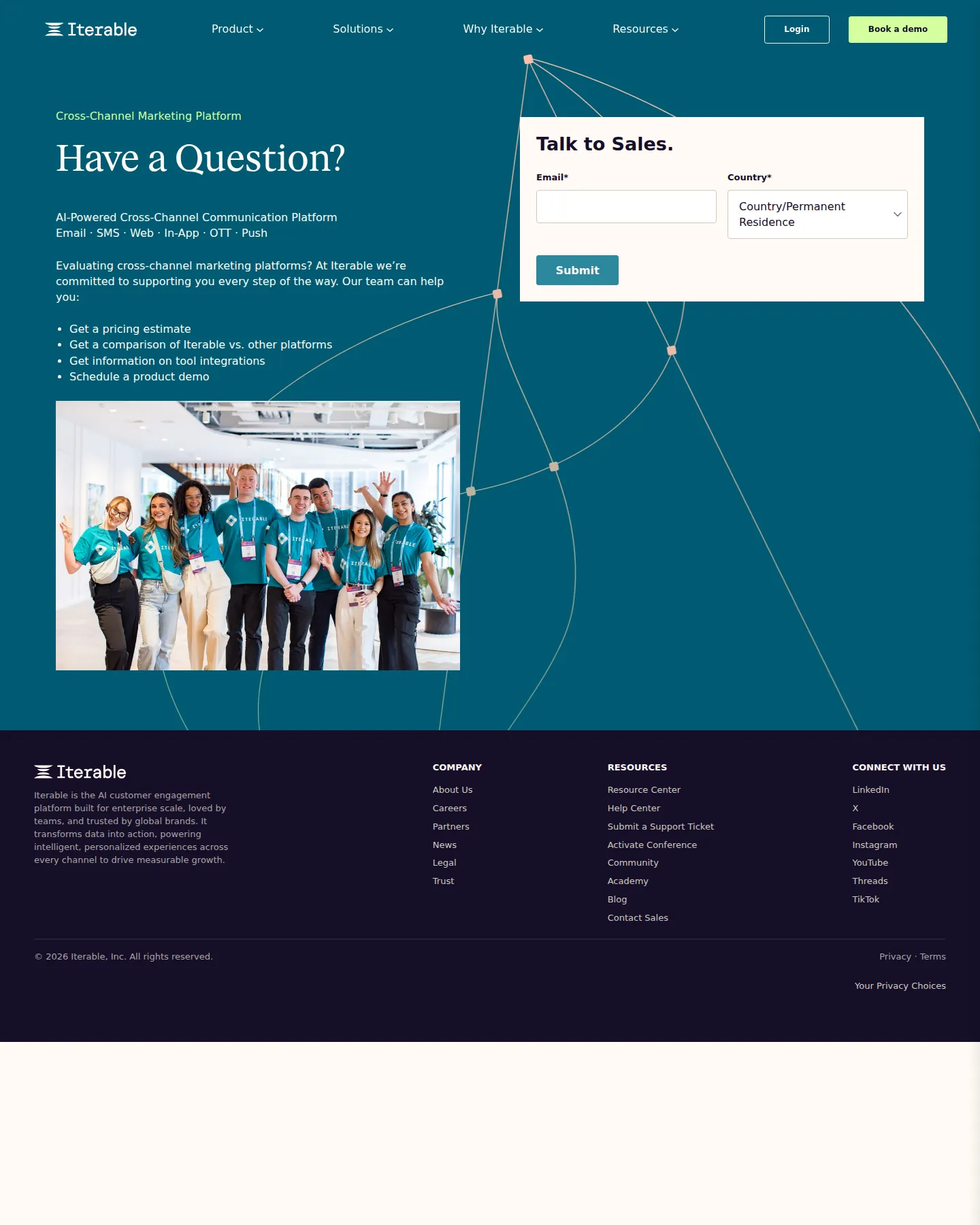
- “Talk to Sales” quote form — the canonical pricing surface at
iterable.com/contact-sales/, with required Email and Country/Permanent Residence fields and a Submit button; its listed outcomes are “Get a pricing estimate,” “Get a comparison of Iterable vs. other platforms,” “Get information on tool integrations” and “Schedule a product demo.” - “Book a demo” call-to-action — the primary conversion button repeated across the product and AI pages, routing into the same sales conversation rather than any online purchase path.
- “Take a tour” interactive walkthrough — a self-guided product tour offered on the platform page in place of a trial or sandbox, letting evaluators explore capabilities without pricing.
- No published invoicing/metering controls — because pricing is a negotiated annual contract, there is no visible usage dashboard, overage meter, or self-serve upgrade/downgrade control on the public site.
Strategic wins : Where the sales-only, AI-bundled model pays off
1. Bundling AI under one “Nova Intelligence” brand avoids surcharge friction
By folding agentic AI into the platform instead of launching a metered AI SKU, Iterable sidesteps the “AI tax” resentment that separately-priced AI add-ons can trigger. This positions AI as table-stakes value inside the existing package, a contrast to the outcome- and usage-based AI pricing patterns emerging across SaaS.
2. Packaging by MAU + channels ties price to delivered reach
Sizing deals by audience and channel breadth aligns cost with the value a marketing team actually gets, closer to usage-based principles than seat licensing — and it gives sales a clean expansion lever as customer audiences grow.
3. Enterprise-only focus concentrates go-to-market on high-ACV accounts
Skipping self-serve and free tiers keeps Iterable’s motion aimed squarely at large consumer brands, where high-touch selling and multi-channel deals justify the value-metric approach and larger annual contracts.
Areas to improve : Transparency gaps that raise evaluation friction
1. Publish at least an entry price or MAU-band starting point
Full opacity — no grid, gated “estimate” — forces every prospect into sales before they can judge fit, losing the self-qualifying traffic that transparent peers capture. Publishing even a “starting at” figure or an MAU-band indicator (as Klaviyo does) would reduce funnel friction while keeping enterprise deals bespoke.
2. Clarify what Nova Intelligence is included at each tier
Because AI is “bundled” but tier boundaries are unpublished, buyers cannot tell which Nova capabilities come with Growth vs. Premier vs. Enterprise. A public entitlement matrix would let evaluators see AI value without a sales call.
3. Offer a self-serve or trial on-ramp for smaller teams
The all-or-nothing sales motion cedes the mid-market entirely to self-serve peers. A lightweight paid entry package or time-boxed trial — echoing how usage-based migration paths capture early-stage buyers — would widen the top of the funnel without diluting enterprise deals.
Monetization stack & signals : how Iterable builds & buys its revenue engine
Buys 3 Builds 0 1 signal role
Buys the quote-to-cash spine — Salesforce over a vendor-unnamed CPQ — with the deal desk itself the tell below. Its 2022 privacy policy named Stripe and Zuora for card processing; the current one names no vendor at all.
-
“Manage sales activity including monthly and quarterly forecasting of revenue in Salesforce and achieve quota quarterly”
-
“Iterable uses third party partners, Stripe and Zuora, for credit card processing which may require and store your billing information.”
-
“Iterable uses third party partners, Stripe and Zuora, for credit card processing which may require and store your billing information.”
-
“Help support sales with quote and order form creation, including making edits inside of the CPQ system and manually updating order forms”
- Deal Desk Analyst - Contract Deal desk seen Aug 12, 2026
A deal desk that hand-edits quotes inside a vendor-unnamed CPQ — the quote-to-cash spine the sales-only motion predicts — staffed as a 6-month contract, not a permanent build-out.
“Help support sales with quote and order form creation, including making edits inside of the CPQ system and manually updating order forms”
Signals reviewed · derived from public job posts, product docs
Job postings fill and close over time — once a posting is filled we keep it as a dated citation (the quoted evidence remains); use View open roles for current listings.
Key takeaways
- Opacity is a deliberate go-to-market choice, not an oversight. Iterable routes 100% of pricing through sales because its buyer is an enterprise marketing org, betting negotiated deals beat a public grid for its segment.
- Bundling AI can be a pricing strategy in itself. Presenting AI as included value (Nova Intelligence) rather than a metered surcharge is a defensible alternative to the AI-SKU trend.
- Choose a value metric that mirrors delivered reach. MAU + channels ties cost to audience and orchestration breadth, a cleaner value metric than seats for a messaging platform.
- Full gating trades funnel breadth for deal control. No free tier or public price filters out smaller buyers but concentrates sales effort on high-value enterprise accounts.
- Reference brands substitute for price signals. With no numbers to anchor on, Iterable leans on marquee logos (Credit Karma, WaPo, Redfin) to establish enterprise credibility.
UBP implications
- Packaged “quote-only” is a legitimate stop short of pure metering. Iterable shows that a vendor can adopt usage-aligned value metrics (MAU, channels) while still wrapping them in negotiated packages rather than exposing per-unit rates.
- AI-as-included challenges the AI-surcharge default. As peers add per-inference or per-resolution AI meters, bundling AI into the base package is a competing narrative worth watching in usage-based pricing strategy.
- Transparency is a spectrum, and the enterprise end tolerates opacity. For large-account, high-ACV marketing software, a fully sales-gated model persists — a reminder that public price grids are not universal even as UBP transparency norms spread.
Sources
- Iterable “Talk to Sales” / contact-sales page (accessed 2026-07-12)
- Iterable platform overview (accessed 2026-07-12)
- Iterable AI (Nova Intelligence) page (accessed 2026-07-12)
- Iterable blog (accessed 2026-07-12)
Bottom line
Iterable is one of the most price-opaque companies in the corpus: no public grid, no free tier, and a “Talk to Sales” form standing in for a pricing page. Its packaged tiers (Growth, Premier, Enterprise) are sized by MAU and channel breadth and negotiated per deal, while its full AI stack ships bundled under the Nova Intelligence brand rather than as a metered surcharge — a deliberate enterprise-first posture that trades funnel transparency for deal control.
Want to compare Iterable against other marketing-automation pricing? Browse the pricing blueprint.
Pricing timeline : Major events on a vertical axis
Each milestone below corresponds to a public pricing change, product launch, or material adjustment. Major events use a filled marker; minor adjustments use a faded one.
Quote-only packaging confirmed; AI consolidated + bundled under Nova Intelligence
Iterable remains fully sales-gated — no public price grid (Wayback snapshots of contact-sales in May and June 2026 show the same quote-only 'Have a Question? / Talk to Sales' page), tiers packaged by MAU + channels and quoted via a 'Talk to Sales' form. The AI layer is consolidated under the 'Nova Intelligence' brand (Nova Agent, Predictive Audiences, Send Time Decisioning, Brand Affinity, Channel Decisioning) and bundled into the platform rather than sold as a separate metered SKU.
$200M Series E at a $2B valuation cements the enterprise, sales-led model
Iterable raises a $200M Series E led by Silver Lake and Adams Street at a $2 billion valuation (~$310M raised to date), announced roughly a month after cofounder-CEO Justin Zhu's ouster and Andrew Boni's move to CEO. The capital funds an enterprise up-market push that keeps pricing fully quote-only — no public grid emerges. Source: Forbes, 2021-06-15.
Founded as an enterprise cross-channel messaging platform
Iterable is founded in San Francisco by Andrew Boni and Justin Zhu as a growth-marketing / cross-channel messaging platform. From the outset it goes to market sales-led with negotiated, quote-only enterprise contracts rather than self-serve pricing.
- · Iterable publishes no public price grid at all — /pricing and /plans both 404, and the only pricing surface is a 'Talk to Sales' quote form whose first bullet literally reads 'Get a pricing estimate'. G2 also lists Iterable's pricing simply as 'on request'.
- · The platform spans six channels out of one contract — Email, SMS, Web, In-App, OTT and Push — which is why deals are packaged and quoted rather than listed.
- · Iterable's AI layer, 'Nova Intelligence' (Nova Agent, Nova Predictive Audiences, Send Time Decisioning, Brand Affinity, Channel Decisioning), is bundled into the platform rather than sold as a separately-priced AI add-on.
Questions & answers
- How much does Iterable cost?
- Iterable does not publish public pricing. Cost is a custom annual quote sized by monthly active users (MAU) and the channels you activate; you request an estimate through Iterable's 'Talk to Sales' form.
- Does Iterable have a free plan or free trial?
- No. Iterable has no free tier and no self-serve signup — access begins with a sales conversation and a negotiated contract.
- What are Iterable's pricing tiers?
- Iterable's sales materials reference Growth, Premier and Enterprise packages, but none carry a published price — each is quoted based on MAU volume and the channels (Email, SMS, Web, In-App, OTT, Push) in scope.
- Is Iterable's AI (Nova Intelligence) priced separately?
- No visible separate AI SKU. Nova Intelligence — Nova Agent, Predictive Audiences, Send Time Decisioning, Brand Affinity and Channel Decisioning — is presented as bundled into the platform, with entitlements varying by negotiated package.
- How is Iterable pricing structured?
- It is a packaged subscription quoted per contract. The two headline dimensions are audience size (MAU) and channel breadth, wrapped into an annual commitment negotiated with sales.