AI Summary
About
Juicebox is an AI-powered recruiting and talent-sourcing platform built around PeopleGPT, a natural-language search engine that lets recruiters describe the candidate they want in plain English instead of building Boolean strings. The platform claims access to roughly 800 million profiles drawn from 30+ real-time data sources, layers AI filters and “Smart Profiles” on top of that index, and markets a “find candidates 7x faster” pitch. It is positioned for in-house talent teams and recruiting agencies that need to surface hard-to-find talent.
The product has expanded beyond search into outreach (email + AI templates, Gmail/Outlook mailboxes), contact enrichment (email and phone “contact credits”), CRM/ATS export, and a newer Juicebox Agents layer — autonomous data-analyst/sourcing agents that run in the background, sold as a $199/agent/month add-on. The page advertises 41 ATS and 21 CRM integrations (Greenhouse, Lever, Ashby, Workday, Salesforce, HubSpot, and others), plus a Chrome extension.
Juicebox markets itself as “the leading AI recruiting platform” and states it is trusted by 25,000 teams, recruiters, and hiring managers and works with 3,000+ companies ranging from Fortune 500 to boutique agencies; named logos on the demo page include Quora, Intuit Credit Karma, and Anyscale. Revenue, valuation, and headcount are not publicly disclosed. The company operates the product on the juicebox.ai marketing domain with the app and docs under juicebox.work.
Pricing summary : per-seat recruiting plans gated by contact and export credits
Juicebox uses a per-seat subscription model with four tiers and one usage add-on. Pricing scales primarily on bundled credit allowances and project/seat counts rather than pure metering:
- Per-seat monthly fee: Free ($0), Starter ($119/seat/mo), Growth ($199/seat/mo — marked POPULAR), and Business (Custom, quote-only). All prices are USD, per seat/month. The Monthly/Yearly toggle carries a “15% OFF” badge and drops Starter to $99/seat/mo and Growth to $179/seat/mo when billed yearly.
- Bundled “contact credits” and “export credits”: the metered dimensions that differentiate tiers. Free includes 5 one-off contact credits and 0 export credits; Starter includes 500 contact + 500 export credits/month; Growth includes 1,500 contact + 1,500 export credits per seat/month; Business is unlimited contact credits with a customizable export limit (2,250/seat/month listed with an asterisk). A contact credit returns all emails and phone numbers associated with a profile, and phone numbers are gated to Growth and above (3 credits each).
- Seats and projects: Free and Starter are 1 seat; Growth allows up to 5 paid seats; Business is custom. Active projects are trial-only on Free and unlimited on every paid plan, so the project count is no longer a gating dimension.
- Juicebox Agents add-on: $199 per agent/month, available on all paid plans, bundling unlimited contact + email credits for autonomous auto-email/auto-shortlist agents.
What makes this different: unlike pure seat SaaS, the real value metric is contact + export credits — searches are unlimited on every paid plan, so the meter that actually constrains usage is how many candidate profiles you can unlock and export, which is what pushes buyers up the tier ladder.
Pricing by product
PeopleGPT recruiting platform (Individual plans)
| Tier | Price | Included | Key mechanics |
|---|---|---|---|
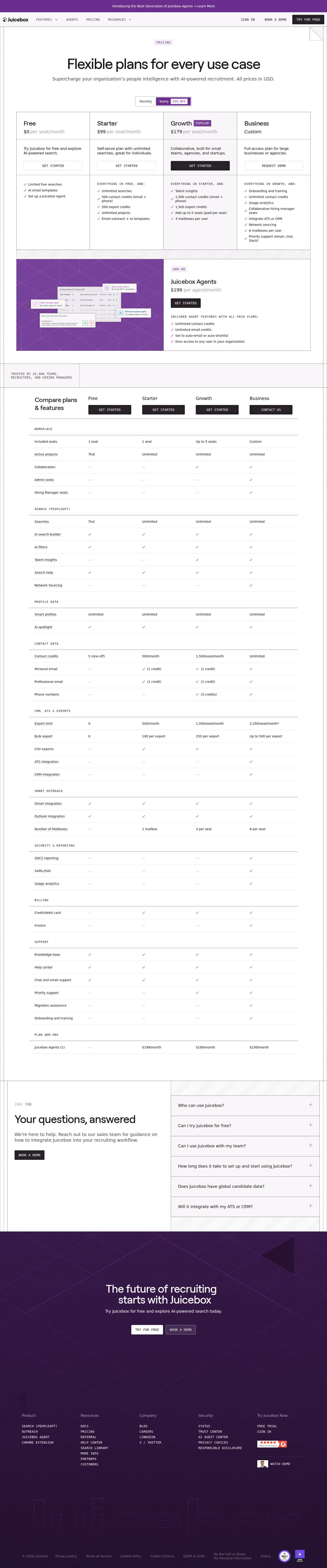
| Free | $0 per seat/mo | Limited free searches, AI email templates, set up a Juicebox Agent; 1 seat; trial projects; 5 one-off contact credits and 0 export credits | Trial of AI-powered search; effectively no contact data unlocked |
| Starter | $119 per seat/mo ($99 billed yearly) | Unlimited searches, 500 contact credits (email) + 500 export credits/mo, unlimited projects, email outreach + AI templates; 1 seat, 1 mailbox | Self-serve plan for individuals |
| Growth | $199 per seat/mo ($179 billed yearly) | Everything in Starter, plus: Talent Insights, 1,500 contact credits (email + phone) + 1,500 export credits/seat/mo, add up to 5 seats, 3 mailboxes/user | Marked POPULAR; built for small teams and agencies |
The Yearly-state plan card labels Starter’s 500 contact credits “(email + phone)” while the Monthly-state card labels them “(email)”; the feature-comparison matrix is the tie-breaker and shows phone numbers unavailable on Starter and gated to Growth at 3 credits each.
PeopleGPT recruiting platform (Business plan)
| Tier | Price | Included | Key mechanics |
|---|---|---|---|
| Business | Custom | Everything in Growth, plus: onboarding and training, unlimited contact credits, usage analytics, collaborative hiring-manager seats, ATS/CRM integration, network sourcing, 6 mailboxes/user, priority support (email, chat, Slack), data-analyst agent running 24/7; export limit 2,250/seat/month* (customizable) | Sales-led, quote-only via Request Demo |
Sales motions across products: PLG / self-serve for Free, Starter, and Growth (sign up online, card billing); sales-led for the Business plan (Request Demo email gate, invoice billing).
Juicebox Agents (add-on)
| Item | Price | Included | Availability |
|---|---|---|---|
| Juicebox Agents | $199 per agent/mo | Unlimited contact credits, unlimited email credits, set to auto-email or auto-shortlist, give access to any user in your org | Add-on on all paid plans (not Free) |
Credit and seat mechanics by tier
| Dimension | Free | Starter | Growth | Business |
|---|---|---|---|---|
| Included seats | 1 seat | 1 seat | Up to 5 seats | Custom |
| Active projects | Trial | Unlimited | Unlimited | Unlimited |
| Searches | Trial | Unlimited | Unlimited | Unlimited |
| Contact credits | 5 (one-off) | 500/month | 1,500/seat/month | Unlimited |
| Phone numbers | — | — | 3 credits each | Included |
| Export limit | 0 | 500/month | 1,500/seat/month | 2,250/seat/month* |
| Bulk export (per run) | 0 | 100 per export | 250 per export | Up to 500 per export |
| Mailboxes | — | 1 mailbox | 3 per seat | 6 per seat |
*Business export limit is listed as customizable; the asterisked 2,250/seat/month is the figure shown on the comparison table. The figures above are the pricing page’s own comparison matrix; Juicebox’s docs and help center still publish the pre-July-2026 contact-credit allowances (Starter 250/month, Growth 1,000/seat/month) and a 1,500/seat/month Business export limit, so the support surfaces lag the plan sheet. Network sourcing, hiring-manager seats, admin seats, ATS and CRM integration, SOC2 reporting, SAML/SSO, usage analytics, invoice billing, migration assistance, and onboarding and training are all gated to the Business plan via sales ([email protected]).
Hidden costs : seat fees plus the agent add-on inflate the headline price
The advertised $119 Starter headline understates what an active sourcer — or a small team running autonomous agents — actually pays. Two real-world examples:
Solo recruiter who wants autonomous sourcing
| Line item | Monthly cost |
|---|---|
| Starter plan (1 seat) | $119 |
| Juicebox Agents add-on (1 agent) | $199 |
| Total | $318 |
The Agents add-on costs more than the Starter seat it sits on top of — so the moment a single recruiter wants 24/7 auto-email sourcing, the effective price more than doubles versus the seat headline. The 2026-07-21 cut widened that gap rather than closing it: the agent went from 1.4x a Starter seat to 1.7x. It also quietly weakened the add-on’s own pitch, because “unlimited contact and email credits” is worth less against a seat that now bundles 500 credits instead of 250.
Three-person agency team on Growth
| Line item | Monthly cost |
|---|---|
| Growth plan, 3 seats × $199 | $597 |
| Juicebox Agents add-on (2 agents) | $398 |
| Total | $995 |
Three Growth seats now carry 4,500 bundled contact credits between them, up from 3,000 before 2026-07-21 — enough that credit exhaustion is no longer the first wall most agencies hit. What binds sooner is the structural ceiling: Growth caps at five paid seats, and phone numbers, ATS/CRM integration, SSO, and network sourcing all sit behind the Business gate. The practical effect of the credit increase is that the trigger for a sales-led quote has shifted from “we ran out of credits” to “we outgrew the seat cap or need the integrations” — a slower, less usage-driven path into the enterprise motion.
Want to estimate your own Juicebox bill? Use the Juicebox pricing calculator to model your monthly cost based on seats, contact/export credits, and the number of agents you run.
Pricing evolution : a seat-price step up, then a credit re-denomination that cut effective cost
Cadence
| Quarter | Price changes | Product / SKU additions | Notes |
|---|---|---|---|
| 2023 Q4 | 0 | 1 | PeopleGPT natural-language candidate search launches; product-led adoption begins. |
| 2025 Q3 | 0 | 1 | 2025-09-25 — $30M Series A led by Sequoia; Juicebox Agents (autonomous sourcing) positioned for scale. |
| 2026 Q2 | 1 | 0 | Starter ($139) and Growth ($199) list above the |
| 2026 Q3 | 1 | 0 | 2026-07-21 — Starter cut to $119/seat/mo ($99 yearly); Starter credits doubled to 500/500 and its 3-project cap removed; Growth credits raised to 1,500/1,500 per seat; Business export limit raised to 2,250/seat/mo. |
Tracked range: 2023-11–2026-07. No archived copy of the pricing page exists for the earlier period, so the 2025-to-2026 price step rests on third-party reviews citing lower Starter and Growth figures. Quarters not listed were not independently observed and are left unasserted rather than marked stable.
Notable changes
- 2023-11 — PeopleGPT launches as a natural-language search engine over ~800M profiles, replacing Boolean strings with plain-English candidate queries.
- 2025-09-25 — Juicebox announces a $30M Series A led by Sequoia ($36M total funding) on the back of $10M+ ARR and 2,500+ customers, with no dedicated sales team (Series A blog post).
- 2025 → 2026 Q2 — Starter rose from a ~$99/month figure and Growth from ~$129/seat/month (per 2025 third-party reviews) to $139 and $199 per seat/month; searches stayed unlimited while the credit allowances became the gating meter.
- 2026-07-21 — Starter was cut to $119/seat/month ($99 billed yearly) with double the bundled credits (500 contact + 500 export) and its 3-project cap lifted to unlimited projects; Growth held at $199 ($179 yearly) but its bundled credits rose 50% to 1,500 contact + 1,500 export per seat/month, and the Business export limit moved from 1,500 to 2,250/seat/month. The Juicebox Agents add-on did not move.
The July 2026 credit re-denomination in detail
The headline story of 2026-07-21 is a 14% cut to the entry seat. The real story is that Juicebox re-denominated the credit currency underneath every tier, which moved effective price far more than the sticker did:
| Tier (monthly) | Seat before → after | Contact credits before → after | Cost per unlocked contact |
|---|---|---|---|
| Starter | $139 → $119 | 250 → 500 | ~$0.56 → ~$0.24 (−57%) |
| Growth | $199 → $199 | 1,000 → 1,500 | ~$0.20 → ~$0.13 (−33%) |
Three things follow. First, Growth got a third cheaper without its price changing — any competitor comparison table that reads only the seat number records “no change.” Second, the Starter-to-Growth unit-economics gap narrowed from roughly 2.8x to 1.8x cost per contact, so the arithmetic that used to make Growth the obvious upgrade is materially weaker. Third, the export ladder was scaled rather than reshaped: Business moved from 1,500 to 2,250 exports precisely because Growth moved from 1,000 to 1,500, preserving the same 1.5x headroom. Combined with lifting Starter’s 3-project cap, the change leaves exactly one meter doing all the tier-separation work — credits — with seats, phone access, and integrations as the only other gates.
What’s unique : unlimited search, but the meter is who you can actually contact
1. Search is free; contact is the value metric — and the credit bundle is the price lever. Unlike legacy sourcing tools that ration searches, every paid Juicebox plan offers unlimited natural-language search. The dimension that actually constrains usage is contact credits (unlocking a profile’s email/phone) and export credits (pushing it to your ATS/CRM); the 2026-07-21 repricing removed the last non-credit gate by making projects unlimited on Starter too. Because price is quoted per seat but value is delivered per credit, Juicebox can reprice by moving the allowance rather than the dollar figure — which is exactly what it did to Growth on 2026-07-21. That decouples “looking” from “acting,” and it is the lever that pushes buyers up the tier ladder — a clean example of choosing a value metric tied to realized outcomes rather than raw activity, the principle covered in our guide to choosing a usage-based pricing metric.
2. Autonomous agents sold as a flat, seat-independent add-on. Juicebox Agents cost a flat $199/agent/month and bundle unlimited contact and email credits — a deliberate inversion of the metered seat plans. The agent is priced as a unit of autonomous work (auto-email, auto-shortlist, 24/7) rather than a seat, which is an early move toward the agent and outcome-pricing patterns emerging across AI software.
3. The headline price depends on the device you arrive on. The page carries a Monthly/Yearly toggle with a flat “15% OFF” badge, but at desktop width it loads pre-set to the Yearly state — so a desktop buyer’s first impression is $99/$179 while a tablet or phone buyer sees $119/$199 for the same plans. The discount is no longer the hidden number; the monthly rate is. That inverts the usual anchoring tactic and creates a subtler problem: two buyers comparing Juicebox against the same competitor can be working from different figures without either realizing a toggle state is doing it.
4. PLG-first with a sales-gated ceiling. Free, Starter, and Growth are fully self-serve with card billing, while Business is quote-only behind a Request Demo email gate. The unlimited-contact-credit jump and SSO/SOC 2/ATS-integration gating at Business are the classic enterprise upgrade triggers that convert a viral bottom-up tool into contracted revenue.
Strengths & weaknesses
| Strengths | Weaknesses |
|---|---|
| Unlimited search on every paid plan removes a major friction point of legacy tools | Headline seat price masks real cost: a single agent ($199) costs more than a Starter seat ($119) |
| Value metric (contact/export credits) tracks realized recruiting outcomes | Free plan has 0 contact and 0 export credits, so it cannot unlock any candidate details |
| Transparent public pricing for three of four tiers; only Business is gated | The headline seat price changes with viewport: desktop loads the Yearly state ($99/$179), narrower screens show Monthly ($119/$199) |
| Flat, predictable $199/agent add-on for autonomous sourcing | Point solution for discovery — no native ATS/pipeline tracking; you still need other tools |
| Strong PLG proof: $10M+ ARR and 2,500+ customers with no real sales team | Unlimited contact credits require a sales-led Business quote, an opaque jump from Growth |
| 2026-07-21 repricing cut cost per unlocked contact ~57% on Starter and ~33% on Growth, and made projects unlimited on every paid plan | Rising bundled credits erode the Agents add-on’s “unlimited credits” selling point without any change to its $199 price |
Billing UX : monthly/annual toggle, per-seat scaling, and a sales-gated top tier
- Monthly / Yearly toggle — a switch at the top of the pricing grid flips all plans between monthly and annual billing, with a “15% OFF” badge on the yearly option; toggling swaps Starter from $119 to $99 and Growth from $199 to $179 per seat/month. At desktop width the page loads pre-set to the Yearly state, so the discounted figures are what a desktop visitor sees first.
- “Compare plans & features” matrix — a full feature-comparison table below the cards spells out included seats, credits, export limits, integrations, security, and support row-by-row across Free / Starter / Growth / Business, grouped into Workplace, Search (PeopleGPT), Profile Data, Contact Data, CRM/ATS & Exports, Smart Outreach, Security & Reporting, Billing, Support, and Plan Add-ons.
- “Add up to 5 seats (paid per seat)” — on the Growth plan, additional seats are added self-serve and billed per seat; team members are invited via an “invite team” button (Growth and Business only).
- Bulk-export ceiling per run — exports are capped both monthly (the export limit) and per action: 100 profiles per export on Starter, 250 on Growth, up to 500 on Business.
- Card vs invoice billing — Free, Starter, and Growth bill to a credit/debit card self-serve; the Business plan is invoice-billed and provisioned by sales.
- “Request Demo” email gate — the Business tier and any Enterprise-class conversation route through a Request a Demo form (work-email required) rather than a self-serve checkout.
- Mailbox connection — Gmail and Outlook mailboxes are connected per seat (1 on Starter, 3/seat on Growth, 6/seat on Business) to send outreach from within the app.
- Juicebox Agents add-on toggle — agents are added at $199/agent/month on top of any paid plan, surfaced both as a standalone card and as a “Plan add-ons” row in the comparison table.
Strategic wins : a value metric that funded product-led growth
1. Picking “contact unlocked” as the value metric, not “searches run”
By making search unlimited and metering only the moment a recruiter unlocks a candidate’s contact details, Juicebox aligned price with the part of the job that actually creates value — reaching someone. Buyers never feel nickel-and-dimed for exploring, but they pay precisely when they get utility. This is the textbook outcome of the framework in our usage-based pricing metrics guide, and it is a big reason the product spread bottom-up.
The 2026-07-21 repricing showed the second-order payoff of that choice: because value is denominated in credits rather than dollars, Juicebox could hand Growth customers a 33% cut in cost per unlocked contact while leaving the $199 anchor — and the POPULAR badge, and the symmetry with the $199 agent add-on — completely untouched. A seat-priced competitor has to discount visibly to do the same thing.
2. Reaching $10M+ ARR with essentially no sales team
Juicebox crossed $10M ARR and 2,500+ customers — including Cognition, Ramp, and Perplexity — on a product-led motion, and only began hiring sales after its Series A. Transparent self-serve pricing for three of four tiers is what makes that possible: a recruiter can sign up and pay on a card without ever talking to sales. Our product-led growth pricing playbook covers why public, self-serve pricing is the precondition for this kind of viral expansion.
3. Pricing autonomous agents as a clean, flat add-on
Rather than burying agent capability inside a higher seat tier, Juicebox carved it out as a flat $199/agent/month line item with unlimited credits. That makes the autonomous-sourcing upsell legible and easy to expand (add a second agent, not a whole tier migration), and positions the company for the shift toward outcome- and agent-based pricing without re-architecting the seat plans underneath.
Areas to improve : surface the agent math and the credit ceiling
1. Stop letting viewport width decide which price a buyer sees
The page defaults to the Yearly toggle at desktop width and to Monthly on narrower screens, so the same plan quotes $99 or $119 depending on the device — with no visual cue that a default was chosen for you. That is worse than the old complaint about a hidden annual figure, because it makes two buyers’ screenshots disagree. Fix: render both figures on every card at every breakpoint (e.g. “$119/mo, or $99/mo billed annually”), so the toggle changes emphasis rather than the number on the page.
2. Make the agent add-on cost obvious before checkout
Because a single $199 agent costs more than a $119 Starter seat, the effective price of “Starter + 1 agent” is $318 — a number a buyer only discovers after stacking line items. Fix: add a worked example or a small calculator on the pricing page showing total cost for common configurations (seat + agents), so the real bill is visible up front rather than a surprise.
3. Give Growth customers a metered path before the Business cliff
The jump from Growth’s 1,500 contact credits/seat to Business’s unlimited is a sales-gated cliff with no visible price, and the 2026-07-21 increase moved the cliff further out without removing it — 1,500 credits simply postpone the same unpriced conversation. Fix: offer a published per-credit overage rate or a credit top-up SKU so heavy Growth teams can grow linearly without negotiating a custom contract — preserving the self-serve motion that drove the company’s growth.
Monetization stack & signals : how Juicebox builds & buys its revenue engine
9 open roles
Juicebox is layering a sales-led GTM org onto its product-led core: open roles cluster in enterprise customer success, RevOps/GTM strategy, and growth — the post-Series-A build-out the push into contracted Business accounts demands.
- Enterprise Customer Success Manager Customer success seen Jun 11, 2026
- Customer Success Manager (San Francisco) Customer success seen Jun 11, 2026
- Customer Success Manager (London, UK) Customer success seen Jun 11, 2026
- GTM Strategy RevOps seen May 30, 2026
- Sales Manager RevOps seen May 30, 2026
- Enterprise Account Executive RevOps seen May 30, 2026
- Growth Product Lead Growth seen Mar 4, 2026
- Product Marketing Lead Growth seen Mar 4, 2026
- Sales Development Representative Growth seen Mar 4, 2026
Signals reviewed · derived from public job posts
Job postings fill and close over time — once a posting is filled we keep it as a dated citation (the quoted evidence remains); use View open roles for current listings.
Key takeaways
- Make the cheap action free, meter the valuable one — then use the meter’s denominator as a price lever. Juicebox gives away unlimited search and charges only when a recruiter unlocks contact details. On 2026-07-21 it moved price by moving that denominator: Growth’s $199 headline never budged while its bundled credits rose 50%, a ~33% cut in cost per unlocked contact that no competitor’s price-comparison table will register.
- A great value metric can replace a sales team. Self-serve, transparent pricing on three of four tiers let Juicebox reach $10M+ ARR and 2,500+ customers product-led, hiring sales only after Series A. If buyers can self-qualify and self-pay, you can defer go-to-market spend.
- Carve outcome features into flat add-ons. The $199/agent line item makes the autonomous-sourcing upsell legible and independently expandable. Add-ons that don’t require a tier migration are easier to land and grow.
- Watch the gap between the headline and the real bill. A single agent costs more than the seat it attaches to; “Starter + 1 agent” is $318, not $119. Buyers eventually notice — surface the stacked cost before they do.
- Leave a metered runway before the enterprise cliff. Jumping straight from capped credits to “unlimited, call us” sends growing customers into a negotiation. A published overage or top-up keeps expansion self-serve.
UBP implications
- Decoupling “look” from “act” is a portable pattern. Any tool where the expensive part is acting on data (contacting, exporting, executing) can give the exploration away and meter the commitment — it reduces friction at the top of funnel while keeping monetization tied to value.
- Agent pricing will sit beside, not inside, seat pricing. Juicebox’s flat per-agent add-on shows how incumbents can graft autonomous-work pricing onto a per-seat base without re-architecting it — a likely transitional model as software moves from seats toward outcomes.
- Transparency is a growth lever, and responsive design can quietly undo it. Public self-serve pricing was the precondition for Juicebox’s viral, sales-light expansion — but a page whose default billing-toggle state varies by breakpoint publishes two different headline prices for one plan. Treat the rendered default as part of the pricing decision, not a layout detail; the residual frictions capping this motion are that inconsistency and the unpriced jump to “unlimited” at Business.
Sources
- Juicebox pricing page (accessed 2026-07-21)
- Juicebox docs — credit allocations by plan (accessed 2026-07-21)
- Juicebox help center — export & contact credits by plan (accessed 2026-07-21)
- Juicebox help center — how to upgrade your plan (seat and credit mechanics) (accessed 2026-07-21)
- Juicebox Request a Demo (Business plan gate) (accessed 2026-06-08)
- Juicebox Series A announcement (company blog) (accessed 2026-06-08)
- Juicebox blog (accessed 2026-06-08)
Bottom line
Juicebox monetizes recruiting the way the job actually works: searching is free and unlimited, but you pay the moment you unlock and act on a candidate. That contact-credit value metric, transparent self-serve pricing, and a flat $199/agent add-on carried it to $10M+ ARR with almost no sales team — and on 2026-07-21 it showed what the metric is really worth, cutting effective price by up to 57% while the Growth headline stayed at $199. The frictions left are a headline that changes with screen width and an unpriced jump to “unlimited” at the Business tier.
Want to compare Juicebox against other AI software pricing? Browse the pricing blueprint.
Pricing timeline : Major events on a vertical axis
Each milestone below corresponds to a public pricing change, product launch, or material adjustment. Major events use a filled marker; minor adjustments use a faded one.
Starter cut to $119 and bundled credits raised across the board
Starter drops from $139 to $119/seat/mo ($119 to $99 billed yearly) and its 3-project cap becomes unlimited projects. Bundled credits double on Starter (250 to 500 contact and export) and rise 50% on Growth (1,000 to 1,500 per seat). Business export limit moves from 1,500 to 2,250/seat/month. Growth holds at $199/$179 and the Juicebox Agents add-on holds at $199/agent/month.

Repriced page first observed live
The pricing page showed Starter at $99 billed yearly with 500 contact and 500 export credits and Growth bundling 1,500 of each — the first sighting of the new plan sheet, with $139 gone from the page entirely. This dates the repricing to on or before 2026-07-14; the figures are set out in the 2026-07-21 entry below.
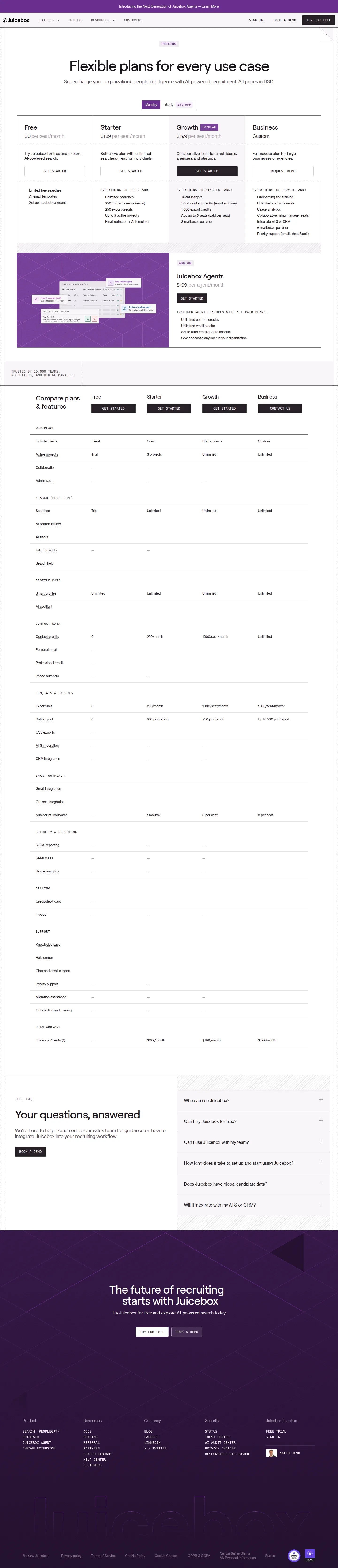
Pricing captured — Starter $139
Per-seat plans: Free $0, Starter $139/seat/mo, Growth $199/seat/mo (POPULAR), Business custom. Juicebox Agents add-on $199/agent/mo. Annual billing advertised at 15% off. Starter included 250 contact + 250 export credits; Growth 1,000 + 1,000.
$30M Series A led by Sequoia
Juicebox announces a $30M Series A led by Sequoia (Coatue, NFDG, Y Combinator, Lux, BOND participating), $36M total funding, with $10M+ ARR and 2,500+ customers — funding the push into autonomous recruiting Agents.
PeopleGPT launches
Juicebox launches PeopleGPT, a natural-language candidate-search engine over ~800M profiles, replacing Boolean search with plain-English queries. Early product-led adoption across startups and large companies (Cognition, Ramp, Perplexity).
- · Juicebox was founded in 2022 by David Paffenholz and Ishan Gupta (22 and 19 at founding) and went through Y Combinator's Summer 2022 batch before launching PeopleGPT in late 2023.
- · The company crossed $10M+ ARR with over 2,500 customers — including Cognition, Ramp, and Perplexity — while operating with essentially no sales team, a textbook product-led growth motion.
- · Searches are unlimited on every paid plan; the real value metric is 'contact credits' and 'export credits' — unlocking a profile's emails/phones is what actually meters usage, not the search itself.
Questions & answers
- How much does Juicebox cost?
- Juicebox has four per-seat plans: Free ($0), Starter ($119/seat/month), Growth ($199/seat/month), and a custom-quoted Business plan. Billed yearly, Starter is $99/seat/month and Growth is $179/seat/month under a '15% OFF' badge.
- What are contact credits and export credits in Juicebox?
- A contact credit unlocks a candidate's emails and phone numbers; an export credit lets you push a profile to your ATS/CRM or download it. Starter includes 500 of each per month, Growth includes 1,500 of each per seat per month, and Business is unlimited contact credits with a 2,250/seat/month export limit.
- What are Juicebox Agents and how much do they cost?
- Juicebox Agents are autonomous sourcing agents that run auto-email or auto-shortlist workflows 24/7. They cost $199 per agent per month as an add-on on any paid plan and include unlimited contact and email credits.
- Is there a free version of Juicebox?
- Yes. The Free plan is $0 per seat and includes limited free searches and AI email templates, but zero contact and export credits, so you cannot unlock candidate contact details on it.
- Has Juicebox changed its prices?
- Yes. As of July 2026 Starter is $119/seat/month (from $139) and $99 billed yearly (from $119), while Growth holds at $199/seat/month. Bundled credits doubled on Starter (250 to 500) and rose 50% on Growth (1,000 to 1,500 per seat), and Starter's 3-project cap became unlimited.