AI Summary
About
Kaiber is a generative-media company that turns text prompts, images and source video into stylized AI video and animation. Its workspace bundles Superstudio tools — Canvas (the generation surface), an Editor, Beat Sync (batch video creation with Auto-Clip, formerly “Cuts”), and creative modes like Motion (animate a prompt or image into a short clip), Flipbook (frame-style animation) and Transform (restyle an existing video) — aimed at music-video makers, social creators, animators and small studios. Kaiber became widely known in 2023 for AI music videos and artist collaborations, and sits in the same generative-media bracket as Runway, Pika and Luma.
Kaiber monetizes through a credit-metered subscription: every generation consumes credits, and each plan bundles a monthly credit allowance. There is no perpetual free tier — the on-ramp is a paid $5 5-day trial — and four paid steps (Starter, Creator, Pro, Visionary) scale the monthly credit budget and feature ceiling. Company financials (ARR, headcount, valuation) are left for later research.
For the most current information, visit Kaiber.
Pricing summary : How Kaiber’s pricing model works
Kaiber runs a credit-based subscription. You pick a tier that bundles a fixed monthly credit allowance, and credits are the single metered unit consumed by every generation — a Motion clip, a Flipbook animation, an upscale, a Transform. When the allowance runs out you buy more credits à la carte. The on-ramp is a paid $5 5-day trial (500 credits, full access to Canvas, Editor and Beat Sync; converts to a Creator Monthly plan after 5 days) — there is no permanently free plan.
Billing dimensions captured (second-sourced from Kaiber’s Help Center, as the live /pricing page failed to render):
- Starter — $10/mo ($8/mo billed annually): 500 credits/month (6,000/year), 1 Canvas, 3 concurrent generations, no commercial-use rights.
- Creator — $29/mo ($23/mo billed annually): 1,500 credits/month, commercial-use rights, all Canvas models, unlimited Timeline Edits, 5 Canvases, 15 concurrent generations.
- Pro — $99/mo ($79/mo billed annually): 5,000 credits/month, unlimited Canvases and generations, Beat Sync Auto-Clip Video, up to 10 videos per batch.
- Visionary — custom quote: unlimited credits, white-glove support.
- Credit lifespan: per Kaiber’s Help Center, credits don’t expire and roll over month to month — anything unused carries forward. Top-up credit packs are purchased à la carte at any time.
What makes this different: Kaiber wraps a credit-based billing meter inside subscription tiers but pairs it with two unusual twists for a consumer creative tool — no free plan at all (the cheapest way in is a paid $5 trial) and commercial-use rights gated above the entry tier ($29 Creator), so the $10 Starter plan is effectively a personal/learning tier rather than a producing one.
Pricing by product
| Tier | Price | Included (credits) | Key mechanics |
|---|---|---|---|
| 5-Day Trial | $5 one-time | 500 credits | Full access to Canvas, Editor & Beat Sync; converts to Creator Monthly after 5 days; the only on-ramp (no free tier) |
| Starter | $10/mo ($8/mo annual) | 500 credits/mo (6,000/yr) | Canvas standard models + Editor; 1 Canvas, 3 concurrent generations; no Beat Sync, premium models or commercial-use rights |
| Creator | $29/mo ($23/mo annual) | 1,500 credits/mo | Commercial-use rights; all Canvas features & models; unlimited Timeline Edits; 5 Canvases, 15 concurrent generations; Beat Sync batch up to 2 videos + Auto-Clip |
| Pro | $99/mo ($79/mo annual) | 5,000 credits/mo | Unlimited Canvases & generations; Beat Sync batch up to 10 videos + Auto-Clip |
| Visionary | Custom (quoted) | Unlimited credits | White-glove support; quoted via [email protected] |
Sales motions across products: self-serve PLG across the entire ladder — sign up, pay the $5 trial or a monthly plan, and generate — with a light sales-assist only for the quoted Visionary tier. Credit packs are an à-la-carte self-serve top-up on every plan. There is no enterprise procurement motion; this is a consumer/creator product.
Hidden costs : What Kaiber users actually pay
The sticker price is the monthly fee, but the number that actually governs your bill is how fast credits drain. Because generations are cheap to start but expensive to finish (preview iterations, then upscaling), the bundled allowance disappears faster than the credit count suggests. Approximate per-action costs (third-party-reported, so treat as indicative): a 4-second Motion clip ≈ 32 credits, Flipbook ≈ 1 credit per generated second (≈ 25 credits to transform 4 seconds of video), and upscaling to 1080p/4K ≈ 33 credits per 5-second clip.
That makes the effective output per tier far smaller than the headline credit number:
| Plan (monthly credits) | Approx. 4-sec Motion clips | Approx. effective cost per clip |
|---|---|---|
| Starter — 500 credits | roughly 15 clips | about 0.67 dollars per clip |
| Creator — 1,500 credits | roughly 46 clips | about 0.62 dollars per clip |
| Pro — 5,000 credits | roughly 156 clips | about 0.63 dollars per clip |
And the “finish the video” tax is the part that surprises people — a clip you like still needs upscaling:
| Line item (illustrative) | Approx. credits |
|---|---|
| Generate a 4-sec Motion clip | about 32 credits |
| Upscale that clip to 1080p/4K | about 33 credits |
| Effective cost of one finished 4-sec clip | about 65 credits (~2x the raw generation) |
The lessons: (1) Starter’s 500 credits is genuinely small — under ~8 finished (generated plus upscaled) 4-second clips a month — so any real project pushes you to Creator or to buying credit packs. (2) As of the July 2026 Help Center change, subscription credits now roll over and don’t expire, so a quiet month is no longer wasted allowance — unused credits carry forward, softening the old penalty for lumpy, project-driven work (and closing the gap that once made purchased credit packs the only balance that survived). (3) Commercial-use rights are an extra gate, not a cost line: a Starter user who needs to monetize must move to the Creator tier regardless of credit usage.
Want to estimate your own Kaiber bill? Use the Kaiber pricing calculator to model your monthly cost based on plan, credit allowance and clip volume.
Pricing evolution : Kaiber pricing history and changes
Cadence
| Period | Price changes | Product / SKU additions | Notes |
|---|---|---|---|
| 2023 | Credit tiers launched | Explorer/Pro/Artist-style ladder + credit packs | Credit-metered subscription established from the start (entry tier reported near 5 dollars/mo) |
| 2024–2025 | Tier reshuffle | Superstudio (Canvas, Cuts, Motion, Flipbook) | Plan names and credit allotments shifted as the product expanded into a full workspace |
| 2026 Q2 | Current ladder | Starter / Creator / Pro / Visionary + 5-dollar trial | Starter 10 / Creator 29 / Pro 99 (≈20% off annual); commercial use gated to Creator+; no free tier |
| 2026 Q3 | 0 | ”Cuts” rebranded to Beat Sync | Credits now roll over and don’t expire (reversing the earlier cycle-reset forfeiture); batch/auto-clip “Cuts” rebranded “Beat Sync”; prices unchanged (per Help Center) |
Tracked range: 2023–present. Kaiber’s live /pricing page failed to render on capture day (a CMS resolver error), and historical Wayback renders of pricing are sparse, so the timeline anchors on the 2023 credit-tier launch and the current Help-Center-documented ladder rather than per-quarter snapshots. Reported earlier tiers (an entry plan near 5 dollars/mo and an Artist plan near 30 dollars) indicate the price points and plan names have been reshuffled at least once.
Notable changes
- 2023 — Kaiber launches on a credit-metered subscription with a low-cost entry tier and paid credit packs, establishing “every generation burns credits” as the core mechanic.
- 2024–2025 — The product expands into the Superstudio workspace (Canvas, Cuts, Motion, Flipbook, Transform); plan names and credit allotments are reshuffled (earlier Explorer/Artist/Pro labels give way to the current ladder).
- 2026-06 — Current shape per the Help Center: Starter $10 / Creator $29 / Pro $99 (≈20% cheaper annual), a quoted Visionary unlimited tier, and a paid $5 5-day trial as the only on-ramp — with commercial-use rights gated to Creator and above.
- 2026-07-23 — Per the Help Center, credits now roll over month to month and don’t expire — a reversal of the earlier use-it-or-lose-it cycle reset — and the batch/auto-clip product “Cuts” was rebranded “Beat Sync” (Batch Create + Auto-Clip Video); the $5 5-day trial now explicitly converts to a Creator Monthly plan. Prices held steady across every tier.
What’s unique : Kaiber’s distinctive pricing mechanics
1. No free tier — the cheapest way in is a paid $5 trial.
Most consumer AI-video tools dangle a perpetual free plan to seed adoption. Kaiber doesn’t: the only entry point is a $5 5-day trial with 500 credits. That filters out tire-kickers and recovers a little GPU cost up front, but it also removes the classic freemium top-of-funnel — a deliberate, slightly contrarian choice for a creator tool.
2. Commercial-use rights gated above the entry tier.
The $10 Starter plan explicitly lacks commercial-use rights; they only unlock at Creator ($29). So Kaiber sells “can you make videos” and “can you sell the videos” as two different price points — a feature gate that nudges any monetizing creator straight past the cheapest plan.
3. Rolling, non-expiring credits — a July 2026 reversal.
Kaiber used to run two credit lifespans in one wallet: subscription credits reset every cycle with no rollover, while purchased credit-pack credits never expired. As of the July 2026 Help Center change that split is gone — subscription credits now roll over month to month and don’t expire, so unused allowance carries forward like a prepaid balance. Rollover is still uncommon among consumer AI-video tools, and the switch trades a margin-protecting forfeiture for a friendlier, stickier balance that no longer punishes bursty, project-driven creators.
4. Concurrency and Canvas count as plan levers, not just credits.
Beyond the credit budget, tiers ration concurrent generations (3 → 15 → unlimited) and Canvases (1 → 5 → unlimited). Heavy iterative workflows hit the concurrency wall before the credit wall, so throughput — not just volume — becomes a reason to upgrade.
Strengths & weaknesses
| Strengths | Weaknesses |
|---|---|
| Simple credit currency meters every modality (Motion, Flipbook, Transform, upscale) in one unit | No perpetual free tier — even trying it costs $5, removing the freemium top-of-funnel |
| Clear tier ladder with ~20% annual discount and transparent published prices | Commercial-use rights gated to Creator+, so the $10 plan can’t be used to monetize |
| Credits now roll over and don’t expire (July 2026), so unused monthly allowance carries forward — not just purchased packs | No rollover cap or accrual limit is stated, so how much unused allowance can bank up is unclear |
| Concurrency/Canvas limits give throughput-based upgrade reasons beyond raw volume | Effective cost is opaque: generate-then-upscale roughly doubles credits per finished clip |
| Pro offers unlimited Canvases/generations for serious creators | Live /pricing page can fail to render (CMS error), and credit-per-action costs aren’t on the pricing page |
Billing UX : Kaiber billing controls and transparency
- Billing controls — Fully self-serve: pay the $5 trial or pick a monthly/annual plan, and (on top) buy credit packs à la carte. There is no sales cycle except the quoted Visionary tier (custom quote via [email protected]).
- Usage visibility — The product surfaces a running credit balance and shows the per-generation credit cost next to the generation button, since every Canvas/Editor/Beat Sync action debits credits; cost per generation varies by output type, model and duration.
- Monthly vs annual — A monthly/annual toggle exposes the ~20% annual saving (Starter $10 to $8, Creator $29 to $23, Pro $99 to $79); annual is billed up front as a credit allotment (e.g. Starter’s 6,000 credits/year).
- Plan management — Upgrade, downgrade or cancel self-serve from the account page (profile icon in the dashboard/Canvas/Beat Sync/Editor toolbar). Upgrades take effect immediately with credits added right away; on downgrade or cancel, access continues to the end of the billing period.
- Payment & credit lifespan — Self-serve card billing. Per Kaiber’s Help Center, credits don’t expire and roll over month to month, so unused allowance carries forward; users can top up any time by purchasing a credit pack.
Strategic wins : Why Kaiber’s pricing decisions worked
1. One credit currency across every creative mode.
By metering Motion, Flipbook, Transform and upscale in a single credit unit, Kaiber can re-price the cost of any model or feature without renaming plans — the standard advantage of credit-based billing for GPU-bound media tools. See choosing the right usage metric.
2. Charging for the trial filters and funds the funnel.
A paid $5 trial recovers some inference cost from day one and screens out non-buyers, so the people who reach a paid plan are pre-qualified. It’s a sharper contrast to the freemium default — and a hedge against the unpredictable-cost economics of running expensive video models for free users.
3. Selling commercial rights as a separate price point.
Gating commercial-use rights to Creator+ turns “I want to monetize” into a clean upgrade trigger, lifting serious creators off the $10 plan without touching credit volume — a packaging lever explored in how AI companies structure pricing.
4. Rolling credits over trades breakage for retention.
Kaiber used to protect margin by forfeiting unused subscription credits each cycle while only purchased packs persisted. The July 2026 switch to non-expiring, rolling credits hands that breakage margin back to users — a bet that lower waste-driven frustration and higher retention outweigh the lost forfeiture, and it aligns the subscription allowance with the never-expiring top-up packs so the whole wallet behaves consistently. Related: outcome-based and prepaid pricing trends.
Areas to improve : Gaps in Kaiber’s pricing approach
1. Publish per-action credit costs on the pricing page.
Buyers can’t tell that a finished 4-second clip is roughly 65 credits (generate plus upscale) until they’re inside the product. Putting per-action costs — and a “credits ≈ X finished clips” translation — on the pricing page would cut bill shock and cost unpredictability and help users self-select a tier.
2. Document the new rollover terms — and add low-balance nudges.
The July 2026 switch to rolling, non-expiring credits fixed the biggest waste complaint, but the Help Center doesn’t say whether accrued credits carry a cap or how the rolled-over balance draws down against each monthly refill. Publishing those mechanics, plus a clear “credits running low” prompt — standard thresholding and alerting — would keep bursty creators from stalling mid-project and reduce upgrade-time confusion.
3. Reconsider the no-free-tier stance for top-of-funnel.
Charging $5 just to try the product likely costs Kaiber awareness against rivals with genuine free tiers. A tightly capped free generation allowance (a handful of watermarked clips) could rebuild the funnel without exposing much GPU cost. See pricing an AI product with unpredictable costs.
Monetization stack & signals : how Kaiber builds & buys its revenue engine
No monetization-stack vendor could be independently confirmed for this small PLG consumer app. The producer's Intercom CS read no longer holds: the intercom.help/kaiber help center is gone (404) and Kaiber's current help center (helpcenter.kaiber.ai) is now hosted on Featurebase, so the company has migrated off Intercom. No public ATS, no engineering-blog disclosures, and first-party billing pages are bot-protected, leaving the payments/metering layer unconfirmed.
Signals reviewed · derived from public sources
Key takeaways
- Credits are the meter; subscriptions are the wrapper. Kaiber bundles a fixed monthly credit allowance into each tier and debits every generation — flat-rate feeling until the allowance runs out, then pure top-up.
- No free tier is a deliberate funnel choice. A paid $5 trial replaces freemium, filtering and funding the top of funnel at the cost of raw reach.
- Commercial-use rights are a packaging lever, not a usage one. Gating them to Creator+ pushes monetizing creators off the $10 plan regardless of how many credits they burn.
- Credit lifespan is a lever you can reverse. Kaiber ran a dual-lifespan wallet (subscription credits reset, purchased packs never expired), then in July 2026 unified it — all credits now roll over and don’t expire. Loosening expiry trades breakage margin for retention and goodwill, and it’s a change you can ship without touching headline prices.
- The real cost is generate-plus-finish. Upscaling roughly doubles credits per usable clip, so headline credit counts overstate how much finished output a plan actually buys.
UBP implications
- A bundled credit allowance turns usage pricing into a predictable subscription — up to the cap. Kaiber feels flat-rate until the allowance is spent, then becomes overage; the churn and bill-shock risk concentrates exactly at that line, so make it visible. See usage-based pricing strategy.
- Charging for the trial is a usage-pricing hedge for expensive inference. When each free generation has real GPU cost, a paid trial qualifies demand and recovers cost — a viable alternative to freemium for compute-heavy AI products.
- Credit expiry is a two-way, reversible lever. Kaiber first used differential expiry (reset subscription credits, keep purchased packs) to protect margin, then in July 2026 switched to rolling, non-expiring credits to cut waste-driven churn. Either direction changes the felt value of an allowance without touching headline prices — so treat credit lifespan as an ongoing dial, not a set-and-forget default.
Sources
- Kaiber Plans: What You Need to Know — Kaiber Help Center (accessed 2026-06-11) — canonical plan list: Starter $10/$8, Creator $29/$23, Pro $99/$79, Visionary custom, $5 5-day trial
- Understanding Subscriptions and Pricing — Kaiber Help Center (accessed 2026-06-11)
- How Superstudio Credits Work — Kaiber Help Center (accessed 2026-06-11) — per-action credit costs, reset vs never-expire
- Kaiber pricing 2026: Plans, credits, and is it worth it? — eesel AI (accessed 2026-06-11)
- Kaiber AI Review 2026 — aichief (accessed 2026-06-11) — per-action credit costs and credit expiry
- Kaiber pricing page (accessed 2026-06-11) — failed to render on capture day (CMS resolver error)
Bottom line
Kaiber prices AI video the way the category is converging on: a credit meter wrapped in subscription tiers — Starter $10/mo (500 credits), Creator $29/mo (1,500 credits, commercial use), Pro $99/mo (5,000 credits), and a quoted Visionary plan with unlimited credits, all roughly 20% cheaper billed annually. Two choices set it apart from rivals: there’s no perpetual free tier (the only on-ramp is a paid $5 5-day trial), and commercial-use rights are gated to the Creator tier and up, so the cheapest plan is a personal/learning tier rather than a producing one. The headline credit counts also overstate real output — a finished 4-second clip costs roughly double its raw generation once you upscale — so the effective cost-per-deliverable is the number creators should actually plan around. Browse the pricing blueprint for more fully-researched company profiles.
Want to compare Kaiber against other generative-media and AI-video companies? Browse the pricing blueprint.
Pricing timeline : Major events on a vertical axis
Each milestone below corresponds to a public pricing change, product launch, or material adjustment. Major events use a filled marker; minor adjustments use a faded one.
Credits now roll over + 'Cuts' rebranded to 'Beat Sync'
Prices held steady (Starter $10/$8, Creator $29/$23, Pro $99/$79, $5 trial, Visionary custom), but two packaging changes landed per the Help Center: credits now don't expire and roll over month to month (a reversal of the earlier use-it-or-lose-it cycle reset), and the batch/auto-clipping product 'Cuts' was rebranded to 'Beat Sync' (Batch Create + Auto-Clip Video). The trial now explicitly converts to a Creator Monthly plan after 5 days. The live /pricing page still failed to render (Strapi CMS resolver error), so figures remain second-sourced from the official Help Center.
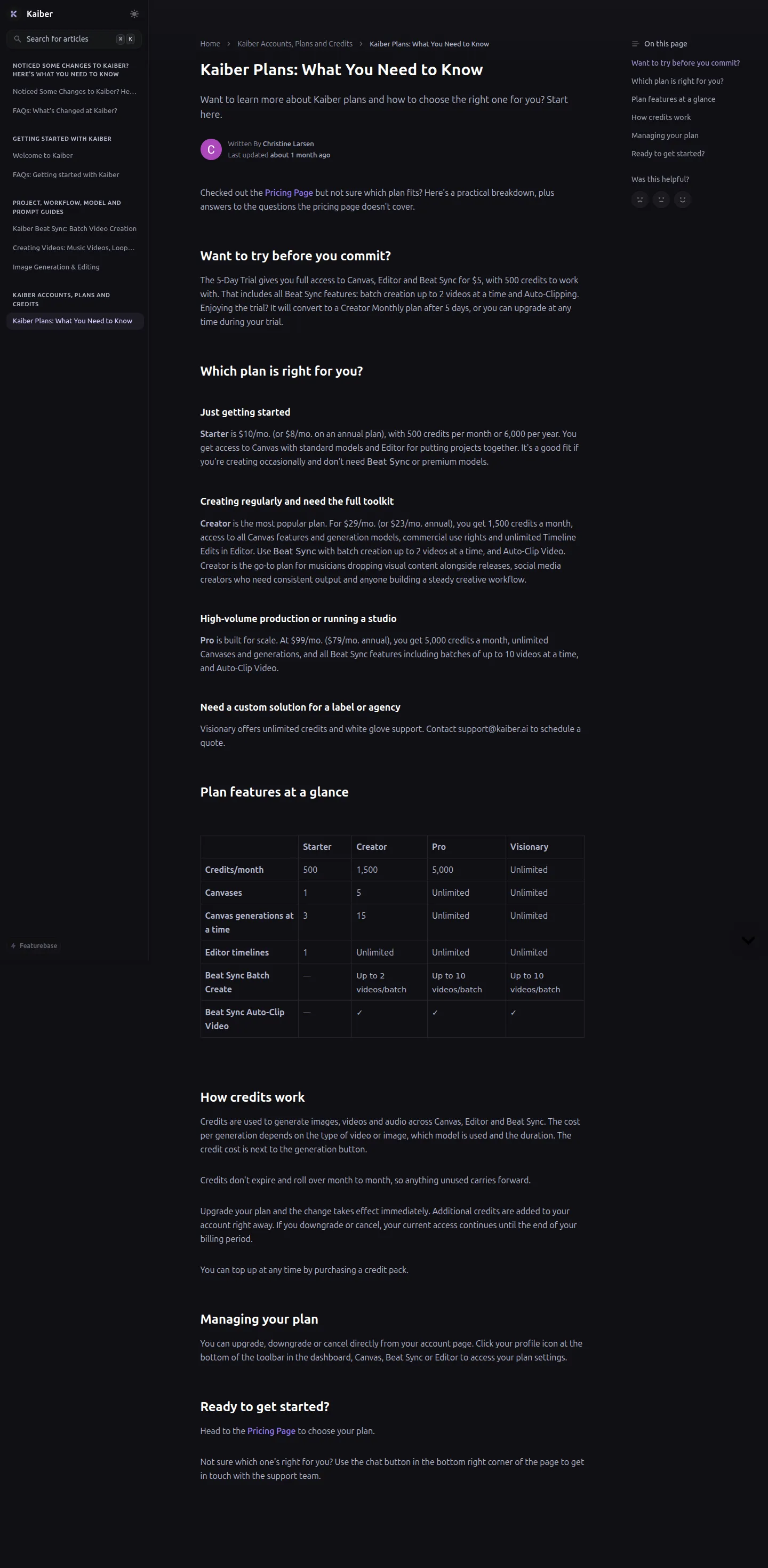
Starter / Creator / Pro / Visionary ladder + $5 trial
Current shape (per Kaiber Help Center): Starter $10/mo ($8 annual, 500 credits), Creator $29/mo ($23 annual, 1,500 credits, commercial use), Pro $99/mo ($79 annual, 5,000 credits, unlimited Canvases/generations), and a quoted Visionary plan with unlimited credits. On-ramp is a paid $5 5-day trial (500 credits) rather than a perpetual free tier. The live /pricing page failed to render on capture day (Strapi CMS error), so prices are second-sourced from the official Help Center.
Credit-based subscription tiers established
Kaiber launched its AI video product on a credit-metered subscription, with low-cost entry tiers (an early Explorer-style plan around $5/mo) and higher Pro/Artist tiers, plus paid credit packs. The defining mechanic from the start: every generation burns credits and each plan bundles a monthly allowance.
- · Kaiber has no permanently free plan — the only on-ramp is a paid $5 5-day trial that grants 500 credits, so even 'trying it out' costs money, unusual among consumer AI video tools.
- · Commercial-use rights don't exist on the cheapest paid tier: a Starter ($10/mo) subscriber cannot legally monetize their output and has to upgrade to Creator ($29/mo) for commercial rights.
- · Kaiber's Help Center now says credits don't expire and roll over month to month, so unused subscription allowance carries forward — a reversal from the older 'use-it-or-lose-it' cycle reset that once made the monthly allowance a hard deadline.
Questions & answers
- What is Kaiber's pricing model?
- Kaiber uses a credit-based subscription model. Each plan bundles a fixed monthly credit allowance, and every generation — a Motion clip, a Flipbook animation, an upscale — consumes credits. Paid tiers are Starter ($10/mo), Creator ($29/mo) and Pro ($99/mo), with a quoted Visionary plan for unlimited credits. Annual billing is about 20% cheaper. There is no perpetual free tier — only a paid $5 5-day trial.
- Does Kaiber offer a free tier?
- Not a permanently free plan. The entry point is a paid 5-Day Trial costing $5, which grants full access to Canvas, Editor and Beat Sync plus 500 credits to experiment with. After the trial you move to a paid subscription (Starter, Creator, Pro or Visionary) to keep generating.
- How much does Kaiber cost per month?
- Starter is $10/mo ($8/mo billed annually) for 500 credits, Creator is $29/mo ($23/mo annually) for 1,500 credits plus commercial-use rights, and Pro is $99/mo ($79/mo annually) for 5,000 credits with unlimited Canvases and generations. Visionary (unlimited credits, white-glove support) is a custom quote.
- Is Kaiber pricing usage-based or subscription?
- It is a hybrid: a subscription that bundles a monthly credit allowance, where credits are the consumption unit metering every generation. You pay a flat monthly fee that includes a credit budget; when the budget runs out you buy more credits à la carte. Per Kaiber's Help Center, credits don't expire and roll over month to month, so unused allowance carries forward.
- Can I use Kaiber videos commercially?
- Commercial-use rights are gated to the Creator plan ($29/mo) and above. The Starter tier does not include commercial-use rights, so creators who need to monetize their output must start at Creator or Pro.