AI Summary
About
Labelbox is an AI training-data company that now describes itself as “the RL data engine for AI teams.” Founded in 2018 and headquartered in San Francisco, it grew out of a pure image-annotation tool into a three-product platform — Catalog (data curation and natural-language search), Annotate (human and model-assisted labeling), and Model (evaluation, model runs, and comparison) — which is still the platform the documentation and the LBU meter describe.
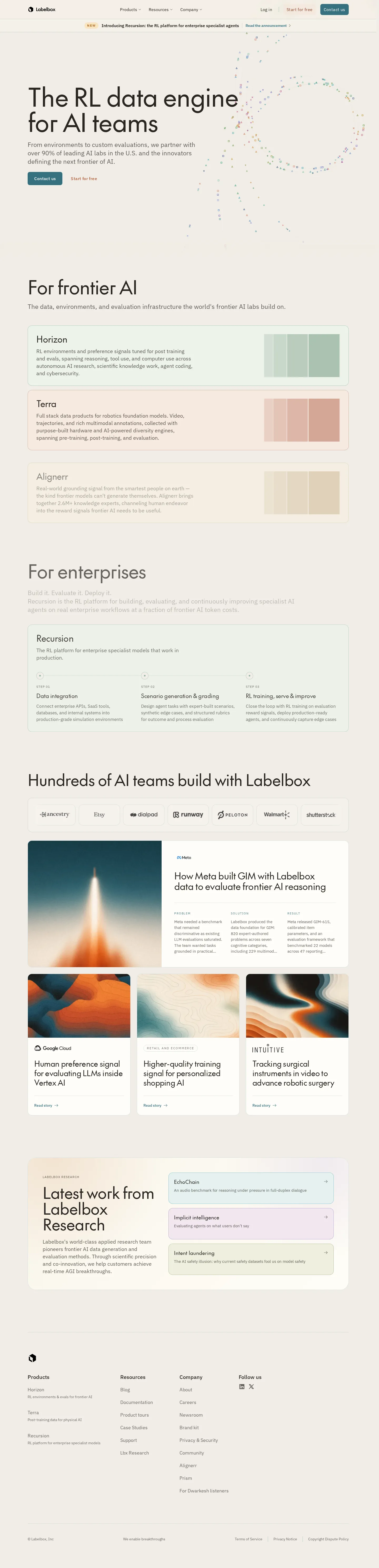
The public-facing story has moved on. The homepage now organises around four named offerings: Horizon (RL environments and preference signals for post-training and evals), Terra (full-stack data products for robotics foundation models), Recursion (an RL platform for enterprise specialist agents, launched with a site-wide “Introducing Recursion” banner), and Alignerr (an expert network the company sizes at 2.6M+ knowledge experts). Labelbox says it partners with over 90% of leading AI labs in the U.S.
That repositioning shows up directly in how Labelbox sells. The self-serve platform still exists — the header carries a “Start for free” button and the docs describe a self-serve Starter upgrade in the Billing tab — but the marketing pricing page and its LBU calculator were retired, and every other route on the homepage is “Contact us.” The result is a business that sells two very different things on two very different terms: a documented usage meter for the software, and sales-quoted human data labour for everything the frontier labs actually buy.
Pricing summary : How Labelbox’s pricing model works
Labelbox runs a pure usage-based model on one meter — the Labelbox Unit (LBU) — across four documented subscription tiers, with everything human sold separately through sales.
- Free — $0. 500 free LBU credits each month, up to 30 users, 50 projects, 25 ontologies, 10M data rows and a 1,500 requests/min API rate limit. Hit the 500-LBU ceiling and you can still access and export your data, but you cannot add data rows, labels or predictions until the next billing period.
- Starter — the docs state a fixed rate of $0.10 per LBU. No limit on users, projects or ontologies; 5,000 API requests/min; 1M data rows per model run; 2M ground-truth annotation imports. You upgrade yourself from the Billing tab with a card or US ACH transfer.
- Enterprise — sales-quoted. No LBU limit, 20,000 API requests/min, 1,000 model runs, 10M ground-truth imports, plus SSO and HIPAA compliance as add-ons.
- Education — free for qualified educational institutions doing non-commercial research: no LBU limit, 5,000 API requests/min, 100,000 projects, 10M data rows.
Four things ride on top of the subscription and are billed separately, explicitly outside the LBU meter: Foundry inference (charged on rows processed, model used and task complexity), labeling services (the Alignerr expert network), SSO and HIPAA compliance. The docs note these “may require you to add a credit card to your account.”
The clever — and confusing — part is the LBU itself. An LBU is a normalized unit of data work consumed at different rates by product and by asset type: credit-style consumption where storing data is cheap, labeling is expensive, and a live multimodal LLM row costs 20x an image row to annotate.
What makes this different: most data-labeling vendors sell either managed labour per-label or software per-seat. Labelbox runs a single consumption rate across curation, labeling and evaluation — but as of September 2026 it no longer markets that rate at all. labelbox.com/pricing and the old LBU calculator both return 404; the $0.10 figure survives only in a developer-docs limits table, which makes Labelbox a rare case of a company with genuinely transparent pricing that has stopped advertising it.
Pricing by product
Labelbox Platform (subscription tiers)
| Tier | Price | Included | Key mechanics |
|---|---|---|---|
| Free | $0 | 500 LBU free each month; 30 users; 50 projects; 25 ontologies; 10M data rows; 1,500 API req/min; 10,000 ground-truth annotation imports; 5 custom metadata fields; 150,000 rows per model run | Hard stop, not an overage: at 500 LBUs you can access and export data but cannot add data rows, labels or predictions until the next billing period |
| Starter | $0.10 / LBU | Docs state “Fixed rate: $0.10 per LBU”; no limit on users, projects or ontologies; 5,000 API req/min; 2M ground-truth imports; 100 custom metadata fields; 20,000 unlabeled LLM data rows; 1M rows per model run | Self-serve upgrade from the Billing tab; card payments take effect immediately, US-only ACH on bank confirmation |
| Enterprise | Custom (contact sales) | No LBU limit; 20,000 API req/min; 10M ground-truth imports; 500 custom metadata fields; 1,000 model runs; no limit on project tags | Sales-led — you must contact sales both to upgrade to Enterprise and to downgrade or change billing frequency |
| Education | $0 | No LBU limit; 5,000 API req/min; 10M data rows; 100,000 projects; 2M ground-truth imports; 1M rows per model run | For people who attend and teach at qualified educational institutions, non-commercial research only |
LBU consumption by product
The LBU rate is flat; what differs is how many data rows it takes to burn one LBU.
| Product | LBU consumption | Billing cadence | When LBUs are consumed |
|---|---|---|---|
| Catalog (curation) | 1 LBU per 60 data rows | Monthly, recurring | On upload and storage, regardless of data type. Seven-day grace period from first upload — rows removed inside it aren’t charged, unless you label them |
| Annotate (labeling) | 1 LBU per data row | One-time | ”When a data row is first submitted to a project and labeled… submitting the same data row to additional projects does not consume additional LBUs.” Skipped rows count as labeled |
| Model (evaluation) | 1 LBU per 5 data rows | One-time | On adding rows to a model run, submitting Foundry predictions, or model-assisted labeling. A row already charged can be reused in other Model tasks free |
LBU consumption by asset type
Not every data row costs the same. This is the part of the meter that surprises buyers.
| Data row asset type | Catalog (monthly) | Annotate (one-time) | Model (one-time) |
|---|---|---|---|
| Image | 1 LBU per 60 data rows | 1 LBU per data row | 1 LBU per 5 data rows |
| Text | 1 LBU per 60 data rows | 1 LBU per data row | 1 LBU per 5 data rows |
| Chat (Conversation) & Offline Multi Modal | 1 LBU per 60 data rows | 1 LBU per data row | 1 LBU per 5 data rows |
| Audio | 1 LBU per 60 data rows | 1 LBU per data row | 1 LBU per 5 data rows |
| Document (PDF), per page | 1 LBU per 60 data rows + 1 LBU per 60 pages | 1 LBU per page | 1 LBU per 5 pages |
| Video | 1 LBU per 60 data rows + 1 LBU per 5,000 frames | 1 LBU per data row + 1 LBU per 150 frames | 1 LBU per 5 data rows + 1 LBU per 1,500 frames |
| Geospatial & Medical Tiled Imagery | 1 LBU per 6 data rows | 4 LBU per data row | 1 LBU per data row |
| Live Multi Modal / LLM | 1 LBU per 60 data rows | 20 LBU per data row | 1 LBU per 5 data rows |
Labelbox’s own worked example: 1,000 images with Foundry pre-labels on 500 of them costs 17 Catalog LBUs per month, 100 Model LBUs one-time and 1,000 Annotate LBUs one-time — “1,117 LBU once and 1.67 LBU each month the data rows remain in Catalog.” Scale that to 60,000 images with 10,000 labeled and it becomes 23,000 LBU once plus 1,000 LBU every month.
Add-on services (billed separately)
| Add-on | Price | Included | Key mechanics |
|---|---|---|---|
| Foundry | Not published | Foundational models that predict labels and enrich your data | Inference costs “based on the amount of data processed, the model used, and the complexity of the task” — on top of the Model LBUs the same rows consume |
| Labeling services | Not published today — a base rate of “$10 USD an hour” was published until the pricing page was retired in June 2026 | A team of professional labelers with specialized knowledge to annotate and review large volumes | Sales-quoted per project; sold to frontier labs through the Alignerr expert network. The retired pricing FAQ read: “Base labeling services start at a flat rate of $10 USD an hour. The actual labeling rates vary based on the complexity of the task and volume discounts are available” |
| Single sign-on (SSO) | Not published | Company SSO for signing in to Labelbox | Docs scope this to “Enterprise teams” — it is an add-on, not a tier inclusion |
| HIPAA compliance | Not published | Helps Enterprise subscribers comply with HIPAA | Enterprise customers “should contact your technical account manager to verify the terms, payment details” |
Sales motions across products: Free and Starter are fully self-serve (PLG) — sign up, add a card in the Billing tab and pay per LBU. Enterprise, every add-on service, and all Alignerr human-data work are sales-led and quoted per project. Education is a free, application-gated tier.
Hidden costs : What Labelbox users actually pay
The headline rate is clean ($0.10/LBU), but the real bill depends heavily on the workload mix and what you add on:
| Line item | Cost |
|---|---|
| Labeling (Annotate) | 1 LBU per data row, one-time — the most LBU-intensive activity |
| Curation (Catalog) | 1 LBU per 60 rows — recurring every month the rows stay stored |
| Model evaluation | 1 LBU per 5 rows, one-time |
| Live multimodal / LLM labeling | 20 LBU per data row — 20x the image rate |
| Geospatial & medical tiled imagery | 4 LBU per data row to label; 1 LBU per 6 rows to store |
| Video frame labeling | 1 LBU per data row plus 1 LBU per 150 frames |
| Foundry inference | Add-on, billed separately; priced on rows processed, model and task complexity |
| SSO and HIPAA compliance | Add-ons, billed separately; not published |
| Human-data services (Alignerr) | Sales-quoted per project — the large, opaque line item; the withdrawn pricing FAQ put base labeling at $10/hour before rates for complex work |
The biggest real-world cost driver isn’t the software meter — it’s human labor. For teams that need managed labeling or RLHF data, the sales-quoted Alignerr services typically dwarf the per-LBU platform charge, and those rates aren’t published. The second trap is the asset-type asymmetry: a team that budgets from the image row rate will be off by 4x on geospatial and 20x on live multimodal LLM rows. The third is Catalog’s recurring meter — stored data keeps consuming LBUs every month unless rows are removed inside the seven-day grace window, so a one-off labeling project leaves a permanent storage tail.
Want to estimate your own Labelbox bill? Use the Labelbox pricing calculator to model your costs based on data rows and product mix.
Pricing evolution : Labelbox pricing history and changes
Cadence
| Period | Price changes | Product / SKU additions | Notes |
|---|---|---|---|
| 2018–2021 | Per-seat annotation subscriptions | Annotate (labeling) | Priced like a seat-based SaaS tool |
| 2022–2023 | Shift to $0.10/LBU consumption | Catalog + Model added | Single LBU meter spans all three products |
| 2024–2026 | LBU rate held at $0.10 | Alignerr / Alignerr Connect | Managed workforce consolidated; services stay sales-quoted |
| 2026 Q2–Q3 | 0 — rate held at $0.10/LBU | Horizon, Terra, Recursion lead the site | Pricing page and LBU calculator retired — last archived live 2026-06-15, 404 by 2026-06-23, re-confirmed 2026-09-11; Annotate’s billable unit restated as a one-time per-data-row charge |
Tracked range: 2021–present.
Notable changes
- Early years (2018–2021) — Labelbox priced its annotation tool on a per-seat / annual-subscription basis, like most early labeling SaaS.
- 2022–2023 — As the platform expanded from pure labeling into Catalog (curation) and Model (evaluation), Labelbox moved to the Labelbox Unit (LBU) consumption model, with a published Starter rate of $0.10/LBU and a free LBU allowance. One meter now prices three products at different conversion rates.
- 2024–2026 — The $0.10/LBU rate held. The managed workforce (formerly “Boost”) consolidated into the Alignerr expert network and the Alignerr Connect marketplace, doubling down on sales-quoted human-data services as RLHF and post-training demand grew.
- June 2026 —
labelbox.com/pricingand its LBU calculator went dark: the last archived snapshot that still served the page is 2026-06-15, and the URL returned 404 by 2026-06-23. The retired calculator was also the only surface that published a human-data rate — “Base labeling services start at a flat rate of $10 USD an hour” — so the services rate disappeared with it while the $0.10/LBU software rate survived in the docs. - 2026-09-11 (re-confirmed) — The retirement of the public pricing surface is complete:
labelbox.com/pricing,labelbox.com/pricing/calculator/andlabelbox.com/plansall return 404, and no Pricing link survives in the nav or footer. No price moved — the docs Limits table still states a fixed $0.10 per LBU on Starter — but the rate now exists only inside developer documentation, which also gives Education its own tier column and confirms first-party that Free includes 500 LBU each month. - 2026-09-11 — The billing docs redefined the Annotate billable unit. An LBU is now charged once per data row, “when a data row is first submitted to a project and labeled”; submitting that same row to additional projects consumes nothing further. The same edit swapped the page’s closing pointer from the (now dead) LBU estimate calculator to the Limits page. The same docs page also sets out the per-asset-type spread inside Annotate — 4 LBU per geospatial/medical tiled-imagery row and 20 LBU per live multimodal LLM row against 1 LBU for image or text, plus 1 LBU per 150 frames on video — so “one LBU per row” holds only for image and text.
The direction of travel: the software meter itself got cheaper and clearer — a row is billed once, whatever you do to it afterwards — while the surface on which Labelbox is willing to advertise that meter shrank to a developer-docs table. Pricing stayed simple; marketing it stopped being the point.
The pricing-page retirement in detail
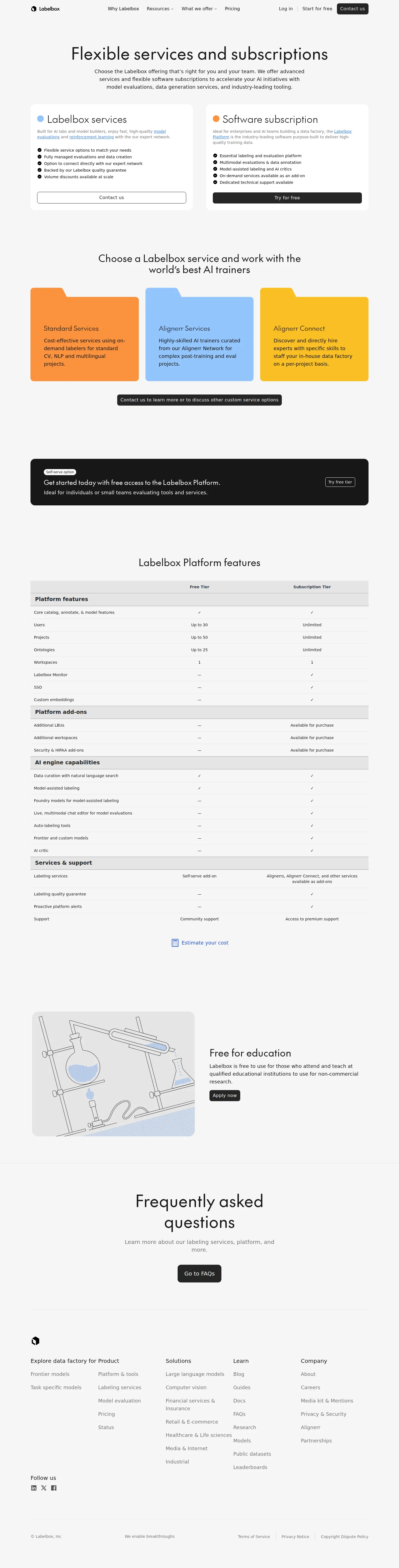
This is a transparency event, not a price event, and the two should not be conflated. Every number a buyer needs is still readable without a login: the $0.10/LBU Starter rate, the 500-LBU monthly free allowance, the four tier columns, and the full per-product and per-asset-type consumption tables. What disappeared in June 2026 is the path to them. The old flow — nav → Pricing → a Free-vs-Subscription matrix → an “Estimate your cost” calculator — is gone in one step; the new homepage leads with “The RL data engine for AI teams” around Horizon, Terra, Recursion and Alignerr, and offers only “Contact us” or “Start for free.”
Three practical consequences for a buyer. You have to already know the word “LBU” to find the price, because the only surviving publication is docs.labelbox.com/docs/limits — a page written for engineers configuring API limits, not for someone sizing a budget. You have lost the arithmetic layer: the retired calculator did the normalization for you, and reconstructing a bill now means hand-multiplying rows by product ratio and asset multiplier, which is exactly the step the 60x Catalog-to-Annotate and 20x image-to-multimodal spreads make error-prone. And self-serve is now the unadvertised path — the product that self-serves (Catalog/Annotate/Model on the LBU meter) appears nowhere on the homepage, while everything the page does promote routes to sales.
Read charitably, this is a company that stopped merchandising a $0.10 meter because that meter is no longer where the revenue is. Read as a buyer, it is a downgrade: a business whose pricing is still genuinely transparent has made itself look sales-only to anyone who arrives through the front door.
What’s unique : Labelbox’s distinctive pricing mechanics
1. One normalized meter, three rates. The LBU prices curation, labeling, and evaluation through a single unit, but converts each at a different ratio (60 rows, 1 row, 5 rows per LBU). It’s a rare example of a usage meter deliberately not being a flat per-row price.
2. Published software, sales-quoted labor — and now published only in the docs. Labelbox still states its $0.10/LBU software rate in the open while selling human-data services entirely through sales. Since 2026-09-11 that published rate lives in a developer-docs limits table rather than a pricing page, which makes Labelbox an unusual hybrid: transparent if you go looking, sales-only if you don’t.
3. The meter charges the asset, not the action. As of 2026-09-11 the billing docs price the data row, once, for its whole life on the platform — a second labeling pass, a new ontology, or a consensus round in another project adds nothing to the Annotate bill. Labelbox meters admission rather than effort, which means your Annotate cost is a function of corpus size rather than of how hard you work the corpus.
4. A two-sided expert marketplace. Alignerr Connect lets customers hire vetted AI trainers per project — Labelbox isn’t just selling its own managed workforce, it’s running a marketplace and pricing access to it separately from the software.
Strengths & weaknesses
| Strengths | Weaknesses |
|---|---|
| Rate is still stated in the open and readable without a login ($0.10/LBU) | Since 2026-09-11 it is stated only in developer docs — the pricing page and LBU calculator both 404 |
| A row is billed once: re-labeling it in another project is free | LBU model is still hard to forecast, and the calculator that did the arithmetic is gone |
| One meter spans curation, labeling, and evaluation | 60x cost asymmetry between Catalog and Annotate surprises buyers |
| Free tier is a hard stop, not an overage — 500 LBU/month, then read-only | Human-data services are entirely sales-quoted (opaque) |
| Free for non-commercial academic use, with Education as a documented tier | Catalog’s recurring monthly meter accrues on stored data |
| Add-ons (SSO, HIPAA, Foundry) keep the base tier simple | No published commit/volume discounts on the self-serve rate |
Billing UX : Labelbox billing controls and transparency
- Billing tab (Workspace Settings) — the single self-serve control surface. It carries the plan list with an Upgrade button next to Starter, a Manage button next to your current plan, payment-method management, and a Cancel plan button at the bottom for Free, Starter and Standard plans.
- View account usage — a dedicated docs-documented screen for reading LBU consumption; the docs also publish per-product and per-asset-type consumption tables so you can reconstruct a bill yourself.
- Catalog seven-day grace period — the closest thing Labelbox has to a spend guard. Rows deleted within seven days of first upload consume no LBUs, unless you label them: “if you take any action that adds a label to a data row… that row will consume LBUs, even if it’s within the grace period.”
- Free-tier hard stop instead of overage — at 500 LBUs per month the Free tier blocks new data rows, labels and predictions rather than billing you. Read and export stay open. There is no published overage rate, so the meter cannot run away on Free.
- Pending-downgrade banner and renew — downgrades take effect at the start of the next billing cycle (typically the 1st of the month). While one is pending the Billing tab shows a reminder banner, and clicking renew on the plan cancels the downgrade.
- Payment activation rules — a valid payment method is required to upgrade any plan, including from Free. Credit-card upgrades go live immediately once payment is accepted; ACH transfers (US only) activate when the bank confirms.
- Add-on billing is separate — Foundry inference, labeling services, SSO and HIPAA compliance “are billed separately from your subscriptions and may require you to add a credit card to your account,” so the LBU meter alone does not describe the invoice.
- Sales-gated exits — cancelling or downgrading an Enterprise plan, or changing its billing frequency, requires contacting Sales; only Free, Starter and Standard can be cancelled in-app.
- Pre-cancellation data warning — the docs advise deleting data rows, datasets and projects before cancelling, because access to that information is lost.
- No published cost estimator — the LBU pricing calculator that previously sat at
labelbox.com/pricing/calculator/now returns 404, and the billing docs’ former pointer to “an LBU estimate calculator” has been replaced with a pointer to the Limits page.
Strategic wins : Why Labelbox’s pricing decisions worked
1. A normalized unit that scales across products
By inventing the LBU, Labelbox could expand from one product (labeling) to three (Catalog, Annotate, Model) without inventing a new price book each time — usage just maps to LBUs at product-specific ratios. See choosing the right usage metric.
2. A real free tier as the top of the funnel
The Free tier’s genuinely useful caps (30 users, 50 projects) let teams prove value before paying a cent, then convert to $0.10/LBU as production volume grows — classic PLG. See how AI companies structure pricing.
3. Monetizing human labor as the market shifted to RLHF
As demand moved from supervised labeling toward reinforcement learning and preference data, Labelbox leaned into sales-quoted Alignerr services and a per-project expert marketplace — capturing high-value human-data spend that a pure software meter never could. The 2026-09-11 site rebuild makes the bet explicit: the homepage now sells Horizon, Terra, Recursion and Alignerr, and the $0.10/LBU software meter is not merchandised at all. A vendor that commits this hard to the sales-led line is telling you where its margin lives. Related: outcome-based pricing trends.
4. Metering the row once instead of the pass
The 2026-09-11 restatement — 1 LBU per data row on first submission, nothing for resubmitting it elsewhere — quietly removes a penalty on exactly the behaviour Labelbox wants: re-labeling a corpus for a new task, running a consensus round, or reusing curated data across projects. It trades a little per-project revenue for a meter customers can predict from corpus size alone — and Labelbox keeps the recurring half of the bill either way, because Catalog still charges 1 LBU per 60 stored rows every month the data stays on the platform. See tracking and metering usage events.
Areas to improve : Gaps in Labelbox’s pricing approach
1. The LBU is hard to forecast — and the calculator that helped is gone
A single “$0.10/LBU” headline hides a 60x range in per-row cost between Catalog and Annotate, plus a 20x spread inside Annotate alone between an image row and a live multimodal LLM row. Until June 2026 the labelbox.com/pricing/calculator/ estimator absorbed that arithmetic; it now returns 404, and the billing docs point to the Limits page instead. Rebuilding an estimator — or at minimum an in-product cost preview and budget alert before a large import — would restore what buyers lost. See bill shock and cost unpredictability.
2. Opaque human-data services
Alignerr and Alignerr Connect are entirely sales-quoted, and the 2026-09-11 homepage put them at the centre of the story without publishing a single rate. Labelbox used to publish an anchor: “Base labeling services start at a flat rate of $10 USD an hour” sat in the pricing-page FAQ until that page was retired in June 2026, and nothing replaced it. Restoring even an indicative per-task or per-hour range would help buyers scope projects without a sales call, especially the smaller teams the free tier attracts.
3. The price is published but no longer findable
Labelbox kept its pricing honest and then hid it: since the pricing page went dark in June 2026 the $0.10/LBU rate and the 500-LBU free allowance exist only in a developer-docs limits table, with no Pricing link in the nav or footer and no marketing page to land on. That costs Labelbox the benefit of its own transparency — a buyer comparing vendors will read “Contact us” and file it as sales-only. A single pricing page, or even a footer link to the Limits table, would fix it without re-opening the strategic question of what the company wants to sell.
4. No published volume or commit discounts on software
The self-serve rate is flat at $0.10/LBU with no published tiers or commit pricing. High-volume teams must negotiate Enterprise, leaving a gap between pay-as-you-go and a custom contract.
Monetization stack & signals : how Labelbox builds & buys its revenue engine
Buys 2 Builds 1 1 open role
Labelbox buys its money plumbing — Stripe for billing — but built the LBU consumption-metering layer itself on Databricks, the in-house piece that makes its normalized usage meter work. Open roles skew to enterprise GTM, fitting the sales-led Alignerr services bet.
-
“Before the company could adopt this billing model, they needed to build a consumption-based billing system... The Gold layer tables... update their billing system, update entitlements in contracts and display usage data to customers.”
-
“Labelbox's billing solution calculates usage within Databricks and pushes the data to a Stripe billing system.”
-
“Labelbox's billing solution calculates usage within Databricks and pushes the data to a Stripe billing system.”
- Managing Partner, Frontier AI Customer success seen Apr 2, 2026
Signals reviewed · derived from public job posts, press & filings
Job postings fill and close over time — once a posting is filled we keep it as a dated citation (the quoted evidence remains); use View open roles for current listings.
Key takeaways
- Labelbox prices platform usage with the Labelbox Unit (LBU) — a normalized consumption meter at $0.10/LBU on the self-serve Starter tier. For the underlying model, see the introduction to usage-based pricing.
- The LBU converts at different rates per product — 60 rows for Catalog, 1 row for Annotate, 5 rows for Model — so the same data costs wildly different amounts depending on the workload.
- A genuine free tier (30 users, 50 projects, 500 LBU a month) drives PLG adoption before the $0.10/LBU meter kicks in, and it stops rather than overages — a hard cap is a cheaper trust guarantee than a bill you have to explain later.
- Human-data services (Alignerr) are sales-quoted and opaque — the largest and least predictable line item for teams that need managed labeling or RLHF.
- Publishing a price and advertising it are two different decisions. Labelbox deleted its pricing page in June 2026 without changing a number; the lesson for other teams is that buyers experience the surface, not the rate card, so retiring the page reads as a move to sales-led even when the rate is unchanged and still public.
UBP implications
- A normalized usage unit can future-proof a multi-product platform. The LBU let Labelbox add products without re-architecting pricing — a reusable pattern for any business expanding its surface area.
- Meter the durable artifact, not the repeatable action. Labelbox’s 2026-09-11 restatement charges an Annotate LBU once per data row for the life of that row, so reusing it across projects is free. Metering the thing that exists rather than the work you do to it makes a usage bill forecastable from inventory — and removes the perverse incentive to under-use what you already paid for.
- Publish what self-serves, quote what scales — but keep the published part findable. Labelbox shows a viable split between a transparent software meter and sales-led pricing for human labor, then undercuts it by moving the rate into developer docs. A price nobody can navigate to buys none of the trust that publishing it was supposed to earn.
Sources
- Labelbox homepage (accessed 2026-09-11)
- Labelbox billing docs — a guide to Labelbox’s LBUs (accessed 2026-09-11)
- Labelbox docs — Limits by subscription type (accessed 2026-09-11)
- Labelbox docs — How to update your account plan (accessed 2026-09-11)
- Labelbox docs — View account usage (accessed 2026-09-11)
- Labelbox pricing page and LBU pricing calculator (
labelbox.com/pricing,labelbox.com/pricing/calculator/) — both returned HTTP 404 on 2026-09-11; last captured 2026-06-15 - Labelbox pricing page, archived 2026-05-08 — second source for the Free-tier caps and the Free-vs-Subscription matrix (accessed 2026-09-11)
- Labelbox LBU pricing calculator, archived 2026-03-05 — second source for the $0.10/LBU Starter rate, the per-product LBU ratios and the withdrawn “$10 USD an hour” base labeling-services rate (accessed 2026-09-11)
Bottom line
Labelbox prices its AI training-data platform with a normalized consumption meter — the Labelbox Unit — at $0.10/LBU on the self-serve Starter tier, sitting above a free tier that gives you 500 LBU a month and then stops rather than billing you. The twist is that the LBU converts at very different rates across Catalog, Annotate, and Model (60, 1, and 5 rows per LBU), so the same dataset can cost wildly different amounts depending on whether you curate, label, or evaluate it — though since 2026-09-11 an Annotate row is charged once and re-labeling it elsewhere is free. The big, opaque line item is human labor: Alignerr and Alignerr Connect are entirely sales-quoted, reflecting Labelbox’s bet on managed RLHF and post-training data as the market shifted. That bet is now the whole shop window: the pricing page and LBU calculator were retired on 2026-09-11, leaving a transparent rate published only in developer docs. Browse the pricing blueprint for more fully-researched company profiles.
Pricing timeline : Major events on a vertical axis
Each milestone below corresponds to a public pricing change, product launch, or material adjustment. Major events use a filled marker; minor adjustments use a faded one.
Public pricing page retired; LBU rate moves into the docs
labelbox.com/pricing and the LBU pricing calculator now return 404. The homepage repositions Labelbox as 'the RL data engine for AI teams' around Horizon, Terra, Recursion and Alignerr, with Contact us / Start for free as the only paths. The $0.10 per LBU Starter rate survives only on the docs Limits page, alongside a 500 LBU/month free allowance, and Annotate metering is restated as a one-time per-data-row charge.
LBU model holds; services consolidate under Alignerr
June 2026 published pricing: Starter $0.10/LBU (Catalog 1 LBU/60 rows, Annotate 1 LBU/labeled row, Model 1 LBU/5 rows), Free tier with caps, Enterprise custom. Managed workforce (formerly Boost) consolidated into the sales-quoted Alignerr expert network and Alignerr Connect marketplace.
Shift to the Labelbox Unit (LBU) consumption model
As Labelbox grew into a three-product 'data factory' (Catalog, Annotate, Model), it moved to a normalized consumption metric — the LBU — metering usage across all three products with a published Starter rate of $0.10 per LBU and a free LBU allowance.
Per-seat annotation subscriptions
In its early years Labelbox priced its annotation platform on a per-seat / annual-subscription basis, before the platform expanded beyond pure labeling into data curation and model evaluation.
- · Labelbox's pricing meter, the LBU, is normalized so different work costs differently: storing data in Catalog is 1 LBU per 60 rows, but labeling in Annotate is a full 1 LBU per single row — labeling is about 60x more LBU-intensive than curation.
- · The Model product sits in between at 1 LBU per 5 data rows, so a single dataset can burn LBUs at three different rates depending on whether you're curating, labeling, or evaluating it.
- · Labelbox runs a two-sided expert marketplace, Alignerr Connect, where customers directly hire vetted AI trainers per project — pricing software and human labor through the same platform but on completely different (published vs sales-quoted) terms.
Questions & answers
- How does Labelbox pricing work?
- Labelbox meters platform usage with a normalized metric called the Labelbox Unit (LBU). The self-serve Starter tier is a fixed rate of $0.10 per LBU, billed on actual usage. The Free tier includes 500 free LBU credits each month with hard caps on users and projects, while Enterprise and all managed human-data services are sales-quoted.
- What is a Labelbox Unit (LBU) and how much does it cost?
- An LBU is a normalized unit of data work across Labelbox's three platform products. The Starter rate is a fixed $0.10 per LBU. Consumption differs by product: Catalog is 1 LBU per 60 data rows per month, Annotate is 1 LBU per data row charged once, and Model is 1 LBU per 5 data rows (one-time). Asset type matters too — annotating a geospatial or medical tiled-imagery row costs 4 LBU and a live multimodal LLM row costs 20 LBU.
- Does labeling the same data row in two Labelbox projects cost twice?
- No. Labelbox's billing documentation states that an Annotate LBU is charged once per data row, on the first time that row is submitted to a project and labeled, and that submitting the same data row to additional projects does not consume additional LBUs. That makes a second labeling pass, a re-label under a new ontology, or a consensus round free on the Annotate meter, though the row keeps consuming Catalog LBUs every month it stays stored.
- Does Labelbox have a free tier?
- Yes. The Free tier includes 500 free LBU credits each month, up to 30 users, 50 projects, 25 ontologies, 10M data rows and a 1,500 requests/min API rate limit. Once the 500 LBUs are used you can still access and export data but cannot add data rows, labels or predictions until the next billing period. A separate free Education tier exists for qualified educational institutions.
- Where is Labelbox's pricing page?
- As of September 2026 Labelbox no longer publishes one. Both labelbox.com/pricing and the old LBU pricing calculator return 404, and the homepage routes everything to 'Contact us' or 'Start for free'. The only first-party published rate is the $0.10 per LBU Starter figure on the documentation's Limits page.
- How much do Labelbox's Alignerr labeling services cost?
- Labelbox no longer publishes rates for its human-data services. Until the pricing page was retired in June 2026 its FAQ stated that base labeling services start at a flat rate of $10 USD an hour, with actual rates varying by task complexity and volume discounts available. Today labeling services appear only in the billing docs as an add-on billed separately from your subscription, quoted per project.