AI Summary
About
Legora (legora.com; formerly Leya) sells what it calls the Legora aOS™ — an “agentic operating system for legal work” — collaborative AI built for lawyers covering document review, drafting, and legal research. The platform spans named products including the Agent (end-to-end execution of complex legal work), Tabular Review, Workflows, Legal Research, Monitors (continuous regulatory-change scanning), Lists, Portal, an Editor, a Mobile app, and Word / Outlook add-ins. It targets law firms and in-house legal teams across practice areas: M&A, litigation, banking, tax, and insurance.
Legora is built for the confidentiality demands of large legal teams, advertising SOC 2 Type II, ISO 27001, ISO 42001 (AI governance), GDPR, and HIPAA compliance, with “zero AI training on your data” and a technical team based in Sweden operating under GDPR. The company markets an ROI Report claiming early-adopter firms see a 30% reduction in non-billable hours and up to $2.0m in potential additional yearly billing per 100 lawyers. The platform is built primarily on Anthropic’s Claude models, and its named clients include elite firms such as Cleary Gottlieb, Bird & Bird, Goodwin, Mannheimer Swartling, and Perez-Llorca.
Founded in Stockholm (an alumnus of the SSE Business Lab and Y Combinator’s W24 batch) by Max Junestrand (CEO), August Erséus (CPO), and Sigge Labor, the company was originally named Leya before rebranding to Legora in February 2025. Its scale-up has been extraordinary: a $25M Series A (Redpoint, 2024), an $80M Series B at a $675M valuation (ICONIQ + General Catalyst, May 2025), a $150M Series C at $1.8B (Bessemer, October 2025), and a $550M Series D at a $5.55B valuation (Accel, March 2026) — roughly $805M raised inside about 18 months. By the Series D it reported ~800 firms across 40+ markets and a team that grew from 40 to 400 people in a year.
Competitively, Legora sits in the enterprise legal-AI cohort alongside Harvey and a wave of “tabular review” challengers. Like most vendors in that segment, it competes on workflow depth, model quality, and compliance posture rather than on published price — a deliberately sales-led go-to-market that mirrors the gated, quote-only pattern seen across high-ACV enterprise vertical AI.
Pricing summary : Why Legora’s legal AI pricing is quote-only
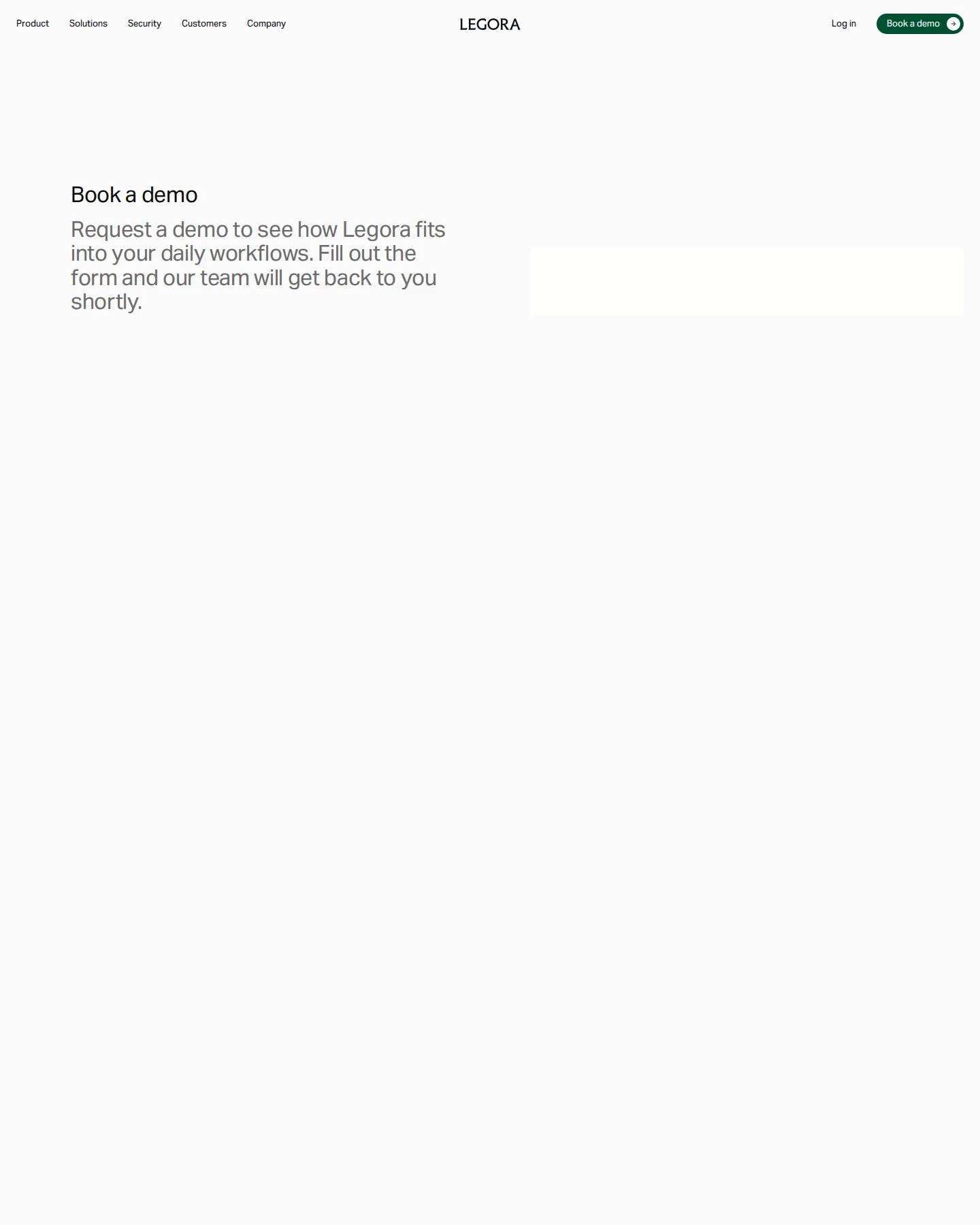
Legora uses a sales-led, quote-only commercial model. As of the 2026-06-05 capture there is no public pricing page — the seeded legora.com/pricing URL returns a 404, and the only commercial call-to-action is “Book a demo” (legora.com/book-a-demo), a lead-capture form that states “our team will get back to you shortly.” No plan names, seat prices, usage rates, or tiers are disclosed publicly.
- Packaging: A single platform offer (the Legora aOS) spanning all named products; no published self-serve tiers.
- Billing unit: Seat-based per the enterprise legal-AI norm, but no per-seat figure is published — pricing is custom-quoted per firm (marked
unknown/ Contact sales here). - Sales motion: Fully sales-led; access is gated behind a demo request.
What makes this different: Unlike self-serve developer tools in the corpus, Legora exposes zero price signal publicly — a deliberate enterprise-legal posture, built on a seat-based subscription model, that keeps all monetisation inside the sales conversation. For buyers, that means budgeting starts with a value-metric conversation, not a published rate card.
Pricing by product
Legora aOS (all plans)
| Tier | Price | Included | Key mechanics |
|---|---|---|---|
| Legora aOS | Contact sales | Agent, Tabular Review, Workflows, Legal Research, Monitors, Lists, Portal, Editor, Word/Outlook add-ins | Seat-based; quoted per firm; sales-led |
No public price is disclosed for any plan; the figure above reflects what is visible on the captured pages (2026-06-05). Seat count, usage allowances, and contract terms are negotiated via the demo request.
Sales motions across products: none are PLG / self-serve; all access is sales-led behind a book-a-demo form.
Hidden costs : What firms actually pay for enterprise legal AI
Legora discloses no public price, so an exact bill cannot be reconstructed from captured evidence. What can be itemised are the cost categories a firm should expect to negotiate — because in gated enterprise legal AI, the headline seat fee is rarely the whole invoice. The line items below are structural, not quoted figures; treat the costs as negotiated placeholders that surface during procurement.
A mid-size firm rolling Legora out to ~50 fee-earners would typically negotiate across these categories:
| Line item | Monthly cost |
|---|---|
| Platform seats (≈50 fee-earners, seat-based) | Negotiated — quoted per firm |
| Annual contract minimum / committed-seat floor | Negotiated — common in enterprise legal AI |
| Agentic / heavy-usage allowances (Agent, Tabular Review at scale) | Negotiated — may meter beyond an included pool |
| Onboarding, integration & training (Word/Outlook, DMS, SSO) | Often a one-time implementation fee, amortised |
| Premium support / customer-success tier | Negotiated — frequently bundled at enterprise size |
| Total | Custom quote — undisclosed publicly |
The lesson: with Legora, the negotiable surface is wider than a per-seat number. Committed-seat floors and any agentic-usage metering — not the sticker seat price — are where a firm’s effective rate is actually set, which is why buyers should treat this like any other usage-based pricing migration and model a range, not a point estimate. If you are scoping a similar buy, the guide to usage-based pricing models lays out how seat, committed-minimum, and metered components combine.
Want to estimate your own Legora bill? A Legora pricing calculator will model seat counts and committed minimums once quoted ranges are sourced from procurement.
Pricing evolution : From Leya rebrand to the agentic OS
Legora’s “pricing evolution” is unusual: across every Wayback snapshot of both leya.law (2023–Feb 2025) and legora.com (Feb 2025–present), there has never been a public pricing page or a published price. The evolution that matters here is one of identity and packaging, not price — a brand change and an agentic product re-frame, all sustained on the same sales-led, quote-only commercial model.
Cadence
| Quarter | Price changes | Product / SKU additions | Notes |
|---|---|---|---|
| 2024 Q3 | 0 | 1 | As Leya, raised a $25M Series A (Redpoint); Wayback shows an AI legal workspace with Tabular Review, no public price. |
| 2025 Q1 | 0 | 0 | Feb 2025 rebrand Leya → Legora; first legora.com snapshot (2025-02-19) still shows a transitional “Leya|” hero cursor. |
| 2025 Q2 | 0 | 1 | 2025-05-21 $80M Series B (ICONIQ + General Catalyst) at $675M; Agent product prominent; pricing unchanged (sales-led). |
| 2025 Q4 | 0 | 0 | 2025-10-30 $150M Series C (Bessemer) at $1.8B; 400+ firms / 40+ markets; still no public price. |
| 2026 Q1 | 0 | 1 | 2026-03-10 $550M Series D (Accel) at $5.55B; product re-framed as the agentic Legora aOS. |
Tracked range: 2023–2026 (Wayback on leya.law + legora.com). Across the full range there were 0 published price changes because no price has ever been public; SKU additions reflect new products (Agent, Monitors, the aOS framing), not pricing-tier changes.
Notable changes
- 2024 (as Leya) — $25M Series A led by Redpoint Ventures; Wayback snapshots of leya.law show a “Book a demo” CTA and no pricing page.
- February 2025 — Rebrand from Leya to Legora. The first legora.com Wayback capture (2025-02-19) still renders the literal “Leya|” cursor in the hero and a founder letter beginning “We founded Leya.”
- 2025-05-21 — $80M Series B (ICONIQ + General Catalyst) at a $675M valuation; 250 firms / 20 markets; ~100 employees. (Legora blog)
- 2025-10-30 — $150M Series C (Bessemer) at a $1.8B valuation; 400+ firms / 40+ markets. (Legora blog)
- 2026-03-10 — $550M Series D (Accel) at a $5.55B valuation; ~800 firms; product positioned as the agentic “Legora aOS.” Pricing remained quote-only throughout.
The Leya → Legora rebrand in detail
The clearest piece of evidence for the February 2025 rebrand is the first archived legora.com homepage (2025-02-19): the navigation and wordmark already read LEGORA, but the hero animation still types out “Leya|” with a blinking cursor, and the founder’s note further down the page opens “We founded Leya with a simple thesis.” In other words, the brand was changed faster than the page copy was fully migrated. The substantive point for pricing readers is that nothing about the commercial model changed — both leya.law and legora.com gate everything behind a “Book a demo” form, and neither domain has ever exposed a /pricing URL. The rebrand coincided with a sharp acceleration in fundraising and US expansion, but the monetisation posture stayed constant.
What’s unique : Agentic legal OS, gated pricing
Zero public price, by design. Legora exposes no pricing page, no tier names, no per-seat number — under either the Leya or Legora brand, across years of Wayback history. In a corpus full of self-serve tools that lead with a rate card, Legora’s entire commercial surface is a single “Book a demo” form. The price is the conversation.
Compliance posture as the public “price of trust.” Where most pages monetise attention with a pricing table, Legora’s homepage leads with SOC 2 Type II, ISO 27001, ISO 42001 (AI governance), GDPR, HIPAA, and “zero AI training on your data.” For law firms, security and confidentiality are the gating purchase criteria, so Legora substitutes a compliance wall for a price wall — the trust signals do the qualifying that a pricing page would otherwise do.
The agentic “aOS” re-frame. Legora packages everything as one product — the Legora aOS (“agentic operating system for legal work”) — rather than splitting Review, Drafting, Research, and Monitors into separately priced modules. A single-platform packaging story is far easier to quote per firm than a multi-SKU menu, and it sidesteps the per-feature unbundling pressure that an outcome-based pricing competitor might apply.
ROI framing in lieu of unit price. Instead of “$X per seat,” Legora markets an ROI Report — 30% fewer non-billable hours, up to $2.0m additional yearly billing per 100 lawyers. For a billable-hour business, anchoring on recovered revenue rather than software cost is a deliberate value-metric choice that reframes the buy as an investment, not an expense — the kind of trade-off the guide to choosing the right usage metric walks through in depth.
Funding velocity as a commercial signal. Four rounds in ~18 months to a $5.55B valuation — all while never publishing a price — tells buyers the company is enterprise-credible and unlikely to nickel-and-dime, but also that any quote will reflect a premium, fast-scaling vendor. The valuation arc is itself part of the sales narrative.
Strengths & weaknesses
| Strengths | Weaknesses |
|---|---|
| Zero public price keeps full pricing power inside the sales conversation — ideal for high-ACV, high-variance legal accounts | No transparency means buyers can’t self-qualify or budget without a sales call, lengthening the funnel |
| Compliance-first homepage (SOC 2 II, ISO 27001/42001, GDPR, HIPAA) matches law-firm procurement gates precisely | ”Zero price signal” cedes the curious-but-not-ready buyer to competitors who publish indicative ranges |
| Single-platform “aOS” packaging is simple to quote and resists per-feature unbundling | Single SKU obscures which capabilities drive value, making expansion pricing harder to anchor |
| ROI Report reframes the buy as recovered billable revenue, not software cost | ROI claims (30% non-billable reduction, $2.0m/100 lawyers) are vendor-supplied and hard to verify pre-purchase |
| Brand + funding velocity ($805M raised, $5.55B valuation) signal durability to risk-averse firms | Rapid rebrand (Leya → Legora) and breakneck scaling can create procurement/contract churn for early customers |
Billing UX : Demo-gated, no self-serve controls
Legora exposes no self-serve billing surface; all commercial interaction is mediated by sales. The only customer-facing commercial controls captured (2026-06-05) are:
- Book a demo form — the single commercial entry point (
legora.com/book-a-demo); a lead-capture form (“Fill out the form and our team will get back to you shortly”) with no pricing, plan selector, or checkout. - Log in — an authenticated app entry point for existing customers; no public sign-up or billing portal is exposed.
- Trust Center / Security page — surfaces the compliance posture (SOC 2 Type II, ISO 27001, ISO 42001, GDPR, HIPAA) that anchors enterprise procurement, in lieu of public pricing.
Strategic wins : Why the sales-led posture works
1. Matching the buyer’s procurement reality
Law firms buy enterprise software through security review, partner sign-off, and negotiated framework agreements — not self-serve checkout. By leading with compliance and gating price behind a demo, Legora aligns its commercial surface with how legal procurement actually works. This is the same enterprise logic that justifies sales-led pricing across high-ACV vertical AI, where a published rate card would anchor negotiations downward.
2. Single-platform “aOS” packaging
Bundling Agent, Tabular Review, Workflows, Research, and Monitors into one Legora aOS offer keeps the quote simple and the value story coherent. It avoids the per-module unbundling pressure that erodes margins, and makes expansion a matter of seats rather than SKU negotiation — a cleaner story than a multi-line usage-based menu would allow.
3. ROI framing over unit price
For a billable-hour business, anchoring on recovered revenue (“$2.0m additional yearly billing per 100 lawyers”) rather than seat cost reframes the purchase as an investment. This sidesteps price-shopping and connects the spend to the firm’s own economics — a disciplined value-metric move that few horizontal tools can replicate.
4. Capitalising on funding velocity
Four rounds to a $5.55B valuation in ~18 months is itself a sales asset: it signals durability and category leadership to risk-averse firms wary of betting on a startup. Legora lets the funding arc do qualifying work that a pricing page can’t — credibility in lieu of transparency.
Areas to improve : Gaps in the pricing surface
1. Publish an indicative starting point or “talk to sales from $X”
Zero price signal cedes the entire top of the funnel — the curious associate, the budget-scoping ops lead — to competitors who publish ranges. A single “starts at $X/seat/year” line, or a published minimum, would let buyers self-qualify without losing negotiating room. Many enterprise vendors successfully pair sales-led motion with an indicative anchor.
2. Clarify the seat-vs-usage boundary
Because the aOS is a single quoted bundle, buyers can’t tell whether heavy agentic usage (Agent runs, large Tabular Reviews) is included or metered. Publishing the structure — “seats include up to N agent runs, then metered” — without exact prices would reduce bill-shock risk and shorten procurement, echoing the predictability lessons in pricing AI products with unpredictable costs.
3. Make the ROI claims independently verifiable
The 30%-non-billable-reduction and $2.0m-per-100-lawyers figures are vendor-supplied. Publishing methodology, sample size, or third-party-audited case studies would turn a marketing claim into a defensible value metric and strengthen the ROI-over-price strategy it depends on.
4. Reduce rebrand/scaling friction for early customers
A Leya → Legora rebrand plus four rounds and 10× headcount growth in a year can create contract, integration, and account-team churn. Clear migration commitments and price-protection clauses for early adopters would convert breakneck scaling from a risk into a trust signal.
Monetization stack & signals : how Legora builds & buys its revenue engine
Buys 5 Builds 1 3 signal roles
Buys its GTM/data spine but builds its own metering: Salesforce is the CRM of record with a dedicated hire now architecting it into a full Lead-to-Cash pipeline (CPQ, CLM, billing, ERP), and Snowflake/dbt/Hex/Dagster anchor the analytics stack — yet alongside the June 2026 launch of usage-based Agent Pro, Legora built the real-time usage dashboard, per-project cost attribution, and spend-threshold controls itself rather than bolting on a Stripe/Metronome-style meter, while the downstream billing platform that turns that usage into an invoice remains unconfirmed.
-
“We have also built in the tools to track and manage usage. A real-time dashboard tracks consumption by organization, user, or project ... Admins can set thresholds and spending controls, and notifications are sent before a limit is reached”
-
“Day-to-day Salesforce ownership - lead routing, stage definitions, validation rules, data hygiene programs”
-
“Integrate the agent with our data warehouse (Snowflake), semantic layer, and dbt models so it can answer questions grounded in real, modelled data”
-
“Lead warehouse design: collaborate with analytics engineers to define modeling conventions, enforce schema governance, and keep our dbt project clean, tested, and scalable”
-
“Hands-on experience with our stack: Snowflake, dbt, Hex, Dagster.”
-
“Hands-on experience with our stack: Snowflake, dbt, Hex, Dagster.”
-
Post-sales tooling (Intercom, Skilljar, Clay, Sana, Granola) is a deliberately separate ownership domain from RevOps-owned Salesforce/CRM — an organizational split between the CRM system of record and the customer-success stack layered around it, rather than one unified platform.
“You'll own the tools and automations that power Legora's post-sales organization ... Salesforce/CRM administration remains owned by RevOps and is not part of this role”
-
This posting confirms Legora now invoices usage-based and hybrid deals alongside pure subscriptions — corroborating the June 2026 Agent Pro consumption-pricing launch — while the invoicing platform itself stays unnamed; the JD points candidates only to 'tools like Zuora, Stripe, or SuiteBilling' as a nice-to-have, not a confirmed vendor.
“Ensure accurate and timely invoicing across subscription, usage-based, and hybrid pricing models”
- GTM Senior Systems Analyst RevOps seen Mar 26, 2026
A dedicated GTM-systems hire tasked with architecting a Salesforce-centered Lead-to-Cash pipeline — CPQ, CLM, billing, and ERP integrations under one roof — points to RevOps building the quote-to-cash connective tissue in-house on top of bought point systems, rather than buying a unified CPQ/billing suite.
“With Salesforce as your primary canvas ... Build and support integrations across Salesforce (CRM), CPQ, CLM, Billing, and ERP systems”
1 more matched role — supporting evidence
- Billing Lead Billing engineering Aug 26, 2026
Signals reviewed · derived from public job posts, engineering blogs
Job postings fill and close over time — once a posting is filled we keep it as a dated citation (the quoted evidence remains); use View open roles for current listings.
Key takeaways
- Gated pricing is a feature, not a gap, in legal AI. When the buyer is a law firm with mandatory security review and partner sign-off, a “Book a demo” form aligned with procurement beats a self-serve rate card. Match your pricing surface to how your buyer actually buys.
- Substitute a trust wall for a price wall when trust is the gate. Legora’s homepage leads with SOC 2, ISO 27001/42001, GDPR, and HIPAA instead of tiers — because confidentiality, not cost, is the qualifying criterion. Identify your buyer’s true gating concern and lead with it.
- Anchor on the customer’s economics, not your software cost. “$2.0m additional billing per 100 lawyers” reframes the buy as recovered revenue. For value-dense verticals, an ROI metric outperforms a per-seat number — see the value-metric problem.
- Single-platform packaging protects pricing power. Bundling everything as one “aOS” avoids per-feature unbundling and keeps expansion a seat conversation, not a SKU negotiation.
- Funding velocity can carry the credibility a price page would otherwise signal. Four rounds to a $5.55B valuation in ~18 months reassures risk-averse buyers — but it only works when paired with genuine compliance and enterprise readiness.
UBP implications
- Sales-led ≠ usage-blind. Even with zero public price, the negotiable surface for legal AI increasingly includes agentic-usage allowances on top of seats. As agent workflows become cost monsters, expect hybrid seat-plus-usage to creep into these quotes — just privately, inside the contract.
- Outcome framing is the on-ramp to outcome pricing. Legora’s ROI Report ($2.0m/100 lawyers) is outcome marketing over a seat model today, but it builds the measurement scaffolding that outcome-based pricing would later require. Vendors that quantify value first are positioned to charge for it next.
- Transparency is a competitive variable, not a default. In commoditised self-serve markets, published pricing wins trust; in high-ACV legal AI, opacity preserves margin. The right level of pricing transparency is a strategic choice that should track ACV and buyer sophistication.
Sources
- Legora — Book a demo (accessed 2026-06-06)
- Legora homepage (accessed 2026-06-06)
- Legora Security / Trust Center (accessed 2026-06-06)
Browse the full pricing blueprint corpus for comparable enterprise-AI pricing models.
Bottom line
Legora (formerly Leya) sells an agentic legal-AI operating system to law firms and in-house teams with zero public price signal: the pricing page 404s and the only door in is a book-a-demo form. It rebranded in February 2025 and rocketed to a $5.55B valuation across four rounds — yet has never published a price under either name. Seat-based, quote-only, and compliance-led, every number lives inside the sales conversation. Compare it against the rest of the pricing blueprint corpus of enterprise-AI models.
Pricing timeline : Major events on a vertical axis
Each milestone below corresponds to a public pricing change, product launch, or material adjustment. Major events use a filled marker; minor adjustments use a faded one.
$550M Series D at $5.55B valuation; agentic aOS
After a $150M Series C (Bessemer, Oct 2025, $1.8B), Legora raised a $550M Series D led by Accel at a $5.55B valuation, ~800 firms / 40+ markets. The live site (captured 2026-06-05) frames the product as the 'Legora aOS' agentic operating system — still no public pricing page; /pricing 404s and access is via book-a-demo only.
$80M Series B at $675M valuation
Legora announced an $80M Series B led by ICONIQ and General Catalyst at a $675M valuation, with 250 firms across 20 markets and ~100 employees. Pricing remained sales-led and quote-only.
Rebrand: Leya → Legora
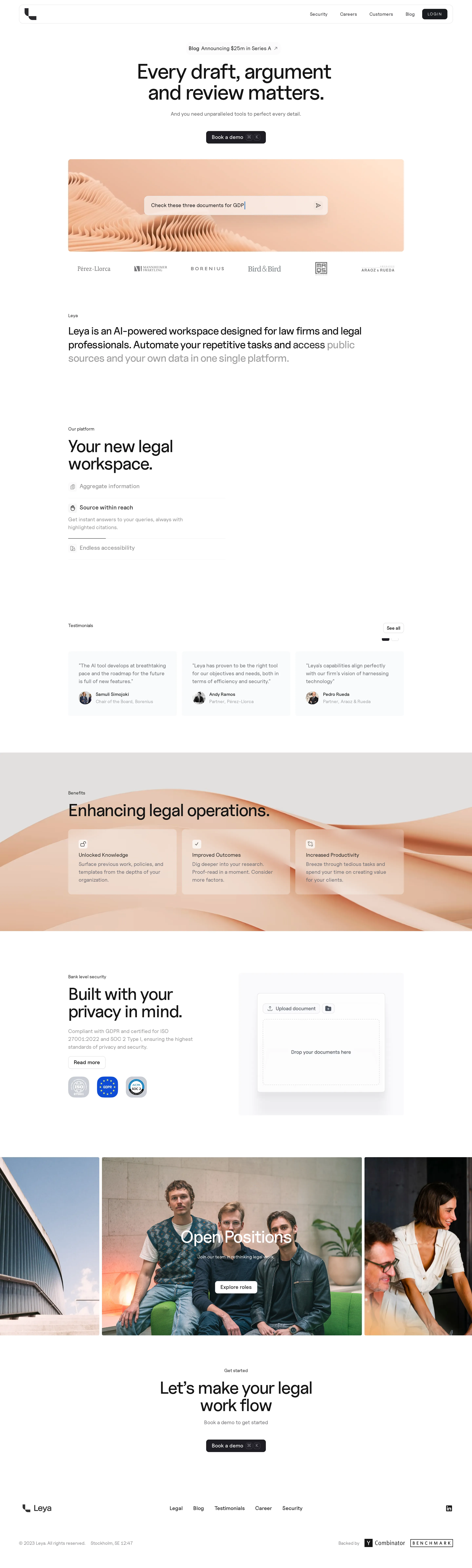
The company rebranded from Leya to Legora in February 2025; legora.com's first Wayback capture (2025-02-19) still shows the transitional 'Leya|' cursor in the hero and a founder letter beginning 'We founded Leya.' Commercial model unchanged — no public price, book-a-demo only.

Leya era — $25M Series A, sales-led from the start
As Leya (leya.law), the company raised a $25M Series A led by Redpoint Ventures. Wayback snapshots through 2024 show an AI legal workspace with Tabular Review and a 'Book a demo' CTA — no pricing page and no public price at any point.
- · Legora was founded as Leya (an earlier name, Judilica, also appears in filings) and rebranded to Legora in February 2025 — a Feb 2025 Wayback snapshot still shows the literal 'Leya|' cursor mid-hero and a founder letter beginning 'We founded Leya.'
- · Despite raising a $25M Series A, $80M Series B, $150M Series C and a $550M Series D inside roughly 18 months — reaching a $5.55B valuation by March 2026 — Legora has never published a public price or pricing page on either leya.law or legora.com.
- · Legora's valuation grew from $675M (Series B, May 2025) to $1.8B (Series C, Oct 2025) to $5.55B (Series D, Mar 2026) — an ~8× markup in ten months while its commercial model stayed entirely sales-led.
Questions & answers
- How much does Legora cost?
- Legora does not publish a public price. Its pricing is sales-led and quote-only: pricing is custom-negotiated per firm, seat-based, and only available after a 'Book a demo' conversation. No tier, per-seat rate, or usage price is disclosed on legora.com.
- Does Legora have a pricing page or free trial?
- No. legora.com has no /pricing page (the URL 404s) and offers no public free tier or self-serve sign-up. The only commercial entry point is a book-a-demo lead-capture form for enterprise legal teams.
- Is Legora the same company as Leya?
- Yes. Legora was formerly named Leya (leya.law) and rebranded to Legora in February 2025. The pricing posture — sales-led, no public price — was identical before and after the rebrand.
- How is Legora priced — by seat or by usage?
- Legora is seat-based per the enterprise legal-AI norm, quoted per firm. Because nothing is published, the exact mix of seat fees, agentic-usage allowances, and contract minimums is negotiated during procurement and not visible publicly.
- How much funding has Legora raised and at what valuation?
- Legora raised a $25M Series A (Redpoint, 2024), an $80M Series B (ICONIQ + General Catalyst, May 2025) at a $675M valuation, a $150M Series C (Bessemer, Oct 2025) at $1.8B, and a $550M Series D (Accel, Mar 2026) at a $5.55B valuation.